
Example A B C Object Analysis 1 Additional
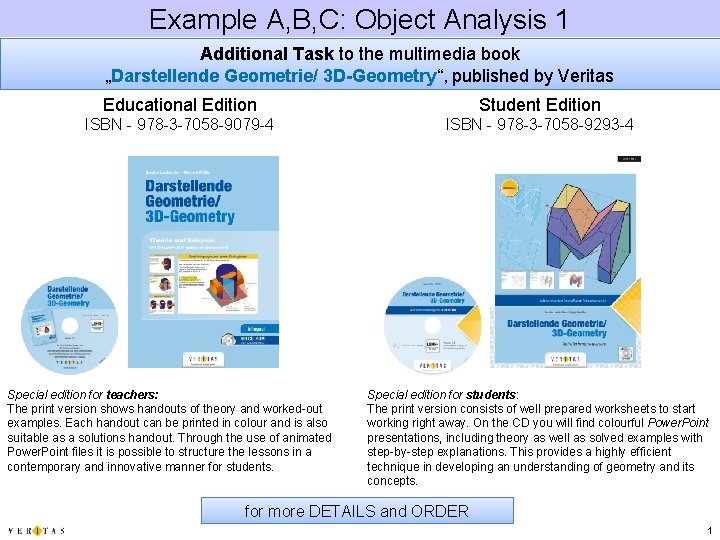
Example A, B, C: Object Analysis 1 Additional Task to the multimedia book „Darstellende Geometrie/ 3 D-Geometry“, published by Veritas Educational Edition Student Edition ISBN - 978 -3 -7058 -9079 -4 ISBN - 978 -3 -7058 -9293 -4 Special edition for teachers: The print version shows handouts of theory and worked-out examples. Each handout can be printed in colour and is also suitable as a solutions handout. Through the use of animated Power. Point files it is possible to structure the lessons in a contemporary and innovative manner for students. Special edition for students: The print version consists of well prepared worksheets to start working right away. On the CD you will find colourful Power. Point presentations, including theory as well as solved examples with step-by-step explanations. This provides a highly efficient technique in developing an understanding of geometry and its concepts. for more DETAILS and ORDER 1
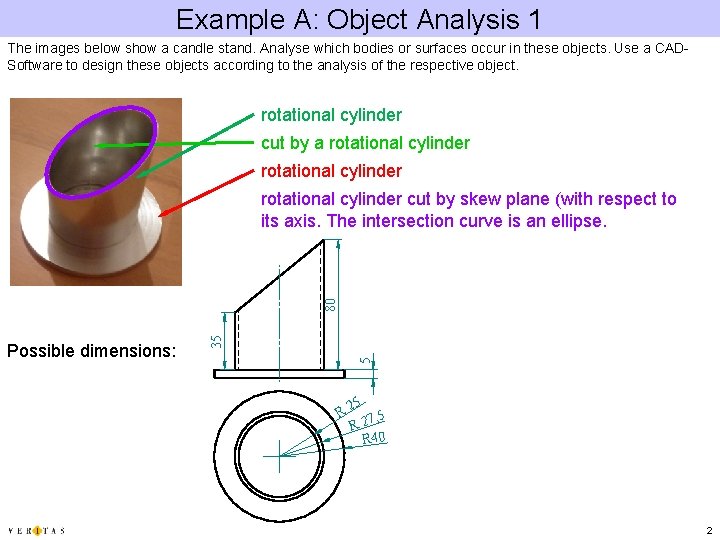
Example A: Object Analysis 1 The images below show a candle stand. Analyse which bodies or surfaces occur in these objects. Use a CADSoftware to design these objects according to the analysis of the respective object. rotational cylinder cut by a rotational cylinder 5 Possible dimensions: 35 80 rotational cylinder cut by skew plane (with respect to its axis. The intersection curve is an ellipse. 5 R 2 7, 5 R 2 R 40 2
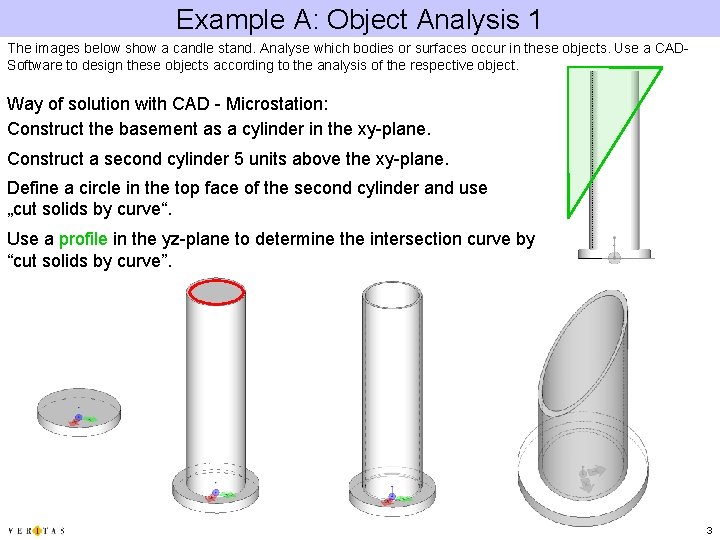
Example A: Object Analysis 1 The images below show a candle stand. Analyse which bodies or surfaces occur in these objects. Use a CADSoftware to design these objects according to the analysis of the respective object. Way of solution with CAD - Microstation: Construct the basement as a cylinder in the xy-plane. Construct a second cylinder 5 units above the xy-plane. Define a circle in the top face of the second cylinder and use „cut solids by curve“. Use a profile in the yz-plane to determine the intersection curve by “cut solids by curve”. 3
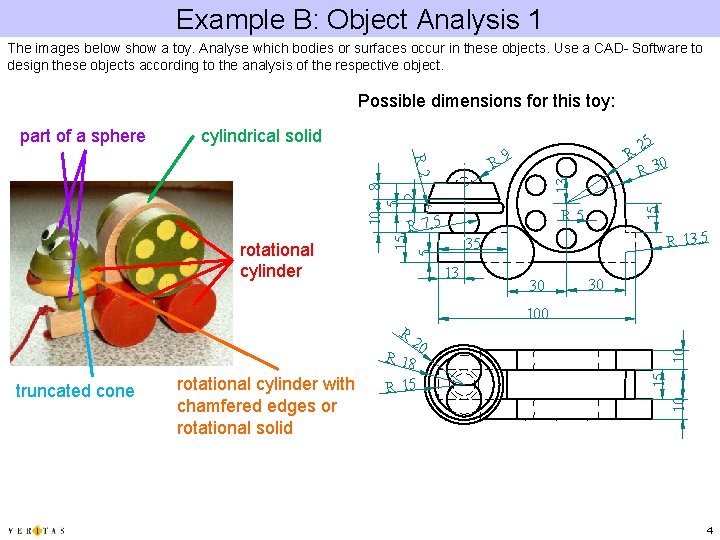
Example B: Object Analysis 1 The images below show a toy. Analyse which bodies or surfaces occur in these objects. Use a CAD- Software to design these objects according to the analysis of the respective object. Possible dimensions for this toy: cylindrical solid R 9 truncated cone rotational cylinder with chamfered edges or rotational solid 30 10 20 R 18 R 15 30 10 13 R R 13, 5 35 5 15 rotational cylinder R 5 R 7, 5 R 30 15 10 5 2 8 13 R 25 15 part of a sphere 4
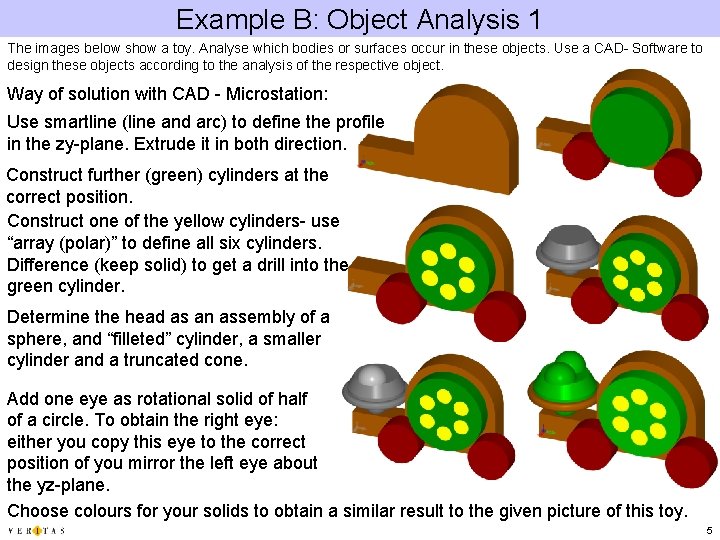
Example B: Object Analysis 1 The images below show a toy. Analyse which bodies or surfaces occur in these objects. Use a CAD- Software to design these objects according to the analysis of the respective object. Way of solution with CAD - Microstation: Use smartline (line and arc) to define the profile in the zy-plane. Extrude it in both direction. Construct further (green) cylinders at the correct position. Construct one of the yellow cylinders- use “array (polar)” to define all six cylinders. Difference (keep solid) to get a drill into the green cylinder. Determine the head as an assembly of a sphere, and “filleted” cylinder, a smaller cylinder and a truncated cone. Add one eye as rotational solid of half of a circle. To obtain the right eye: either you copy this eye to the correct position of you mirror the left eye about the yz-plane. Choose colours for your solids to obtain a similar result to the given picture of this toy. 5
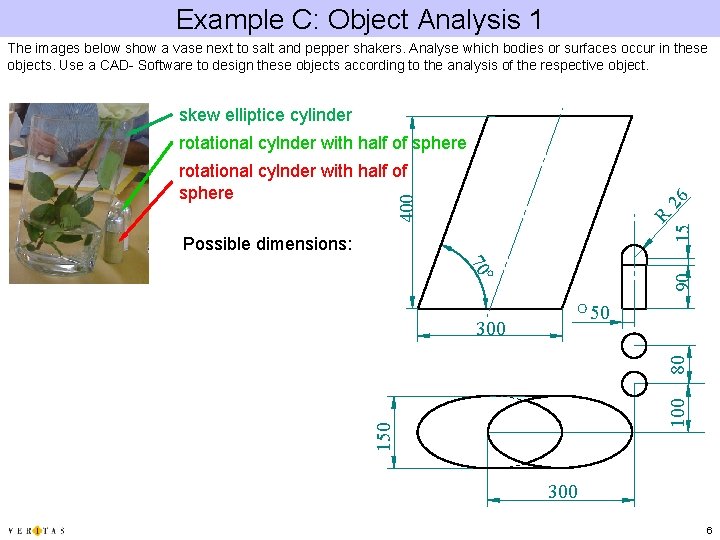
Example C: Object Analysis 1 The images below show a vase next to salt and pepper shakers. Analyse which bodies or surfaces occur in these objects. Use a CAD- Software to design these objects according to the analysis of the respective object. skew elliptice cylinder rotational cylnder with half of sphere 15 R 26 400 rotational cylnder with half of sphere Possible dimensions: 90 ° 70 150 100 80 300 O 50 300 6
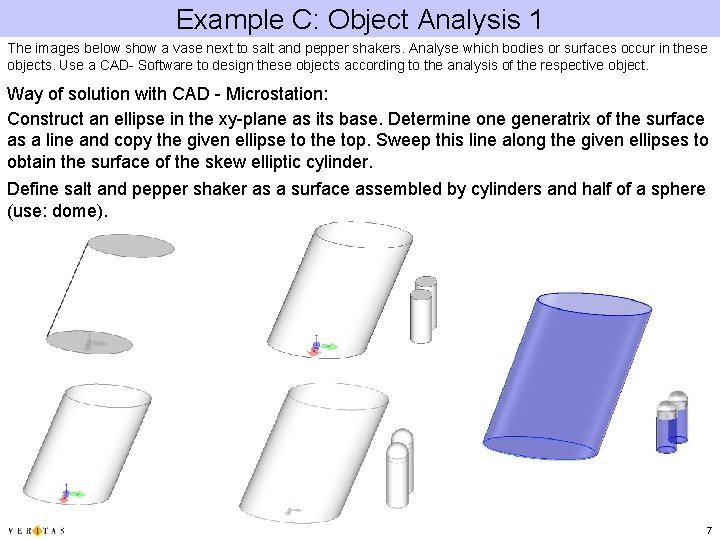
Example C: Object Analysis 1 The images below show a vase next to salt and pepper shakers. Analyse which bodies or surfaces occur in these objects. Use a CAD- Software to design these objects according to the analysis of the respective object. Way of solution with CAD - Microstation: Construct an ellipse in the xy-plane as its base. Determine one generatrix of the surface as a line and copy the given ellipse to the top. Sweep this line along the given ellipses to obtain the surface of the skew elliptic cylinder. Define salt and pepper shaker as a surface assembled by cylinders and half of a sphere (use: dome). 7
- Slides: 7