
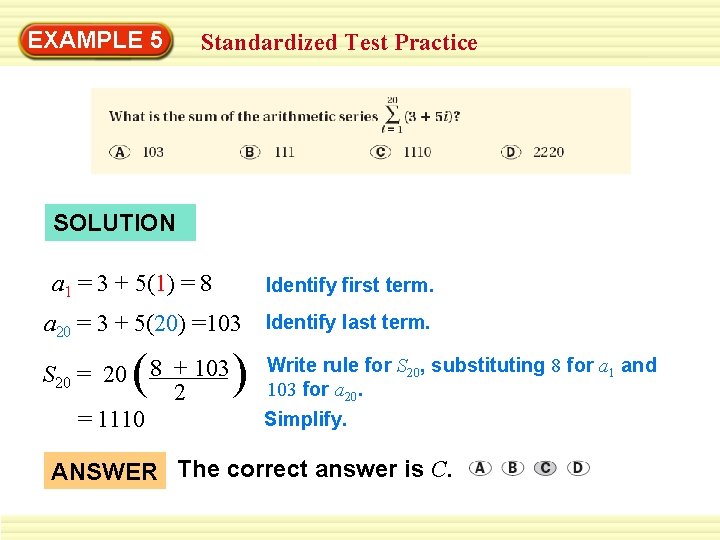
EXAMPLE 5 Standardized Test Practice SOLUTION a 1
- Slides: 5
EXAMPLE 5 Standardized Test Practice SOLUTION a 1 = 3 + 5(1) = 8 Identify first term. a 20 = 3 + 5(20) =103 Identify last term. ( S 20 = 20 8 + 103 2 = 1110 ) Write rule for S 20, substituting 8 for a 1 and 103 for a 20. Simplify. ANSWER The correct answer is C.
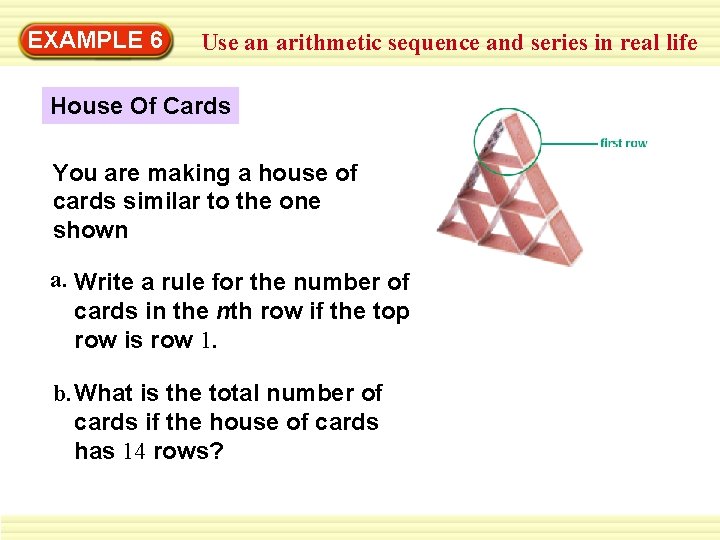
EXAMPLE 6 Use an arithmetic sequence and series in real life House Of Cards You are making a house of cards similar to the one shown a. Write a rule for the number of cards in the nth row if the top row is row 1. b. What is the total number of cards if the house of cards has 14 rows?
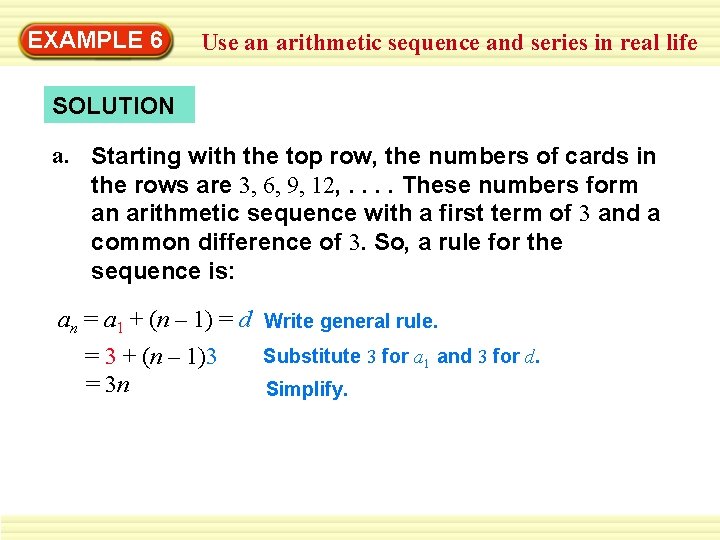
EXAMPLE 6 Use an arithmetic sequence and series in real life SOLUTION a. Starting with the top row, the numbers of cards in the rows are 3, 6, 9, 12, . . These numbers form an arithmetic sequence with a first term of 3 and a common difference of 3. So, a rule for the sequence is: an = a 1 + (n – 1) = d Write general rule. = 3 + (n – 1)3 = 3 n Substitute 3 for a 1 and 3 for d. Simplify.
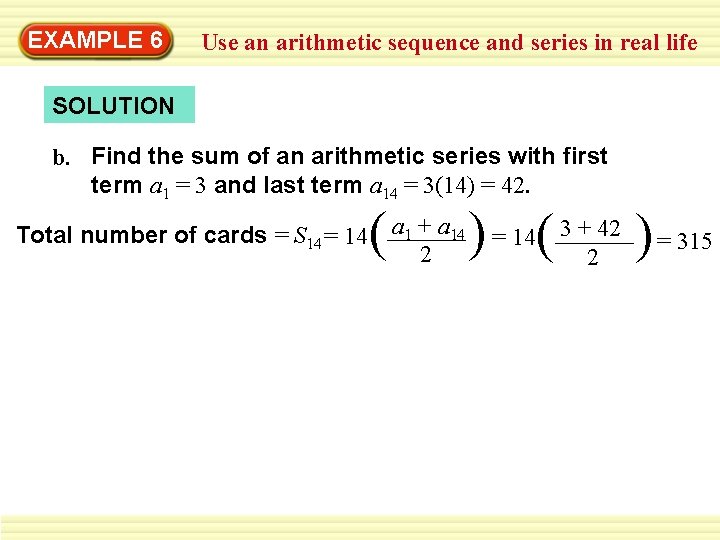
EXAMPLE 6 Use an arithmetic sequence and series in real life SOLUTION b. Find the sum of an arithmetic series with first term a 1 = 3 and last term a 14 = 3(14) = 42. Total number of cards = S 14 = 14 ( a 1 + a 14 2 ) = 14( 3 +242 ) = 315
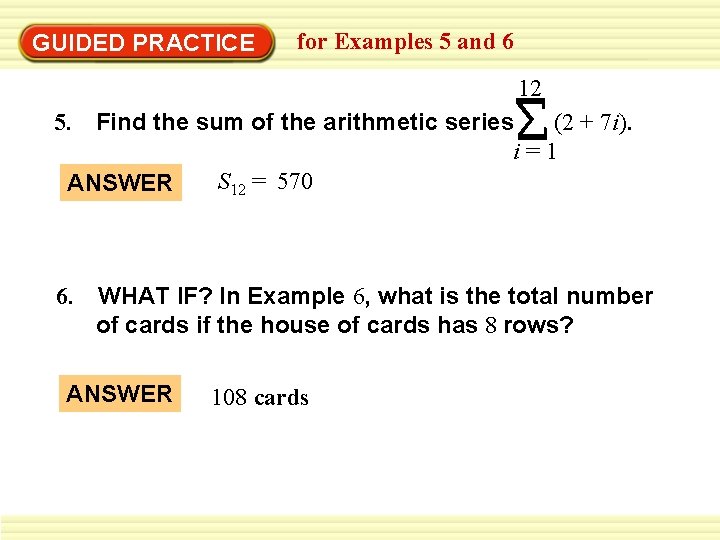
GUIDED PRACTICE for Examples 5 and 6 12 5. Find the sum of the arithmetic series (2 + 7 i). i=1 S 12 = 570 ANSWER 6. WHAT IF? In Example 6, what is the total number of cards if the house of cards has 8 rows? ANSWER 108 cards