
EXAMPLE 3 Use definitions Decide whether each statement



- Slides: 7
EXAMPLE 3 Use definitions Decide whether each statement about the diagram is true. Explain your answer using the definitions you have learned. a. AC b. BD AEB and CEB are a linear pair. c. EA and EB are opposite rays.
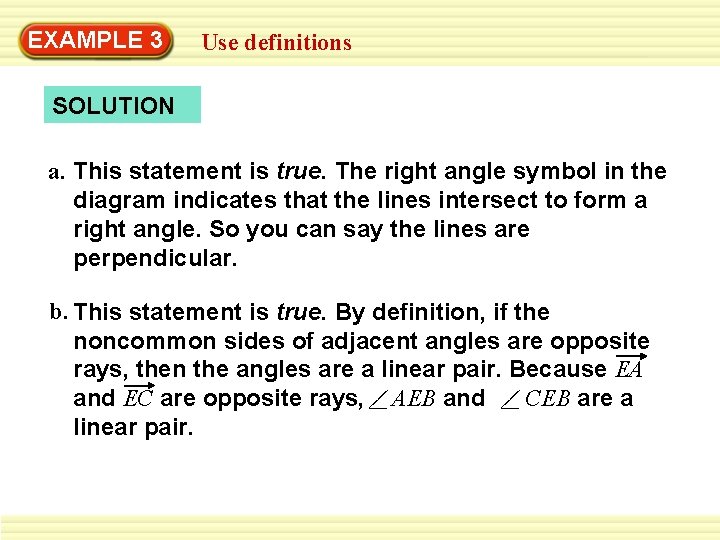
EXAMPLE 3 Use definitions SOLUTION a. This statement is true. The right angle symbol in the diagram indicates that the lines intersect to form a right angle. So you can say the lines are perpendicular. b. This statement is true. By definition, if the noncommon sides of adjacent angles are opposite rays, then the angles are a linear pair. Because EA and EC are opposite rays, AEB and CEB are a linear pair.
EXAMPLE 3 Use definitions c. This statement is false. Point E does not lie on the same line as A and B, so the rays are not opposite rays.
GUIDED PRACTICE for Example 3 Use the diagram shown. Decide whether each statement is true. Explain your answer using the definitions you have learned. 7. JMF and FMG are supplementary. ANSWER This statement is true : Because linear pairs of angles are supplementary.
GUIDED PRACTICE for Example 3 Use the diagram shown. Decide whether each statement is true. Explain your answer using the definitions you have learned. 8. Point M is the midpoint of FH. ANSWER This statement is false : Because it is not known that FM = MH. So, you can say that point M is the mid-point of FH
GUIDED PRACTICE for Example 3 Use the diagram shown. Decide whether each statement is true. Explain your answer using the definitions you have learned. 9. JMF and HMG are vertical angles. ANSWER This statement is true : Because in the diagram two intersecting lines form 2 pairs of vertical HMG angles. So, you can say that JMF and are vertical angles.
GUIDED PRACTICE for Example 3 Use the diagram shown. Decide whether each statement is true. Explain your answer using the definitions you have learned. 10. FH JG ANSWER This statement is false : By definition if two intersect to form a right angle then they are perpendicular. But in the diagram it is not known that the lines intersect at right angles. So you cannot say that FH JG