
EXAMPLE 3 Prove the Alternate Interior Angles Converse
- Slides: 10
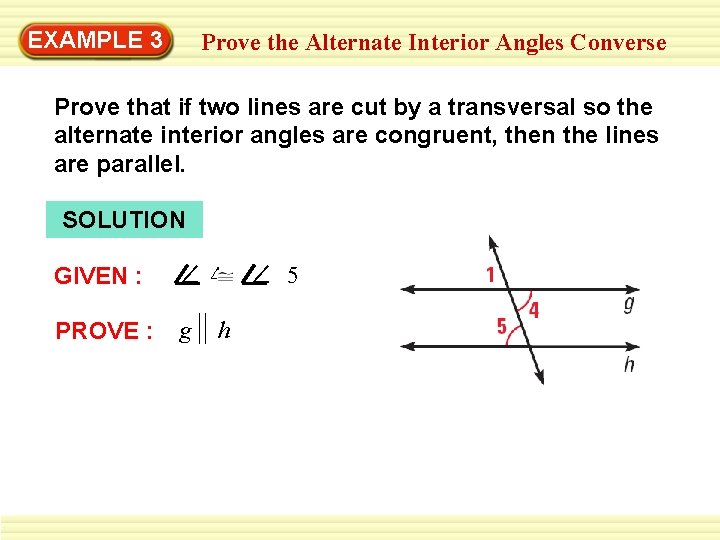
EXAMPLE 3 Prove the Alternate Interior Angles Converse Prove that if two lines are cut by a transversal so the alternate interior angles are congruent, then the lines are parallel. SOLUTION GIVEN : ∠ 4 PROVE : g h ∠ 5
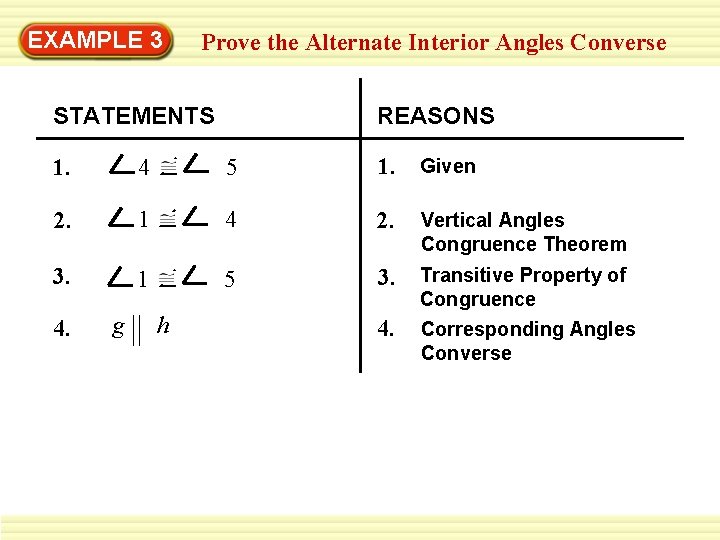
EXAMPLE 3 Prove the Alternate Interior Angles Converse REASONS STATEMENTS 1. 4∠ 5 1. Given 2. 1∠ 4 2. 3. 1∠ 5 3. Transitive Property of 4. g h Vertical Angles Congruence Theorem Congruence 4. Corresponding Angles Converse
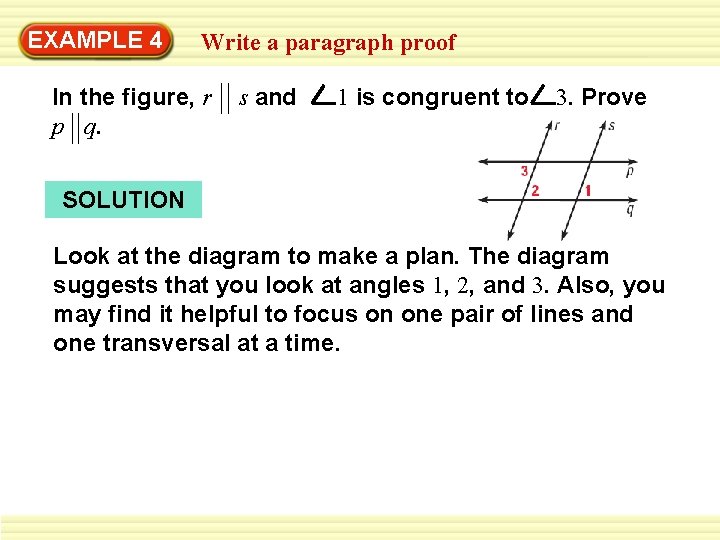
EXAMPLE 4 Write a paragraph proof In the figure, r p q. s and 1 is congruent to 3. Prove SOLUTION Look at the diagram to make a plan. The diagram suggests that you look at angles 1, 2, and 3. Also, you may find it helpful to focus on one pair of lines and one transversal at a time.
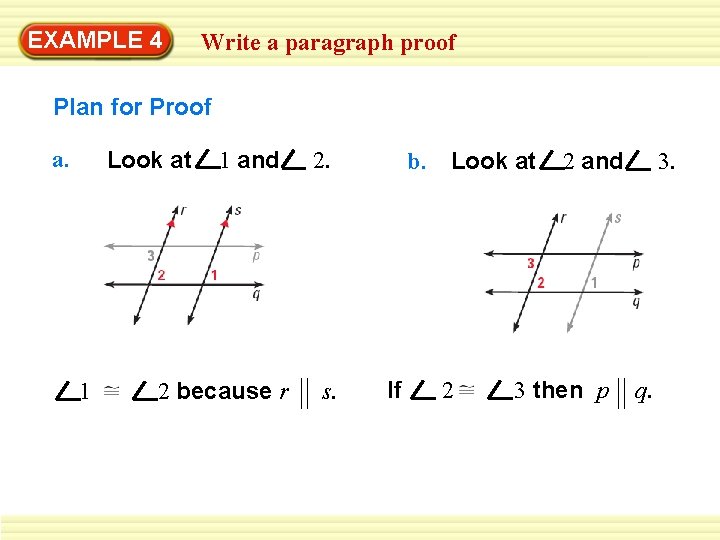
EXAMPLE 4 Write a paragraph proof Plan for Proof a. Look at 1 1 and 2 because r 2. s. b. If Look at 2 2 and 3 then p 3. q.
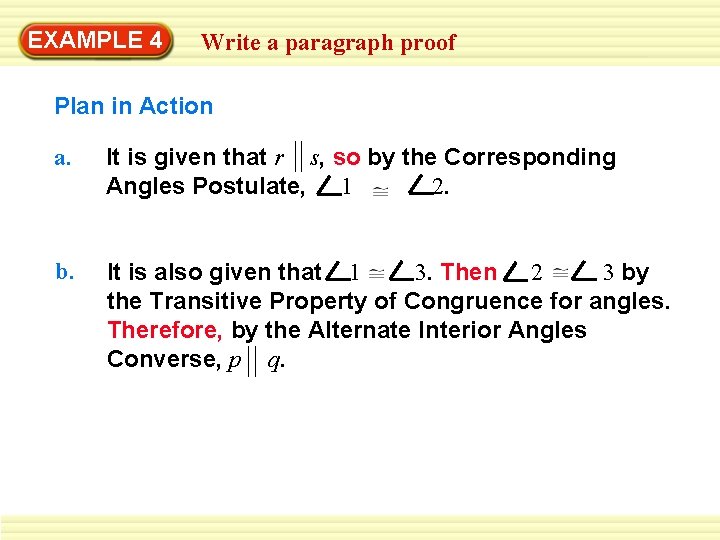
EXAMPLE 4 Write a paragraph proof Plan in Action a. It is given that r s, so by the Corresponding Angles Postulate, 1 2. b. It is also given that 1 3. Then 2 3 by the Transitive Property of Congruence for angles. Therefore, by the Alternate Interior Angles Converse, p q.
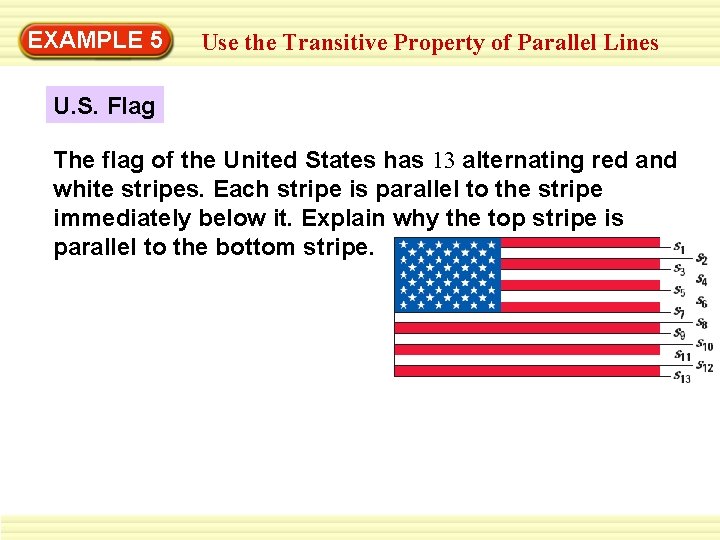
EXAMPLE 5 Use the Transitive Property of Parallel Lines U. S. Flag The flag of the United States has 13 alternating red and white stripes. Each stripe is parallel to the stripe immediately below it. Explain why the top stripe is parallel to the bottom stripe.
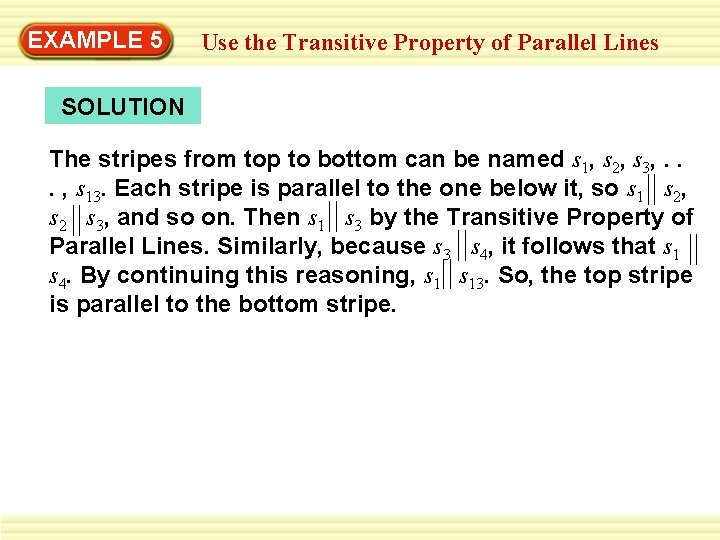
EXAMPLE 5 Use the Transitive Property of Parallel Lines SOLUTION The stripes from top to bottom can be named s 1, s 2, s 3, . . . , s 13. Each stripe is parallel to the one below it, so s 1 s 2, s 2 s 3, and so on. Then s 1 s 3 by the Transitive Property of Parallel Lines. Similarly, because s 3 s 4, it follows that s 1 s 4. By continuing this reasoning, s 13. So, the top stripe is parallel to the bottom stripe.
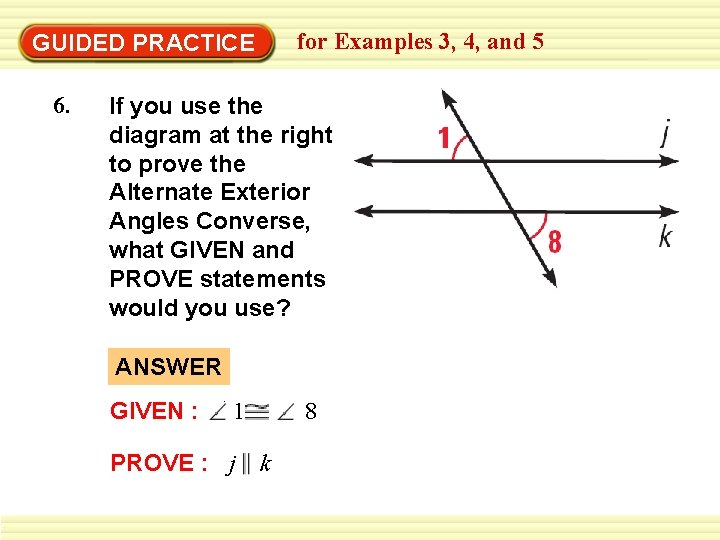
for Examples 3, 4, and 5 GUIDED PRACTICE 6. If you use the diagram at the right to prove the Alternate Exterior Angles Converse, what GIVEN and PROVE statements would you use? ANSWER GIVEN : ∠ 1 PROVE : j 8 k
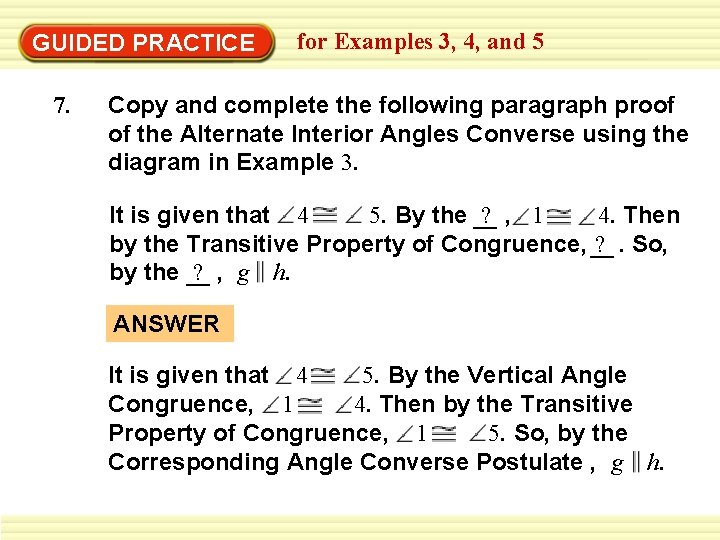
GUIDED PRACTICE 7. for Examples 3, 4, and 5 Copy and complete the following paragraph proof of the Alternate Interior Angles Converse using the diagram in Example 3. It is given that 4 5. By the ? , 1 4. Then by the Transitive Property of Congruence, ? . So, by the ? , g h. ANSWER It is given that 4 5. By the Vertical Angle Congruence, 1 4. Then by the Transitive Property of Congruence, 1 5. So, by the Corresponding Angle Converse Postulate , g h.
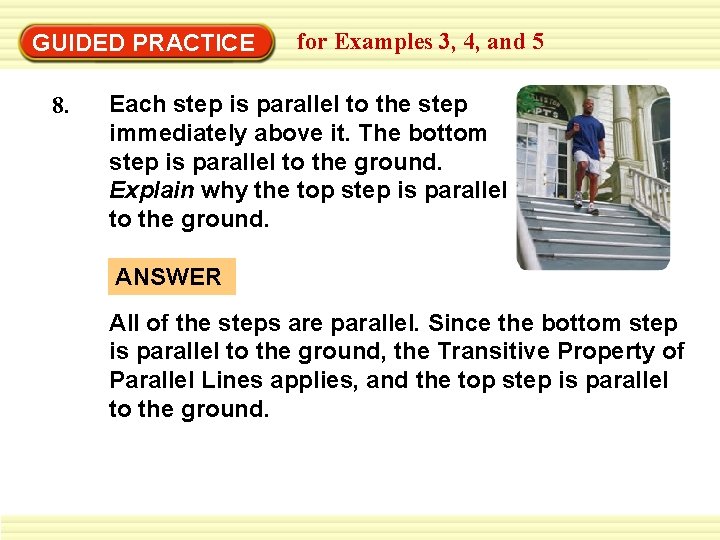
GUIDED PRACTICE 8. for Examples 3, 4, and 5 Each step is parallel to the step immediately above it. The bottom step is parallel to the ground. Explain why the top step is parallel to the ground. ANSWER All of the steps are parallel. Since the bottom step is parallel to the ground, the Transitive Property of Parallel Lines applies, and the top step is parallel to the ground.