
EXAMPLE 2 Use properties of isosceles trapezoids Arch
- Slides: 6
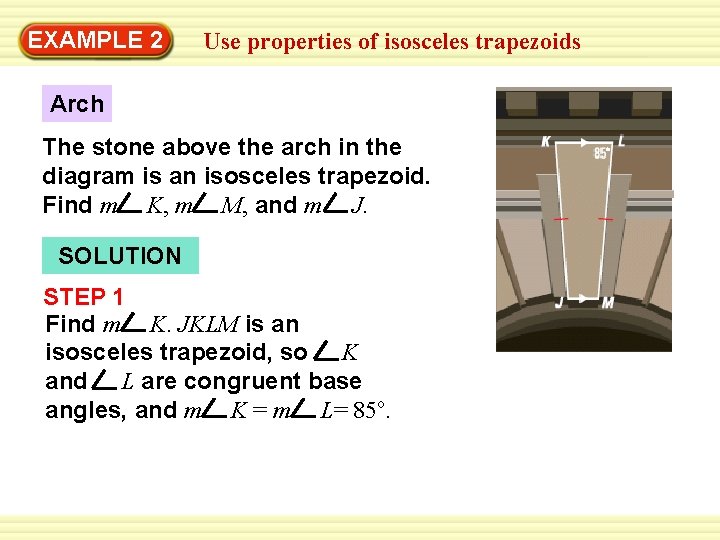
EXAMPLE 2 Use properties of isosceles trapezoids Arch The stone above the arch in the diagram is an isosceles trapezoid. Find m K, m M, and m J. SOLUTION STEP 1 Find m K. JKLM is an isosceles trapezoid, so K and L are congruent base angles, and m K = m L= 85 o.
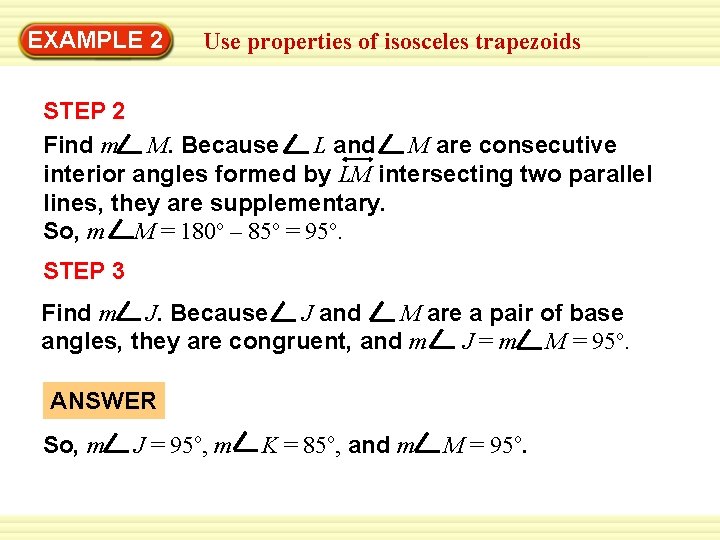
EXAMPLE 2 Use properties of isosceles trapezoids STEP 2 Find m M. Because L and M are consecutive interior angles formed by LM intersecting two parallel lines, they are supplementary. So, m M = 180 o – 85 o = 95 o. STEP 3 Find m J. Because J and M are a pair of base angles, they are congruent, and m J = m M = 95 o. ANSWER So, m J = 95 o, m K = 85 o, and m M = 95 o.
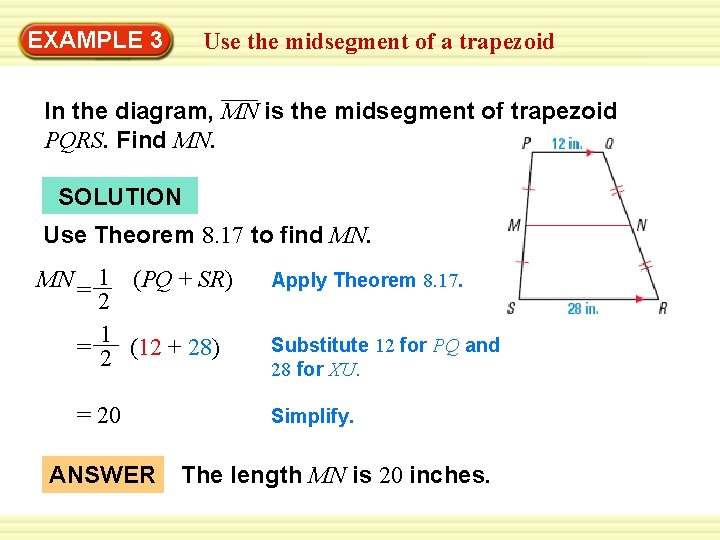
EXAMPLE 3 Use the midsegment of a trapezoid In the diagram, MN is the midsegment of trapezoid PQRS. Find MN. SOLUTION Use Theorem 8. 17 to find MN. MN = 1 (PQ + SR) 2 1 = 2 (12 + 28) = 20 ANSWER Apply Theorem 8. 17. Substitute 12 for PQ and 28 for XU. Simplify. The length MN is 20 inches.
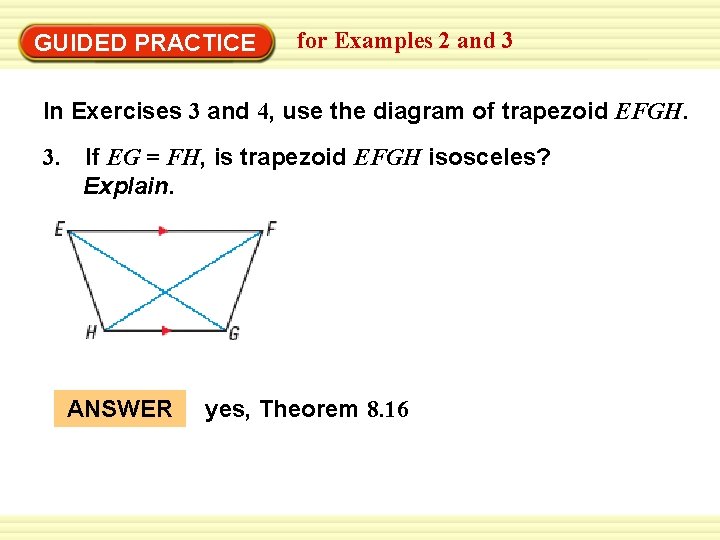
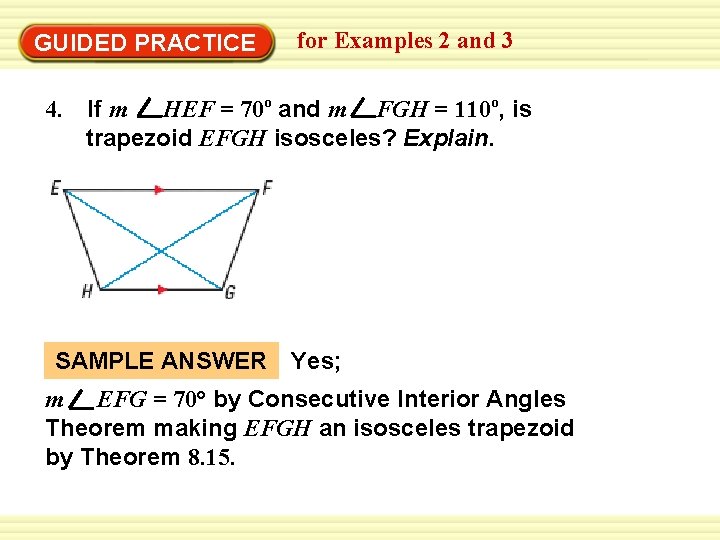
GUIDED PRACTICE for Examples 2 and 3 In Exercises 3 and 4, use the diagram of trapezoid EFGH. 3. If EG = FH, is trapezoid EFGH isosceles? Explain. ANSWER yes, Theorem 8. 16
GUIDED PRACTICE for Examples 2 and 3 4. If m HEF = 70 o and m FGH = 110 o, is trapezoid EFGH isosceles? Explain. SAMPLE ANSWER Yes; m EFG = 70° by Consecutive Interior Angles Theorem making EFGH an isosceles trapezoid by Theorem 8. 15.
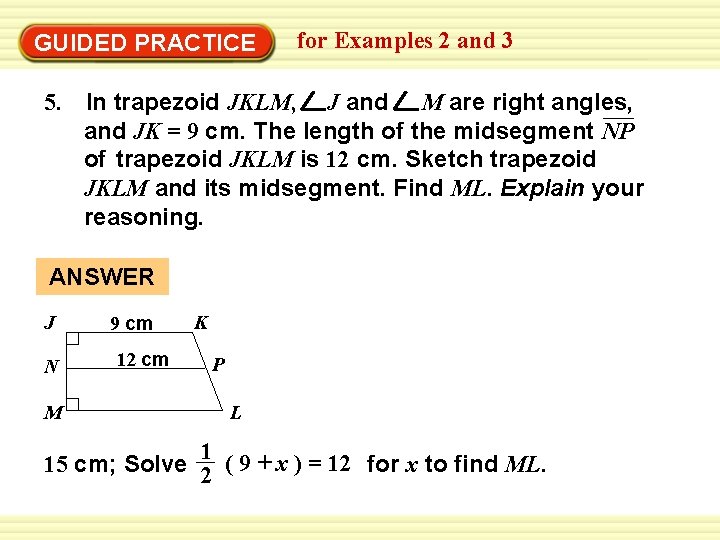
GUIDED PRACTICE for Examples 2 and 3 5. In trapezoid JKLM, J and M are right angles, and JK = 9 cm. The length of the midsegment NP of trapezoid JKLM is 12 cm. Sketch trapezoid JKLM and its midsegment. Find ML. Explain your reasoning. ANSWER J 9 cm N 12 cm M K P L 1 15 cm; Solve 2 ( 9 + x ) = 12 for x to find ML.