
EXAMPLE 2 Graphing Points in a Coordinate Plane
- Slides: 8
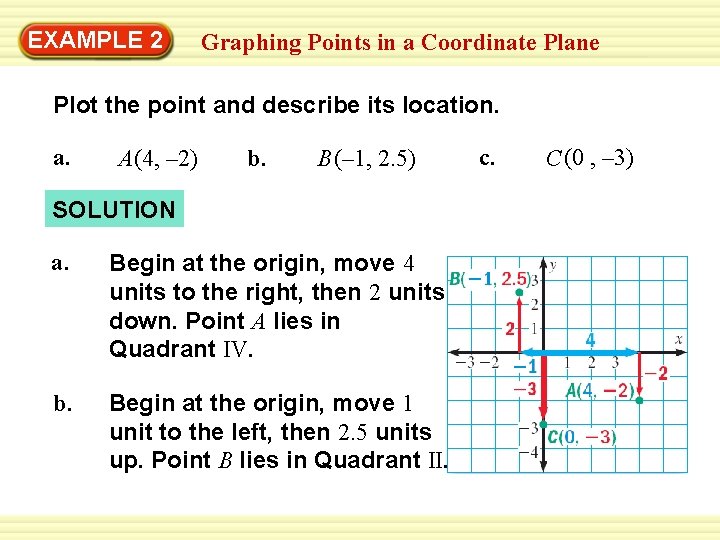
EXAMPLE 2 Graphing Points in a Coordinate Plane Plot the point and describe its location. a. A(4, – 2) b. B (– 1, 2. 5) SOLUTION a. Begin at the origin, move 4 units to the right, then 2 units down. Point A lies in Quadrant IV. b. Begin at the origin, move 1 unit to the left, then 2. 5 units up. Point B lies in Quadrant II. c. C (0 , – 3)
EXAMPLE 2 c. Graphing Points in a Coordinate Plane Begin at the origin, move 3 units down. Point C lies on the y-axis.
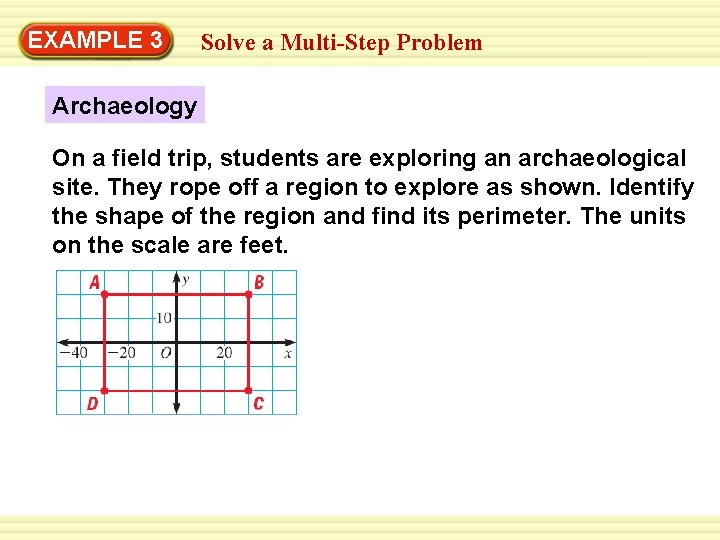
EXAMPLE 3 Solve a Multi-Step Problem Archaeology On a field trip, students are exploring an archaeological site. They rope off a region to explore as shown. Identify the shape of the region and find its perimeter. The units on the scale are feet.
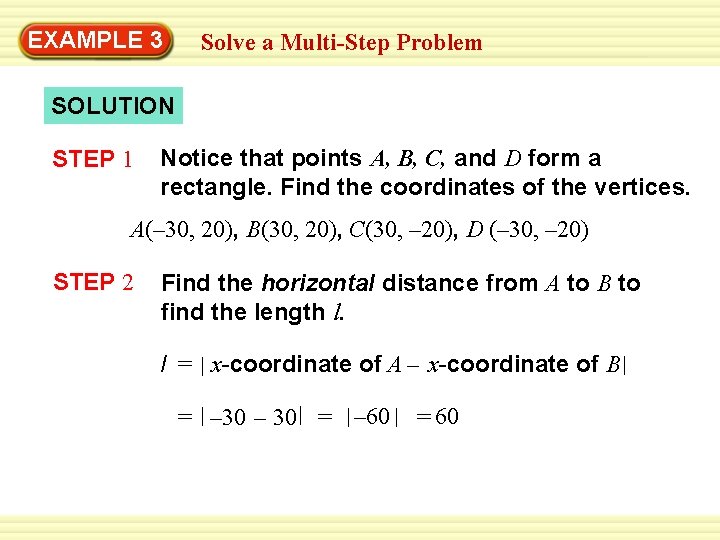
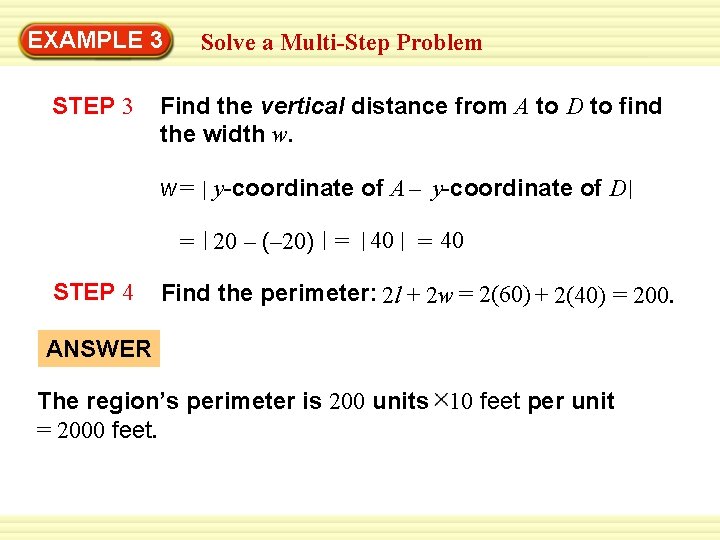
EXAMPLE 3 Solve a Multi-Step Problem SOLUTION STEP 1 Notice that points A, B, C, and D form a rectangle. Find the coordinates of the vertices. A(– 30, 20), B(30, 20), C(30, – 20), D (– 30, – 20) STEP 2 Find the horizontal distance from A to B to find the length l. l = x-coordinate of A – x-coordinate of B = – 30 = – 60 = 60
EXAMPLE 3 STEP 3 Solve a Multi-Step Problem Find the vertical distance from A to D to find the width w. w = y-coordinate of A – y-coordinate of D = 20 – (– 20) = 40 STEP 4 = 40 Find the perimeter: 2 l + 2 w = 2(60) + 2(40) = 200. ANSWER The region’s perimeter is 200 units 10 feet per unit = 2000 feet.
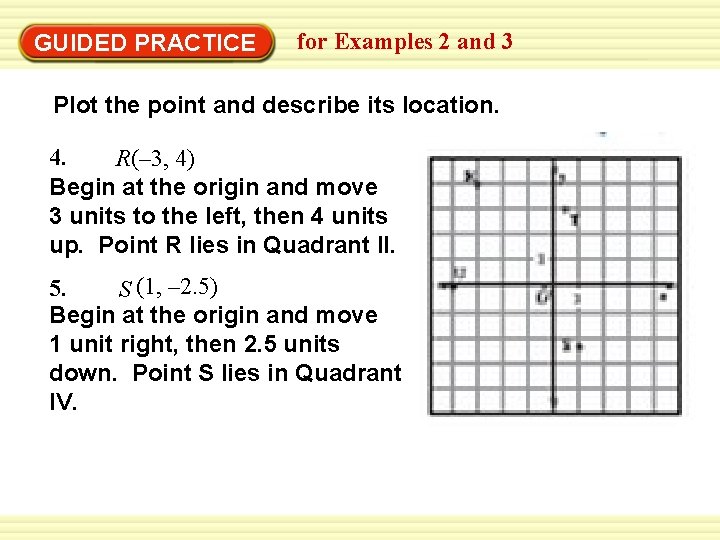
GUIDED PRACTICE for Examples 2 and 3 Plot the point and describe its location. 4. R(– 3, 4) Begin at the origin and move 3 units to the left, then 4 units up. Point R lies in Quadrant II. 5. S (1, – 2. 5) Begin at the origin and move 1 unit right, then 2. 5 units down. Point S lies in Quadrant IV.
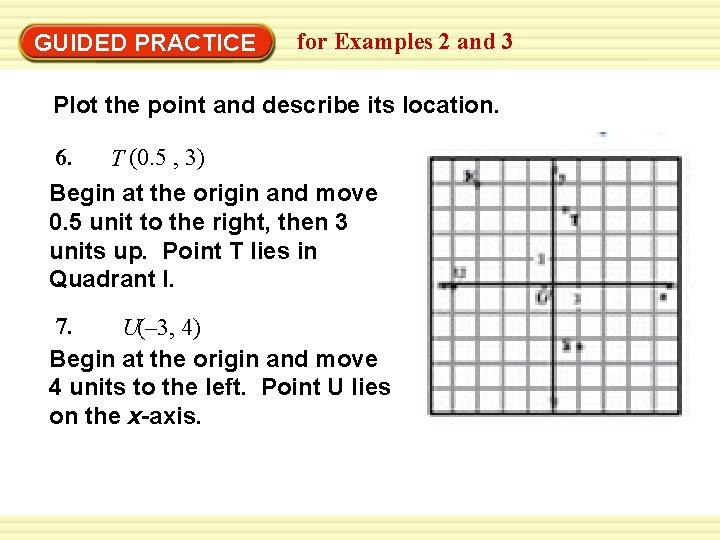
GUIDED PRACTICE for Examples 2 and 3 Plot the point and describe its location. 6. T (0. 5 , 3) Begin at the origin and move 0. 5 unit to the right, then 3 units up. Point T lies in Quadrant I. 7. U(– 3, 4) Begin at the origin and move 4 units to the left. Point U lies on the x-axis.
GUIDED PRACTICE for Examples 2 and 3 Plot the point and describe its location. 8. Move points A and B in Example 3 to form a new rectangle. Find the perimeter. ANSWER Answers may vary. Sample answer: Moving A and B to A(– 30, 0) and B(30, 0), the perimeter is 160 units.