
EXAMPLE 2 Find the image of a composition
- Slides: 9
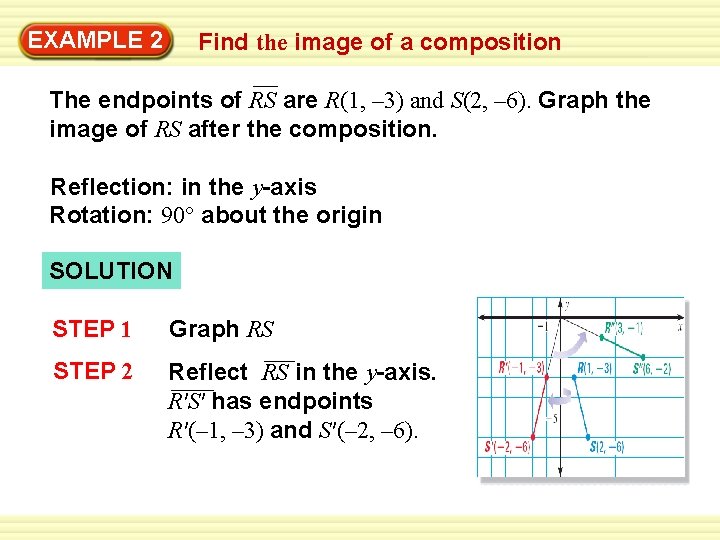
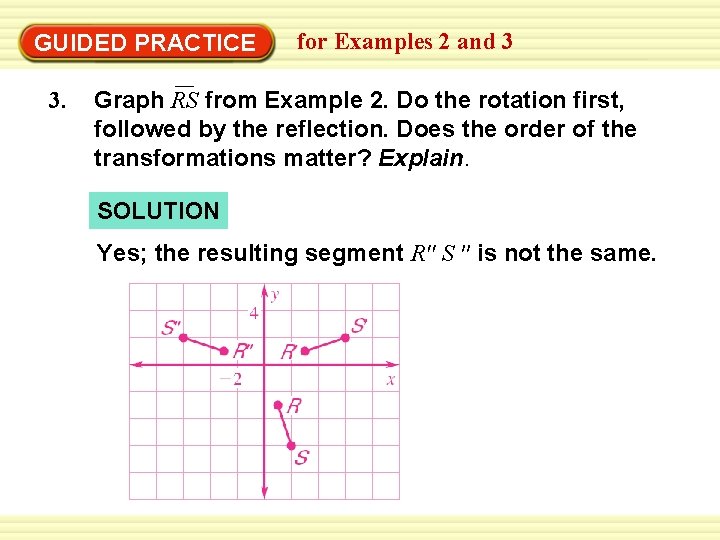
EXAMPLE 2 Find the image of a composition The endpoints of RS are R(1, – 3) and S(2, – 6). Graph the image of RS after the composition. Reflection: in the y-axis Rotation: 90° about the origin SOLUTION STEP 1 Graph RS STEP 2 Reflect RS in the y-axis. R′S′ has endpoints R′(– 1, – 3) and S′(– 2, – 6).
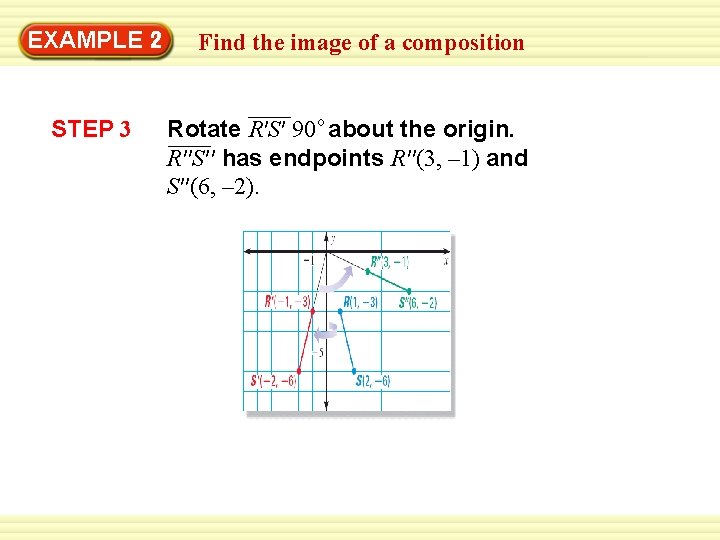
EXAMPLE 2 STEP 3 Find the image of a composition Rotate R′S′ 90 o about the origin. R′′S′′ has endpoints R′′(3, – 1) and S′′(6, – 2).
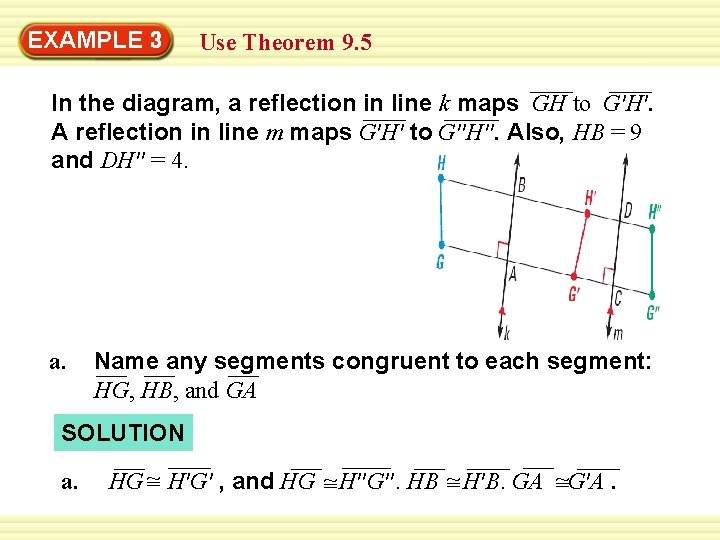
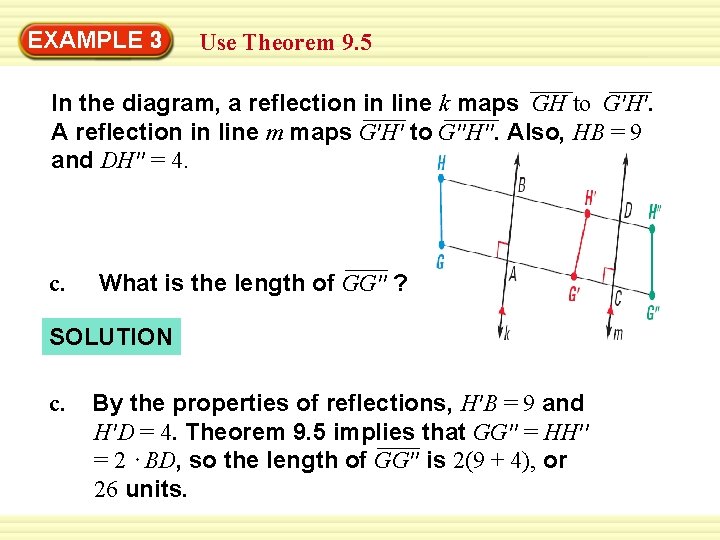
EXAMPLE 3 Use Theorem 9. 5 In the diagram, a reflection in line k maps GH to G′H′. A reflection in line m maps G′H′ to G′′H′′. Also, HB = 9 and DH′′ = 4. a. Name any segments congruent to each segment: HG, HB, and GA SOLUTION a. HG ~ H′G′ , and HG ~ H′′G′′. HB ~ H′B. GA ~G′A.
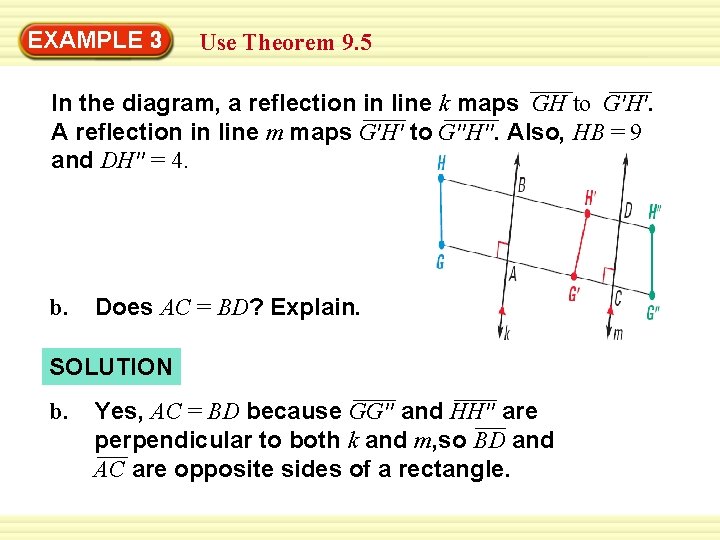
EXAMPLE 3 Use Theorem 9. 5 In the diagram, a reflection in line k maps GH to G′H′. A reflection in line m maps G′H′ to G′′H′′. Also, HB = 9 and DH′′ = 4. b. Does AC = BD? Explain. SOLUTION b. Yes, AC = BD because GG′′ and HH′′ are perpendicular to both k and m, so BD and AC are opposite sides of a rectangle.
EXAMPLE 3 Use Theorem 9. 5 In the diagram, a reflection in line k maps GH to G′H′. A reflection in line m maps G′H′ to G′′H′′. Also, HB = 9 and DH′′ = 4. c. What is the length of GG′′ ? SOLUTION c. By the properties of reflections, H′B = 9 and H′D = 4. Theorem 9. 5 implies that GG′′ = HH′′ = 2 BD, so the length of GG′′ is 2(9 + 4), or 26 units.
GUIDED PRACTICE 3. for Examples 2 and 3 Graph RS from Example 2. Do the rotation first, followed by the reflection. Does the order of the transformations matter? Explain. SOLUTION Yes; the resulting segment R′′ S ′′ is not the same.
GUIDED PRACTICE 4. for Examples 2 and 3 In Example 3, part (c), explain how you know that GG′′ = HH′′. SOLUTION They are opposite sides of a parallelogram.
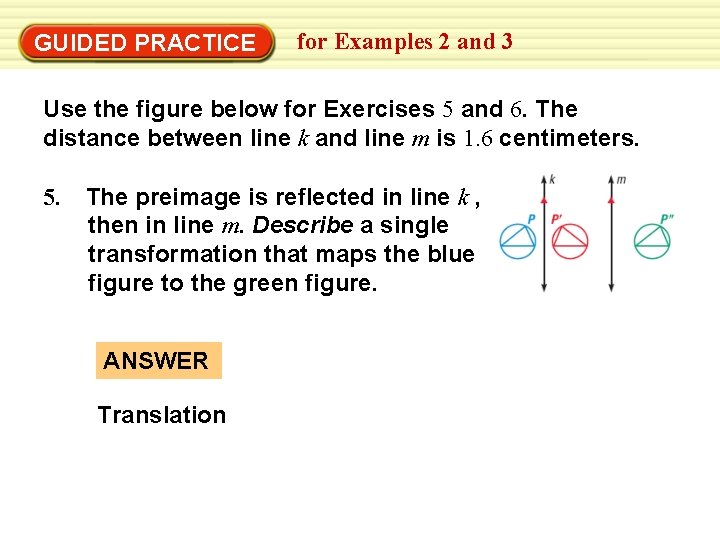
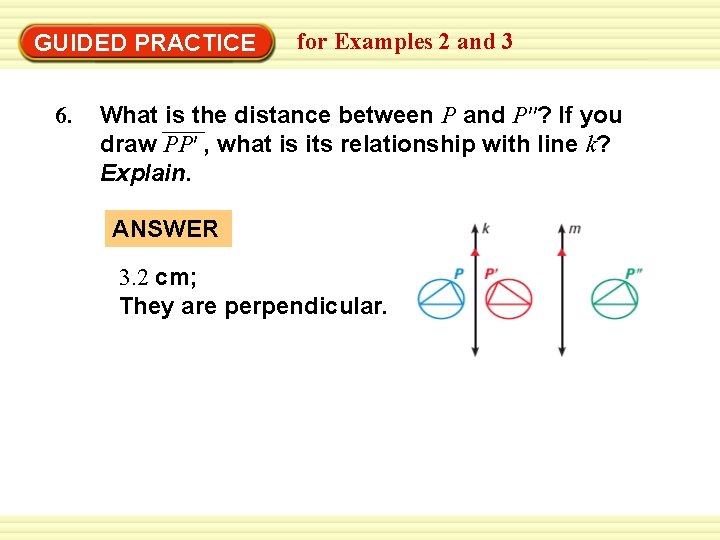
GUIDED PRACTICE for Examples 2 and 3 Use the figure below for Exercises 5 and 6. The distance between line k and line m is 1. 6 centimeters. 5. The preimage is reflected in line k , then in line m. Describe a single transformation that maps the blue figure to the green figure. ANSWER Translation
GUIDED PRACTICE 6. for Examples 2 and 3 What is the distance between P and P′′? If you draw PP′ , what is its relationship with line k? Explain. ANSWER 3. 2 cm; They are perpendicular.