
Example 14 1 Expressing Equilibrium Constants for Chemical
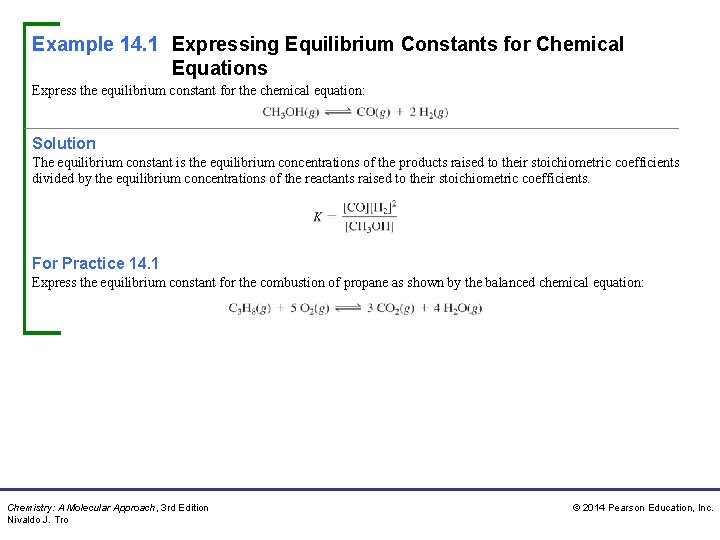
Example 14. 1 Expressing Equilibrium Constants for Chemical Equations Express the equilibrium constant for the chemical equation: Solution The equilibrium constant is the equilibrium concentrations of the products raised to their stoichiometric coefficients divided by the equilibrium concentrations of the reactants raised to their stoichiometric coefficients. For Practice 14. 1 Express the equilibrium constant for the combustion of propane as shown by the balanced chemical equation: Chemistry: A Molecular Approach, 3 rd Edition Nivaldo J. Tro © 2014 Pearson Education, Inc.
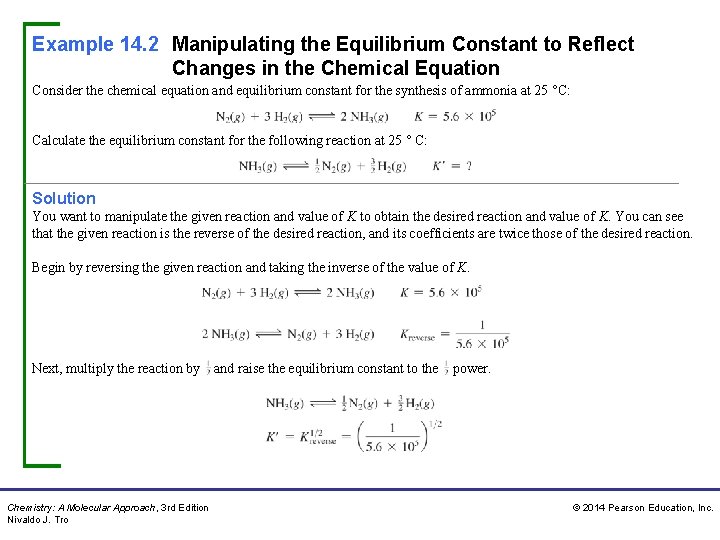
Example 14. 2 Manipulating the Equilibrium Constant to Reflect Changes in the Chemical Equation Consider the chemical equation and equilibrium constant for the synthesis of ammonia at 25 °C: Calculate the equilibrium constant for the following reaction at 25 ° C: Solution You want to manipulate the given reaction and value of K to obtain the desired reaction and value of K. You can see that the given reaction is the reverse of the desired reaction, and its coefficients are twice those of the desired reaction. Begin by reversing the given reaction and taking the inverse of the value of K. Next, multiply the reaction by Chemistry: A Molecular Approach, 3 rd Edition Nivaldo J. Tro and raise the equilibrium constant to the power. © 2014 Pearson Education, Inc.
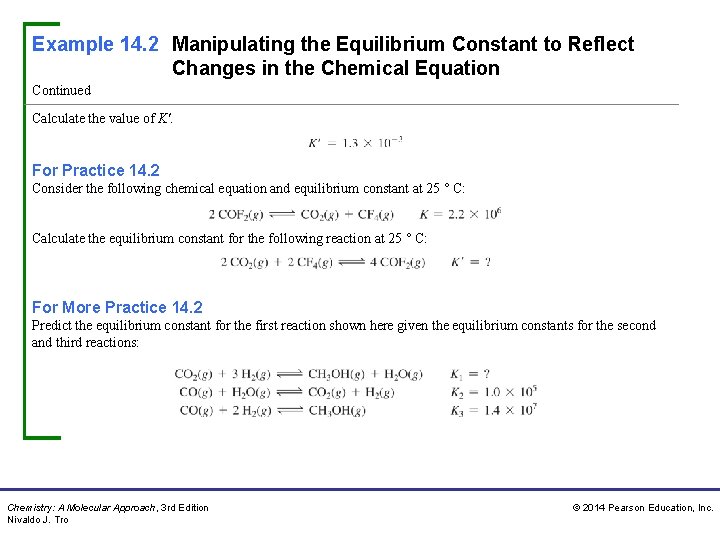
Example 14. 2 Manipulating the Equilibrium Constant to Reflect Changes in the Chemical Equation Continued Calculate the value of K′. For Practice 14. 2 Consider the following chemical equation and equilibrium constant at 25 ° C: Calculate the equilibrium constant for the following reaction at 25 ° C: For More Practice 14. 2 Predict the equilibrium constant for the first reaction shown here given the equilibrium constants for the second and third reactions: Chemistry: A Molecular Approach, 3 rd Edition Nivaldo J. Tro © 2014 Pearson Education, Inc.
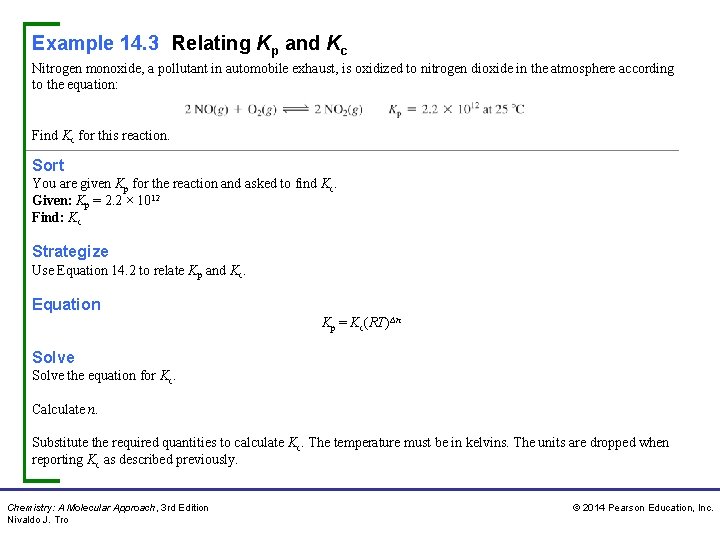
Example 14. 3 Relating Kp and Kc Nitrogen monoxide, a pollutant in automobile exhaust, is oxidized to nitrogen dioxide in the atmosphere according to the equation: Find Kc for this reaction. Sort You are given Kp for the reaction and asked to find Kc. Given: Kp = 2. 2 × 10¹² Find: Kc Strategize Use Equation 14. 2 to relate Kp and Kc. Equation Kp = Kc(RT)Δn Solve the equation for Kc. Calculate n. Substitute the required quantities to calculate Kc. The temperature must be in kelvins. The units are dropped when reporting Kc as described previously. Chemistry: A Molecular Approach, 3 rd Edition Nivaldo J. Tro © 2014 Pearson Education, Inc.
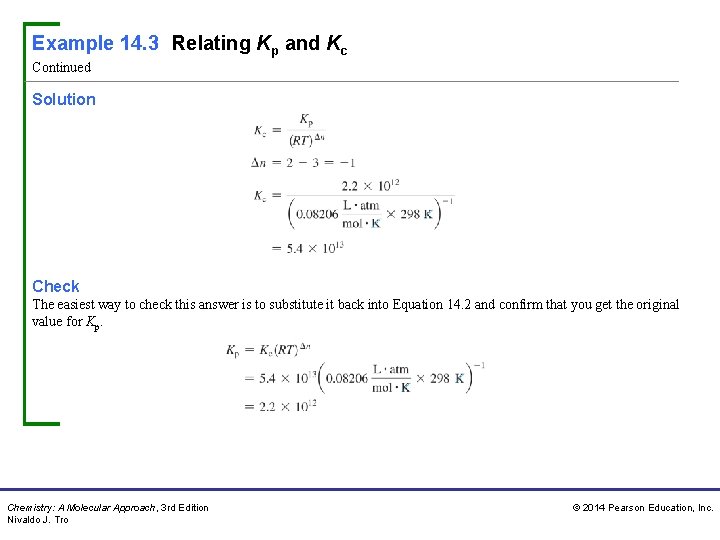
Example 14. 3 Relating Kp and Kc Continued Solution Check The easiest way to check this answer is to substitute it back into Equation 14. 2 and confirm that you get the original value for Kp. Chemistry: A Molecular Approach, 3 rd Edition Nivaldo J. Tro © 2014 Pearson Education, Inc.
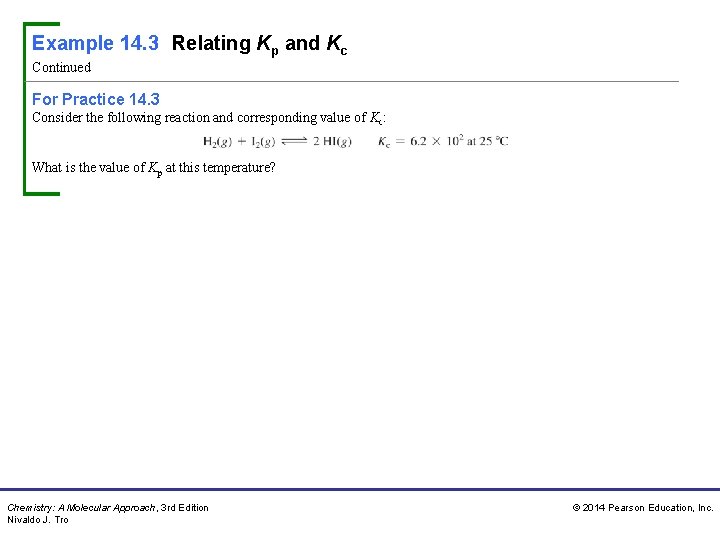
Example 14. 3 Relating Kp and Kc Continued For Practice 14. 3 Consider the following reaction and corresponding value of Kc: What is the value of Kp at this temperature? Chemistry: A Molecular Approach, 3 rd Edition Nivaldo J. Tro © 2014 Pearson Education, Inc.
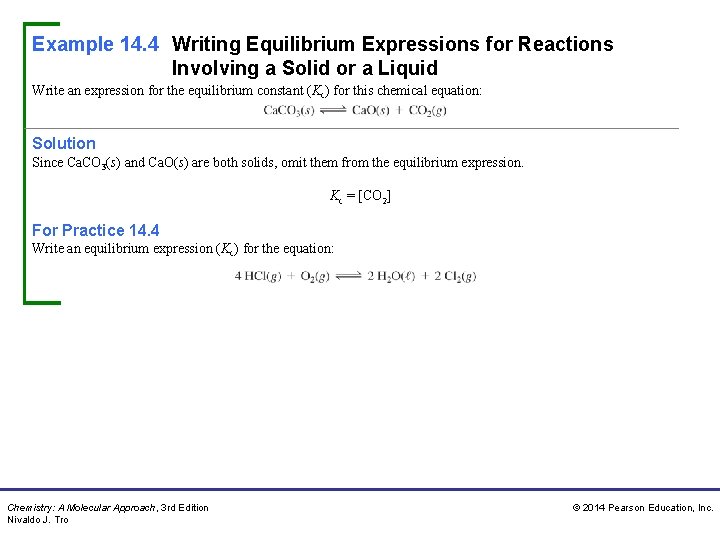
Example 14. 4 Writing Equilibrium Expressions for Reactions Involving a Solid or a Liquid Write an expression for the equilibrium constant (Kc) for this chemical equation: Solution Since Ca. CO 3(s) and Ca. O(s) are both solids, omit them from the equilibrium expression. Kc = [CO 2] For Practice 14. 4 Write an equilibrium expression (Kc) for the equation: Chemistry: A Molecular Approach, 3 rd Edition Nivaldo J. Tro © 2014 Pearson Education, Inc.
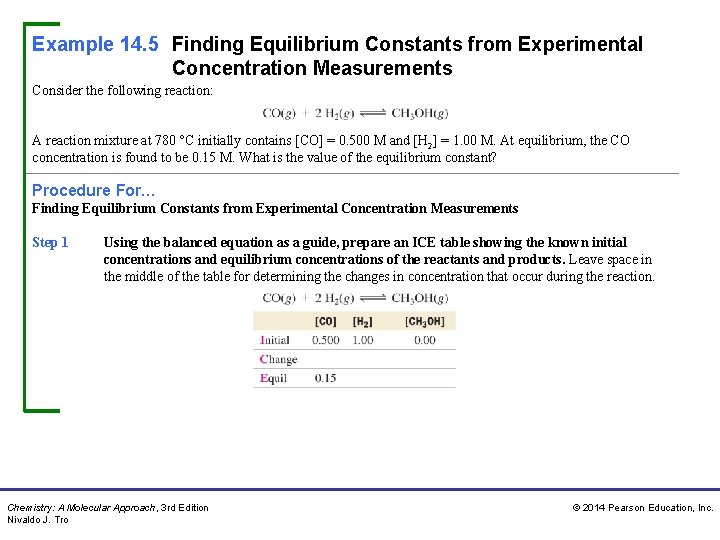
Example 14. 5 Finding Equilibrium Constants from Experimental Concentration Measurements Consider the following reaction: A reaction mixture at 780 °C initially contains [CO] = 0. 500 M and [H 2] = 1. 00 M. At equilibrium, the CO concentration is found to be 0. 15 M. What is the value of the equilibrium constant? Procedure For… Finding Equilibrium Constants from Experimental Concentration Measurements Step 1 Using the balanced equation as a guide, prepare an ICE table showing the known initial concentrations and equilibrium concentrations of the reactants and products. Leave space in the middle of the table for determining the changes in concentration that occur during the reaction. Chemistry: A Molecular Approach, 3 rd Edition Nivaldo J. Tro © 2014 Pearson Education, Inc.
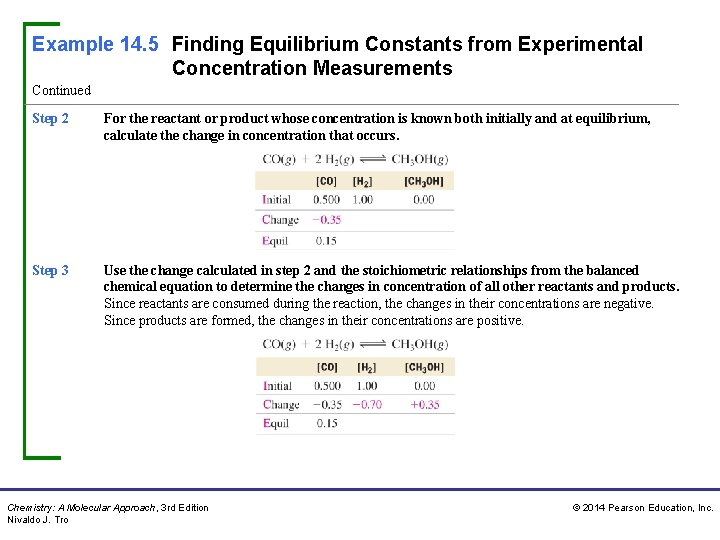
Example 14. 5 Finding Equilibrium Constants from Experimental Concentration Measurements Continued Step 2 For the reactant or product whose concentration is known both initially and at equilibrium, calculate the change in concentration that occurs. Step 3 Use the change calculated in step 2 and the stoichiometric relationships from the balanced chemical equation to determine the changes in concentration of all other reactants and products. Since reactants are consumed during the reaction, the changes in their concentrations are negative. Since products are formed, the changes in their concentrations are positive. Chemistry: A Molecular Approach, 3 rd Edition Nivaldo J. Tro © 2014 Pearson Education, Inc.
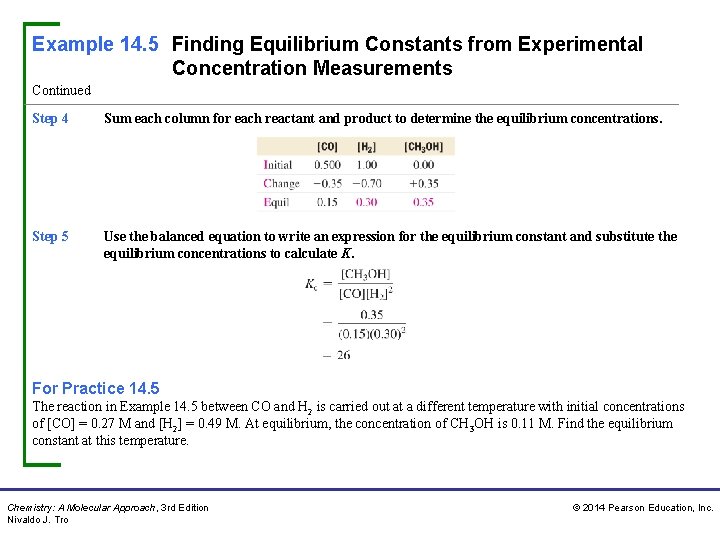
Example 14. 5 Finding Equilibrium Constants from Experimental Concentration Measurements Continued Step 4 Sum each column for each reactant and product to determine the equilibrium concentrations. Step 5 Use the balanced equation to write an expression for the equilibrium constant and substitute the equilibrium concentrations to calculate K. For Practice 14. 5 The reaction in Example 14. 5 between CO and H 2 is carried out at a different temperature with initial concentrations of [CO] = 0. 27 M and [H 2] = 0. 49 M. At equilibrium, the concentration of CH 3 OH is 0. 11 M. Find the equilibrium constant at this temperature. Chemistry: A Molecular Approach, 3 rd Edition Nivaldo J. Tro © 2014 Pearson Education, Inc.
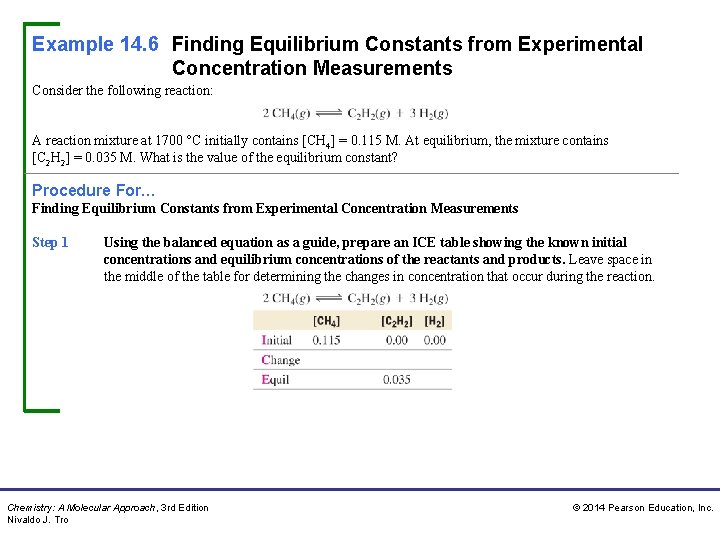
Example 14. 6 Finding Equilibrium Constants from Experimental Concentration Measurements Consider the following reaction: A reaction mixture at 1700 °C initially contains [CH 4] = 0. 115 M. At equilibrium, the mixture contains [C 2 H 2] = 0. 035 M. What is the value of the equilibrium constant? Procedure For… Finding Equilibrium Constants from Experimental Concentration Measurements Step 1 Using the balanced equation as a guide, prepare an ICE table showing the known initial concentrations and equilibrium concentrations of the reactants and products. Leave space in the middle of the table for determining the changes in concentration that occur during the reaction. Chemistry: A Molecular Approach, 3 rd Edition Nivaldo J. Tro © 2014 Pearson Education, Inc.
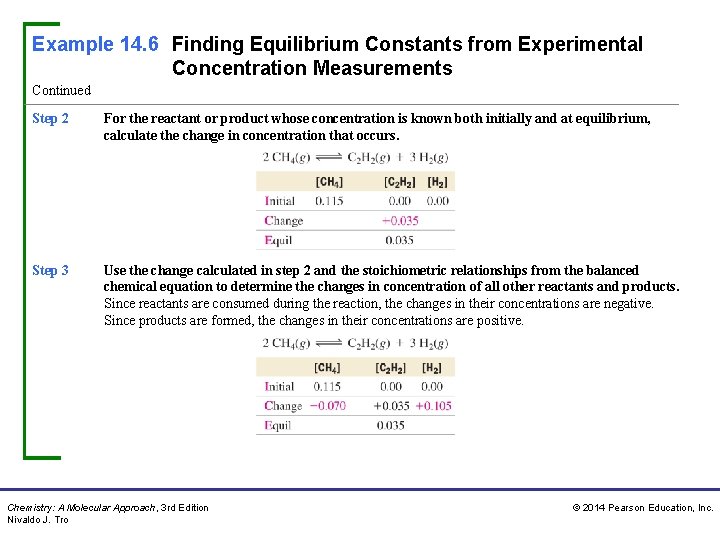
Example 14. 6 Finding Equilibrium Constants from Experimental Concentration Measurements Continued Step 2 For the reactant or product whose concentration is known both initially and at equilibrium, calculate the change in concentration that occurs. Step 3 Use the change calculated in step 2 and the stoichiometric relationships from the balanced chemical equation to determine the changes in concentration of all other reactants and products. Since reactants are consumed during the reaction, the changes in their concentrations are negative. Since products are formed, the changes in their concentrations are positive. Chemistry: A Molecular Approach, 3 rd Edition Nivaldo J. Tro © 2014 Pearson Education, Inc.
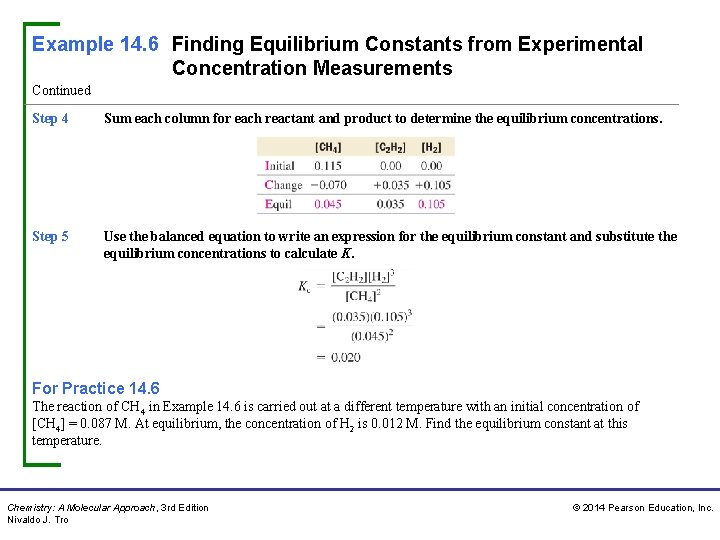
Example 14. 6 Finding Equilibrium Constants from Experimental Concentration Measurements Continued Step 4 Sum each column for each reactant and product to determine the equilibrium concentrations. Step 5 Use the balanced equation to write an expression for the equilibrium constant and substitute the equilibrium concentrations to calculate K. For Practice 14. 6 The reaction of CH 4 in Example 14. 6 is carried out at a different temperature with an initial concentration of [CH 4] = 0. 087 M. At equilibrium, the concentration of H 2 is 0. 012 M. Find the equilibrium constant at this temperature. Chemistry: A Molecular Approach, 3 rd Edition Nivaldo J. Tro © 2014 Pearson Education, Inc.
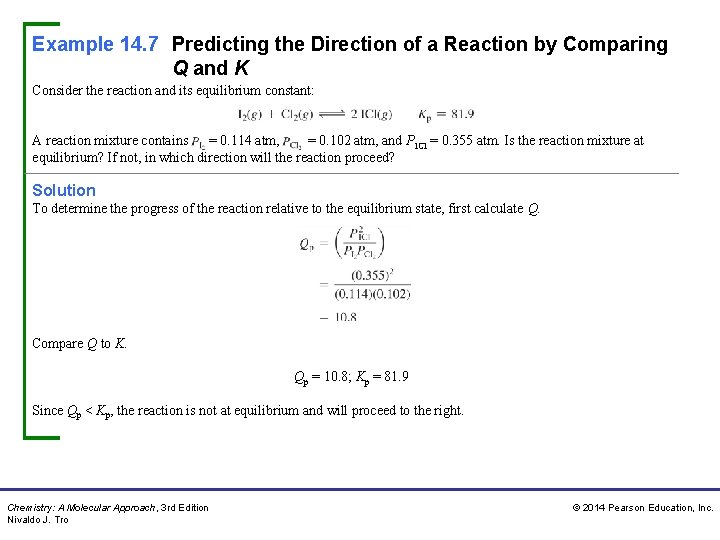
Example 14. 7 Predicting the Direction of a Reaction by Comparing Q and K Consider the reaction and its equilibrium constant: A reaction mixture contains = 0. 114 atm, = 0. 102 atm, and PICl = 0. 355 atm. Is the reaction mixture at equilibrium? If not, in which direction will the reaction proceed? Solution To determine the progress of the reaction relative to the equilibrium state, first calculate Q. Compare Q to K. Qp = 10. 8; Kp = 81. 9 Since Qp < Kp, the reaction is not at equilibrium and will proceed to the right. Chemistry: A Molecular Approach, 3 rd Edition Nivaldo J. Tro © 2014 Pearson Education, Inc.
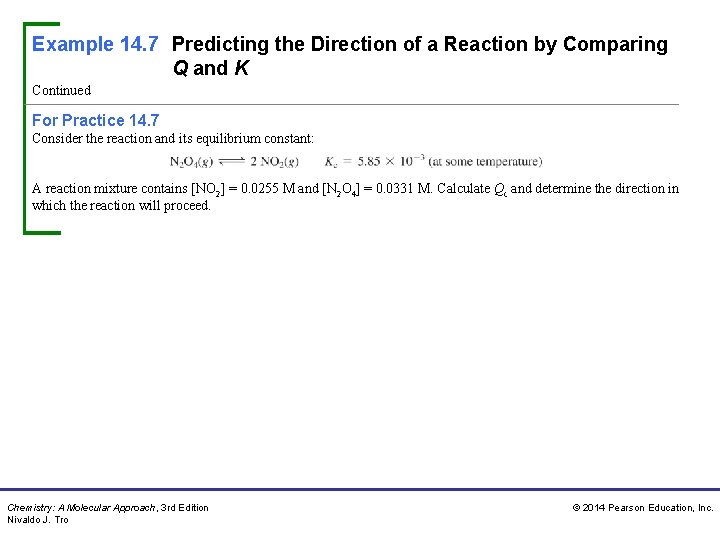
Example 14. 7 Predicting the Direction of a Reaction by Comparing Q and K Continued For Practice 14. 7 Consider the reaction and its equilibrium constant: A reaction mixture contains [NO 2] = 0. 0255 M and [N 2 O 4] = 0. 0331 M. Calculate Qc and determine the direction in which the reaction will proceed. Chemistry: A Molecular Approach, 3 rd Edition Nivaldo J. Tro © 2014 Pearson Education, Inc.
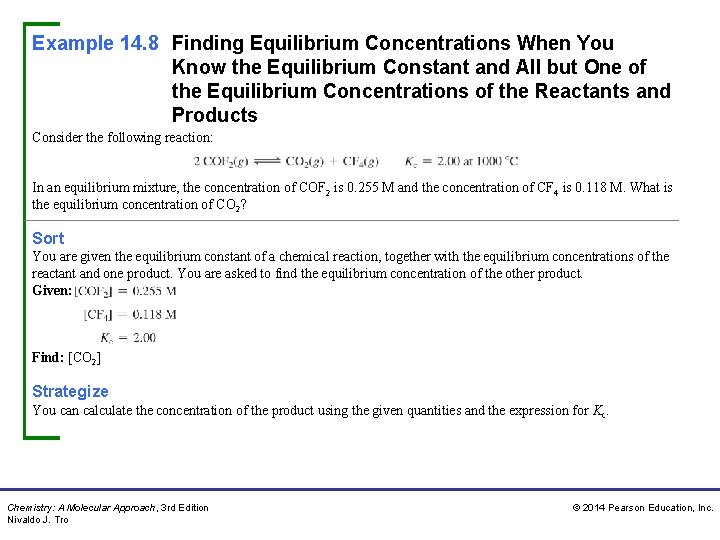
Example 14. 8 Finding Equilibrium Concentrations When You Know the Equilibrium Constant and All but One of the Equilibrium Concentrations of the Reactants and Products Consider the following reaction: In an equilibrium mixture, the concentration of COF 2 is 0. 255 M and the concentration of CF 4 is 0. 118 M. What is the equilibrium concentration of CO 2? Sort You are given the equilibrium constant of a chemical reaction, together with the equilibrium concentrations of the reactant and one product. You are asked to find the equilibrium concentration of the other product. Given: Find: [CO 2] Strategize You can calculate the concentration of the product using the given quantities and the expression for Kc. Chemistry: A Molecular Approach, 3 rd Edition Nivaldo J. Tro © 2014 Pearson Education, Inc.
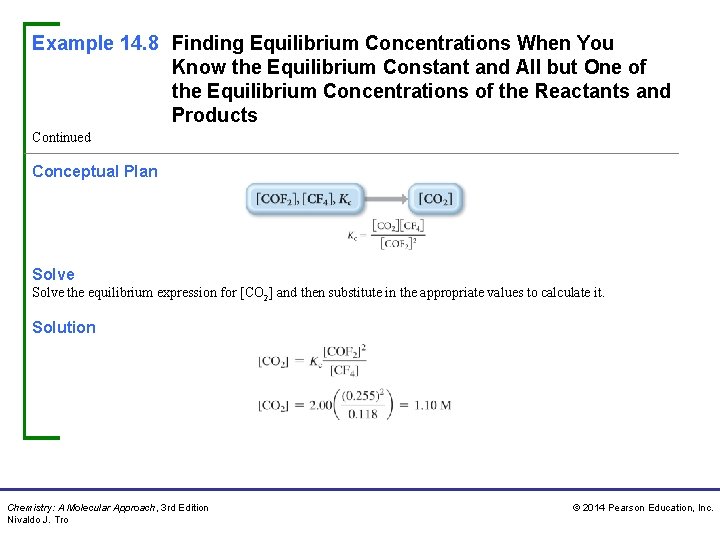
Example 14. 8 Finding Equilibrium Concentrations When You Know the Equilibrium Constant and All but One of the Equilibrium Concentrations of the Reactants and Products Continued Conceptual Plan Solve the equilibrium expression for [CO 2] and then substitute in the appropriate values to calculate it. Solution Chemistry: A Molecular Approach, 3 rd Edition Nivaldo J. Tro © 2014 Pearson Education, Inc.
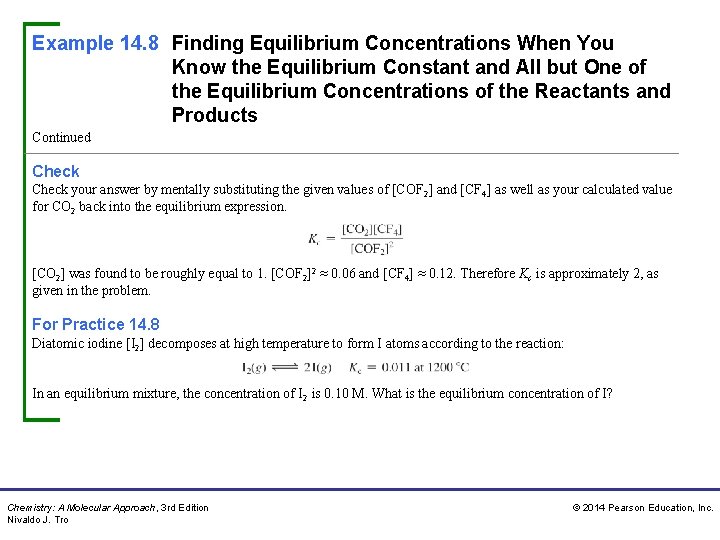
Example 14. 8 Finding Equilibrium Concentrations When You Know the Equilibrium Constant and All but One of the Equilibrium Concentrations of the Reactants and Products Continued Check your answer by mentally substituting the given values of [COF 2] and [CF 4] as well as your calculated value for CO 2 back into the equilibrium expression. [CO 2] was found to be roughly equal to 1. [COF 2]2 ≈ 0. 06 and [CF 4] ≈ 0. 12. Therefore Kc is approximately 2, as given in the problem. For Practice 14. 8 Diatomic iodine [I 2] decomposes at high temperature to form I atoms according to the reaction: In an equilibrium mixture, the concentration of I 2 is 0. 10 M. What is the equilibrium concentration of I? Chemistry: A Molecular Approach, 3 rd Edition Nivaldo J. Tro © 2014 Pearson Education, Inc.
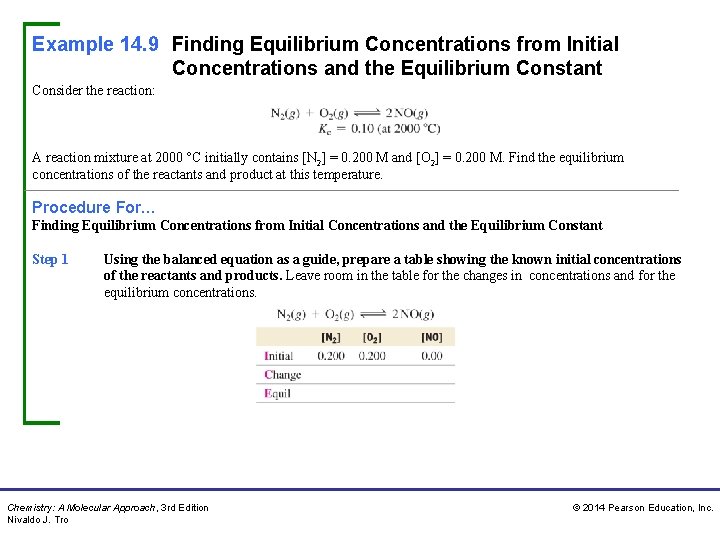
Example 14. 9 Finding Equilibrium Concentrations from Initial Concentrations and the Equilibrium Constant Consider the reaction: A reaction mixture at 2000 °C initially contains [N 2] = 0. 200 M and [O 2] = 0. 200 M. Find the equilibrium concentrations of the reactants and product at this temperature. Procedure For… Finding Equilibrium Concentrations from Initial Concentrations and the Equilibrium Constant Step 1 Using the balanced equation as a guide, prepare a table showing the known initial concentrations of the reactants and products. Leave room in the table for the changes in concentrations and for the equilibrium concentrations. Chemistry: A Molecular Approach, 3 rd Edition Nivaldo J. Tro © 2014 Pearson Education, Inc.
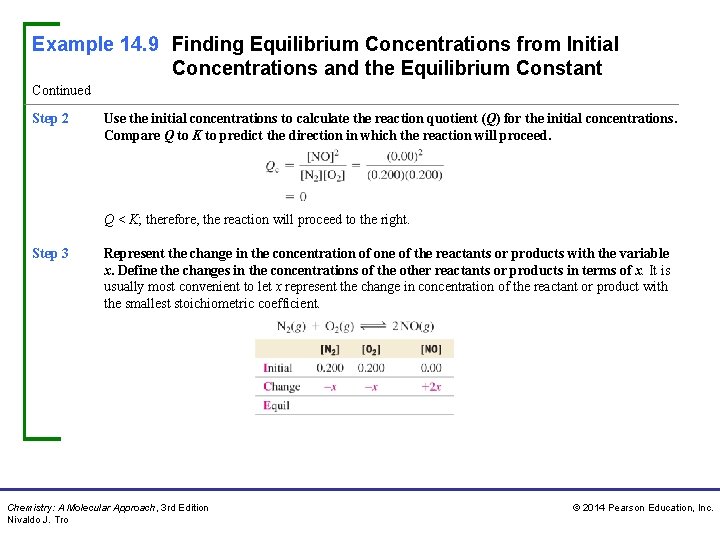
Example 14. 9 Finding Equilibrium Concentrations from Initial Concentrations and the Equilibrium Constant Continued Step 2 Use the initial concentrations to calculate the reaction quotient (Q) for the initial concentrations. Compare Q to K to predict the direction in which the reaction will proceed. Q < K; therefore, the reaction will proceed to the right. Step 3 Represent the change in the concentration of one of the reactants or products with the variable x. Define the changes in the concentrations of the other reactants or products in terms of x. It is usually most convenient to let x represent the change in concentration of the reactant or product with the smallest stoichiometric coefficient. Chemistry: A Molecular Approach, 3 rd Edition Nivaldo J. Tro © 2014 Pearson Education, Inc.
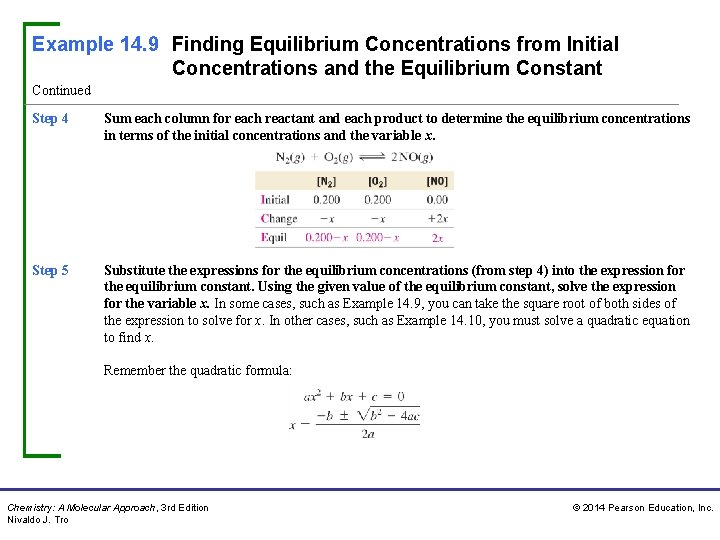
Example 14. 9 Finding Equilibrium Concentrations from Initial Concentrations and the Equilibrium Constant Continued Step 4 Sum each column for each reactant and each product to determine the equilibrium concentrations in terms of the initial concentrations and the variable x. Step 5 Substitute the expressions for the equilibrium concentrations (from step 4) into the expression for the equilibrium constant. Using the given value of the equilibrium constant, solve the expression for the variable x. In some cases, such as Example 14. 9, you can take the square root of both sides of the expression to solve for x. In other cases, such as Example 14. 10, you must solve a quadratic equation to find x. Remember the quadratic formula: Chemistry: A Molecular Approach, 3 rd Edition Nivaldo J. Tro © 2014 Pearson Education, Inc.
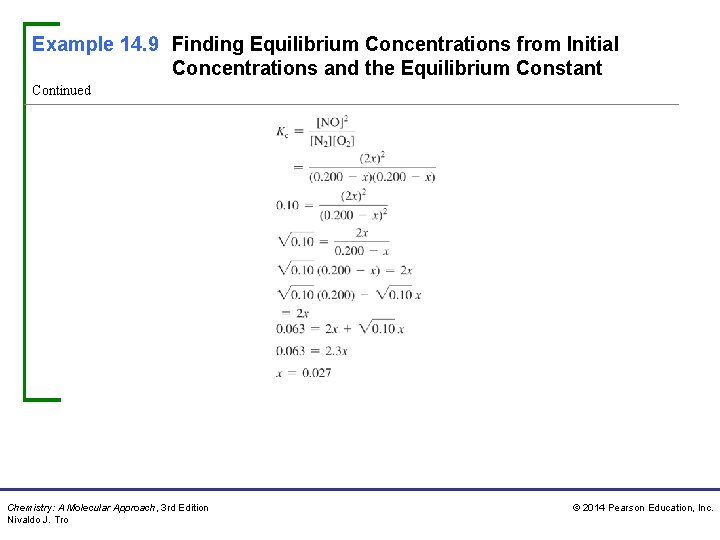
Example 14. 9 Finding Equilibrium Concentrations from Initial Concentrations and the Equilibrium Constant Continued Chemistry: A Molecular Approach, 3 rd Edition Nivaldo J. Tro © 2014 Pearson Education, Inc.
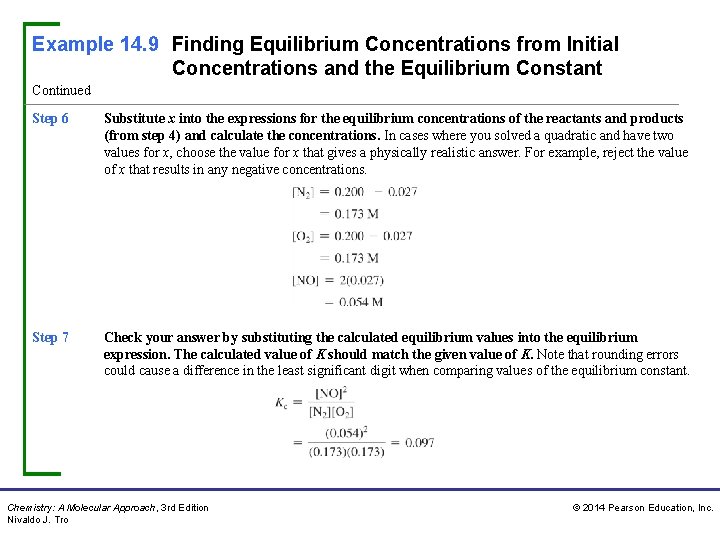
Example 14. 9 Finding Equilibrium Concentrations from Initial Concentrations and the Equilibrium Constant Continued Step 6 Substitute x into the expressions for the equilibrium concentrations of the reactants and products (from step 4) and calculate the concentrations. In cases where you solved a quadratic and have two values for x, choose the value for x that gives a physically realistic answer. For example, reject the value of x that results in any negative concentrations. Step 7 Check your answer by substituting the calculated equilibrium values into the equilibrium expression. The calculated value of K should match the given value of K. Note that rounding errors could cause a difference in the least significant digit when comparing values of the equilibrium constant. Chemistry: A Molecular Approach, 3 rd Edition Nivaldo J. Tro © 2014 Pearson Education, Inc.
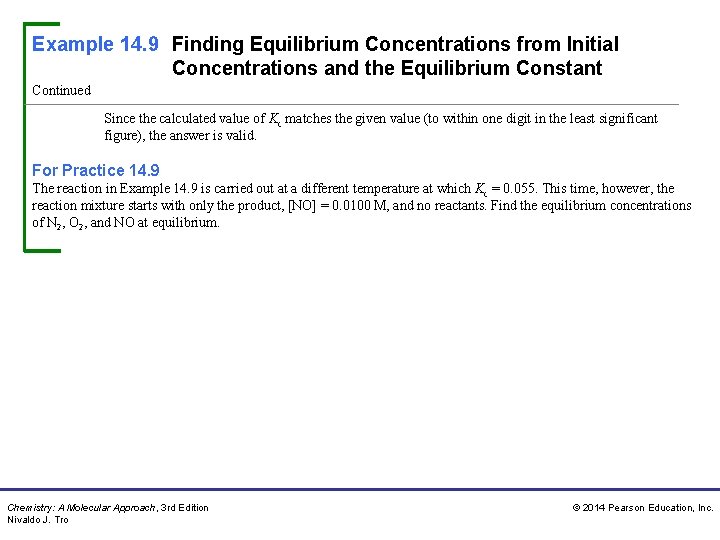
Example 14. 9 Finding Equilibrium Concentrations from Initial Concentrations and the Equilibrium Constant Continued Since the calculated value of Kc matches the given value (to within one digit in the least significant figure), the answer is valid. For Practice 14. 9 The reaction in Example 14. 9 is carried out at a different temperature at which Kc = 0. 055. This time, however, the reaction mixture starts with only the product, [NO] = 0. 0100 M, and no reactants. Find the equilibrium concentrations of N 2, O 2, and NO at equilibrium. Chemistry: A Molecular Approach, 3 rd Edition Nivaldo J. Tro © 2014 Pearson Education, Inc.
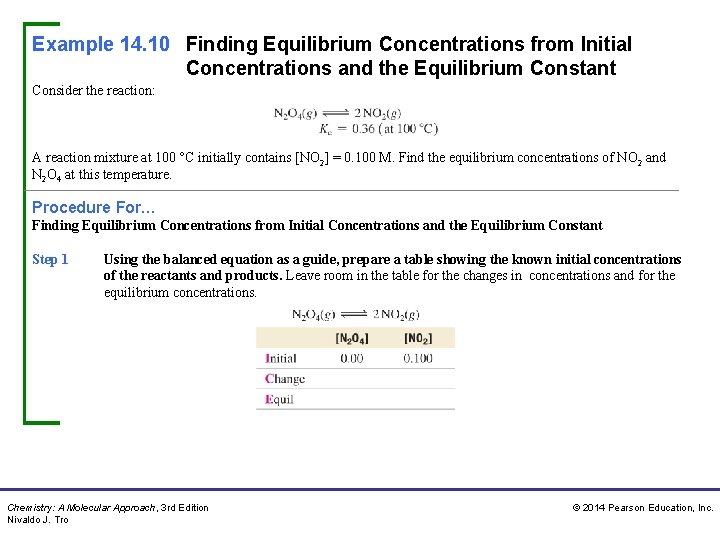
Example 14. 10 Finding Equilibrium Concentrations from Initial Concentrations and the Equilibrium Constant Consider the reaction: A reaction mixture at 100 °C initially contains [NO 2] = 0. 100 M. Find the equilibrium concentrations of NO 2 and N 2 O 4 at this temperature. Procedure For… Finding Equilibrium Concentrations from Initial Concentrations and the Equilibrium Constant Step 1 Using the balanced equation as a guide, prepare a table showing the known initial concentrations of the reactants and products. Leave room in the table for the changes in concentrations and for the equilibrium concentrations. Chemistry: A Molecular Approach, 3 rd Edition Nivaldo J. Tro © 2014 Pearson Education, Inc.
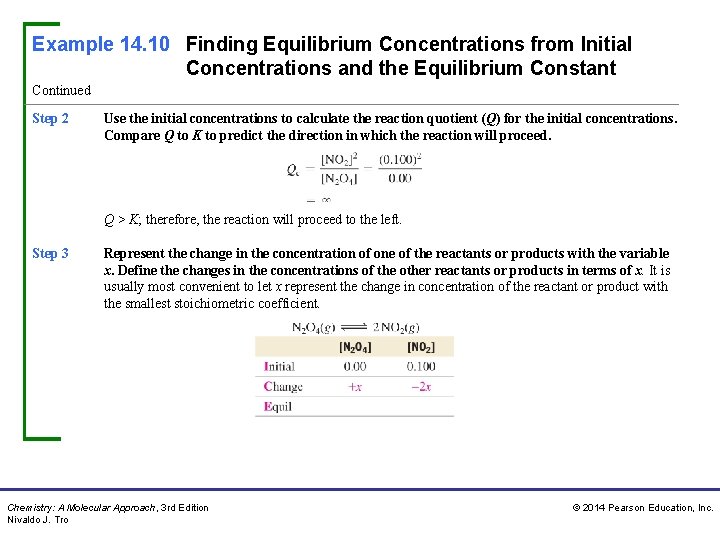
Example 14. 10 Finding Equilibrium Concentrations from Initial Concentrations and the Equilibrium Constant Continued Step 2 Use the initial concentrations to calculate the reaction quotient (Q) for the initial concentrations. Compare Q to K to predict the direction in which the reaction will proceed. Q > K; therefore, the reaction will proceed to the left. Step 3 Represent the change in the concentration of one of the reactants or products with the variable x. Define the changes in the concentrations of the other reactants or products in terms of x. It is usually most convenient to let x represent the change in concentration of the reactant or product with the smallest stoichiometric coefficient. Chemistry: A Molecular Approach, 3 rd Edition Nivaldo J. Tro © 2014 Pearson Education, Inc.
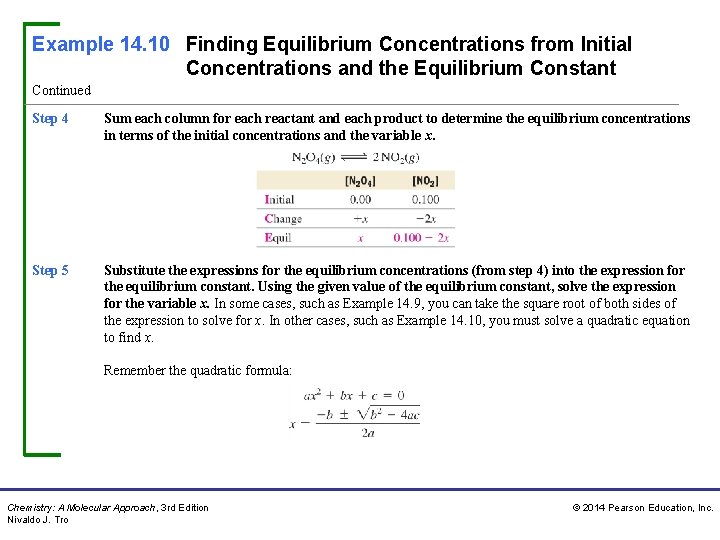
Example 14. 10 Finding Equilibrium Concentrations from Initial Concentrations and the Equilibrium Constant Continued Step 4 Sum each column for each reactant and each product to determine the equilibrium concentrations in terms of the initial concentrations and the variable x. Step 5 Substitute the expressions for the equilibrium concentrations (from step 4) into the expression for the equilibrium constant. Using the given value of the equilibrium constant, solve the expression for the variable x. In some cases, such as Example 14. 9, you can take the square root of both sides of the expression to solve for x. In other cases, such as Example 14. 10, you must solve a quadratic equation to find x. Remember the quadratic formula: Chemistry: A Molecular Approach, 3 rd Edition Nivaldo J. Tro © 2014 Pearson Education, Inc.
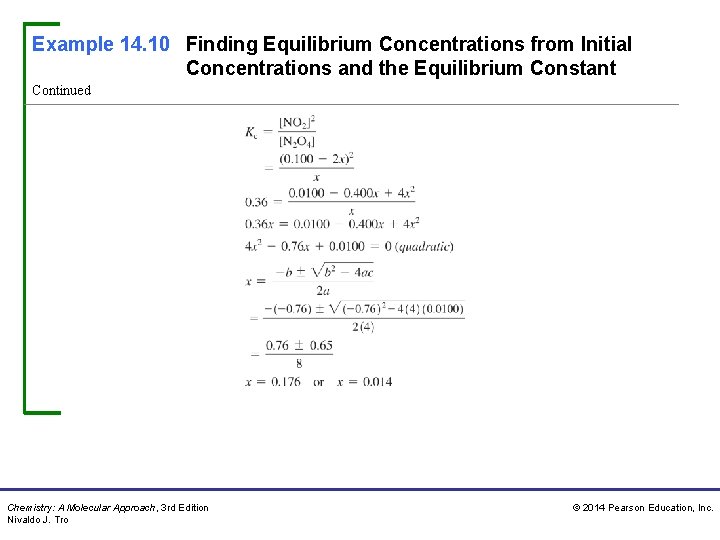
Example 14. 10 Finding Equilibrium Concentrations from Initial Concentrations and the Equilibrium Constant Continued Chemistry: A Molecular Approach, 3 rd Edition Nivaldo J. Tro © 2014 Pearson Education, Inc.
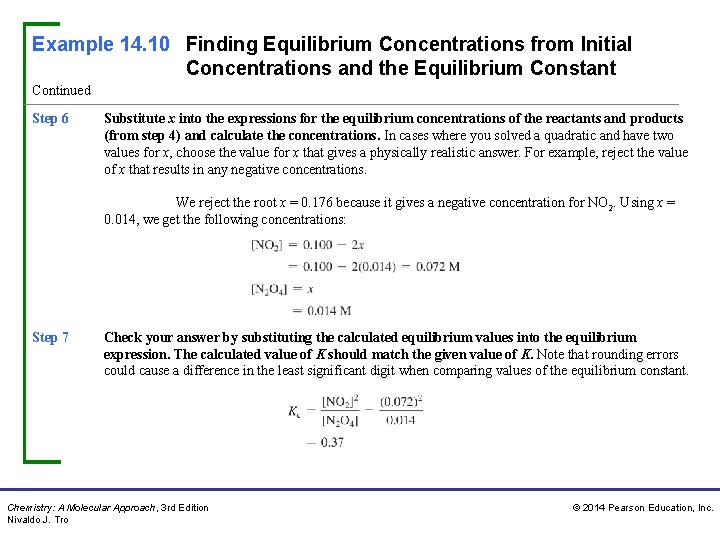
Example 14. 10 Finding Equilibrium Concentrations from Initial Concentrations and the Equilibrium Constant Continued Step 6 Substitute x into the expressions for the equilibrium concentrations of the reactants and products (from step 4) and calculate the concentrations. In cases where you solved a quadratic and have two values for x, choose the value for x that gives a physically realistic answer. For example, reject the value of x that results in any negative concentrations. We reject the root x = 0. 176 because it gives a negative concentration for NO 2. Using x = 0. 014, we get the following concentrations: Step 7 Check your answer by substituting the calculated equilibrium values into the equilibrium expression. The calculated value of K should match the given value of K. Note that rounding errors could cause a difference in the least significant digit when comparing values of the equilibrium constant. Chemistry: A Molecular Approach, 3 rd Edition Nivaldo J. Tro © 2014 Pearson Education, Inc.
Example 14. 10 Finding Equilibrium Concentrations from Initial Concentrations and the Equilibrium Constant Continued Since the calculated value of Kc matches the given value (to within one digit in the least significant figure), the answer is valid. For Practice 14. 10 The reaction in Example 14. 10 is carried out at the same temperature, but this time the reaction mixture initially contains only the reactant, [N 2 O 4] = 0. 0250 M, and no NO 2. Find the equilibrium concentrations of N 2 O 4 and NO 2. Chemistry: A Molecular Approach, 3 rd Edition Nivaldo J. Tro © 2014 Pearson Education, Inc.
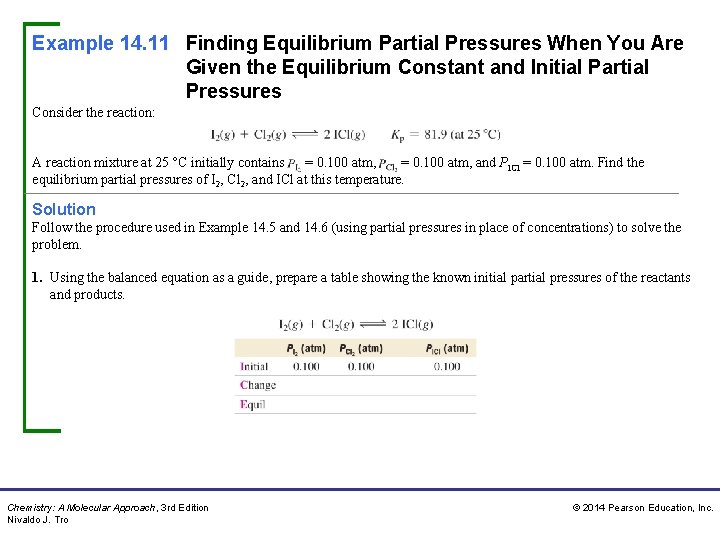
Example 14. 11 Finding Equilibrium Partial Pressures When You Are Given the Equilibrium Constant and Initial Partial Pressures Consider the reaction: A reaction mixture at 25 °C initially contains = 0. 100 atm, and PICl = 0. 100 atm. Find the equilibrium partial pressures of I 2, Cl 2, and ICl at this temperature. Solution Follow the procedure used in Example 14. 5 and 14. 6 (using partial pressures in place of concentrations) to solve the problem. 1. Using the balanced equation as a guide, prepare a table showing the known initial partial pressures of the reactants and products. Chemistry: A Molecular Approach, 3 rd Edition Nivaldo J. Tro © 2014 Pearson Education, Inc.

Example 14. 11 Finding Equilibrium Partial Pressures When You Are Given the Equilibrium Constant and Initial Partial Pressures Continued 2. Use the initial partial pressures to calculate the reaction quotient (Q). Compare Q to K to predict the direction in which the reaction will proceed. Q < K; therefore, the reaction will proceed to the right. 3. Represent the change in the partial pressure of one of the reactants or products with the variable x. Define the changes in the partial pressures of the other reactants or products in terms of x. Chemistry: A Molecular Approach, 3 rd Edition Nivaldo J. Tro © 2014 Pearson Education, Inc.

Example 14. 11 Finding Equilibrium Partial Pressures When You Are Given the Equilibrium Constant and Initial Partial Pressures Continued 4. Sum each column for each reactant and product to determine the equilibrium partial pressures in terms of the initial partial pressures and the variable x. 5. Substitute the expressions for the equilibrium partial pressures (from step 4) into the expression for the equilibrium constant. Use the given value of the equilibrium constant to solve the expression for the variable x. Chemistry: A Molecular Approach, 3 rd Edition Nivaldo J. Tro © 2014 Pearson Education, Inc.
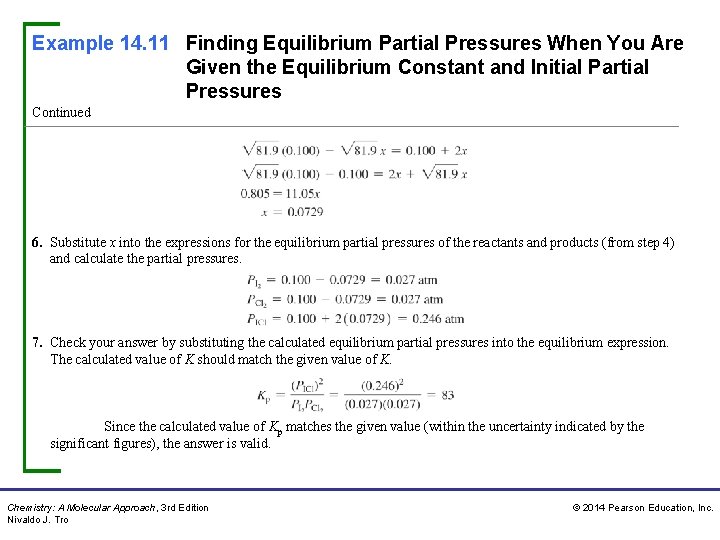
Example 14. 11 Finding Equilibrium Partial Pressures When You Are Given the Equilibrium Constant and Initial Partial Pressures Continued 6. Substitute x into the expressions for the equilibrium partial pressures of the reactants and products (from step 4) and calculate the partial pressures. 7. Check your answer by substituting the calculated equilibrium partial pressures into the equilibrium expression. The calculated value of K should match the given value of K. Since the calculated value of Kp matches the given value (within the uncertainty indicated by the significant figures), the answer is valid. Chemistry: A Molecular Approach, 3 rd Edition Nivaldo J. Tro © 2014 Pearson Education, Inc.
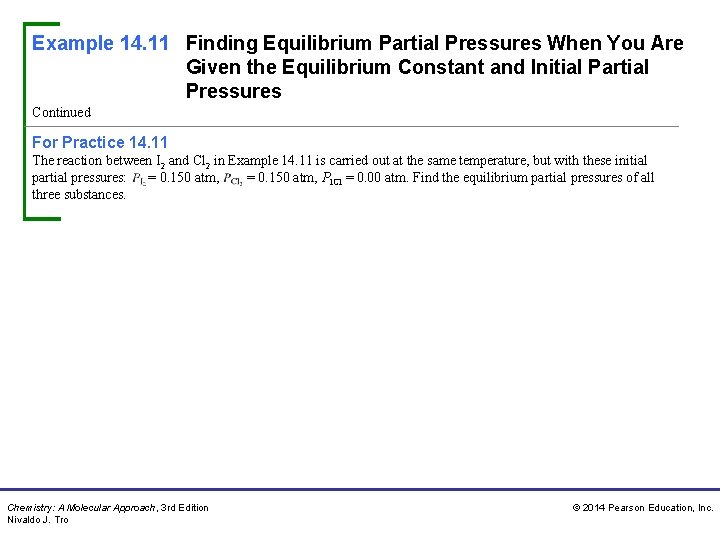
Example 14. 11 Finding Equilibrium Partial Pressures When You Are Given the Equilibrium Constant and Initial Partial Pressures Continued For Practice 14. 11 The reaction between I 2 and Cl 2 in Example 14. 11 is carried out at the same temperature, but with these initial partial pressures: = 0. 150 atm, PICl = 0. 00 atm. Find the equilibrium partial pressures of all three substances. Chemistry: A Molecular Approach, 3 rd Edition Nivaldo J. Tro © 2014 Pearson Education, Inc.
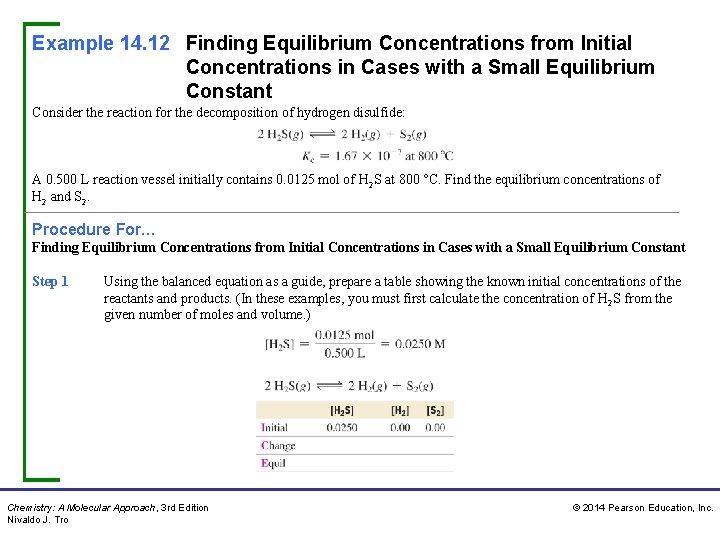
Example 14. 12 Finding Equilibrium Concentrations from Initial Concentrations in Cases with a Small Equilibrium Constant Consider the reaction for the decomposition of hydrogen disulfide: A 0. 500 L reaction vessel initially contains 0. 0125 mol of H 2 S at 800 °C. Find the equilibrium concentrations of H 2 and S 2. Procedure For… Finding Equilibrium Concentrations from Initial Concentrations in Cases with a Small Equilibrium Constant Step 1 Using the balanced equation as a guide, prepare a table showing the known initial concentrations of the reactants and products. (In these examples, you must first calculate the concentration of H 2 S from the given number of moles and volume. ) Chemistry: A Molecular Approach, 3 rd Edition Nivaldo J. Tro © 2014 Pearson Education, Inc.
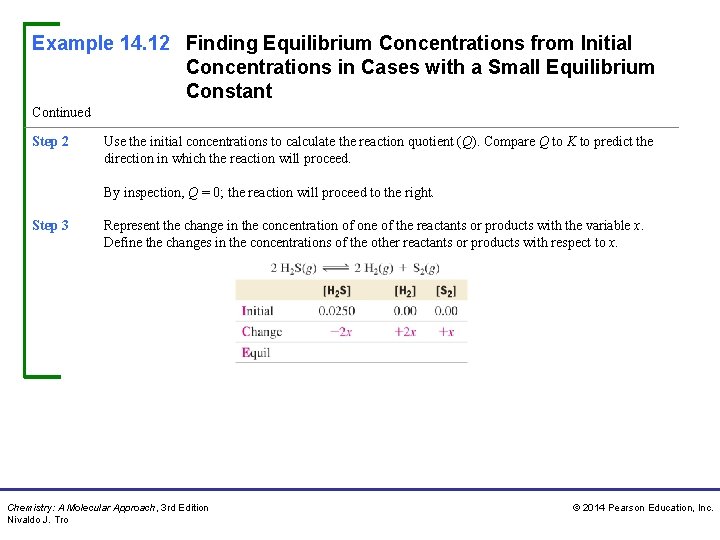
Example 14. 12 Finding Equilibrium Concentrations from Initial Concentrations in Cases with a Small Equilibrium Constant Continued Step 2 Use the initial concentrations to calculate the reaction quotient (Q). Compare Q to K to predict the direction in which the reaction will proceed. By inspection, Q = 0; the reaction will proceed to the right. Step 3 Represent the change in the concentration of one of the reactants or products with the variable x. Define the changes in the concentrations of the other reactants or products with respect to x. Chemistry: A Molecular Approach, 3 rd Edition Nivaldo J. Tro © 2014 Pearson Education, Inc.
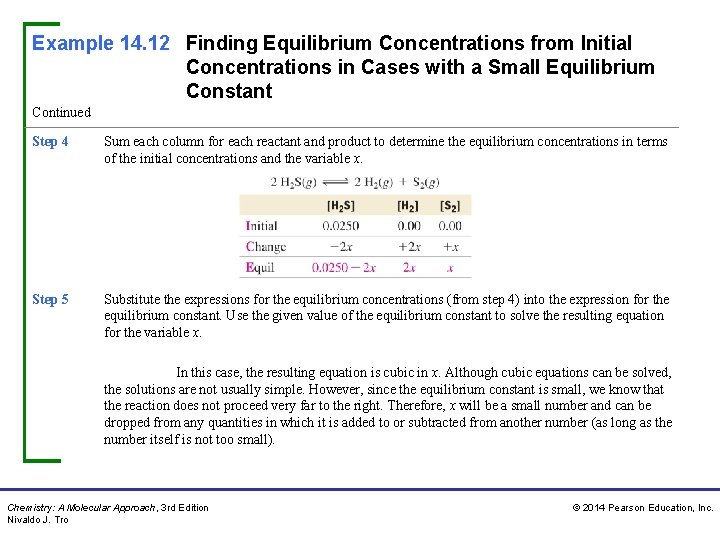
Example 14. 12 Finding Equilibrium Concentrations from Initial Concentrations in Cases with a Small Equilibrium Constant Continued Step 4 Sum each column for each reactant and product to determine the equilibrium concentrations in terms of the initial concentrations and the variable x. Step 5 Substitute the expressions for the equilibrium concentrations (from step 4) into the expression for the equilibrium constant. Use the given value of the equilibrium constant to solve the resulting equation for the variable x. In this case, the resulting equation is cubic in x. Although cubic equations can be solved, the solutions are not usually simple. However, since the equilibrium constant is small, we know that the reaction does not proceed very far to the right. Therefore, x will be a small number and can be dropped from any quantities in which it is added to or subtracted from another number (as long as the number itself is not too small). Chemistry: A Molecular Approach, 3 rd Edition Nivaldo J. Tro © 2014 Pearson Education, Inc.
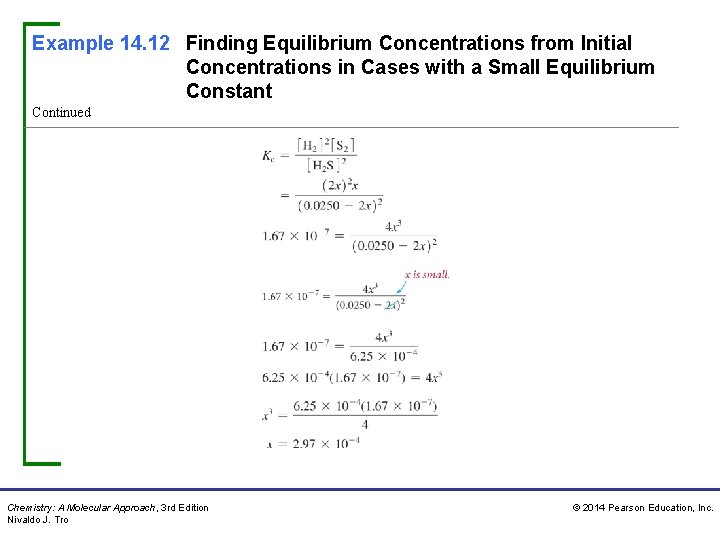
Example 14. 12 Finding Equilibrium Concentrations from Initial Concentrations in Cases with a Small Equilibrium Constant Continued Chemistry: A Molecular Approach, 3 rd Edition Nivaldo J. Tro © 2014 Pearson Education, Inc.
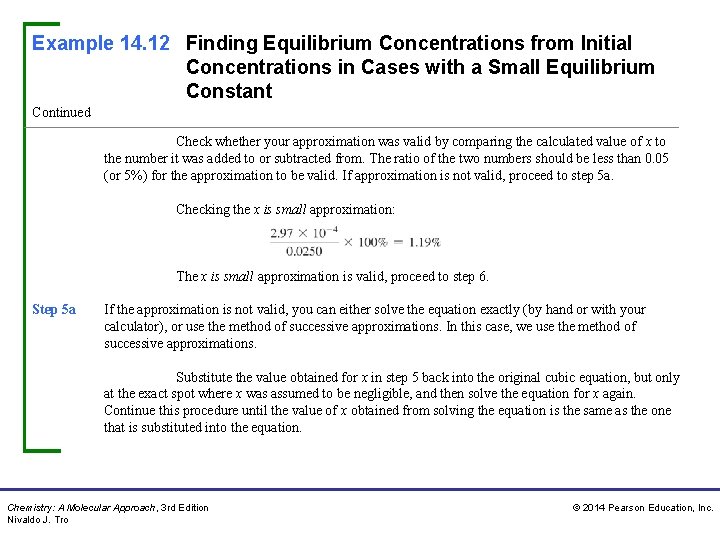
Example 14. 12 Finding Equilibrium Concentrations from Initial Concentrations in Cases with a Small Equilibrium Constant Continued Check whether your approximation was valid by comparing the calculated value of x to the number it was added to or subtracted from. The ratio of the two numbers should be less than 0. 05 (or 5%) for the approximation to be valid. If approximation is not valid, proceed to step 5 a. Checking the x is small approximation: The x is small approximation is valid, proceed to step 6. Step 5 a If the approximation is not valid, you can either solve the equation exactly (by hand or with your calculator), or use the method of successive approximations. In this case, we use the method of successive approximations. Substitute the value obtained for x in step 5 back into the original cubic equation, but only at the exact spot where x was assumed to be negligible, and then solve the equation for x again. Continue this procedure until the value of x obtained from solving the equation is the same as the one that is substituted into the equation. Chemistry: A Molecular Approach, 3 rd Edition Nivaldo J. Tro © 2014 Pearson Education, Inc.
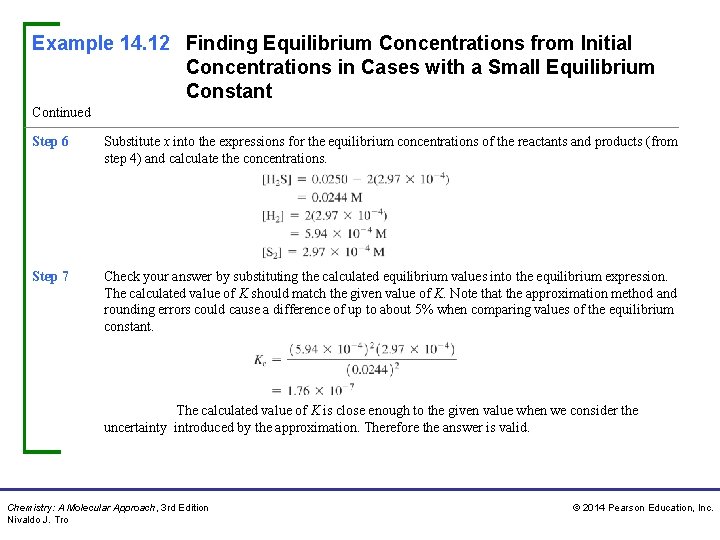
Example 14. 12 Finding Equilibrium Concentrations from Initial Concentrations in Cases with a Small Equilibrium Constant Continued Step 6 Substitute x into the expressions for the equilibrium concentrations of the reactants and products (from step 4) and calculate the concentrations. Step 7 Check your answer by substituting the calculated equilibrium values into the equilibrium expression. The calculated value of K should match the given value of K. Note that the approximation method and rounding errors could cause a difference of up to about 5% when comparing values of the equilibrium constant. The calculated value of K is close enough to the given value when we consider the uncertainty introduced by the approximation. Therefore the answer is valid. Chemistry: A Molecular Approach, 3 rd Edition Nivaldo J. Tro © 2014 Pearson Education, Inc.
Example 14. 12 Finding Equilibrium Concentrations from Initial Concentrations in Cases with a Small Equilibrium Constant Continued For Practice 14. 12 The reaction in Example 14. 12 is carried out at the same temperature with the following initial concentrations: [H 2 S] = 0. 100 M, [H 2] = 0. 100 M, and [S 2] = 0. 00 M. Find the equilibrium concentration of [S 2]. Chemistry: A Molecular Approach, 3 rd Edition Nivaldo J. Tro © 2014 Pearson Education, Inc.
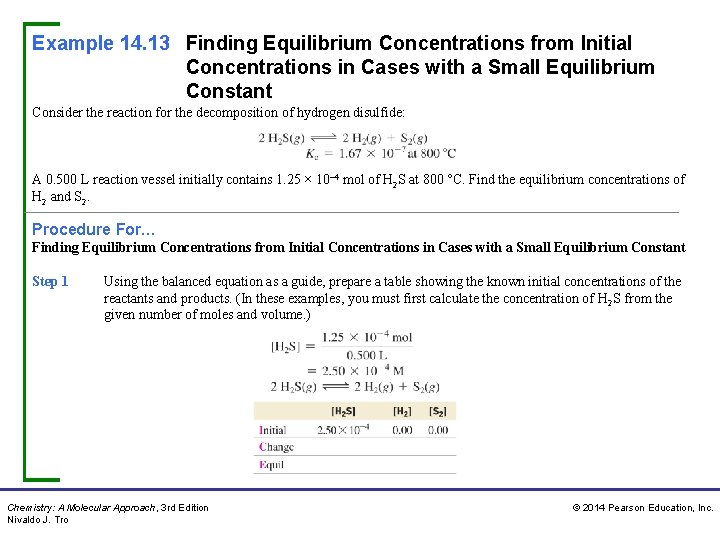
Example 14. 13 Finding Equilibrium Concentrations from Initial Concentrations in Cases with a Small Equilibrium Constant Consider the reaction for the decomposition of hydrogen disulfide: A 0. 500 L reaction vessel initially contains 1. 25 × 10– 4 mol of H 2 S at 800 °C. Find the equilibrium concentrations of H 2 and S 2. Procedure For… Finding Equilibrium Concentrations from Initial Concentrations in Cases with a Small Equilibrium Constant Step 1 Using the balanced equation as a guide, prepare a table showing the known initial concentrations of the reactants and products. (In these examples, you must first calculate the concentration of H 2 S from the given number of moles and volume. ) Chemistry: A Molecular Approach, 3 rd Edition Nivaldo J. Tro © 2014 Pearson Education, Inc.
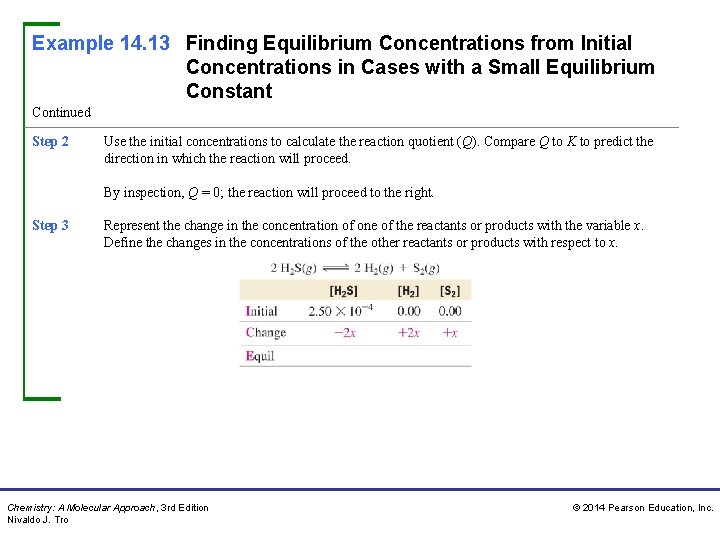
Example 14. 13 Finding Equilibrium Concentrations from Initial Concentrations in Cases with a Small Equilibrium Constant Continued Step 2 Use the initial concentrations to calculate the reaction quotient (Q). Compare Q to K to predict the direction in which the reaction will proceed. By inspection, Q = 0; the reaction will proceed to the right. Step 3 Represent the change in the concentration of one of the reactants or products with the variable x. Define the changes in the concentrations of the other reactants or products with respect to x. Chemistry: A Molecular Approach, 3 rd Edition Nivaldo J. Tro © 2014 Pearson Education, Inc.

Example 14. 13 Finding Equilibrium Concentrations from Initial Concentrations in Cases with a Small Equilibrium Constant Continued Step 4 Sum each column for each reactant and product to determine the equilibrium concentrations in terms of the initial concentrations and the variable x. Step 5 Substitute the expressions for the equilibrium concentrations (from step 4) into the expression for the equilibrium constant. Use the given value of the equilibrium constant to solve the resulting equation for the variable x. In this case, the resulting equation is cubic in x. Although cubic equations can be solved, the solutions are not usually simple. However, since the equilibrium constant is small, we know that the reaction does not proceed very far to the right. Therefore, x will be a small number and can be dropped from any quantities in which it is added to or subtracted from another number (as long as the number itself is not too small). Chemistry: A Molecular Approach, 3 rd Edition Nivaldo J. Tro © 2014 Pearson Education, Inc.
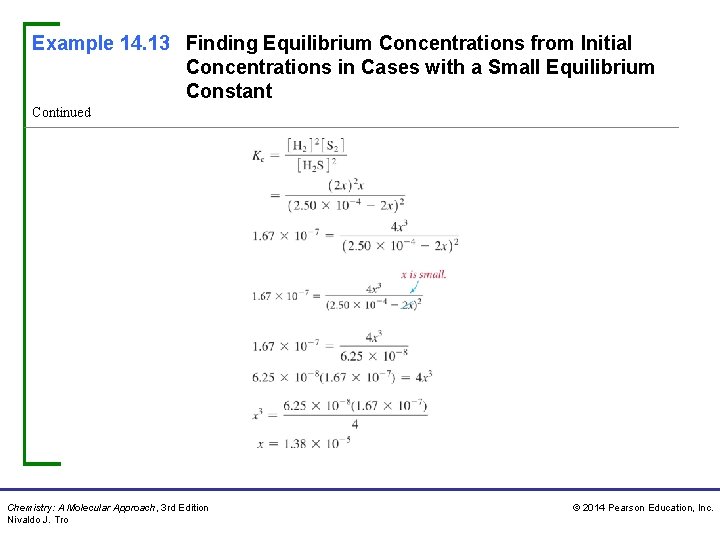
Example 14. 13 Finding Equilibrium Concentrations from Initial Concentrations in Cases with a Small Equilibrium Constant Continued Chemistry: A Molecular Approach, 3 rd Edition Nivaldo J. Tro © 2014 Pearson Education, Inc.
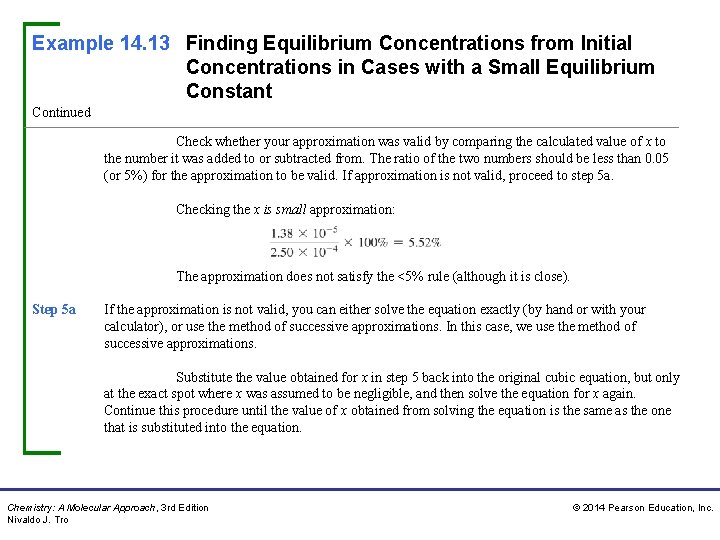
Example 14. 13 Finding Equilibrium Concentrations from Initial Concentrations in Cases with a Small Equilibrium Constant Continued Check whether your approximation was valid by comparing the calculated value of x to the number it was added to or subtracted from. The ratio of the two numbers should be less than 0. 05 (or 5%) for the approximation to be valid. If approximation is not valid, proceed to step 5 a. Checking the x is small approximation: The approximation does not satisfy the <5% rule (although it is close). Step 5 a If the approximation is not valid, you can either solve the equation exactly (by hand or with your calculator), or use the method of successive approximations. In this case, we use the method of successive approximations. Substitute the value obtained for x in step 5 back into the original cubic equation, but only at the exact spot where x was assumed to be negligible, and then solve the equation for x again. Continue this procedure until the value of x obtained from solving the equation is the same as the one that is substituted into the equation. Chemistry: A Molecular Approach, 3 rd Edition Nivaldo J. Tro © 2014 Pearson Education, Inc.
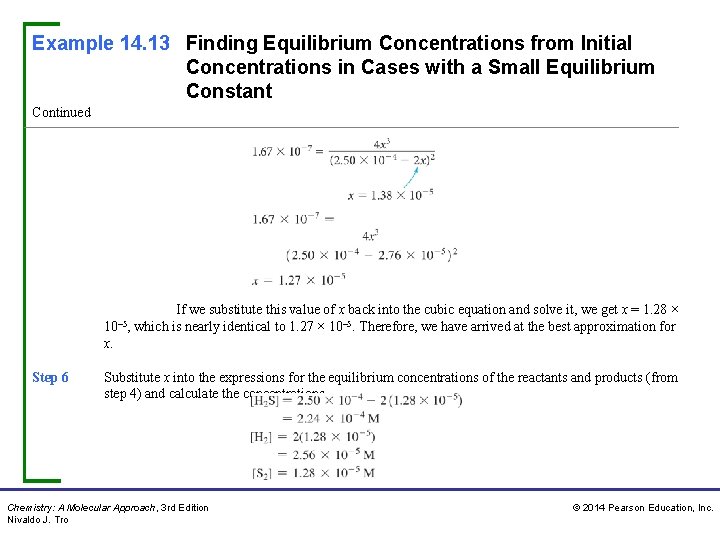
Example 14. 13 Finding Equilibrium Concentrations from Initial Concentrations in Cases with a Small Equilibrium Constant Continued 10– 5, If we substitute this value of x back into the cubic equation and solve it, we get x = 1. 28 × which is nearly identical to 1. 27 × 10– 5. Therefore, we have arrived at the best approximation for x. Step 6 Substitute x into the expressions for the equilibrium concentrations of the reactants and products (from step 4) and calculate the concentrations. Chemistry: A Molecular Approach, 3 rd Edition Nivaldo J. Tro © 2014 Pearson Education, Inc.
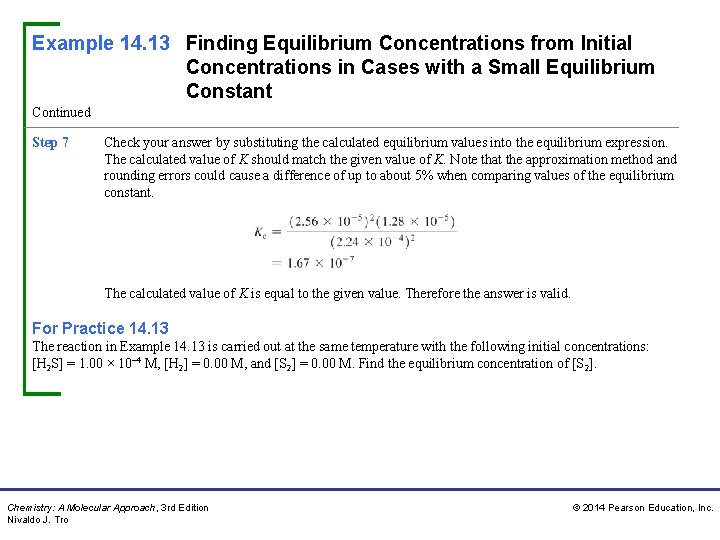
Example 14. 13 Finding Equilibrium Concentrations from Initial Concentrations in Cases with a Small Equilibrium Constant Continued Step 7 Check your answer by substituting the calculated equilibrium values into the equilibrium expression. The calculated value of K should match the given value of K. Note that the approximation method and rounding errors could cause a difference of up to about 5% when comparing values of the equilibrium constant. The calculated value of K is equal to the given value. Therefore the answer is valid. For Practice 14. 13 The reaction in Example 14. 13 is carried out at the same temperature with the following initial concentrations: [H 2 S] = 1. 00 × 10– 4 M, [H 2] = 0. 00 M, and [S 2] = 0. 00 M. Find the equilibrium concentration of [S 2]. Chemistry: A Molecular Approach, 3 rd Edition Nivaldo J. Tro © 2014 Pearson Education, Inc.
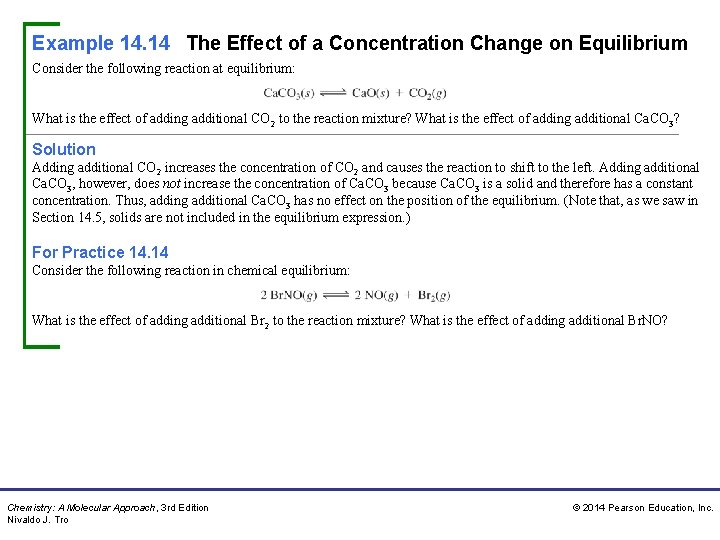
Example 14. 14 The Effect of a Concentration Change on Equilibrium Consider the following reaction at equilibrium: What is the effect of adding additional CO 2 to the reaction mixture? What is the effect of adding additional Ca. CO 3? Solution Adding additional CO 2 increases the concentration of CO 2 and causes the reaction to shift to the left. Adding additional Ca. CO 3, however, does not increase the concentration of Ca. CO 3 because Ca. CO 3 is a solid and therefore has a constant concentration. Thus, adding additional Ca. CO 3 has no effect on the position of the equilibrium. (Note that, as we saw in Section 14. 5, solids are not included in the equilibrium expression. ) For Practice 14. 14 Consider the following reaction in chemical equilibrium: What is the effect of adding additional Br 2 to the reaction mixture? What is the effect of adding additional Br. NO? Chemistry: A Molecular Approach, 3 rd Edition Nivaldo J. Tro © 2014 Pearson Education, Inc.
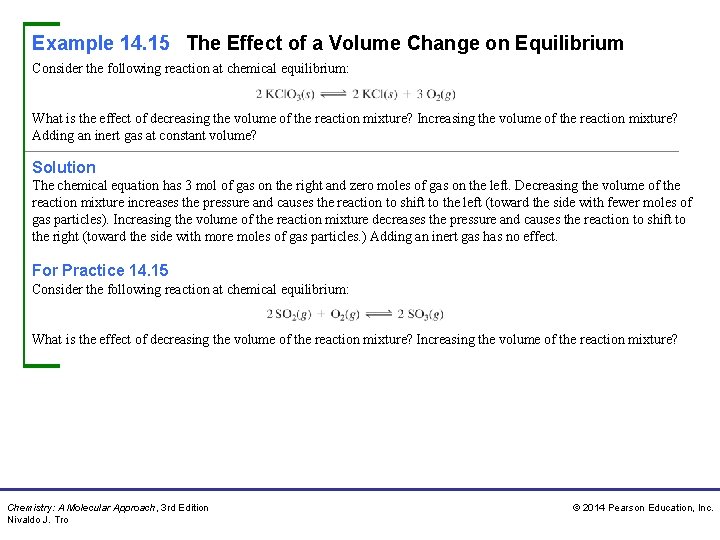
Example 14. 15 The Effect of a Volume Change on Equilibrium Consider the following reaction at chemical equilibrium: What is the effect of decreasing the volume of the reaction mixture? Increasing the volume of the reaction mixture? Adding an inert gas at constant volume? Solution The chemical equation has 3 mol of gas on the right and zero moles of gas on the left. Decreasing the volume of the reaction mixture increases the pressure and causes the reaction to shift to the left (toward the side with fewer moles of gas particles). Increasing the volume of the reaction mixture decreases the pressure and causes the reaction to shift to the right (toward the side with more moles of gas particles. ) Adding an inert gas has no effect. For Practice 14. 15 Consider the following reaction at chemical equilibrium: What is the effect of decreasing the volume of the reaction mixture? Increasing the volume of the reaction mixture? Chemistry: A Molecular Approach, 3 rd Edition Nivaldo J. Tro © 2014 Pearson Education, Inc.
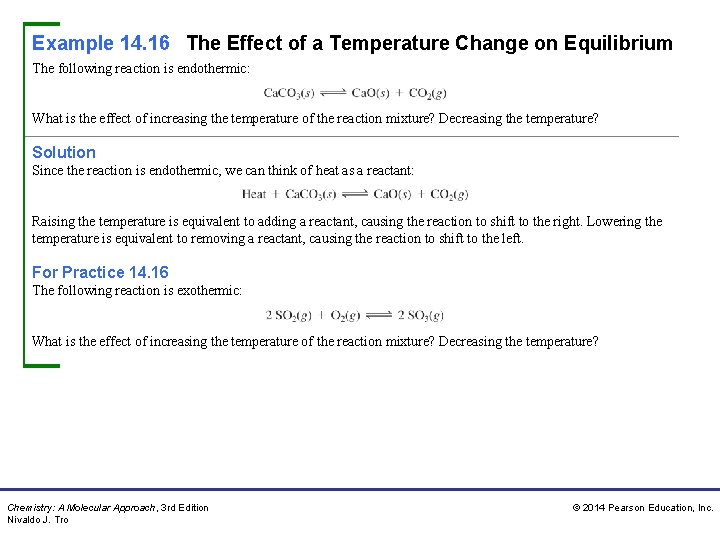
Example 14. 16 The Effect of a Temperature Change on Equilibrium The following reaction is endothermic: What is the effect of increasing the temperature of the reaction mixture? Decreasing the temperature? Solution Since the reaction is endothermic, we can think of heat as a reactant: Raising the temperature is equivalent to adding a reactant, causing the reaction to shift to the right. Lowering the temperature is equivalent to removing a reactant, causing the reaction to shift to the left. For Practice 14. 16 The following reaction is exothermic: What is the effect of increasing the temperature of the reaction mixture? Decreasing the temperature? Chemistry: A Molecular Approach, 3 rd Edition Nivaldo J. Tro © 2014 Pearson Education, Inc.
- Slides: 52