
Example 10 1 VSEPR Theory and the Basic
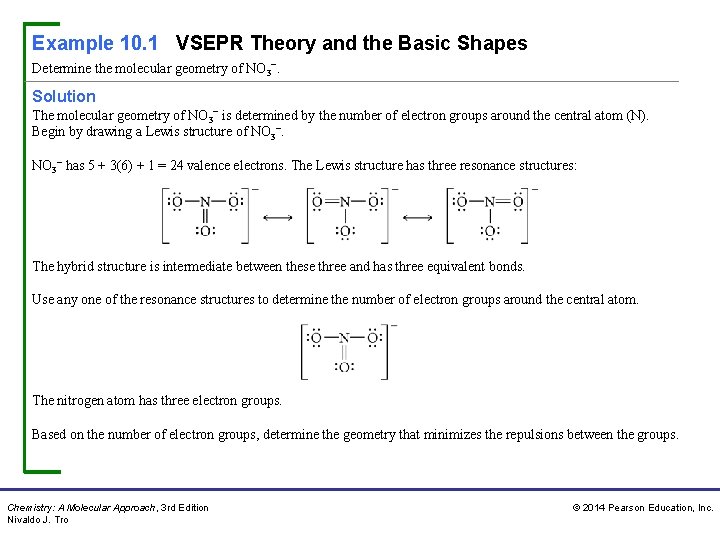
Example 10. 1 VSEPR Theory and the Basic Shapes Determine the molecular geometry of NO 3−. Solution The molecular geometry of NO 3− is determined by the number of electron groups around the central atom (N). Begin by drawing a Lewis structure of NO 3− has 5 + 3(6) + 1 = 24 valence electrons. The Lewis structure has three resonance structures: The hybrid structure is intermediate between these three and has three equivalent bonds. Use any one of the resonance structures to determine the number of electron groups around the central atom. The nitrogen atom has three electron groups. Based on the number of electron groups, determine the geometry that minimizes the repulsions between the groups. Chemistry: A Molecular Approach, 3 rd Edition Nivaldo J. Tro © 2014 Pearson Education, Inc.
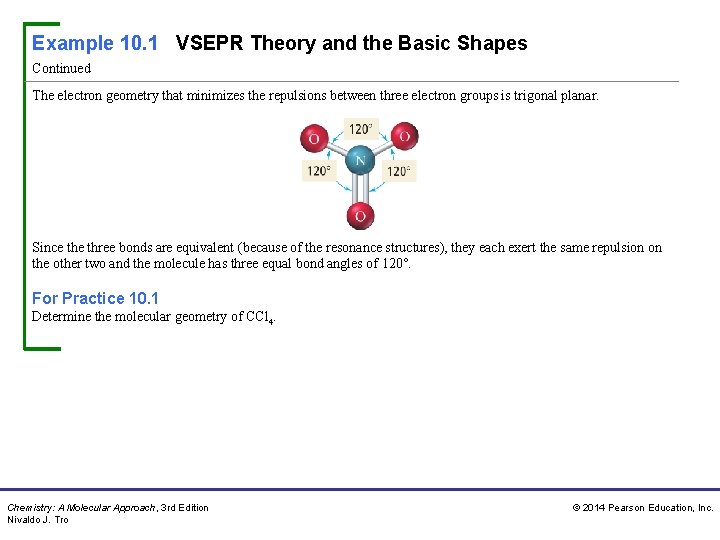
Example 10. 1 VSEPR Theory and the Basic Shapes Continued The electron geometry that minimizes the repulsions between three electron groups is trigonal planar. Since three bonds are equivalent (because of the resonance structures), they each exert the same repulsion on the other two and the molecule has three equal bond angles of 120°. For Practice 10. 1 Determine the molecular geometry of CCl 4. Chemistry: A Molecular Approach, 3 rd Edition Nivaldo J. Tro © 2014 Pearson Education, Inc.
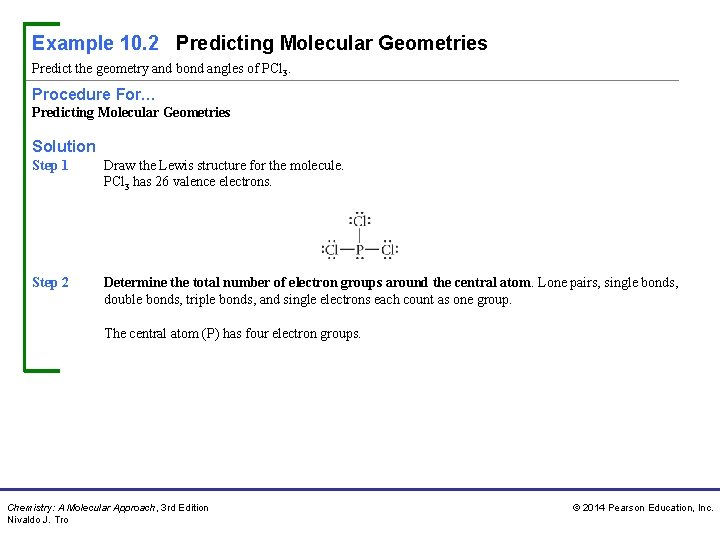
Example 10. 2 Predicting Molecular Geometries Predict the geometry and bond angles of PCl 3. Procedure For… Predicting Molecular Geometries Solution Step 1 Draw the Lewis structure for the molecule. PCl 3 has 26 valence electrons. Step 2 Determine the total number of electron groups around the central atom. Lone pairs, single bonds, double bonds, triple bonds, and single electrons each count as one group. The central atom (P) has four electron groups. Chemistry: A Molecular Approach, 3 rd Edition Nivaldo J. Tro © 2014 Pearson Education, Inc.
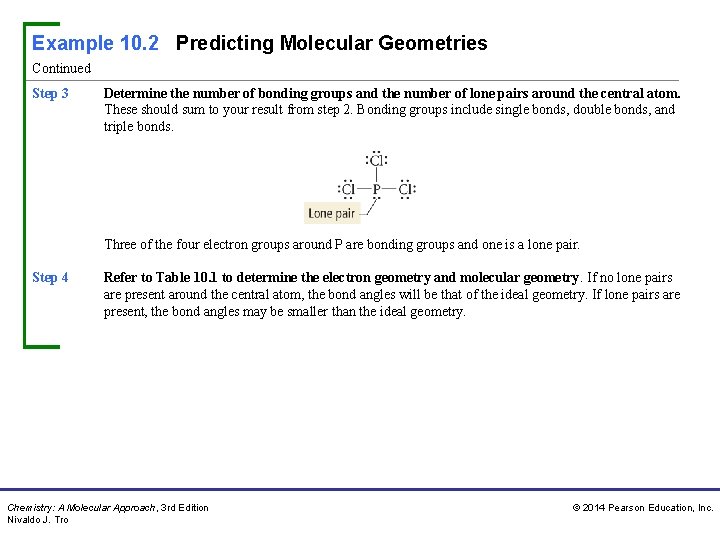
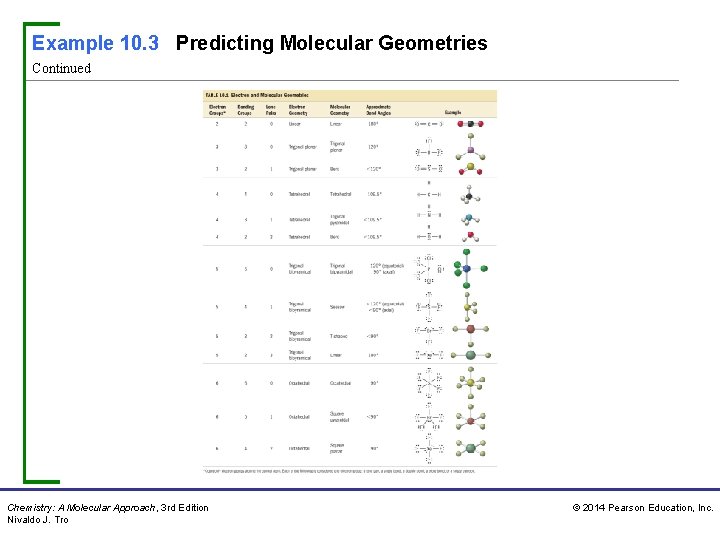
Example 10. 2 Predicting Molecular Geometries Continued Step 3 Determine the number of bonding groups and the number of lone pairs around the central atom. These should sum to your result from step 2. Bonding groups include single bonds, double bonds, and triple bonds. Three of the four electron groups around P are bonding groups and one is a lone pair. Step 4 Refer to Table 10. 1 to determine the electron geometry and molecular geometry. If no lone pairs are present around the central atom, the bond angles will be that of the ideal geometry. If lone pairs are present, the bond angles may be smaller than the ideal geometry. Chemistry: A Molecular Approach, 3 rd Edition Nivaldo J. Tro © 2014 Pearson Education, Inc.
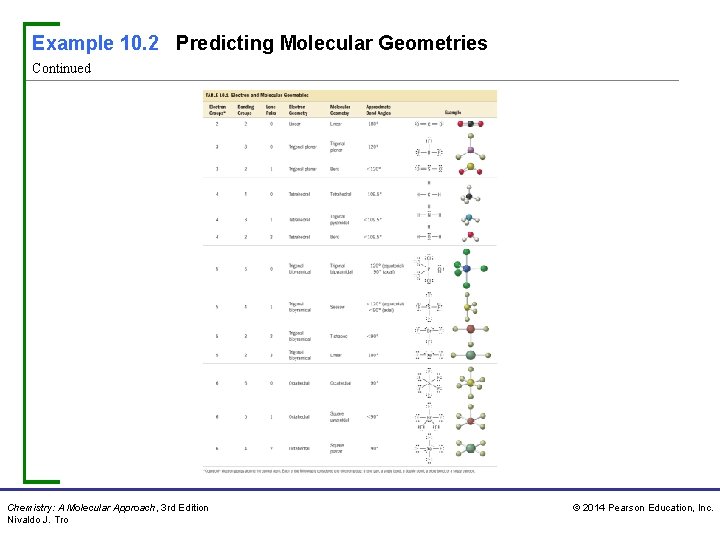
Example 10. 2 Predicting Molecular Geometries Continued Chemistry: A Molecular Approach, 3 rd Edition Nivaldo J. Tro © 2014 Pearson Education, Inc.
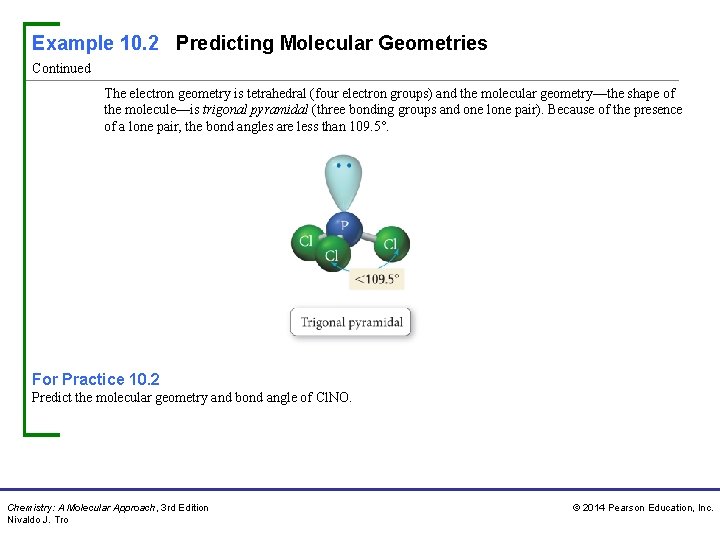
Example 10. 2 Predicting Molecular Geometries Continued The electron geometry is tetrahedral (four electron groups) and the molecular geometry—the shape of the molecule—is trigonal pyramidal (three bonding groups and one lone pair). Because of the presence of a lone pair, the bond angles are less than 109. 5°. For Practice 10. 2 Predict the molecular geometry and bond angle of Cl. NO. Chemistry: A Molecular Approach, 3 rd Edition Nivaldo J. Tro © 2014 Pearson Education, Inc.
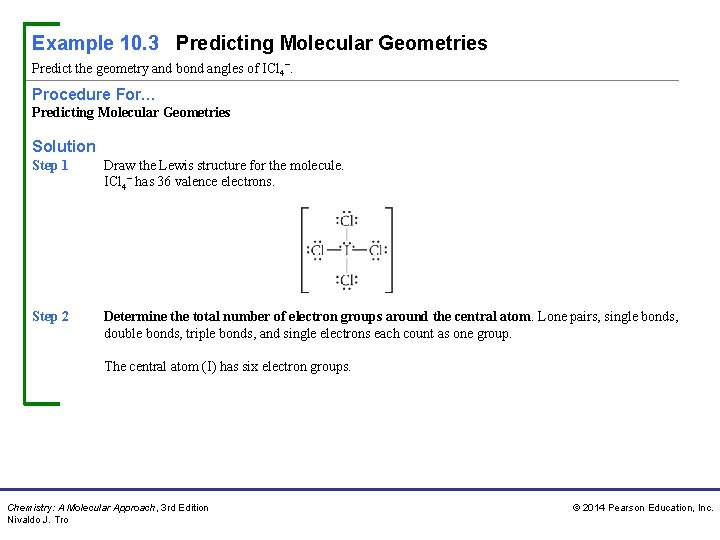
Example 10. 3 Predicting Molecular Geometries Predict the geometry and bond angles of ICl 4−. Procedure For… Predicting Molecular Geometries Solution Step 1 Draw the Lewis structure for the molecule. ICl 4− has 36 valence electrons. Step 2 Determine the total number of electron groups around the central atom. Lone pairs, single bonds, double bonds, triple bonds, and single electrons each count as one group. The central atom (I) has six electron groups. Chemistry: A Molecular Approach, 3 rd Edition Nivaldo J. Tro © 2014 Pearson Education, Inc.
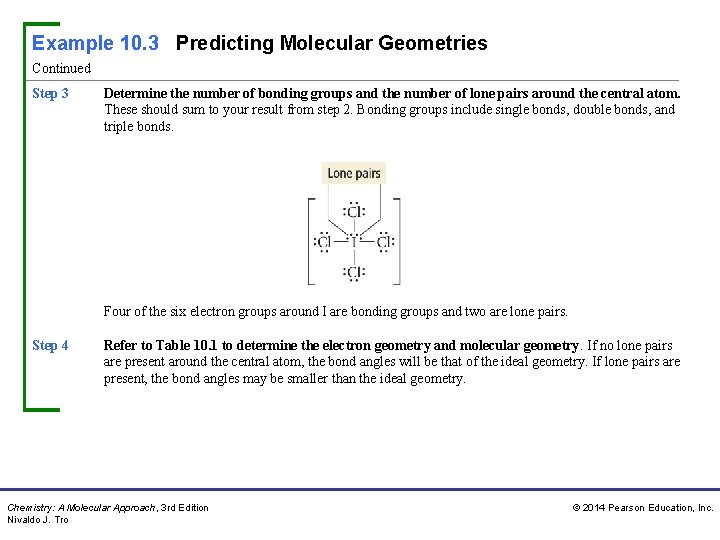
Example 10. 3 Predicting Molecular Geometries Continued Step 3 Determine the number of bonding groups and the number of lone pairs around the central atom. These should sum to your result from step 2. Bonding groups include single bonds, double bonds, and triple bonds. Four of the six electron groups around I are bonding groups and two are lone pairs. Step 4 Refer to Table 10. 1 to determine the electron geometry and molecular geometry. If no lone pairs are present around the central atom, the bond angles will be that of the ideal geometry. If lone pairs are present, the bond angles may be smaller than the ideal geometry. Chemistry: A Molecular Approach, 3 rd Edition Nivaldo J. Tro © 2014 Pearson Education, Inc.
Example 10. 3 Predicting Molecular Geometries Continued Chemistry: A Molecular Approach, 3 rd Edition Nivaldo J. Tro © 2014 Pearson Education, Inc.
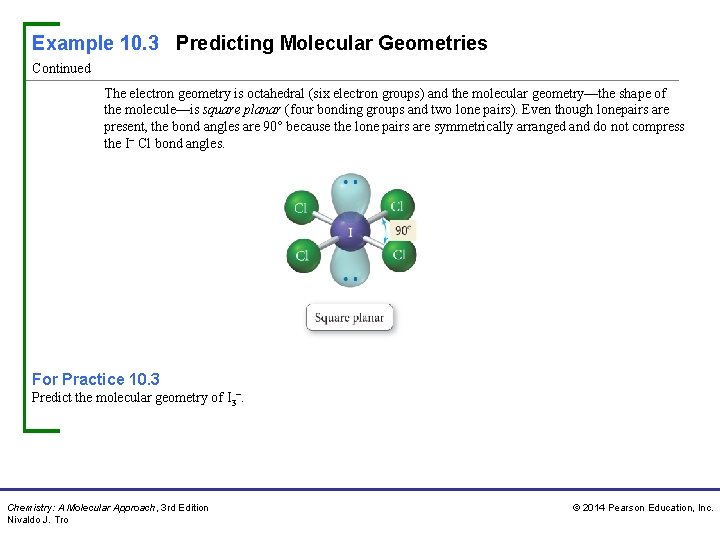
Example 10. 3 Predicting Molecular Geometries Continued The electron geometry is octahedral (six electron groups) and the molecular geometry—the shape of the molecule—is square planar (four bonding groups and two lone pairs). Even though lonepairs are present, the bond angles are 90° because the lone pairs are symmetrically arranged and do not compress the I− Cl bond angles. For Practice 10. 3 Predict the molecular geometry of I 3−. Chemistry: A Molecular Approach, 3 rd Edition Nivaldo J. Tro © 2014 Pearson Education, Inc.
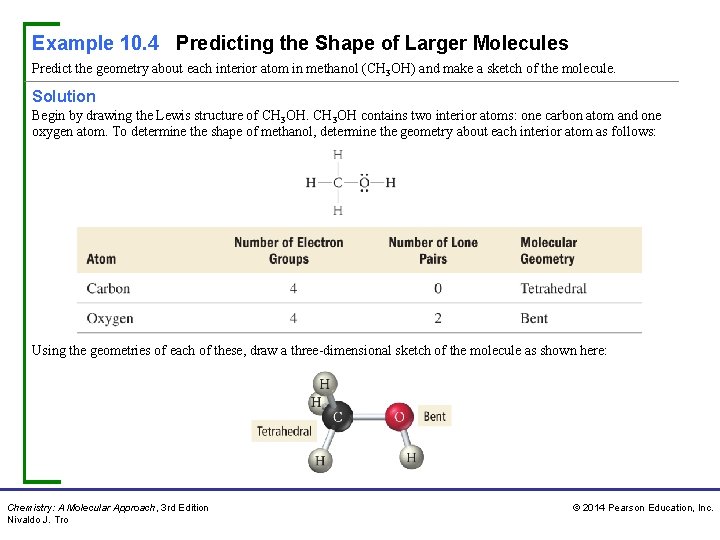
Example 10. 4 Predicting the Shape of Larger Molecules Predict the geometry about each interior atom in methanol (CH 3 OH) and make a sketch of the molecule. Solution Begin by drawing the Lewis structure of CH 3 OH contains two interior atoms: one carbon atom and one oxygen atom. To determine the shape of methanol, determine the geometry about each interior atom as follows: Using the geometries of each of these, draw a three-dimensional sketch of the molecule as shown here: Chemistry: A Molecular Approach, 3 rd Edition Nivaldo J. Tro © 2014 Pearson Education, Inc.
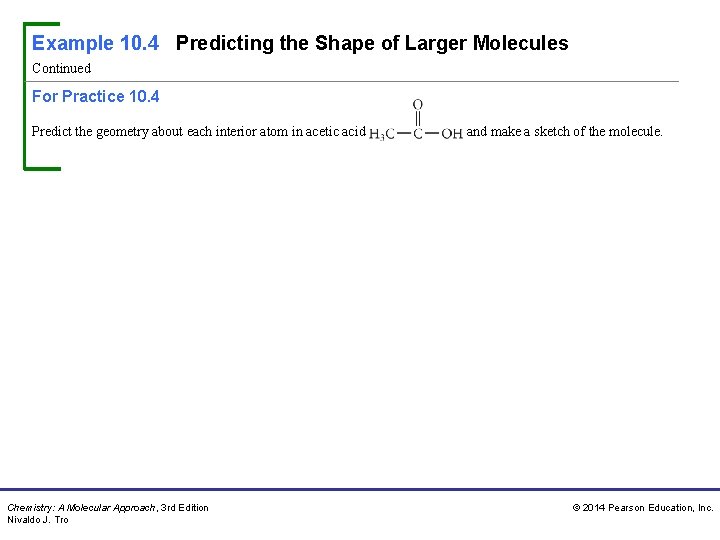
Example 10. 4 Predicting the Shape of Larger Molecules Continued For Practice 10. 4 Predict the geometry about each interior atom in acetic acid Chemistry: A Molecular Approach, 3 rd Edition Nivaldo J. Tro and make a sketch of the molecule. © 2014 Pearson Education, Inc.
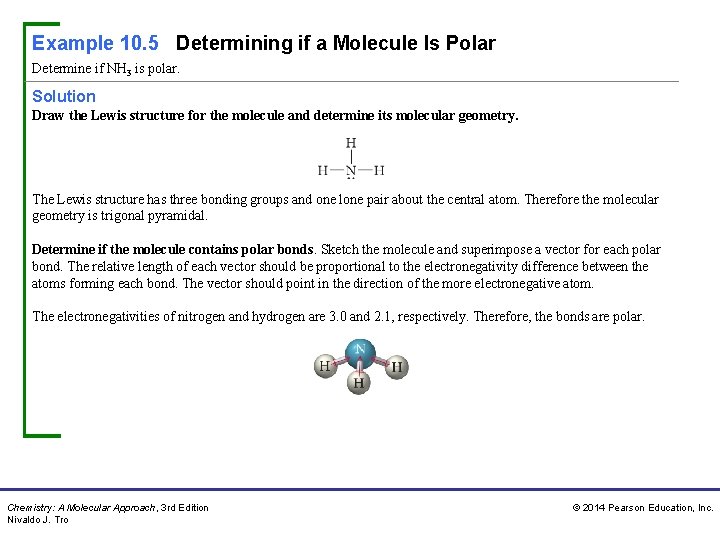
Example 10. 5 Determining if a Molecule Is Polar Determine if NH 3 is polar. Solution Draw the Lewis structure for the molecule and determine its molecular geometry. The Lewis structure has three bonding groups and one lone pair about the central atom. Therefore the molecular geometry is trigonal pyramidal. Determine if the molecule contains polar bonds. Sketch the molecule and superimpose a vector for each polar bond. The relative length of each vector should be proportional to the electronegativity difference between the atoms forming each bond. The vector should point in the direction of the more electronegative atom. The electronegativities of nitrogen and hydrogen are 3. 0 and 2. 1, respectively. Therefore, the bonds are polar. Chemistry: A Molecular Approach, 3 rd Edition Nivaldo J. Tro © 2014 Pearson Education, Inc.
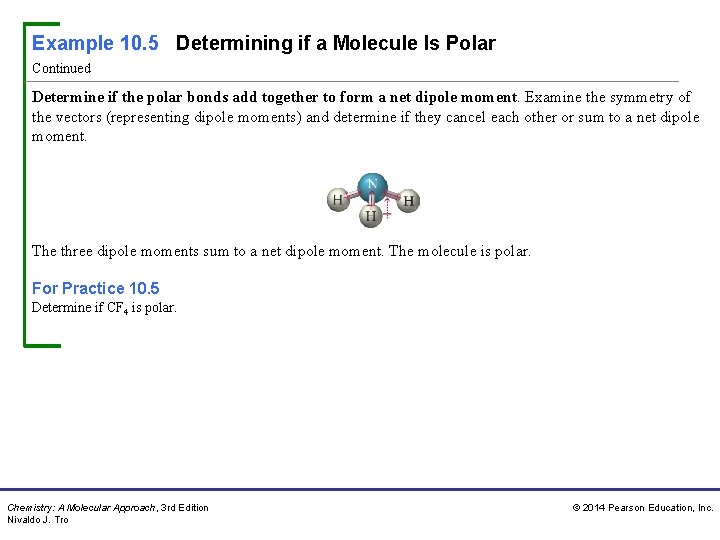
Example 10. 5 Determining if a Molecule Is Polar Continued Determine if the polar bonds add together to form a net dipole moment. Examine the symmetry of the vectors (representing dipole moments) and determine if they cancel each other or sum to a net dipole moment. The three dipole moments sum to a net dipole moment. The molecule is polar. For Practice 10. 5 Determine if CF 4 is polar. Chemistry: A Molecular Approach, 3 rd Edition Nivaldo J. Tro © 2014 Pearson Education, Inc.
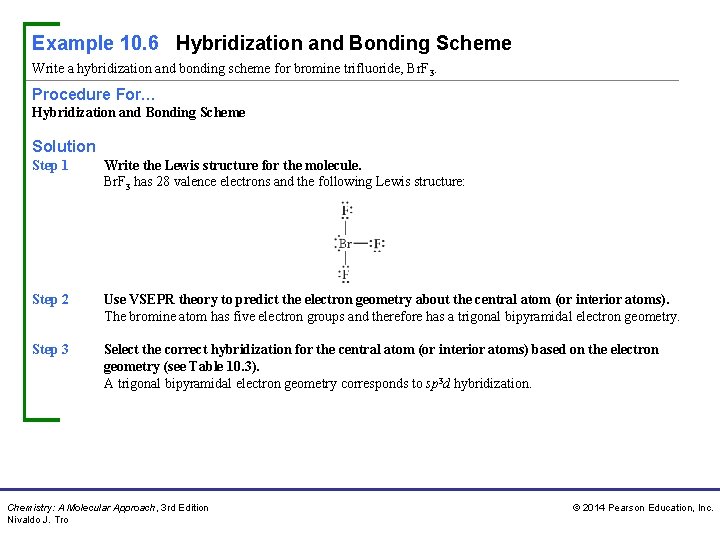
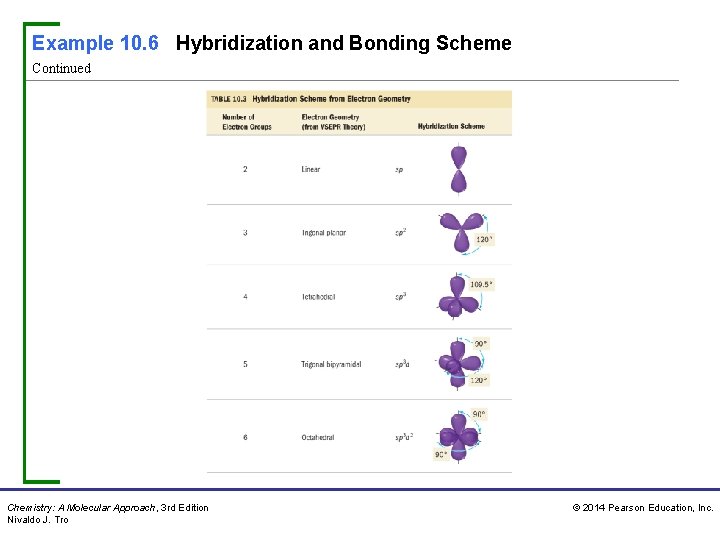
Example 10. 6 Hybridization and Bonding Scheme Write a hybridization and bonding scheme for bromine trifluoride, Br. F 3. Procedure For… Hybridization and Bonding Scheme Solution Step 1 Write the Lewis structure for the molecule. Br. F 3 has 28 valence electrons and the following Lewis structure: Step 2 Use VSEPR theory to predict the electron geometry about the central atom (or interior atoms). The bromine atom has five electron groups and therefore has a trigonal bipyramidal electron geometry. Step 3 Select the correct hybridization for the central atom (or interior atoms) based on the electron geometry (see Table 10. 3). A trigonal bipyramidal electron geometry corresponds to sp 3 d hybridization. Chemistry: A Molecular Approach, 3 rd Edition Nivaldo J. Tro © 2014 Pearson Education, Inc.
Example 10. 6 Hybridization and Bonding Scheme Continued Chemistry: A Molecular Approach, 3 rd Edition Nivaldo J. Tro © 2014 Pearson Education, Inc.
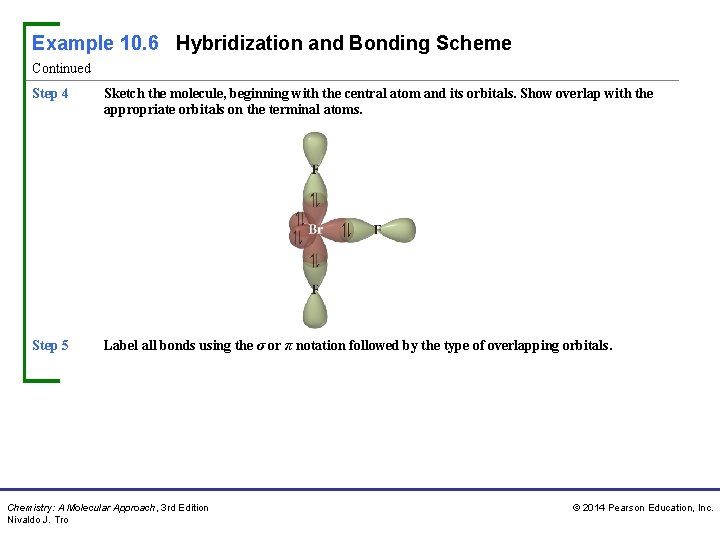
Example 10. 6 Hybridization and Bonding Scheme Continued Step 4 Sketch the molecule, beginning with the central atom and its orbitals. Show overlap with the appropriate orbitals on the terminal atoms. Step 5 Label all bonds using the σ or π notation followed by the type of overlapping orbitals. Chemistry: A Molecular Approach, 3 rd Edition Nivaldo J. Tro © 2014 Pearson Education, Inc.
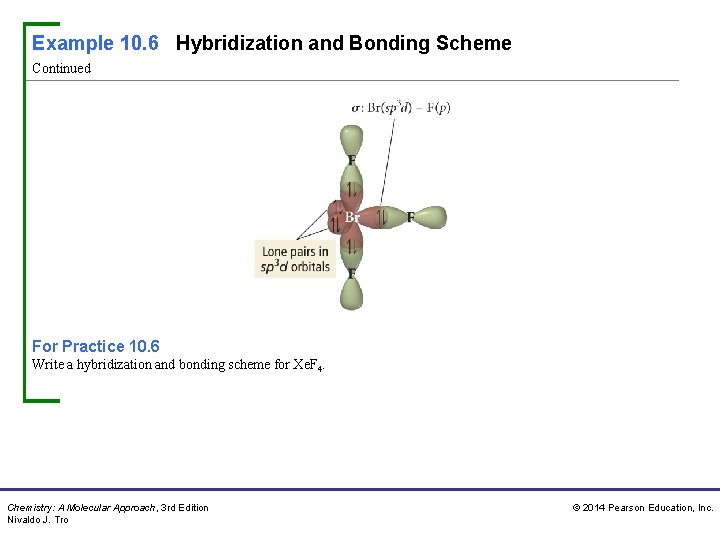
Example 10. 6 Hybridization and Bonding Scheme Continued For Practice 10. 6 Write a hybridization and bonding scheme for Xe. F 4. Chemistry: A Molecular Approach, 3 rd Edition Nivaldo J. Tro © 2014 Pearson Education, Inc.
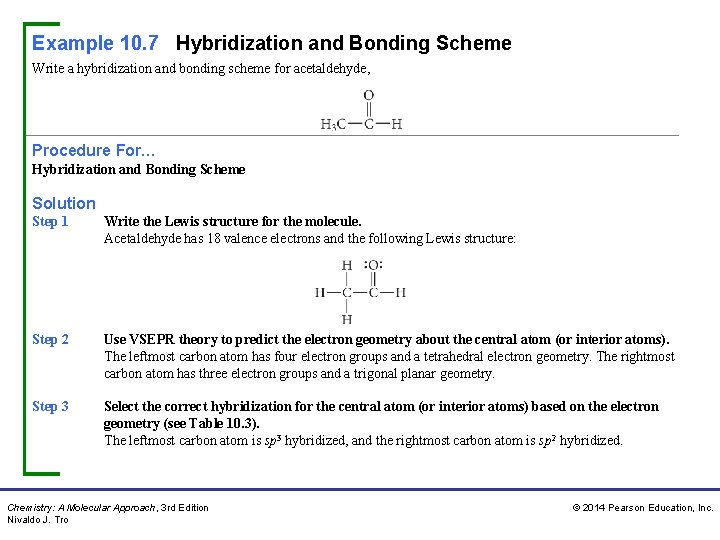
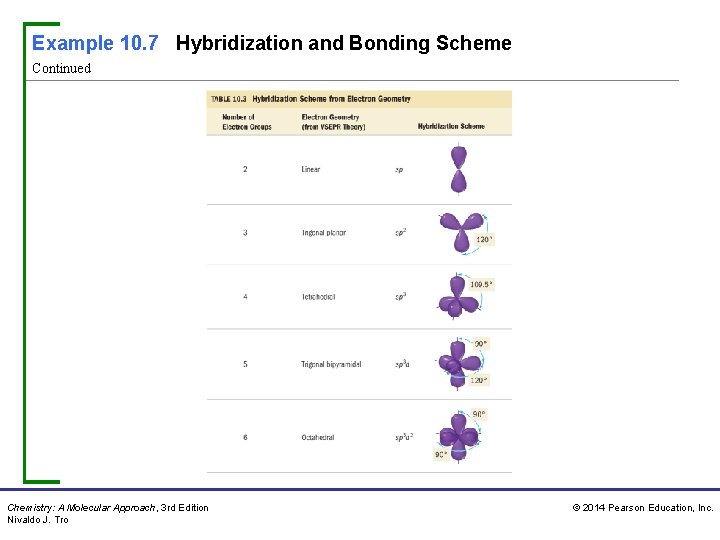
Example 10. 7 Hybridization and Bonding Scheme Write a hybridization and bonding scheme for acetaldehyde, Procedure For… Hybridization and Bonding Scheme Solution Step 1 Write the Lewis structure for the molecule. Acetaldehyde has 18 valence electrons and the following Lewis structure: Step 2 Use VSEPR theory to predict the electron geometry about the central atom (or interior atoms). The leftmost carbon atom has four electron groups and a tetrahedral electron geometry. The rightmost carbon atom has three electron groups and a trigonal planar geometry. Step 3 Select the correct hybridization for the central atom (or interior atoms) based on the electron geometry (see Table 10. 3). The leftmost carbon atom is sp 3 hybridized, and the rightmost carbon atom is sp 2 hybridized. Chemistry: A Molecular Approach, 3 rd Edition Nivaldo J. Tro © 2014 Pearson Education, Inc.
Example 10. 7 Hybridization and Bonding Scheme Continued Chemistry: A Molecular Approach, 3 rd Edition Nivaldo J. Tro © 2014 Pearson Education, Inc.
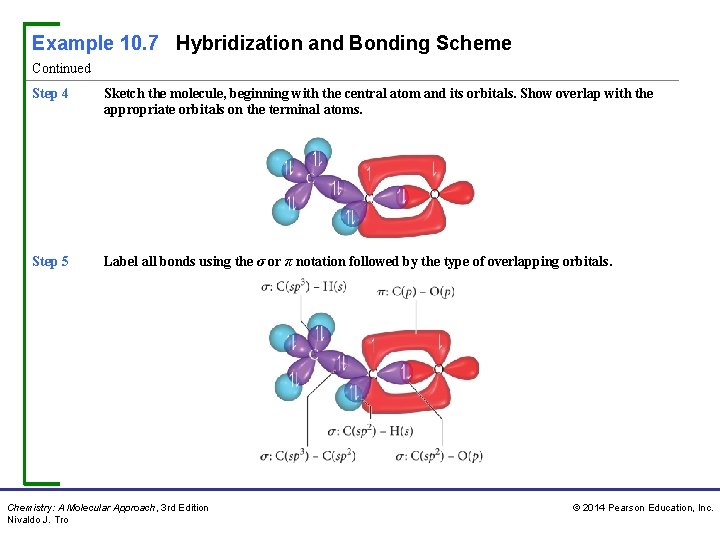
Example 10. 7 Hybridization and Bonding Scheme Continued Step 4 Sketch the molecule, beginning with the central atom and its orbitals. Show overlap with the appropriate orbitals on the terminal atoms. Step 5 Label all bonds using the σ or π notation followed by the type of overlapping orbitals. Chemistry: A Molecular Approach, 3 rd Edition Nivaldo J. Tro © 2014 Pearson Education, Inc.
Example 10. 7 Hybridization and Bonding Scheme Continued For Practice 10. 7 Write a hybridization and bonding scheme for HCN. Chemistry: A Molecular Approach, 3 rd Edition Nivaldo J. Tro © 2014 Pearson Education, Inc.
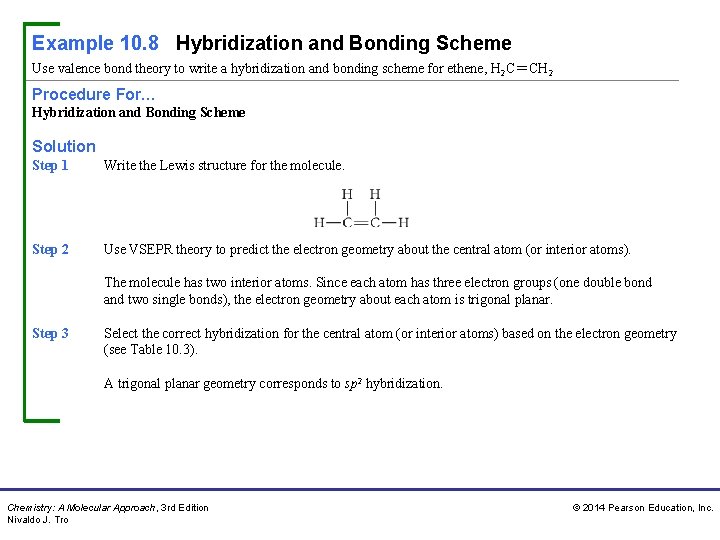
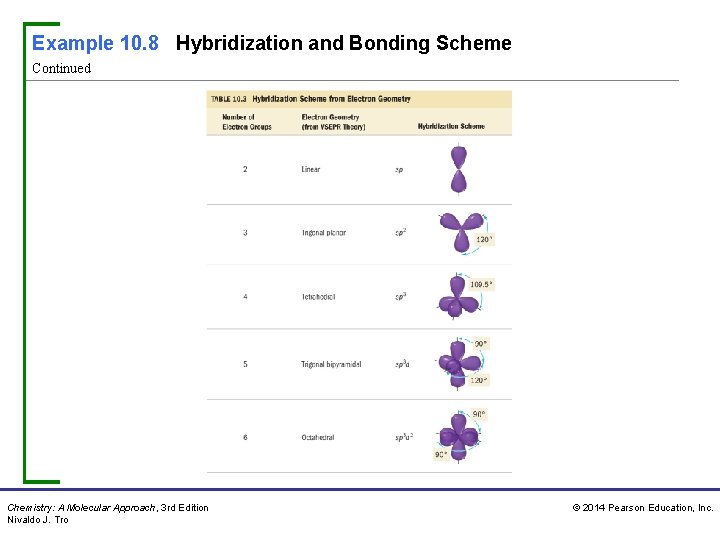
Example 10. 8 Hybridization and Bonding Scheme Use valence bond theory to write a hybridization and bonding scheme for ethene, H 2 C=CH 2 Procedure For… Hybridization and Bonding Scheme Solution Step 1 Write the Lewis structure for the molecule. Step 2 Use VSEPR theory to predict the electron geometry about the central atom (or interior atoms). The molecule has two interior atoms. Since each atom has three electron groups (one double bond and two single bonds), the electron geometry about each atom is trigonal planar. Step 3 Select the correct hybridization for the central atom (or interior atoms) based on the electron geometry (see Table 10. 3). A trigonal planar geometry corresponds to sp 2 hybridization. Chemistry: A Molecular Approach, 3 rd Edition Nivaldo J. Tro © 2014 Pearson Education, Inc.
Example 10. 8 Hybridization and Bonding Scheme Continued Chemistry: A Molecular Approach, 3 rd Edition Nivaldo J. Tro © 2014 Pearson Education, Inc.
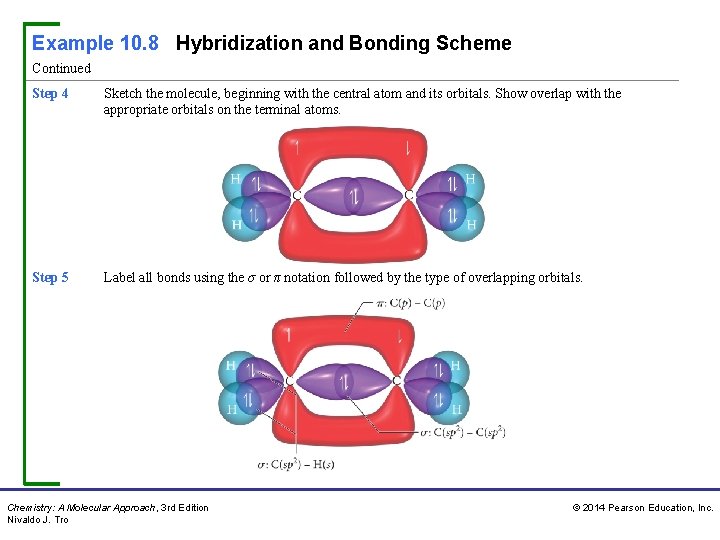
Example 10. 8 Hybridization and Bonding Scheme Continued Step 4 Sketch the molecule, beginning with the central atom and its orbitals. Show overlap with the appropriate orbitals on the terminal atoms. Step 5 Label all bonds using the σ or π notation followed by the type of overlapping orbitals. Chemistry: A Molecular Approach, 3 rd Edition Nivaldo J. Tro © 2014 Pearson Education, Inc.
Example 10. 8 Hybridization and Bonding Scheme Continued For Practice 10. 8 Use valence bond theory to write a hybridization and bonding scheme for CO 2. For More Practice 10. 8 What is the hybridization of the central iodine atom in I 3−? Chemistry: A Molecular Approach, 3 rd Edition Nivaldo J. Tro © 2014 Pearson Education, Inc.
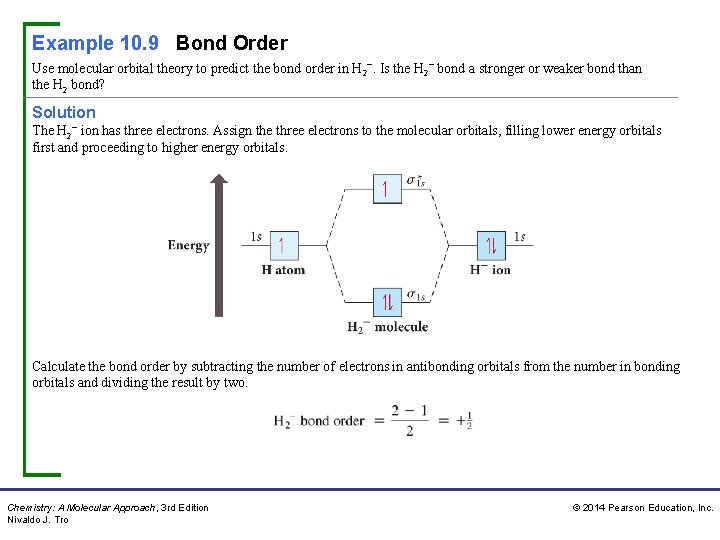
Example 10. 9 Bond Order Use molecular orbital theory to predict the bond order in H 2−. Is the H 2− bond a stronger or weaker bond than the H 2 bond? Solution The H 2− ion has three electrons. Assign the three electrons to the molecular orbitals, filling lower energy orbitals first and proceeding to higher energy orbitals. Calculate the bond order by subtracting the number of electrons in antibonding orbitals from the number in bonding orbitals and dividing the result by two. Chemistry: A Molecular Approach, 3 rd Edition Nivaldo J. Tro © 2014 Pearson Education, Inc.
Example 10. 9 Bond Order Continued Since the bond order is positive, H 2− should be stable. However, the bond order of H 2− is lower than the bond order of H 2 (which is 1); therefore, the bond in H 2− is weaker than in H 2. For Practice 10. 9 Use molecular orbital theory to predict the bond order in H 2+. Is the H 2+ bond a stronger or weaker bond than the H 2 bond? Chemistry: A Molecular Approach, 3 rd Edition Nivaldo J. Tro © 2014 Pearson Education, Inc.
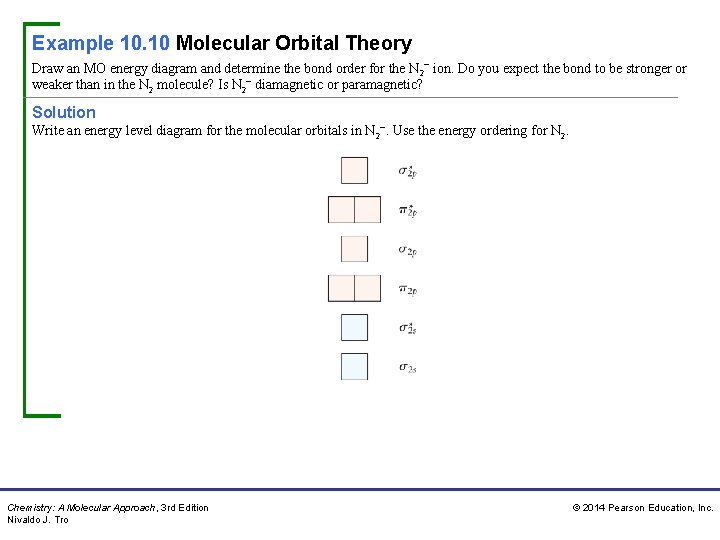
Example 10. 10 Molecular Orbital Theory Draw an MO energy diagram and determine the bond order for the N 2− ion. Do you expect the bond to be stronger or weaker than in the N 2 molecule? Is N 2− diamagnetic or paramagnetic? Solution Write an energy level diagram for the molecular orbitals in N 2−. Use the energy ordering for N 2. Chemistry: A Molecular Approach, 3 rd Edition Nivaldo J. Tro © 2014 Pearson Education, Inc.
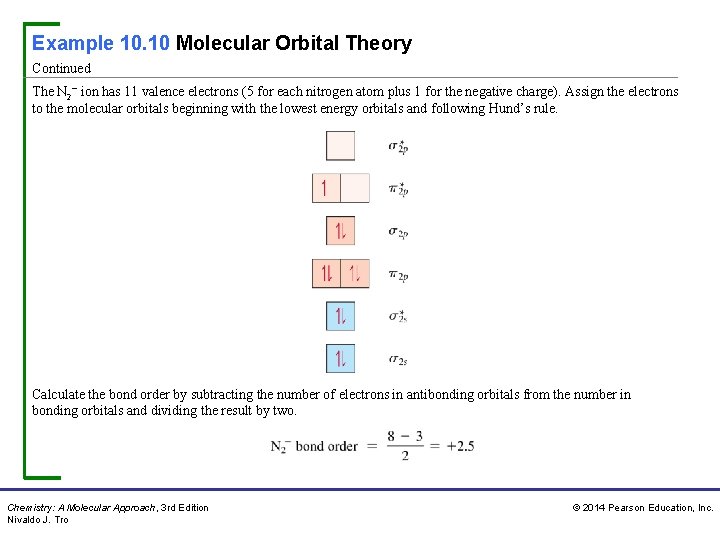
Example 10. 10 Molecular Orbital Theory Continued The N 2− ion has 11 valence electrons (5 for each nitrogen atom plus 1 for the negative charge). Assign the electrons to the molecular orbitals beginning with the lowest energy orbitals and following Hund’s rule. Calculate the bond order by subtracting the number of electrons in antibonding orbitals from the number in bonding orbitals and dividing the result by two. Chemistry: A Molecular Approach, 3 rd Edition Nivaldo J. Tro © 2014 Pearson Education, Inc.
Example 10. 10 Molecular Orbital Theory Continued The bond order is 2. 5, which is a lower bond order than in the N 2 molecule (bond order = 3); therefore, the bond is weaker. The MO diagram shows that the N 2− ion has one unpaired electron and is therefore paramagnetic. For Practice 10. 10 Draw an MO energy diagram and determine the bond order for the N 2+ ion. Do you expect the bond to be stronger or weaker than in the N 2 molecule? Is N 2+ diamagnetic or paramagnetic? For More Practice 10. 10 Use molecular orbital theory to determine the bond order of Ne 2. Chemistry: A Molecular Approach, 3 rd Edition Nivaldo J. Tro © 2014 Pearson Education, Inc.
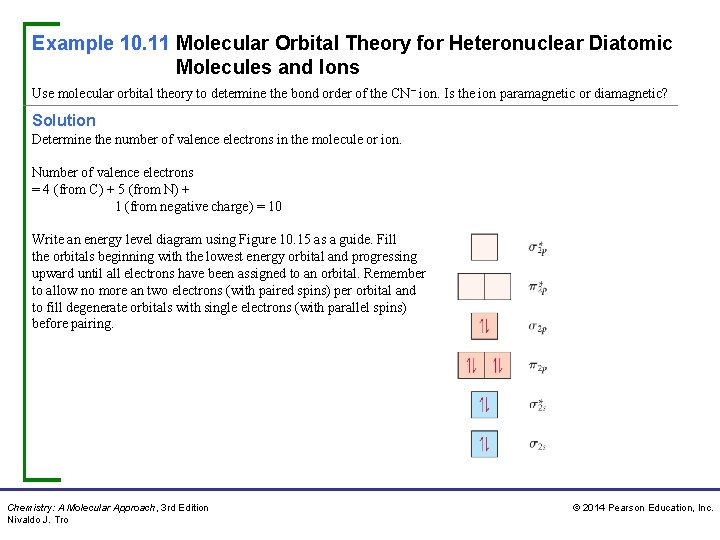
Example 10. 11 Molecular Orbital Theory for Heteronuclear Diatomic Molecules and Ions Use molecular orbital theory to determine the bond order of the CN− ion. Is the ion paramagnetic or diamagnetic? Solution Determine the number of valence electrons in the molecule or ion. Number of valence electrons = 4 (from C) + 5 (from N) + 1 (from negative charge) = 10 Write an energy level diagram using Figure 10. 15 as a guide. Fill the orbitals beginning with the lowest energy orbital and progressing upward until all electrons have been assigned to an orbital. Remember to allow no more an two electrons (with paired spins) per orbital and to fill degenerate orbitals with single electrons (with parallel spins) before pairing. Chemistry: A Molecular Approach, 3 rd Edition Nivaldo J. Tro © 2014 Pearson Education, Inc.
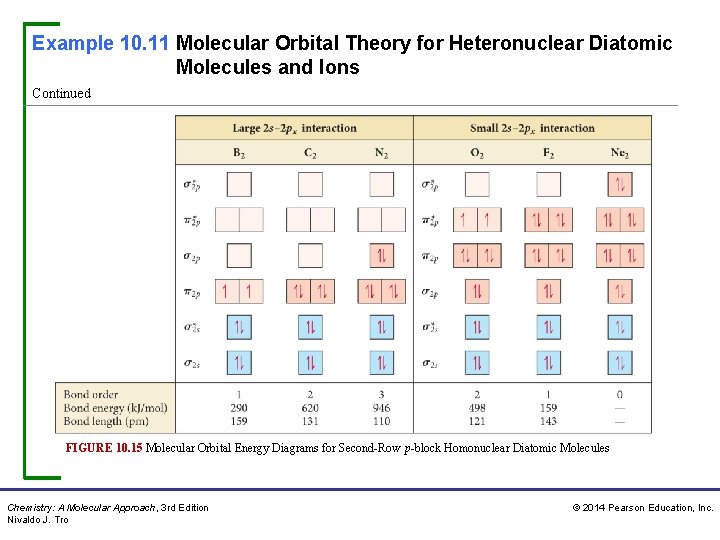
Example 10. 11 Molecular Orbital Theory for Heteronuclear Diatomic Molecules and Ions Continued FIGURE 10. 15 Molecular Orbital Energy Diagrams for Second-Row p-block Homonuclear Diatomic Molecules Chemistry: A Molecular Approach, 3 rd Edition Nivaldo J. Tro © 2014 Pearson Education, Inc.
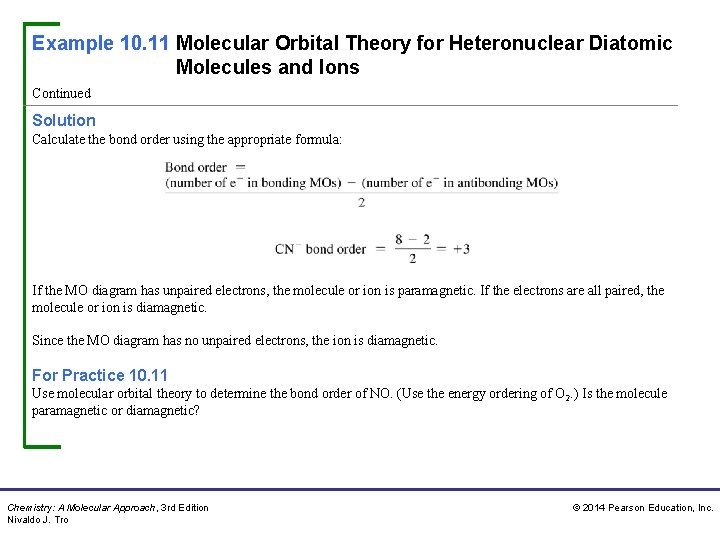
Example 10. 11 Molecular Orbital Theory for Heteronuclear Diatomic Molecules and Ions Continued Solution Calculate the bond order using the appropriate formula: If the MO diagram has unpaired electrons, the molecule or ion is paramagnetic. If the electrons are all paired, the molecule or ion is diamagnetic. Since the MO diagram has no unpaired electrons, the ion is diamagnetic. For Practice 10. 11 Use molecular orbital theory to determine the bond order of NO. (Use the energy ordering of O 2. ) Is the molecule paramagnetic or diamagnetic? Chemistry: A Molecular Approach, 3 rd Edition Nivaldo J. Tro © 2014 Pearson Education, Inc.
- Slides: 34