
EXAMPLE 1 Solve an equation with variables on

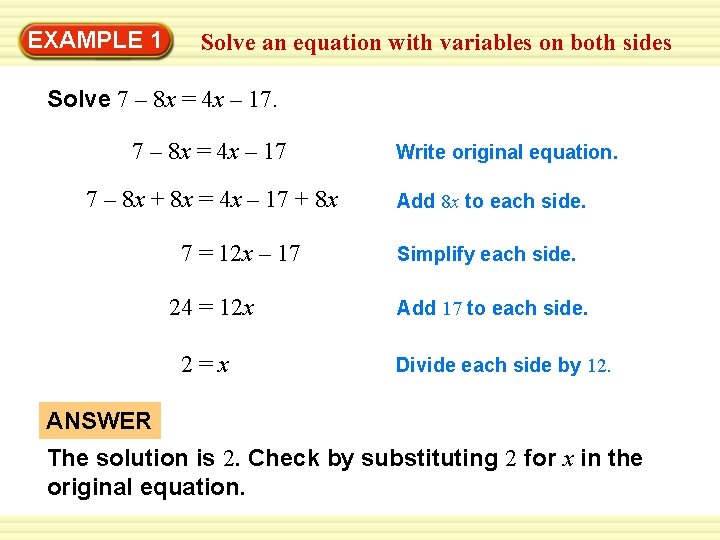
EXAMPLE 1 Solve an equation with variables on both sides Solve 7 – 8 x = 4 x – 17 7 – 8 x + 8 x = 4 x – 17 + 8 x 7 = 12 x – 17 24 = 12 x 2=x Write original equation. Add 8 x to each side. Simplify each side. Add 17 to each side. Divide each side by 12. ANSWER The solution is 2. Check by substituting 2 for x in the original equation.
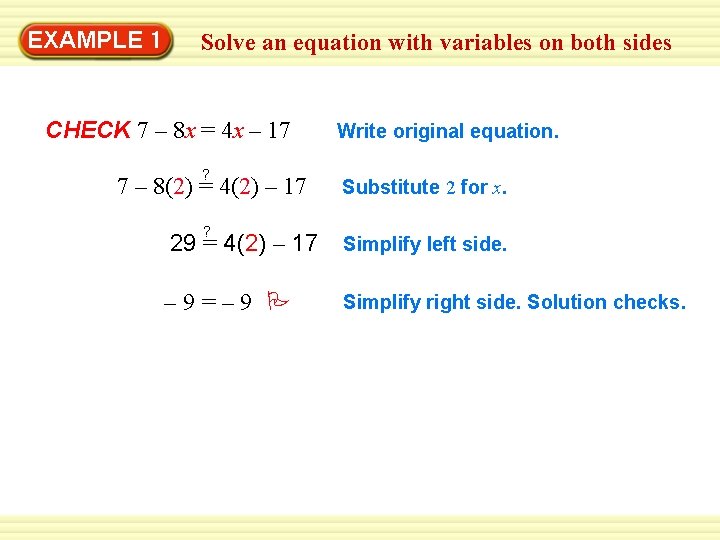
EXAMPLE 1 Solve an equation with variables on both sides CHECK 7 – 8 x = 4 x – 17 ? 7 – 8(2) = 4(2) – 17 ? Write original equation. Substitute 2 for x. 29 = 4(2) – 17 Simplify left side. – 9=– 9 Simplify right side. Solution checks.
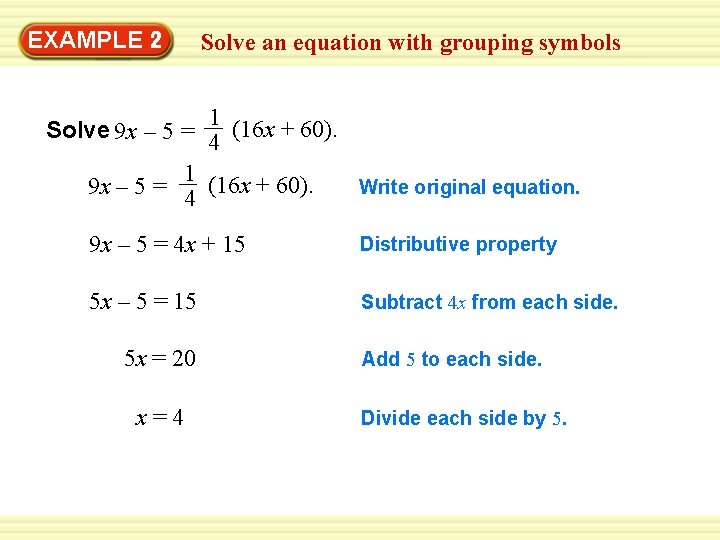
EXAMPLE 2 Solve an equation with grouping symbols 1 Solve 9 x – 5 = 4 (16 x + 60). 1 (16 x + 60). Write original equation. 9 x – 5 = 4 x + 15 Distributive property 5 x – 5 = 15 Subtract 4 x from each side. 5 x = 20 x=4 Add 5 to each side. Divide each side by 5.
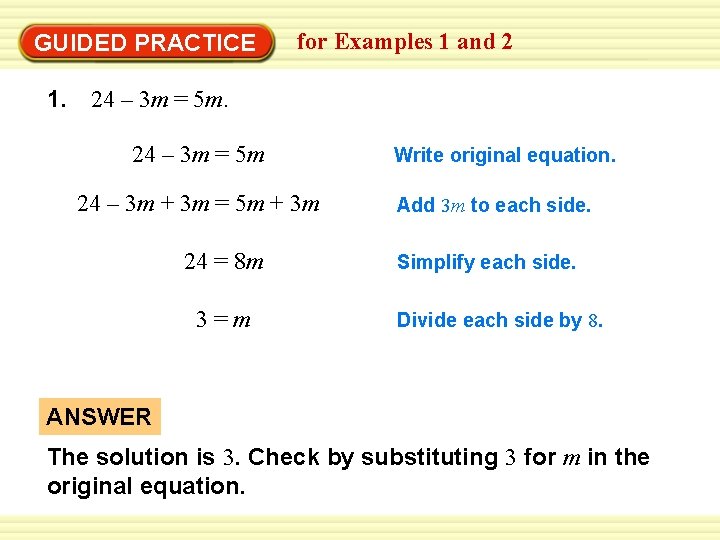
GUIDED PRACTICE for Examples 1 and 2 1. 24 – 3 m = 5 m 24 – 3 m + 3 m = 5 m + 3 m 24 = 8 m 3=m Write original equation. Add 3 m to each side. Simplify each side. Divide each side by 8. ANSWER The solution is 3. Check by substituting 3 for m in the original equation.
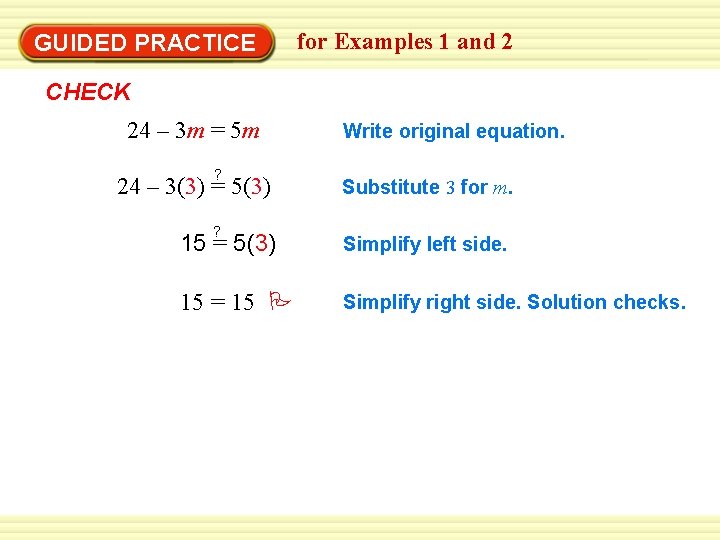
GUIDED PRACTICE for Examples 1 and 2 CHECK 24 – 3 m = 5 m ? 24 – 3(3) = 5(3) ? Write original equation. Substitute 3 for m. 15 = 5(3) Simplify left side. 15 = 15 Simplify right side. Solution checks.
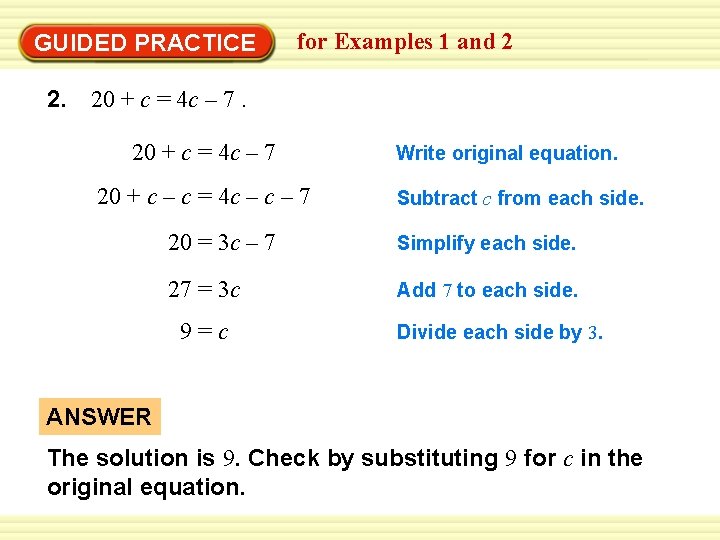
GUIDED PRACTICE for Examples 1 and 2 2. 20 + c = 4 c – 7 20 + c – c = 4 c – 7 Write original equation. Subtract c from each side. 20 = 3 c – 7 Simplify each side. 27 = 3 c Add 7 to each side. 9=c Divide each side by 3. ANSWER The solution is 9. Check by substituting 9 for c in the original equation.
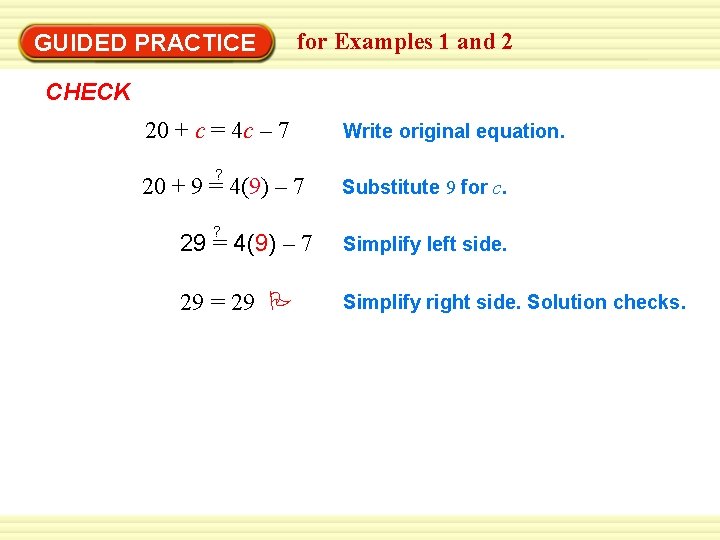
GUIDED PRACTICE for Examples 1 and 2 CHECK 20 + c = 4 c – 7 ? 20 + 9 = 4(9) – 7 ? Write original equation. Substitute 9 for c. 29 = 4(9) – 7 Simplify left side. 29 = 29 Simplify right side. Solution checks.
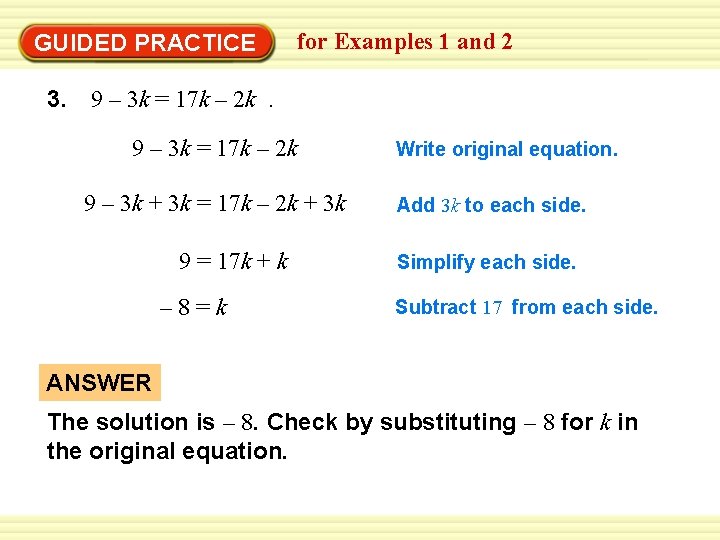
GUIDED PRACTICE for Examples 1 and 2 3. 9 – 3 k = 17 k – 2 k 9 – 3 k + 3 k = 17 k – 2 k + 3 k 9 = 17 k + k – 8=k Write original equation. Add 3 k to each side. Simplify each side. Subtract 17 from each side. ANSWER The solution is – 8. Check by substituting – 8 for k in the original equation.
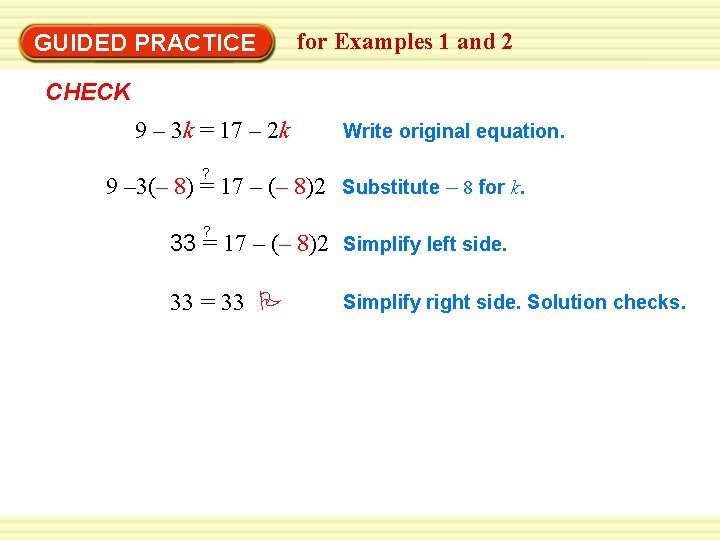
GUIDED PRACTICE for Examples 1 and 2 CHECK 9 – 3 k = 17 – 2 k Write original equation. ? 9 – 3(– 8) = 17 – (– 8)2 Substitute – 8 for k. ? 33 = 17 – (– 8)2 Simplify left side. 33 = 33 Simplify right side. Solution checks.
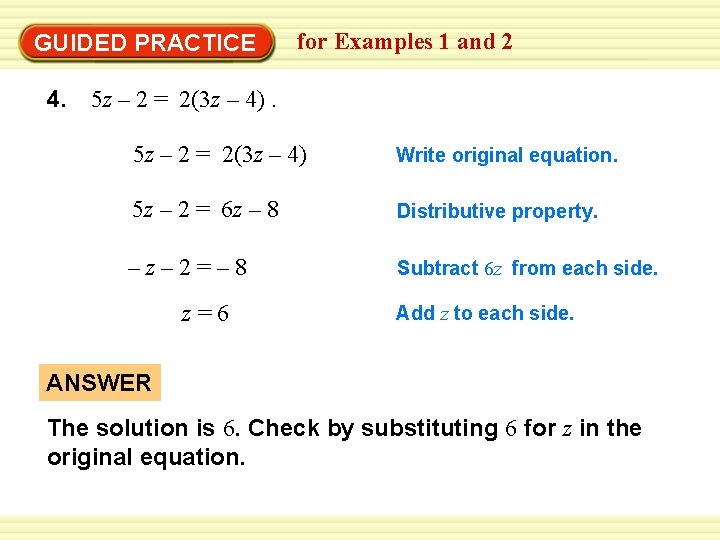
GUIDED PRACTICE for Examples 1 and 2 4. 5 z – 2 = 2(3 z – 4) Write original equation. 5 z – 2 = 6 z – 8 Distributive property. –z– 2=– 8 Subtract 6 z from each side. z=6 Add z to each side. ANSWER The solution is 6. Check by substituting 6 for z in the original equation.
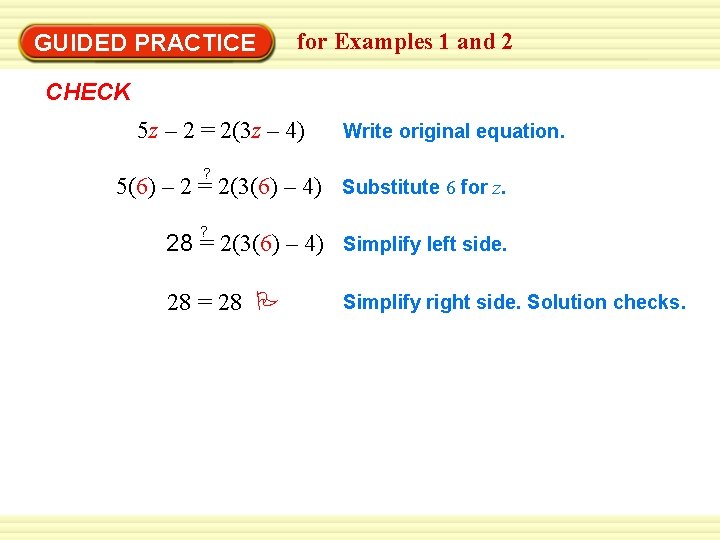
GUIDED PRACTICE for Examples 1 and 2 CHECK 5 z – 2 = 2(3 z – 4) Write original equation. ? 5(6) – 2 = 2(3(6) – 4) Substitute 6 for z. ? 28 = 2(3(6) – 4) Simplify left side. 28 = 28 Simplify right side. Solution checks.
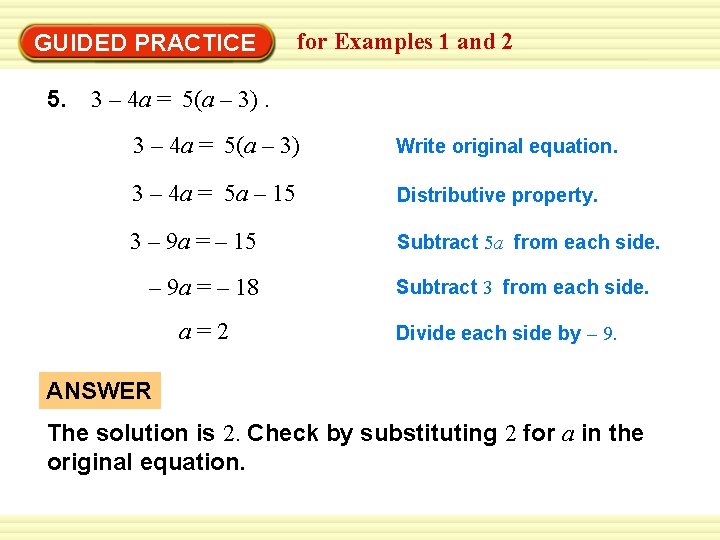
GUIDED PRACTICE for Examples 1 and 2 5. 3 – 4 a = 5(a – 3) Write original equation. 3 – 4 a = 5 a – 15 Distributive property. 3 – 9 a = – 15 Subtract 5 a from each side. – 9 a = – 18 a=2 Subtract 3 from each side. Divide each side by – 9. ANSWER The solution is 2. Check by substituting 2 for a in the original equation.
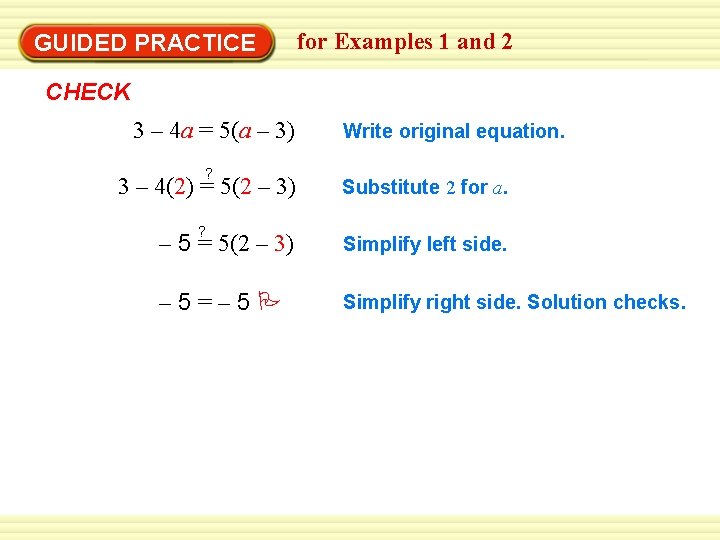
GUIDED PRACTICE for Examples 1 and 2 CHECK 3 – 4 a = 5(a – 3) ? 3 – 4(2) = 5(2 – 3) ? Write original equation. Substitute 2 for a. – 5 = 5(2 – 3) Simplify left side. – 5=– 5 Simplify right side. Solution checks.
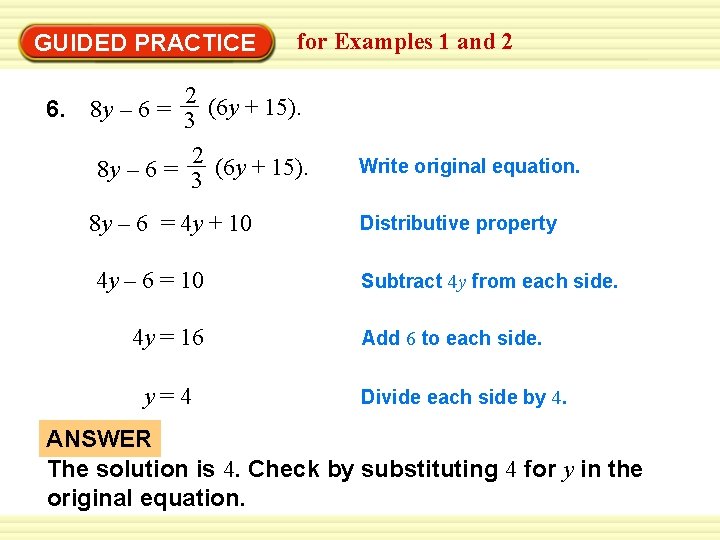
GUIDED PRACTICE 6. for Examples 1 and 2 2 8 y – 6 = 3 (6 y + 15). 8 y – 6 = 4 y + 10 4 y – 6 = 10 4 y = 16 y=4 Write original equation. Distributive property Subtract 4 y from each side. Add 6 to each side. Divide each side by 4. ANSWER The solution is 4. Check by substituting 4 for y in the original equation.
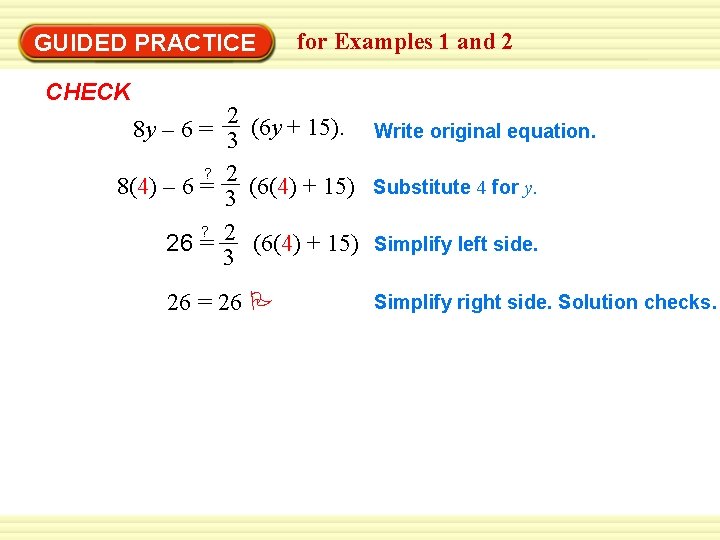
GUIDED PRACTICE for Examples 1 and 2 CHECK 2 8 y – 6 = 3 (6 y + 15). Write original equation. ? 2 8(4) – 6 = (6(4) + 15) Substitute 4 for y. 3 ? 26 = 2 (6(4) + 15) Simplify left side. 3 26 = 26 Simplify right side. Solution checks.

EXAMPLE 3 Solve a real-world problem CAR SALES A car dealership sold 78 new cars and 67 used cars this year. The number of new cars sold by the dealership has been increasing by 6 cars each year. The number of used cars sold by the dealership has been decreasing by 4 cars each year. If these trends continue, in how many years will the number of new cars sold be twice the number of used cars sold?
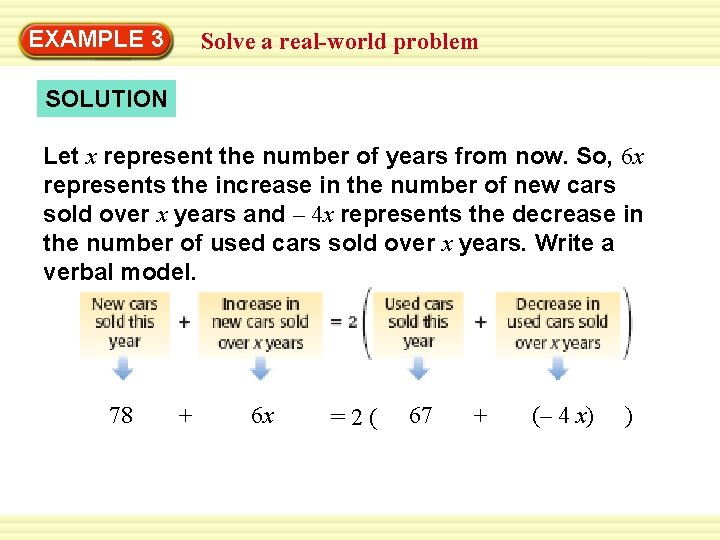
EXAMPLE 3 Solve a real-world problem SOLUTION Let x represent the number of years from now. So, 6 x represents the increase in the number of new cars sold over x years and – 4 x represents the decrease in the number of used cars sold over x years. Write a verbal model. 78 + 6 x =2( 67 + (– 4 x) )
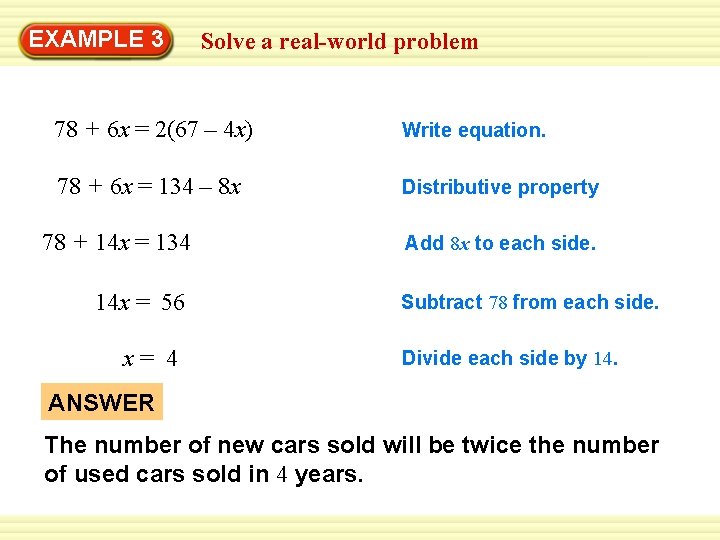
EXAMPLE 3 Solve a real-world problem 78 + 6 x = 2(67 – 4 x) Write equation. 78 + 6 x = 134 – 8 x Distributive property 78 + 14 x = 134 14 x = 56 x= 4 Add 8 x to each side. Subtract 78 from each side. Divide each side by 14. ANSWER The number of new cars sold will be twice the number of used cars sold in 4 years.
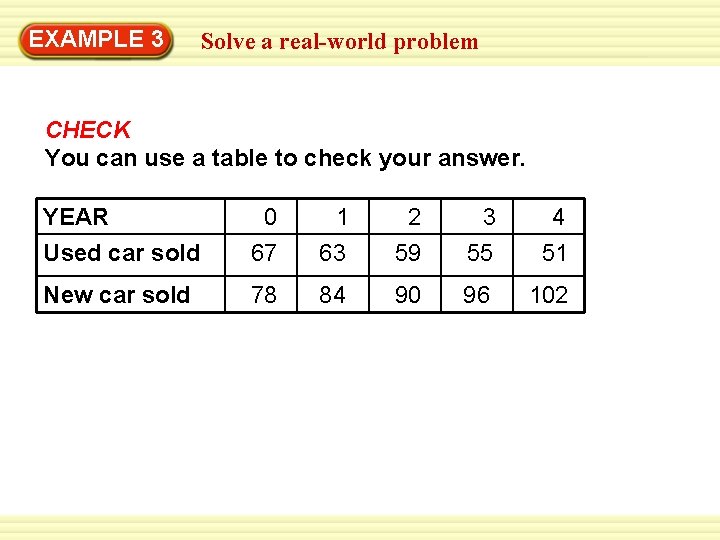
EXAMPLE 3 Solve a real-world problem CHECK You can use a table to check your answer. YEAR Used car sold 0 67 1 63 2 59 3 55 4 51 New car sold 78 84 90 96 102
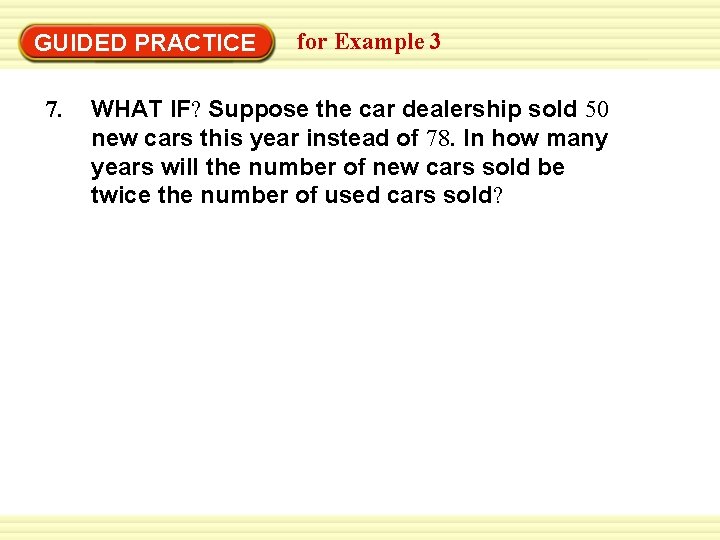
GUIDED PRACTICE 7. for Example 3 WHAT IF? Suppose the car dealership sold 50 new cars this year instead of 78. In how many years will the number of new cars sold be twice the number of used cars sold?
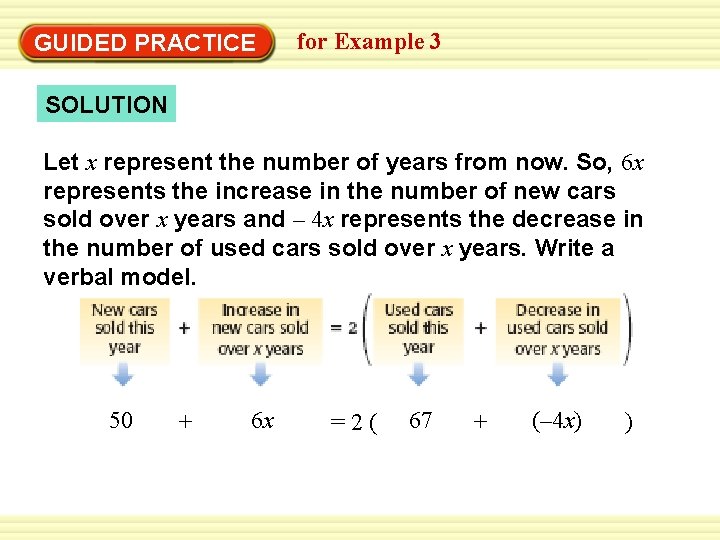
GUIDED PRACTICE for Example 3 SOLUTION Let x represent the number of years from now. So, 6 x represents the increase in the number of new cars sold over x years and – 4 x represents the decrease in the number of used cars sold over x years. Write a verbal model. 50 + 6 x =2( 67 + (– 4 x) )
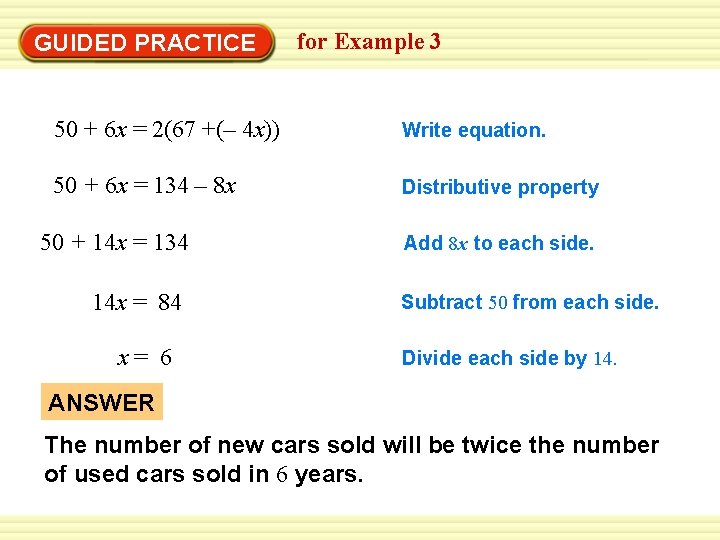
GUIDED PRACTICE for Example 3 50 + 6 x = 2(67 +(– 4 x)) Write equation. 50 + 6 x = 134 – 8 x Distributive property 50 + 14 x = 134 14 x = 84 x= 6 Add 8 x to each side. Subtract 50 from each side. Divide each side by 14. ANSWER The number of new cars sold will be twice the number of used cars sold in 6 years.
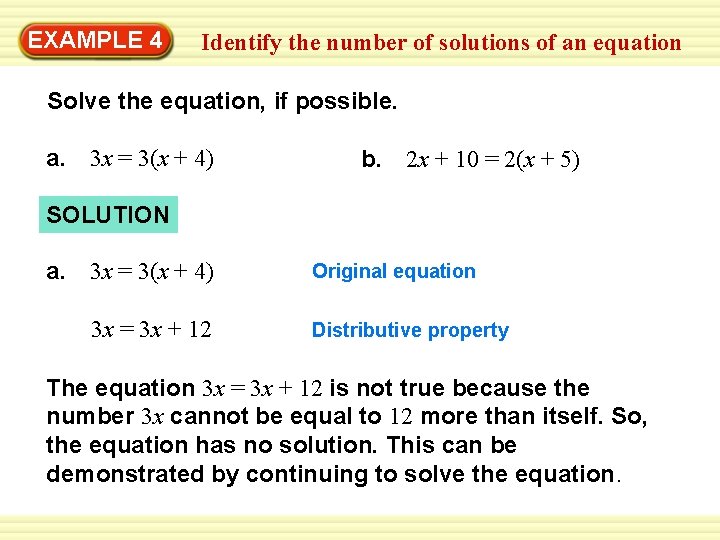
EXAMPLE 4 Identify the number of solutions of an equation Solve the equation, if possible. a. 3 x = 3(x + 4) b. 2 x + 10 = 2(x + 5) SOLUTION a. 3 x = 3(x + 4) 3 x = 3 x + 12 Original equation Distributive property The equation 3 x = 3 x + 12 is not true because the number 3 x cannot be equal to 12 more than itself. So, the equation has no solution. This can be demonstrated by continuing to solve the equation.
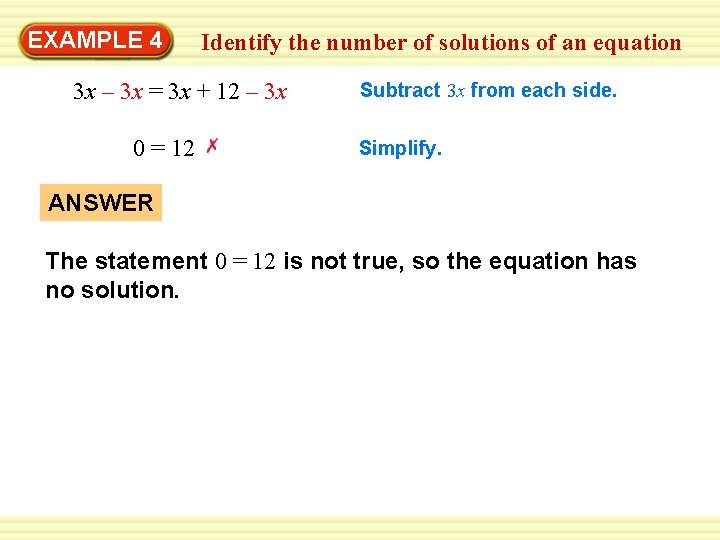
EXAMPLE 4 Identify the number of solutions of an equation 3 x – 3 x = 3 x + 12 – 3 x 0 = 12 Subtract 3 x from each side. Simplify. ANSWER The statement 0 = 12 is not true, so the equation has no solution.
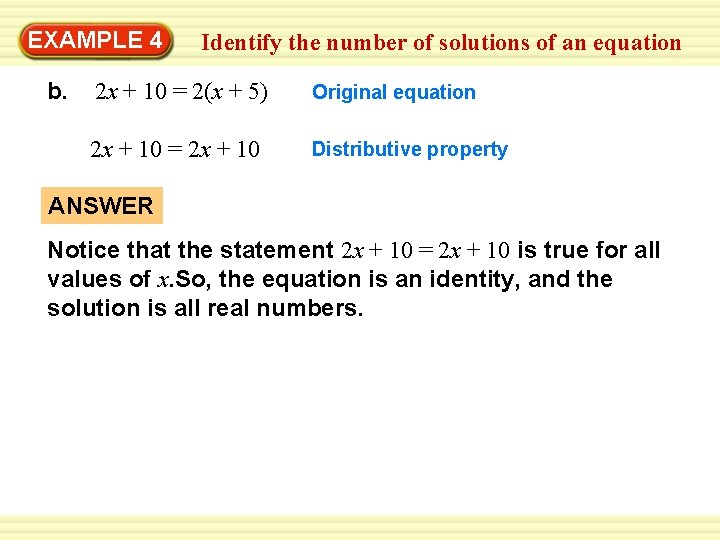
EXAMPLE 4 1 b. Identify the number of solutions of an equation 2 x + 10 = 2(x + 5) Original equation 2 x + 10 = 2 x + 10 Distributive property ANSWER Notice that the statement 2 x + 10 = 2 x + 10 is true for all values of x. So, the equation is an identity, and the solution is all real numbers.
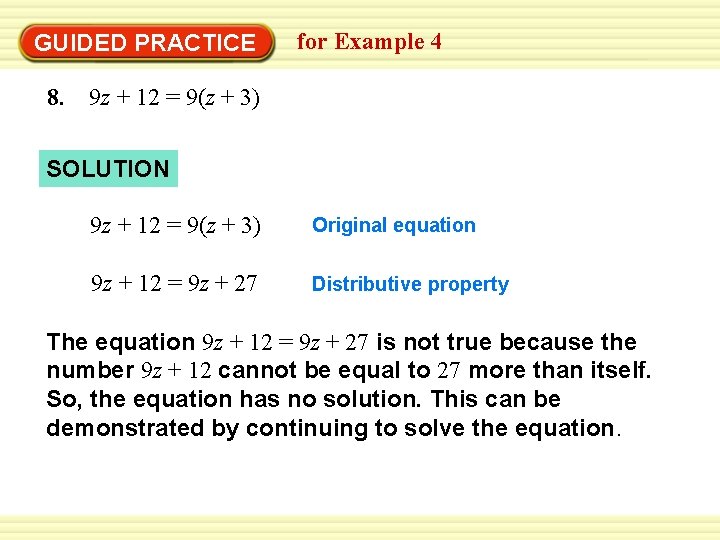
GUIDED PRACTICE for Example 4 8. 9 z + 12 = 9(z + 3) SOLUTION 9 z + 12 = 9(z + 3) Original equation 9 z + 12 = 9 z + 27 Distributive property The equation 9 z + 12 = 9 z + 27 is not true because the number 9 z + 12 cannot be equal to 27 more than itself. So, the equation has no solution. This can be demonstrated by continuing to solve the equation.
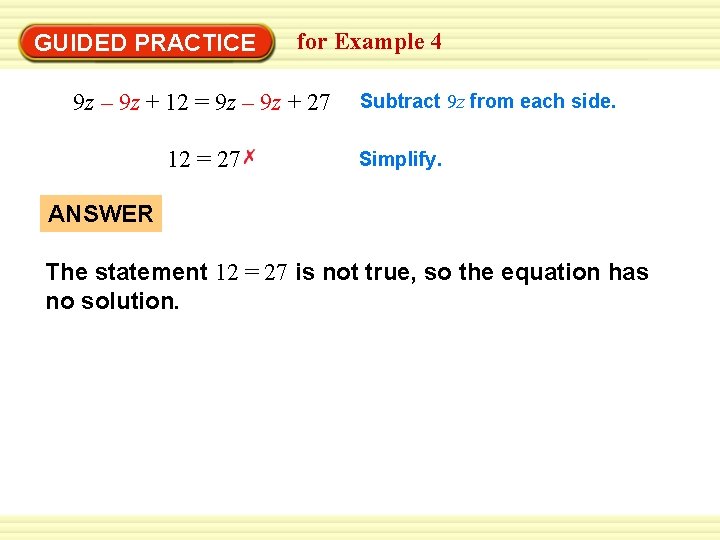
GUIDED PRACTICE for Example 4 9 z – 9 z + 12 = 9 z – 9 z + 27 12 = 27 Subtract 9 z from each side. Simplify. ANSWER The statement 12 = 27 is not true, so the equation has no solution.
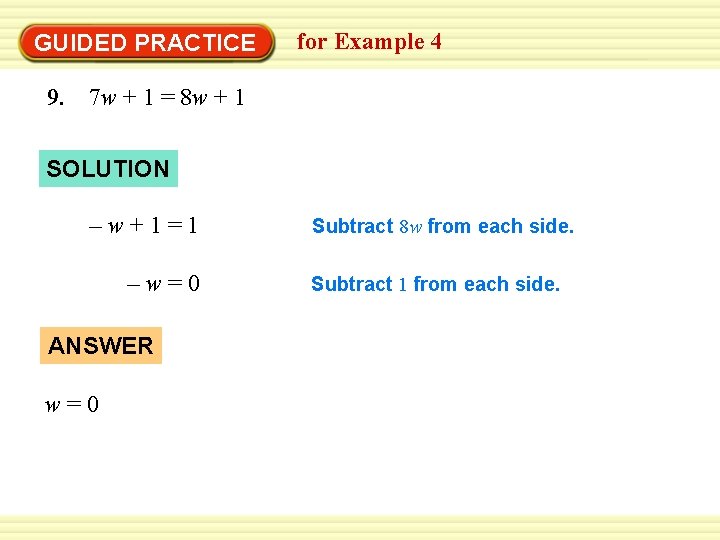
GUIDED PRACTICE for Example 4 9. 7 w + 1 = 8 w + 1 SOLUTION –w+1=1 –w=0 ANSWER w=0 Subtract 8 w from each side. Subtract 1 from each side.
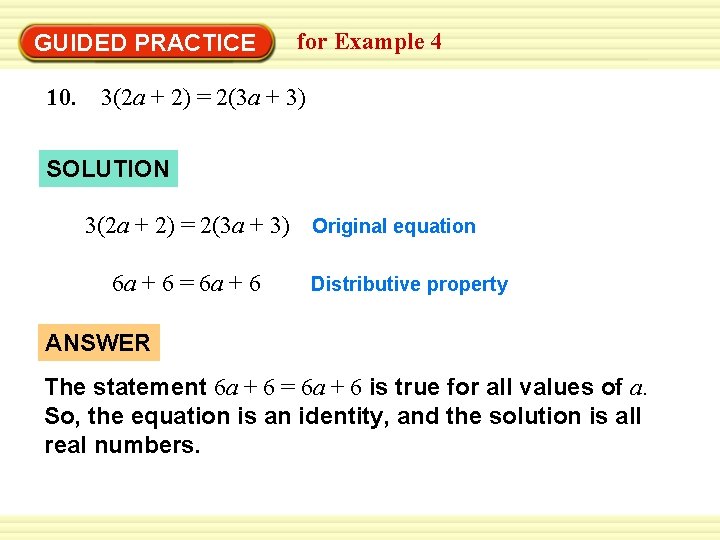
GUIDED PRACTICE for Example 4 10. 3(2 a + 2) = 2(3 a + 3) SOLUTION 3(2 a + 2) = 2(3 a + 3) Original equation 6 a + 6 = 6 a + 6 Distributive property ANSWER The statement 6 a + 6 = 6 a + 6 is true for all values of a. So, the equation is an identity, and the solution is all real numbers.
- Slides: 30