
EXAMPLE 1 Solve a simple absolute value equation
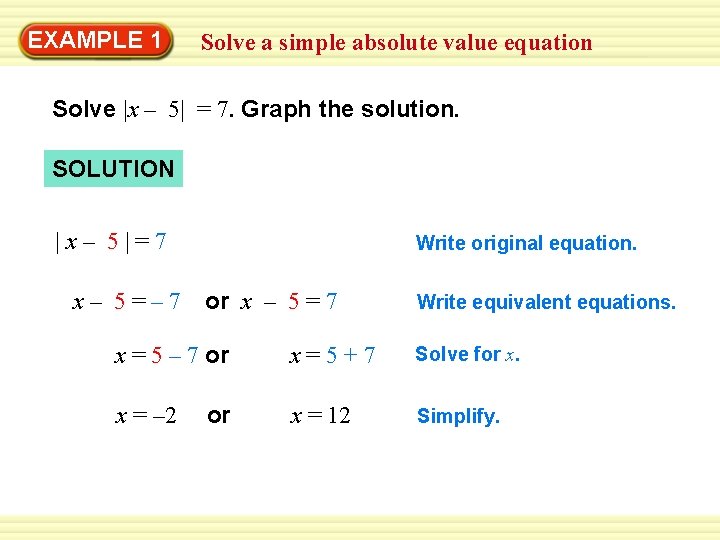
EXAMPLE 1 Solve a simple absolute value equation Solve |x – 5| = 7. Graph the solution. SOLUTION |x– 5|=7 Write original equation. x – 5 = – 7 or x – 5 = 7 x = 5 – 7 or x = – 2 or Write equivalent equations. x=5+7 Solve for x. x = 12 Simplify.
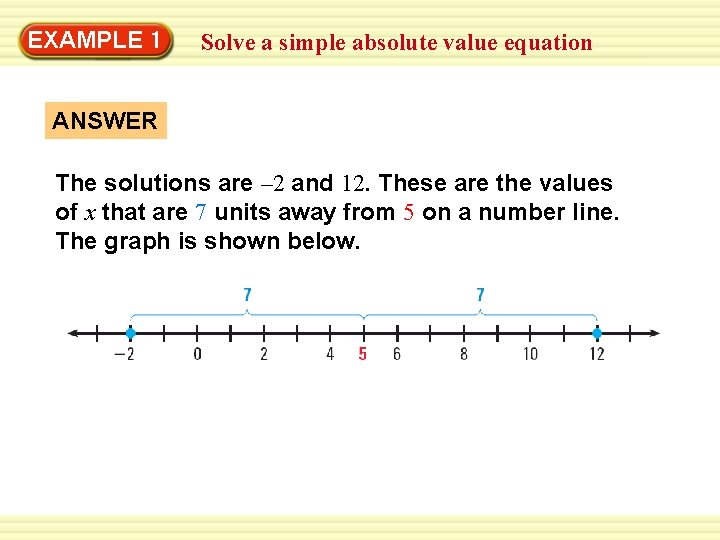
EXAMPLE 1 Solve a simple absolute value equation ANSWER The solutions are – 2 and 12. These are the values of x that are 7 units away from 5 on a number line. The graph is shown below.
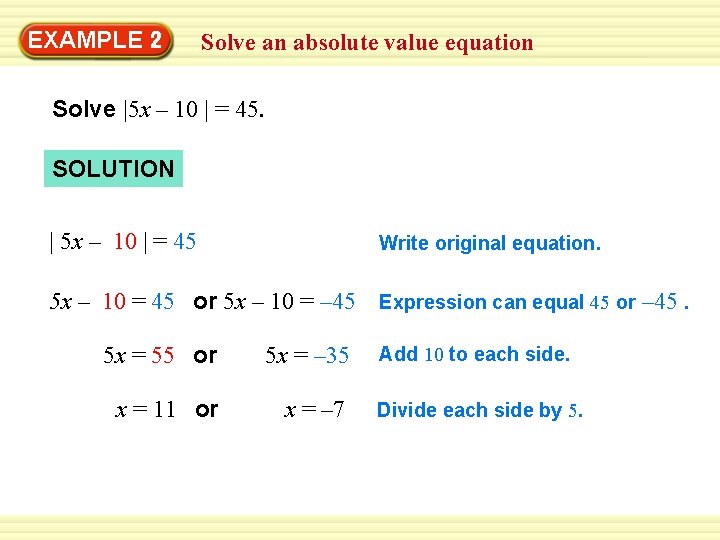
EXAMPLE 2 Solve an absolute value equation Solve |5 x – 10 | = 45. SOLUTION | 5 x – 10 | = 45 Write original equation. 5 x – 10 = 45 or 5 x – 10 = – 45 Expression can equal 45 or – 45. 5 x = 55 or 5 x = – 35 x = 11 or x = – 7 Add 10 to each side. Divide each side by 5.
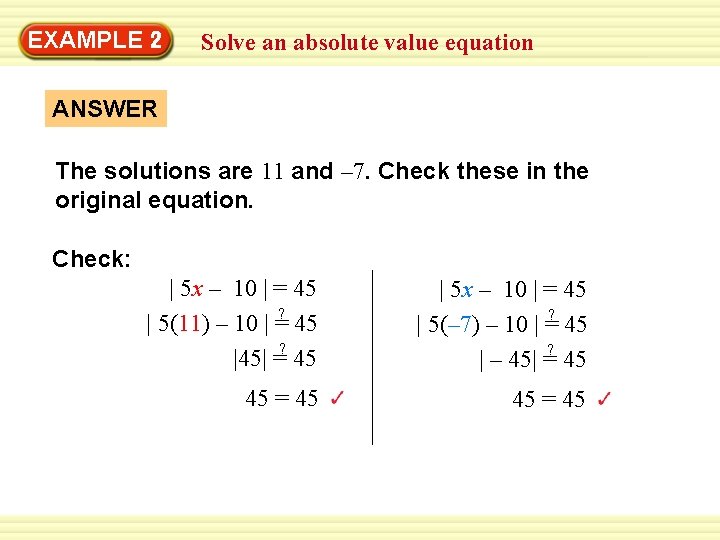
EXAMPLE 2 Solve an absolute value equation ANSWER The solutions are 11 and – 7. Check these in the original equation. Check: | 5 x – 10 | = 45 | 5(11) – 10 | =? 45 |45| =? 45 | 5 x – 10 | = 45 | 5(– 7) – 10 | =? 45 | – 45| =? 45 45 = 45
GUIDED PRACTICE for Examples 1, 2 and 3 Solve the equation. Check for extraneous solutions. 4. |3 x – 2| = 13 ANSWER The solutions are 5 and .

EXAMPLE 3 Check for extraneous solutions Solve |2 x + 12 | = 4 x. Check for extraneous solutions. SOLUTION | 2 x + 12 | = 4 x Write original equation. 2 x + 12 = 4 x or 2 x + 12 = – 4 x Expression can equal 4 x or – 4 x 12 = 2 x or 12 = – 6 x 6=x or – 2 = x Add – 2 x to each side. Solve for x.
GUIDED PRACTICE for Examples 1, 2 and 3 Solve the equation. Check for extraneous solutions. 6. |4 x – 1| = 2 x + 9 ANSWER The solutions are – 1 1 and 5. 3

EXAMPLE 3 Check for extraneous solutions Check the apparent solutions to see if either is extraneous. CHECK | 2 x + 12 | = 4 x | 2(6) +12 | =? 4(6) |24| =? 24 24 = 24 | 2(– 2) +12 | =? 4(– 2) |8| =? – 8 8 = – 8 ANSWER The solution is 6. Reject – 2 because it is an extraneous solution.
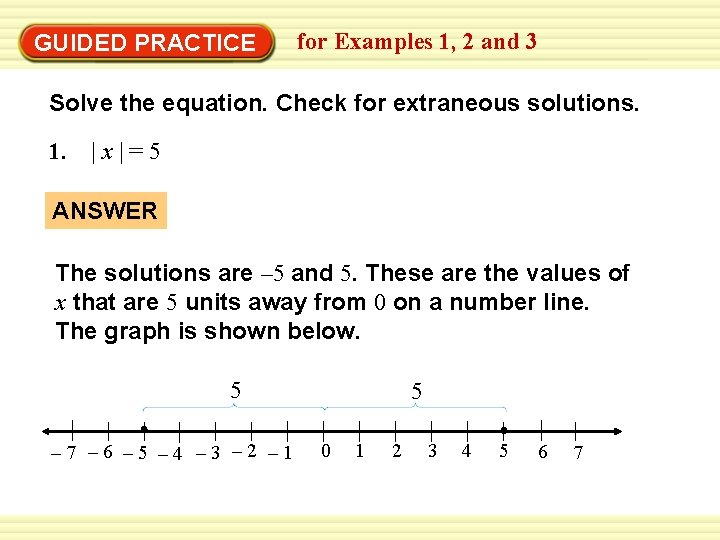
GUIDED PRACTICE for Examples 1, 2 and 3 Solve the equation. Check for extraneous solutions. 1. | x | = 5 ANSWER The solutions are – 5 and 5. These are the values of x that are 5 units away from 0 on a number line. The graph is shown below. 5 – 7 – 6 – 5 – 4 – 3 – 2 – 1 5 0 1 2 3 4 5 6 7
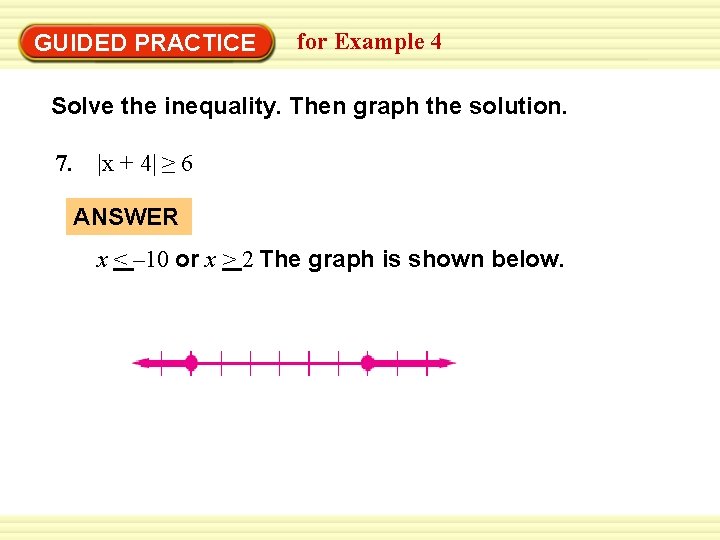
GUIDED PRACTICE for Example 4 Solve the inequality. Then graph the solution. 7. |x + 4| ≥ 6 ANSWER x < – 10 or x > 2 The graph is shown below.
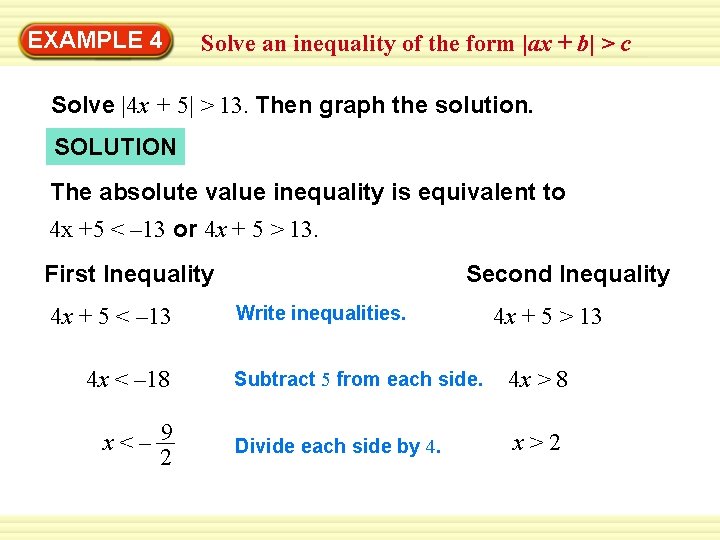
EXAMPLE 4 Solve an inequality of the form |ax + b| > c Solve |4 x + 5| > 13. Then graph the solution. SOLUTION The absolute value inequality is equivalent to 4 x +5 < – 13 or 4 x + 5 > 13. First Inequality 4 x + 5 < – 13 4 x < – 18 x<– 9 2 Second Inequality Write inequalities. 4 x + 5 > 13 Subtract 5 from each side. 4 x > 8 Divide each side by 4. x>2
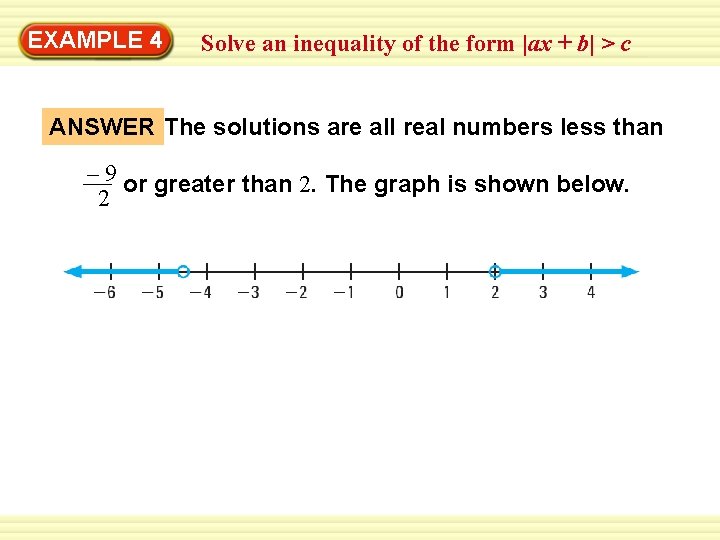
EXAMPLE 4 Solve an inequality of the form |ax + b| > c ANSWER The solutions are all real numbers less than – 9 or greater than 2. The graph is shown below. 2

GUIDED PRACTICE for Examples 1, 2 and 3 Solve the equation. Check for extraneous solutions. 2. |x – 3| = 10 ANSWER The solutions are – 7 and 13. These are the values of x that are 10 units away from 3 on a number line. The graph is shown below. 10 – 7 – 6– 5– 4 – 3 – 2– 1 0 1 2 10 3 4 5 6 7 8 9 10 11 12 13
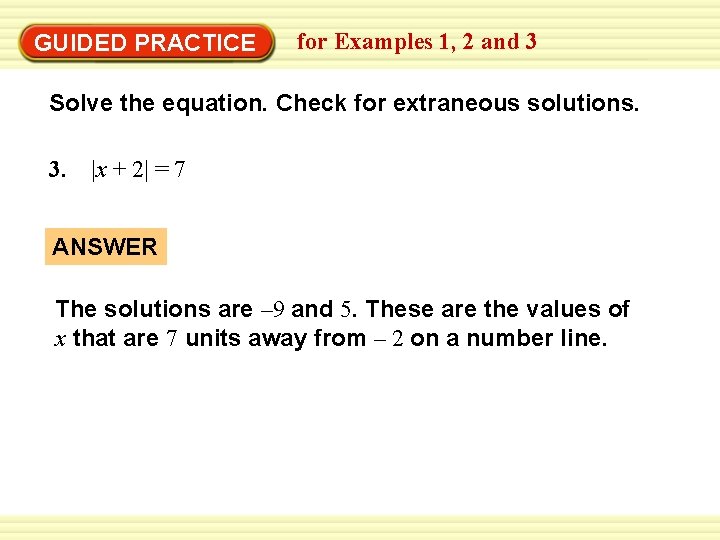
GUIDED PRACTICE for Examples 1, 2 and 3 Solve the equation. Check for extraneous solutions. 3. |x + 2| = 7 ANSWER The solutions are – 9 and 5. These are the values of x that are 7 units away from – 2 on a number line.
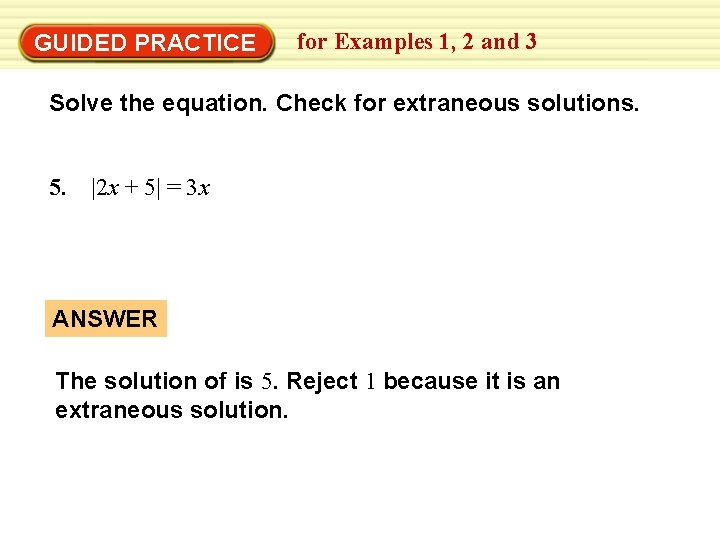
GUIDED PRACTICE for Examples 1, 2 and 3 Solve the equation. Check for extraneous solutions. 5. |2 x + 5| = 3 x ANSWER The solution of is 5. Reject 1 because it is an extraneous solution.
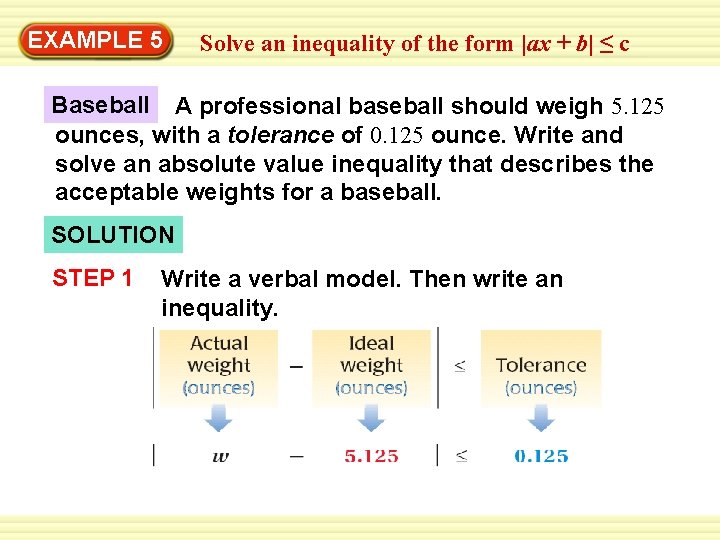
EXAMPLE 5 Solve an inequality of the form |ax + b| ≤ c Baseball A professional baseball should weigh 5. 125 ounces, with a tolerance of 0. 125 ounce. Write and solve an absolute value inequality that describes the acceptable weights for a baseball. SOLUTION STEP 1 Write a verbal model. Then write an inequality.
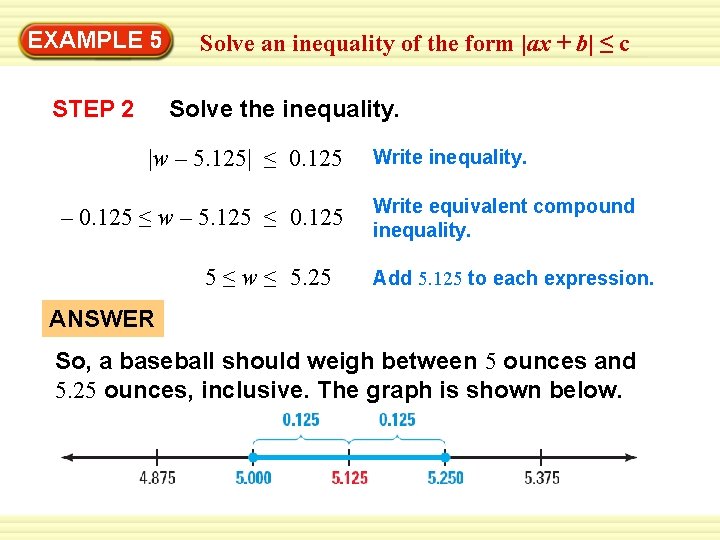
EXAMPLE 5 STEP 2 Solve an inequality of the form |ax + b| ≤ c Solve the inequality. |w – 5. 125| ≤ 0. 125 – 0. 125 ≤ w – 5. 125 ≤ 0. 125 5 ≤ w ≤ 5. 25 Write inequality. Write equivalent compound inequality. Add 5. 125 to each expression. ANSWER So, a baseball should weigh between 5 ounces and 5. 25 ounces, inclusive. The graph is shown below.
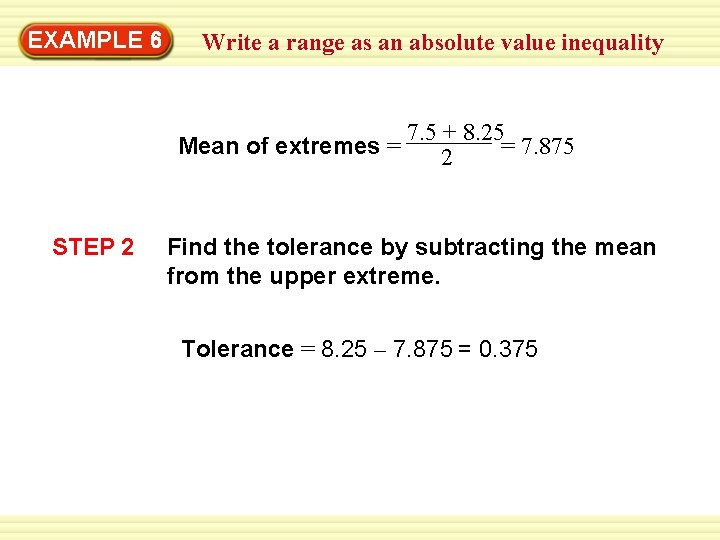
EXAMPLE 6 Write a range as an absolute value inequality 7. 5 + 8. 25 Mean of extremes = = 7. 875 2 STEP 2 Find the tolerance by subtracting the mean from the upper extreme. Tolerance = 8. 25 – 7. 875 = 0. 375
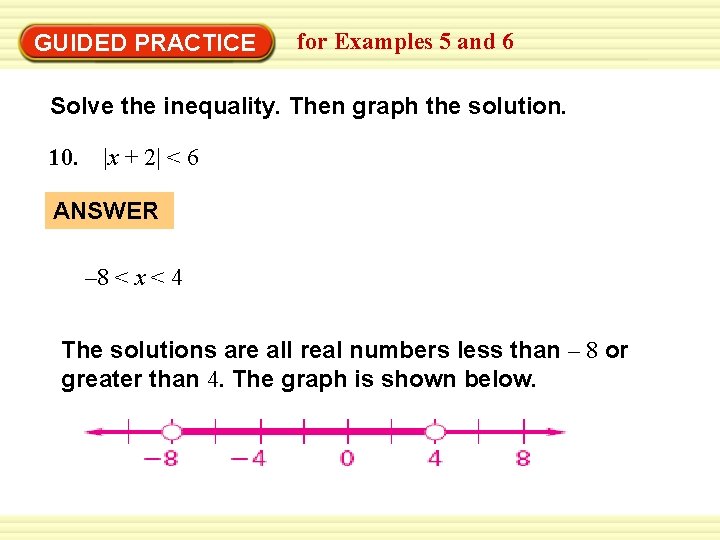
GUIDED PRACTICE for Examples 5 and 6 Solve the inequality. Then graph the solution. 10. |x + 2| < 6 ANSWER – 8 < x < 4 The solutions are all real numbers less than – 8 or greater than 4. The graph is shown below.
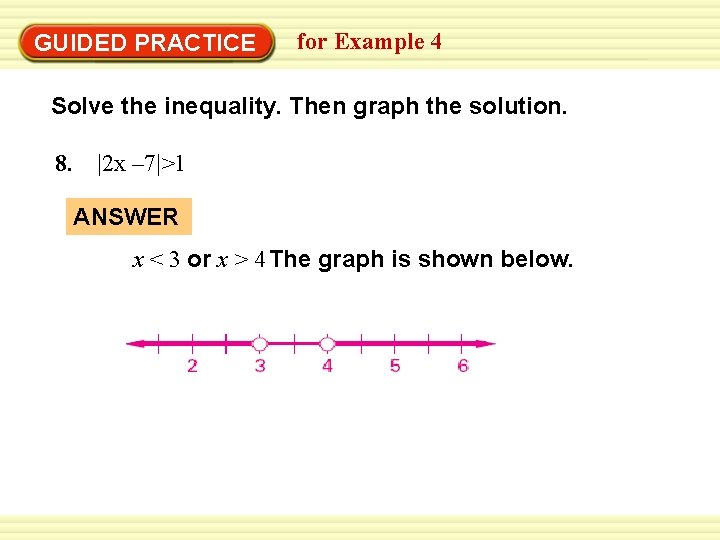
GUIDED PRACTICE for Example 4 Solve the inequality. Then graph the solution. 8. |2 x – 7|>1 ANSWER x < 3 or x > 4 The graph is shown below.
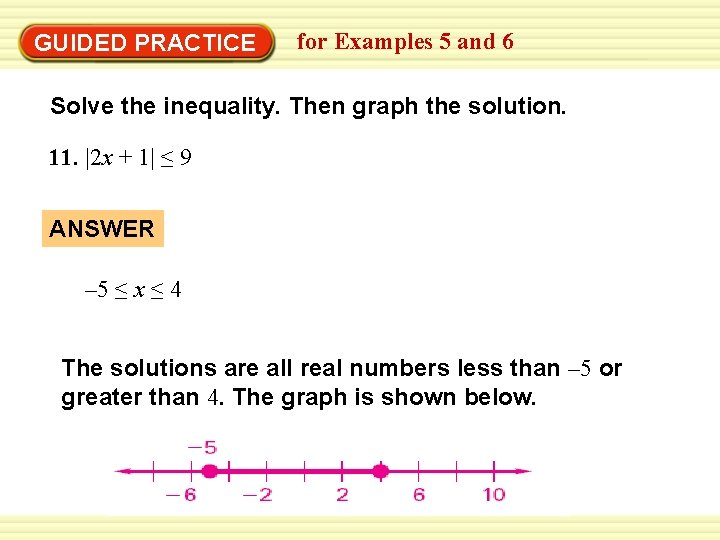
GUIDED PRACTICE for Examples 5 and 6 Solve the inequality. Then graph the solution. 11. |2 x + 1| ≤ 9 ANSWER – 5 ≤ x ≤ 4 The solutions are all real numbers less than – 5 or greater than 4. The graph is shown below.
GUIDED PRACTICE 13. for Examples 5 and 6 Gymnastics: For Example 6, write an absolute value inequality describing the unacceptable mat thicknesses. ANSWER A mat is unacceptable if its thickness t satisfies |t – 7. 875| > 0. 375.
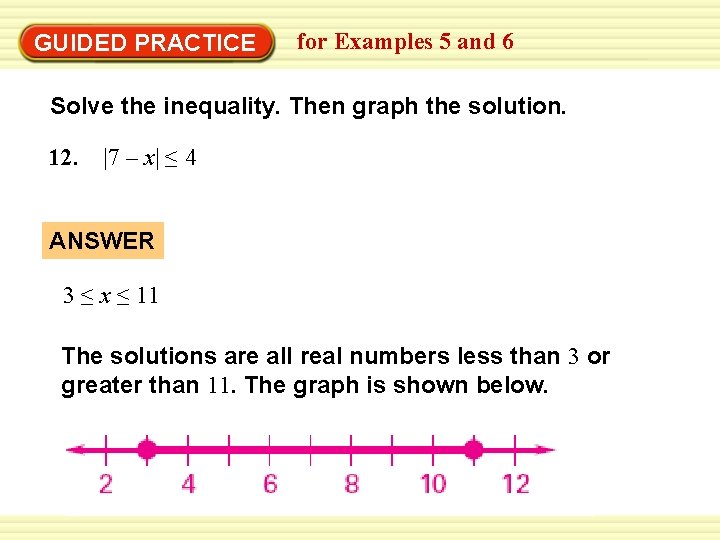
GUIDED PRACTICE for Examples 5 and 6 Solve the inequality. Then graph the solution. 12. |7 – x| ≤ 4 ANSWER 3 ≤ x ≤ 11 The solutions are all real numbers less than 3 or greater than 11. The graph is shown below.
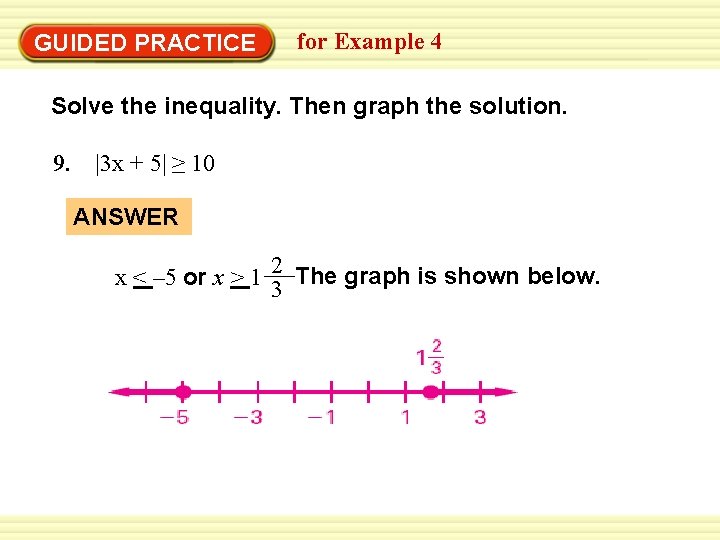
GUIDED PRACTICE for Example 4 Solve the inequality. Then graph the solution. 9. |3 x + 5| ≥ 10 ANSWER x < – 5 or x > 1 2 The graph is shown below. 3
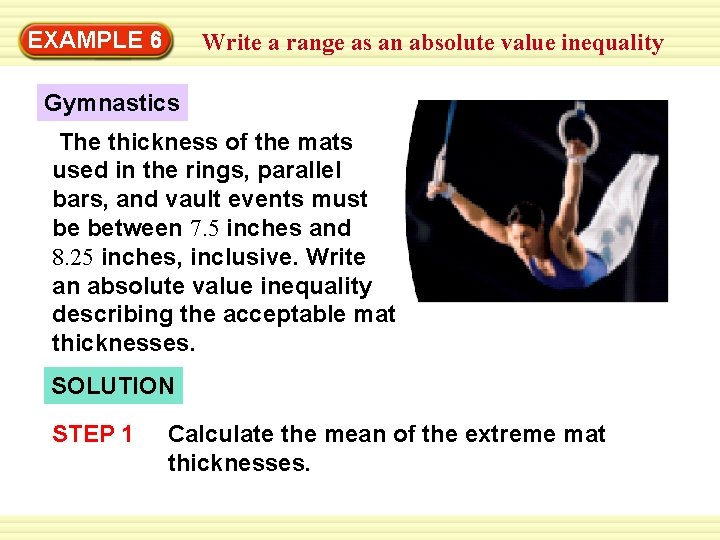
EXAMPLE 6 Write a range as an absolute value inequality Gymnastics The thickness of the mats used in the rings, parallel bars, and vault events must be between 7. 5 inches and 8. 25 inches, inclusive. Write an absolute value inequality describing the acceptable mat thicknesses. SOLUTION STEP 1 Calculate the mean of the extreme mat thicknesses.
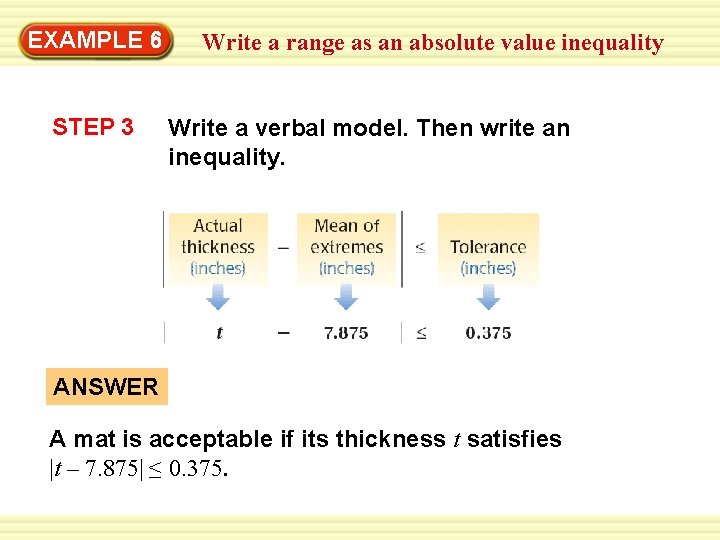
EXAMPLE 6 STEP 3 Write a range as an absolute value inequality Write a verbal model. Then write an inequality. ANSWER A mat is acceptable if its thickness t satisfies |t – 7. 875| ≤ 0. 375.
Solving Absolute Value Review Inequalities
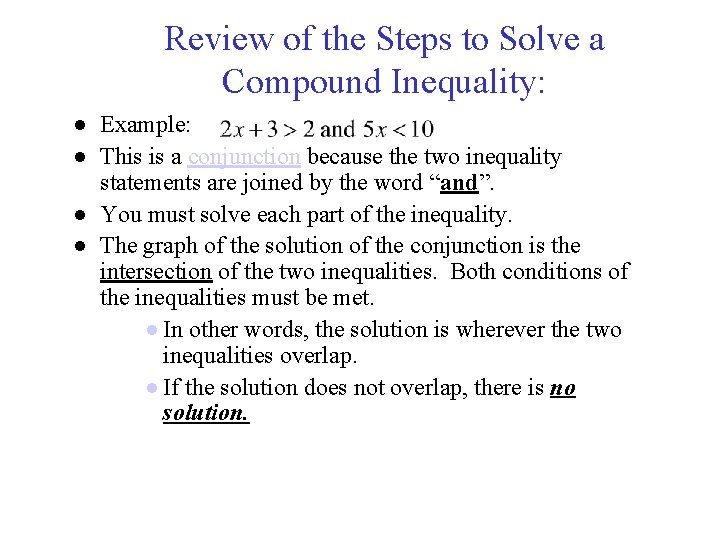
Review of the Steps to Solve a Compound Inequality: ● Example: ● This is a conjunction because the two inequality statements are joined by the word “and”. ● You must solve each part of the inequality. ● The graph of the solution of the conjunction is the intersection of the two inequalities. Both conditions of the inequalities must be met. ● In other words, the solution is wherever the two inequalities overlap. ● If the solution does not overlap, there is no solution.
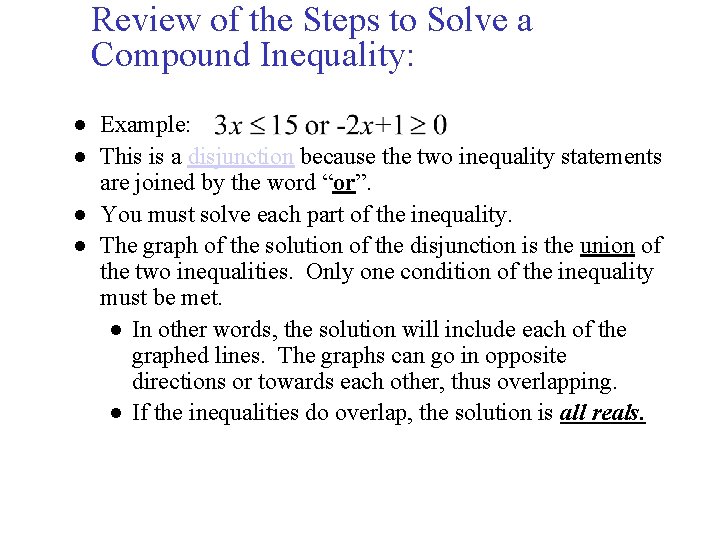
Review of the Steps to Solve a Compound Inequality: ● Example: ● This is a disjunction because the two inequality statements are joined by the word “or”. ● You must solve each part of the inequality. ● The graph of the solution of the disjunction is the union of the two inequalities. Only one condition of the inequality must be met. ● In other words, the solution will include each of the graphed lines. The graphs can go in opposite directions or towards each other, thus overlapping. ● If the inequalities do overlap, the solution is all reals.
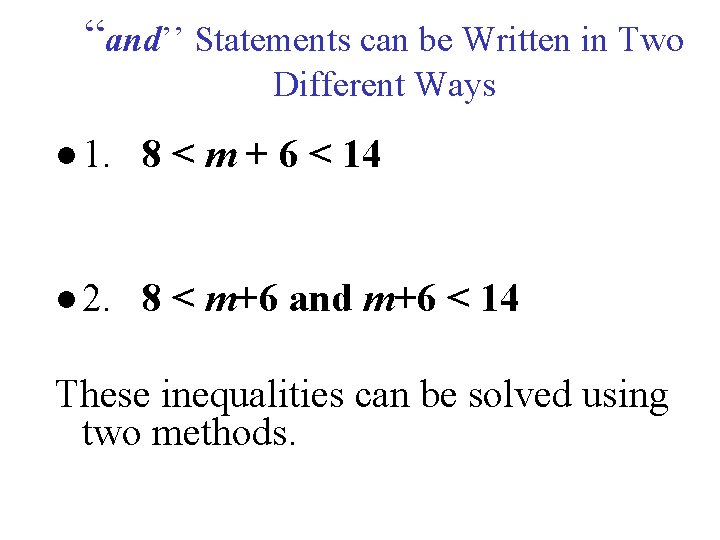
“and’’ Statements can be Written in Two Different Ways ● 1. 8 < m + 6 < 14 ● 2. 8 < m+6 and m+6 < 14 These inequalities can be solved using two methods.
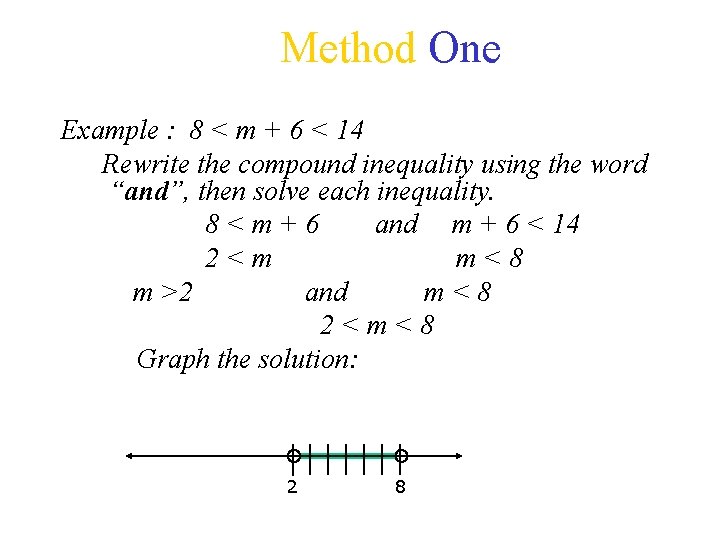
Method One Example : 8 < m + 6 < 14 Rewrite the compound inequality using the word “and”, then solve each inequality. 8<m+6 and m + 6 < 14 2<m m<8 m >2 and m<8 2<m<8 Graph the solution: 2 8
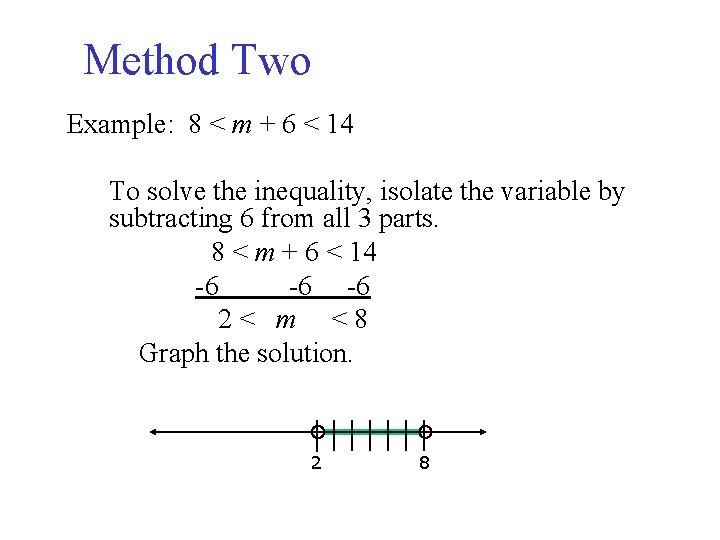
Method Two Example: 8 < m + 6 < 14 To solve the inequality, isolate the variable by subtracting 6 from all 3 parts. 8 < m + 6 < 14 -6 -6 -6 2< m <8 Graph the solution. 2 8
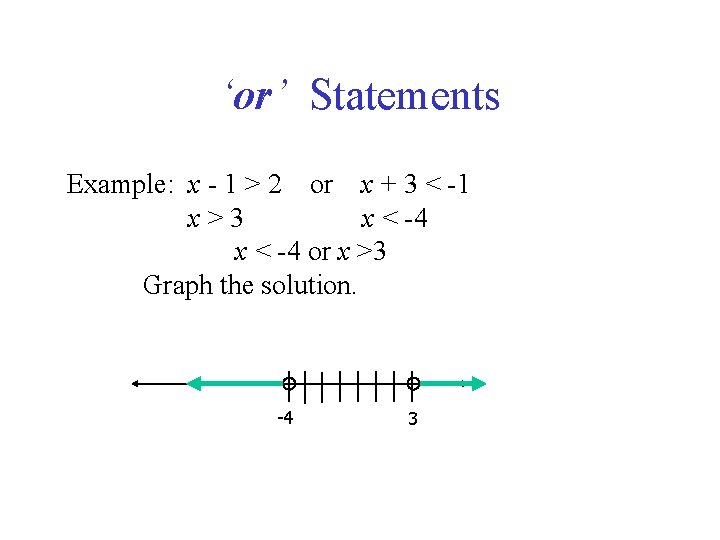
‘or’ Statements Example: x - 1 > 2 or x + 3 < -1 x>3 x < -4 or x >3 Graph the solution. -4 3
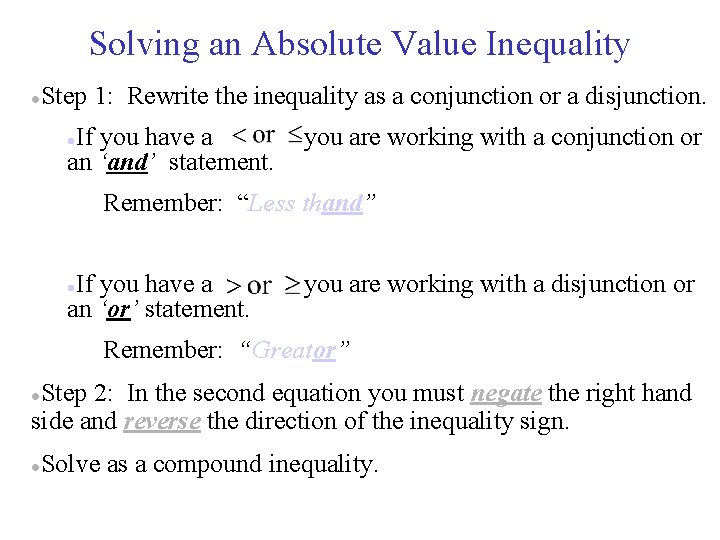
Solving an Absolute Value Inequality ● Step 1: Rewrite the inequality as a conjunction or a disjunction. If you have a an ‘and’ statement. ● you are working with a conjunction or Remember: “Less thand” If you have a an ‘or’ statement. ● you are working with a disjunction or Remember: “Greator” Step 2: In the second equation you must negate the right hand side and reverse the direction of the inequality sign. ● ● Solve as a compound inequality.
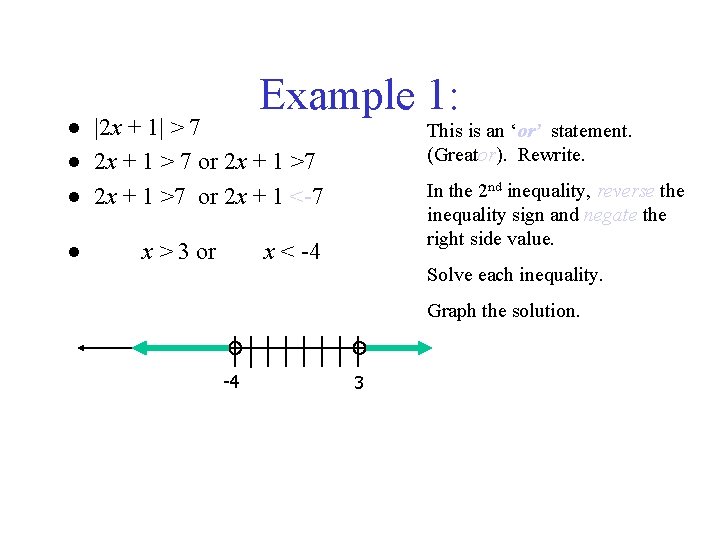
Example 1: ● |2 x + 1| > 7 ● 2 x + 1 > 7 or 2 x + 1 >7 ● 2 x + 1 >7 or 2 x + 1 <-7 ● x > 3 or This is an ‘or’ statement. (Greator). Rewrite. In the 2 nd inequality, reverse the inequality sign and negate the right side value. x < -4 Solve each inequality. Graph the solution. -4 3
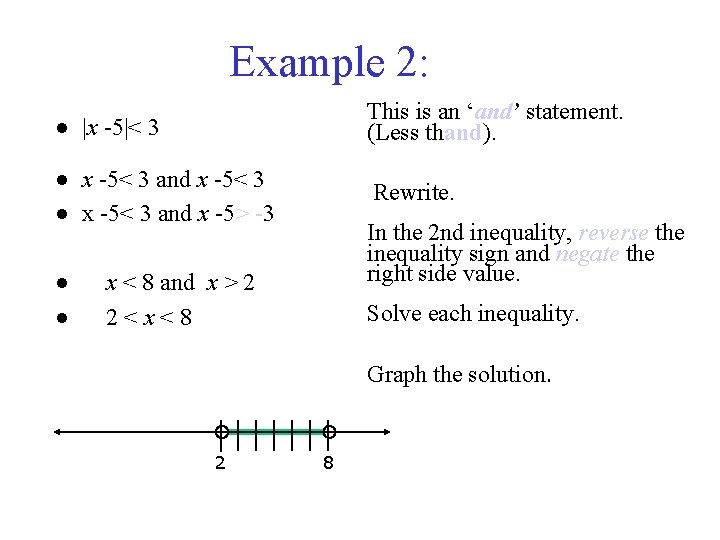
Example 2: ● |x -5|< 3 This is an ‘and’ statement. (Less thand). ● x -5< 3 and x -5< 3 ● x -5< 3 and x -5> -3 Rewrite. ● ● In the 2 nd inequality, reverse the inequality sign and negate the right side value. x < 8 and x > 2 2<x<8 Solve each inequality. Graph the solution. 2 8
- Slides: 36