
EXAMPLE 1 Find an inverse relation Find an
- Slides: 6
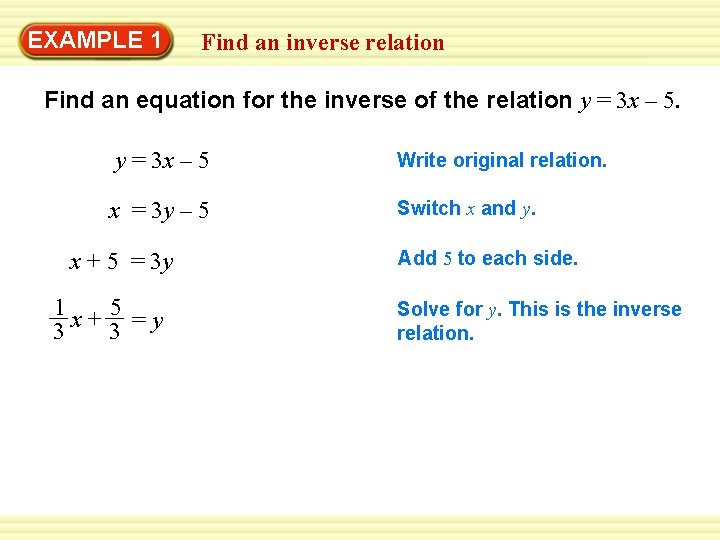
EXAMPLE 1 Find an inverse relation Find an equation for the inverse of the relation y = 3 x – 5 Write original relation. x = 3 y – 5 Switch x and y. x + 5 = 3 y 1 x+ 5 3 3 =y Add 5 to each side. Solve for y. This is the inverse relation.
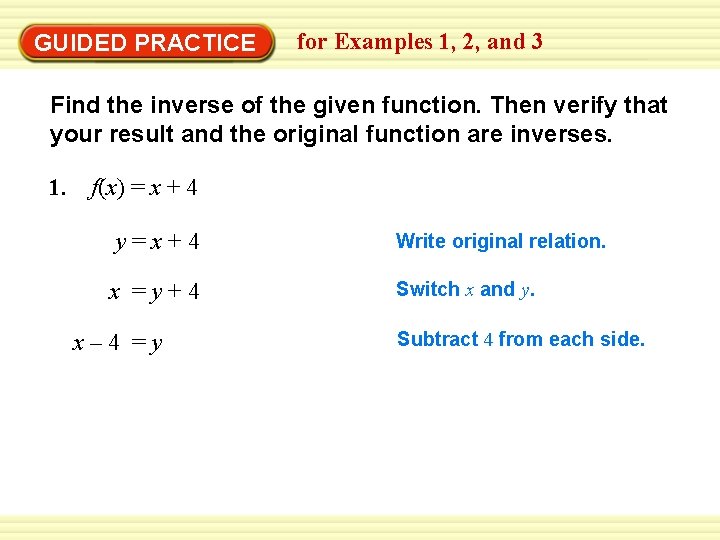
GUIDED PRACTICE for Examples 1, 2, and 3 Find the inverse of the given function. Then verify that your result and the original function are inverses. 1. f(x) = x + 4 y=x+4 Write original relation. x =y+4 Switch x and y. x– 4 =y Subtract 4 from each side.
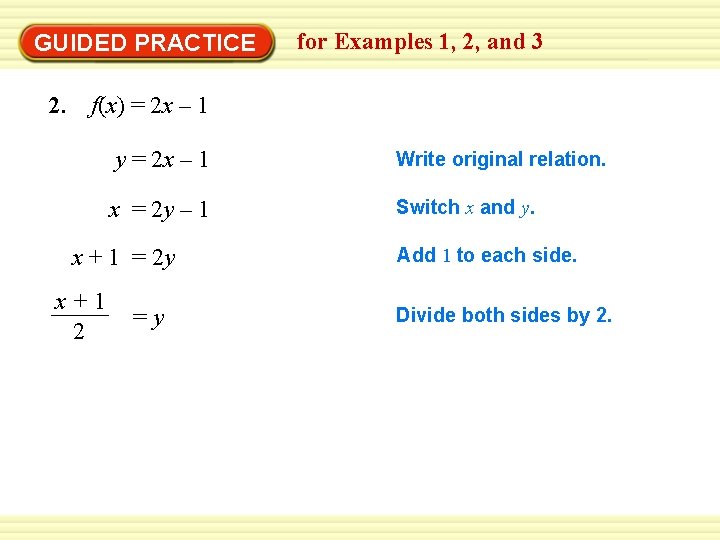
GUIDED PRACTICE for Examples 1, 2, and 3 2. f(x) = 2 x – 1 y = 2 x – 1 Write original relation. x = 2 y – 1 Switch x and y. x + 1 = 2 y x+1 2 =y Add 1 to each side. Divide both sides by 2.
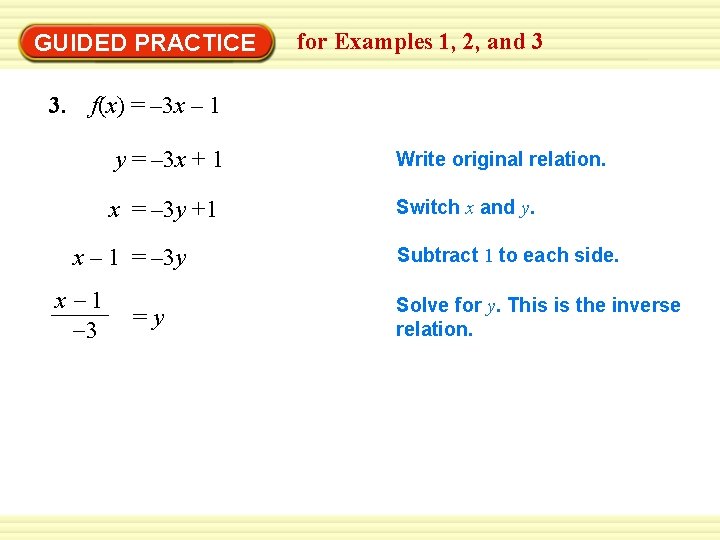
GUIDED PRACTICE for Examples 1, 2, and 3 3. f(x) = – 3 x – 1 y = – 3 x + 1 Write original relation. x = – 3 y +1 Switch x and y. x – 1 = – 3 y x 1 3 =y Subtract 1 to each side. Solve for y. This is the inverse relation.
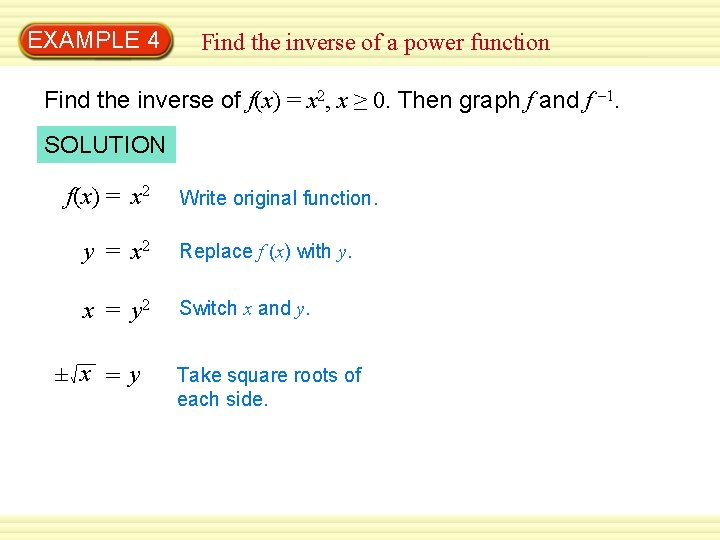
EXAMPLE 4 Find the inverse of a power function Find the inverse of f(x) = x 2, x ≥ 0. Then graph f and f – 1. SOLUTION f(x) = x 2 Write original function. y = x 2 Replace f (x) with y. x = y 2 Switch x and y. ± x =y Take square roots of each side.
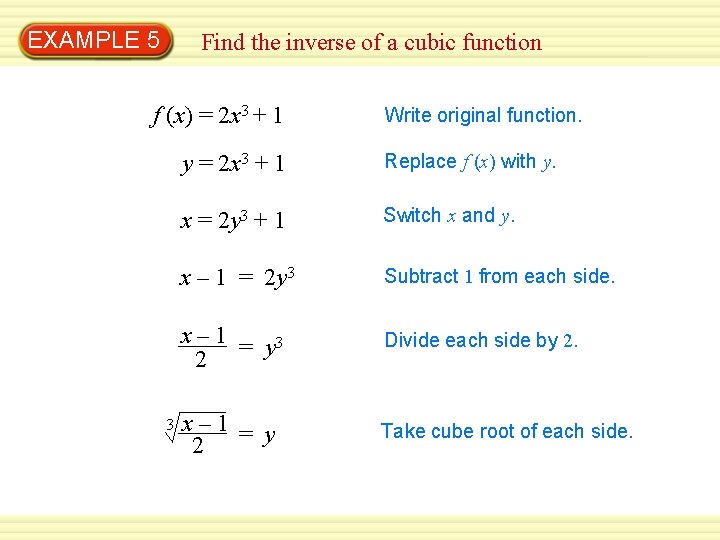
EXAMPLE 5 Find the inverse of a cubic function f (x) = 2 x 3 + 1 3 Write original function. y = 2 x 3 + 1 Replace f (x) with y. x = 2 y 3 + 1 Switch x and y. x – 1 = 2 y 3 Subtract 1 from each side. x – 1 = y 3 2 Divide each side by 2. x– 1 = y 2 Take cube root of each side.