
Example 1 2 3 4 Figure 1 gsand
- Slides: 10
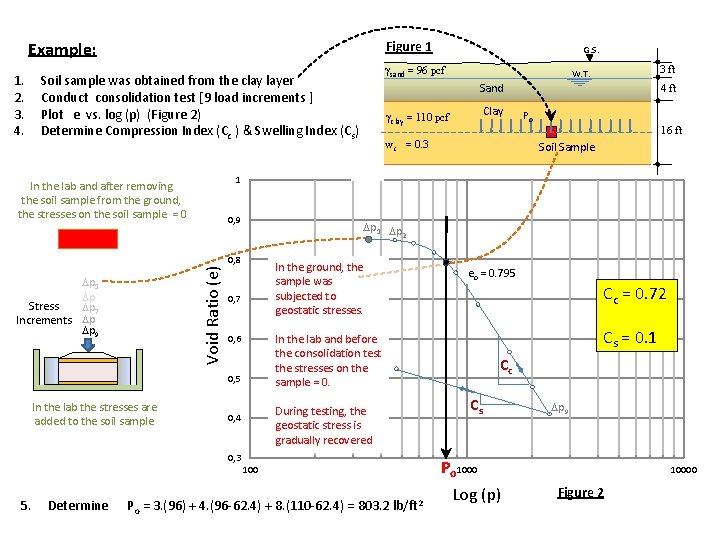
Example: 1. 2. 3. 4. Figure 1 gsand = 96 pcf Soil sample was obtained from the clay layer Conduct consolidation test [9 load increments ] Plot e vs. log (p) (Figure 2) Determine Compression Index (Cc ) & Swelling Index (Cs) 0, 9 Sand Void Ratio (e) 0, 7 Soil Sample eo = 0. 795 Cc = 0. 72 Cs = 0. 1 In the lab and before the consolidation test the stresses on the sample = 0. 0, 6 During testing, the geostatic stress is gradually recovered 0, 4 0, 3 100 Determine Po 16 ft wc = 0. 3 In the ground, the sample was subjected to geostatic stresses. 0, 5 5. Clay gclay = 110 pcf 4 ft Dp 1 Dp 2 0, 8 In the lab the stresses are added to the soil sample 3 ft W. T. 1 In the lab and after removing the soil sample from the ground, the stresses on the soil sample = 0 Dp 1 Dp Stress Dp 7 Dp Increments Dp 9 G. S. Po = 3. (96) + 4. (96 -62. 4) + 8. (110 -62. 4) = 803. 2 lb/ft 2 Cc Cs Dp 9 Po 1000 Log (p) 10000 Figure 2
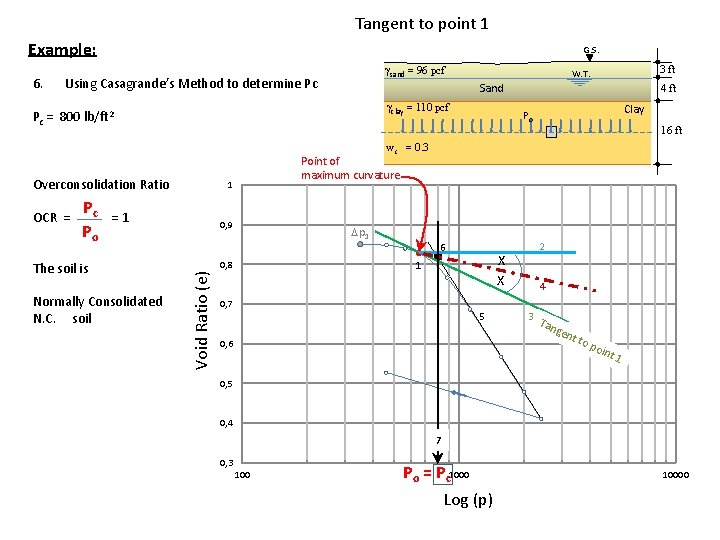
Tangent to point 1 Example: 6. G. S. gsand = 96 pcf Using Casagrande’s Method to determine Pc 3 ft W. T. Sand gclay = 110 pcf Pc = 800 lb/ft 2 4 ft Clay Po 16 ft wc = 0. 3 Overconsolidation Ratio Pc Po 1 =1 The soil is Normally Consolidated N. C. soil 0, 9 Dp 1 0, 8 Void Ratio (e) OCR = Point of maximum curvature 6 X X 1 0, 7 2 5 0, 6 4 3 Tan gen t to poi nt 1 0, 5 0, 4 7 0, 3 100 Po = Pc 1000 Log (p) 10000
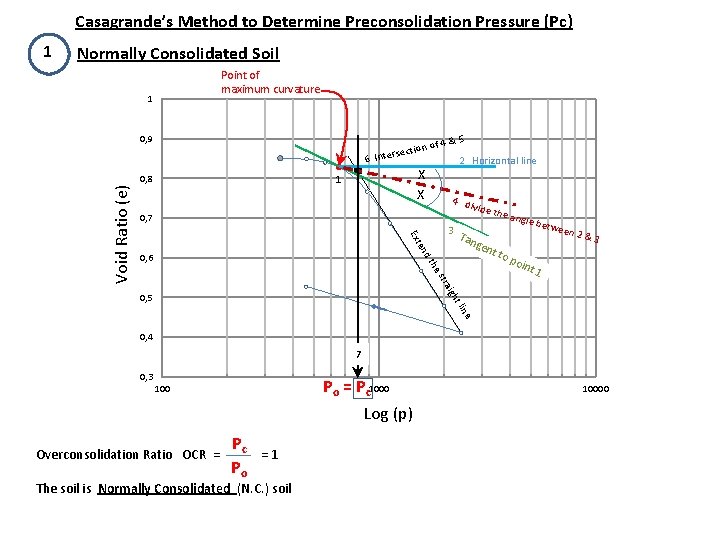
Casagrande’s Method to Determine Preconsolidation Pressure (Pc) 1 Normally Consolidated Soil Point of maximum curvature 1 0, 9 n rsectio 6 Inte 2 Horizontal line X X 1 4 di vide 0, 7 3 ten Ex 0, 6 Tan the a ngle gen he dt t to betw een 2 &3 poi nt 1 aig str Void Ratio (e) 0, 8 5 of 4 & ht 0, 5 e lin 0, 4 7 0, 3 Po = Pc 1000 100 Log (p) Overconsolidation Ratio OCR = Pc Po =1 The soil is Normally Consolidated (N. C. ) soil 10000
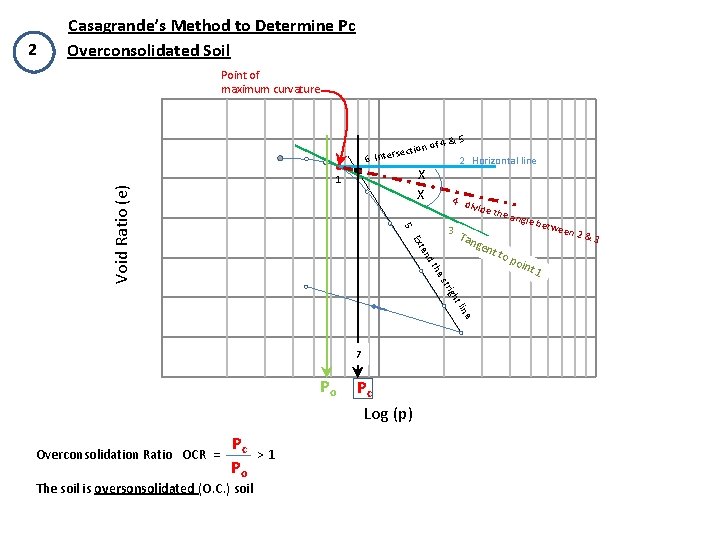
2 Casagrande’s Method to Determine Pc Overconsolidated Soil Point of maximum curvature n rsectio 6 Inte 5 2 Horizontal line X X 1 4 di vide 3 5 Void Ratio (e) of 4 & he str ne t li igh 7 Po Overconsolidation Ratio OCR = Pc Po The soil is oversonsolidated (O. C. ) soil >1 Pc Log (p) ngle gen dt ten Ex Tan the a t to poi betw nt 1 een 2 &3
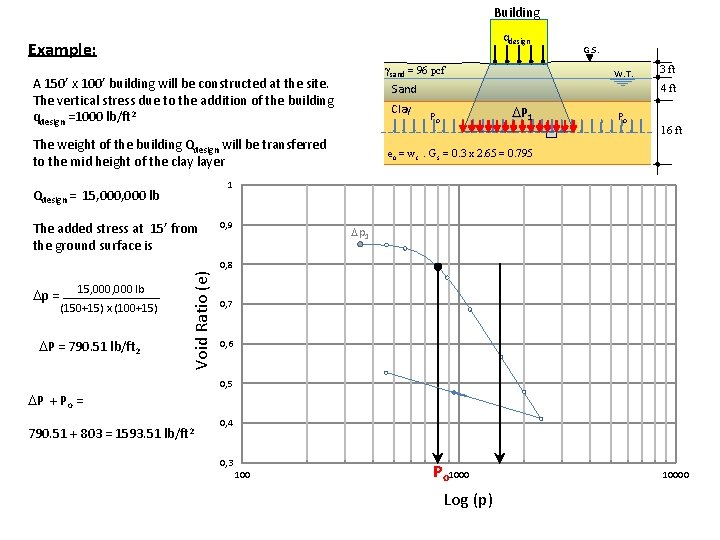
Building qdesign Example: gsand = 96 pcf A 150’ x 100’ building will be constructed at the site. The vertical stress due to the addition of the building qdesign =1000 lb/ft 2 G. S. W. T. Sand Clay The weight of the building Qdesign will be transferred to the mid height of the clay layer 3 ft 4 ft D P 1 Po Po 16 ft eo = wc. Gs = 0. 3 x 2. 65 = 0. 795 1 Qdesign = 15, 000 lb The added stress at 15’ from the ground surface is 0, 9 Dp 1 Dp = 15, 000 lb (150+15) x (100+15) DP = 790. 51 lb/ft 2 Void Ratio (e) 0, 8 0, 7 0, 6 0, 5 DP + Po = 790. 51 + 803 = 1593. 51 lb/ft 2 0, 4 0, 3 100 Po 1000 Log (p) 10000
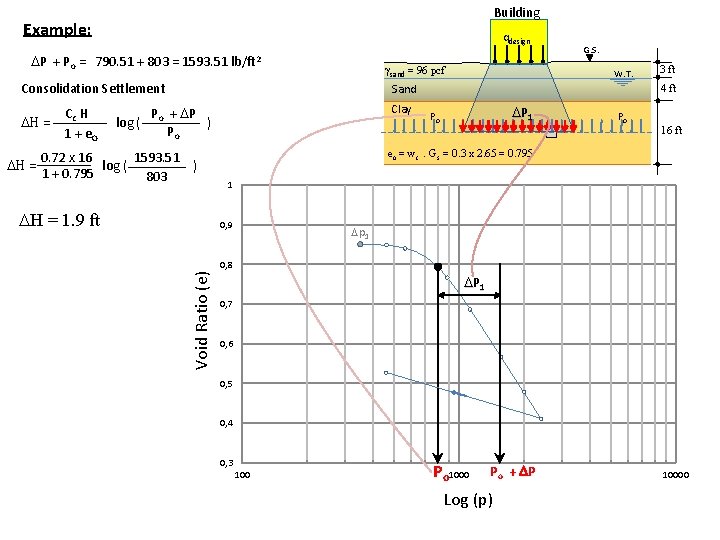
Building Example: qdesign DP + Po = 790. 51 + 803 = 1593. 51 lb/ft 2 gsand = 96 pcf Consolidation Settlement DH = Cc H 1 + e. O log ( G. S. W. T. Sand Clay Po + DP ) Po 0. 72 x 16 1593. 51 log ( ) 1 + 0. 795 803 DH = 1. 9 ft 3 ft 4 ft D P 1 Po Po 16 ft eo = wc. Gs = 0. 3 x 2. 65 = 0. 795 1 0, 9 Dp 1 Void Ratio (e) 0, 8 D P 1 0, 7 0, 6 0, 5 0, 4 0, 3 100 Po 1000 Po + DP Log (p) 10000
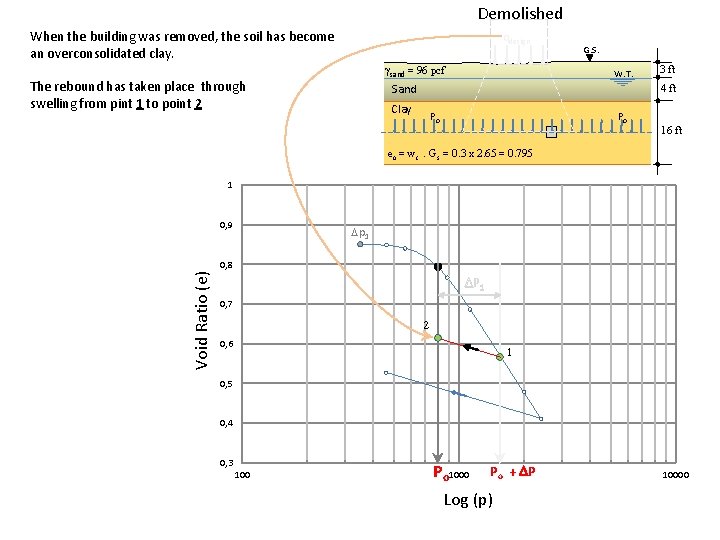
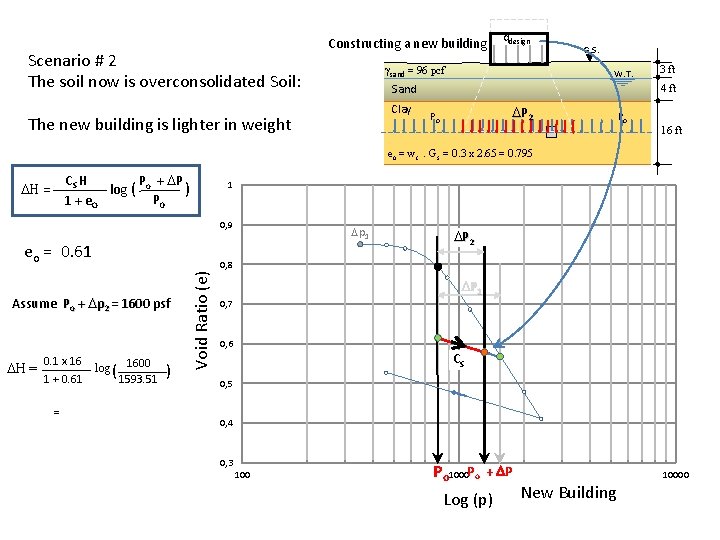
Demolished When the building was removed, the soil has become an overconsolidated clay. qdesign gsand = 96 pcf The rebound has taken place through swelling from pint 1 to point 2 G. S. W. T. Sand Clay 3 ft 4 ft Po Po 16 ft eo = wc. Gs = 0. 3 x 2. 65 = 0. 795 1 0, 9 Dp 1 Void Ratio (e) 0, 8 D P 1 0, 7 2 0, 6 1 0, 5 0, 4 0, 3 100 Po 1000 Po + DP Log (p) 10000
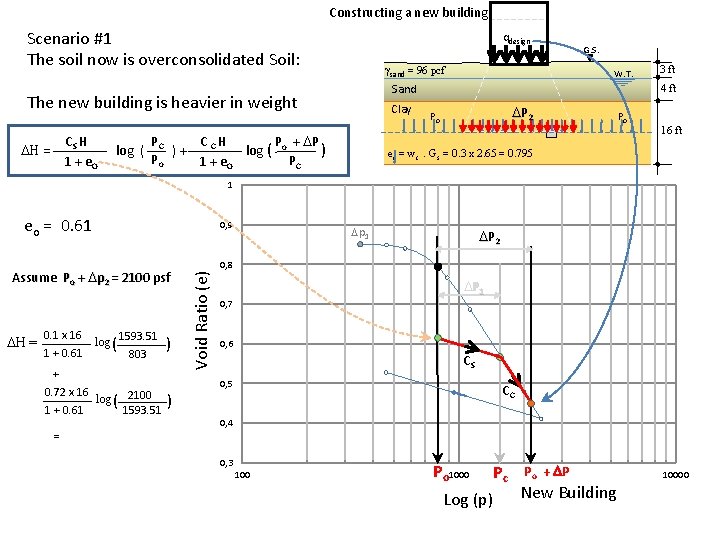
Constructing a new building Scenario #1 The soil now is overconsolidated Soil: qdesign gsand = 96 pcf DH = W. T. Sand The new building is heavier in weight CS H 1 + e. O G. S. Clay P C CH P + DP log ( C ) + log ( o ) Po PC 1 + e. O 3 ft 4 ft D P 2 Po Po 16 ft eo = wc. Gs = 0. 3 x 2. 65 = 0. 795 1 eo = 0. 61 0, 9 DH = 0. 1 x 16 1 + 0. 61 log ( 1593. 51 803 + 0. 72 x 16 log ( 2100 1 + 0. 61 1593. 51 = ) D P 2 0, 8 Void Ratio (e) Assume Po + Dp 2 = 2100 psf Dp 1 D P 1 0, 7 0, 6 CS 0, 5 CC ) 0, 4 0, 3 100 Po 1000 Pc Log (p) Po + DP New Building 10000
Scenario # 2 The soil now is overconsolidated Soil: Constructing a new building qdesign gsand = 96 pcf G. S. W. T. Sand Clay The new building is lighter in weight 3 ft 4 ft D P 2 Po Po 16 ft eo = wc. Gs = 0. 3 x 2. 65 = 0. 795 CS H P + DP log ( o ) P 0 1 + e. O DH = 1 0, 9 eo = 0. 61 = log ( 1600 1593. 51 ) Void Ratio (e) 0. 1 x 16 1 + 0. 61 D P 2 0, 8 Assume Po + Dp 2 = 1600 psf DH = Dp 1 D P 1 0, 7 0, 6 CS 0, 5 0, 4 0, 3 100 Po 1000 Po + DP Log (p) 10000 New Building
Example of Semi-log Scale 0, 8 0, 7 0, 6 0, 5 0, 4 0, 3 0, 2 0, 1 1 10 100