
EXAMINING FOOD NUTRIENTS AND THE BODY Food Science
EXAMINING FOOD, NUTRIENTS, AND THE BODY Food Science and Personal Nutrition UNIT 2
Why Does the Body Need Food? • Satisfy hunger and give pleasure • Provide the body with nutrients • Provide and replenish energy • Build and repair cells • Regulate body process
Turning Food Into Energy… Digestion • Mouth - Digestion begins (saliva softens food with ptyalin, teeth break up food. ) • Esophagus - Food is moved by peristaltic wave action to the stomach. • Stomach - Food is mixed with gastric juices and proteins start to break it down.
• Small Intestine - Breaks down chyme into nutrients which are absorbed by villi and digestion is complete. Waste is carried to large intestine. • Liver - Converts nutrients into different forms needed by the body and sends them into the blood stream. Nutrients are excreted if the body cannot use them. • Large Intestine - Processes waste products of digestion.
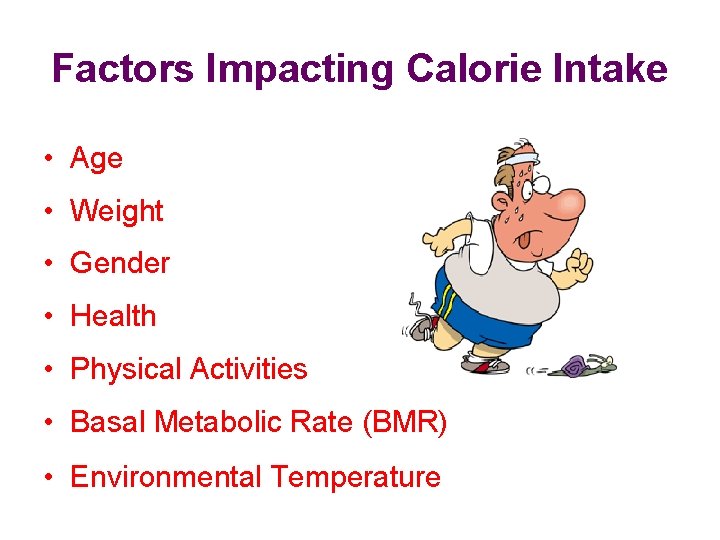
Factors Impacting Calorie Intake • Age • Weight • Gender • Health • Physical Activities • Basal Metabolic Rate (BMR) • Environmental Temperature
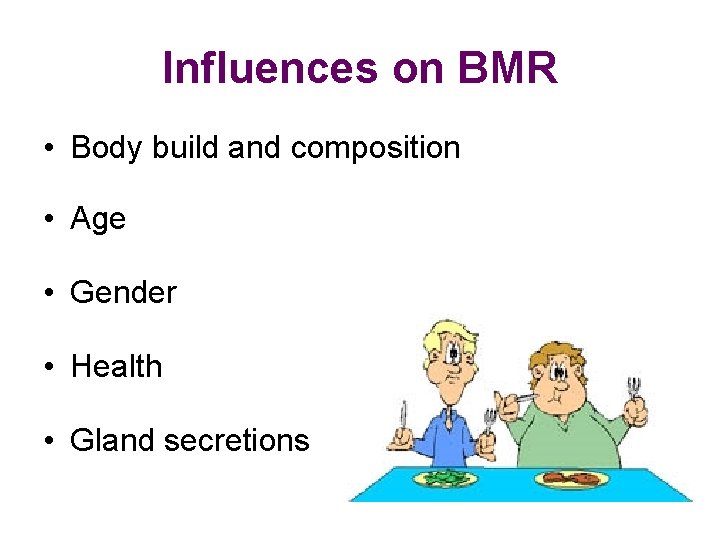
Influences on BMR • Body build and composition • Age • Gender • Health • Gland secretions
Words to Know: • compound - a substance composed of two or more elements or parts • element - a substance that cannot be broken down into simpler substances by chemical means • glycerol - a fat-related liquid contained in all fats • glycogen - a substance stored in the liver and muscles that can be converted rapidly into glucose; the storage form of carbohydrates
Words to Know: • amino acid - chemical compounds which are the building blocks of proteins • monosaccharide - simple sugars that include fructose and glucose • disaccharide - double sugars that include sucrose • fatty acids - organic acids which combine with glycerol to form fat
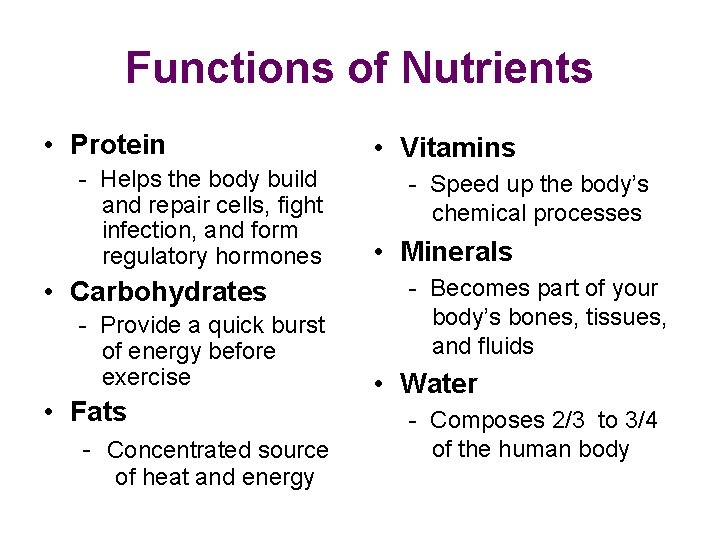
Functions of Nutrients • Protein - Helps the body build and repair cells, fight infection, and form regulatory hormones • Carbohydrates - Provide a quick burst of energy before exercise • Fats - Concentrated source of heat and energy • Vitamins - Speed up the body’s chemical processes • Minerals - Becomes part of your body’s bones, tissues, and fluids • Water - Composes 2/3 to 3/4 of the human body
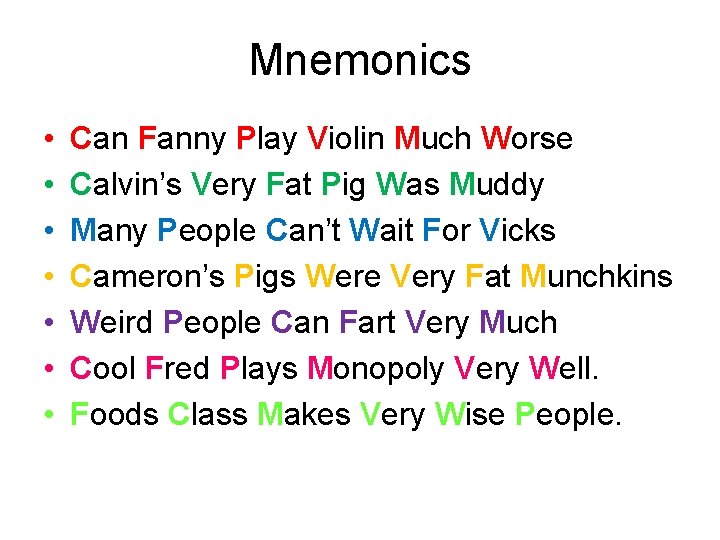
Mnemonics • • Can Fanny Play Violin Much Worse Calvin’s Very Fat Pig Was Muddy Many People Can’t Wait For Vicks Cameron’s Pigs Were Very Fat Munchkins Weird People Can Fart Very Much Cool Fred Plays Monopoly Very Well. Foods Class Makes Very Wise People.

Nutrient Density • Foods rich in nutrients and low in calories are nutrient dense. • Nutrient density is the amount of nutrients provided per calorie. • Nutrient-dense foods provide more nutrients than calories. • Low nutrient density foods have empty calories: they are high in calories without providing worthwhile nutrients.
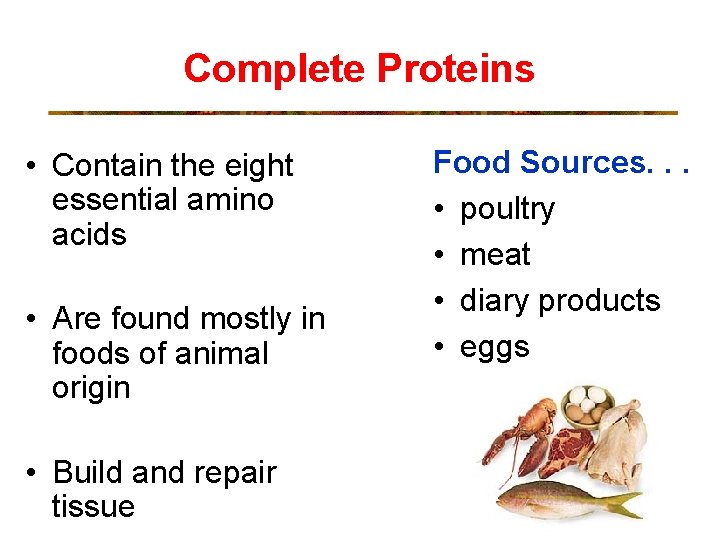
Complete Proteins • Contain the eight essential amino acids • Are found mostly in foods of animal origin • Build and repair tissue Food Sources. . . • poultry • meat • diary products • eggs
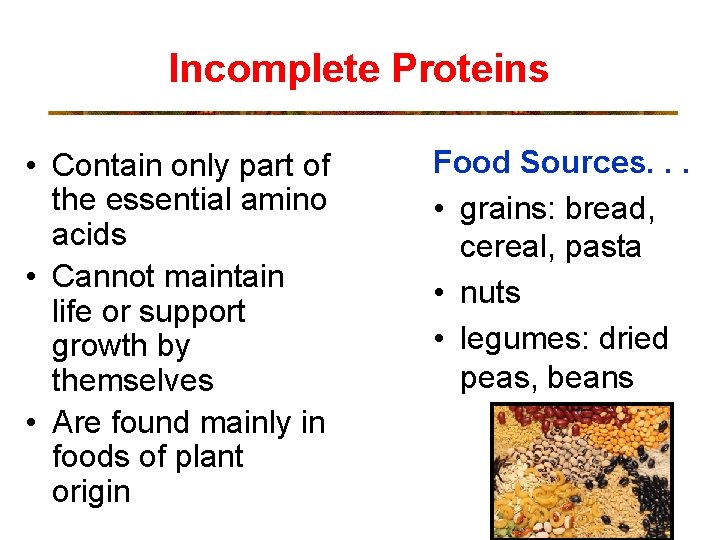
Incomplete Proteins • Contain only part of the essential amino acids • Cannot maintain life or support growth by themselves • Are found mainly in foods of plant origin Food Sources. . . • grains: bread, cereal, pasta • nuts • legumes: dried peas, beans
Food Sources of Carbohydrates • SUGAR - fruit, fruit juice, table sugar, honey, molasses, soft drinks and other sweets, milk (lactose or milk sugar) • STARCH - grains: bread, cereal, pasta, potatoes, rice, legumes (dried peas and beans) • FIBER - bran, whole grain foods, vegetables – raw and unpeeled, fruit – raw and unpeeled, nuts, seeds, popcorn, legumes
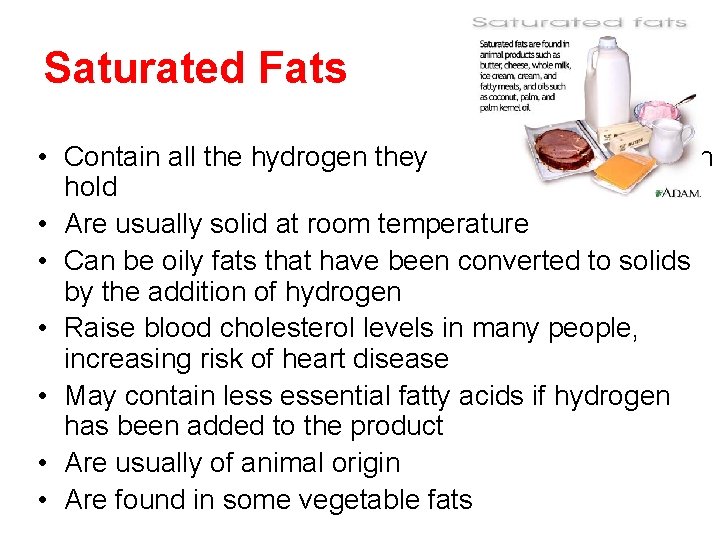
Saturated Fats • Contain all the hydrogen they can hold • Are usually solid at room temperature • Can be oily fats that have been converted to solids by the addition of hydrogen • Raise blood cholesterol levels in many people, increasing risk of heart disease • May contain less essential fatty acids if hydrogen has been added to the product • Are usually of animal origin • Are found in some vegetable fats
Unsaturated Fats • Include monounsaturated and polyunsaturated fats • Have less hydrogen than saturated fats • Are usually in liquid form at room temperature • Are usually of plant origin • Can lower blood cholesterol levels when included in the diet
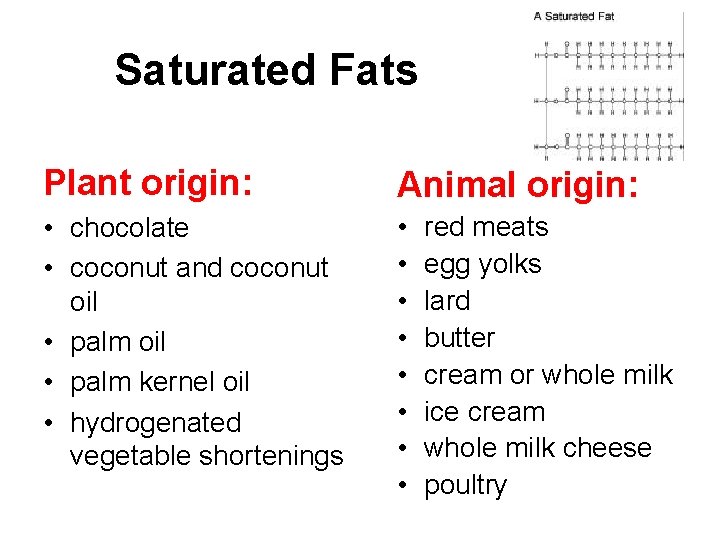
Saturated Fats Plant origin: Animal origin: • chocolate • coconut and coconut oil • palm kernel oil • hydrogenated vegetable shortenings • • red meats egg yolks lard butter cream or whole milk ice cream whole milk cheese poultry
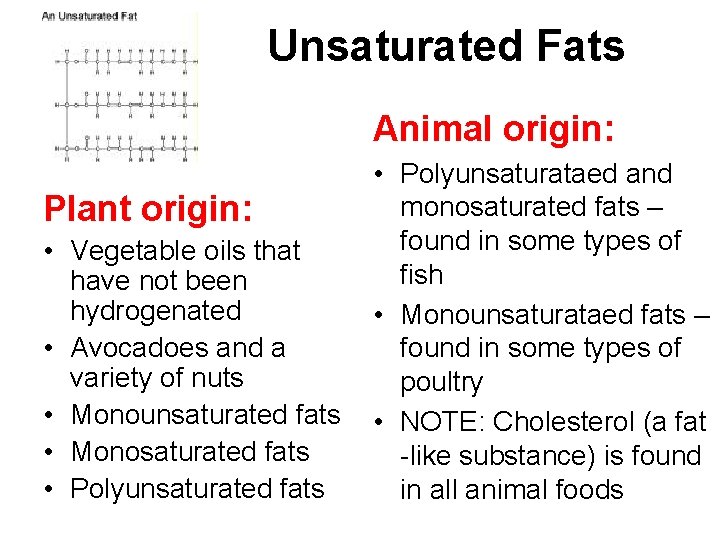
Unsaturated Fats Animal origin: Plant origin: • Vegetable oils that have not been hydrogenated • Avocadoes and a variety of nuts • Monounsaturated fats • Monosaturated fats • Polyunsaturated fats • Polyunsaturataed and monosaturated fats – found in some types of fish • Monounsaturataed fats – found in some types of poultry • NOTE: Cholesterol (a fat -like substance) is found in all animal foods
Cholesterol • Fat-like substance in our cells that help carry out body processes. • Our body makes all we need. • LDL – bad cholesterol (lousy cholesterol) • HDL – good cholesterol • High levels cause heart disease and stokes as it builds up in the arteries and prevents blood flow
Fat-Soluble and Water-Soluble Vitamins Fat-soluble Vitamins • Vitamin A, D, E, and K • Can be stored in the body and cause toxic effects • Are not absorbed properly by digestive track unless a sufficient amount of fatty foods are included in diet • Must be transported to various body sites in blood lips • Can be lost due to poor storage techniques • Are not destroyed by ordinary cooking methods Water-soluble Vitamins • Vitamin C, B 1 (thiamine), B 2 (riboflavin), B 6, B 12, Niacin, Folic acid, Biotin, and Pantothenic acid • Are usually not stored in body because they are excreted in urine • Can be lost due to poor storage techniques • Are easily destroyed by ordinary cooking methods • Best preserved by cooking for a short time in a covered container and small amount of boiling water
Food Sources of Vitamins Fat-soluble • Vitamin A - liver, whole milk, cream, butter, cheese, egg yolk, green and yellow vegetables • Vitamin D - vitamin D fortified milk, egg yolks, liver • Vitamin E - vegetable oils, egg yolks • Vitamin K - green leafy vegetables, liver, cauliflower, cabbage Water-soluble Vitamin C - citrus fruits, tomatoes, cabbage, potatoes, strawberries Vitamin B 1 - enriched and whole grain cereals, pork, legumes, liver, oysters Vitamin B 2 - milk, cheese, yogurt, liver, legumes, whole grain and enriched cereal Vitamin B 6 - whole grains, bananas, oatmeal, meat
Food Sources of Vitamins Water-soluble • Vitamin B 12 - lean meat, organ meat, eggs, dairy products • Niacin - enriched breads and cereals, organ meats, legumes, nuts • Folic acid - green leafy vegetables, organ meats, asparagus, lima beans • Biotin - egg yolk, organ meats, mushrooms, peanuts, dark green vegetables • Pantothenic acid - organ meats, eggs, whole grain cereals and breads, nuts, dark green vegetables
Minerals • Calcium, Phosphorus, and Magnesium help build strong bones and teeth. • Iron – Builds red blood cells and prevents anemia • Sodium helps maintain the water balance in your body.
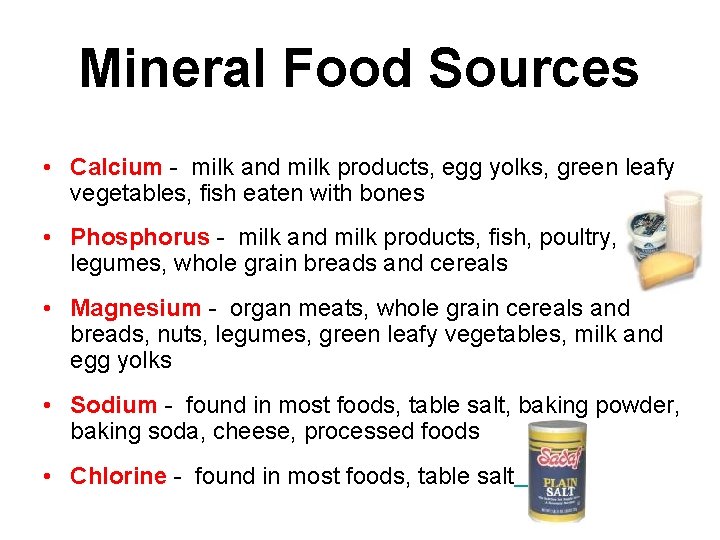
Mineral Food Sources • Calcium - milk and milk products, egg yolks, green leafy vegetables, fish eaten with bones • Phosphorus - milk and milk products, fish, poultry, legumes, whole grain breads and cereals • Magnesium - organ meats, whole grain cereals and breads, nuts, legumes, green leafy vegetables, milk and egg yolks • Sodium - found in most foods, table salt, baking powder, baking soda, cheese, processed foods • Chlorine - found in most foods, table salt
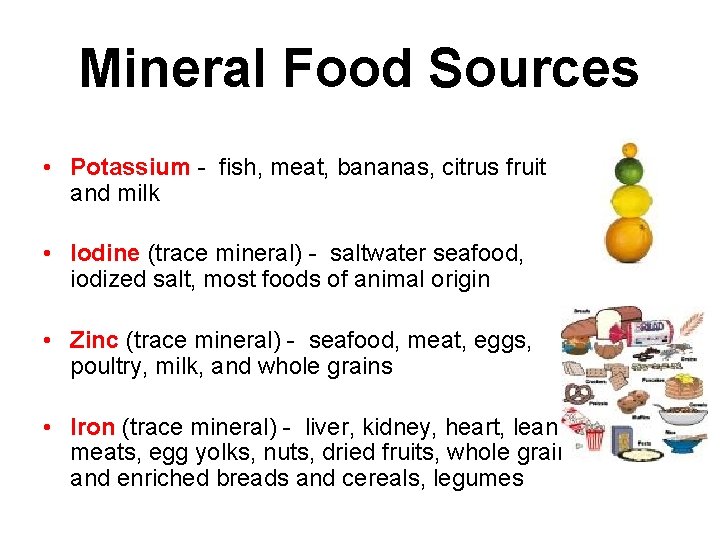
Mineral Food Sources • Potassium - fish, meat, bananas, citrus fruit and milk • Iodine (trace mineral) - saltwater seafood, iodized salt, most foods of animal origin • Zinc (trace mineral) - seafood, meat, eggs, poultry, milk, and whole grains • Iron (trace mineral) - liver, kidney, heart, lean meats, egg yolks, nuts, dried fruits, whole grain and enriched breads and cereals, legumes
Impact of Nutrient Levels in the Diet Too Much/Not Enough
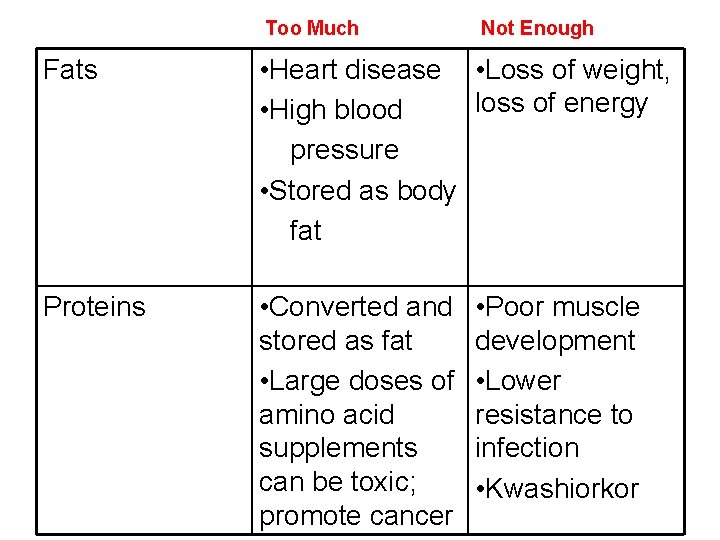
Too Much Not Enough Fats • Heart disease • Loss of weight, loss of energy • High blood pressure • Stored as body fat Proteins • Converted and stored as fat • Large doses of amino acid supplements can be toxic; promote cancer • Poor muscle development • Lower resistance to infection • Kwashiorkor
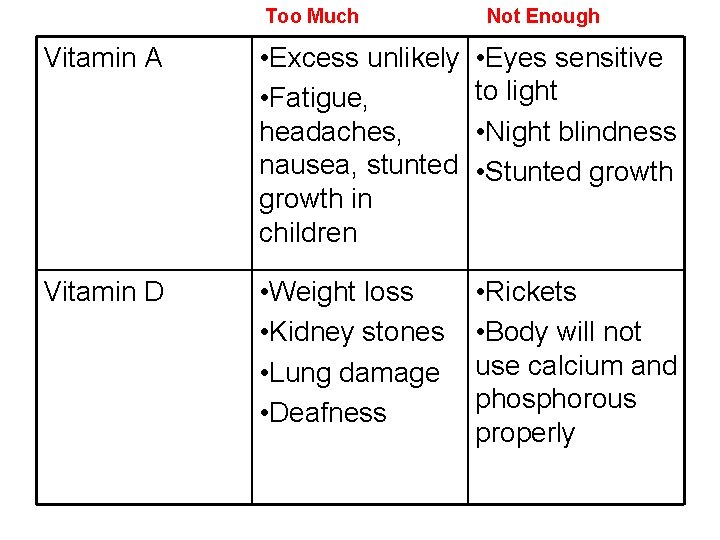
Too Much Not Enough Vitamin A • Excess unlikely • Fatigue, headaches, nausea, stunted growth in children • Eyes sensitive to light • Night blindness • Stunted growth Vitamin D • Weight loss • Kidney stones • Lung damage • Deafness • Rickets • Body will not use calcium and phosphorous properly
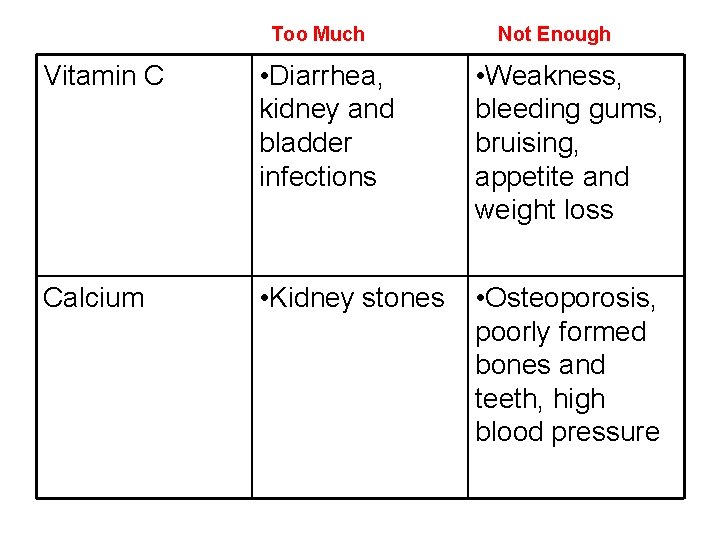
Too Much Not Enough Vitamin C • Diarrhea, kidney and bladder infections • Weakness, bleeding gums, bruising, appetite and weight loss Calcium • Kidney stones • Osteoporosis, poorly formed bones and teeth, high blood pressure
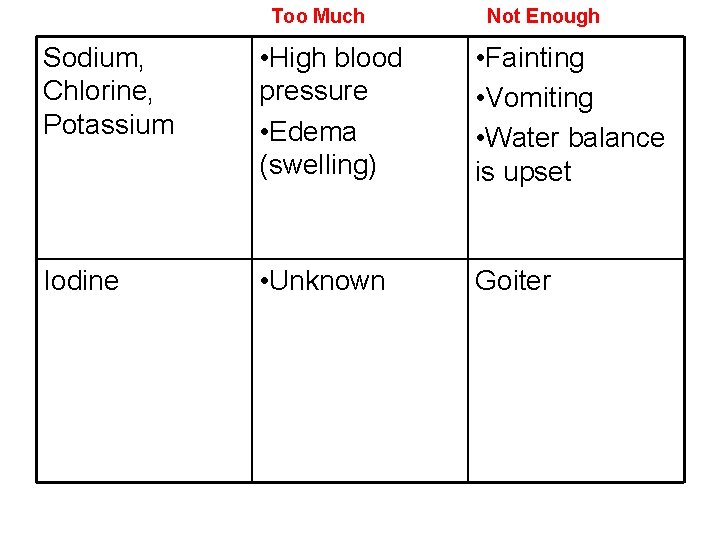
Too Much Not Enough Sodium, Chlorine, Potassium • High blood pressure • Edema (swelling) • Fainting • Vomiting • Water balance is upset Iodine • Unknown Goiter
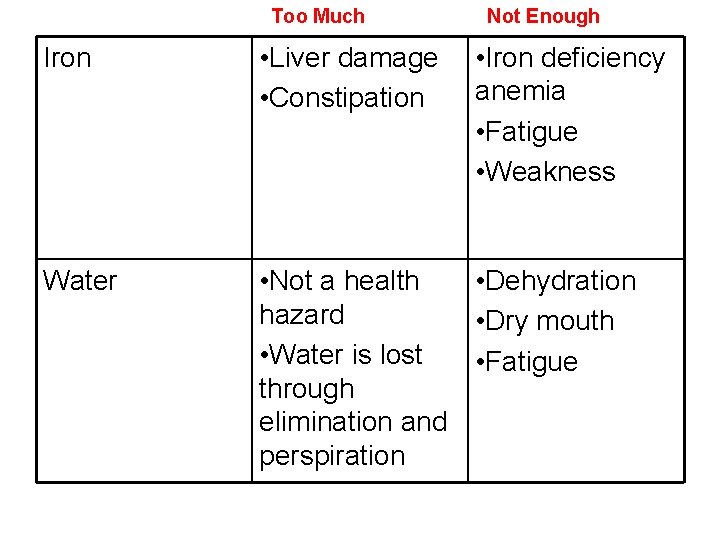
Too Much Not Enough Iron • Liver damage • Constipation • Iron deficiency anemia • Fatigue • Weakness Water • Not a health • Dehydration hazard • Dry mouth • Water is lost • Fatigue through elimination and perspiration

- Slides: 32