
EXAMINING EVIDENCE USING FINGERPRINT ANALYSIS FORENSIC BIOLOGY LAB

EXAMINING EVIDENCE USING FINGERPRINT ANALYSIS FORENSIC BIOLOGY LAB I
INTRODUCTION Fingerprint continues to be one of the most important and valuable pieces of forensic evidence Unique for each person Even slight differences in identical twins Can compare fingerprints at a crime scene with a suspect’s fingerprint record Can establish a person’s presence at a particular location
BACKGROUND Human skin represents the body’s first line of defense against foreign invaders Composed of epidermal outer layer and dermal inner layer Surface between epidermis and dermis is usually uneven Friction ridge responsible for one-of-a-kind fingerprint patterns Friction ridge forms in 8 th gestational week and remains unchanged throughout life Scar tissue may change the ridge Sweat glands located in dermis leave an identifiable residue conforming to the pattern of an individual’s fingerprint
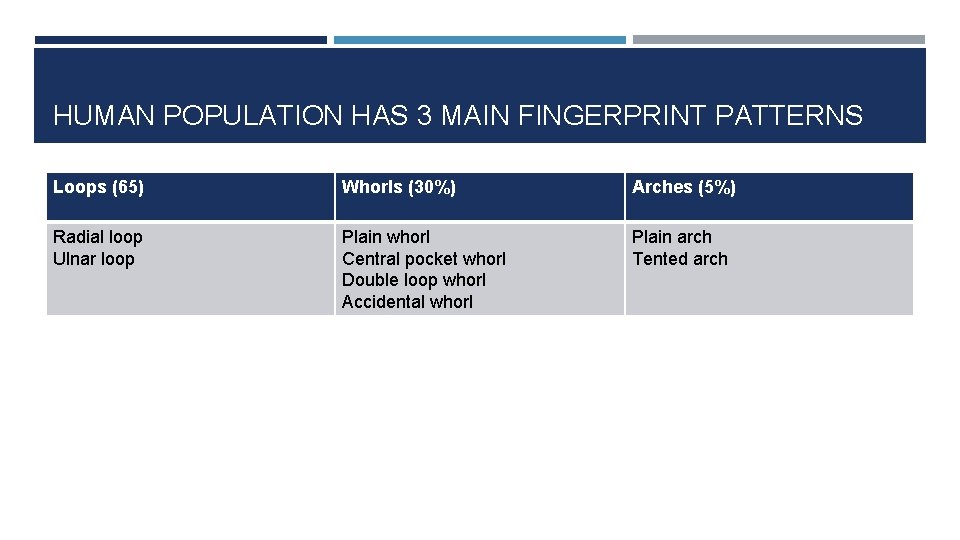
HUMAN POPULATION HAS 3 MAIN FINGERPRINT PATTERNS Loops (65) Whorls (30%) Arches (5%) Radial loop Ulnar loop Plain whorl Central pocket whorl Double loop whorl Accidental whorl Plain arch Tented arch

IAFIS (INTEGRATED AUTOMATED FINGERPRINT IDENTIFICATION SYSTEM) Processed through IAFIS Submitted electronically or by mail Processed and returned within 2 hours for electronic and 24 hours for mail
RARE TWIN MURDER CASE SOLVED BY FINGERPRINTS In 2008, police arrested Donald Smith for carjacking and murder of a preschool teacher in Gwinnett Co, GA Police were certain they had the right man Smith matched witness descriptions Appeared on nearby surveillance cameras DNA evidence proving he was at crime scene Donald Smith claimed his twin brother Ronald Smith was to blame Fingerprints at the crime scene belongs to Ronald and not Donald How does identical twin’s DNA fingerprint compare to an actual “fingerprint”? Complete pgs. 43 -54 in your lab manual
- Slides: 6