
Examining Deprivation and Threat Dimensions of Trauma Exposure
- Slides: 1
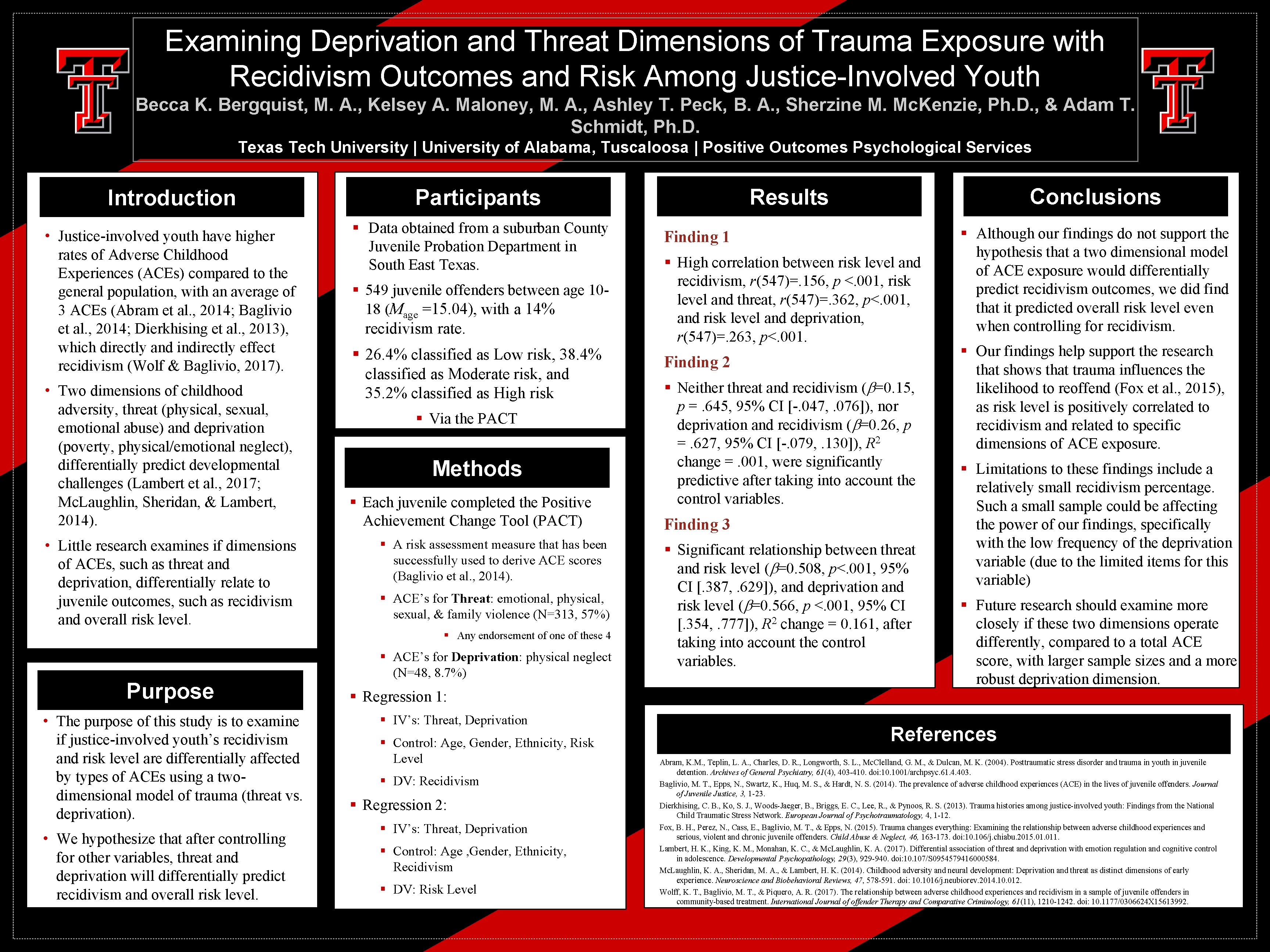
Examining Deprivation and Threat Dimensions of Trauma Exposure with Recidivism Outcomes and Risk Among Justice-Involved Youth Becca K. Bergquist, M. A. , Kelsey A. Maloney, M. A. , Ashley T. Peck, B. A. , Sherzine M. Mc. Kenzie, Ph. D. , & Adam T. Schmidt, Ph. D. Texas Tech University | University of Alabama, Tuscaloosa | Positive Outcomes Psychological Services Introduction • Justice-involved youth have higher rates of Adverse Childhood Experiences (ACEs) compared to the general population, with an average of 3 ACEs (Abram et al. , 2014; Baglivio et al. , 2014; Dierkhising et al. , 2013), which directly and indirectly effect recidivism (Wolf & Baglivio, 2017). • Two dimensions of childhood adversity, threat (physical, sexual, emotional abuse) and deprivation (poverty, physical/emotional neglect), differentially predict developmental challenges (Lambert et al. , 2017; Mc. Laughlin, Sheridan, & Lambert, 2014). • Little research examines if dimensions of ACEs, such as threat and deprivation, differentially relate to juvenile outcomes, such as recidivism and overall risk level. § Data obtained from a suburban County Juvenile Probation Department in South East Texas. § 549 juvenile offenders between age 1018 (Mage =15. 04), with a 14% recidivism rate. § 26. 4% classified as Low risk, 38. 4% classified as Moderate risk, and 35. 2% classified as High risk § Via the PACT Methods § Each juvenile completed the Positive Achievement Change Tool (PACT) § A risk assessment measure that has been successfully used to derive ACE scores (Baglivio et al. , 2014). § ACE’s for Threat: emotional, physical, sexual, & family violence (N=313, 57%) § Any endorsement of one of these 4 Purpose • The purpose of this study is to examine if justice-involved youth’s recidivism and risk level are differentially affected by types of ACEs using a twodimensional model of trauma (threat vs. deprivation). • We hypothesize that after controlling for other variables, threat and deprivation will differentially predict recidivism and overall risk level. § ACE’s for Deprivation: physical neglect (N=48, 8. 7%) Conclusions Results Participants Finding 1 § High correlation between risk level and recidivism, r(547)=. 156, p <. 001, risk level and threat, r(547)=. 362, p<. 001, and risk level and deprivation, r(547)=. 263, p<. 001. Finding 2 § Neither threat and recidivism ( =0. 15, p =. 645, 95% CI [-. 047, . 076]), nor deprivation and recidivism ( =0. 26, p =. 627, 95% CI [-. 079, . 130]), R 2 change =. 001, were significantly predictive after taking into account the control variables. Finding 3 § Significant relationship between threat and risk level ( =0. 508, p<. 001, 95% CI [. 387, . 629]), and deprivation and risk level ( =0. 566, p <. 001, 95% CI [. 354, . 777]), R 2 change = 0. 161, after taking into account the control variables. § Although our findings do not support the hypothesis that a two dimensional model of ACE exposure would differentially predict recidivism outcomes, we did find that it predicted overall risk level even when controlling for recidivism. § Our findings help support the research that shows that trauma influences the likelihood to reoffend (Fox et al. , 2015), as risk level is positively correlated to recidivism and related to specific dimensions of ACE exposure. § Limitations to these findings include a relatively small recidivism percentage. Such a small sample could be affecting the power of our findings, specifically with the low frequency of the deprivation variable (due to the limited items for this variable) § Future research should examine more closely if these two dimensions operate differently, compared to a total ACE score, with larger sample sizes and a more robust deprivation dimension. § Regression 1: § IV’s: Threat, Deprivation § Control: Age, Gender, Ethnicity, Risk Level § DV: Recidivism § Regression 2: § IV’s: Threat, Deprivation § Control: Age , Gender, Ethnicity, Recidivism § DV: Risk Level References Abram, K. M. , Teplin, L. A. , Charles, D. R. , Longworth, S. L. , Mc. Clelland, G. M. , & Dulcan, M. K. (2004). Posttraumatic stress disorder and trauma in youth in juvenile detention. Archives of General Psychiatry, 61(4), 403 -410. doi: 10. 1001/archpsyc. 61. 4. 403. Baglivio, M. T. , Epps, N. , Swartz, K. , Huq, M. S. , & Hardt, N. S. (2014). The prevalence of adverse childhood experiences (ACE) in the lives of juvenile offenders. Journal of Juvenile Justice, 3, 1 -23. Dierkhising, C. B. , Ko, S. J. , Woods-Jaeger, B. , Briggs, E. C. , Lee, R. , & Pynoos, R. S. (2013). Trauma histories among justice-involved youth: Findings from the National Child Traumatic Stress Network. European Journal of Psychotraumatology, 4, 1 -12. Fox, B. H. , Perez, N. , Cass, E. , Baglivio, M. T. , & Epps, N. (2015). Trauma changes everything: Examining the relationship between adverse childhood experiences and serious, violent and chronic juvenile offenders. Child Abuse & Neglect, 46, 163 -173. doi: 10. 106/j. chiabu. 2015. 011. Lambert, H. K. , King, K. M. , Monahan, K. C. , & Mc. Laughlin, K. A. (2017). Differential association of threat and deprivation with emotion regulation and cognitive control in adolescence. Developmental Psychopathology, 29(3), 929 -940. doi: 10. 107/S 0954579416000584. Mc. Laughlin, K. A. , Sheridan, M. A. , & Lambert, H. K. (2014). Childhood adversity and neural development: Deprivation and threat as distinct dimensions of early experience. Neuroscience and Biobehavioral Reviews, 47, 578 -591. doi: 10. 1016/j. neubiorev. 2014. 10. 012. Wolff, K. T. , Baglivio, M. T. , & Piquero, A. R. (2017). The relationship between adverse childhood experiences and recidivism in a sample of juvenile offenders in community-based treatment. International Journal of offender Therapy and Comparative Criminology, 61(11), 1210 -1242. doi: 10. 1177/0306624 X 15613992.