
Examine one interaction between cognition and physiology Evaluate
Examine one interaction between cognition and physiology. Evaluate two studies
How brain damage affects memory processing Refers to the learning outcome: Explain how biological factors may affect one cognitive process
What is amnesia? • Memory loss (inability to learn new information or retrieve information) • Two types • I. Retrograde Memory loss of events BEFORE brain damage • II. Anterograde Memory loss of events AFTER brain damage Info: http: //www. tbiguide. com/memory. html
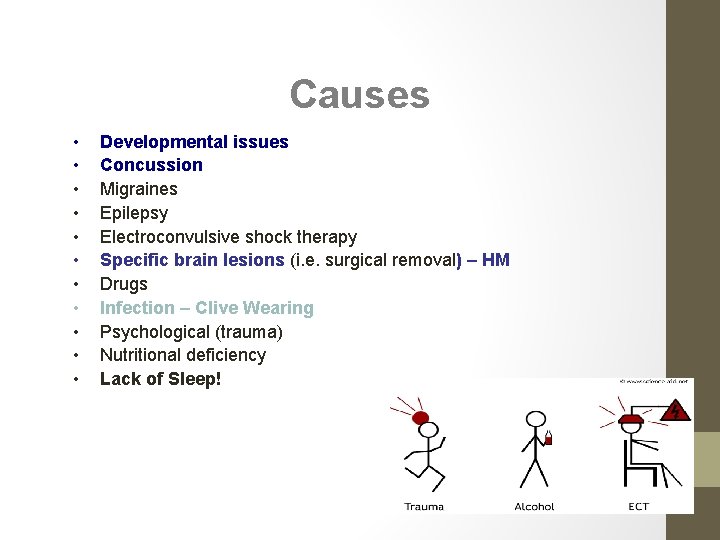
Causes • • • Developmental issues Concussion Migraines Epilepsy Electroconvulsive shock therapy Specific brain lesions (i. e. surgical removal) – HM Drugs Infection – Clive Wearing Psychological (trauma) Nutritional deficiency Lack of Sleep!
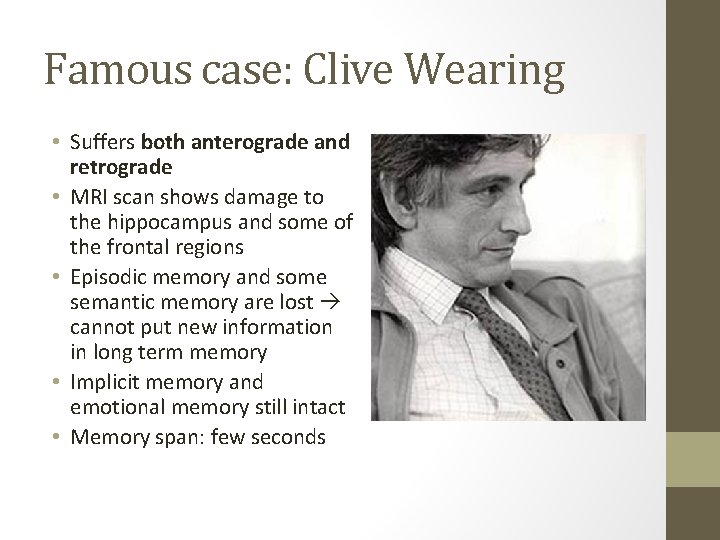
Famous case: Clive Wearing • Suffers both anterograde and retrograde • MRI scan shows damage to the hippocampus and some of the frontal regions • Episodic memory and some semantic memory are lost cannot put new information in long term memory • Implicit memory and emotional memory still intact • Memory span: few seconds
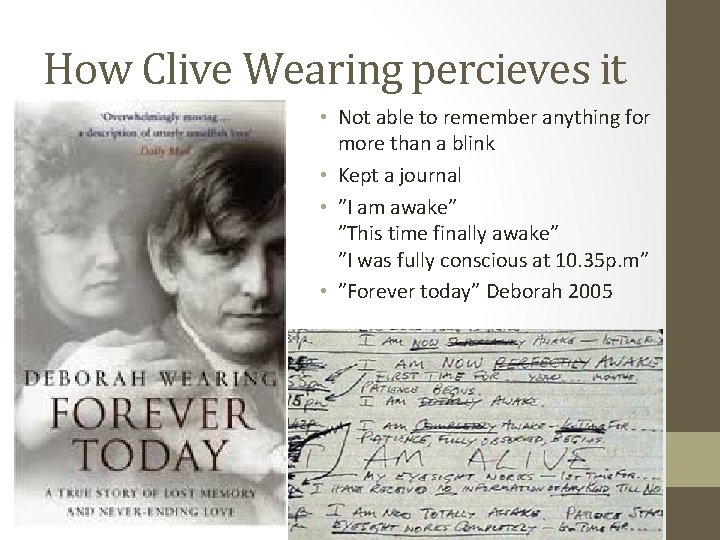
How Clive Wearing percieves it • Not able to remember anything for more than a blink • Kept a journal • ”I am awake” ”This time finally awake” ”I was fully conscious at 10. 35 p. m” • ”Forever today” Deborah 2005
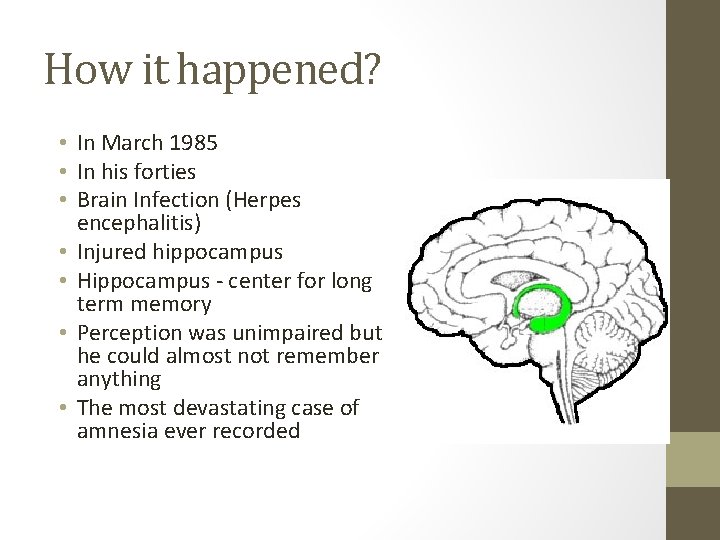
How it happened? • In March 1985 • In his forties • Brain Infection (Herpes encephalitis) • Injured hippocampus • Hippocampus - center for long term memory • Perception was unimpaired but he could almost not remember anything • The most devastating case of amnesia ever recorded
CLIP ON CLIVE WEARING! • http: //www. youtube. com/ watch? v=Wmz. U 47 i 2 xgw • http: //www. youtube. com/ watch? v=Vwigmktix 2 Y
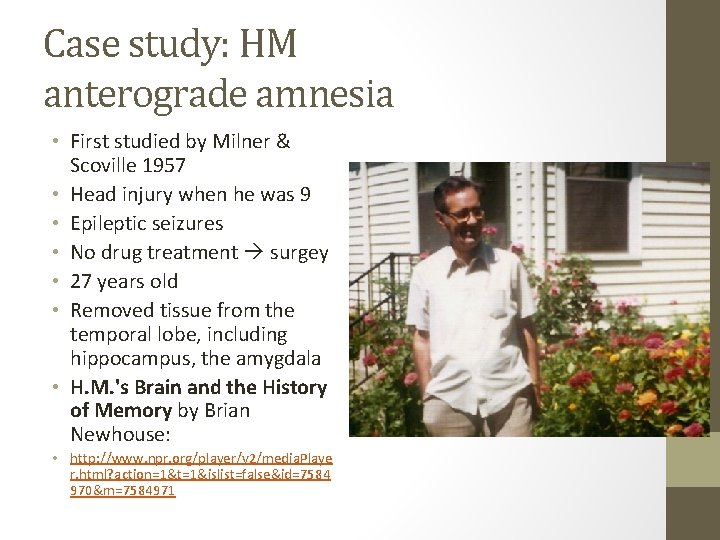
Case study: HM anterograde amnesia • First studied by Milner & Scoville 1957 • Head injury when he was 9 • Epileptic seizures • No drug treatment surgey • 27 years old • Removed tissue from the temporal lobe, including hippocampus, the amygdala • H. M. 's Brain and the History of Memory by Brian Newhouse: • http: //www. npr. org/player/v 2/media. Playe r. html? action=1&t=1&islist=false&id=7584 970&m=7584971
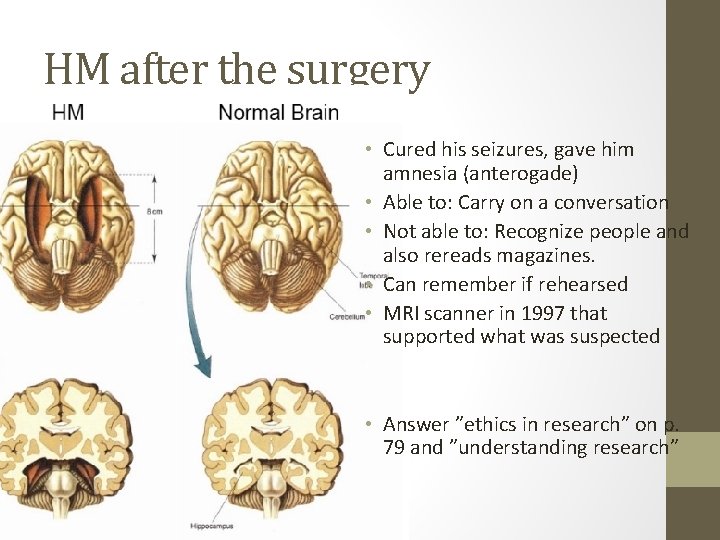
HM after the surgery • Cured his seizures, gave him amnesia (anterogade) • Able to: Carry on a conversation • Not able to: Recognize people and also rereads magazines. • Can remember if rehearsed • MRI scanner in 1997 that supported what was suspected • Answer ”ethics in research” on p. 79 and ”understanding research”
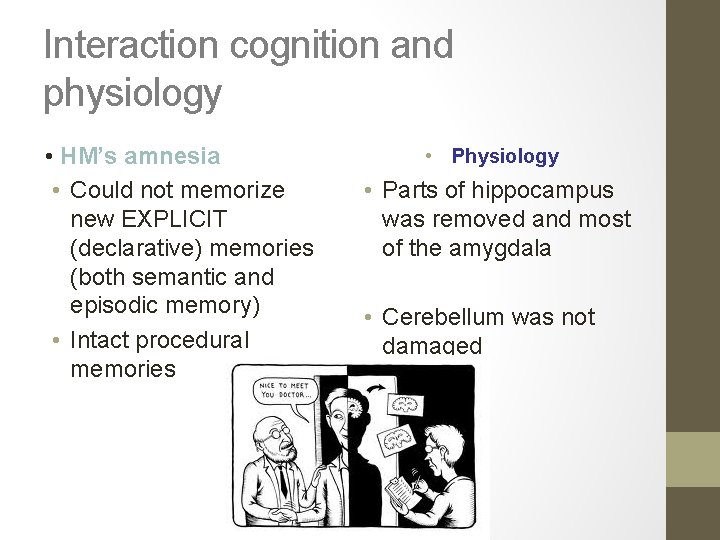
Interaction cognition and physiology • HM’s amnesia • Could not memorize new EXPLICIT (declarative) memories (both semantic and episodic memory) • Intact procedural memories • Physiology • Parts of hippocampus was removed and most of the amygdala • Cerebellum was not damaged
Critical thinking – the case studies Strengths • Raise interesting questions for further research • Could generalize if similar cases • Very in depth, rich data through a variety of methods • High ecological validity • Longitudinal • Ethical if not stressful and nor forcing Limitations • Researchers to close to the participants • Time consuming • Ethical considerations; • Long, intense, stressful • Can’t generalize?
MRI study and Medial Temporal Lobe Amnesia • Varga-Khadem et al. (1997) performed a study using MRI scanning with three young patients who had brain injuries. • Aim; investigate the relationship between the brain injury and anterograde amnesia. • Methods; MRI scanning and memory tests/experiments • Participants; One child had suffered brain damage at birth, the second by the age of 4 years, and the third one by the age of 9.
• • • Results; all three children had damage to the hippocampus. Amnesia - severe problems with episodic memory, their cognitive development was within the normal range. They were low-average to average in language skills, factual knowledge, and literacy. • Conclusion; the study provides support for the idea that there are separate episodic and semantic stores in longterm memory. • Only episodic memory seems to be fully dependent on the hippocampus. • Critical thinking; a lot of scientific research support this
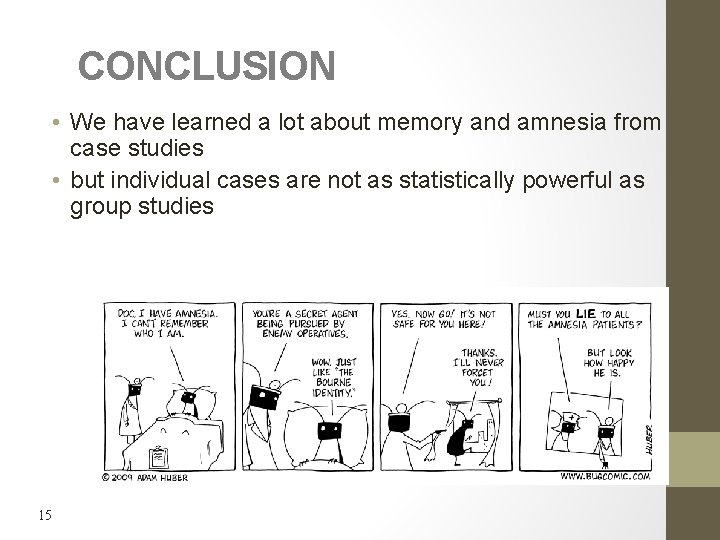
CONCLUSION • We have learned a lot about memory and amnesia from case studies • but individual cases are not as statistically powerful as group studies 15
• animal research is needed for in depth analysis • Animal research show the same thing
Critical thinking research and theories MLA • Case studies +/ • Scanning evidence +/ • Few cases • Animal research (cause amnesia in e g monkeys and investigate) +/ • Applicability Useful and important findings – • 1) Treat the amnesia • 2) The existence of Multiple memory systems • 3) Localization of cognitive functions 17
Summary • You can use Clive and H. M as support (how biological factors may affect one cognitive process: brain damage on memory) • H. M and Clive W can also be used as support for the multistore model of memory (since they show that our memory consists of different memory systems) • Both can be used as support in LO about ethical considerations • Since you need two biological factors: you can use the study by Martinez and Kesner (1991) Ach in memory formation • You can also (great isn’t it? ) use H. M and Clive for the LO in the biological level of analysis: ”Examine one interaction between cognition and physiology in terms of behaviour”
- Slides: 18