
Examination Techniques for Accuracy and Efficiency Refractive Errors




- Slides: 24
Examination Techniques for Accuracy and Efficiency Refractive Errors and Accommodative Control A VOSH-Florida Presentation
• • • Important elements of Accommodation Myopia and accommodation Hyperopia and accommodation Age Factors and Accommodation Final Rx vs. Uncorrected Acuity Pseudomyopia Accommodative Spasms Latent Hyperopia Manifestations of Presbyopia Amblyopia – refractive vs. strabismic
• Important elements of Accommodation – Accommodation can be defined as the controlled flexing of the crystalline lens resulting in the increase of it’s dioptric power necessary to place a near object in sharp focus at the plane of the fovea. – Types of Accommodative Responses: • • Reflex Vergence Proximal Tonic
• Types of Accommodative Responses: – Reflex: • Largest accommodative response. • Reaction to blur input – Vergence: • Second largest accommodative response. • Neurological link to the convergence stimulus. • Measured using the Accommodative Convergence/Accommodation ratio (AC/A).
– Proximal: • Accommodative response to the knowledge that an object is in close proximity (within 3 meters). • Typically provides 4% - 10% of accommodative response to a near stimulus. – Tonic: • Basal neural input to crystalline lens resulting in a stable minimal accommodative tonicity. • Results in a mean tonic accommodative level of between 1 – 2 diopters in young adults. • Tonic accommodation decreases with age.
– Amplitude of Accommodation: • The maximum accommodative response measured in a fully corrected eye. • At age 10, this is ~13. 5 diopters. • Amplitude of Accommodation decreases by ~0. 3 D/year. • By age 40, near point asthenopia may develop indicating early presbyopia. • Presbyopia is an inadequate amplitude of accommodation necessary to achieve or maintain a sharp focus at the normal reading position (usually 40 cm).
• Myopia and accommodation: – Overcorrection of Myopia: • Any increase in minus power that yields an increase in visual acuity is considered a correction of refractive error. • Any increase in minus power that does not yield an increase in visual acuity is considered an overcorrection. • Myopic overcorrection results in increased contrast due to minification, which the patient perceives as sharper vision.
• Symptoms of overcorrection: – Asthenopia – Intermittent distance blur – Nearpoint problems – blur, esophoria – Accommodative/Convergence problems • Managing an overcorrection problem: – Patient may not accept reduced minus initially. – Reduce the overcorrection slowly over time and as symptoms develop.
– The Uncorrected Myope: • Will try to take more minus correction than necessary. • May have an underdeveloped accommodative response at near with correction, due to lack of demand for accommodation when uncorrected. • May show a sudden increase in esophoria or esotropia at near when corrected for the first time, due to a poor AC/A relationship. • Patient may need to increase the near working distance with a new myopic correction in order to reduce the accommodative demand. • Bifocals or removing of glasses may be necessary at near.
• Hyperopia and accommodation: – Clinical Forms and Responses to Hyperopia: • • • Facultative Hyperopia Absolute Hyperopia Latent Hyperopia Spasm of Accommodation Pseudomyopia
– Facultative Hyperopia: • The amount of hyperopia that can be overcome by accommodation. • Generally asymptomatic at a younger age, unless high enough to create AC/A problems. • Patient will often not accept the hyperopic correction until symptoms occur due to loss of accommodation with aging.
– Absolute Hyperopia: • The amount of hyperopia that cannot be overcome by accommodation. • Near-point symptoms present first. • Distance blur can present as intermittent or constant. • Patients will usually accept only enough correction necessary to relieve symptoms. • Requires increasing plus correction gradually over time.
– Latent Hyperopia: • Hyperopia that is present, but cannot be measured using routine refractive methods. • Two Types: – Tonic: • Constant spasm of accommodation. • May not be symptomatic until there is a sufficient loss of accommodation with aging, becoming absolute hyperopia. – Clonic: • Intermittent spasm of accommodation. • May produce Pseudomyopia.
– Pseudomyopia: • Patient with latent hyperopia who overaccommodates on refraction yielding a false myopic correction. • Correcting this patient for myopia may result in the following symptoms: – – Asthenopia Intermittent blur at distance Near point fatigue Esophoria/Esotropia
– Pseudomyopia: • Refractive Presentations: – Young, non-presbyopic patient with near point complaints. – Presents with uncorrected 20/20 (6/6) acuity. – Fluctuating light reflex on retinoscopy. – Fluctuating results on repeated autorefractor readings. – Low minus subjective refractive error (-0. 25 – 0. 50 x 180)
– Pseudomyopia: • Refraction Tips: – Recognize the signs and symptoms of pseudomyopia. – Examining instruments (autorefractors, phoropters) sometimes stimulate proximal accommodation. – Do not prescribe minus lenses if distance acuity is 20/20. – Look for astigmatism, anisometropia, or antimetropia. – Prescribe for the symptoms.
• Manifestations of Presbyopia: – Results from a loss of flexibility of the crystalline lens, causing a gradual reduction in the Amplitude of Accommodation (AA). – Onset of symptoms usually occurs when the AA is less than half of the accommodative demand. – Generally, by age 40 the AA is <5. 00 diopters and the accommodative demand at 40 cm is 2. 50 diopters, resulting in symptoms of presbyopia.
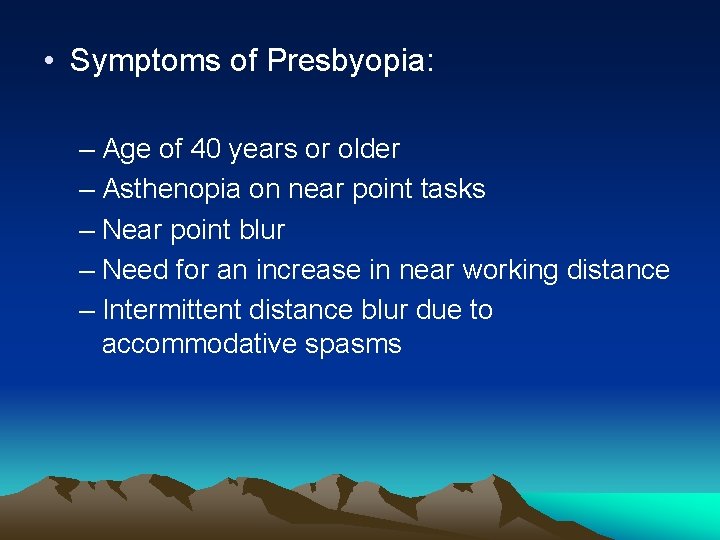
• Symptoms of Presbyopia: – Age of 40 years or older – Asthenopia on near point tasks – Near point blur – Need for an increase in near working distance – Intermittent distance blur due to accommodative spasms
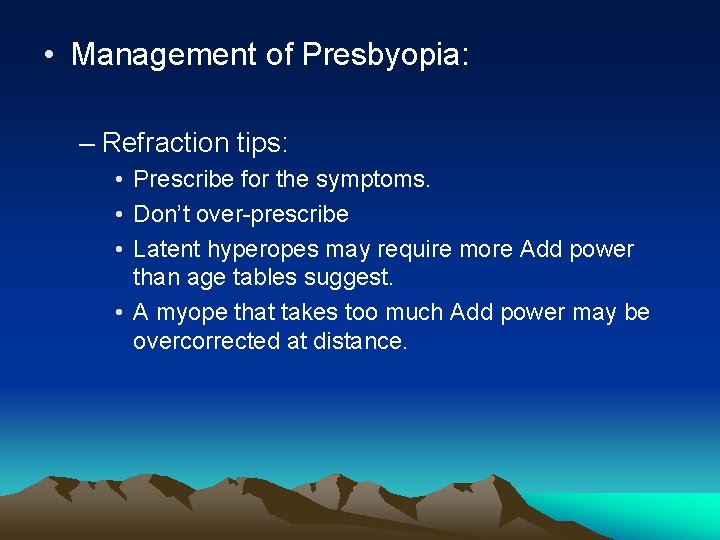
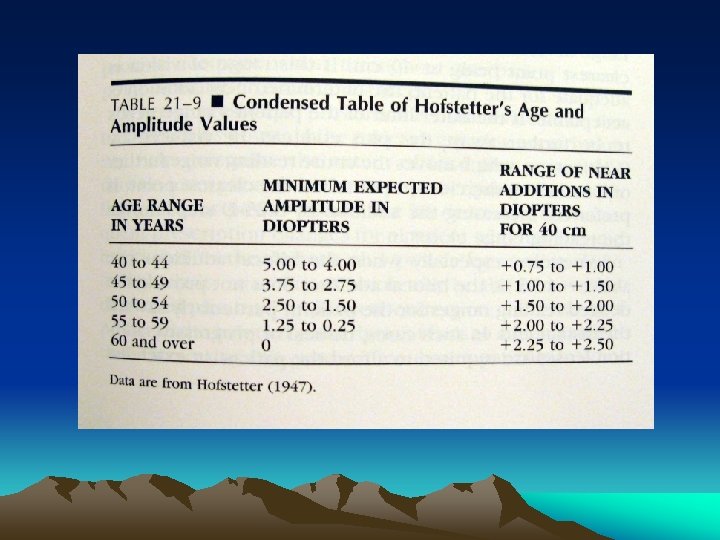
• Management of Presbyopia: – Refraction tips: • Prescribe for the symptoms. • Don’t over-prescribe • Latent hyperopes may require more Add power than age tables suggest. • A myope that takes too much Add power may be overcorrected at distance.
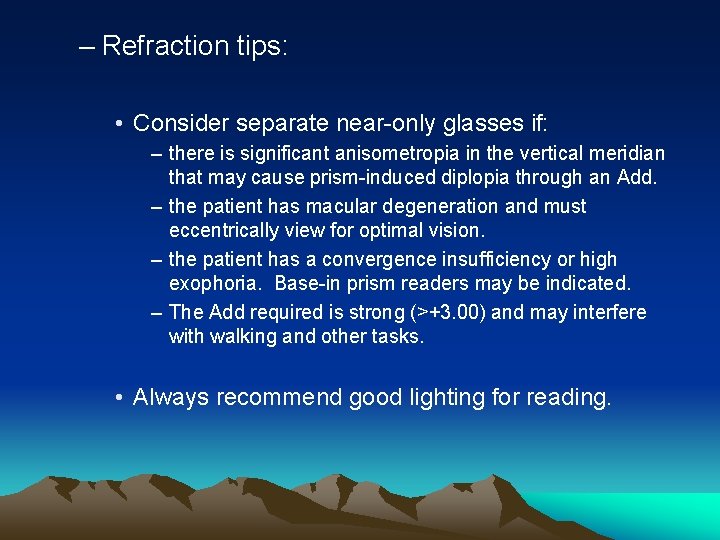
– Refraction tips: • Consider separate near-only glasses if: – there is significant anisometropia in the vertical meridian that may cause prism-induced diplopia through an Add. – the patient has macular degeneration and must eccentrically view for optimal vision. – the patient has a convergence insufficiency or high exophoria. Base-in prism readers may be indicated. – The Add required is strong (>+3. 00) and may interfere with walking and other tasks. • Always recommend good lighting for reading.
• Amblyopia – Definition: • A nonspecific loss of visual acuity of at least two lines that is not caused by pathology nor correctable by ordinary refractive means (Shapero et al. , 1980)
• Amblyopia – refractive vs. strabismic – Refractive : • Results in poor macular development due to a significant anisometropia causing one eye to be essentially fogged at a young age. – Strabismic: • Results in poor macular development due to an inability to fuse the eyes at the point of fixation causing suppression of one eye at a young age.
– Management tips to prevent amblyopia: • Any child or young adult presenting with a tropia or significantly unequal acuities should be screened for: – – – High hyperopia High myopia High astigmatism Restricted eye movements Eye disease, trauma, congenital anomalies • Refer for cycloplegic refraction and possible neurological evaluation.