
EXAMINATION REFORMS AND CONTINUOUS AND COMPREHENSIVE EVALUATION Grading
- Slides: 24
EXAMINATION REFORMS AND CONTINUOUS AND COMPREHENSIVE EVALUATION + Grading system A CBSE INITIATIVE
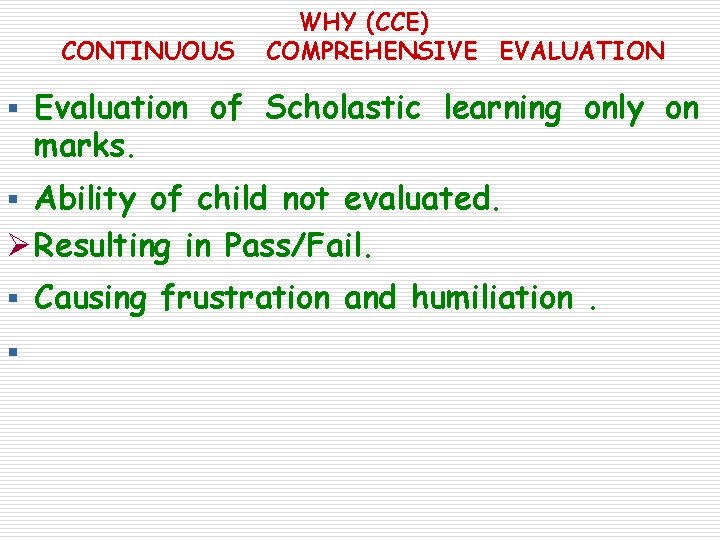
CONTINUOUS WHY (CCE) COMPREHENSIVE EVALUATION § Evaluation of Scholastic learning only on marks. § Ability of child not evaluated. Ø Resulting in Pass/Fail. § Causing frustration and humiliation. §
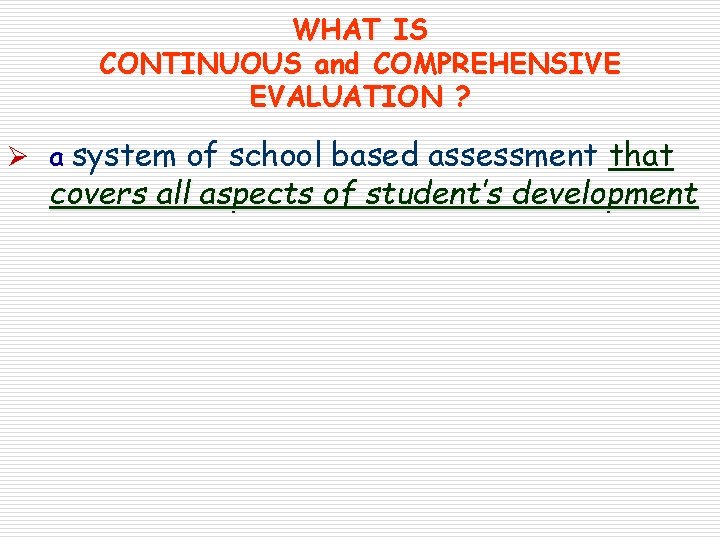
WHAT IS CONTINUOUS and COMPREHENSIVE EVALUATION ? Ø a system of school based assessment that covers all aspects of student’s development
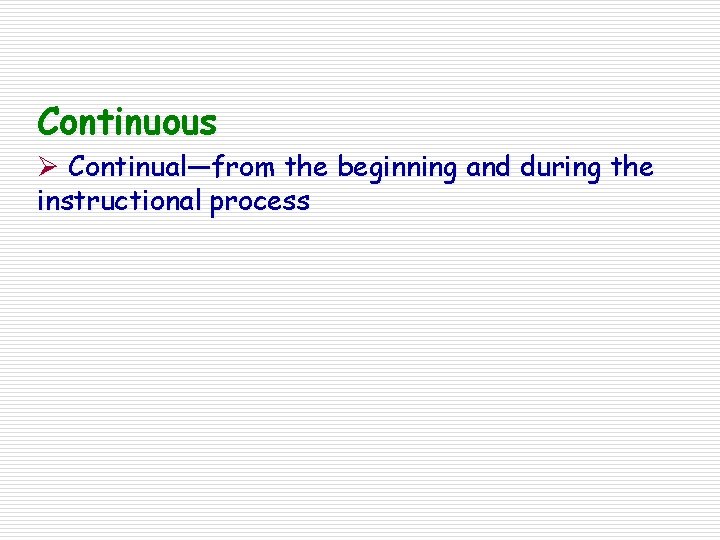
Continuous Ø Continual—from the beginning and during the instructional process
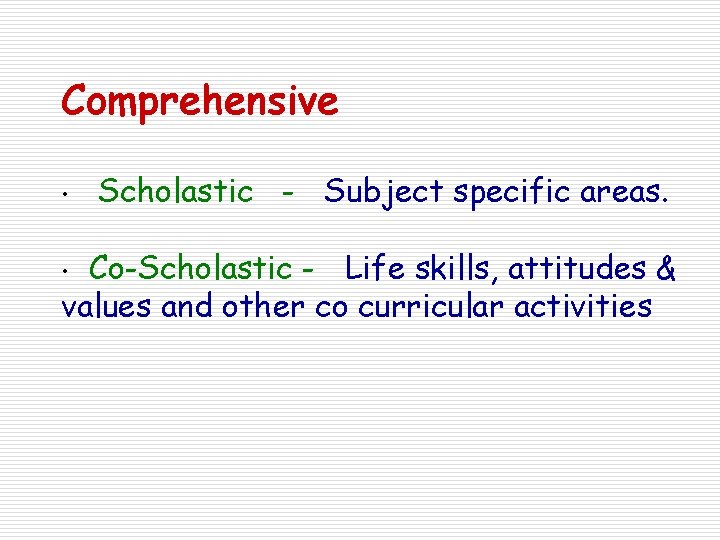
Comprehensive • Scholastic - Subject specific areas. Co-Scholastic - Life skills, attitudes & values and other co curricular activities •
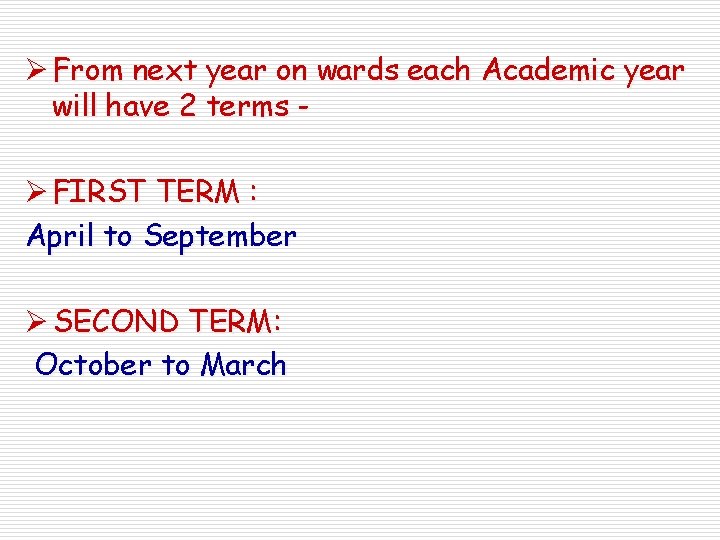
Ø From next year on wards each Academic year will have 2 terms Ø FIRST TERM : April to September Ø SECOND TERM: October to March
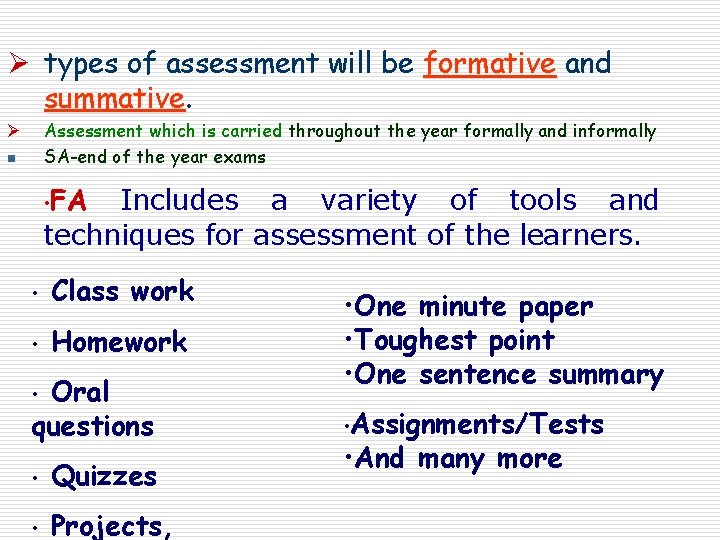
Ø types of assessment will be formative and summative Assessment which is carried throughout the year formally and informally SA-end of the year exams Ø n • FA Includes a variety of tools and techniques for assessment of the learners. • Class work • Homework Oral questions • • Quizzes • Projects, • One minute paper • Toughest point • One sentence summary • Assignments/Tests • And many more
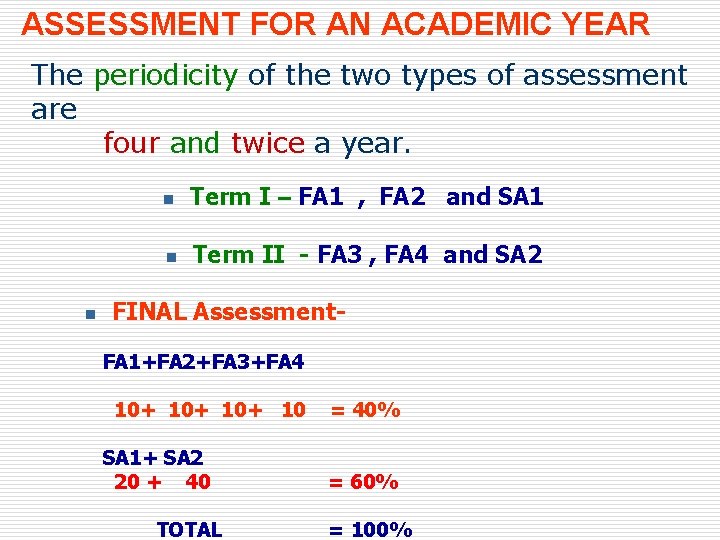
ASSESSMENT FOR AN ACADEMIC YEAR The periodicity of the two types of assessment are four and twice a year. n n Term I – FA 1 , FA 2 and SA 1 n Term II - FA 3 , FA 4 and SA 2 FINAL Assessment. FA 1+FA 2+FA 3+FA 4 10+ 10+ 10 SA 1+ SA 2 20 + 40 TOTAL = 40% = 60% = 100%
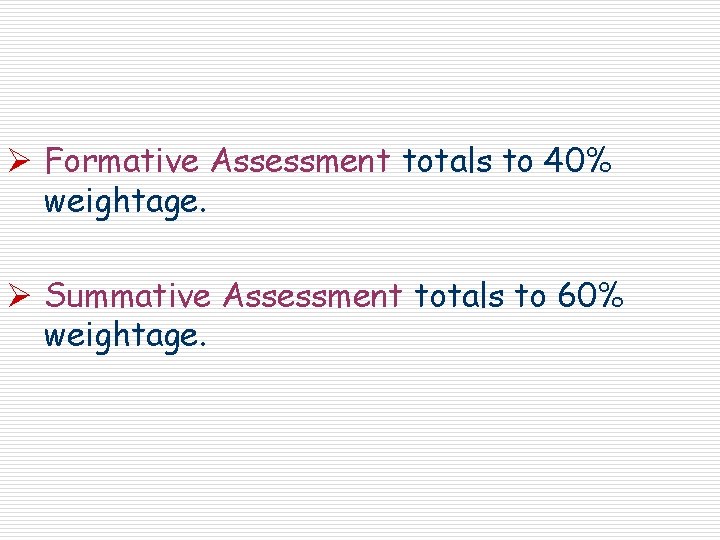
Ø Formative Assessment totals to 40% weightage. Ø Summative Assessment totals to 60% weightage.
Assessment – Design April – July. Sept FA 1 10% Sept Oct – Dec. Mar FA 2 SA 1 FA 3 FA 4 SA 2 10% 20% 10% 40%
SCHEME OF GRADING SCHOLASTIC & CO- SCHOLASTIC Performance will be assessed using conventional numerical marking and same will be converted into grades.
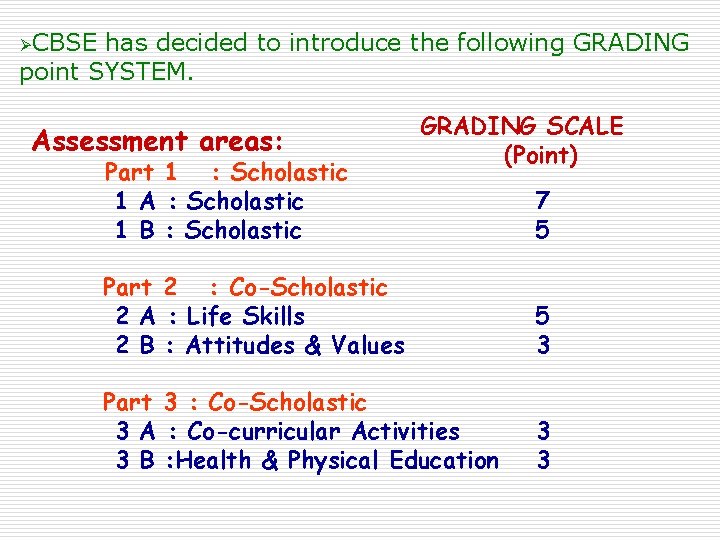
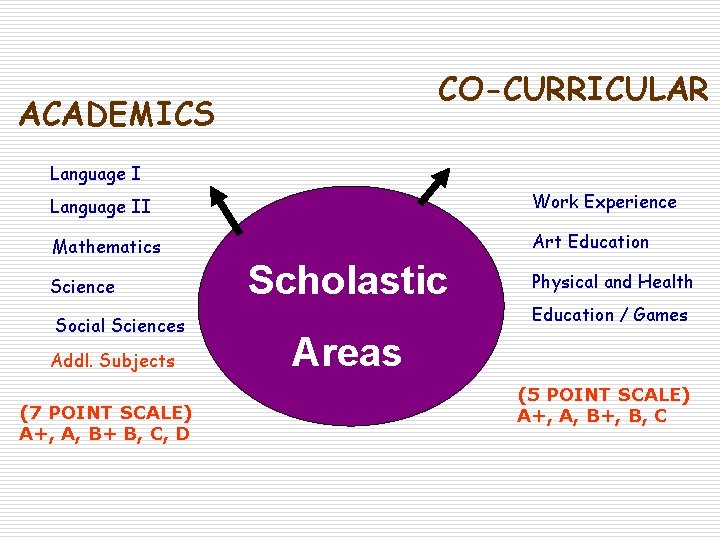
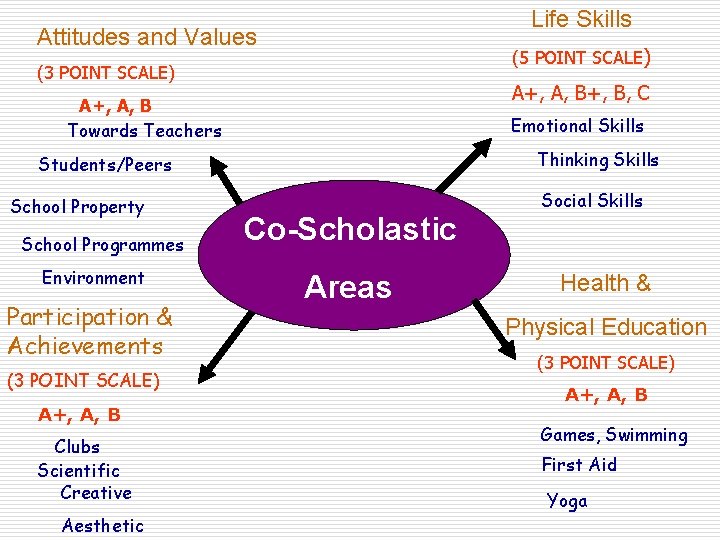
ØCBSE has decided to introduce the following GRADING point SYSTEM. Assessment areas: Part 1 : Scholastic 1 A : Scholastic 1 B : Scholastic GRADING SCALE (Point) 7 5 Part 2 : Co-Scholastic 2 A : Life Skills 2 B : Attitudes & Values 5 3 Part 3 : Co-Scholastic 3 A : Co-curricular Activities 3 B : Health & Physical Education 3 3
CO-CURRICULAR ACADEMICS Language II Work Experience Mathematics Art Education Science Social Sciences Addl. Subjects (7 POINT SCALE) A+, A, B+ B, C, D Scholastic Physical and Health Education / Games Areas (5 POINT SCALE) A+, A, B+, B, C
Life Skills Attitudes and Values (5 POINT SCALE) (3 POINT SCALE) A+, A, B+, B, C A+, A, B Towards Teachers Emotional Skills Thinking Skills Students/Peers School Property School Programmes Environment Participation & Achievements (3 POINT SCALE) A+, A, B Clubs Scientific Creative Aesthetic Co-Scholastic Areas Social Skills Health & Physical Education (3 POINT SCALE) A+, A, B Games, Swimming First Aid Yoga
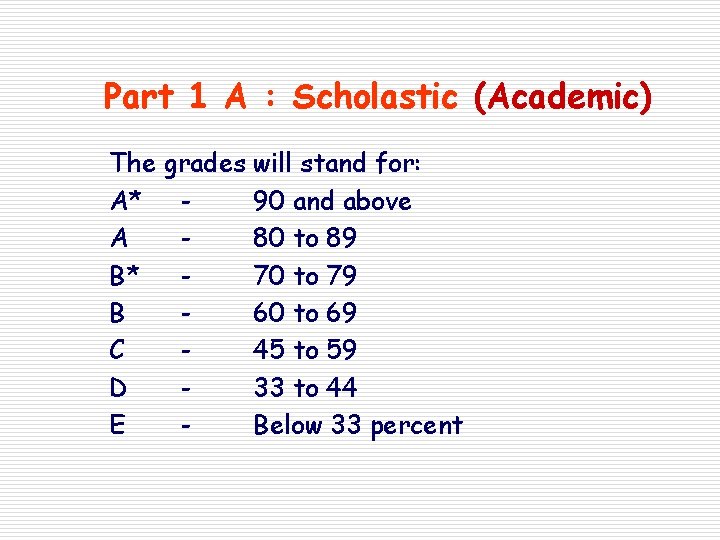
Part 1 A : Scholastic (Academic) The grades will stand for: A* 90 and above A 80 to 89 B* 70 to 79 B 60 to 69 C 45 to 59 D 33 to 44 E Below 33 percent
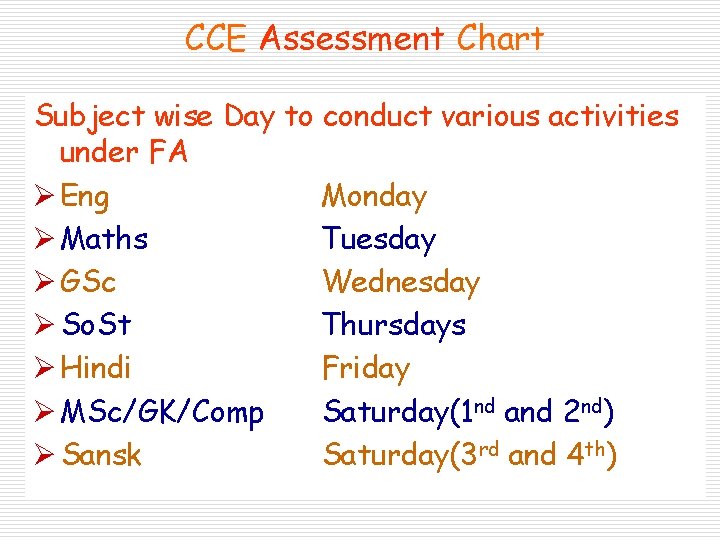
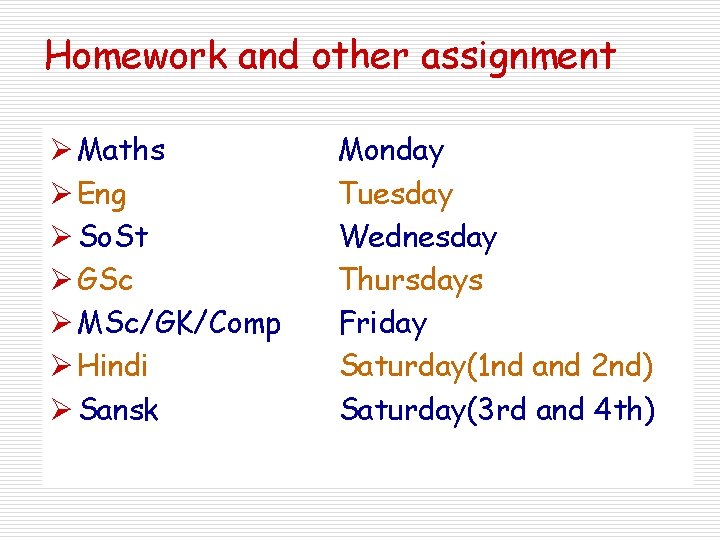
CCE Assessment Chart Subject wise Day to conduct various activities under FA Ø Eng Monday Ø Maths Tuesday Ø GSc Wednesday Ø So. St Thursdays Ø Hindi Friday Ø MSc/GK/Comp Saturday(1 nd and 2 nd) Ø Sansk Saturday(3 rd and 4 th)
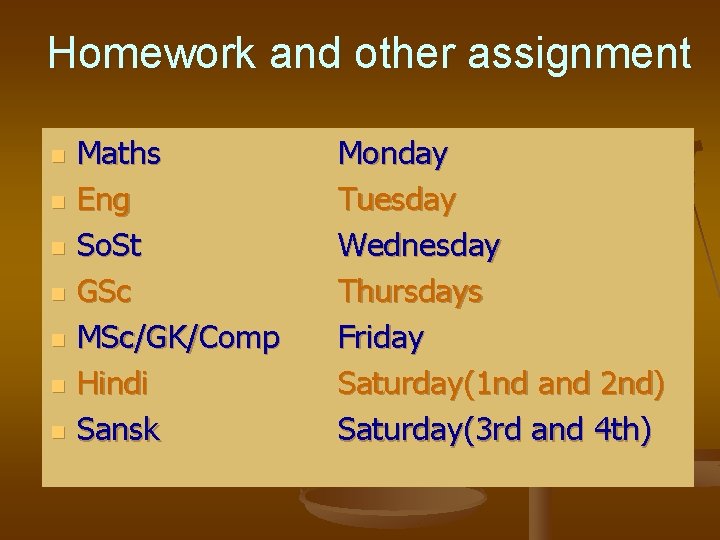
Homework and other assignment Ø Maths Ø Eng Ø So. St Ø GSc Ø MSc/GK/Comp Ø Hindi Ø Sansk Monday Tuesday Wednesday Thursdays Friday Saturday(1 nd and 2 nd) Saturday(3 rd and 4 th)
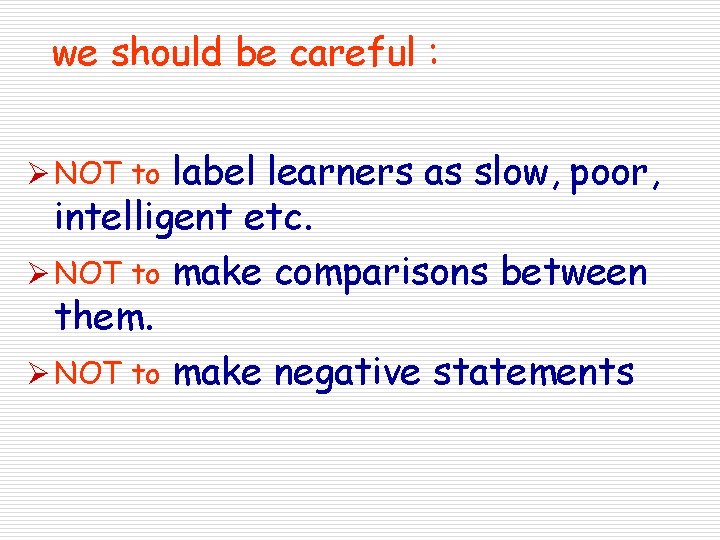
we should be careful : label learners as slow, poor, intelligent etc. Ø NOT to make comparisons between them. Ø NOT to make negative statements Ø NOT to
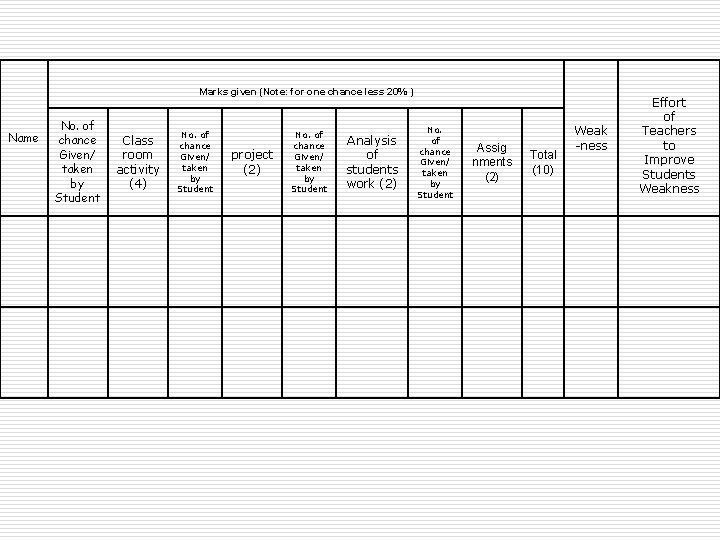
Marks given (Note: for one chance less 20% ) Name No. of chance Given/ taken by Student Class room activity (4) No. of chance Given/ taken by Student project (2) No. of chance Given/ taken by Student Analysis of students work (2) No. of chance Given/ taken by Student Assig nments (2) Total (10) Weak -ness Effort of Teachers to Improve Students Weakness
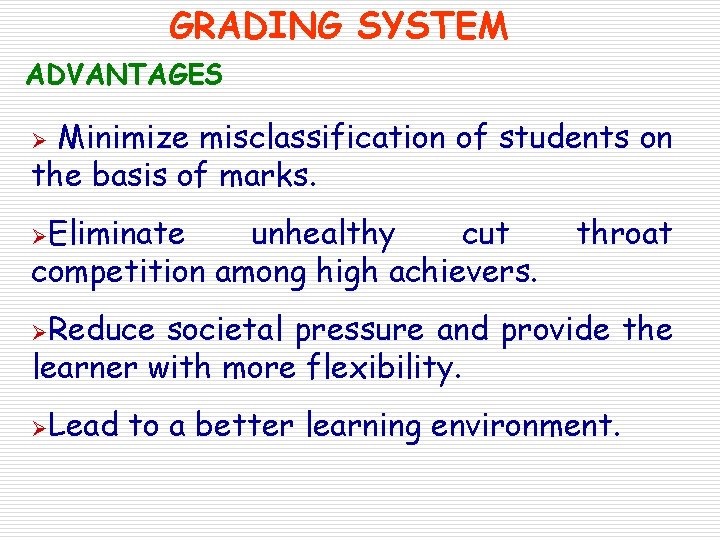
GRADING SYSTEM ADVANTAGES Minimize misclassification of students on the basis of marks. Ø ØEliminate unhealthy cut competition among high achievers. throat ØReduce societal pressure and provide the learner with more flexibility. ØLead to a better learning environment.
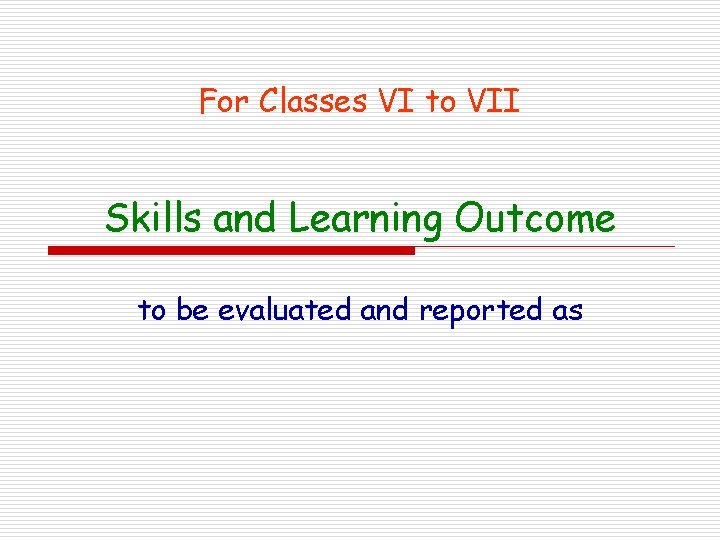
For Classes VI to VII Skills and Learning Outcome to be evaluated and reported as
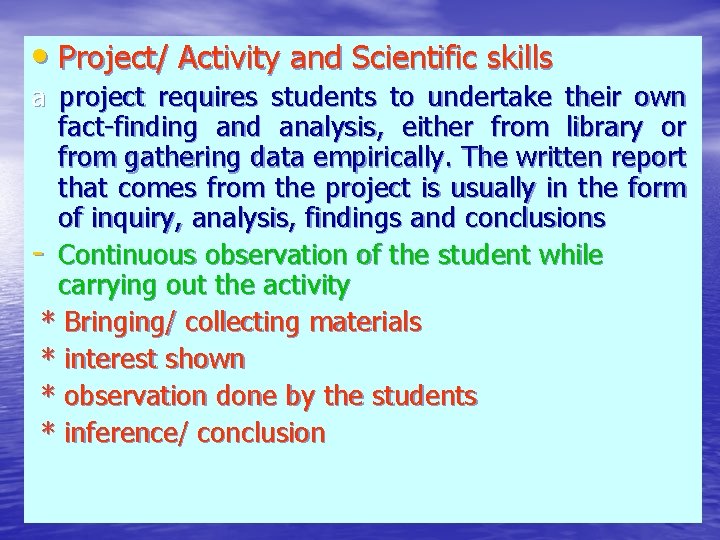
• Project/ Activity and Scientific skills a project requires students to undertake their own fact-finding and analysis, either from library or from gathering data empirically. The written report that comes from the project is usually in the form of inquiry, analysis, findings and conclusions - Continuous observation of the student while carrying out the activity * Bringing/ collecting materials * interest shown * observation done by the students * inference/ conclusion
Homework and other assignment n n n n Maths Eng So. St GSc MSc/GK/Comp Hindi Sansk Monday Tuesday Wednesday Thursdays Friday Saturday(1 nd and 2 nd) Saturday(3 rd and 4 th)
The End Thanks