
Examination of Therapeutic Outcome Knowledge for its Impact
- Slides: 1
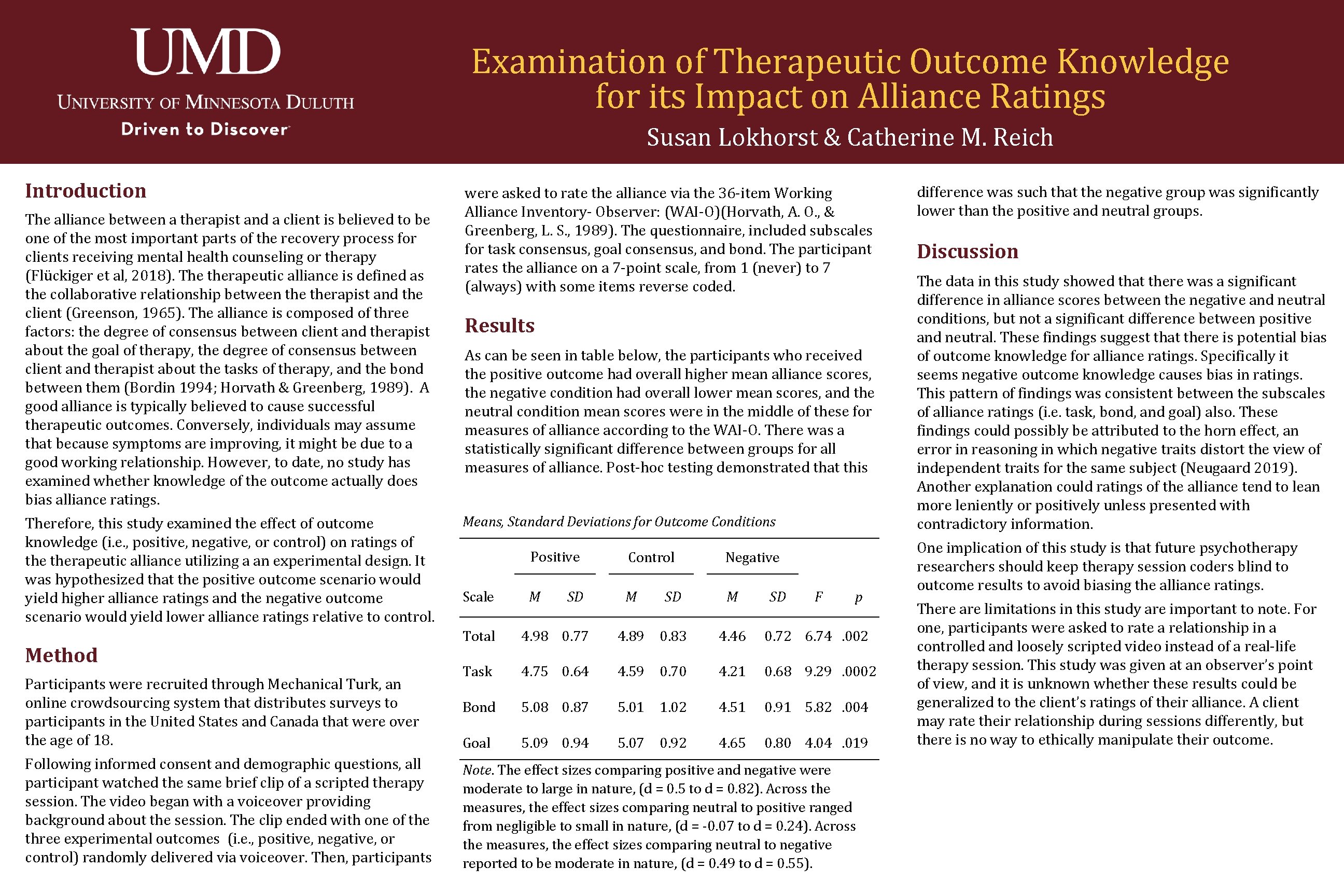
Examination of Therapeutic Outcome Knowledge for its Impact on Alliance Ratings Susan Lokhorst & Catherine M. Reich Introduction The alliance between a therapist and a client is believed to be one of the most important parts of the recovery process for clients receiving mental health counseling or therapy (Flückiger et al, 2018). The therapeutic alliance is defined as the collaborative relationship between therapist and the client (Greenson, 1965). The alliance is composed of three factors: the degree of consensus between client and therapist about the goal of therapy, the degree of consensus between client and therapist about the tasks of therapy, and the bond between them (Bordin 1994; Horvath & Greenberg, 1989). A good alliance is typically believed to cause successful therapeutic outcomes. Conversely, individuals may assume that because symptoms are improving, it might be due to a good working relationship. However, to date, no study has examined whether knowledge of the outcome actually does bias alliance ratings. Therefore, this study examined the effect of outcome knowledge (i. e. , positive, negative, or control) on ratings of therapeutic alliance utilizing a an experimental design. It was hypothesized that the positive outcome scenario would yield higher alliance ratings and the negative outcome scenario would yield lower alliance ratings relative to control. Method Participants were recruited through Mechanical Turk, an online crowdsourcing system that distributes surveys to participants in the United States and Canada that were over the age of 18. Following informed consent and demographic questions, all participant watched the same brief clip of a scripted therapy session. The video began with a voiceover providing background about the session. The clip ended with one of the three experimental outcomes (i. e. , positive, negative, or control) randomly delivered via voiceover. Then, participants were asked to rate the alliance via the 36 -item Working Alliance Inventory- Observer: (WAI-O)(Horvath, A. O. , & Greenberg, L. S. , 1989). The questionnaire, included subscales for task consensus, goal consensus, and bond. The participant rates the alliance on a 7 -point scale, from 1 (never) to 7 (always) with some items reverse coded. Results As can be seen in table below, the participants who received the positive outcome had overall higher mean alliance scores, the negative condition had overall lower mean scores, and the neutral condition mean scores were in the middle of these for measures of alliance according to the WAI-O. There was a statistically significant difference between groups for all measures of alliance. Post-hoc testing demonstrated that this Means, Standard Deviations for Outcome Conditions Scale Total Task Bond Goal Positive M SD 4. 98 0. 77 4. 75 0. 64 5. 08 0. 87 5. 09 0. 94 Control M 4. 89 4. 59 5. 01 5. 07 SD 0. 83 0. 70 1. 02 0. 92 Negative M F p SD 4. 46 0. 72 6. 74. 002 4. 21 0. 68 9. 29. 0002 4. 51 0. 91 5. 82. 004 4. 65 0. 80 4. 019 Note. The effect sizes comparing positive and negative were moderate to large in nature, (d = 0. 5 to d = 0. 82). Across the measures, the effect sizes comparing neutral to positive ranged from negligible to small in nature, (d = -0. 07 to d = 0. 24). Across the measures, the effect sizes comparing neutral to negative reported to be moderate in nature, (d = 0. 49 to d = 0. 55). difference was such that the negative group was significantly lower than the positive and neutral groups. Discussion The data in this study showed that there was a significant difference in alliance scores between the negative and neutral conditions, but not a significant difference between positive and neutral. These findings suggest that there is potential bias of outcome knowledge for alliance ratings. Specifically it seems negative outcome knowledge causes bias in ratings. This pattern of findings was consistent between the subscales of alliance ratings (i. e. task, bond, and goal) also. These findings could possibly be attributed to the horn effect, an error in reasoning in which negative traits distort the view of independent traits for the same subject (Neugaard 2019). Another explanation could ratings of the alliance tend to lean more leniently or positively unless presented with contradictory information. One implication of this study is that future psychotherapy researchers should keep therapy session coders blind to outcome results to avoid biasing the alliance ratings. There are limitations in this study are important to note. For one, participants were asked to rate a relationship in a controlled and loosely scripted video instead of a real-life therapy session. This study was given at an observer’s point of view, and it is unknown whether these results could be generalized to the client’s ratings of their alliance. A client may rate their relationship during sessions differently, but there is no way to ethically manipulate their outcome.