
Examination of sulfate production by CB 05 TU
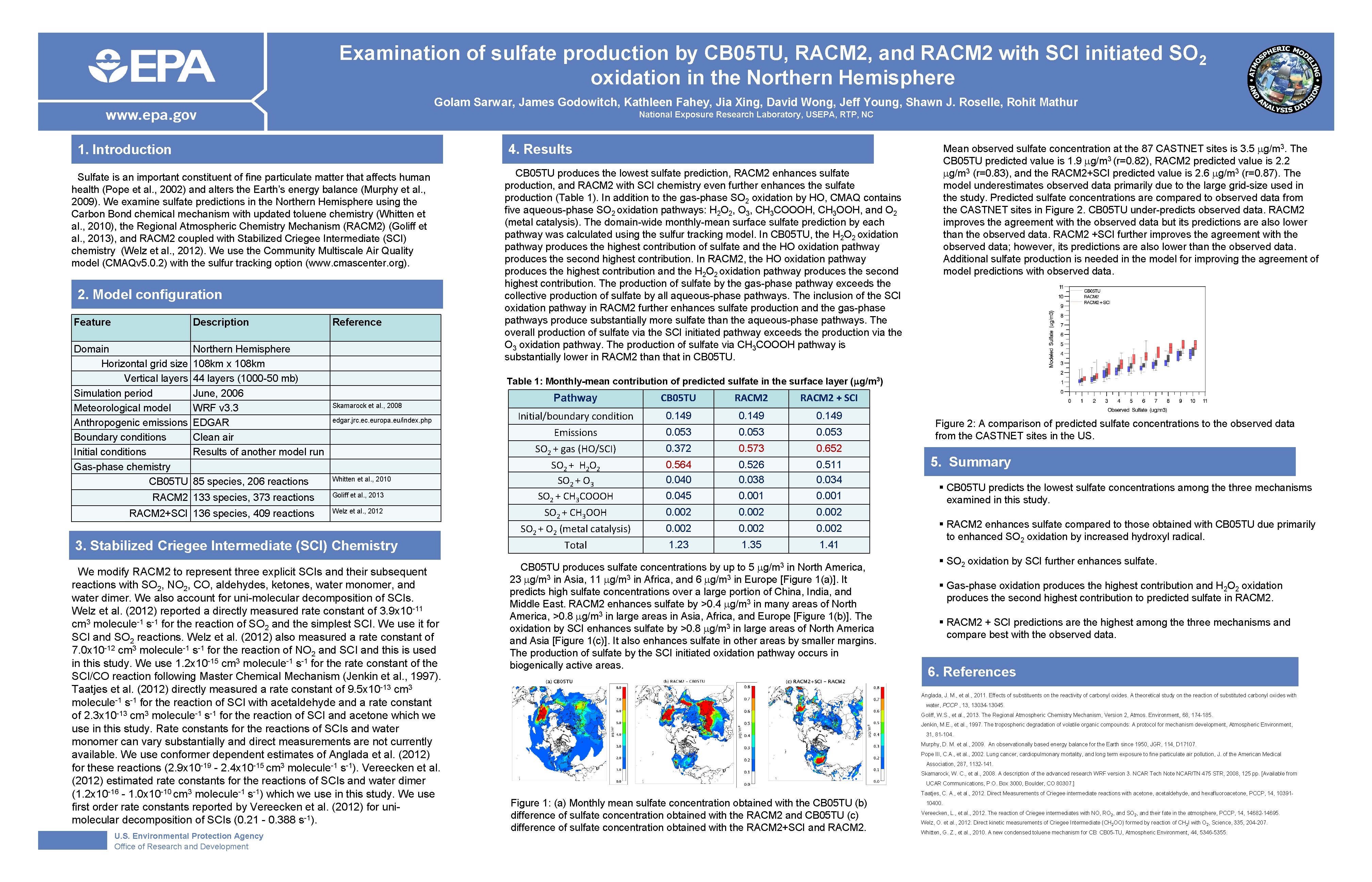
Examination of sulfate production by CB 05 TU, RACM 2, and RACM 2 with SCI initiated SO 2 oxidation in the Northern Hemisphere Golam Sarwar, James Godowitch, Kathleen Fahey, Jia Xing, David Wong, Jeff Young, Shawn J. Roselle, Rohit Mathur National Exposure Research Laboratory, USEPA, RTP, NC 4. Results 1. Introduction Sulfate is an important constituent of fine particulate matter that affects human health (Pope et al. , 2002) and alters the Earth’s energy balance (Murphy et al. , 2009). We examine sulfate predictions in the Northern Hemisphere using the Carbon Bond chemical mechanism with updated toluene chemistry (Whitten et al. , 2010), the Regional Atmospheric Chemistry Mechanism (RACM 2) (Goliff et al. , 2013), and RACM 2 coupled with Stabilized Criegee Intermediate (SCI) chemistry (Welz et al. , 2012). We use the Community Multiscale Air Quality model (CMAQv 5. 0. 2) with the sulfur tracking option (www. cmascenter. org). 2. Model configuration Feature Description Domain Horizontal grid size Vertical layers Simulation period Meteorological model Anthropogenic emissions Boundary conditions Initial conditions Gas-phase chemistry PHOTO CB 05 TU Northern Hemisphere 108 km x 108 km 44 layers (1000 -50 mb) June, 2006 WRF v 3. 3 EDGAR Clean air Results of another model run 85 species, 206 reactions Reference CB 05 TU produces the lowest sulfate prediction, RACM 2 enhances sulfate production, and RACM 2 with SCI chemistry even further enhances the sulfate production (Table 1). In addition to the gas-phase SO 2 oxidation by HO, CMAQ contains five aqueous-phase SO 2 oxidation pathways: H 2 O 2, O 3, CH 3 COOOH, CH 3 OOH, and O 2 (metal catalysis). The domain-wide monthly-mean surface sulfate prediction by each pathway was calculated using the sulfur tracking model. In CB 05 TU, the H 2 O 2 oxidation pathway produces the highest contribution of sulfate and the HO oxidation pathway produces the second highest contribution. In RACM 2, the HO oxidation pathway produces the highest contribution and the H 2 O 2 oxidation pathway produces the second highest contribution. The production of sulfate by the gas-phase pathway exceeds the collective production of sulfate by all aqueous-phase pathways. The inclusion of the SCI oxidation pathway in RACM 2 further enhances sulfate production and the gas-phase pathways produce substantially more sulfate than the aqueous-phase pathways. The overall production of sulfate via the SCI initiated pathway exceeds the production via the O 3 oxidation pathway. The production of sulfate via CH 3 COOOH pathway is substantially lower in RACM 2 than that in CB 05 TU. Table 1: Monthly-mean contribution of predicted sulfate in the surface layer (mg/m 3) Skamarock et al. , 2008 edgar. jrc. europa. eu/index. php PHOTO Whitten et al. , 2010 RACM 2 133 species, 373 reactions Goliff et al. , 2013 RACM 2+SCI 136 species, 409 reactions Welz et al. , 2012 3. Stabilized Criegee Intermediate (SCI) Chemistry We modify RACM 2 to represent three explicit SCIs and their subsequent reactions with SO 2, NO 2, CO, aldehydes, ketones, water monomer, and water dimer. We also account for uni-molecular decomposition of SCIs. Welz et al. (2012) reported a directly measured rate constant of 3. 9 x 10 -11 cm 3 molecule-1 s-1 for the reaction of SO 2 and the simplest SCI. We use it for SCI and SO 2 reactions. Welz et al. (2012) also measured a rate constant of 7. 0 x 10 -12 cm 3 molecule-1 s-1 for the reaction of NO 2 and SCI and this is used in this study. We use 1. 2 x 10 -15 cm 3 molecule-1 s-1 for the rate constant of the SCI/CO reaction following Master Chemical Mechanism (Jenkin et al. , 1997). Taatjes et al. (2012) directly measured a rate constant of 9. 5 x 10 -13 cm 3 molecule-1 s-1 for the reaction of SCI with acetaldehyde and a rate constant of 2. 3 x 10 -13 cm 3 molecule-1 s-1 for the reaction of SCI and acetone which we use in this study. Rate constants for the reactions of SCIs and water monomer can vary substantially and direct measurements are not currently available. We use conformer dependent estimates of Anglada et al. (2012) for these reactions (2. 9 x 10 -19 - 2. 4 x 10 -15 cm 3 molecule-1 s-1). Vereecken et al. (2012) estimated rate constants for the reactions of SCIs and water dimer (1. 2 x 10 -16 - 1. 0 x 10 -10 cm 3 molecule-1 s-1) which we use in this study. We use first order rate constants reported by Vereecken et al. (2012) for unimolecular decomposition of SCIs (0. 21 - 0. 388 s-1). U. S. Environmental Protection Agency Office of Research and Development Mean observed sulfate concentration at the 87 CASTNET sites is 3. 5 mg/m 3. The CB 05 TU predicted value is 1. 9 mg/m 3 (r=0. 82), RACM 2 predicted value is 2. 2 mg/m 3 (r=0. 83), and the RACM 2+SCI predicted value is 2. 6 mg/m 3 (r=0. 87). The model underestimates observed data primarily due to the large grid-size used in the study. Predicted sulfate concentrations are compared to observed data from the CASTNET sites in Figure 2. CB 05 TU under-predicts observed data. RACM 2 improves the agreement with the observed data but its predictions are also lower PHOO PHOTO than the observed data. RACM 2 +SCI further improves the agreement with the PHOTO observed data; however, its predictions are also lower than the observed data. Additional sulfate production is needed in the model for improving the agreement of model predictions with observed data. Pathway CB 05 TU RACM 2 + SCI Initial/boundary condition Emissions SO 2 + gas (HO/SCI) SO 2 + H 2 O 2 SO 2 + O 3 SO 2 + CH 3 COOOH SO 2 + CH 3 OOH SO 2 + O 2 (metal catalysis) Total 0. 149 0. 053 0. 372 0. 573 0. 652 0. 564 0. 040 0. 526 0. 038 0. 511 0. 034 0. 045 0. 001 0. 002 1. 23 1. 35 1. 41 mg/m 3 CB 05 TU produces sulfate concentrations by up to 5 in North America, 23 mg/m 3 in Asia, 11 mg/m 3 in Africa, and 6 mg/m 3 in Europe [Figure 1(a)]. It predicts high sulfate concentrations over a large portion of China, India, and Middle East. RACM 2 enhances sulfate by >0. 4 mg/m 3 in many areas of North America, >0. 8 mg/m 3 in large areas in Asia, Africa, and Europe [Figure 1(b)]. The oxidation by SCI enhances sulfate by >0. 8 mg/m 3 in large areas of North America and Asia [Figure 1(c)]. It also enhances sulfate in other areas by smaller margins. The production of sulfate by the SCI initiated oxidation pathway occurs in biogenically active areas. Figure 2: A comparison of predicted sulfate concentrations to the observed data from the CASTNET sites in the US. 5. Summary § CB 05 TU predicts the lowest sulfate concentrations among the three mechanisms examined in this study. § RACM 2 enhances sulfate compared to those obtained with CB 05 TU due primarily to enhanced SO 2 oxidation by increased hydroxyl radical. § SO 2 oxidation by SCI further enhances sulfate. § Gas-phase oxidation produces the highest contribution and H 2 O 2 oxidation produces the second highest contribution to predicted sulfate in RACM 2. § RACM 2 + SCI predictions are the highest among the three mechanisms and compare best with the observed data. 6. References Anglada, J. M. , et al. , 2011. Effects of substituents on the reactivity of carbonyl oxides. A theoretical study on the reaction of substituted carbonyl oxides with water, PCCP , 13034 -13045. Goliff, W. S. , et al. , 2013. The Regional Atmospheric Chemistry Mechanism, Version 2, Atmos. Environment, 68, 174 -185. Jenkin, M. E. , et al. , 1997. The tropospheric degradation of volatile organic compounds: A protocol for mechanism development, Atmospheric Environment, 31, 81 -104. Murphy, D. M. et al. , 2009. An observationally based energy balance for the Earth since 1950, JGR, 114, D 17107. Pope III, C. A. , et al. , 2002. Lung cancer, cardiopulmonary mortality, and long term exposure to fine particulate air pollution, J. of the American Medical Association, 287, 1132 -141. Skamarock, W. C. , et al. , 2008. A description of the advanced research WRF version 3. NCAR Tech Note NCAR/TN 475 STR, 2008, 125 pp. [Available from UCAR Communications, P. O. Box 3000, Boulder, CO 80307. ] Taatjes, C. A. , et al. , 2012. Direct Measurements of Criegee intermediate reactions with acetone, acetaldehyde, and hexafluoroacetone, PCCP, 14, 10391 - Figure 1: (a) Monthly mean sulfate concentration obtained with the CB 05 TU (b) difference of sulfate concentration obtained with the RACM 2 and CB 05 TU (c) difference of sulfate concentration obtained with the RACM 2+SCI and RACM 2. 10400. Vereecken, L. , et al. , 2012. The reaction of Criegee intermediates with NO, RO 2, and SO 2, and their fate in the atmosphere, PCCP, 14682 -14695. Welz, O. et al. , 2012. Direct kinetic measurements of Criegee Intermediate (CH 2 OO) formed by reaction of CH 2 I with O 2, Science, 335, 204 -207. Whitten, G. Z. , et al. , 2010. A new condensed toluene mechanism for CB: CB 05 -TU, Atmospheric Environment, 44, 5346 -5355.
- Slides: 1