
Examination of postural control Safety of therapist and
- Slides: 18
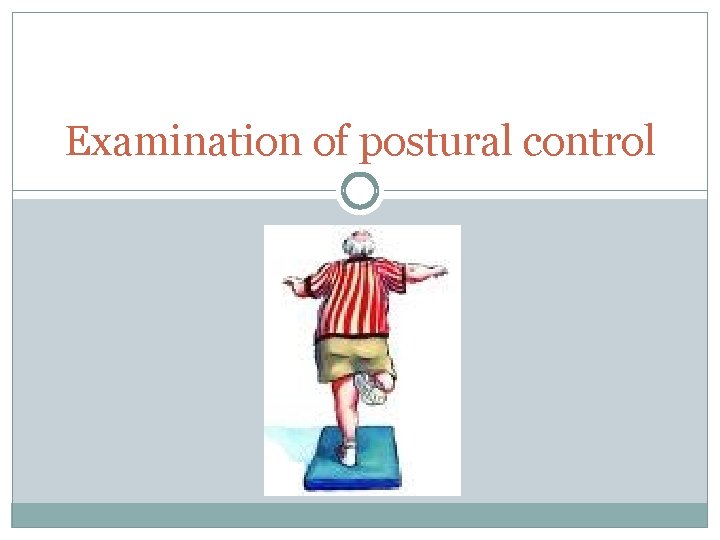
Examination of postural control
�Safety of therapist and patient is the first concern. �Examination of balance in a functional context Tasks may reflect the need for: -steady state postural control -anticipatory postural control -reactive postural control
�Steady state postural control Example: maintaining a safe independent sitting or standing position
�Anticipatory postural control Example: ability to maintain stability while performing tasks that are potentially destabilising such as reaching, leaning or lifting
�Reactive postural control Recovering a stable position following an unexpected perturbation
Self report measure for balance ability (subjective) �Self report information on the number of recent falls and circumstances leading to falls or loss of balance �This helps therapist to hypothesise about which aspects op postural control are impaired and to determine the next step in the examination. �Additional insight can be gained from a patient’s perceptions regarding how balance abilities have an impact on daily life
Self report measure for balance ability �Examples of self report measures: -Activities specific balance confidence scale (Powell and Myers 1995) -Falls efficacy Scale (Tinetti 1990)
Performance based measure of balance (objective) �Provides clinician with information on the patient’s level of performance compared with established norms �Examples: -Timed up and go test -Reach test -Performance oriented mobility assessment (POMA) -Berg Balance Test -Short performance battery
Limitations of functional tests and measures �Patient’s performance is examined under a limited set of environmental conditions �Few test examine all three aspects of postural control �Most tests provide little insight into the quality of movement used to accomplish the task THUS OTHER OBJECTIVE ASSESSING STRATEGIES FOR BALANCE
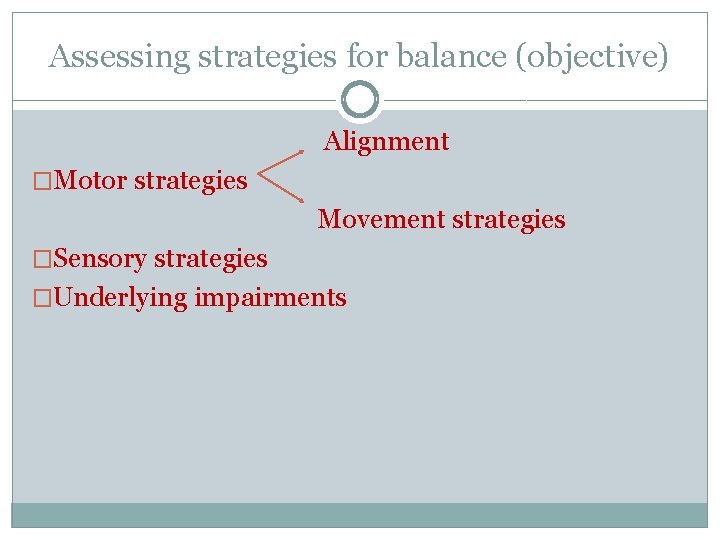
Assessing strategies for balance (objective) Alignment �Motor strategies Movement strategies �Sensory strategies �Underlying impairments
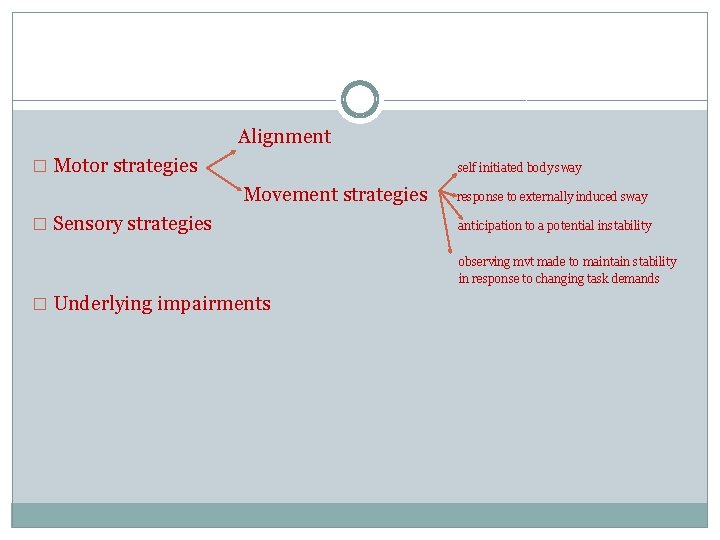
Alignment � Motor strategies self initiated body sway Movement strategies � Sensory strategies response to externally induced sway anticipation to a potential instability observing mvt made to maintain stability in response to changing task demands � Underlying impairments
Movement strategies �Self initiated body sway -Patient voluntarily shifts the weight forward, backwards, side ways -Sitting and standing -strategies
Movement strategies �Response to externally induced sway -Therapist’s hands on patient’s hips, displaces hips in multiple directions -Strategies?
Movement strategies �Anticipatory to a potentially destabilising movement -Ask patient to lift a heavy object as rapidly as possible or by placing one foot on top of a stool
Movement strategies �Observing movements made to maintain stability in response to changing task demands. -Standing on one foot, standing tandem, etc. -Strategies?
Sensory strategies �Stability must be maintained in a wide variety of environments �Instability when certain sensory cues are unavailable �Can provide insight into environmental conditions likely to produce instability �The clinical test for sensory interaction in balance (Shumway, Cook, Horak 1987)
Examination of underlying impairments �Impairments that will have the most direct impact on postural control �Strenght �ROM �Proprioception * You would have detected this within your normal objective evaluation.
Interpreting the results of examination �Interpret results �Identify problems (impairments and participation restriction) �Goals �Plan