
Exam Focus Question 2 Key Words verbs adjectives
Exam Focus: Question 2 Key Words: verbs, adjectives, connotations, language analysis 1. Sort these words into columns: verbs (doing words) and adjectives (describing words. disposed circled whisked spindly 2. Find a synonym for each word (a word that has the same or similar meaning). desperate fine wild driven terrible gangling
Understanding the Text Question 1 practice: Read again the first part of the source, lines 1 to 4. List four things from this part of the text that we learn about the horse’s early memories. [4 marks] Additional questions: 1. Who is the narrator? 2. What is happening to him? 3. How does he feel about it?
What will Language Paper 1 look like? You will have to read one fiction text and answer questions on it. Front cover SECTION B: 40 marks SECTION A: 40 marks Today we will be looking at Question 3 Q 1: 4 marks Q 1: Finding information Q 2: 8 marks Q 3: 8 marks Q 4: 20 marks Q 5: 40 marks
![QUESTION 2 Q 2 [AO 2] Look in detail at this extract from lines](http://slidetodoc.com/presentation_image_h2/317588f668419dfdffc19c301b19d4b1/image-4.jpg "QUESTION 2 Q 2 [AO 2] Look in detail at this extract from lines")
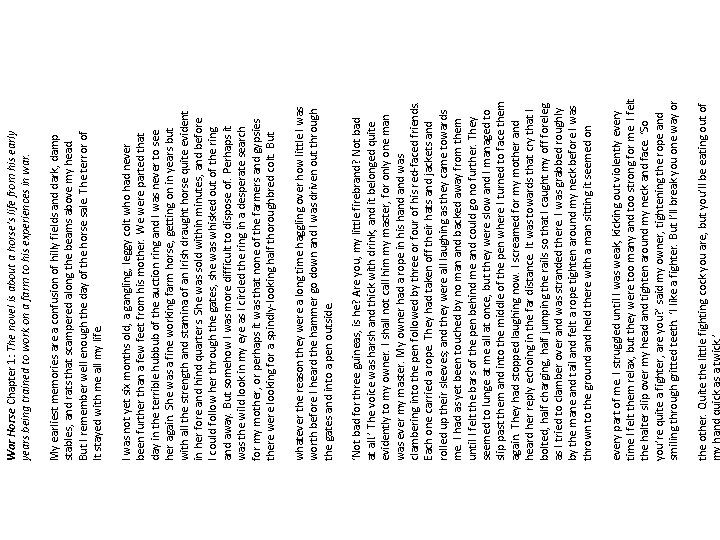
QUESTION 2 Q 2 [AO 2] Look in detail at this extract from lines 5 to 18 of the source. I was not yet six months old, a gangling, leggy colt who had never been further than a few feet from his mother. We were parted that day in the terrible hubbub of the auction ring and I was never to see her again. She was a fine working farm horse, getting on in years but with all the strength and stamina of an Irish draught horse quite evident in her fore and hind quarters. She was sold within minutes, and before I could follow her through the gates, she was whisked out of the ring and away. But somehow I was more difficult to dispose of. Perhaps it was the wild look in my eye as I circled the ring in a desperate search for my mother, or perhaps it was that none of the farmers and gypsies there were looking for a spindly-looking half thoroughbred colt. But whatever the reason they were a long time haggling over how little I was worth before I heard the hammer go down and I was driven out through the gates and into a pen outside. How does the writer use language here to show us what the horse felt about being up for sale? You could include the writer’s choice of: • words and phrases • language features and techniques • sentence forms. TASK: Highlight at least four powerful[8 marks] words and phrases.
![QUESTION 2 Q 2 [AO 2] Look in detail at this extract from lines](http://slidetodoc.com/presentation_image_h2/317588f668419dfdffc19c301b19d4b1/image-5.jpg "QUESTION 2 Q 2 [AO 2] Look in detail at this extract from lines")
QUESTION 2 Q 2 [AO 2] Look in detail at this extract from lines 5 to 18 of the source. I was not yet six months old, a gangling, leggy colt who had never been further than a few feet from his mother. We were parted that day in the terrible hubbub of the auction ring and I was never to see her again. She was a fine working farm horse, getting on in years but with all the strength and stamina of an Irish draught horse quite evident in her fore and hind quarters. She was sold within minutes, and before I could follow her through the gates, she was whisked out of the ring and away. But somehow I was more difficult to dispose of. Perhaps it was the wild look in my eye as I circled the ring in a desperate search for my mother, or perhaps it was that none of the farmers and gypsies there were looking for a spindly-looking half thoroughbred colt. But whatever the reason they were a long time haggling over how little I was worth before I heard the hammer go down and I was driven out through the gates and into a pen outside. How does the writer use language here to show us what the horse felt about being up for sale? You could include the writer’s choice of: • words and phrases • language features and techniques • sentence forms. TASK: Highlight at least four powerful[8 marks] words and phrases.

Key Word: Connotations are the images or ideas associated with a word or phrase. What about this word? energetic wildlife untamed wild ring angry mad Out of control Choose your own word from the text and explore its connotations
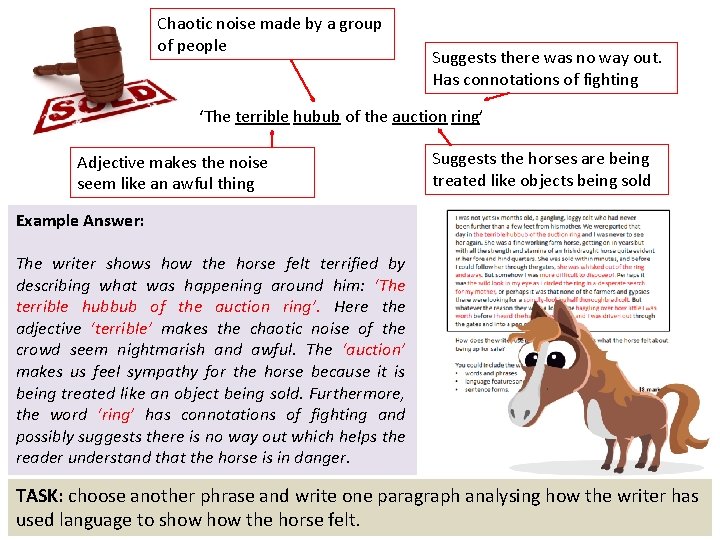
Chaotic noise made by a group of people Suggests there was no way out. Has connotations of fighting ‘The terrible hubub of the auction ring’ Adjective makes the noise seem like an awful thing Suggests the horses are being treated like objects being sold Example Answer: The writer shows how the horse felt terrified by describing what was happening around him: ‘The terrible hubbub of the auction ring’. Here the adjective ‘terrible’ makes the chaotic noise of the crowd seem nightmarish and awful. The ‘auction’ makes us feel sympathy for the horse because it is being treated like an object being sold. Furthermore, the word ‘ring’ has connotations of fighting and possibly suggests there is no way out which helps the reader understand that the horse is in danger. TASK: choose another phrase and write one paragraph analysing how the writer has used language to show the horse felt.
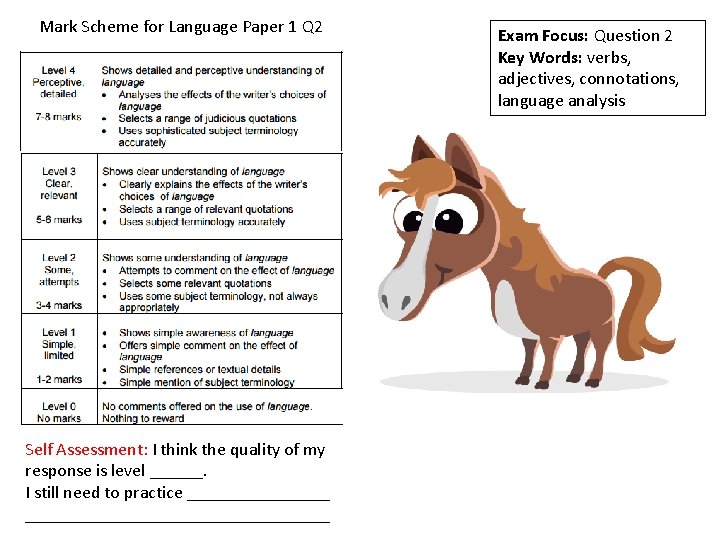
Mark Scheme for Language Paper 1 Q 2 Self Assessment: I think the quality of my response is level ______. I still need to practice _________________________ Exam Focus: Question 2 Key Words: verbs, adjectives, connotations, language analysis

Resources
the other. Quite the little fighting cock you are, but you’ll be eating out of every part of me. I struggled until I was weak, kicking out violently every time I felt them relax, but they were too many and too strong for me. I felt the halter slip over my head and tighten around my neck and face. ‘So you’re quite a fighter, are you? ’ said my owner, tightening the rope and smiling through gritted teeth. ‘I like a fighter. But I’ll break you one way or ‘Not bad for three guineas, is he? Are you, my little firebrand? Not bad at all. ’ The voice was harsh and thick with drink, and it belonged quite evidently to my owner. I shall not call him my master, for only one man was ever my master. My owner had a rope in his hand was clambering into the pen followed by three or four of his red-faced friends. Each one carried a rope. They had taken off their hats and jackets and rolled up their sleeves; and they were all laughing as they came towards me. I had as yet been touched by no man and backed away from them until I felt the bars of the pen behind me and could go no further. They seemed to lunge at me all at once, but they were slow and I managed to slip past them and into the middle of the pen where I turned to face them again. They had stopped laughing now. I screamed for my mother and heard her reply echoing in the far distance. It was towards that cry that I bolted, half charging, half jumping the rails so that I caught my off foreleg as I tried to clamber over and was stranded there. I was grabbed roughly by the mane and tail and felt a rope tighten around my neck before I was thrown to the ground and held there with a man sitting it seemed on whatever the reason they were a long time haggling over how little I was worth before I heard the hammer go down and I was driven out through the gates and into a pen outside. I was not yet six months old, a gangling, leggy colt who had never been further than a few feet from his mother. We were parted that day in the terrible hubbub of the auction ring and I was never to see her again. She was a fine working farm horse, getting on in years but with all the strength and stamina of an Irish draught horse quite evident in her fore and hind quarters. She was sold within minutes, and before I could follow her through the gates, she was whisked out of the ring and away. But somehow I was more difficult to dispose of. Perhaps it was the wild look in my eye as I circled the ring in a desperate search for my mother, or perhaps it was that none of the farmers and gypsies there were looking for a spindly-looking half thoroughbred colt. But My earliest memories are a confusion of hilly fields and dark, damp stables, and rats that scampered along the beams above my head. But I remember well enough the day of the horse sale. The terror of It stayed with me all my life. War Horse Chapter 1: The novel is about a horse’s life from his early years being trained to work on a farm to his experiences in war.
- Slides: 10