
Exact Numbers vs Measurements Sometimes you can determine
Exact Numbers vs. Measurements • Sometimes you can determine an exact value for a quality of an object. ü Often by counting. • Pennies in a pile. ü Sometimes by definition • 1 ounce is exactly 1/16 th of 1 pound. • Whenever you use an instrument to compare a quality of an object to a standard, there is uncertainty in the comparison. Tro's "Introductory Chemistry", Chapter 2 1
Units • Always write every number with its associated unit. • Always include units in your calculations. üYou can do the same kind of operations on units as you can with numbers. • cm × cm = cm 2 • cm + cm = cm • cm ÷ cm = 1 üUsing units as a guide to problem solving is called dimensional analysis. Tro's "Introductory Chemistry", Chapter 2 2
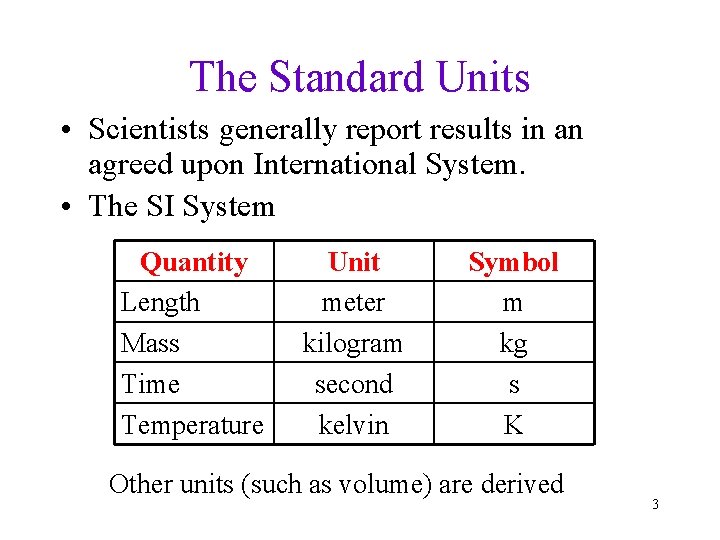
The Standard Units • Scientists generally report results in an agreed upon International System. • The SI System Quantity Length Mass Time Temperature Unit meter kilogram second kelvin Symbol m kg s K Other units (such as volume) are derived 3
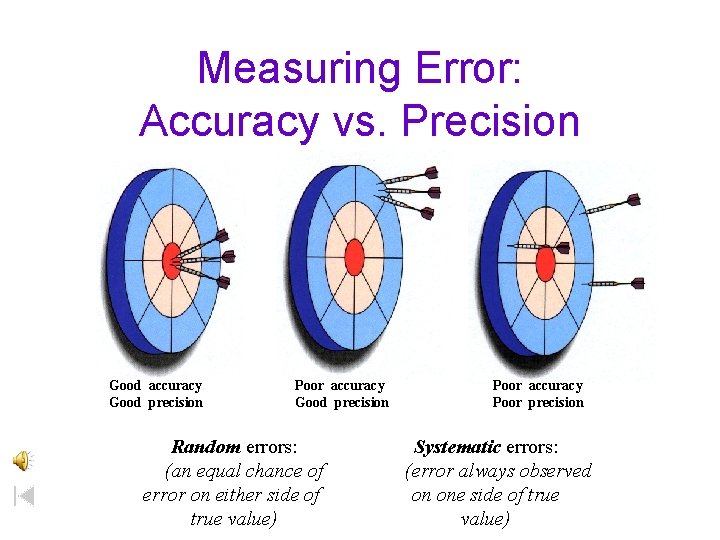
Measuring Error: Accuracy vs. Precision Good accuracy Good precision Poor accuracy Good precision Random errors: (an equal chance of error on either side of true value) Poor accuracy Poor precision Systematic errors: (error always observed on one side of true value)
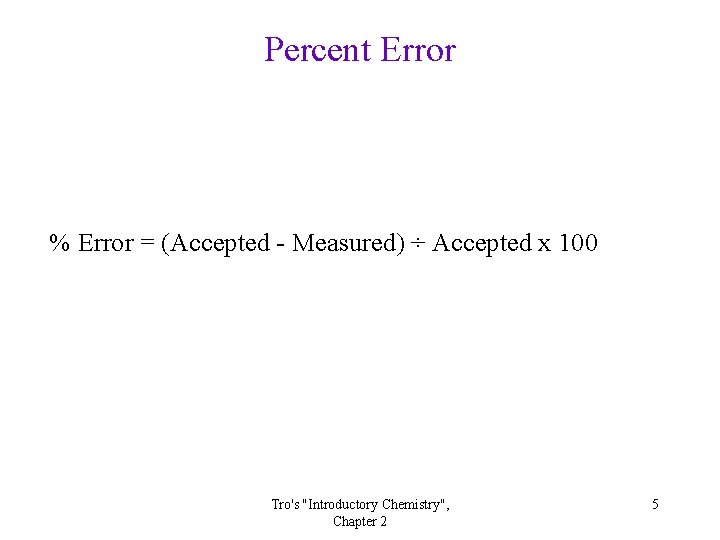
Percent Error % Error = (Accepted - Measured) ÷ Accepted x 100 Tro's "Introductory Chemistry", Chapter 2 5
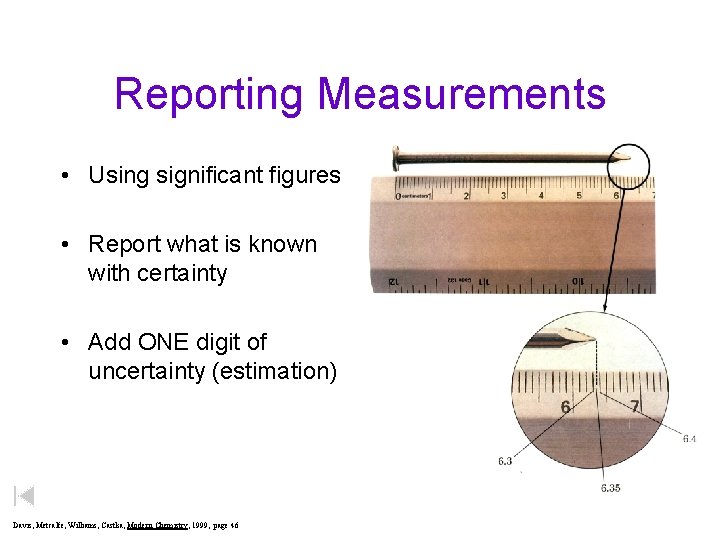
Reporting Measurements • Using significant figures • Report what is known with certainty • Add ONE digit of uncertainty (estimation) Davis, Metcalfe, Williams, Castka, Modern Chemistry, 1999, page 46
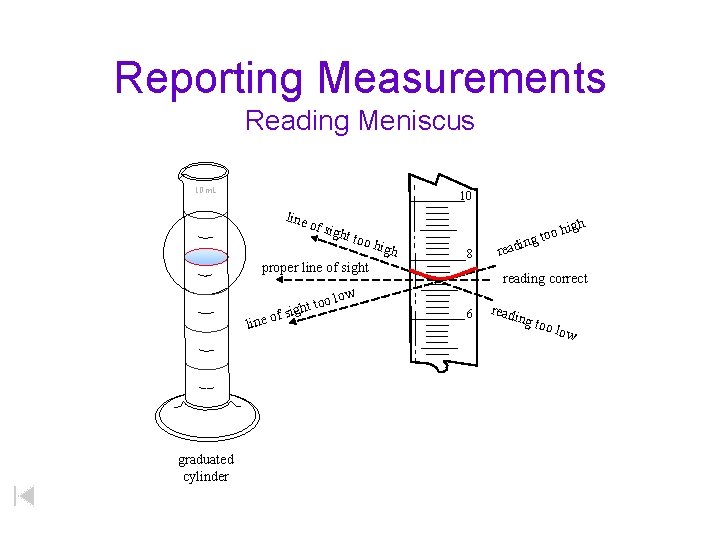
Reporting Measurements Reading Meniscus 10 m. L 10 line o f sig ht to o hig proper line of sight of line graduated cylinder too sight h 8 high o o t ing reading correct low 6 read i ng to o low
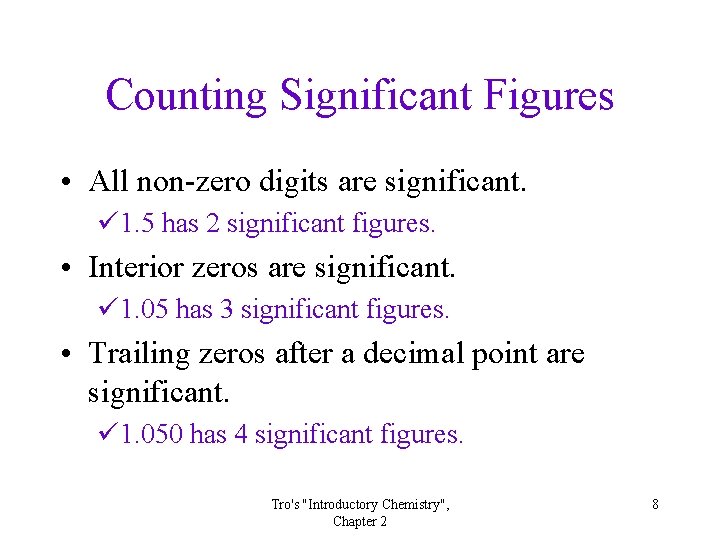
Counting Significant Figures • All non-zero digits are significant. ü 1. 5 has 2 significant figures. • Interior zeros are significant. ü 1. 05 has 3 significant figures. • Trailing zeros after a decimal point are significant. ü 1. 050 has 4 significant figures. Tro's "Introductory Chemistry", Chapter 2 8
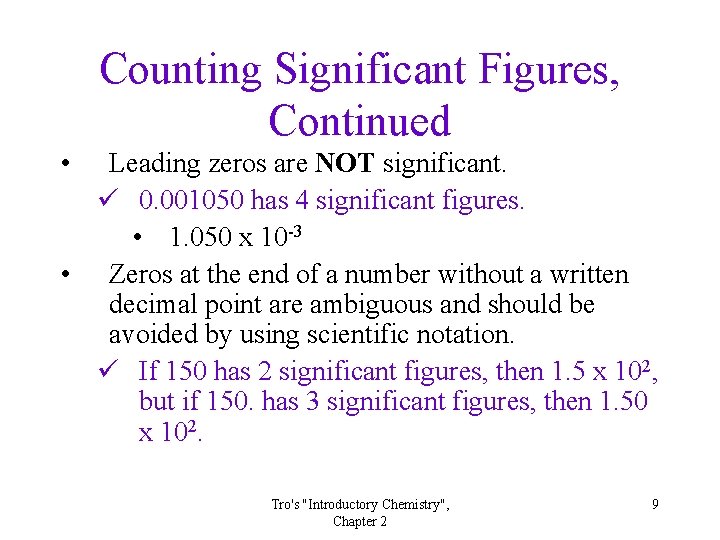
Counting Significant Figures, Continued • Leading zeros are NOT significant. ü 0. 001050 has 4 significant figures. • 1. 050 x 10 -3 • Zeros at the end of a number without a written decimal point are ambiguous and should be avoided by using scientific notation. ü If 150 has 2 significant figures, then 1. 5 x 10², but if 150. has 3 significant figures, then 1. 50 x 102. Tro's "Introductory Chemistry", Chapter 2 9

Example • How many significant figures are in each of the following numbers? 0. 0035 2 significant figures—leading zeros are not significant. 1. 080 4 significant figures—trailing and interior zeros are significant. 2371 4 significant figures—All digits are significant. 2. 97 × 105 3 significant figures—Only decimal parts count as significant. 1 dozen = 12 100, 000 Unlimited significant figures—Definition Ambiguous Tro's "Introductory Chemistry", Chapter 2 10
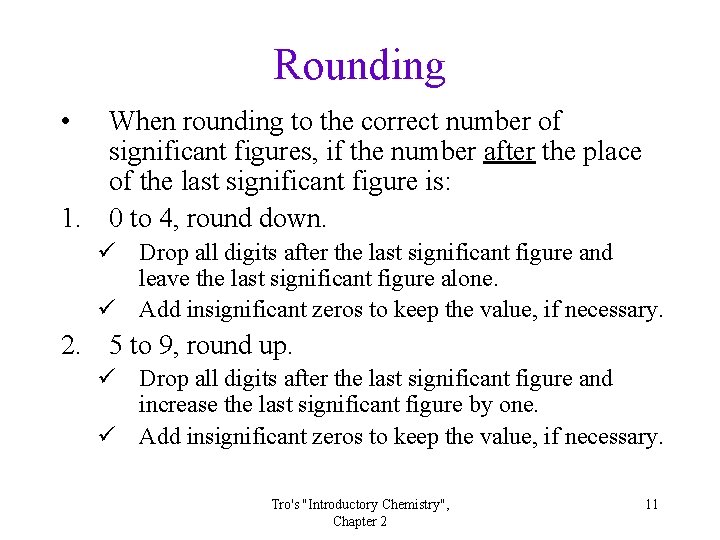
Rounding • When rounding to the correct number of significant figures, if the number after the place of the last significant figure is: 1. 0 to 4, round down. ü Drop all digits after the last significant figure and leave the last significant figure alone. ü Add insignificant zeros to keep the value, if necessary. 2. 5 to 9, round up. ü Drop all digits after the last significant figure and increase the last significant figure by one. ü Add insignificant zeros to keep the value, if necessary. Tro's "Introductory Chemistry", Chapter 2 11
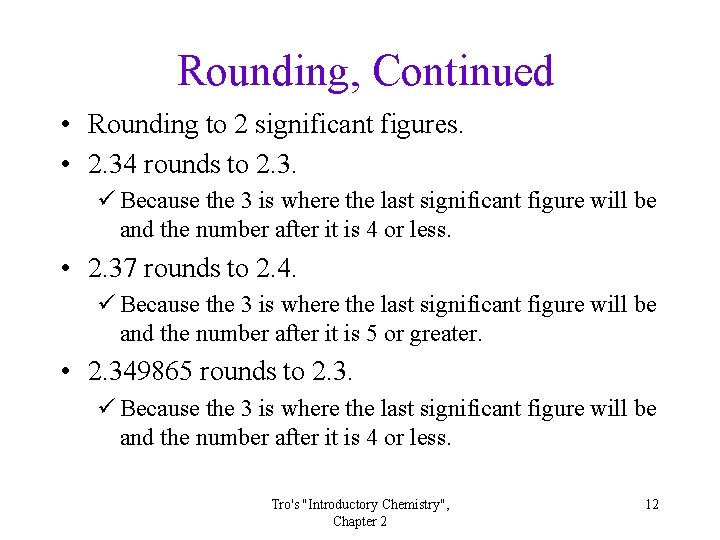
Rounding, Continued • Rounding to 2 significant figures. • 2. 34 rounds to 2. 3. ü Because the 3 is where the last significant figure will be and the number after it is 4 or less. • 2. 37 rounds to 2. 4. ü Because the 3 is where the last significant figure will be and the number after it is 5 or greater. • 2. 349865 rounds to 2. 3. ü Because the 3 is where the last significant figure will be and the number after it is 4 or less. Tro's "Introductory Chemistry", Chapter 2 12
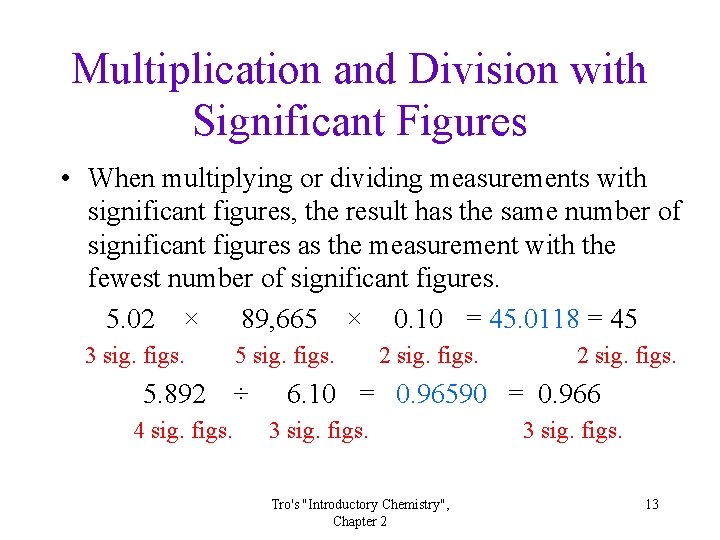
Multiplication and Division with Significant Figures • When multiplying or dividing measurements with significant figures, the result has the same number of significant figures as the measurement with the fewest number of significant figures. 5. 02 × 89, 665 × 0. 10 = 45. 0118 = 45 3 sig. figs. 5. 892 4 sig. figs. 5 sig. figs. ÷ 2 sig. figs. 6. 10 = 0. 96590 = 0. 966 3 sig. figs. Tro's "Introductory Chemistry", Chapter 2 3 sig. figs. 13
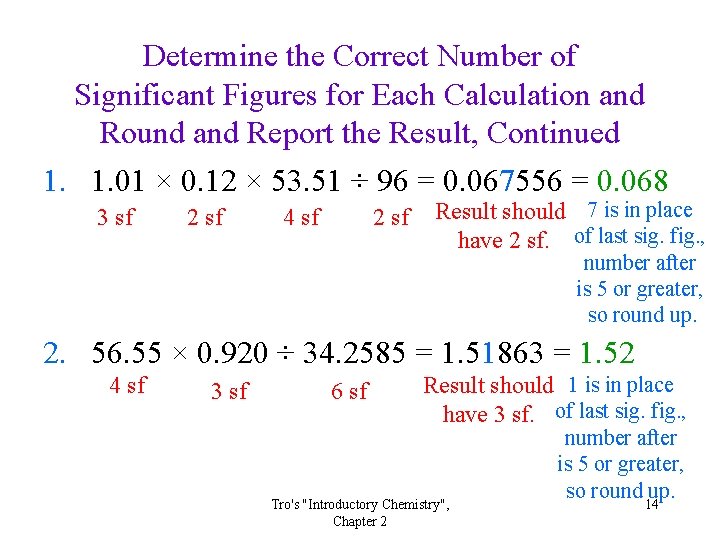
Determine the Correct Number of Significant Figures for Each Calculation and Round and Report the Result, Continued 1. 1. 01 × 0. 12 × 53. 51 ÷ 96 = 0. 067556 = 0. 068 3 sf 2 sf 4 sf 2 sf Result should 7 is in place have 2 sf. of last sig. fig. , number after is 5 or greater, so round up. 2. 56. 55 × 0. 920 ÷ 34. 2585 = 1. 51863 = 1. 52 4 sf 3 sf 6 sf Result should 1 is in place have 3 sf. of last sig. fig. , Tro's "Introductory Chemistry", Chapter 2 number after is 5 or greater, so round up. 14
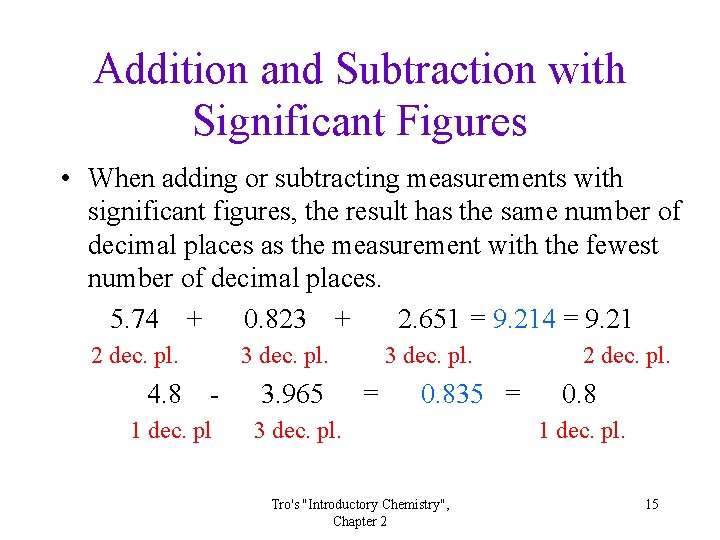
Addition and Subtraction with Significant Figures • When adding or subtracting measurements with significant figures, the result has the same number of decimal places as the measurement with the fewest number of decimal places. 5. 74 + 0. 823 + 2. 651 = 9. 214 = 9. 21 2 dec. pl. 4. 8 3 dec. pl. - 1 dec. pl 3. 965 3 dec. pl. = 0. 835 = 3 dec. pl. Tro's "Introductory Chemistry", Chapter 2 2 dec. pl. 0. 8 1 dec. pl. 15
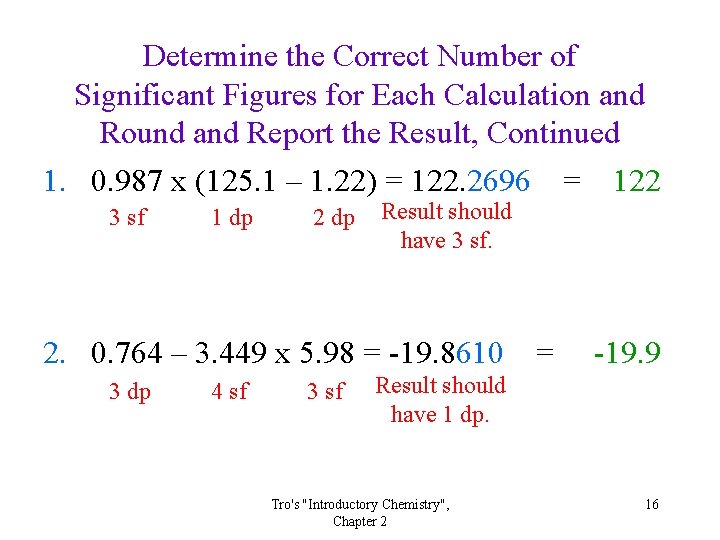
Determine the Correct Number of Significant Figures for Each Calculation and Round and Report the Result, Continued 1. 0. 987 x (125. 1 – 1. 22) = 122. 2696 = 122 3 sf 1 dp 2 dp Result should have 3 sf. 2. 0. 764 – 3. 449 x 5. 98 = -19. 8610 = 3 dp 4 sf 3 sf -19. 9 Result should have 1 dp. Tro's "Introductory Chemistry", Chapter 2 16
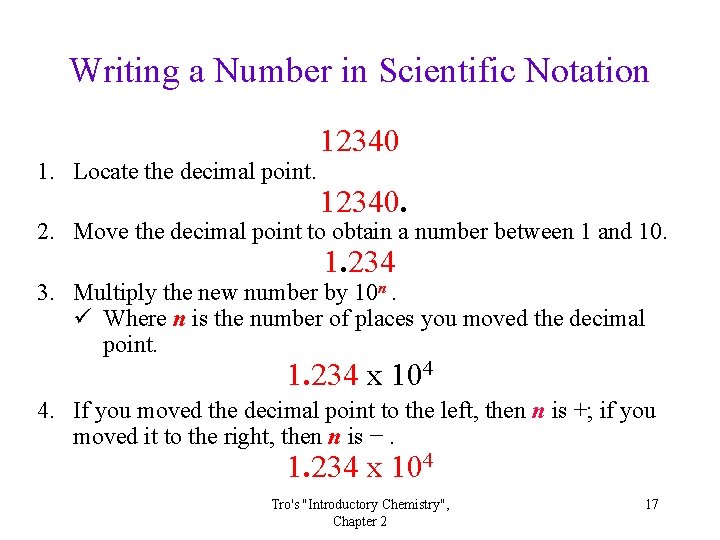
Writing a Number in Scientific Notation 1. Locate the decimal point. 12340. 2. Move the decimal point to obtain a number between 1 and 10. 1. 234 3. Multiply the new number by 10 n. ü Where n is the number of places you moved the decimal point. 1. 234 x 104 4. If you moved the decimal point to the left, then n is +; if you moved it to the right, then n is −. 1. 234 x 104 Tro's "Introductory Chemistry", Chapter 2 17
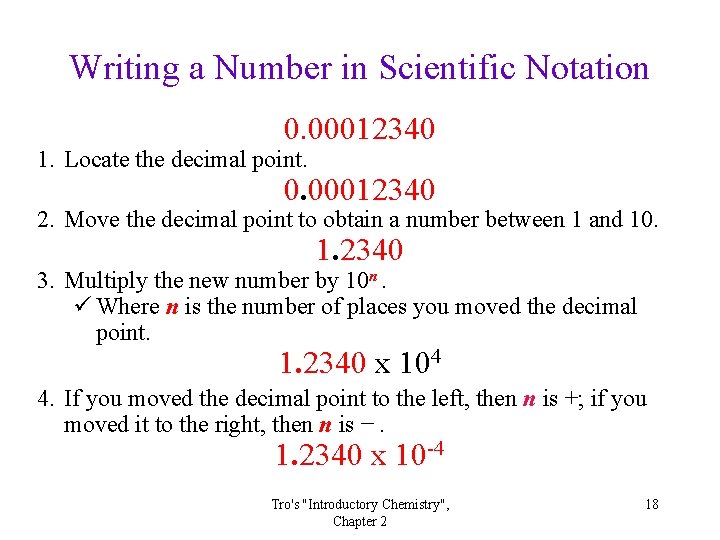
Writing a Number in Scientific Notation 0. 00012340 1. Locate the decimal point. 0. 00012340 2. Move the decimal point to obtain a number between 1 and 10. 1. 2340 3. Multiply the new number by 10 n. ü Where n is the number of places you moved the decimal point. 1. 2340 x 104 4. If you moved the decimal point to the left, then n is +; if you moved it to the right, then n is −. 1. 2340 x 10 -4 Tro's "Introductory Chemistry", Chapter 2 18
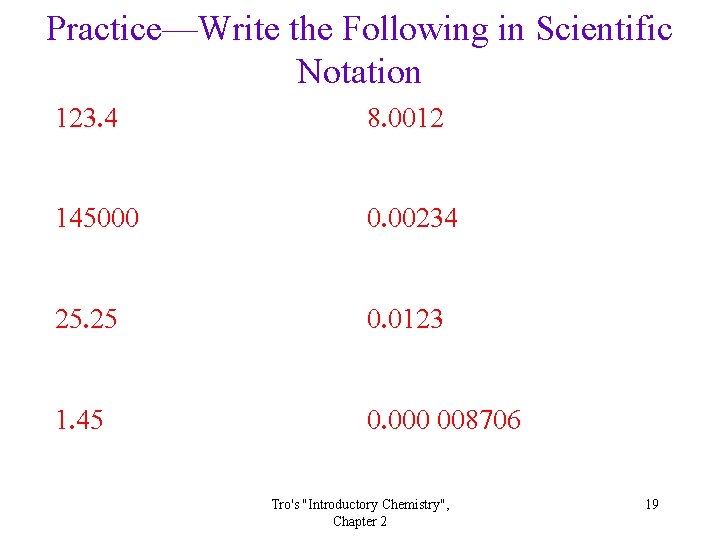
Practice—Write the Following in Scientific Notation 123. 4 8. 0012 145000 0. 00234 25. 25 0. 0123 1. 45 0. 000 008706 Tro's "Introductory Chemistry", Chapter 2 19
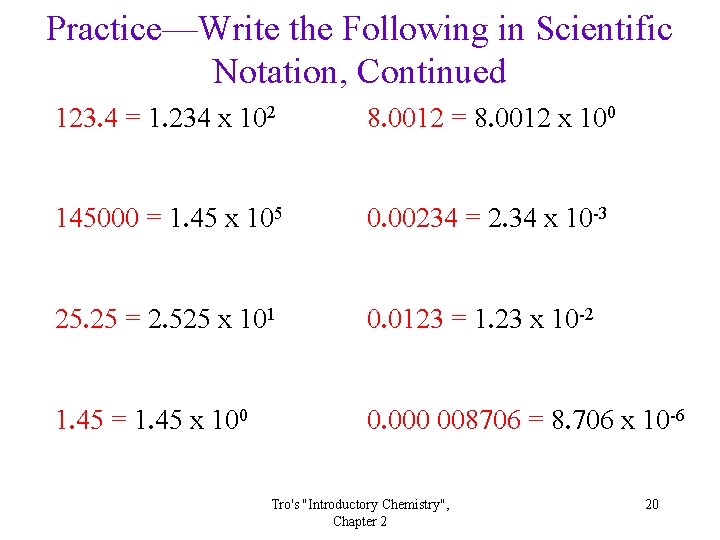
Practice—Write the Following in Scientific Notation, Continued 123. 4 = 1. 234 x 102 8. 0012 = 8. 0012 x 100 145000 = 1. 45 x 105 0. 00234 = 2. 34 x 10 -3 25. 25 = 2. 525 x 101 0. 0123 = 1. 23 x 10 -2 1. 45 = 1. 45 x 100 0. 000 008706 = 8. 706 x 10 -6 Tro's "Introductory Chemistry", Chapter 2 20
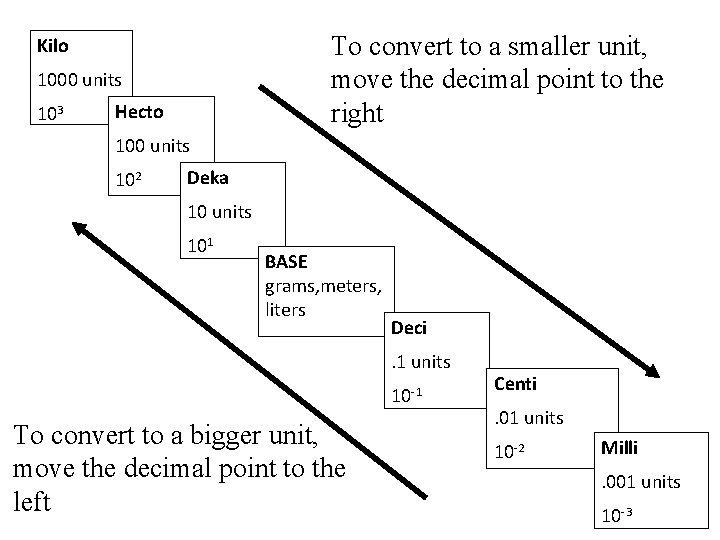
To convert to a smaller unit, move the decimal point to the right Kilo 1000 units 103 Hecto 100 units 102 Deka 10 units 101 BASE grams, meters, liters Deci. 1 units 10 -1 To convert to a bigger unit, move the decimal point to the left Centi. 01 units 10 -2 Milli. 001 units 10 -3
Mass and Volume • Two main characteristics of matter. • Cannot be used to identify what type of matter something is. üIf you are given a large glass containing 100 g of a clear, colorless liquid and a small glass containing 25 g of a clear, colorless liquid, are both liquids the same stuff? • Even though mass and volume are individual properties, for a given type of matter they are related to each other! Tro's "Introductory Chemistry", Chapter 2 22
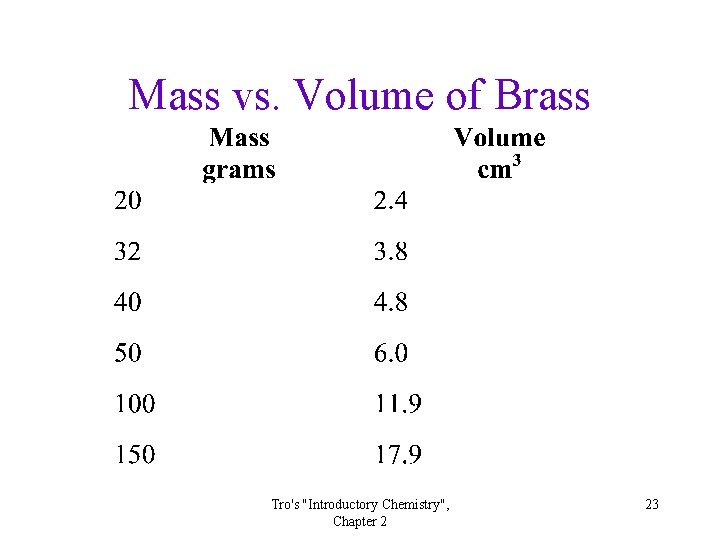
Mass vs. Volume of Brass Tro's "Introductory Chemistry", Chapter 2 23
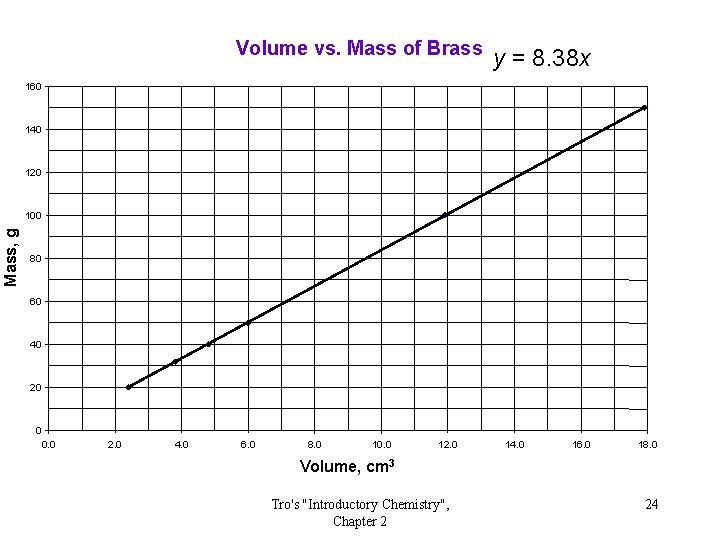
Volume vs. Mass of Brass y = 8. 38 x 160 140 120 Mass, g 100 80 60 40 20 0 0. 0 2. 0 4. 0 6. 0 8. 0 10. 0 12. 0 14. 0 16. 0 18. 0 Volume, cm 3 Tro's "Introductory Chemistry", Chapter 2 24
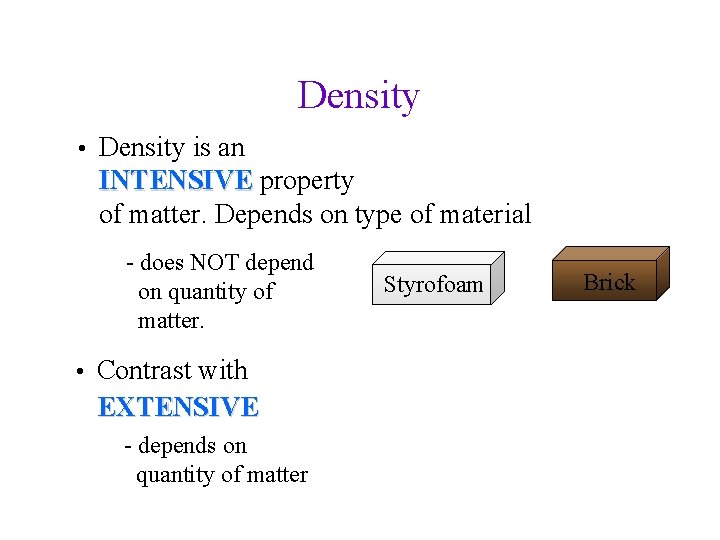
Density • Density is an INTENSIVE property of matter. Depends on type of material - does NOT depend on quantity of matter. • Contrast with EXTENSIVE - depends on quantity of matter Styrofoam Brick
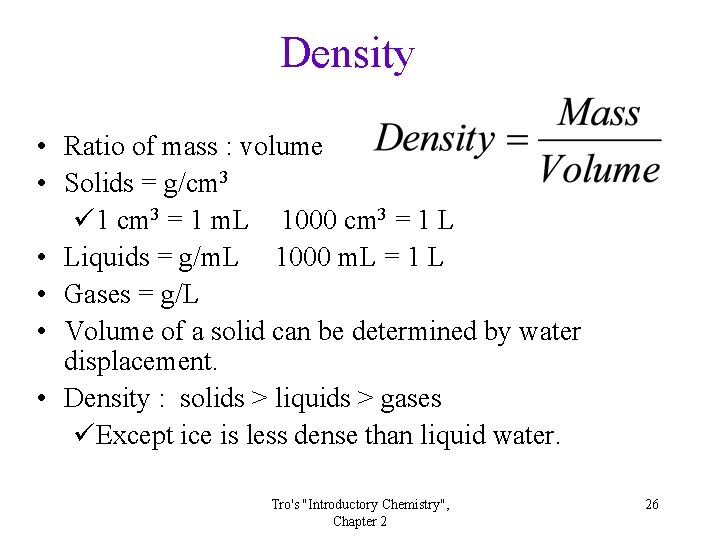
Density • Ratio of mass : volume • Solids = g/cm 3 ü 1 cm 3 = 1 m. L 1000 cm 3 = 1 L • Liquids = g/m. L 1000 m. L = 1 L • Gases = g/L • Volume of a solid can be determined by water displacement. • Density : solids > liquids > gases üExcept ice is less dense than liquid water. Tro's "Introductory Chemistry", Chapter 2 26
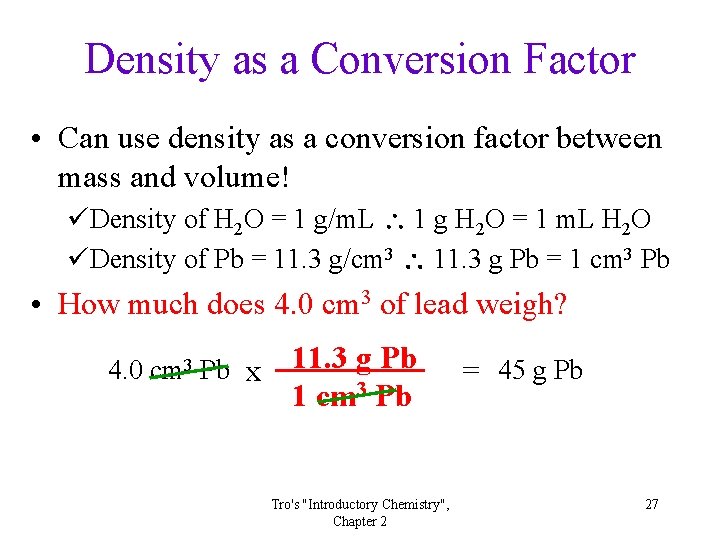
Density as a Conversion Factor • Can use density as a conversion factor between mass and volume! üDensity of H 2 O = 1 g/m. L 1 g H 2 O = 1 m. L H 2 O üDensity of Pb = 11. 3 g/cm 3 11. 3 g Pb = 1 cm 3 Pb • How much does 4. 0 cm 3 of lead weigh? 4. 0 cm 3 Pb x 11. 3 g Pb 1 cm 3 Pb Tro's "Introductory Chemistry", Chapter 2 = 45 g Pb 27
- Slides: 27