
Ex 5 Attitudes and Movements Ex 5 Attitudes
- Slides: 40
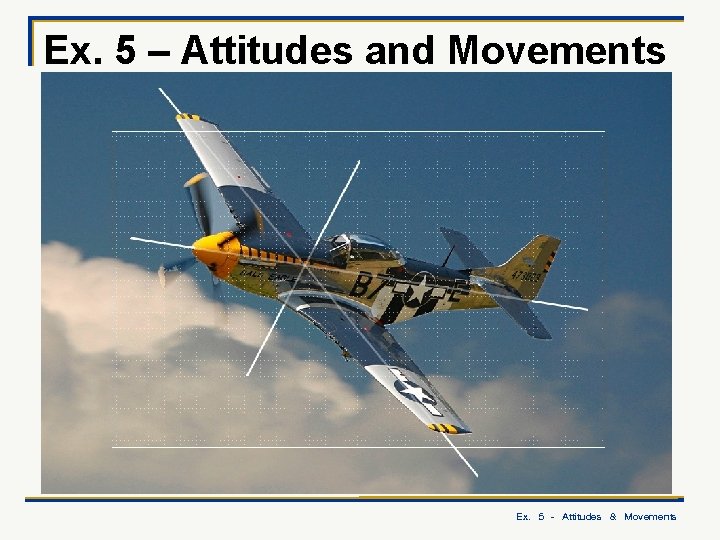
Ex. 5 – Attitudes and Movements Ex. 5 - Attitudes & Movements
OBJECTIVE What you will learn: What’s an attitude? P The range of the airplane’s normal operating attitudes P Producing and controlling airplane movements to achieve and maintain desired attitudes of flight. Ex. 5 - Attitudes & Movements
MOTIVATION Why learn all this: P These basic concepts are the foundation of every manoeuvre you will ever perform as a pilot P It’s important to get a solid grasp on them from the start. Ex. 5 - Attitudes & Movements
BACKGROUND KNOWLEDGE Let’s see how much you already know: Q What is lift? Q What is angle of attack? Q How does lift depend on angle of attack? Q What is airspeed? Q How does lift depend on airspeed? Review the first few chapters in your FTM, or chat with your flight instructor for clarification on any of the above… Ex. 5 - Attitudes & Movements
THEORIES & DEFINITIONS Theories & Definitions P Attitudes § § § P Cruise Attitude Pitch Attitudes Bank Attitudes Axes and Movements § § § Pitch Roll Yaw P Instrument Indications P Look-out. Ex. 5 - Attitudes & Movements
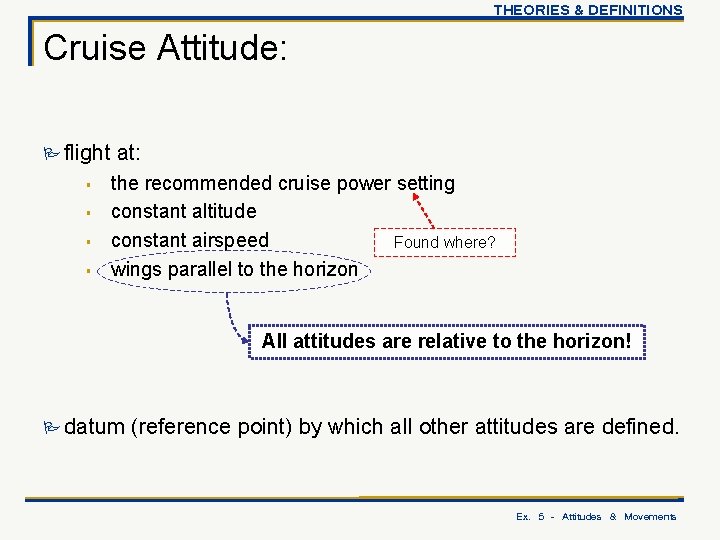
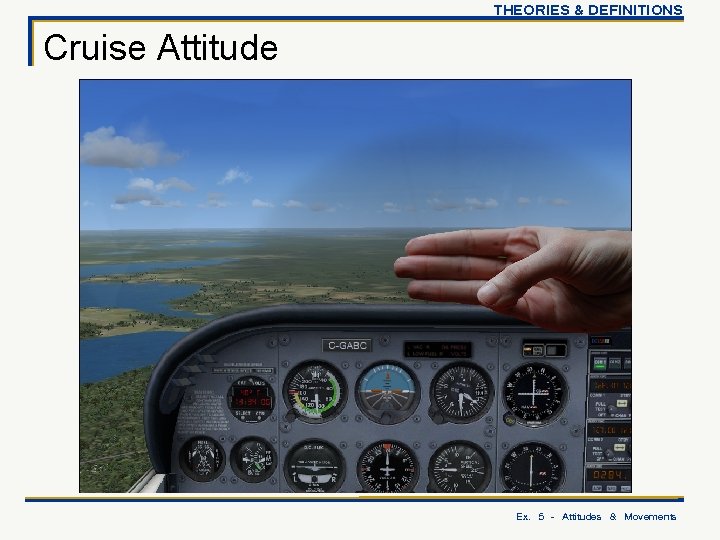
THEORIES & DEFINITIONS Cruise Attitude: P flight § § at: the recommended cruise power setting constant altitude constant airspeed Found where? wings parallel to the horizon All attitudes are relative to the horizon! P datum (reference point) by which all other attitudes are defined. Ex. 5 - Attitudes & Movements
THEORIES & DEFINITIONS Cruise Attitude Ex. 5 - Attitudes & Movements
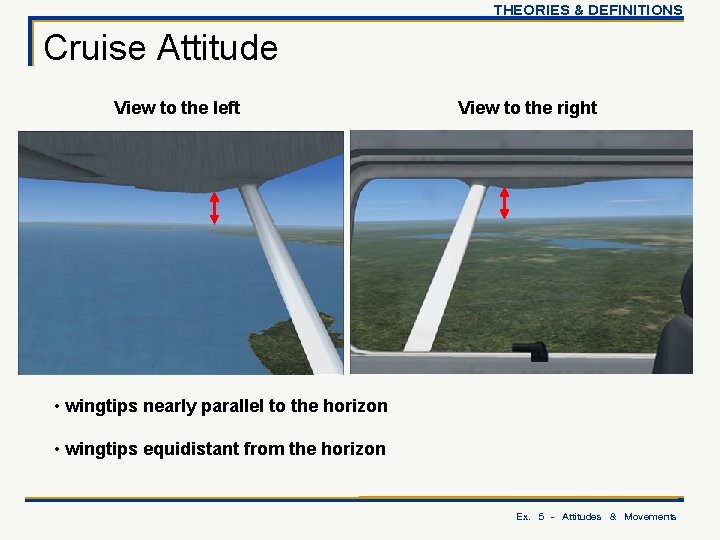
THEORIES & DEFINITIONS Cruise Attitude View to the left View to the right • wingtips nearly parallel to the horizon • wingtips equidistant from the horizon Ex. 5 - Attitudes & Movements
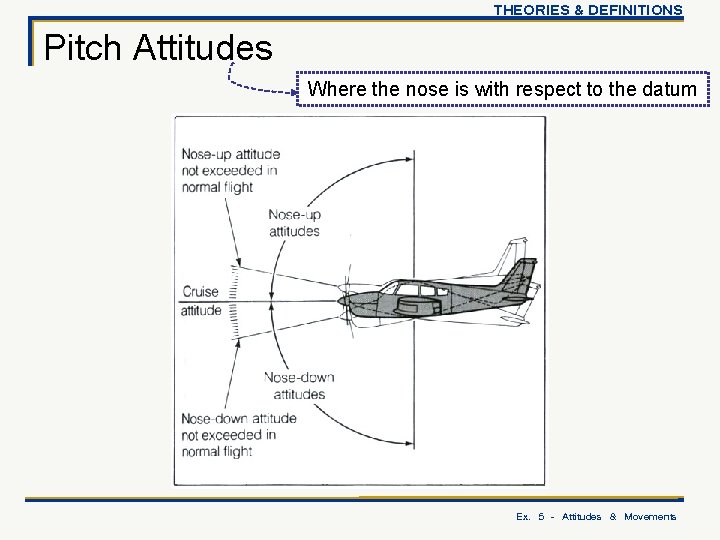
THEORIES & DEFINITIONS Pitch Attitudes Where the nose is with respect to the datum Ex. 5 - Attitudes & Movements
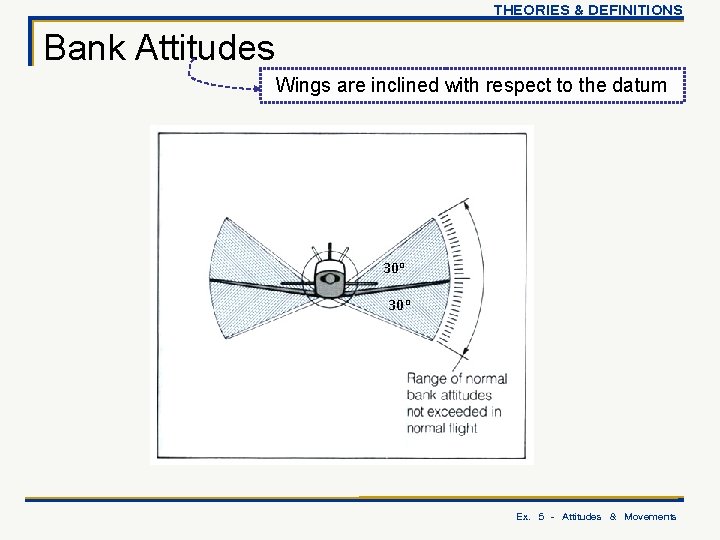
THEORIES & DEFINITIONS Bank Attitudes Wings are inclined with respect to the datum 30 o Ex. 5 - Attitudes & Movements
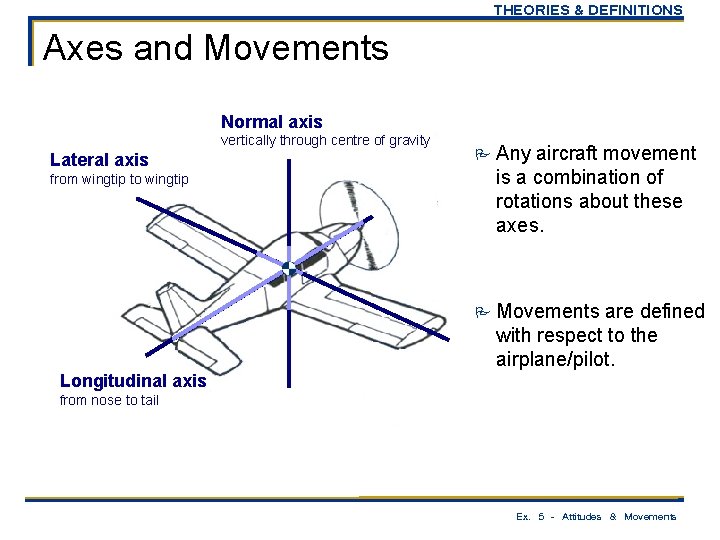
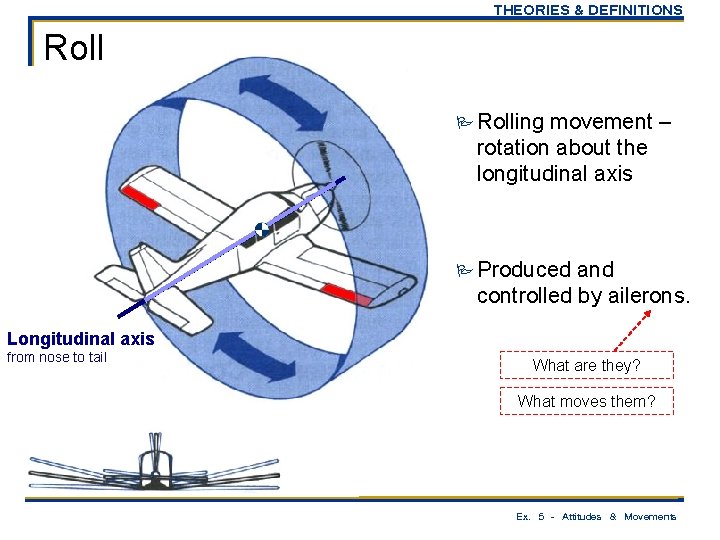
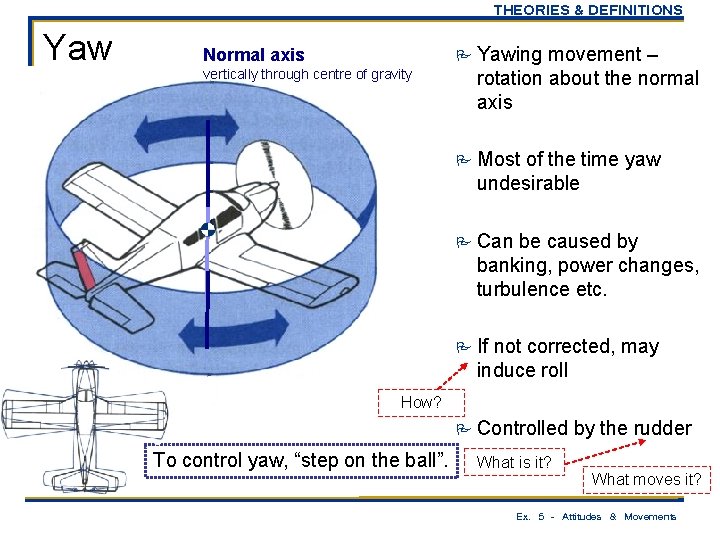
THEORIES & DEFINITIONS Axes and Movements Normal axis vertically through centre of gravity Lateral axis from wingtip to wingtip P Any aircraft movement is a combination of rotations about these axes. P Movements Longitudinal axis are defined with respect to the airplane/pilot. from nose to tail Ex. 5 - Attitudes & Movements
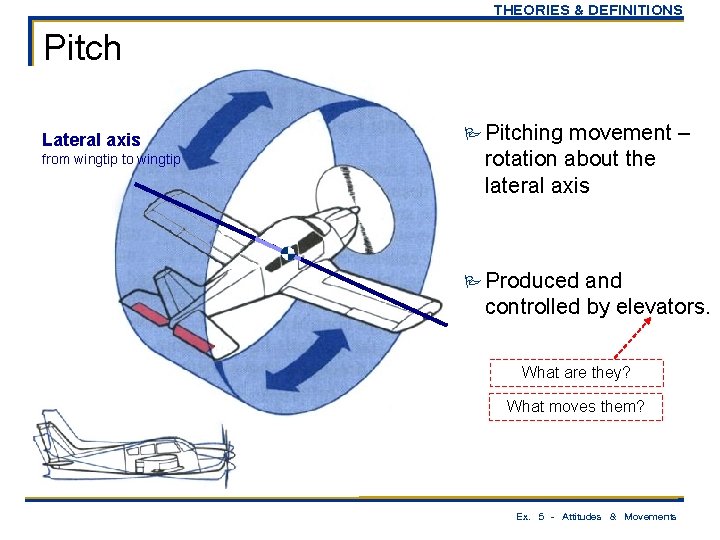
THEORIES & DEFINITIONS Pitch Lateral axis from wingtip to wingtip P Pitching movement – rotation about the lateral axis P Produced and controlled by elevators. What are they? What moves them? Ex. 5 - Attitudes & Movements
THEORIES & DEFINITIONS Roll P Rolling movement – rotation about the longitudinal axis P Produced and controlled by ailerons. Longitudinal axis from nose to tail What are they? What moves them? Ex. 5 - Attitudes & Movements
THEORIES & DEFINITIONS Yaw P Yawing Normal axis vertically through centre of gravity movement – rotation about the normal axis P Most of the time yaw undesirable P Can be caused by banking, power changes, turbulence etc. P If not corrected, may induce roll How? P Controlled To control yaw, “step on the ball”. What is it? by the rudder What moves it? Ex. 5 - Attitudes & Movements
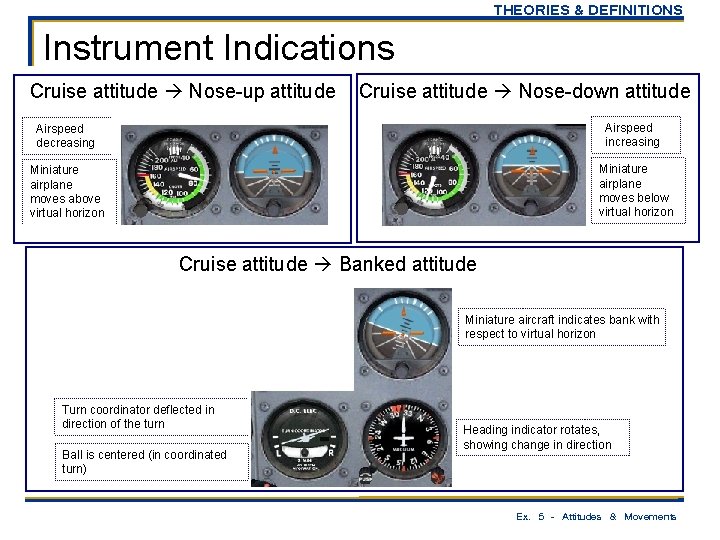
THEORIES & DEFINITIONS Instrument Indications Cruise attitude Nose-up attitude Cruise attitude Nose-down attitude Airspeed decreasing Airspeed increasing Miniature airplane moves above virtual horizon Miniature airplane moves below virtual horizon Cruise attitude Banked attitude Miniature aircraft indicates bank with respect to virtual horizon Turn coordinator deflected in direction of the turn Ball is centered (in coordinated turn) Heading indicator rotates, showing change in direction Ex. 5 - Attitudes & Movements
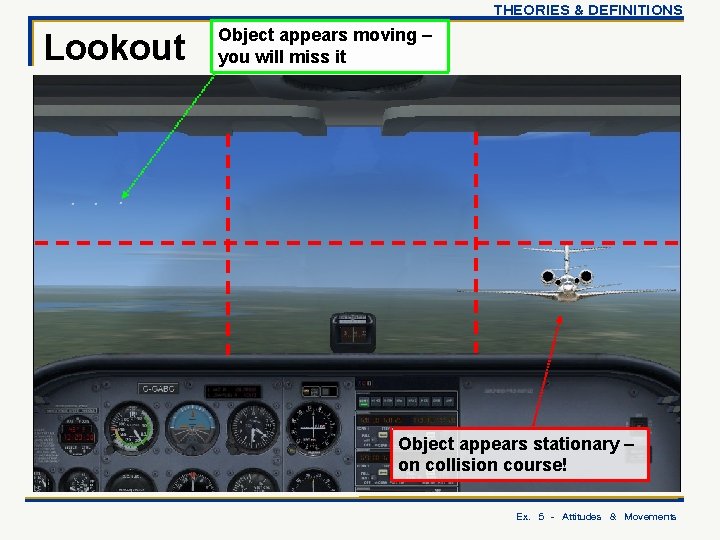
THEORIES & DEFINITIONS Lookout What are the implications of this word? P We fly VFR = Visual Flight Rules P Operations are based on “see-and-avoid” principle P Must be on constant lookout for other traffic (as well as weather, terrain, obstructions etc. ) Ex. 5 - Attitudes & Movements
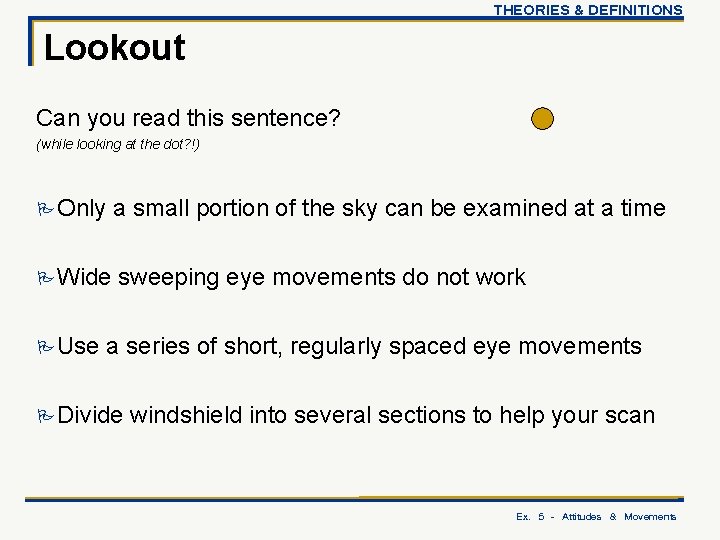
THEORIES & DEFINITIONS Lookout Can you read this sentence? (while looking at the dot? !) P Only a small portion of the sky can be examined at a time P Wide sweeping eye movements do not work P Use a series of short, regularly spaced eye movements P Divide windshield into several sections to help your scan Ex. 5 - Attitudes & Movements
THEORIES & DEFINITIONS Lookout Object appears moving – you will miss it Object appears stationary – on collision course! Ex. 5 - Attitudes & Movements
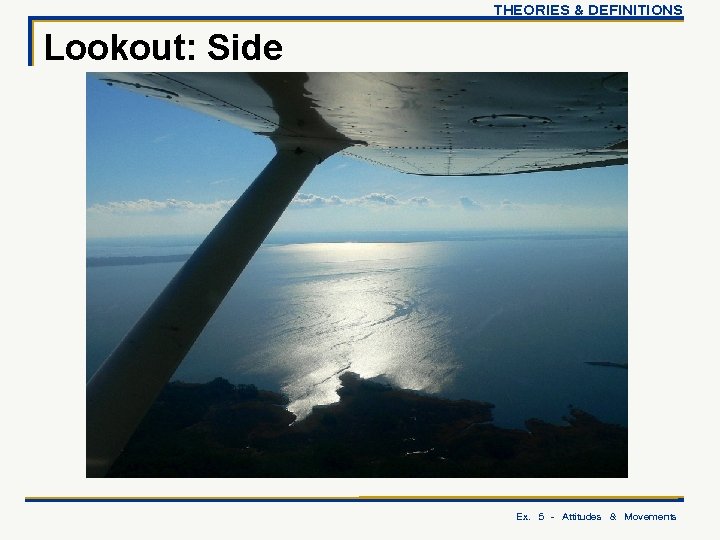
THEORIES & DEFINITIONS Lookout: Side Ex. 5 - Attitudes & Movements
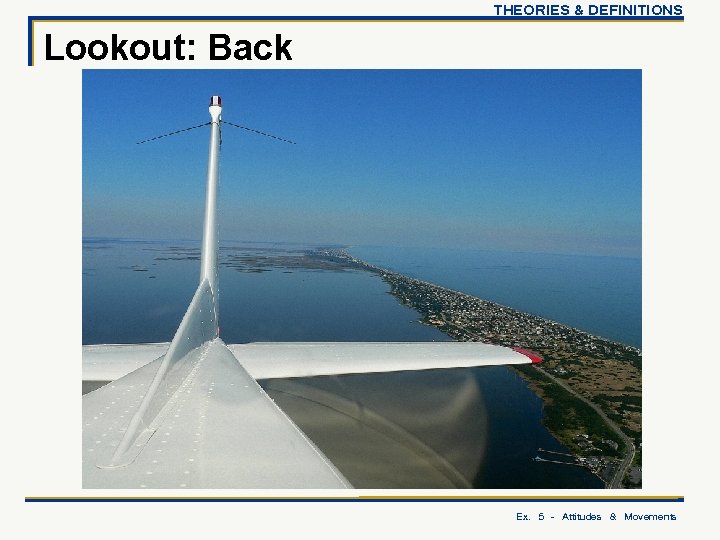
THEORIES & DEFINITIONS Lookout: Back Ex. 5 - Attitudes & Movements
PROCEDURES Procedures P Pitch Up § § § P Pitch Down § § § P Entry During Recovery Roll § § § P Entry During Recovery Yaw § § Entry Recovery. Ex. 5 - Attitudes & Movements
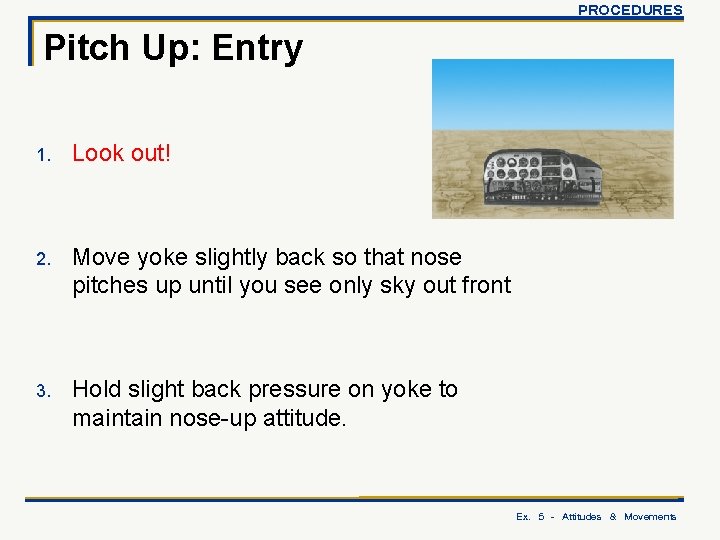
PROCEDURES Pitch Up: Entry 1. Look out! 2. Move yoke slightly back so that nose pitches up until you see only sky out front 3. Hold slight back pressure on yoke to maintain nose-up attitude. Ex. 5 - Attitudes & Movements
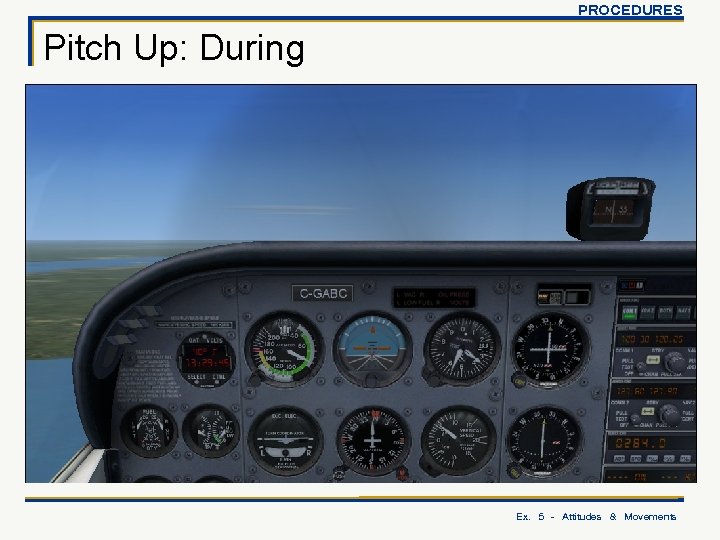
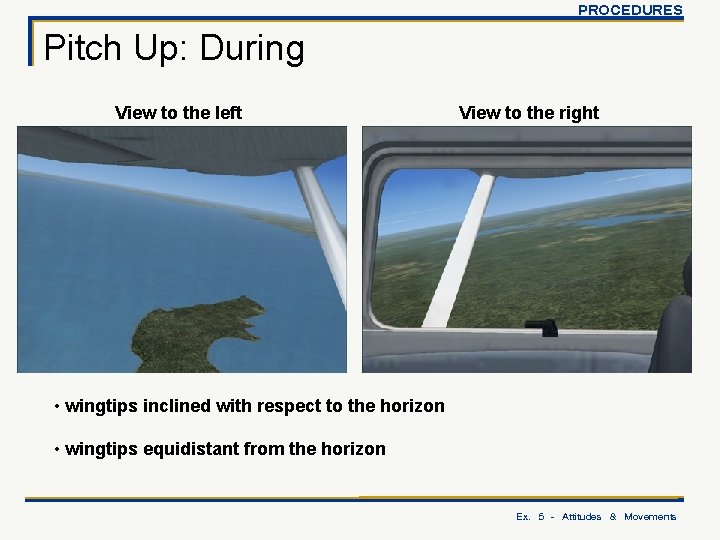
PROCEDURES Pitch Up: During P Keep good look-out! P Keep slight back pressure on yoke to maintain pitch-up attitude P Maintain straight flight with ailerons P Control yaw with rudder Ex. 5 - Attitudes & Movements
PROCEDURES Pitch Up: During Ex. 5 - Attitudes & Movements
PROCEDURES Pitch Up: During View to the left View to the right • wingtips inclined with respect to the horizon • wingtips equidistant from the horizon Ex. 5 - Attitudes & Movements
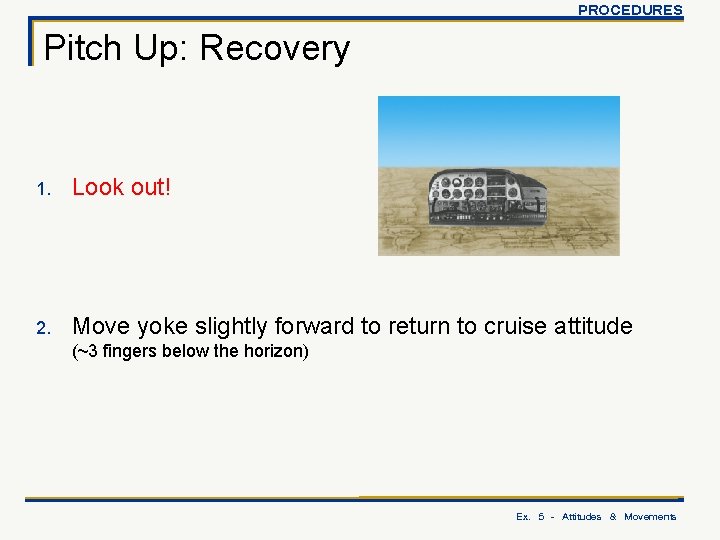
PROCEDURES Pitch Up: Recovery 1. Look out! 2. Move yoke slightly forward to return to cruise attitude (~3 fingers below the horizon) Ex. 5 - Attitudes & Movements
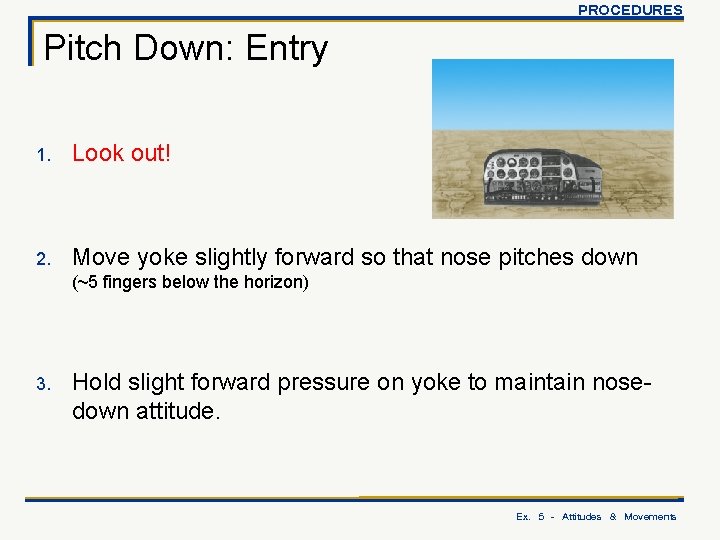
PROCEDURES Pitch Down: Entry 1. Look out! 2. Move yoke slightly forward so that nose pitches down (~5 fingers below the horizon) 3. Hold slight forward pressure on yoke to maintain nosedown attitude. Ex. 5 - Attitudes & Movements
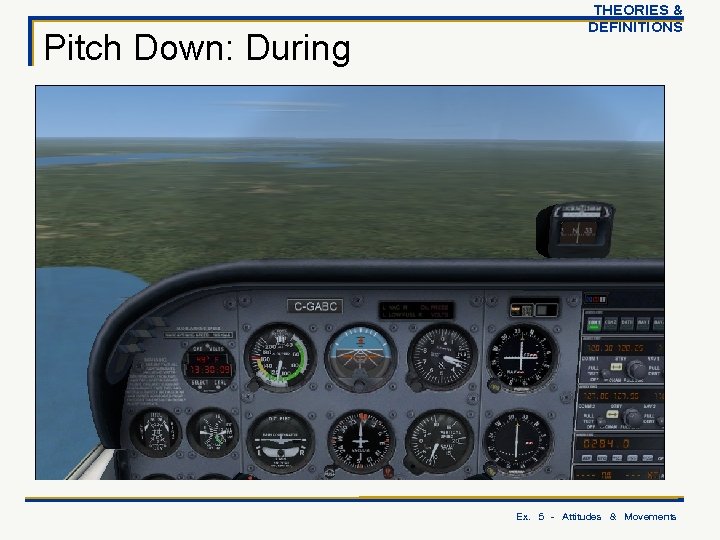
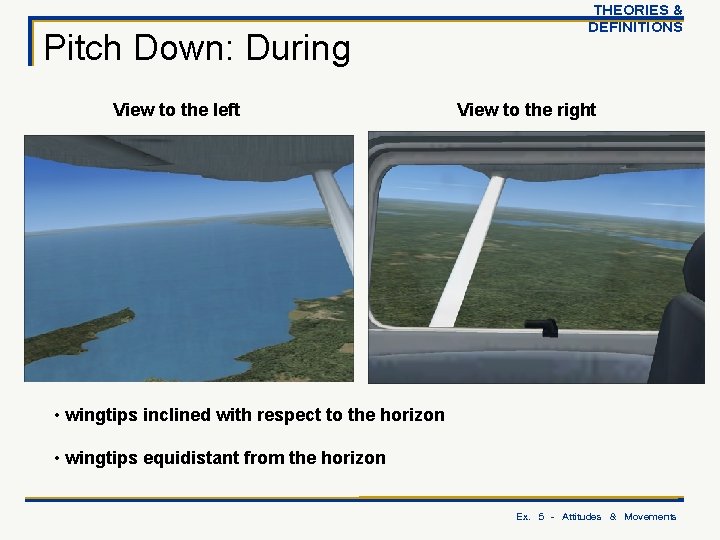
PROCEDURES Pitch Down: During P Keep good look-out! P Keep slight forward pressure on yoke to maintain pitchdown attitude P Maintain straight flight with ailerons P Control yaw with rudder Ex. 5 - Attitudes & Movements
Pitch Down: During THEORIES & DEFINITIONS Ex. 5 - Attitudes & Movements
Pitch Down: During View to the left THEORIES & DEFINITIONS View to the right • wingtips inclined with respect to the horizon • wingtips equidistant from the horizon Ex. 5 - Attitudes & Movements
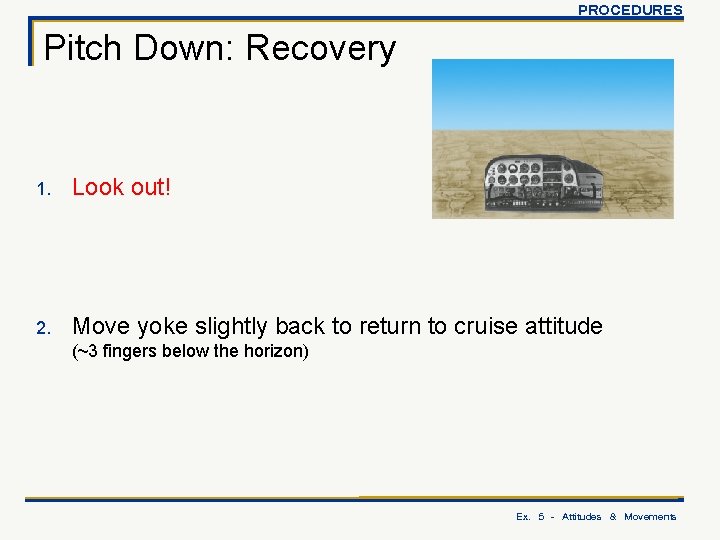
PROCEDURES Pitch Down: Recovery 1. Look out! 2. Move yoke slightly back to return to cruise attitude (~3 fingers below the horizon) Ex. 5 - Attitudes & Movements
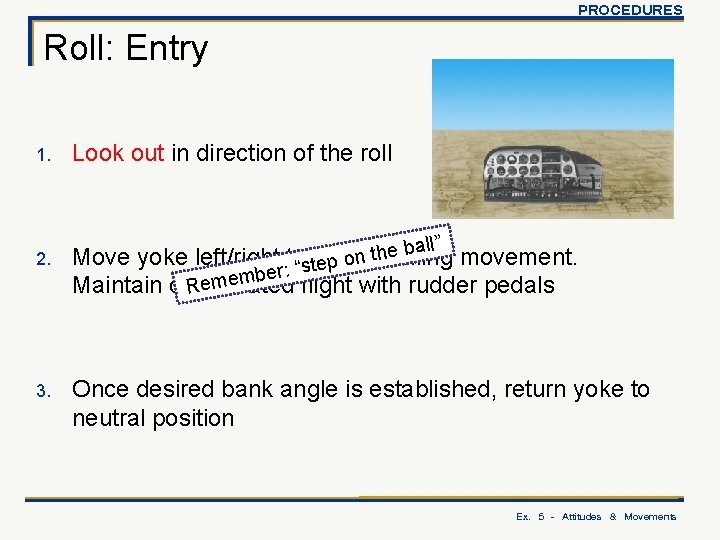
PROCEDURES Roll: Entry 1. Look out in direction of the roll 2. all” b e h t n Move yoke left/right : to“stinitiate rolling movement. ep o r e b Maintain coordinated flight with rudder pedals Remem 3. Once desired bank angle is established, return yoke to neutral position Ex. 5 - Attitudes & Movements
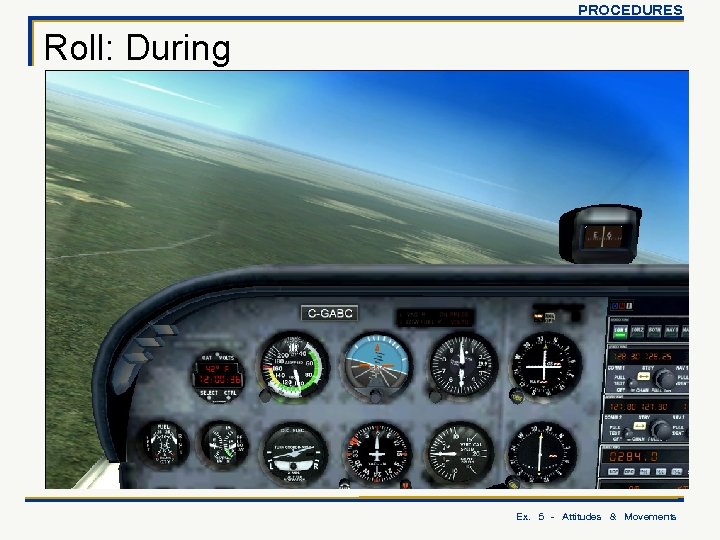
PROCEDURES Roll: During P Keep good look-out! P Maintain bank angle with ailerons P Control yaw with rudder P Maintain level flight by controlling attitude with the yoke Ex. 5 - Attitudes & Movements
PROCEDURES Roll: During Ex. 5 - Attitudes & Movements
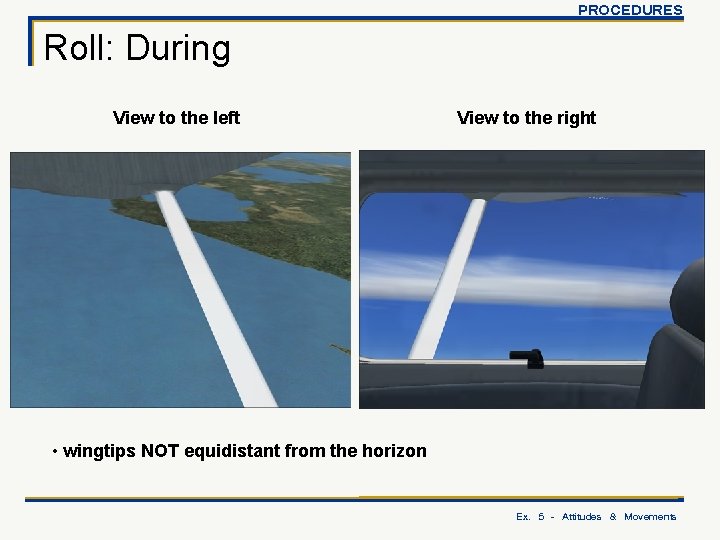
PROCEDURES Roll: During View to the left View to the right • wingtips NOT equidistant from the horizon Ex. 5 - Attitudes & Movements
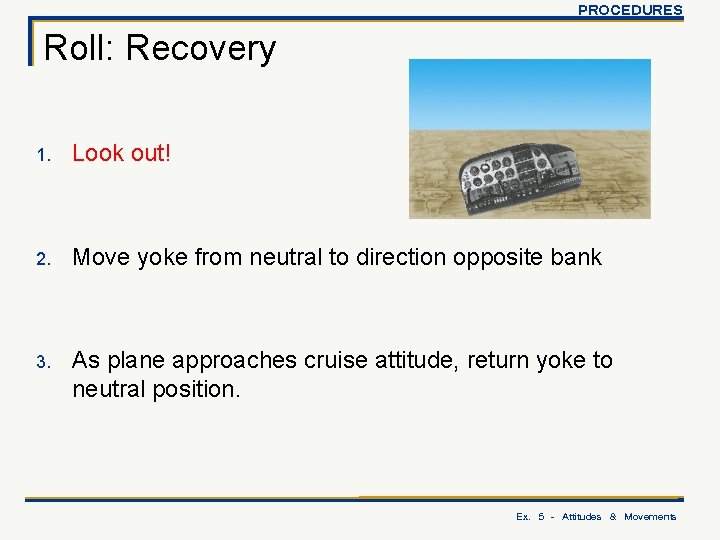
PROCEDURES Roll: Recovery 1. Look out! 2. Move yoke from neutral to direction opposite bank 3. As plane approaches cruise attitude, return yoke to neutral position. Ex. 5 - Attitudes & Movements
PROCEDURES Yaw: Entry 1. Look out! 2. Put slight pressure on left/right rudder pedal to initiate yaw in desired direction 3. Hold the pressure to maintain ball deflection to the side. Ex. 5 - Attitudes & Movements
PROCEDURES Yaw: Recovery 1. Look out! 2. Relax rudder pressure on depressed pedal and put slight pressure on the opposite pedal as necessary to return ball to centre. Ex. 5 - Attitudes & Movements
SAFETY: Control Transfer P There must always be a clear understanding of who is handling the controls at any given moment P Handing § § When handing over control, must say: “You have control” Acceptance must be acknowledged by: “I have control” P Taking § § aircraft control over: control When instructor needs to take over, will say: “I have control” Student must acknowledge: “You have control”. Ex. 5 - Attitudes & Movements
CONCLUSION Conclusion P This is your first real flight training exercise! P Things may seem confusing and difficult at this point. Do not be discouraged: things will get better as you practice and gain experience P For next lesson, read Ex. 6 – Straight-and-Level Flight. Ex. 5 - Attitudes & Movements