
Ex 18 Approach and Landing Ex 18 Approach
- Slides: 34
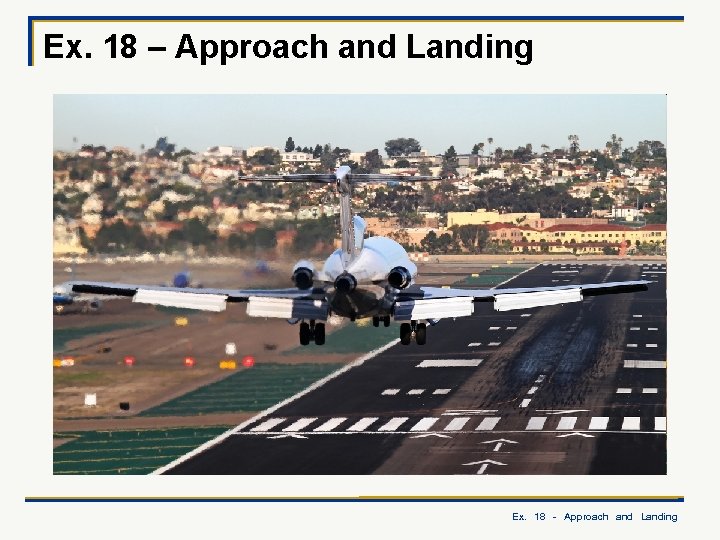
Ex. 18 – Approach and Landing Ex. 18 - Approach and Landing
OBJECTIVE What you will learn: P How to perform safe and precise approaches and landings, accounting for: § your aircraft’s performance characteristics § wind § other traffic (including wake turbulence). Ex. 18 - Approach and Landing
MOTIVATION Why learn this: P Landings require a high degree of accuracy and piloting skills P Like take-offs, landings involve low flying at low speeds. Ex. 18 - Approach and Landing
LINKS Links: P You have learned about take-offs and circuits: landings are the natural next step P You have been acquiring flight skills, knowledge and experience, which makes you prepared to handle this advanced, high-precision manoeuvre. Ex. 18 - Approach and Landing
BACKGROUND KNOWLEDGE - TKT Let’s see how much you already know: Q Explain “Attitude + Power = Performance” Q How do you control airspeed on descent? Altitude? Q What effect do flaps have on lift and drag? Why might these effects be desirable for approach and landing? Q Why is it important that the plane be aligned with the runway on touch-down? What technique can you use in a crosswind landing to ensure this alignment? Q What word must you hear from the air traffic controller before you can land at a controlled airport? Q What illusion may you experience turning from downwind to base? Ex. 18 - Approach and Landing
THEORIES & DEFINITIONS Theories and Definitions: P P P Normal Landings § Approach § Flare, Touchdown & Roll-out Crosswind Landings § Approach § Touchdown & Roll-out Landing Performance § Head/Tail Wind § Density Altitude. Ex. 18 - Approach and Landing
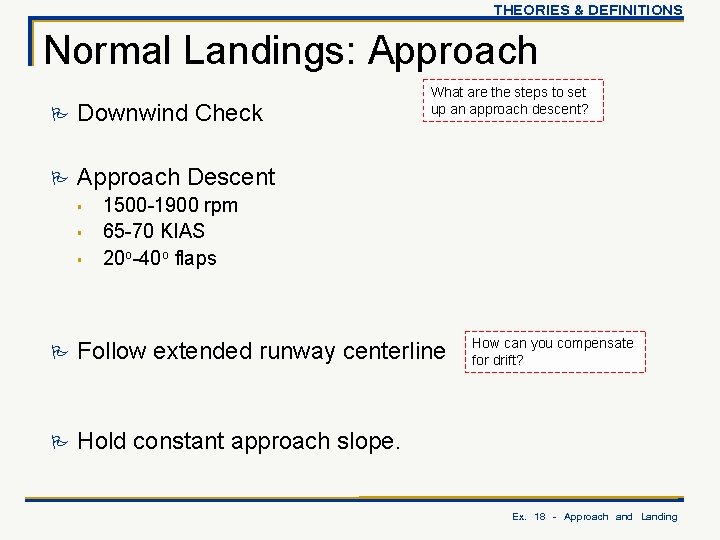
THEORIES & DEFINITIONS Normal Landings: Approach P Downwind Check P Approach Descent § § § What are the steps to set up an approach descent? 1500 -1900 rpm 65 -70 KIAS 20 o-40 o flaps P Follow extended runway centerline P Hold constant approach slope. How can you compensate for drift? Ex. 18 - Approach and Landing
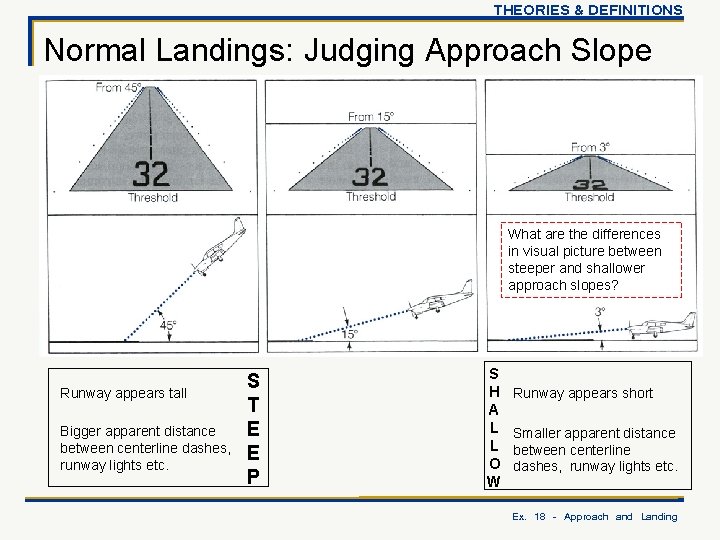
THEORIES & DEFINITIONS Normal Landings: Judging Approach Slope What are the differences in visual picture between steeper and shallower approach slopes? Runway appears tall Bigger apparent distance between centerline dashes, runway lights etc. S T E E P S H A L L O W Runway appears short Smaller apparent distance between centerline dashes, runway lights etc. Ex. 18 - Approach and Landing
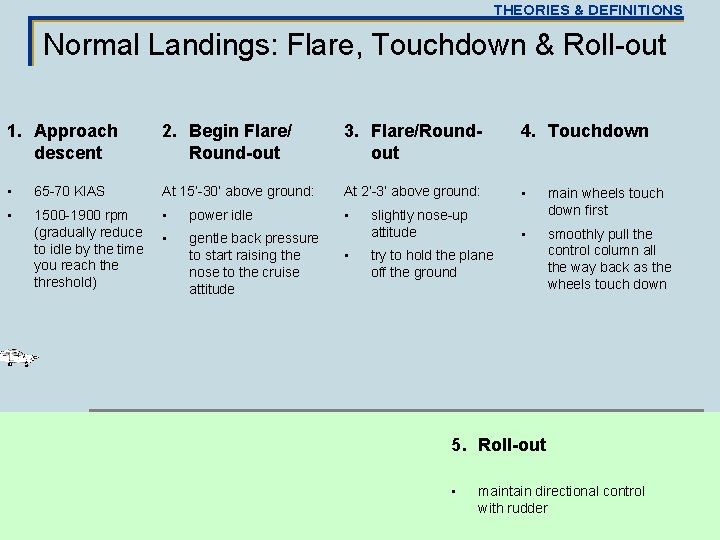
THEORIES & DEFINITIONS Normal Landings: Flare, Touchdown & Roll-out 1. Approach descent 2. Begin Flare/ Round-out 3. Flare/Roundout 4. Touchdown • 65 -70 KIAS At 15’-30’ above ground: At 2’-3’ above ground: • • 1500 -1900 rpm (gradually reduce to idle by the time you reach the threshold) • power idle • main wheels touch down first • gentle back pressure to start raising the nose to the cruise attitude • smoothly pull the control column all the way back as the wheels touch down • slightly nose-up attitude try to hold the plane off the ground 5. Roll-out • maintain directional control with rudder Ex. 18 - Approach and Landing
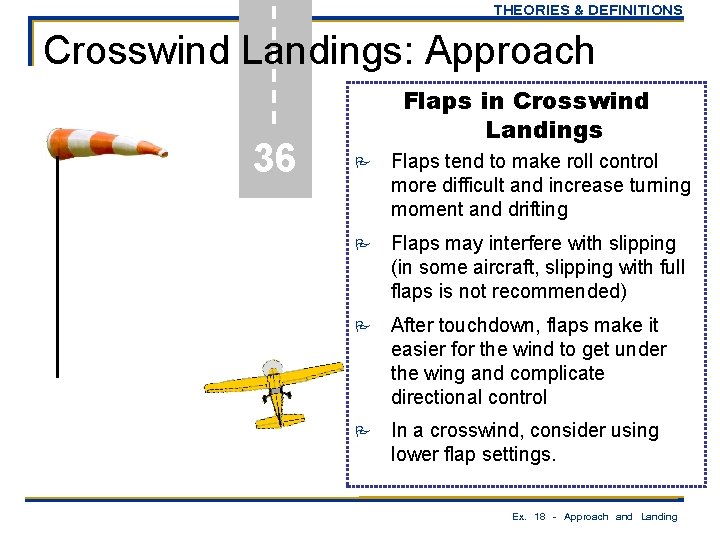
THEORIES & DEFINITIONS Crosswind Landings: Approach 36 Flaps in Crosswind Landings P Flaps tend to make roll control more difficult and increase turning moment and drifting P Flaps may interfere with slipping (in some aircraft, slipping with full flaps is not recommended) P After touchdown, flaps make it easier for the wind to get under the wing and complicate directional control P In a crosswind, consider using lower flap settings. Ex. 18 - Approach and Landing
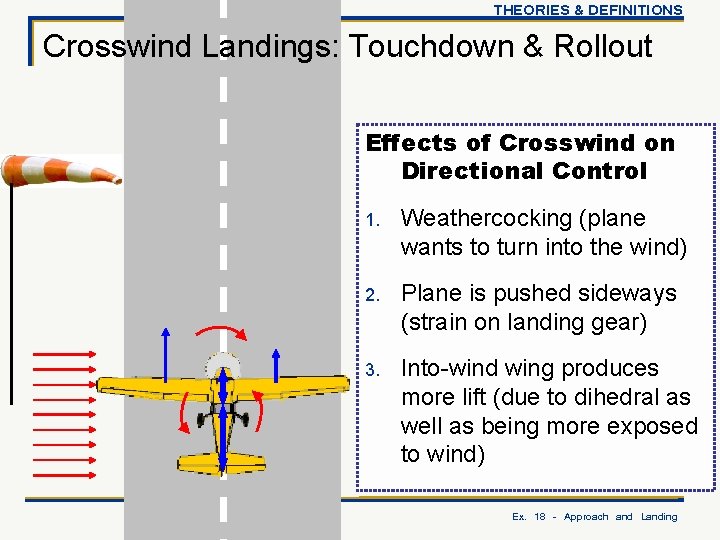
THEORIES & DEFINITIONS Crosswind Landings: Touchdown & Rollout Effects of Crosswind on Directional Control 1. Weathercocking (plane wants to turn into the wind) 2. Plane is pushed sideways (strain on landing gear) 3. Into-wind wing produces more lift (due to dihedral as well as being more exposed to wind) Ex. 18 - Approach and Landing
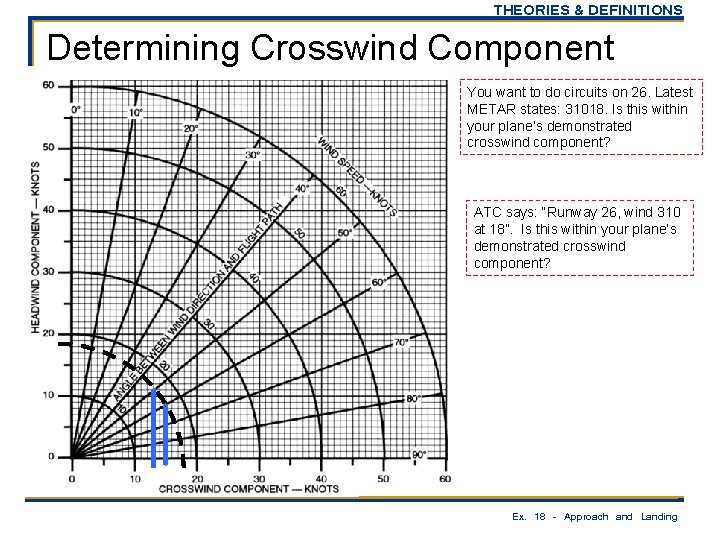
THEORIES & DEFINITIONS Determining Crosswind Component You want to do circuits on 26. Latest METAR states: 31018. Is this within your plane’s demonstrated crosswind component? ATC says: “Runway 26, wind 310 at 18”. Is this within your plane’s demonstrated crosswind component? Ex. 18 - Approach and Landing
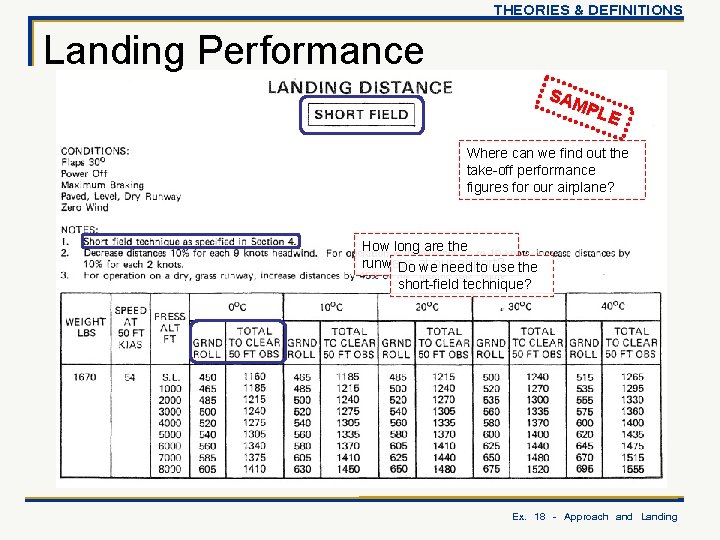
THEORIES & DEFINITIONS Landing Performance SAM PLE Where can we find out the take-off performance figures for our airplane? How long are the runways airport? Do at weour need to use the short-field technique? Ex. 18 - Approach and Landing
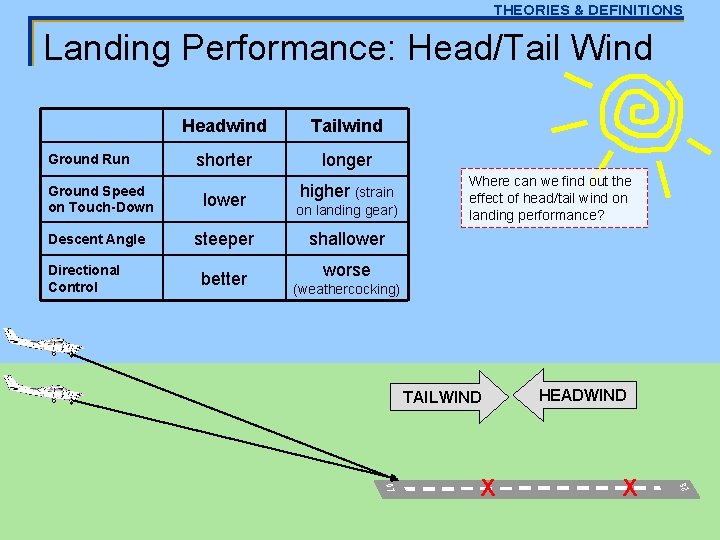
THEORIES & DEFINITIONS Landing Performance: Head/Tail Wind Ground Speed on Touch-Down Descent Angle Directional Control Tailwind shorter longer lower higher (strain on landing gear) steeper shallower better worse Where can we find out the effect of head/tail wind on landing performance? (weathercocking) TAILWIND 07 X HEADWIND X Ex. 18 - Approach and Landing 25 Ground Run Headwind
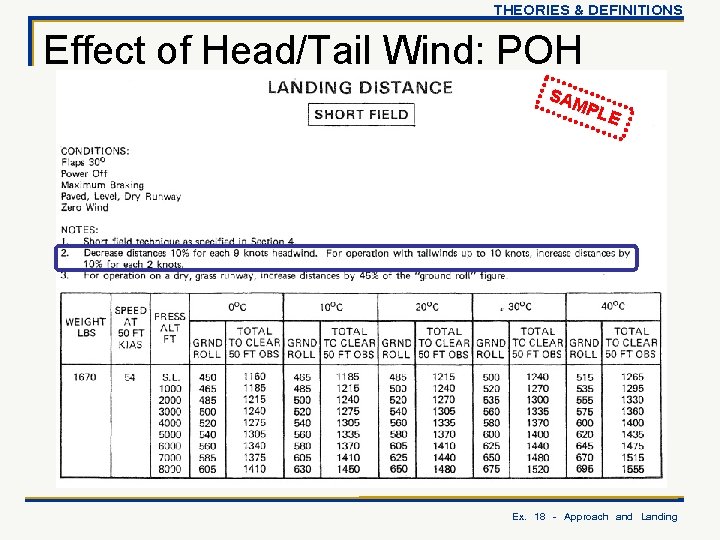
THEORIES & DEFINITIONS Effect of Head/Tail Wind: POH SAM PLE Ex. 18 - Approach and Landing
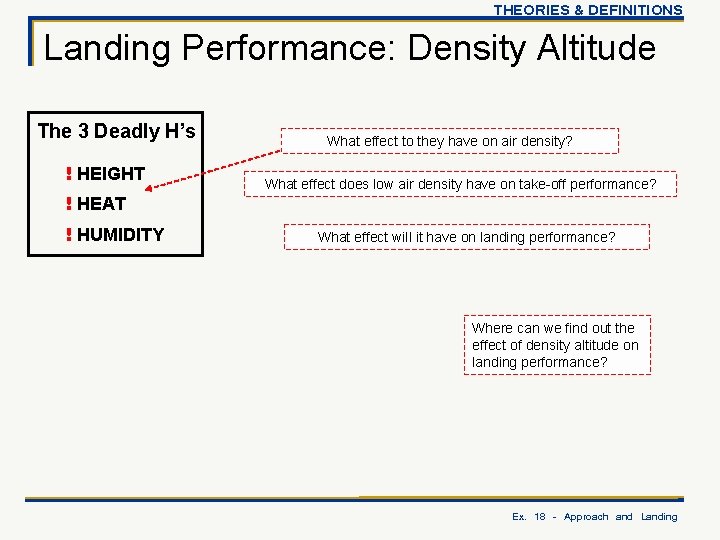
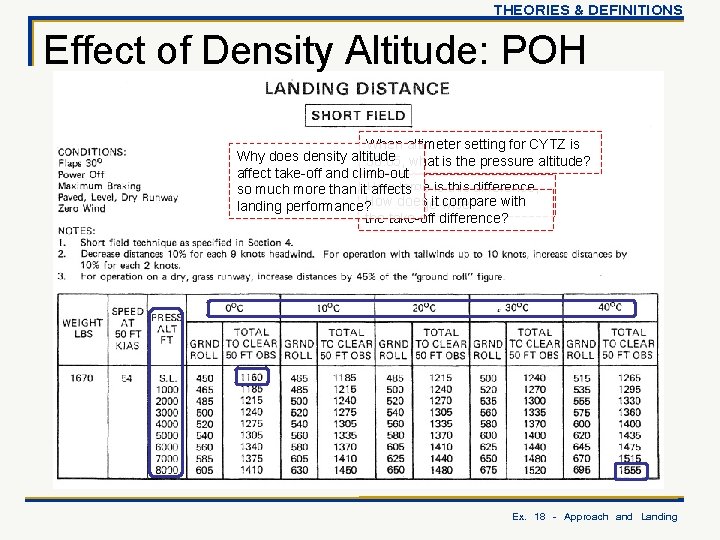
THEORIES & DEFINITIONS Landing Performance: Density Altitude The 3 Deadly H’s ! HEIGHT ! HEAT ! HUMIDITY What effect to they have on air density? What effect does low air density have on take-off performance? What effect will it have on landing performance? Where can we find out the effect of density altitude on landing performance? Ex. 18 - Approach and Landing
THEORIES & DEFINITIONS Effect of Density Altitude: POH When altimeter setting for CYTZ is Why does density altitude 30. 05, what is the pressure altitude? affect take-off and climb-out large is this difference, so much more than it. How affects does it compare with percentage-wise? landing performance? How the take-off difference? Ex. 18 - Approach and Landing
PROCEDURES Procedures PNormal § § § Landing Downwind Base Final Flare, Touch-down, Roll-out Post-Landing PCrosswind Landing POvershoot. Ex. 18 - Approach and Landing
PROCEDURES Normal Landing: Downwind P Fly parallel to the runway (crab into wind as necessary to maintain parallel track) P Maintain circuit altitude P Downwind check. Ex. 18 - Approach and Landing
PROCEDURES Normal Landing: Base P At 45 o to the threshold, reduce power (1500 -1900 rpm) and turn base P When airspeed is in the white arc, extend flaps § anticipate nose wanting to rise § use forward pressure to maintain constant attitude P Descend at ~70 KIAS. Ex. 18 - Approach and Landing
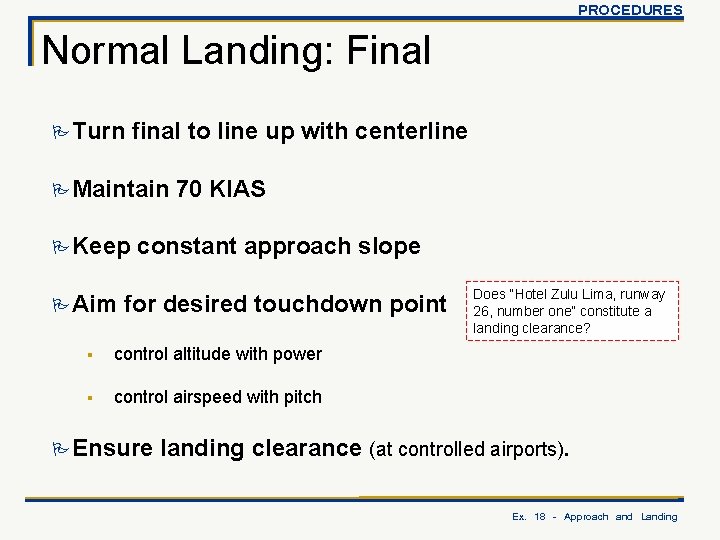
PROCEDURES Normal Landing: Final P Turn final to line up with centerline P Maintain P Keep P Aim 70 KIAS constant approach slope for desired touchdown point § control altitude with power § control airspeed with pitch P Ensure Does “Hotel Zulu Lima, runway 26, number one” constitute a landing clearance? landing clearance (at controlled airports). Ex. 18 - Approach and Landing
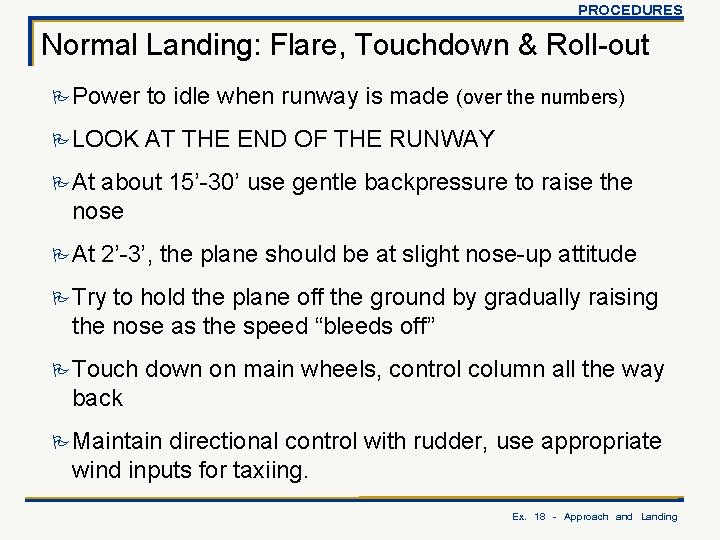
PROCEDURES Normal Landing: Flare, Touchdown & Roll-out P Power to idle when runway is made (over the numbers) P LOOK AT THE END OF THE RUNWAY P At about 15’-30’ use gentle backpressure to raise the nose P At 2’-3’, the plane should be at slight nose-up attitude P Try to hold the plane off the ground by gradually raising the nose as the speed “bleeds off” P Touch down on main wheels, control column all the way back P Maintain directional control with rudder, use appropriate wind inputs for taxiing. Ex. 18 - Approach and Landing
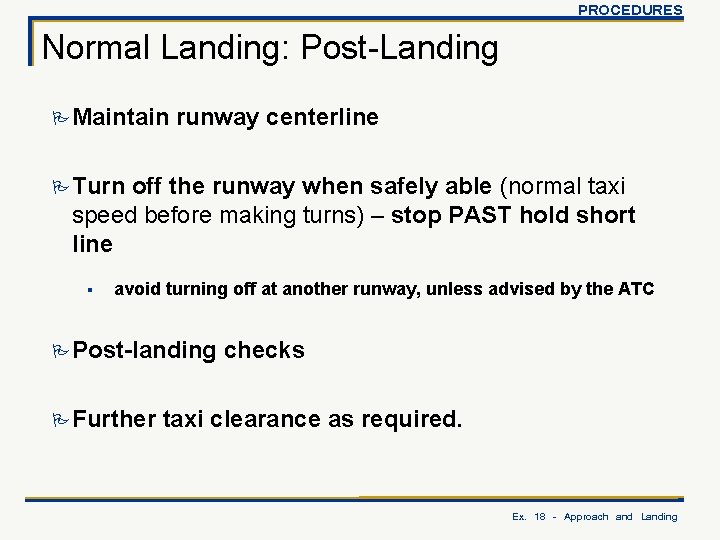
PROCEDURES Normal Landing: Post-Landing P Maintain runway centerline P Turn off the runway when safely able (normal taxi speed before making turns) – stop PAST hold short line § avoid turning off at another runway, unless advised by the ATC P Post-landing P Further checks taxi clearance as required. Ex. 18 - Approach and Landing
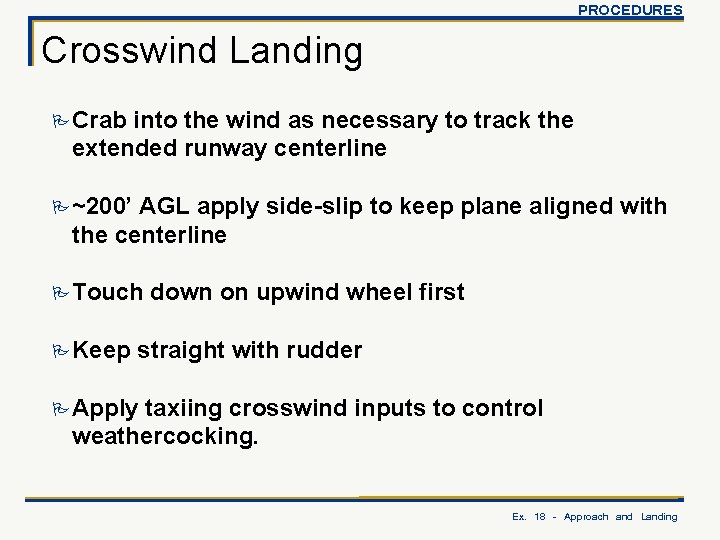
PROCEDURES Crosswind Landing P Crab into the wind as necessary to track the extended runway centerline P ~200’ AGL apply side-slip to keep plane aligned with the centerline P Touch P Keep down on upwind wheel first straight with rudder P Apply taxiing crosswind inputs to control weathercocking. Ex. 18 - Approach and Landing
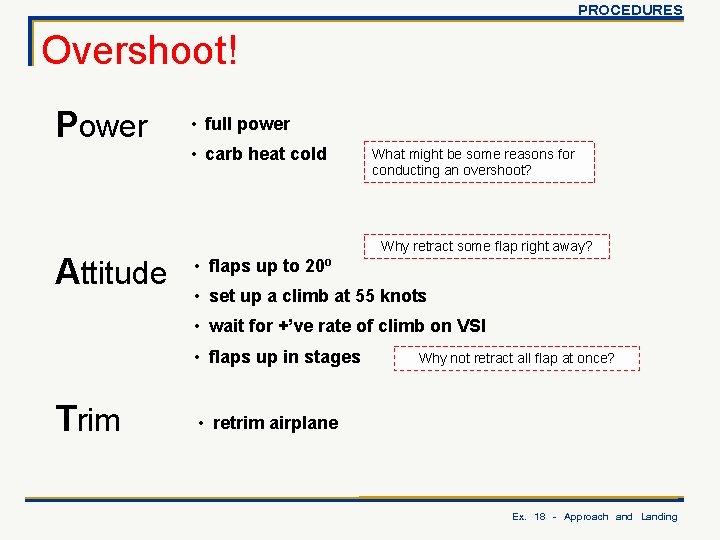
PROCEDURES Overshoot! Power Attitude • full power • carb heat cold What might be some reasons for conducting an overshoot? Why retract some flap right away? • flaps up to 20 o • set up a climb at 55 knots • wait for +’ve rate of climb on VSI • flaps up in stages Trim Why not retract all flap at once? • retrim airplane Ex. 18 - Approach and Landing
CONSIDERATIONS Considerations P Touch-and-Goes P Wind Shear P Wake Turbulence P Visual Illusions P Recovering from Bad Landings. Ex. 18 - Approach and Landing
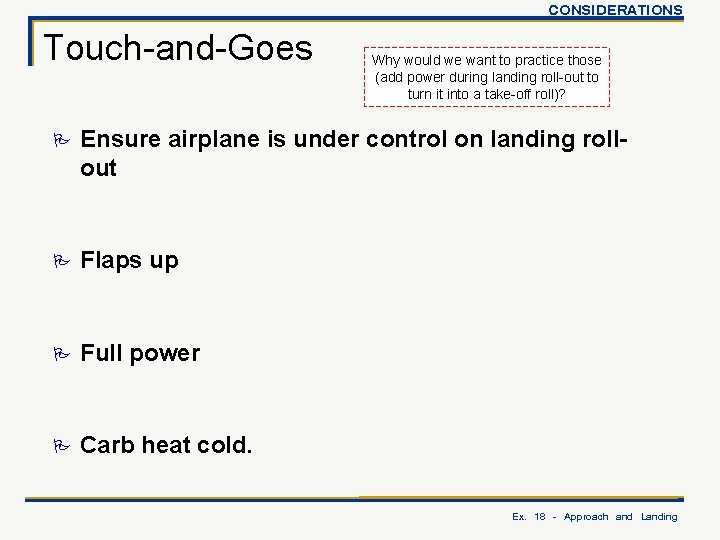
CONSIDERATIONS Touch-and-Goes Why would we want to practice those (add power during landing roll-out to turn it into a take-off roll)? P Ensure airplane is under control on landing rollout P Flaps up P Full power P Carb heat cold. Ex. 18 - Approach and Landing
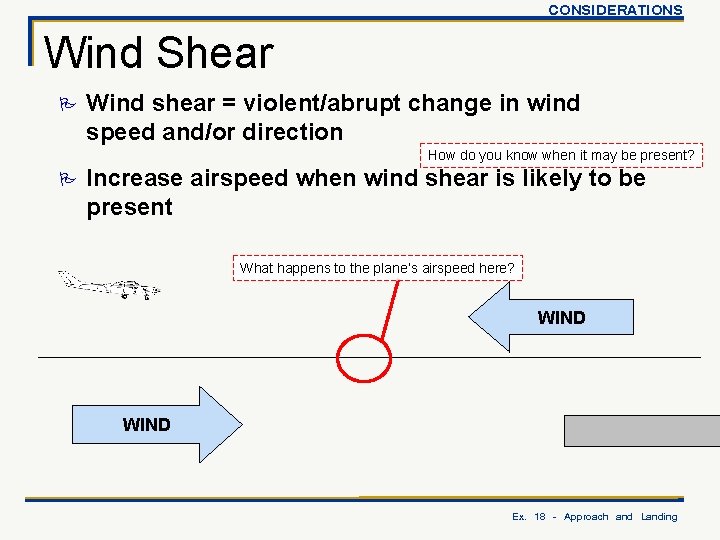
CONSIDERATIONS Wind Shear P Wind shear = violent/abrupt change in wind speed and/or direction How do you know when it may be present? P Increase airspeed when wind shear is likely to be present What happens to the plane’s airspeed here? WIND Ex. 18 - Approach and Landing
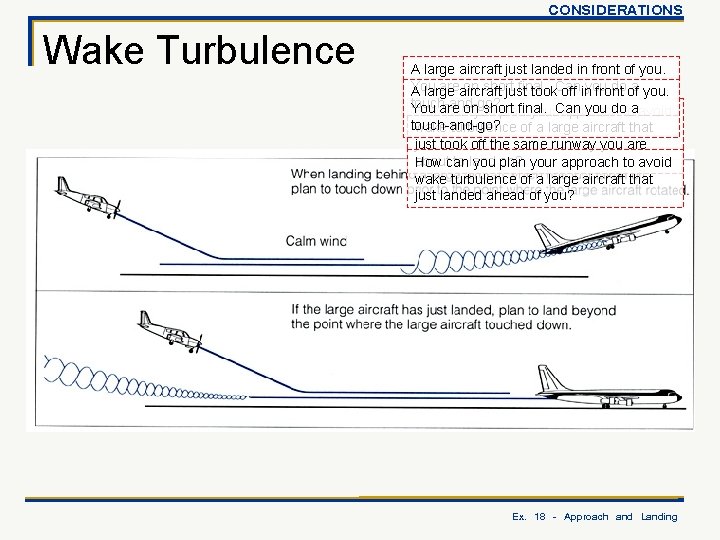
CONSIDERATIONS Wake Turbulence A large aircraft just landed in front of you. You areaircraft on short final. do of a you. A large just took. Can off inyou front touch-and-go? You short final. you dotoaavoid Howare canonyou plan your. Can approach touch-and-go? wake turbulence of a large aircraft that just took off the same runway you are aboutcan to land on? your approach to avoid How you plan wake turbulence of a large aircraft that just landed ahead of you? Ex. 18 - Approach and Landing
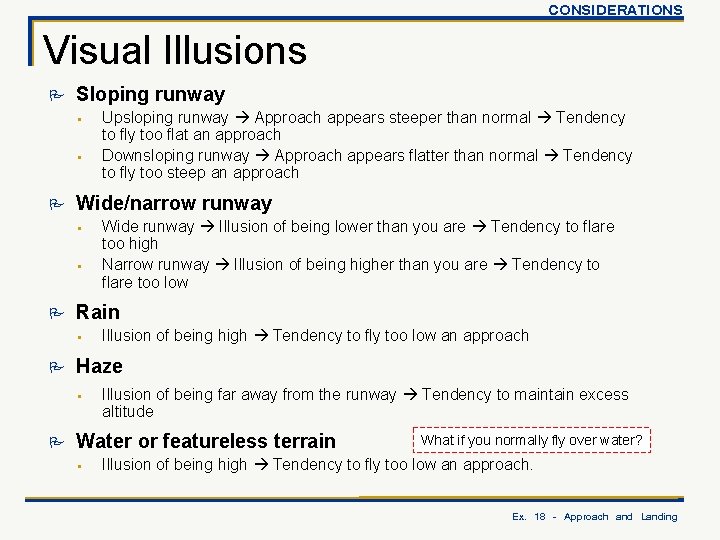
CONSIDERATIONS Visual Illusions P Sloping runway § § P Wide/narrow runway § § P Illusion of being high Tendency to fly too low an approach Haze § P Wide runway Illusion of being lower than you are Tendency to flare too high Narrow runway Illusion of being higher than you are Tendency to flare too low Rain § P Upsloping runway Approach appears steeper than normal Tendency to fly too flat an approach Downsloping runway Approach appears flatter than normal Tendency to fly too steep an approach Illusion of being far away from the runway Tendency to maintain excess altitude Water or featureless terrain § What if you normally fly over water? Illusion of being high Tendency to fly too low an approach. Ex. 18 - Approach and Landing
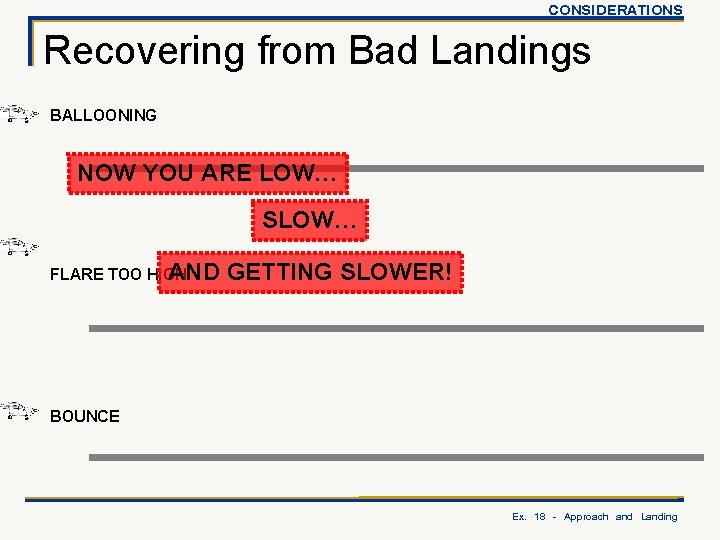
CONSIDERATIONS Recovering from Bad Landings BALLOONING NOW YOU ARE LOW… SLOW… FLARE TOO HIGH AND GETTING SLOWER! BOUNCE Ex. 18 - Approach and Landing
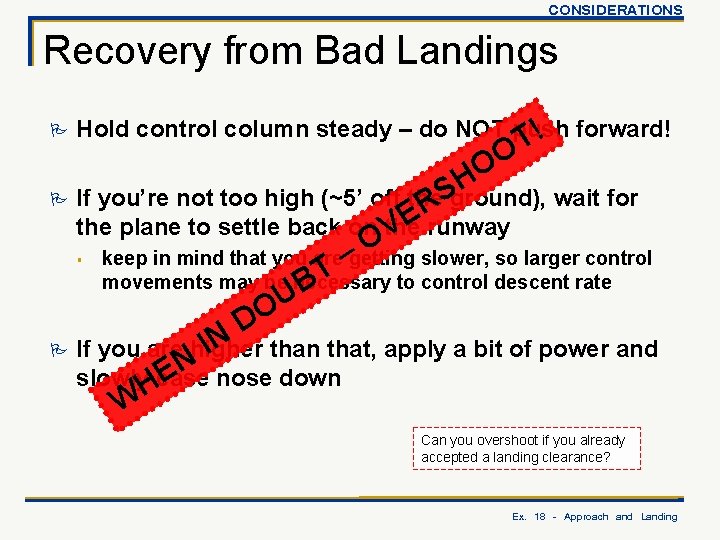
CONSIDERATIONS Recovery from Bad Landings P Hold control column steady – do NOT push ! forward! T O O H Sground), wait for P If you’re not too high (~5’ off the R E runway the plane to settle back on the V O keep in mind that you are – getting slower, so larger control T movements may be necessary to control descent rate B U DO IN than that, apply a bit of power and P If you are higher EN nose down slowly. Hease W § Can you overshoot if you already accepted a landing clearance? Ex. 18 - Approach and Landing
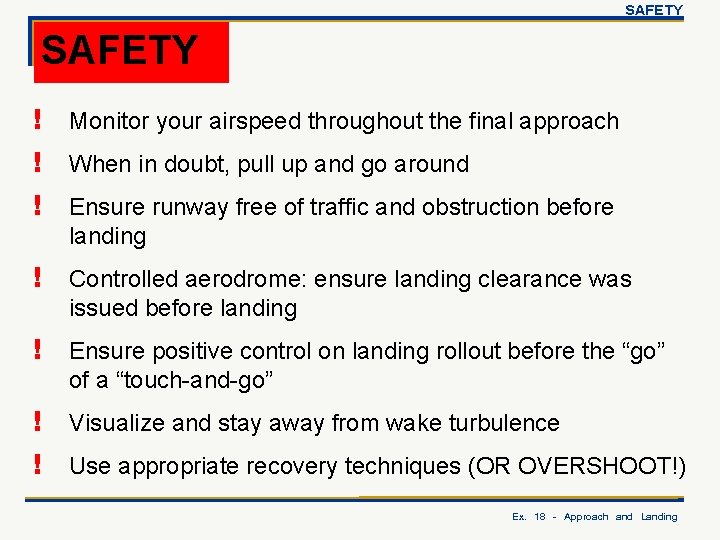
SAFETY ! Monitor your airspeed throughout the final approach ! When in doubt, pull up and go around ! Ensure runway free of traffic and obstruction before landing ! Controlled aerodrome: ensure landing clearance was issued before landing ! Ensure positive control on landing rollout before the “go” of a “touch-and-go” ! Visualize and stay away from wake turbulence ! Use appropriate recovery techniques (OR OVERSHOOT!) Ex. 18 - Approach and Landing
CONCLUSION Conclusion P This is the final exercise in the segment of your training concentrating on take-offs, circuits and landings P Practice of these exercises leads to your first solo! P Mastering the landing is a great confidence-booster: but don’t get overconfident P In future lessons we will discuss “specialty” landings (for soft/rough and short fields) Ex. 18 - Approach and Landing