
EWSB beyond the Standard Model Supersymmetry Third Lecture
EWSB beyond the Standard Model: Supersymmetry? Third Lecture Outline: 1. Why we do believe in S. M. ? 2. Why we do not believe in S. M. ? 3. Why we believe in Supersymmetry? 4. Phenomenology Particle content, models, parameters, Higgs sector, … 5. Some searches at LEP Higgs bosons, charginos, neutralinos, sleptons… 6. LSP mass limit, m. SUGRA constraints SLAC Summer Institute August 13 -24, 2001 Probes of Electroweak Symmetry Breaking at LEP and SLC 1
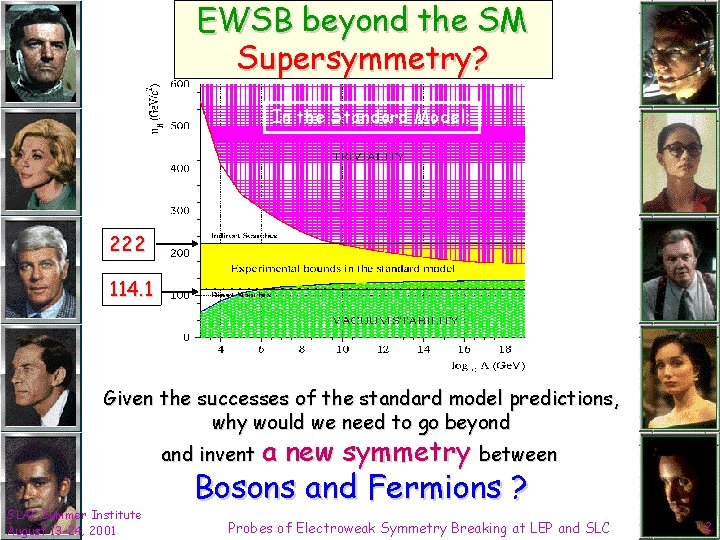
EWSB beyond the SM Supersymmetry? In the Standard Model: 222 114. 1 Given the successes of the standard model predictions, why would we need to go beyond and invent a SLAC Summer Institute August 13 -24, 2001 new symmetry between Bosons and Fermions ? Probes of Electroweak Symmetry Breaking at LEP and SLC 2
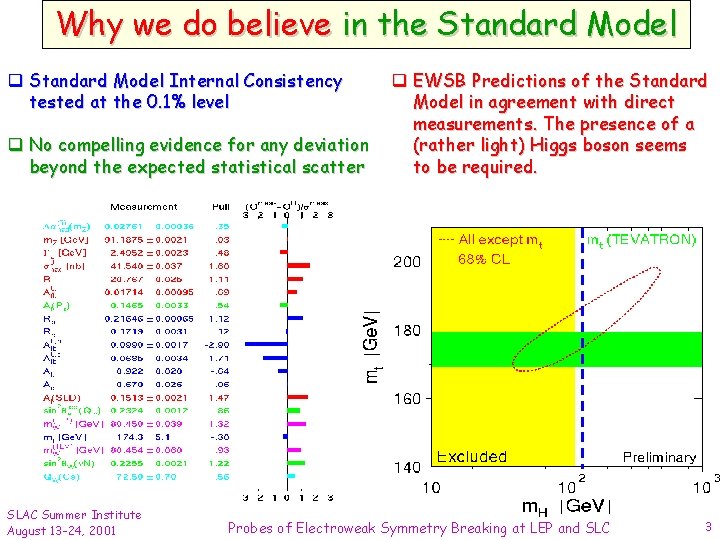
Why we do believe in the Standard Model q Standard Model Internal Consistency tested at the 0. 1% level q No compelling evidence for any deviation beyond the expected statistical scatter SLAC Summer Institute August 13 -24, 2001 q EWSB Predictions of the Standard Model in agreement with direct measurements. The presence of a (rather light) Higgs boson seems to be required. Probes of Electroweak Symmetry Breaking at LEP and SLC 3
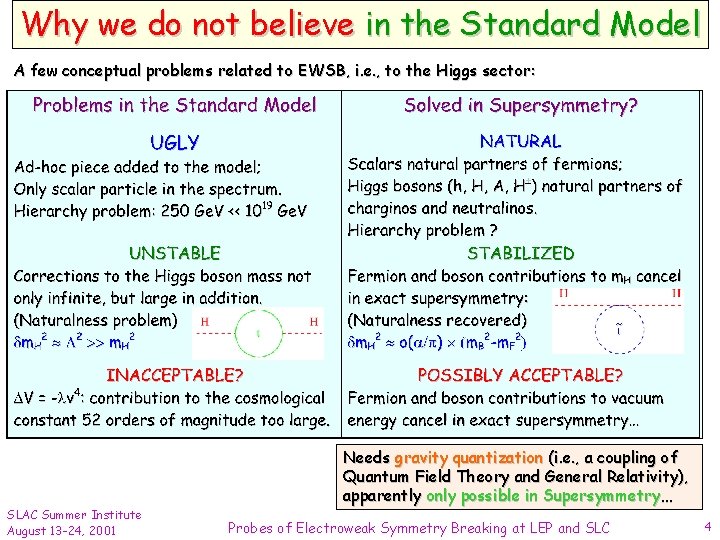
Why we do not believe in the Standard Model A few conceptual problems related to EWSB, i. e. , to the Higgs sector: SLAC Summer Institute August 13 -24, 2001 Needs gravity quantization (i. e. , a coupling of Quantum Field Theory and General Relativity), apparently only possible in Supersymmetry… Probes of Electroweak Symmetry Breaking at LEP and SLC 4
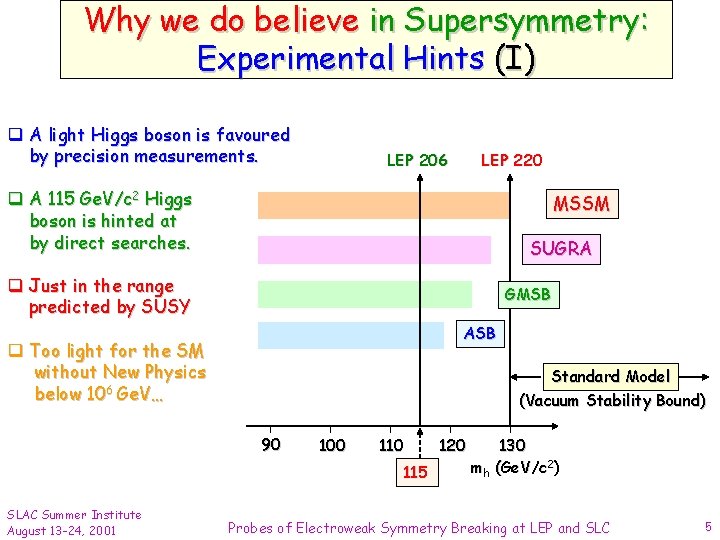
Why we do believe in Supersymmetry: Experimental Hints (I) q A light Higgs boson is favoured by precision measurements. LEP 206 LEP 220 q A 115 Ge. V/c 2 Higgs boson is hinted at by direct searches. MSSM SUGRA q Just in the range predicted by SUSY GMSB ASB q Too light for the SM without New Physics below 106 Ge. V… Standard Model (Vacuum Stability Bound) 90 100 115 SLAC Summer Institute August 13 -24, 2001 120 130 mh (Ge. V/c 2) Probes of Electroweak Symmetry Breaking at LEP and SLC 5
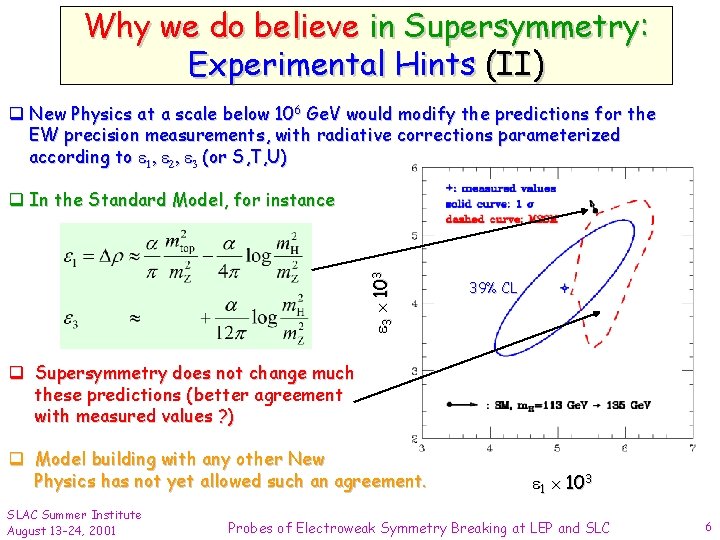
Why we do believe in Supersymmetry: Experimental Hints (II) q New Physics at a scale below 106 Ge. V would modify the predictions for the EW precision measurements, with radiative corrections parameterized according to e 1, e 2, e 3 (or S, T, U) e 3 103 q In the Standard Model, for instance 39% CL q Supersymmetry does not change much these predictions (better agreement with measured values ? ) q Model building with any other New Physics has not yet allowed such an agreement. SLAC Summer Institute August 13 -24, 2001 e 1 103 Probes of Electroweak Symmetry Breaking at LEP and SLC 6
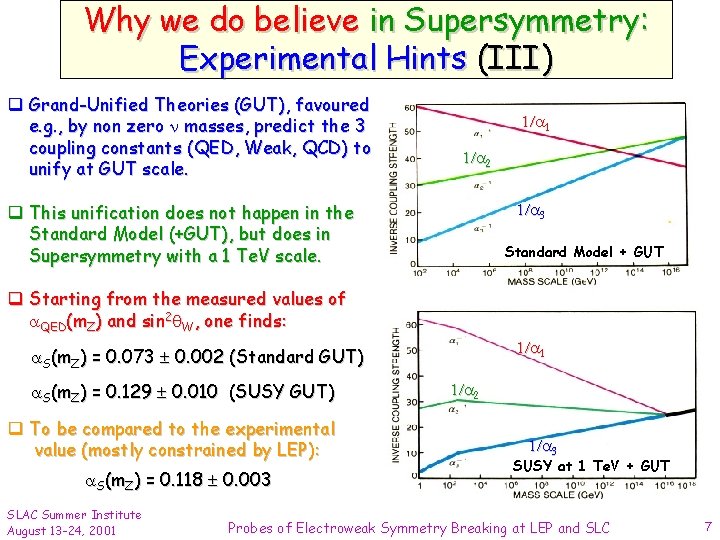
Why we do believe in Supersymmetry: Experimental Hints (III) q Grand-Unified Theories (GUT), favoured, e. g. , by non zero masses, predict the 3 coupling constants (QED, Weak, QCD) to unify at GUT scale. 1/a 1 1/a 2 1/a 3 q This unification does not happen in the Standard Model (+GUT), but does in Supersymmetry with a 1 Te. V scale. Standard Model + GUT q Starting from the measured values of a. QED(m. Z) and sin 2 W, one finds: 1/a 1 a. S(m. Z) = 0. 073 0. 002 (Standard GUT) a. S(m. Z) = 0. 129 0. 010 (SUSY GUT) q To be compared to the experimental value (mostly constrained by LEP): a. S(m. Z) = 0. 118 0. 003 SLAC Summer Institute August 13 -24, 2001 1/a 2 1/a 3 SUSY at 1 Te. V + GUT Probes of Electroweak Symmetry Breaking at LEP and SLC 7
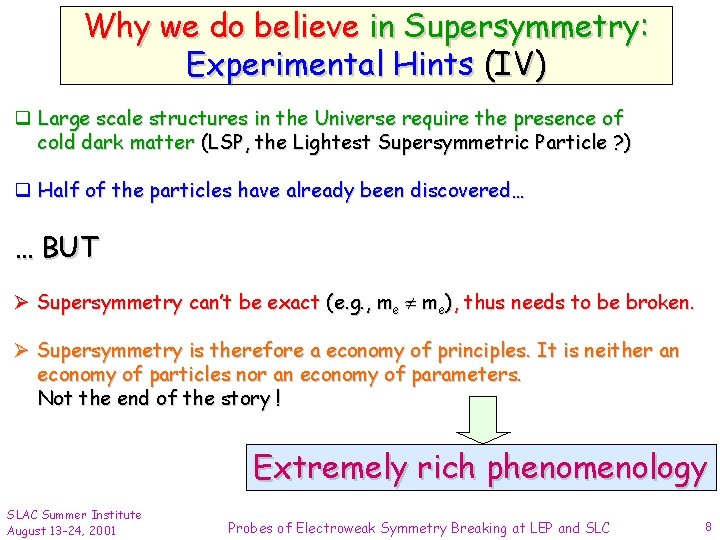
Why we do believe in Supersymmetry: Experimental Hints (IV) q Large scale structures in the Universe require the presence of cold dark matter (LSP, the Lightest Supersymmetric Particle ? ) q Half of the particles have already been discovered… … BUT Ø Supersymmetry can’t be exact (e. g. , me me), thus needs to be broken. Ø Supersymmetry is therefore a economy of principles. It is neither an economy of particles nor an economy of parameters. Not the end of the story ! Extremely rich phenomenology SLAC Summer Institute August 13 -24, 2001 Probes of Electroweak Symmetry Breaking at LEP and SLC 8
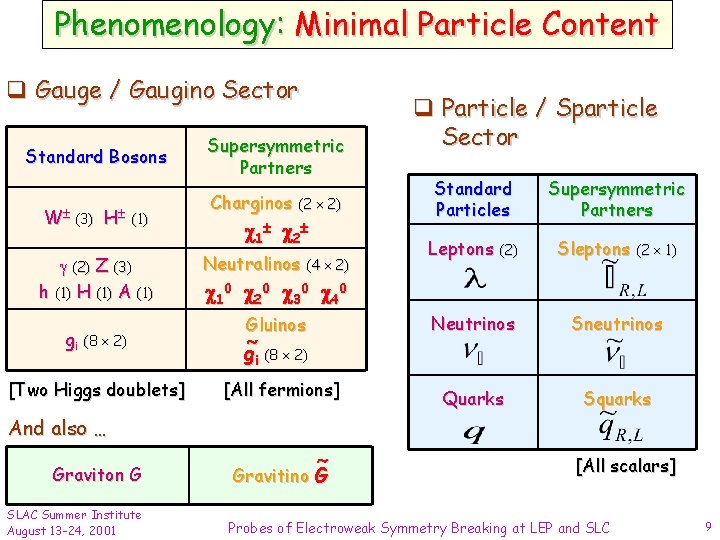
Phenomenology: Minimal Particle Content q Gauge / Gaugino Sector Standard Bosons W (3) H (1) (2) Z (3) h (1) H (1) A (1) Supersymmetric Partners Charginos (2 2) 1 2 Neutralinos (4 2) q Particle / Sparticle Sector Standard Particles Supersymmetric Partners Leptons (2) Sleptons (2 1) Neutrinos Sneutrinos Quarks Squarks 10 20 30 40 Gluinos gi (8 2) [Two Higgs doublets] [All fermions] And also … Graviton G SLAC Summer Institute August 13 -24, 2001 Gravitino G [All scalars] Probes of Electroweak Symmetry Breaking at LEP and SLC 9
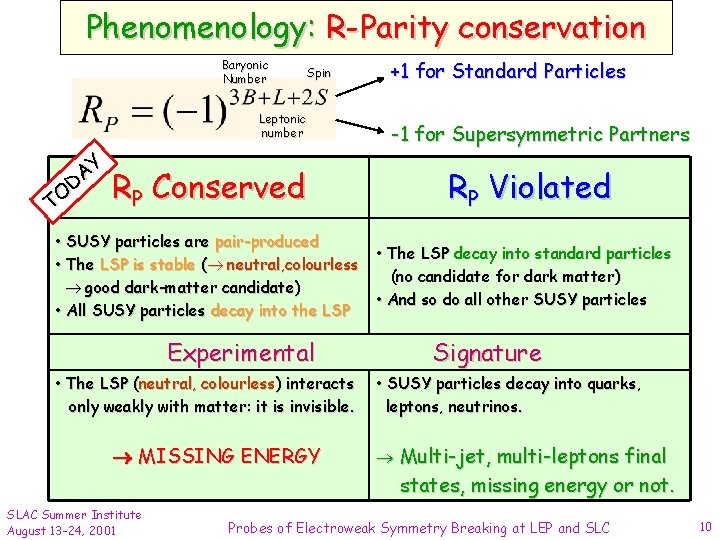
Phenomenology: R-Parity conservation Baryonic Number Spin Leptonic number Y A D O T RP Conserved +1 for Standard Particles -1 for Supersymmetric Partners RP Violated • SUSY particles are pair-produced • The LSP decay into standard particles • The LSP is stable ( neutral, colourless (no candidate for dark matter) good dark-matter candidate) • And so do all other SUSY particles • All SUSY particles decay into the LSP Experimental • The LSP (neutral, colourless) interacts only weakly with matter: it is invisible. MISSING ENERGY SLAC Summer Institute August 13 -24, 2001 Signature . • SUSY particles decay into quarks, leptons, neutrinos. Multi-jet, multi-leptons final states, missing energy or not. Probes of Electroweak Symmetry Breaking at LEP and SLC 10
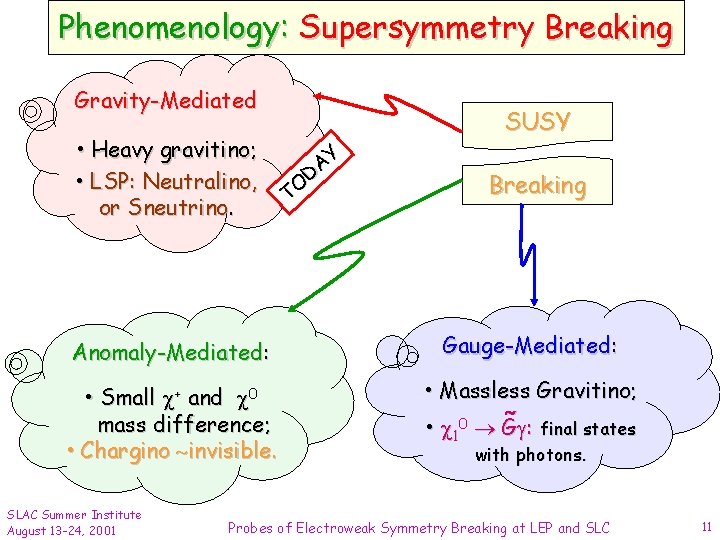
Phenomenology: Supersymmetry Breaking Gravity-Mediated • Heavy gravitino; • LSP: Neutralino, or Sneutrino. SUSY Y A D O T Breaking Anomaly-Mediated: Gauge-Mediated: • Small + and 0 mass difference; • Chargino invisible. • Massless Gravitino; SLAC Summer Institute August 13 -24, 2001 • 10 G : final states with photons. Probes of Electroweak Symmetry Breaking at LEP and SLC 11
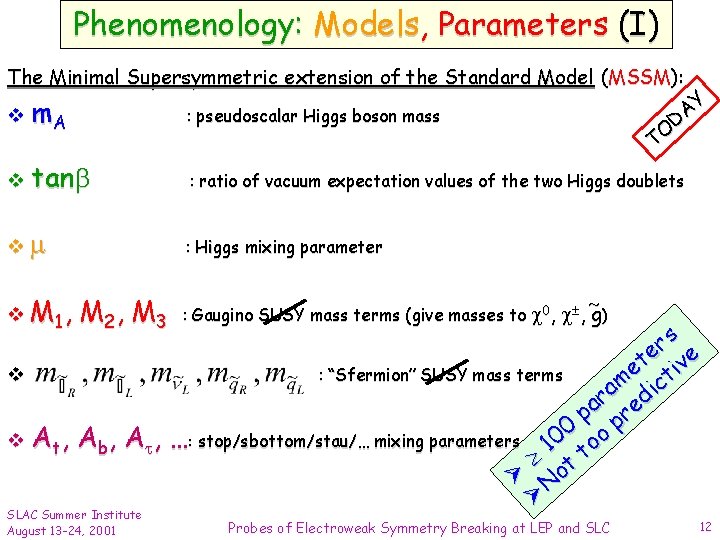
Phenomenology: Models, Parameters (I) The Minimal Supersymmetric extension of the Standard Model (MSSM): Y A D O T v m. A : pseudoscalar Higgs boson mass v tanb : ratio of vacuum expectation values of the two Higgs doublets vm : Higgs mixing parameter v M 1, M 2, M 3 : Gaugino SUSY mass terms (give masses to 0, , g) s r e ve t e ti v : “Sfermion” SUSY mass terms m ic a r ed a p pr 0 v At, Ab, A , …: stop/sbottom/stau/… mixing parameters 10 oo tt Ø No Ø SLAC Summer Institute August 13 -24, 2001 Probes of Electroweak Symmetry Breaking at LEP and SLC 12
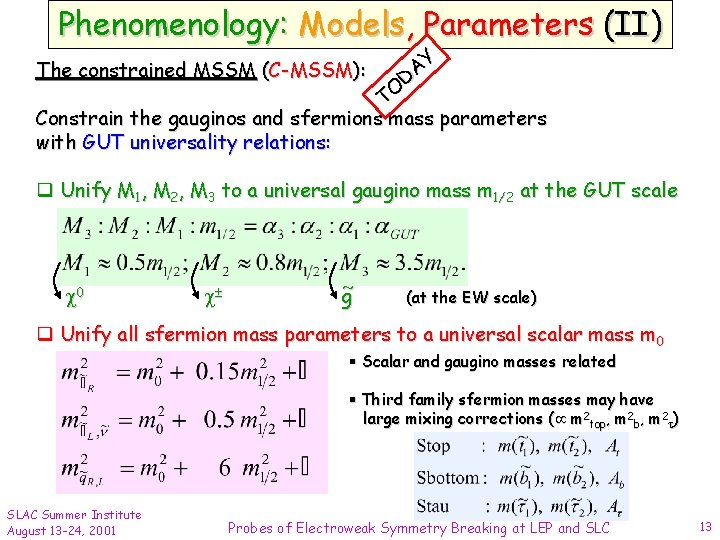
Phenomenology: Models, Parameters (II) Y A D O T Constrain the gauginos and sfermions mass parameters with GUT universality relations: The constrained MSSM (C-MSSM): q Unify M 1, M 2, M 3 to a universal gaugino mass m 1/2 at the GUT scale 0 g (at the EW scale) q Unify all sfermion mass parameters to a universal scalar mass m 0 § Scalar and gaugino masses related § Third family sfermion masses may have large mixing corrections ( m 2 top, m 2 b, m 2 ) SLAC Summer Institute August 13 -24, 2001 Probes of Electroweak Symmetry Breaking at LEP and SLC 13
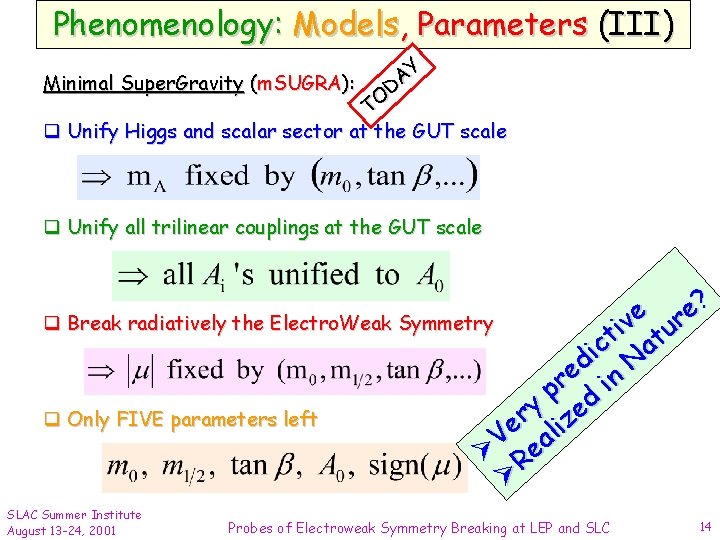
Phenomenology: Models, Parameters (III) Y A Minimal Super. Gravity (m. SUGRA): D O T q Unify Higgs and scalar sector at the GUT scale q Unify all trilinear couplings at the GUT scale ? e e q Break radiatively the Electro. Weak Symmetry v ur i ct at i d N e pr d in y e r q Only FIVE parameters left z e i l V ea Ø R Ø SLAC Summer Institute August 13 -24, 2001 Probes of Electroweak Symmetry Breaking at LEP and SLC 14
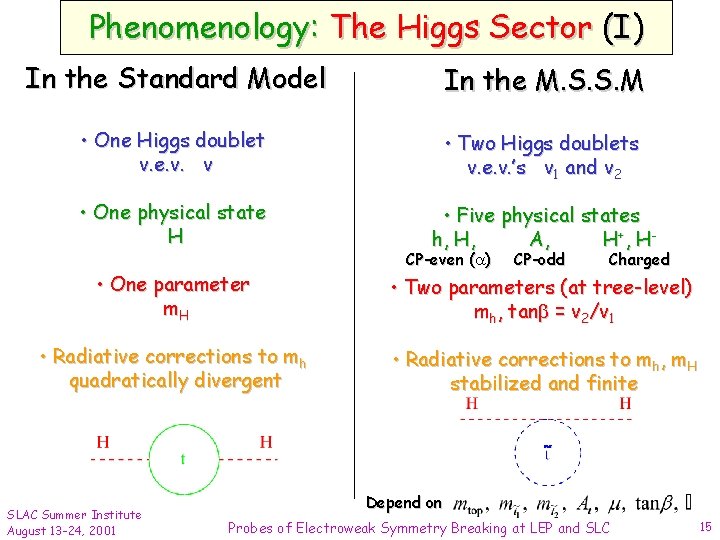
Phenomenology: The Higgs Sector (I) In the Standard Model In the M. S. S. M • One Higgs doublet v. e. v. v • Two Higgs doublets v. e. v. ’s v 1 and v 2 • One physical state H • Five physical states h, H, A, H +, H- CP-even (a) CP-odd Charged • One parameter m. H • Two parameters (at tree-level) mh, tanb = v 2/v 1 • Radiative corrections to mh quadratically divergent • Radiative corrections to mh, m. H stabilized and finite SLAC Summer Institute August 13 -24, 2001 Depend on Probes of Electroweak Symmetry Breaking at LEP and SLC 15
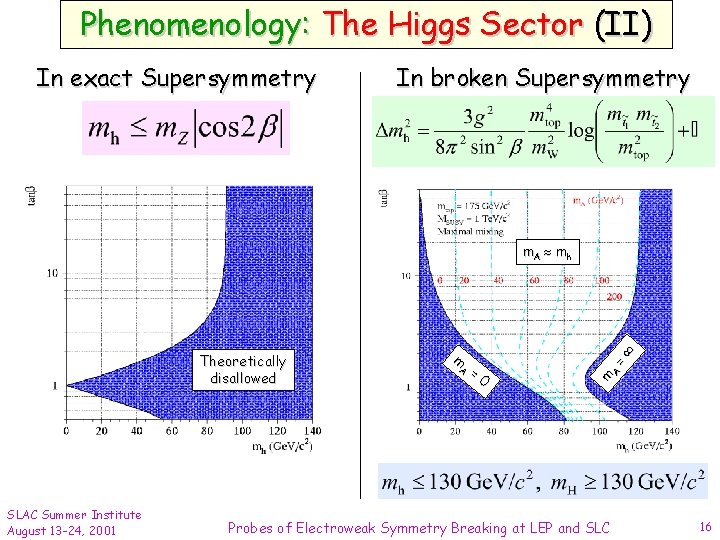
Phenomenology: The Higgs Sector (II) In exact Supersymmetry In broken Supersymmetry SLAC Summer Institute August 13 -24, 2001 A = 0 A m m Theoretically disallowed = m. A m h Probes of Electroweak Symmetry Breaking at LEP and SLC 16
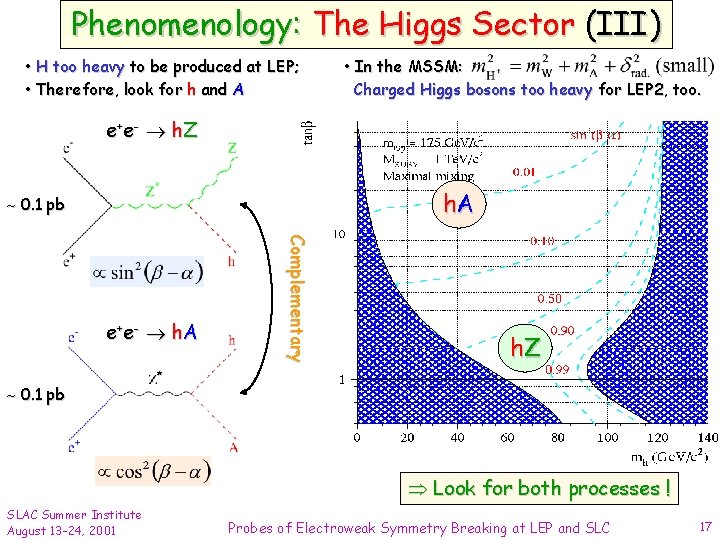
Phenomenology: The Higgs Sector (III) • H too heavy to be produced at LEP; • Therefore, look for h and A • In the MSSM: Charged Higgs bosons too heavy for LEP 2, too. e + e - h. Z h. A 0. 1 pb Complementary e + e - h. A h. Z * Look for both processes ! SLAC Summer Institute August 13 -24, 2001 Probes of Electroweak Symmetry Breaking at LEP and SLC 17
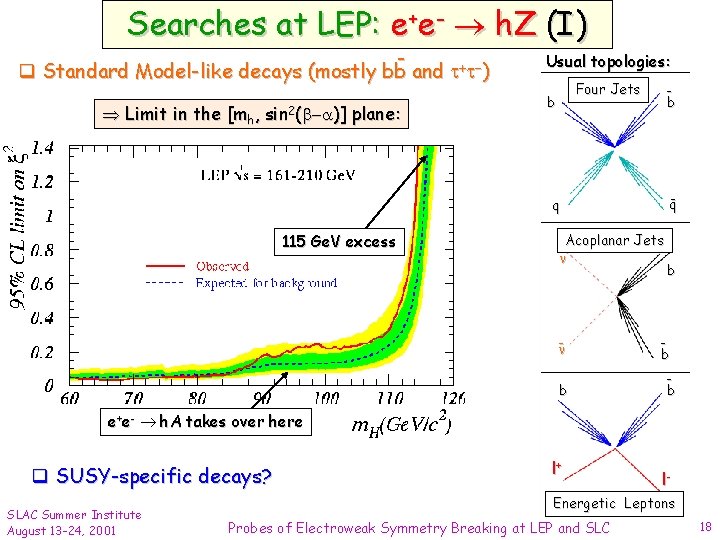
Searches at LEP: e+e- h. Z (I) q Standard Model-like decays (mostly bb and + -) Limit in the [mh, sin 2(b-a)] plane: Usual topologies: Four Jets b b q- q 115 Ge. V excess Acoplanar Jets b b e+e- h. A takes over here q SUSY-specific decays? SLAC Summer Institute August 13 -24, 2001 l+ l- Energetic Leptons Probes of Electroweak Symmetry Breaking at LEP and SLC 18
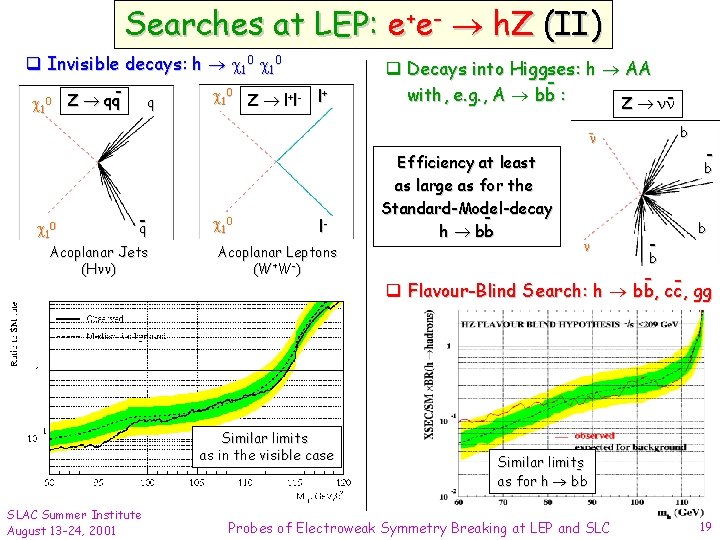
Searches at LEP: e+e- h. Z (II) q Invisible decays: h 10 10 10 Z qq q 10 Z l+l- l+ q Decays into Higgses: h AA with, e. g. , A bb : Z - 10 -q Acoplanar Jets (H ) 10 l- Acoplanar Leptons (W+W-) Similar limits as in the visible case SLAC Summer Institute August 13 -24, 2001 Efficiency at least as large as for the Standard-Model-decay h bb b - b - - - gg q Flavour-Blind Search: h bb, cc, Similar limitsas for h bb Probes of Electroweak Symmetry Breaking at LEP and SLC 19
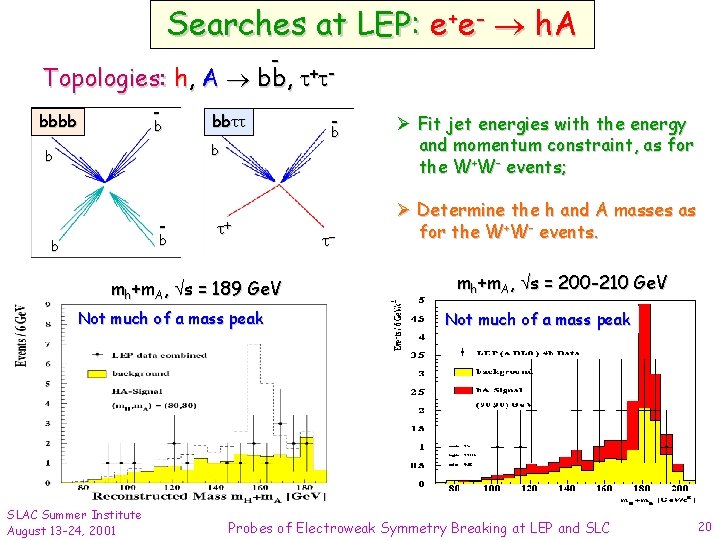
Searches at LEP: e+e- h. A - Topologies: h, A bb, + - bbbb b bb b b - b b + mh+m. A, s = 189 Ge. V Not much of a mass peak SLAC Summer Institute August 13 -24, 2001 - b - Ø Fit jet energies with the energy and momentum constraint, as for the W+W- events; Ø Determine the h and A masses as for the W+W- events. mh+m. A, s = 200 -210 Ge. V Not much of a mass peak Probes of Electroweak Symmetry Breaking at LEP and SLC 20
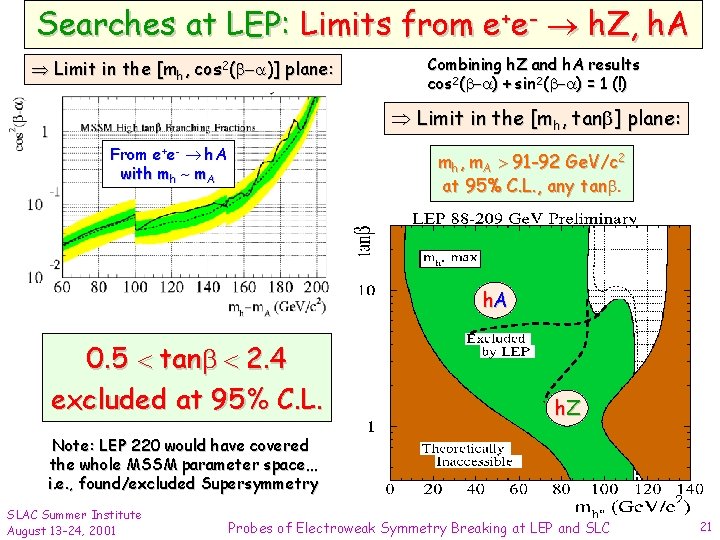
Searches at LEP: Limits from e+e- h. Z, h. A Limit in the [mh, cos 2(b-a)] plane: Combining h. Z and h. A results cos 2(b-a) + sin 2(b-a) = 1 (!) Limit in the [mh, tanb] plane: From e+e- h. A with mh m. A mh, m. A > 91 -92 Ge. V/c 2 at 95% C. L. , any tanb. h. A 0. 5 < tanb < 2. 4 excluded at 95% C. L. h. Z Note: LEP 220 would have covered the whole MSSM parameter space… i. e. , found/excluded Supersymmetry SLAC Summer Institute August 13 -24, 2001 Probes of Electroweak Symmetry Breaking at LEP and SLC 21
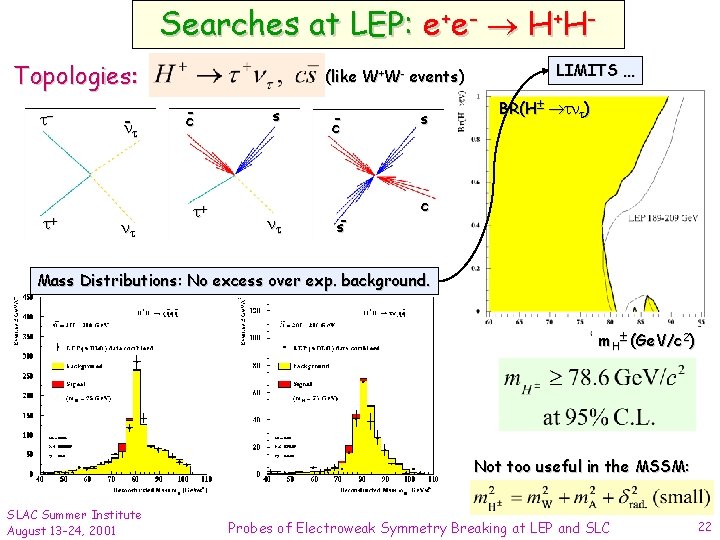
Searches at LEP: e+e- H+HTopologies: - + - (like W+W- events) c- + s c s- s LIMITS … BR(H ) c Mass Distributions: No excess over exp. background. m. H (Ge. V/c 2) Not too useful in the MSSM: SLAC Summer Institute August 13 -24, 2001 Probes of Electroweak Symmetry Breaking at LEP and SLC 22
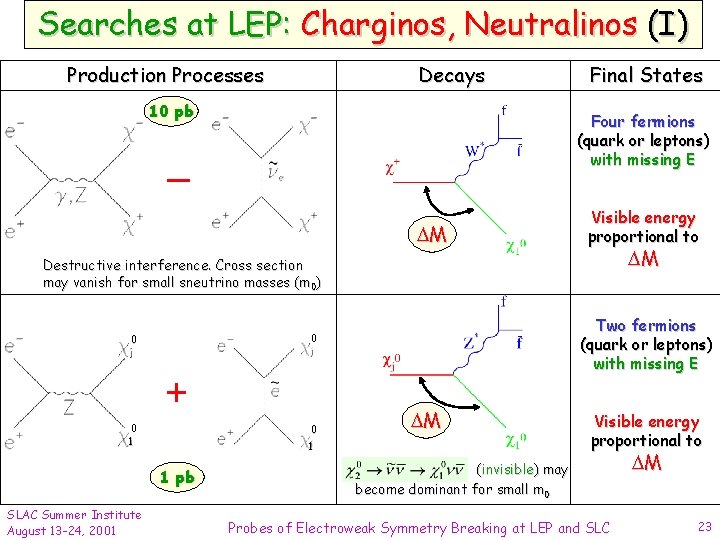
Searches at LEP: Charginos, Neutralinos (I) Production Processes Decays 10 pb Final States Four fermions (quark or leptons) with missing E _ M Visible energy proportional to M Destructive interference. Cross section may vanish for small sneutrino masses (m 0) + 0 1 0 M 1 1 pb SLAC Summer Institute August 13 -24, 2001 Two fermions (quark or leptons) with missing E 0 0 Visible energy proportional to (invisible) may become dominant for small m 0 Probes of Electroweak Symmetry Breaking at LEP and SLC M 23
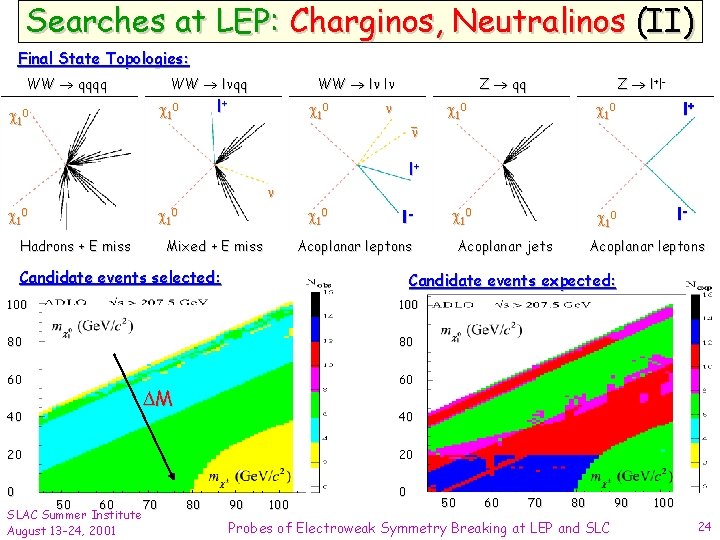
Searches at LEP: Charginos, Neutralinos (II) Final State Topologies: WW qqqq WW l qq l+ 10 WW l l 10 Z qq Z l + l- 10 l+ 10 Hadrons + E miss 10 Mixed + E miss l- Acoplanar leptons Candidate events selected: 100 80 80 60 60 M 50 60 70 SLAC Summer Institute August 13 -24, 2001 Acoplanar jets Acoplanar leptons 40 20 0 l- 10 Candidate events expected: 100 40 10 20 80 90 100 0 50 60 70 80 Probes of Electroweak Symmetry Breaking at LEP and SLC 90 100 24
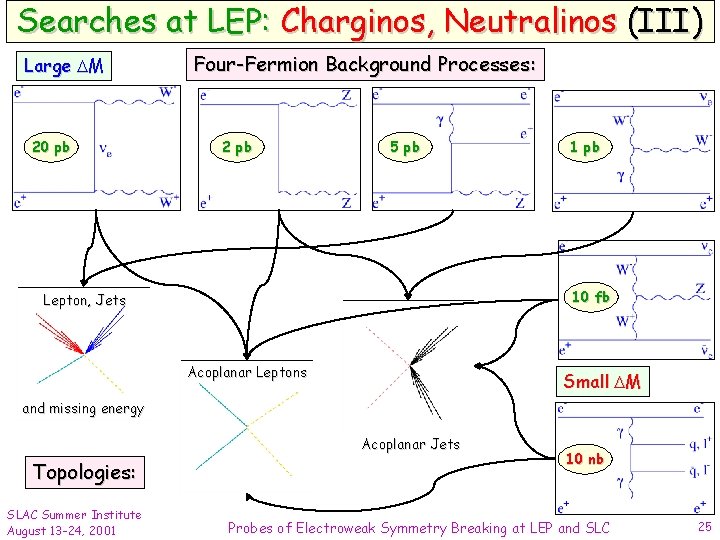
Searches at LEP: Charginos, Neutralinos (III) Large M 20 pb Four-Fermion Background Processes: 2 pb 5 pb 10 fb Lepton, Jets Acoplanar Leptons Small M and missing energy Acoplanar Jets Topologies: SLAC Summer Institute August 13 -24, 2001 10 nb Probes of Electroweak Symmetry Breaking at LEP and SLC 25
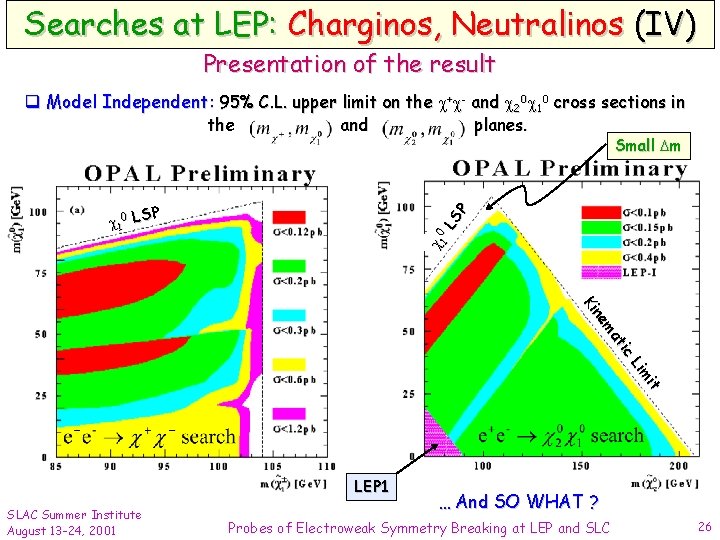
Searches at LEP: Charginos, Neutralinos (IV) Presentation of the result q Model Independent: 95% C. L. upper limit on the + - and 20 10 cross sections in the and Small m 1 1 0 LS P P 10 LS planes. t mi Li tic ma ne Ki LEP 1 SLAC Summer Institute August 13 -24, 2001 … And SO WHAT ? Probes of Electroweak Symmetry Breaking at LEP and SLC 26
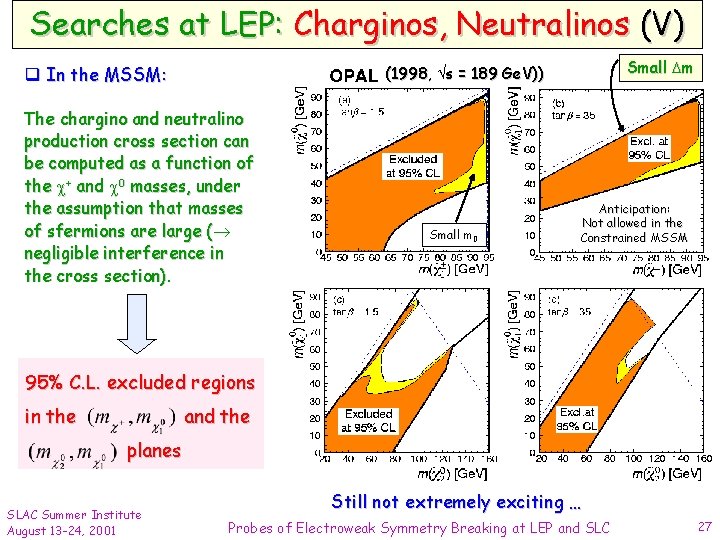
Searches at LEP: Charginos, Neutralinos (V) q In the MSSM: Small m (1998, s = 189 Ge. V)) The chargino and neutralino production cross section can be computed as a function of the + and 0 masses, under the assumption that masses of sfermions are large ( negligible interference in the cross section). Small m 0 Anticipation: Not allowed in the Constrained MSSM 95% C. L. excluded regions in the and the planes SLAC Summer Institute August 13 -24, 2001 Still not extremely exciting … Probes of Electroweak Symmetry Breaking at LEP and SLC 27
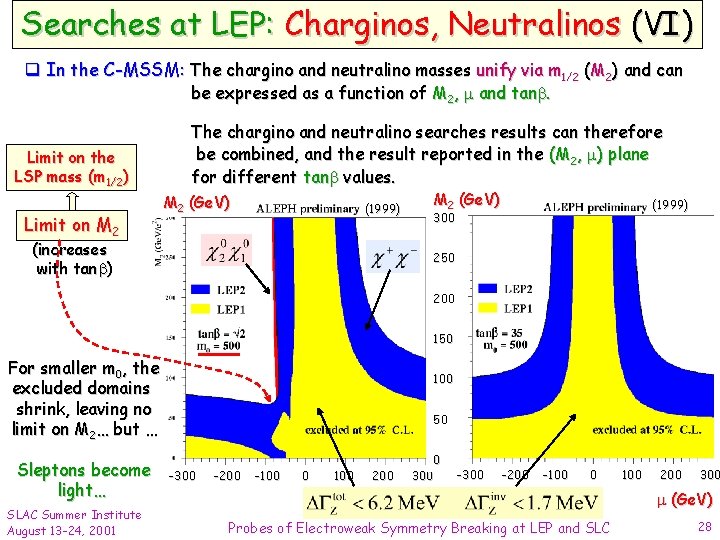
Searches at LEP: Charginos, Neutralinos (VI) q In the C-MSSM: The chargino and neutralino masses unify via m 1/2 (M 2) and can be expressed as a function of M 2, m and tanb. Limit on the LSP mass (m 1/2) Limit on M 2 The chargino and neutralino searches results can therefore be combined, and the result reported in the (M 2, m) plane for different tanb values. M 2 (Ge. V) (1999) (increases with tanb) M 2 (Ge. V) (1999) 300 250 200 150 For smaller m 0, the excluded domains shrink, leaving no limit on M 2… but … Sleptons become light… SLAC Summer Institute August 13 -24, 2001 100 50 -300 -200 -100 0 100 200 0 300 -200 -100 0 100 200 300 m (Ge. V) Probes of Electroweak Symmetry Breaking at LEP and SLC 28
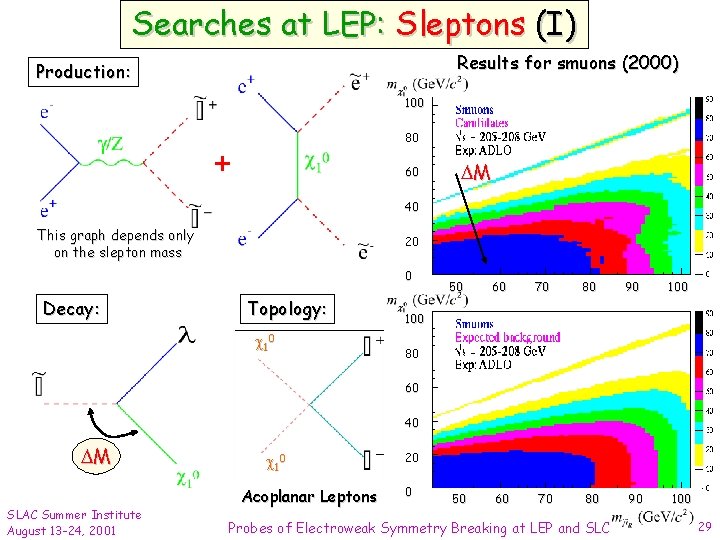
Searches at LEP: Sleptons (I) Results for smuons (2000) Production: 100 80 + 60 M 40 This graph depends only on the slepton mass 20 0 Decay: Topology: 10 50 60 70 80 90 100 100 80 60 40 M SLAC Summer Institute August 13 -24, 2001 10 Acoplanar Leptons 20 0 Probes of Electroweak Symmetry Breaking at LEP and SLC 29
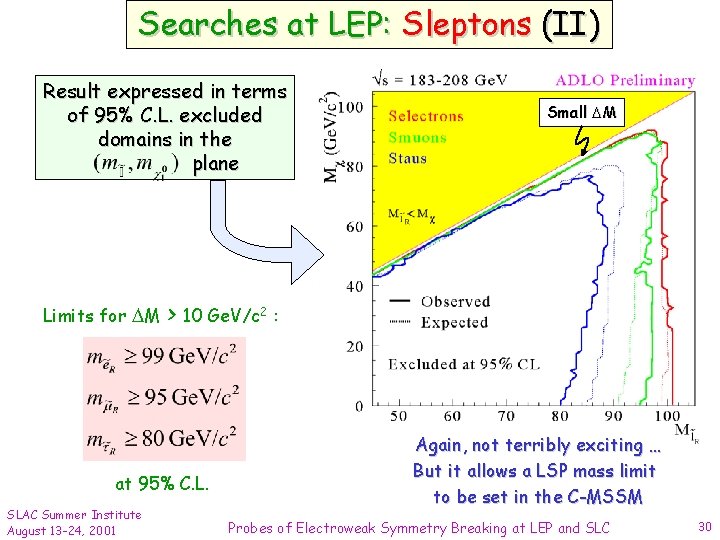
Searches at LEP: Sleptons (II) Result expressed in terms of 95% C. L. excluded domains in the plane Limits for M > 10 Ge. V/c 2 : at 95% C. L. SLAC Summer Institute August 13 -24, 2001 Small M Again, not terribly exciting … But it allows a LSP mass limit to be set in the C-MSSM Probes of Electroweak Symmetry Breaking at LEP and SLC 30
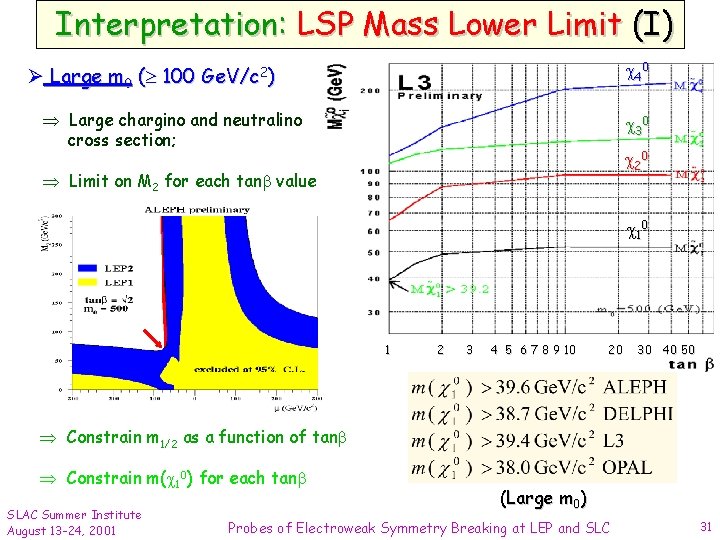
Interpretation: LSP Mass Lower Limit (I) 40 Ø Large m 0 ( 100 Ge. V/c 2) Large chargino and neutralino cross section; 30 20 Limit on M 2 for each tanb value 1 0 1 2 3 4 5 6 7 8 9 10 20 30 40 50 Constrain m 1/2 as a function of tanb Constrain m( 10) for each tanb SLAC Summer Institute August 13 -24, 2001 (Large m 0) Probes of Electroweak Symmetry Breaking at LEP and SLC 31
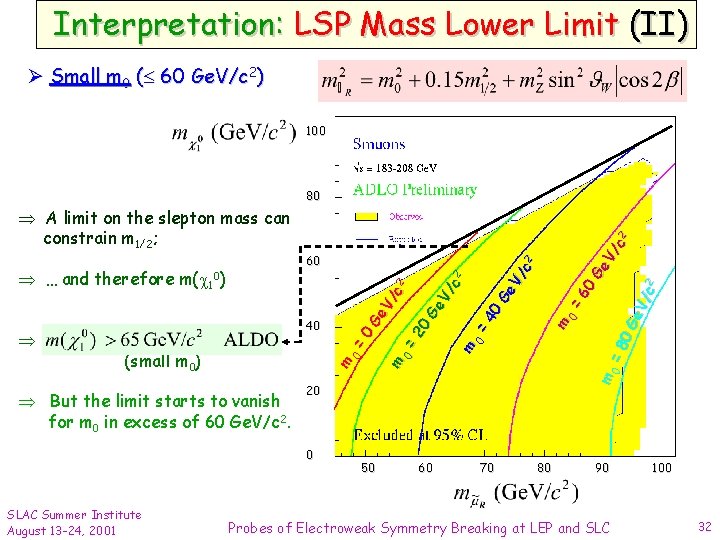
Interpretation: LSP Mass Lower Limit (II) Ø Small m 0 ( 60 Ge. V/c 2) 100 80 But the limit starts to vanish for m 0 in excess of 60 Ge. V/c 2. =6 0 Ge m V/ 0 = c 2 80 Ge V/ 2 c 0 m 20 0 SLAC Summer Institute August 13 -24, 2001 Ge V/ c 2 0 (small m 0) m 40 =0 … and therefore 60 m( 10) =2 0 Ge V/ c 2 m 0 = 40 Ge V/ c 2 A limit on the slepton mass can constrain m 1/2; 50 60 70 80 90 Probes of Electroweak Symmetry Breaking at LEP and SLC 100 32
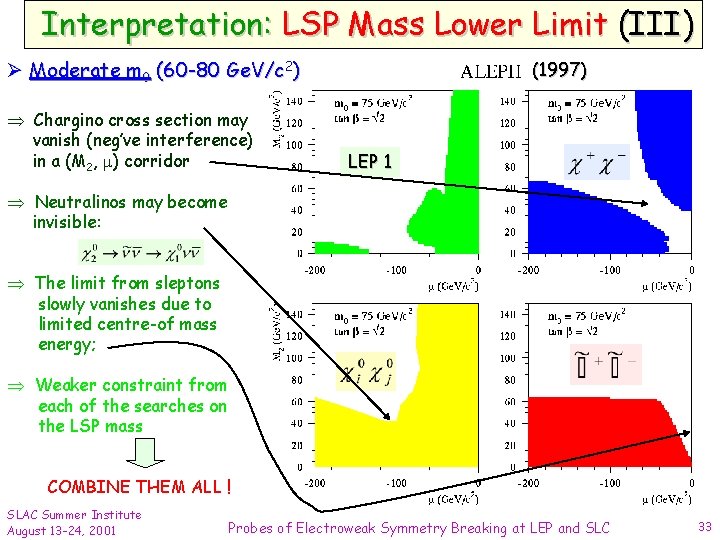
Interpretation: LSP Mass Lower Limit (III) Ø Moderate m 0 (60 -80 Ge. V/c 2) Chargino cross section may vanish (neg’ve interference) in a (M 2, m) corridor (1997) LEP 1 Neutralinos may become invisible: The limit from sleptons slowly vanishes due to limited centre-of mass energy; Weaker constraint from each of the searches on the LSP mass COMBINE THEM ALL ! SLAC Summer Institute August 13 -24, 2001 Probes of Electroweak Symmetry Breaking at LEP and SLC 33
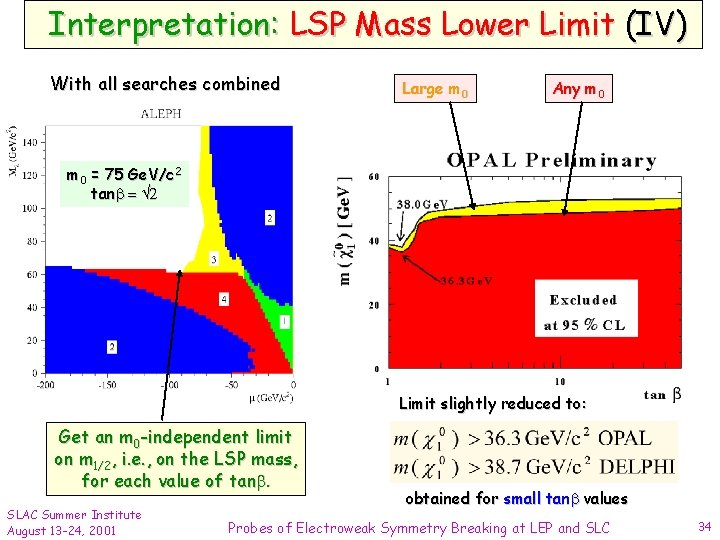
Interpretation: LSP Mass Lower Limit (IV) With all searches combined Large m 0 Any m 0 = 75 Ge. V/c 2 tanb = 2 Limit slightly reduced to: Get an m 0 -independent limit on m 1/2, i. e. , on the LSP mass, for each value of tanb. SLAC Summer Institute August 13 -24, 2001 obtained for small tanb values Probes of Electroweak Symmetry Breaking at LEP and SLC 34
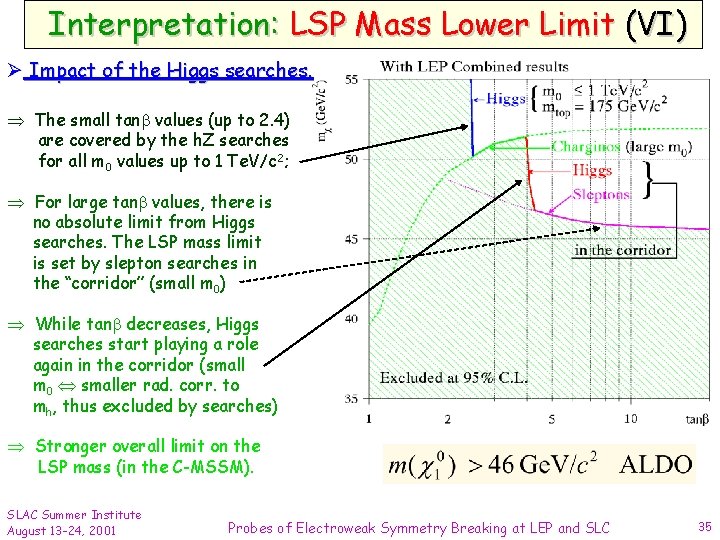
Interpretation: LSP Mass Lower Limit (VI) Ø Impact of the Higgs searches. The small tanb values (up to 2. 4) are covered by the h. Z searches for all m 0 values up to 1 Te. V/c 2; For large tanb values, there is no absolute limit from Higgs searches. The LSP mass limit is set by slepton searches in the “corridor” (small m 0) While tanb decreases, Higgs searches start playing a role again in the corridor (small m 0 smaller rad. corr. to mh, thus excluded by searches) Stronger overall limit on the LSP mass (in the C-MSSM). SLAC Summer Institute August 13 -24, 2001 Probes of Electroweak Symmetry Breaking at LEP and SLC 35
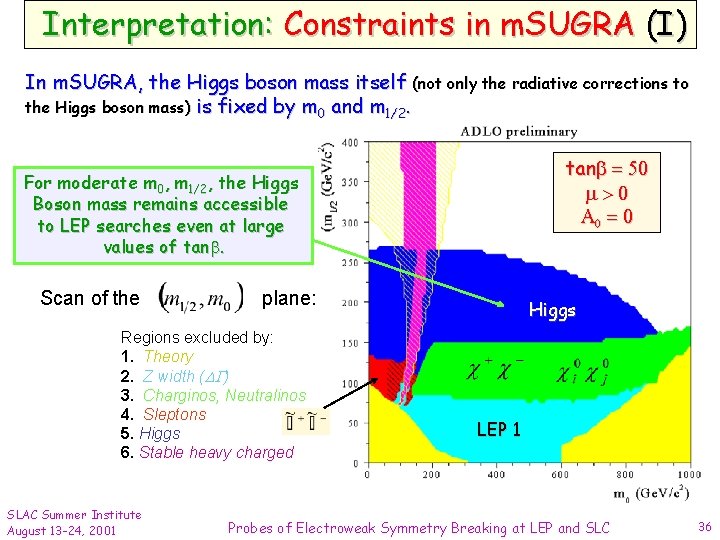
Interpretation: Constraints in m. SUGRA (I) In m. SUGRA, the Higgs boson mass itself (not only the radiative corrections to the Higgs boson mass) is fixed by m 0 and m 1/2. tanb = 50 m>0 A 0 = 0 For moderate m 0, m 1/2, the Higgs Boson mass remains accessible to LEP searches even at large values of tanb. Scan of the plane: Regions excluded by: 1. Theory 2. Z width ( ) 3. Charginos, Neutralinos 4. Sleptons 5. Higgs 6. Stable heavy charged SLAC Summer Institute August 13 -24, 2001 Higgs LEP 1 Probes of Electroweak Symmetry Breaking at LEP and SLC 36
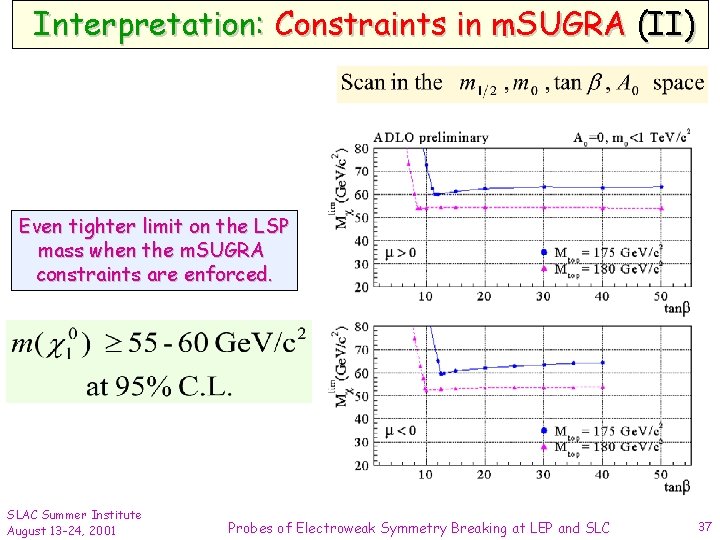
Interpretation: Constraints in m. SUGRA (II) Even tighter limit on the LSP mass when the m. SUGRA constraints are enforced. SLAC Summer Institute August 13 -24, 2001 Probes of Electroweak Symmetry Breaking at LEP and SLC 37
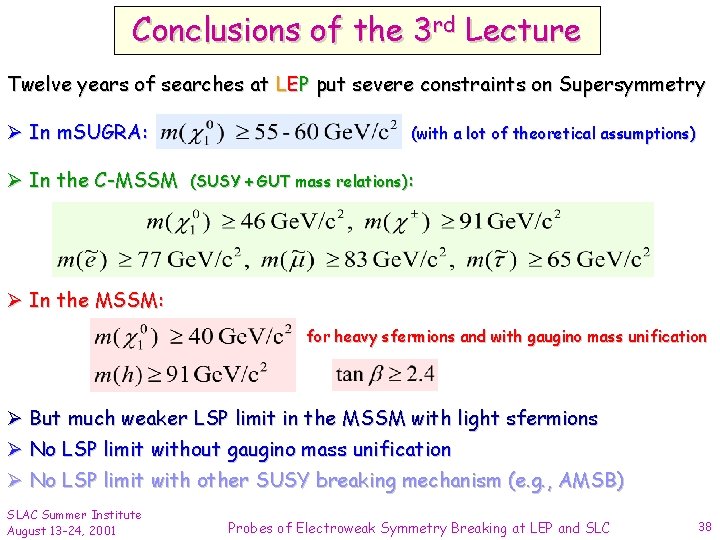
Conclusions of the 3 rd Lecture Twelve years of searches at LEP put severe constraints on Supersymmetry Ø In m. SUGRA: Ø In the C-MSSM (with a lot of theoretical assumptions) (SUSY + GUT mass relations): Ø In the MSSM: for heavy sfermions and with gaugino mass unification Ø But much weaker LSP limit in the MSSM with light sfermions Ø No LSP limit without gaugino mass unification Ø No LSP limit with other SUSY breaking mechanism (e. g. , AMSB) SLAC Summer Institute August 13 -24, 2001 Probes of Electroweak Symmetry Breaking at LEP and SLC 38
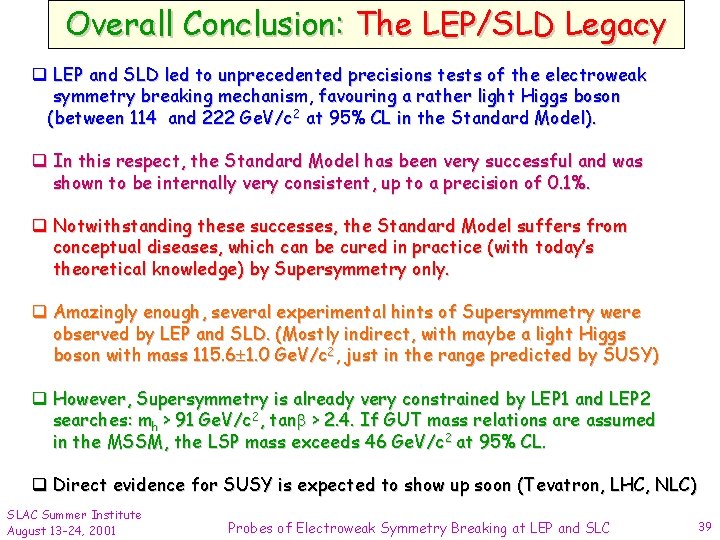
Overall Conclusion: The LEP/SLD Legacy q LEP and SLD led to unprecedented precisions tests of the electroweak symmetry breaking mechanism, favouring a rather light Higgs boson (between 114 and 222 Ge. V/c 2 at 95% CL in the Standard Model). q In this respect, the Standard Model has been very successful and was shown to be internally very consistent, up to a precision of 0. 1%. q Notwithstanding these successes, the Standard Model suffers from conceptual diseases, which can be cured in practice (with today’s theoretical knowledge) by Supersymmetry only. q Amazingly enough, several experimental hints of Supersymmetry were observed by LEP and SLD. (Mostly indirect, with maybe a light Higgs boson with mass 115. 6 1. 0 Ge. V/c 2, just in the range predicted by SUSY) q However, Supersymmetry is already very constrained by LEP 1 and LEP 2 searches: mh > 91 Ge. V/c 2, tanb > 2. 4. If GUT mass relations are assumed in the MSSM, the LSP mass exceeds 46 Ge. V/c 2 at 95% CL. q Direct evidence for SUSY is expected to show up soon (Tevatron, LHC, NLC) SLAC Summer Institute August 13 -24, 2001 Probes of Electroweak Symmetry Breaking at LEP and SLC 39
- Slides: 39