
EWP Load Carrying Impact Assessment 1 Introduction This

- Slides: 13
EWP Load Carrying Impact Assessment 1
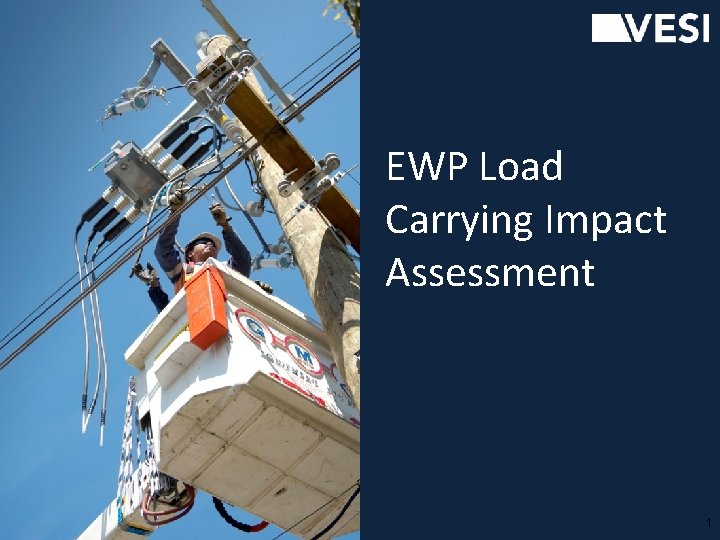
Introduction This Presentation has been produced by the VESI Work Practice Committee (WPC) following recent discussions with Worksafe regarding the suitability of an EWP to lift and support crossarms and other materials on the basket rim This practice raises a number of issues including the effects of overhanging loads, stability of the EWP and security of the load The VESI WPC engaged Peter Wenn of Wenn Wilkinson and Associates (Mechanical Engineering Consultancy) to assess the impact of loads carried on the basket of a number of types of EWP’s used in the VESI www. vesi. com. au 2
Introduction The assessment included: • Load bearing Capacity of the Basket Wall • Load bearing Capacity from Sideways Forces • Effect on Stability of the EWP • Snagging of the crossarm and the effect on the EWP • Restraining the Crossarm to the Basket • Loading and Load Distribution of the basket • Other Loads • Conclusion www. vesi. com. au 3
Load bearing Capacity of the Basket Wall Vertical Forces A nominal load of 100 kg was applied on the top surface of one rim of the EWP basket. Results indicate that the compressive stress in the wall is negligible. Side way Forces The capacity of the wall when subject to sideways forces is determined by the bending strength of the rim. Calculations indicate that the smallest rim is capable of sustaining a sideways load equal to the mass of a 100 kg crossarm. Stability of the EWP The effect on stability of the EWP arises from the increased wind area due to the crossarm and the increased height of the load. The effect on stability due the increased height of the load are negligible. www. vesi. com. au 4
Load bearing Capacity of the Basket Wall The models assessed in all instances confirm the basket has adequate structural capacity to support the weight of a crossarm during normal use. This is also confirmed by the following observations: • The basket wall regularly supports the mass of a person egressing from the basket and observation of many EWP’s over many years indicates no detrimental effect. • During load testing of EWP’s the test load is usually slung from a bar or soft sling that is placed over the basket rim. For most EWP’s the test load is at least 1. 5 times the rated capacity – equivalent to a load of at least 225 kg acting on one side of the basket. (For a EWP with rated capacity of 300 kg) and as such the basket is capable of supporting test loads of such magnitude without detriment. www. vesi. com. au 5
Snagging the Crossarm Most insulated EWP’s are not fitted with a load limiting system and will have the capability, in certain boom positions of applying forces against an obstruction that is well in excess of the rated capacity to the basket. This effect is amplified if the load is overhanging the basket as could occur if a crossarm becomes entangled with conductors or other obstructions. If the crossarm is secured to the basket and is snagged against an obstruction, the forces acting in components such as basket levelling systems, basket frames and rotators could foreseeably double or treble in magnitude. www. vesi. com. au 6
Snagging the Crossarm If the crossarm is not restrained vertically so it can lift and tilt the magnitude of the forces in such components is limited by the mass of the crossarm itself. If the crossarm is secured to the basket rim e. g. by tying it down, there is a possibility of overload and instability should the crossarm become caught or snagged in conductors or caught under a structure. If there is any possibility of a crossarm being caught or snagged on external structures or conductors, the crossarm should not be completely secured and should, ultimately be permitted to fall from the basket. www. vesi. com. au 7
Snagging the Crossarm The risk could be controlled by employing the following methods: • Always employing two persons when carrying crossarms on the basket rim - one as an observer • Maintaining clearances from external structures and wires if the crossarm is secured to the basket • Ensuring that the crossarm is released - in particular by permitting vertical movement when in proximity to structures or wires • Maintaining a drop zone at all times during the operation www. vesi. com. au 8
Restraining the Crossarm to the Basket It is preferable to permit vertical movement of the crossarm at all times, and provide devices that contain the crossarm within the confines of the basket. www. vesi. com. au 9
Rated Capacity EWP’s with a rated capacity of 250 kg or less are not considered appropriate to carry crossarms as the rated capacity can be readily exceeded – Two people (nominally 160 kg) – The liner (55 kg) – Tools (approx. . 40 kg) – a total of 245 kg One person could carry a smaller, lighter crossarm contained inside the basket (not on the basket rim) so long as it can be safely handled www. vesi. com. au 10
Loading and load distribution Under no circumstances should the combined mass of persons, tools, equipment including the liner and cross arm exceed the rated capacity of the machine. It is recommended that the mass of the tools contained in the aprons be limited to those that are essential and frequently employed and most importantly, the tool aprons are located at the front of the basket – closest to the boom. Concentration of load at the rear edge of the basket (that furthest from the boom) increases the forces in the basket levelling system and may result in failure of the levelling system in the medium term. www. vesi. com. au 11
Other Loads Other loads, such as lighting brackets or lengthy material could be supported on the basket rim in a similar manner to crossarms. In order to control the load and distribute the force into the rim, circular sections should be supported in a saddle or bracket. As a general rule, that the length of any load should not exceed the twice length of the basket. www. vesi. com. au 12
Conclusion • Carrying crossarms on the EWP’s listed has negligible effect on the load bearing capacity or stability of the EWP. This is based on the assumption that the total load does not exceed the rated capacity and the load is distributed in the basket and not concentrated at one edge. • Crossarms should be restrained when carried on the EWP basket • An audit of the practices associated with carrying tools should be undertaken, and that the number of tools is restricted and tools aprons are located on the front wall of the basket only (i. e. the wall closest to the boom). www. vesi. com. au 13