
EVSGTR TF 5 Update Progress TF 5 task

- Slides: 6
EVS-GTR TF 5 Update Progress TF 5 task force –thermal propagation Prof. Xiao Chengwei 2015/6/3
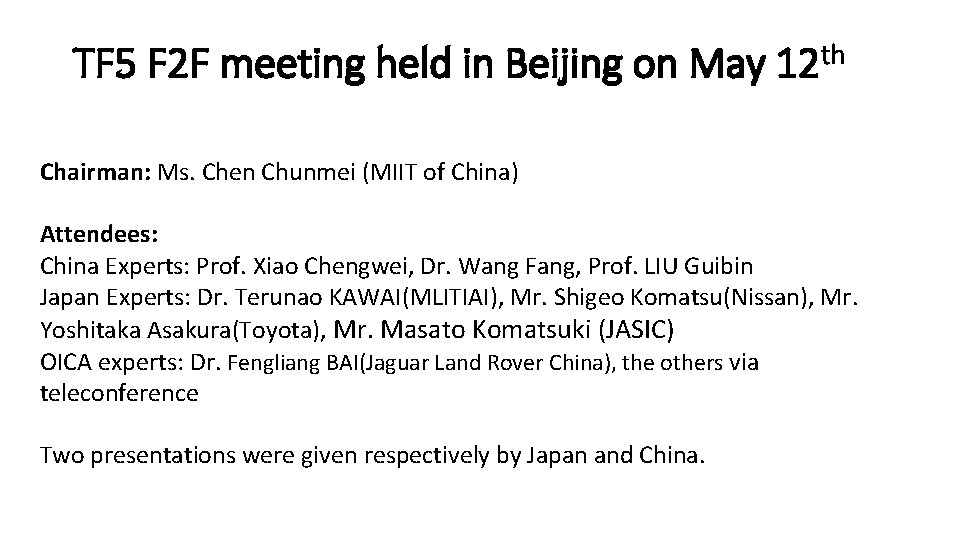
TF 5 F 2 F meeting held in Beijing on May th 12 Chairman: Ms. Chen Chunmei (MIIT of China) Attendees: China Experts: Prof. Xiao Chengwei, Dr. Wang Fang, Prof. LIU Guibin Japan Experts: Dr. Terunao KAWAI(MLITIAI), Mr. Shigeo Komatsu(Nissan), Mr. Yoshitaka Asakura(Toyota), Mr. Masato Komatsuki (JASIC) OICA experts: Dr. Fengliang BAI(Jaguar Land Rover China), the others via teleconference Two presentations were given respectively by Japan and China.
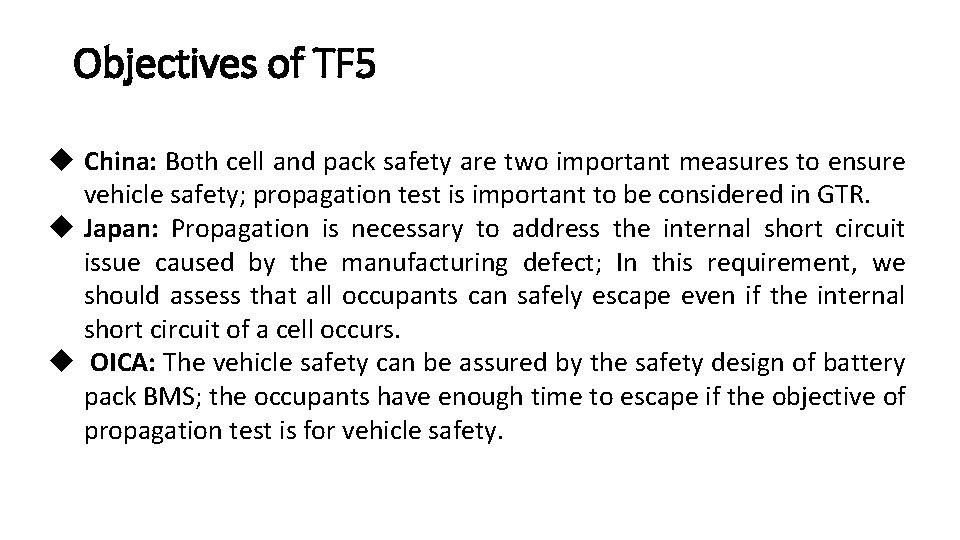
Objectives of TF 5 u China: Both cell and pack safety are two important measures to ensure vehicle safety; propagation test is important to be considered in GTR. u Japan: Propagation is necessary to address the internal short circuit issue caused by the manufacturing defect; In this requirement, we should assess that all occupants can safely escape even if the internal short circuit of a cell occurs. u OICA: The vehicle safety can be assured by the safety design of battery pack BMS; the occupants have enough time to escape if the objective of propagation test is for vehicle safety.
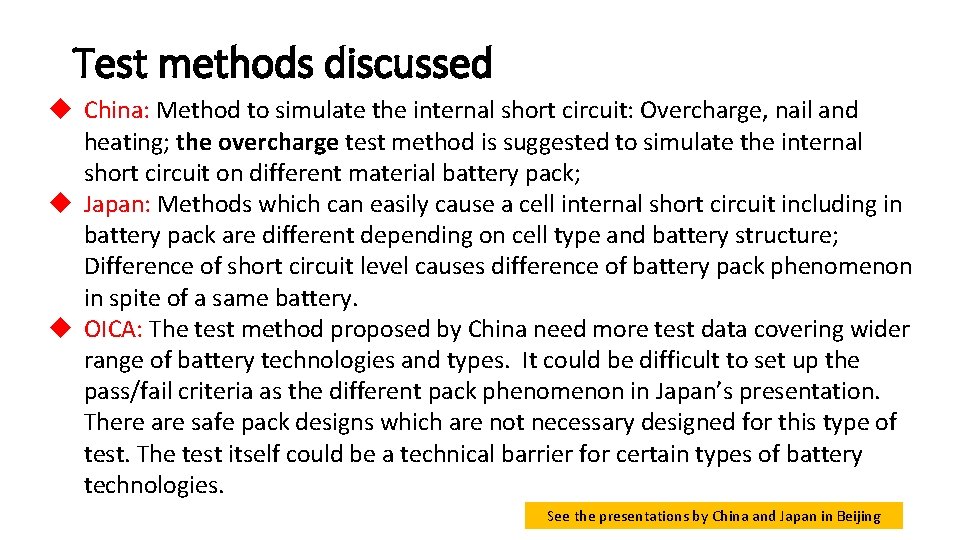
Test methods discussed u China: Method to simulate the internal short circuit: Overcharge, nail and heating; the overcharge test method is suggested to simulate the internal short circuit on different material battery pack; u Japan: Methods which can easily cause a cell internal short circuit including in battery pack are different depending on cell type and battery structure; Difference of short circuit level causes difference of battery pack phenomenon in spite of a same battery. u OICA: The test method proposed by China need more test data covering wider range of battery technologies and types. It could be difficult to set up the pass/fail criteria as the different pack phenomenon in Japan’s presentation. There are safe pack designs which are not necessary designed for this type of test. The test itself could be a technical barrier for certain types of battery technologies. See the presentations by China and Japan in Beijing
Conclusion reached The meeting was productive; all parties had lively discussions about the objectives and test methods. It needs deeper communications to achieve a common understanding on the necessity of the propagation test. All members have agreed to conduct a follow-up meeting as soon as the following information is available. u China and Japan: Agreed on the necessity of thermal propagation test; u OICA: To provide evidence that the occupants have enough time to escape when thermal propagation occurs.
Thanks!