
EVPN and L 2 Access Protocols SingleFlowActive loadbalancing
EVPN and L 2 Access Protocols: Single-Flow-Active load-balancing mode draft-brissette-bess-evpn-l 2 gw-proto
Requirements • Support L 2 Access Protocols into EVPN core (incl. EVPN-IRB). • (M)STP 802. 1 d, G. 8032, MPLS-TP, MST-AG, REP-AG, etc. • L 2 gateways largely unaware of the access network topology but • Access network is running an L 2 protocol breaking loops • Access network is segmented by design • Solution MUST support: • Optimal forwarding at L 2 and L 3 • Fast-convergence • Scalability • Anycast IRB support 2
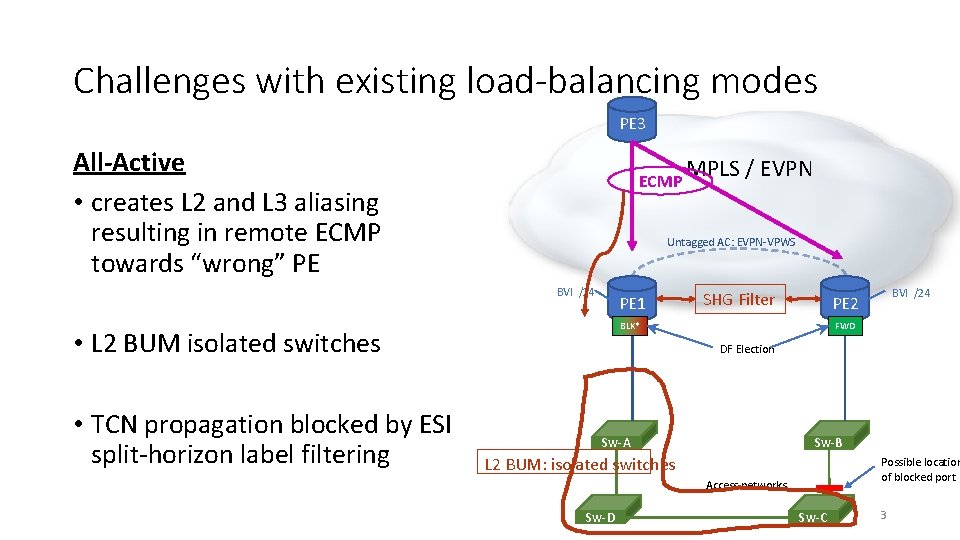
Challenges with existing load-balancing modes PE 3 All-Active • creates L 2 and L 3 aliasing resulting in remote ECMP towards “wrong” PE ECMP Untagged AC: EVPN-VPWS BVI /24 PE 1 SHG Filter BVI /24 PE 2 FWD BLK* • L 2 BUM isolated switches • TCN propagation blocked by ESI split-horizon label filtering MPLS / EVPN DF Election Sw-A Sw-B L 2 BUM: isolated switches Possible location of blocked port Access networks Sw-D Sw-C 3
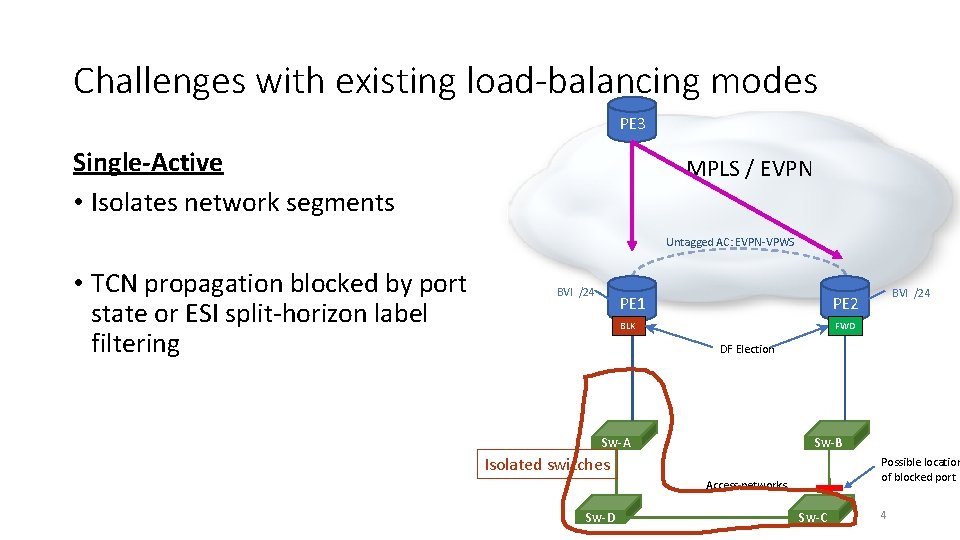
Challenges with existing load-balancing modes PE 3 Single-Active • Isolates network segments MPLS / EVPN Untagged AC: EVPN-VPWS • TCN propagation blocked by port state or ESI split-horizon label filtering BVI /24 PE 1 BVI /24 PE 2 FWD BLK DF Election Sw-A Sw-B Isolated switches Possible location of blocked port Access networks Sw-D Sw-C 4

Single-Flow-Active PE 3 Active / Backup • Same ESI between peering PEs: MPLS / EVPN • Ethernet-segment procedures still apply • ESI-Label BGP extcomm extension to signal [2: 0]- 000 = all-active, Untagged AC: EVPN-VPWS 001 = single-active, 010 = single-flow-active , BVI /24 other = unused [7: 3]- Reserved PE 1 PE 2 FWD BVI /24 No ESI Split-horizon • Peering PE in SFA mode, MUST: • not perform ESI Split-Horizon filtering • enable MAC-Mobility within same ESI • Remote PE for remote ESI in SFA mode: • MUST disable aliasing (at Layer-2 and Layer-3) • SHOULD pre-program backup per MAC entry Sw-A Sw-B Possible location of blocked port Access protocol STP, ERP, . . . Sw-D Sw-C
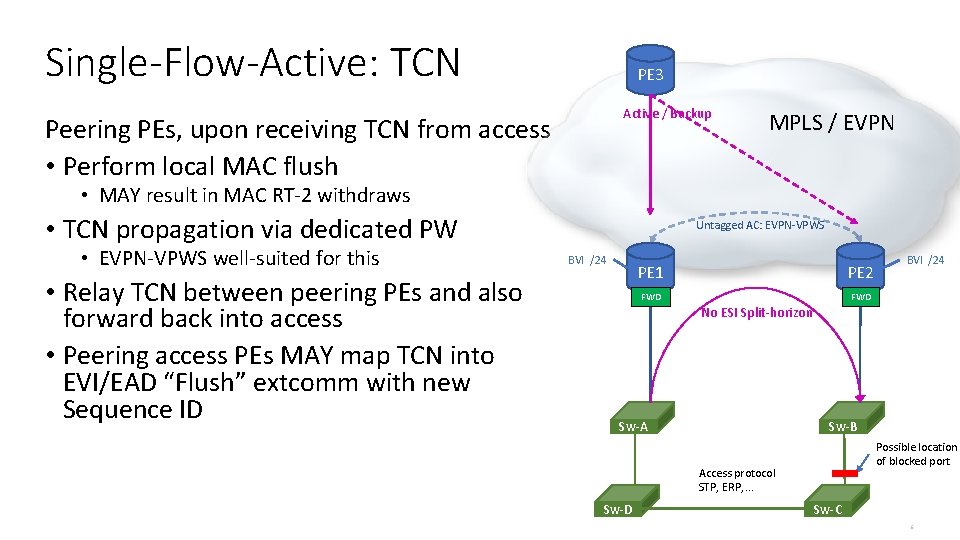
Single-Flow-Active: TCN PE 3 Active / Backup Peering PEs, upon receiving TCN from access • Perform local MAC flush MPLS / EVPN • MAY result in MAC RT-2 withdraws • TCN propagation via dedicated PW • EVPN-VPWS well-suited for this • Relay TCN between peering PEs and also forward back into access • Peering access PEs MAY map TCN into EVI/EAD “Flush” extcomm with new Sequence ID Untagged AC: EVPN-VPWS BVI /24 PE 1 PE 2 FWD BVI /24 No ESI Split-horizon Sw-A Sw-B Possible location of blocked port Access protocol STP, ERP, . . . Sw-D Sw-C 6
- Slides: 6