
Evolving Xray Polarimetry towards high energy and solar


![RHESSI [gamma-rays (blue) and X-rays (red)] and TRACE [UV image]View of January 20, 2005](https://slidetodoc.com/presentation_image/4a155fb76823a8d7739e3b9a98f86e47/image-14.jpg "RHESSI [gamma-rays (blue) and X-rays (red)] and TRACE [UV image]View of January 20, 2005")
- Slides: 17
Evolving X-ray Polarimetry towards high energy and solar science Sergio Fabiani Università degli Studi di Roma “Tor Vergata” INAF / IAPS IAPS Istituto di Astrofisica e Planetologia Spaziali
OUTLINE Polarimetry Basics Solar Flares X-ray Emission Solar Flares X-ray Polarization Photoelectric Polarimeter (Gas Pixel Detector – Low Energy: 2 -35 ke. V) Compton Polarimeter (High Energy : starting from 20 ke. V) Conclusions
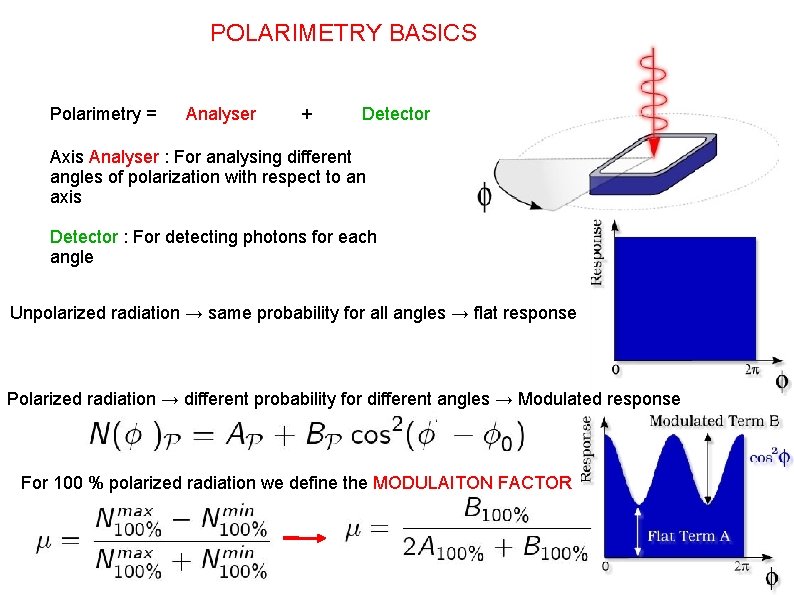
POLARIMETRY BASICS Polarimetry = Analyser + Detector Axis Analyser : For analysing different angles of polarization with respect to an axis Detector : For detecting photons for each angle Unpolarized radiation → same probability for all angles → flat response Polarized radiation → different probability for different angles → Modulated response For 100 % polarized radiation we define the MODULAITON FACTOR
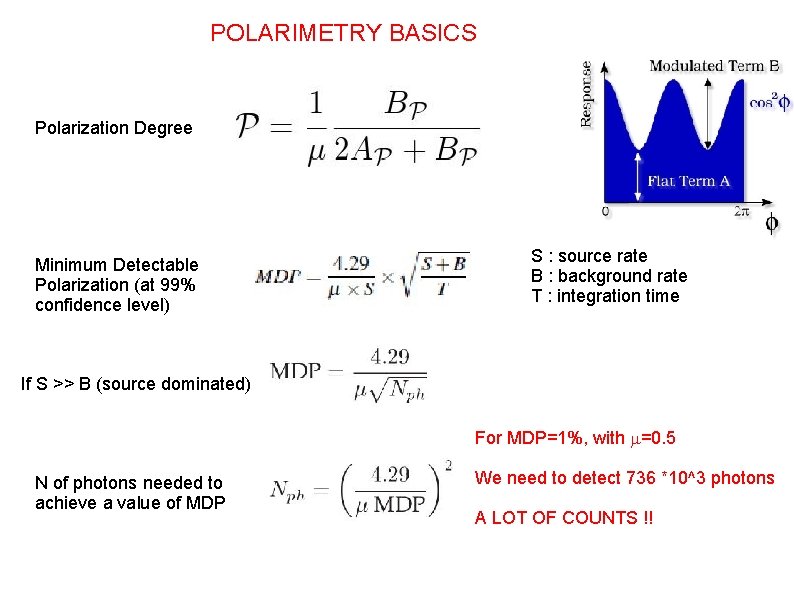
POLARIMETRY BASICS Polarization Degree Minimum Detectable Polarization (at 99% confidence level) S : source rate B : background rate T : integration time If S >> B (source dominated) For MDP=1%, with m=0. 5 N of photons needed to achieve a value of MDP We need to detect 736 *10^3 photons A LOT OF COUNTS !!
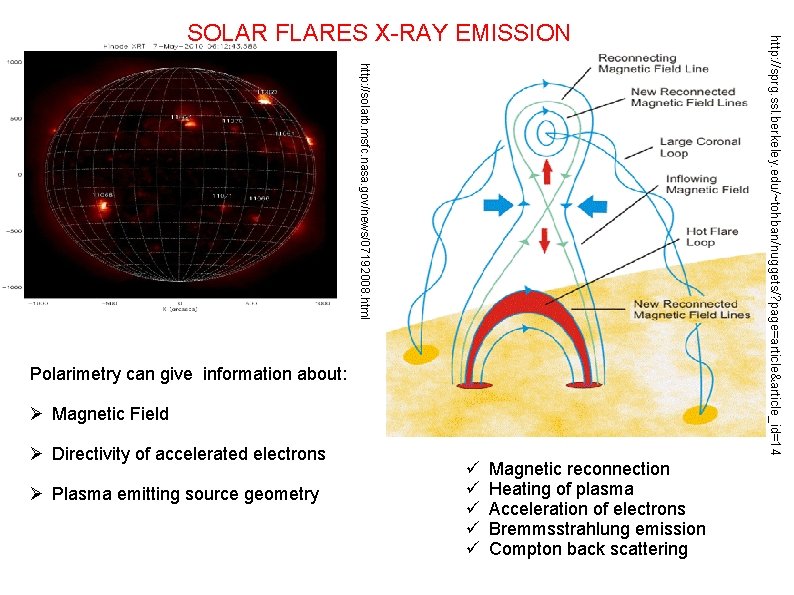
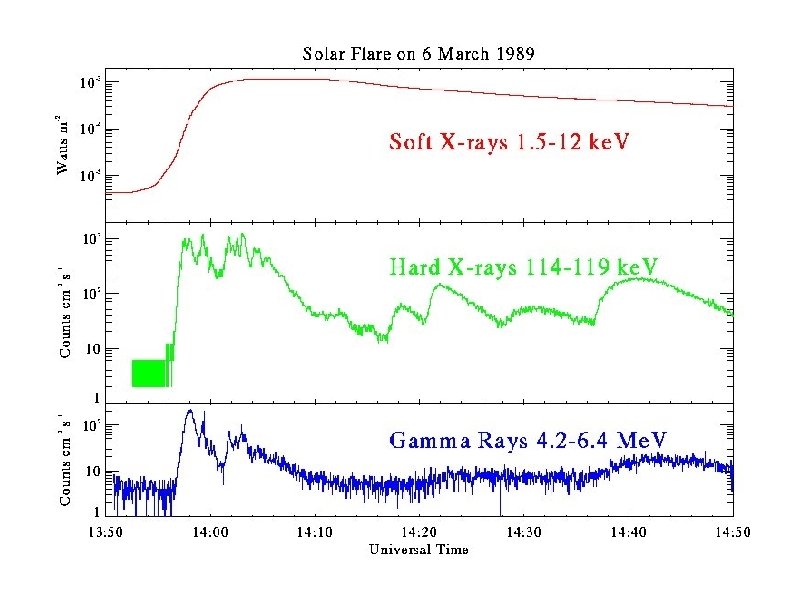
http: //solarb. msfc. nasa. gov/news/07192008. html Polarimetry can give information about: Ø Magnetic Field Ø Directivity of accelerated electrons Ø Plasma emitting source geometry ü ü ü Magnetic reconnection Heating of plasma Acceleration of electrons Bremmsstrahlung emission Compton back scattering http: //sprg. ssl. berkeley. edu/~tohban/nuggets/? page=article&article_id=14 SOLAR FLARES X-RAY EMISSION
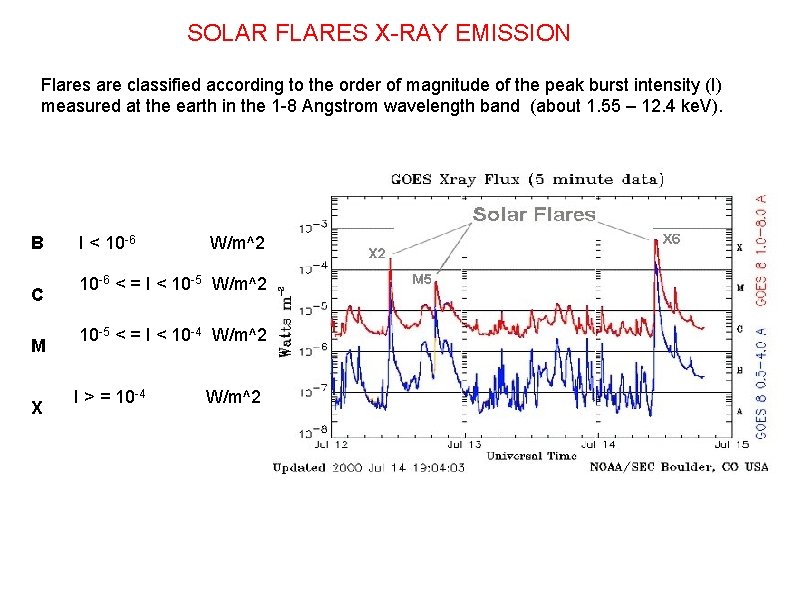
SOLAR FLARES X-RAY EMISSION Flares are classified according to the order of magnitude of the peak burst intensity (I) measured at the earth in the 1 -8 Angstrom wavelength band (about 1. 55 – 12. 4 ke. V). B C M X I < 10 -6 W/m^2 10 -6 < = I < 10 -5 W/m^2 10 -5 < = I < 10 -4 W/m^2 I > = 10 -4 W/m^2
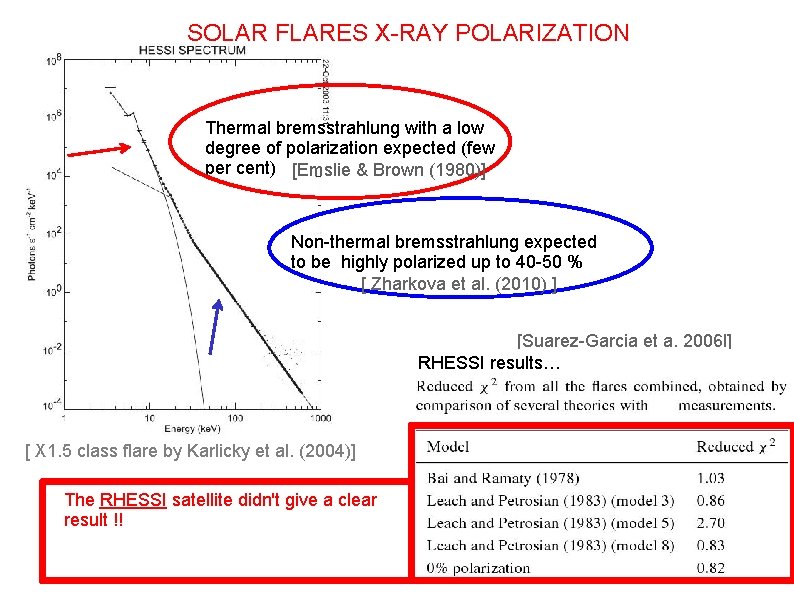
SOLAR FLARES X-RAY POLARIZATION Thermal bremsstrahlung with a low degree of polarization expected (few per cent) [Emslie & Brown (1980)] Non-thermal bremsstrahlung expected to be highly polarized up to 40 -50 % [ Zharkova et al. (2010) ] [Suarez-Garcia et a. 2006 l] RHESSI results… [ X 1. 5 class flare by Karlicky et al. (2004)] The RHESSI satellite didn't give a clear result !!
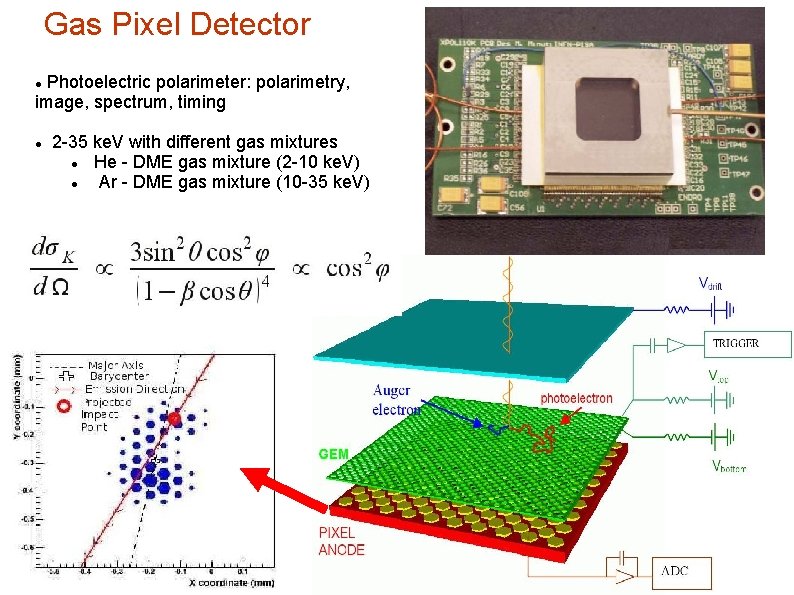
Gas Pixel Detector Photoelectric polarimeter: polarimetry, image, spectrum, timing 2 -35 ke. V with different gas mixtures He - DME gas mixture (2 -10 ke. V) Ar - DME gas mixture (10 -35 ke. V)
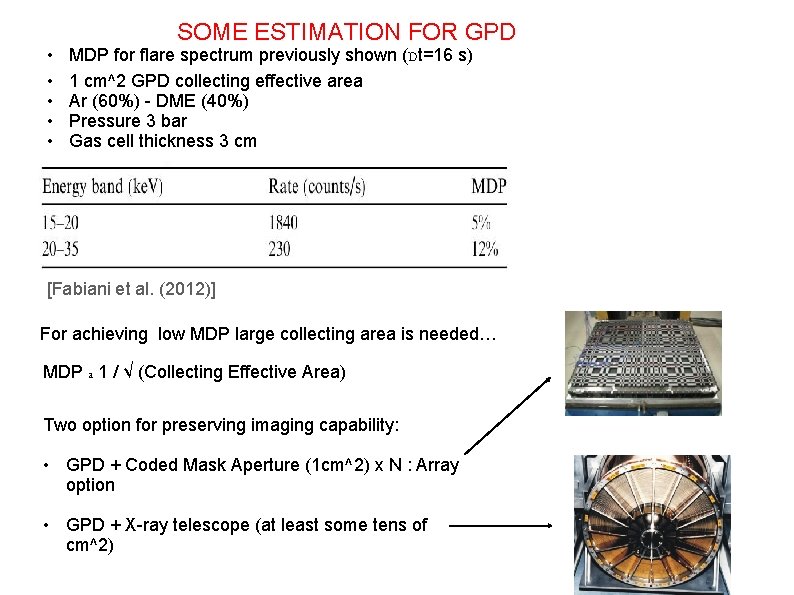
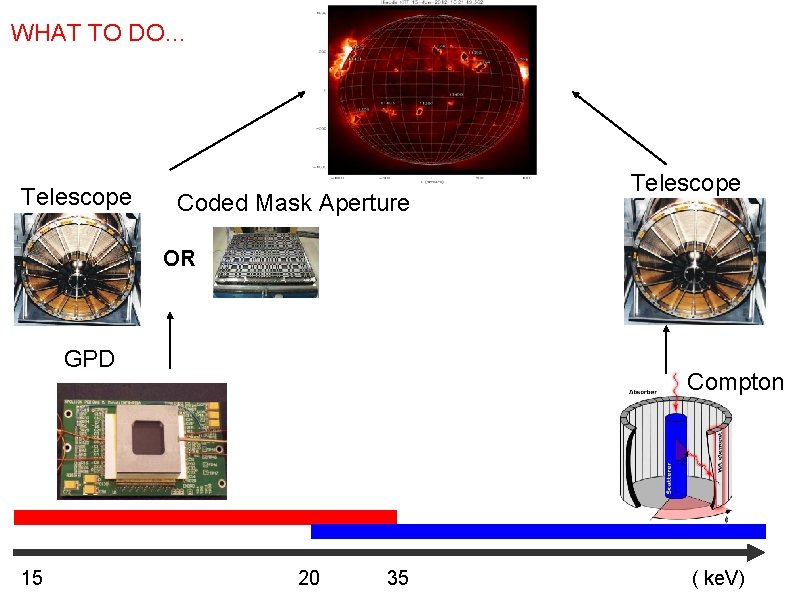
• • • SOME ESTIMATION FOR GPD MDP for flare spectrum previously shown (Dt=16 s) 1 cm^2 GPD collecting effective area Ar (60%) - DME (40%) Pressure 3 bar Gas cell thickness 3 cm [Fabiani et al. (2012)] For achieving low MDP large collecting area is needed… MDP a 1 / √ (Collecting Effective Area) Two option for preserving imaging capability: • GPD + Coded Mask Aperture (1 cm^2) x N : Array option • GPD + X-ray telescope (at least some tens of cm^2)
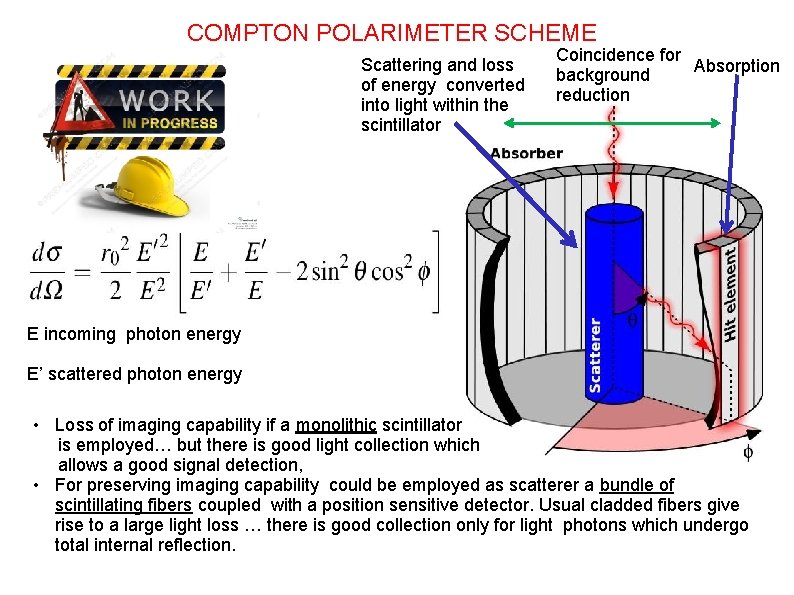
COMPTON POLARIMETER SCHEME Scattering and loss of energy converted into light within the scintillator Coincidence for Absorption background reduction E incoming photon energy E’ scattered photon energy • Loss of imaging capability if a monolithic scintillator is employed… but there is good light collection which allows a good signal detection, • For preserving imaging capability could be employed as scatterer a bundle of scintillating fibers coupled with a position sensitive detector. Usual cladded fibers give rise to a large light loss … there is good collection only for light photons which undergo total internal reflection.
WHAT TO DO… Telescope Coded Mask Aperture Telescope OR GPD Compton 15 20 35 ( ke. V)
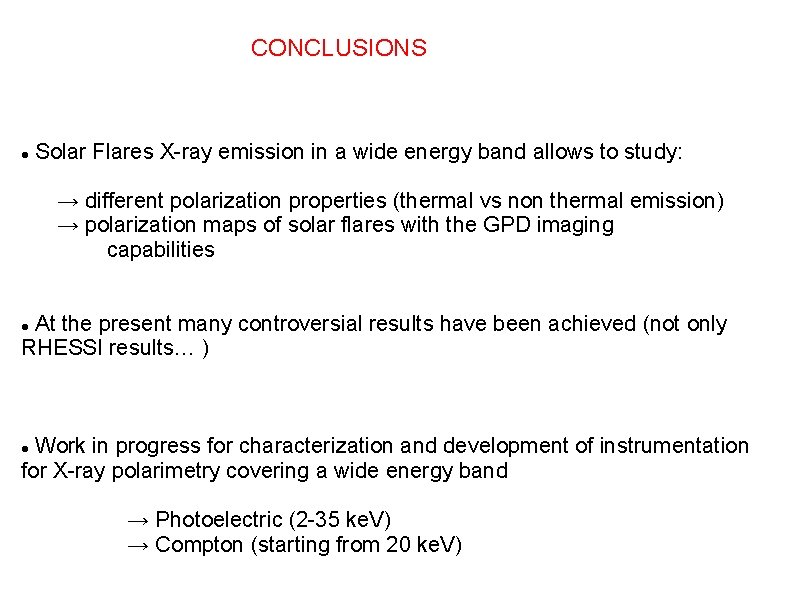
CONCLUSIONS Solar Flares X-ray emission in a wide energy band allows to study: → different polarization properties (thermal vs non thermal emission) → polarization maps of solar flares with the GPD imaging capabilities At the present many controversial results have been achieved (not only RHESSI results… ) Work in progress for characterization and development of instrumentation for X-ray polarimetry covering a wide energy band → Photoelectric (2 -35 ke. V) → Compton (starting from 20 ke. V)
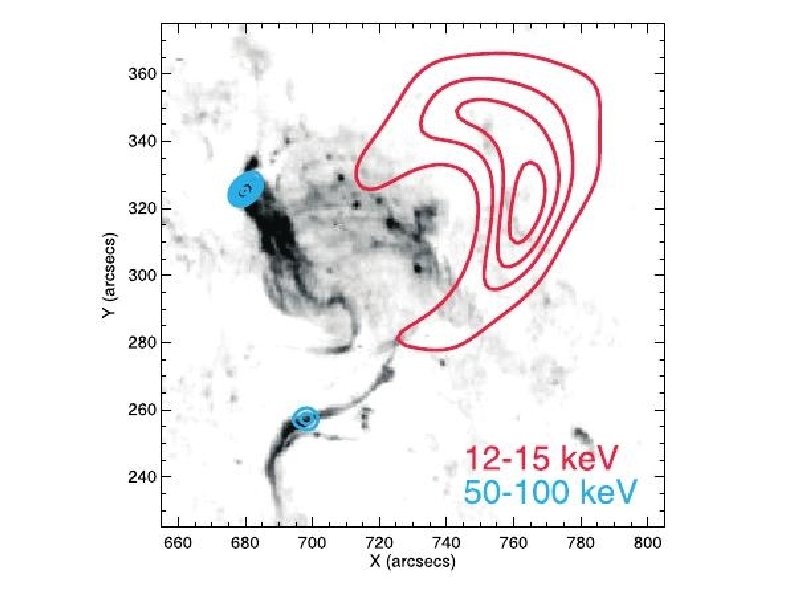
RHESSI [gamma-rays (blue) and X-rays (red)] and TRACE [UV image]View of January 20, 2005 Solar Flare. (http: //solarb. msfc. nasa. gov/science/multimedia. html)
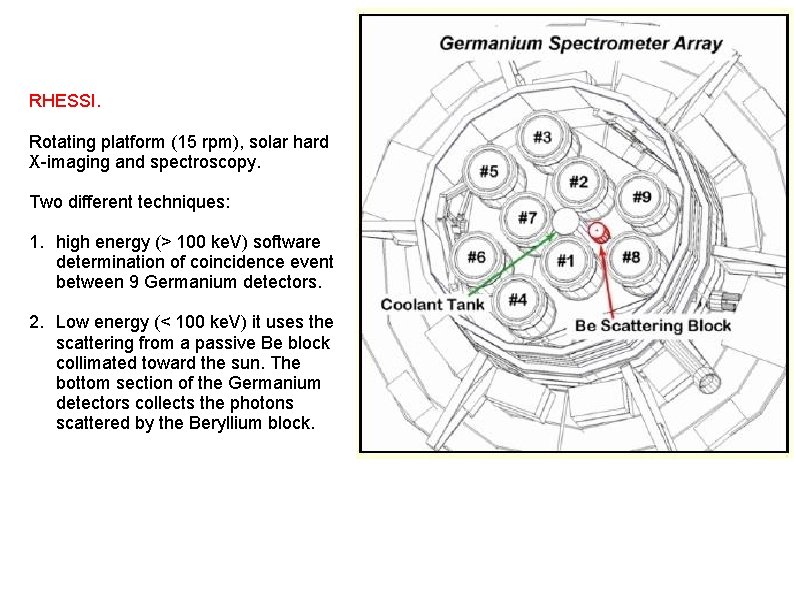
RHESSI. Rotating platform (15 rpm), solar hard X-imaging and spectroscopy. Two different techniques: 1. high energy (> 100 ke. V) software determination of coincidence event between 9 Germanium detectors. 2. Low energy (< 100 ke. V) it uses the scattering from a passive Be block collimated toward the sun. The bottom section of the Germanium detectors collects the photons scattered by the Beryllium block.