
EVOLVING OPTIONS FOR HBV THERAPY NAVIGATING THE NEW

EVOLVING OPTIONS FOR HBV THERAPY: NAVIGATING THE NEW TREATMENT LANDSCAPE ©UNIVERSITY OF UTAH HEALTH, 2018
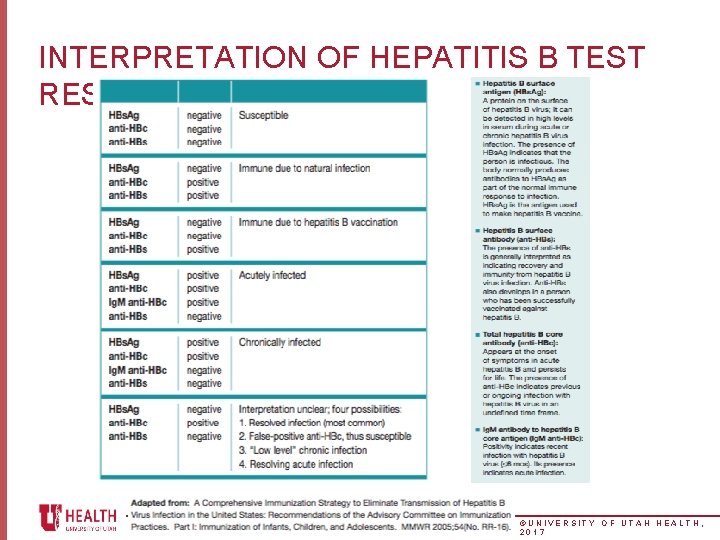
INTERPRETATION OF HEPATITIS B TEST RESULTS ©UNIVERSITY OF UTAH HEALTH, 2017
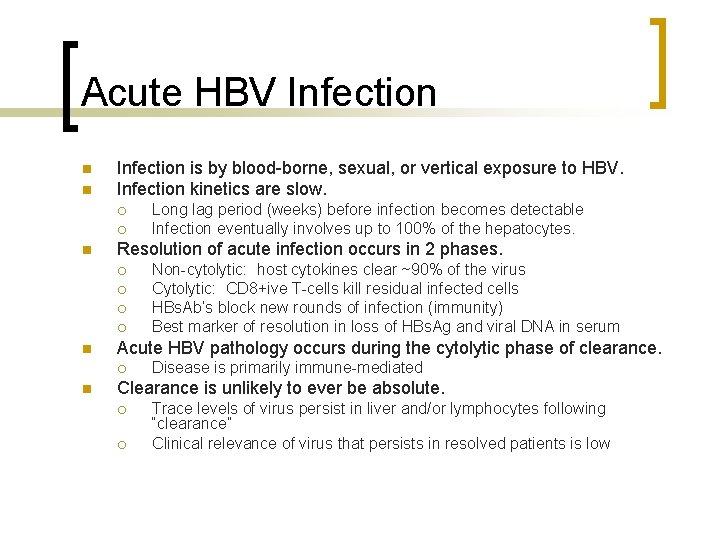
Acute HBV Infection n n Infection is by blood-borne, sexual, or vertical exposure to HBV. Infection kinetics are slow. ¡ ¡ n Resolution of acute infection occurs in 2 phases. ¡ ¡ n Non-cytolytic: host cytokines clear ~90% of the virus Cytolytic: CD 8+ive T-cells kill residual infected cells HBs. Ab’s block new rounds of infection (immunity) Best marker of resolution in loss of HBs. Ag and viral DNA in serum Acute HBV pathology occurs during the cytolytic phase of clearance. ¡ n Long lag period (weeks) before infection becomes detectable Infection eventually involves up to 100% of the hepatocytes. Disease is primarily immune-mediated Clearance is unlikely to ever be absolute. ¡ ¡ Trace levels of virus persist in liver and/or lymphocytes following “clearance” Clinical relevance of virus that persists in resolved patients is low
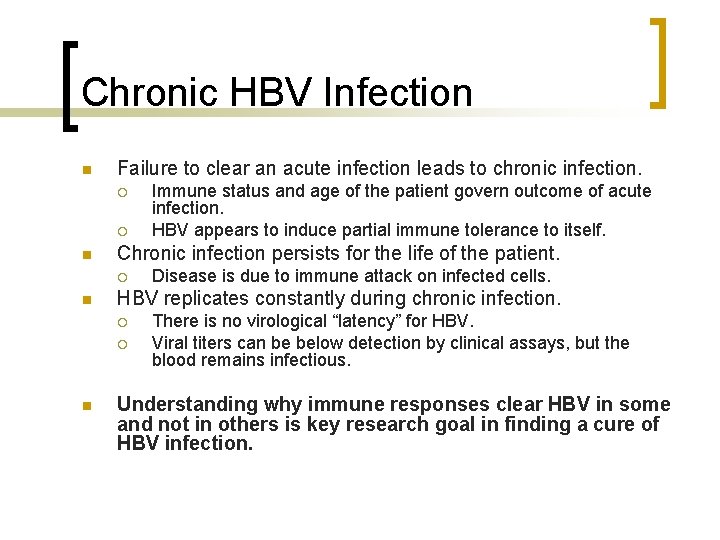
Chronic HBV Infection n Failure to clear an acute infection leads to chronic infection. ¡ ¡ n Chronic infection persists for the life of the patient. ¡ n Disease is due to immune attack on infected cells. HBV replicates constantly during chronic infection. ¡ ¡ n Immune status and age of the patient govern outcome of acute infection. HBV appears to induce partial immune tolerance to itself. There is no virological “latency” for HBV. Viral titers can be below detection by clinical assays, but the blood remains infectious. Understanding why immune responses clear HBV in some and not in others is key research goal in finding a cure of HBV infection.
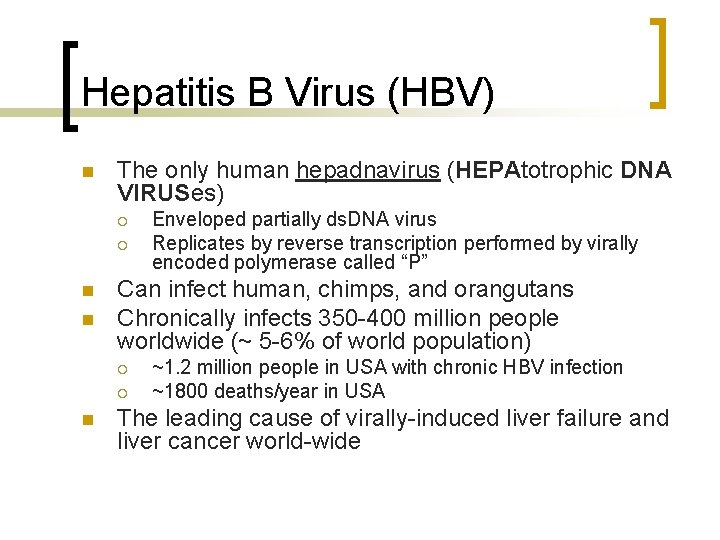
Hepatitis B Virus (HBV) n The only human hepadnavirus (HEPAtotrophic DNA VIRUSes) ¡ ¡ n n Can infect human, chimps, and orangutans Chronically infects 350 -400 million people worldwide (~ 5 -6% of world population) ¡ ¡ n Enveloped partially ds. DNA virus Replicates by reverse transcription performed by virally encoded polymerase called “P” ~1. 2 million people in USA with chronic HBV infection ~1800 deaths/year in USA The leading cause of virally-induced liver failure and liver cancer world-wide
CURE AS A GOAL OF THERAPY • Actual cure – True cure = all traces of HBV gone from the liver (like HCV) – VERY difficult (if not impossible) ccc. DNA • Functional cure – Use the markers of pts who do well: 1. HBs. Ag loss (ideally with anti-HBs) 2. Possibly sustained off-treatment inactive disease without HBs. Ag loss (HBe. Ag negative, DNA undetectable, normal ALT, normal histology) Cure not so simple. . . reasons lie in the virology
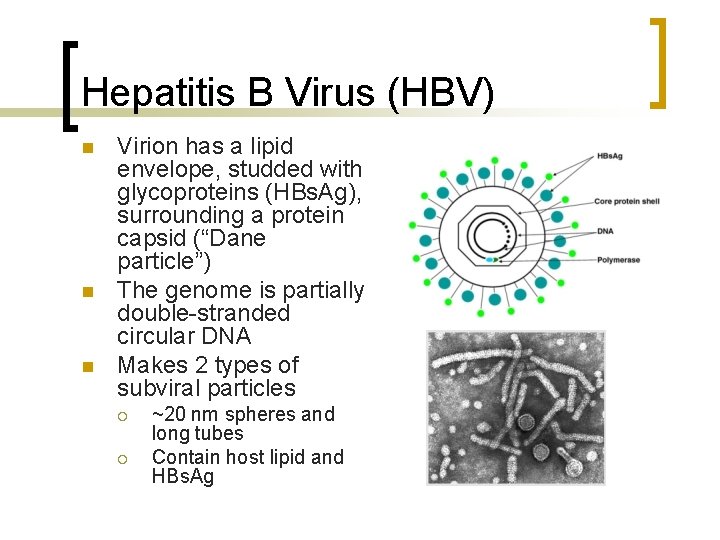
Hepatitis B Virus (HBV) n n n Virion has a lipid envelope, studded with glycoproteins (HBs. Ag), surrounding a protein capsid (“Dane particle”) The genome is partially double-stranded circular DNA Makes 2 types of subviral particles ¡ ¡ ~20 nm spheres and long tubes Contain host lipid and HBs. Ag
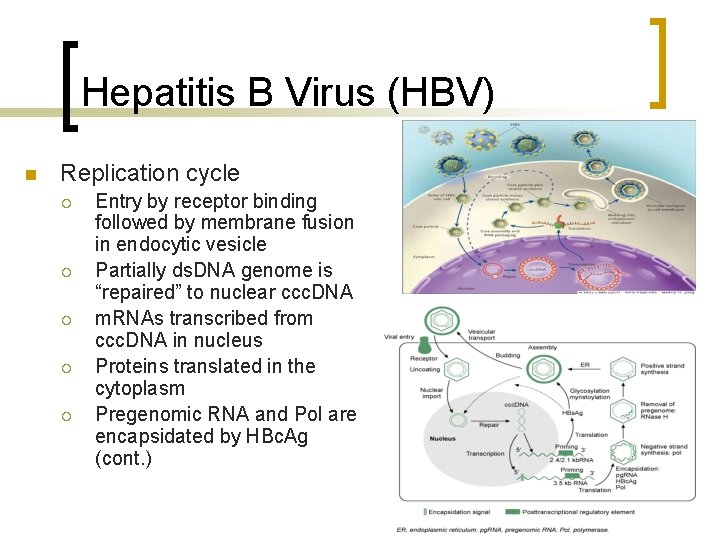
Hepatitis B Virus (HBV) n Replication cycle ¡ ¡ ¡ Entry by receptor binding followed by membrane fusion in endocytic vesicle Partially ds. DNA genome is “repaired” to nuclear ccc. DNA m. RNAs transcribed from ccc. DNA in nucleus Proteins translated in the cytoplasm Pregenomic RNA and Pol are encapsidated by HBc. Ag (cont. )
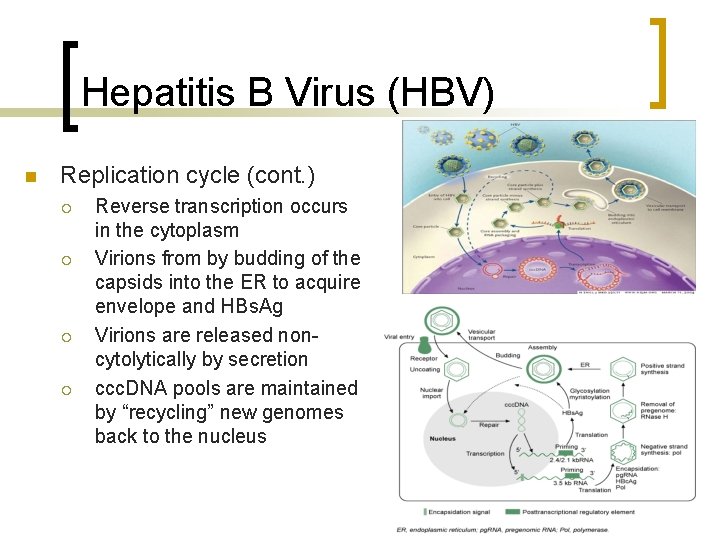
Hepatitis B Virus (HBV) n Replication cycle (cont. ) ¡ ¡ Reverse transcription occurs in the cytoplasm Virions from by budding of the capsids into the ER to acquire envelope and HBs. Ag Virions are released noncytolytically by secretion ccc. DNA pools are maintained by “recycling” new genomes back to the nucleus
![POTENT HBV DNA SUPPRESSION WITH NUCLEOS(T)IDE THERAPY HBe. Ag positive Long-term ETV[1] 83 80](http://slidetodoc.com/presentation_image_h/b6f1f3519aa4a078e92992e2634a0a0f/image-10.jpg "POTENT HBV DNA SUPPRESSION WITH NUCLEOS(T)IDE THERAPY HBe. Ag positive Long-term ETV[1] 83 80")
POTENT HBV DNA SUPPRESSION WITH NUCLEOS(T)IDE THERAPY HBe. Ag positive Long-term ETV[1] 83 80 89 91 67 55 40 0 236/ 354 80/ 146 116/ 140 116/ 131 98/ 108 88/ 94* 1 1 2 3 4 5 97 100 94 Pts With Suppressed HBV DNA (%) 100 20 n/N = Long-term TDF Open label Blinded 60 HBe. Ag negative 80 99 99 83 60 40 20 n/N = Yr *5 additional pts who remained on treatment at the Yr 5 visit had missing HBV DNA measurements. 99 97 0 133/ 233/ 160 241 1[2]] 170/ 292/ 175 295 159/ 271/ 160 273 5[3] 7[4] Yr Long-term therapy with potent nucleos(t)ides leads to suppression in almost all pts 1. Chang TT, et al. Hepatology. 2010; 51: 422 -430. 2. Marcellin P, et al. N Engl J Med 2008; 359: 2442 -2455. 3. Marcellin P, et al. Lancet. 2013; 381: 468 -75. 4. Buti M, et al. Dig Dis Sci. 2015; 60: 1457 -1464. Slide credit: clinicaloptions. com

HBV THERAPY REDUCES RISK OF DISEASE PROGRESSION • Prospective cohort study in pts with HBV and first-onset complications of decompensated cirrhosis (N = 707) treated predominantly with lamivudine (n = 203) or entecavir (n = 198) Treated, responder (n = 245) Treated, nonresponder* (n = 178) Untreated (n = 284) LT-Free Survival (%) 100 80 Nonresponders included pts with HBV rebound or genotypic resistance, primary nonresponse, NE due to early event (death, LTFU). 60 40 20 0 P <. 0003 0 12 24 36 48 60 72 84 Mos • Antiviral therapy improved transplant-free survival over mean follow-up of 49 mos (P =. 0098 vs untreated) Jang JW, et al. Hepatology. 2015; 61: 1809 -1820. Slide credit: clinicaloptions. com

NEED FOR LONG-TERM THERAPY
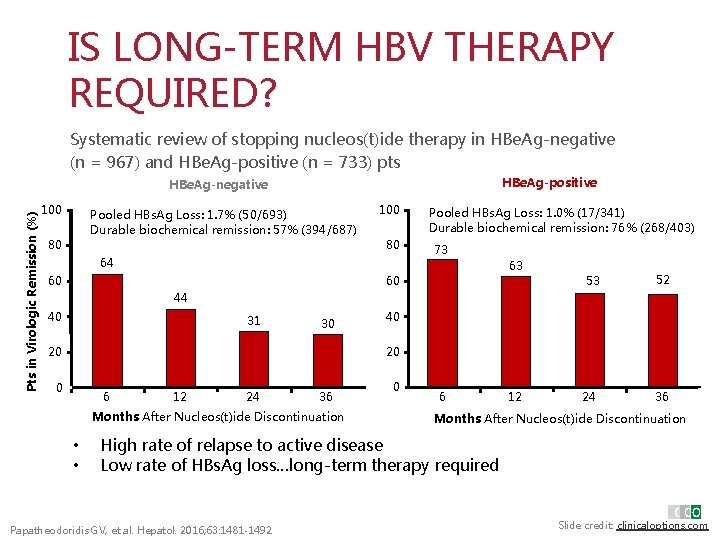
IS LONG-TERM HBV THERAPY REQUIRED? Systematic review of stopping nucleos(t)ide therapy in HBe. Ag-negative (n = 967) and HBe. Ag-positive (n = 733) pts HBe. Ag-positive Pts in Virologic Remission (%) HBe. Ag-negative 100 Pooled HBs. Ag Loss: 1. 7% (50/693) Durable biochemical remission: 57% (394/687) 80 100 80 64 Pooled HBs. Ag Loss: 1. 0% (17/341) Durable biochemical remission: 76% (268/403) 73 63 60 60 53 52 44 40 31 30 40 20 20 0 6 12 24 36 Months After Nucleos(t)ide Discontinuation • • 0 6 12 24 36 Months After Nucleos(t)ide Discontinuation High rate of relapse to active disease Low rate of HBs. Ag loss…long-term therapy required Papatheodoridis GV, et al. Hepatol. 2016; 63: 1481 -1492. Slide credit: clinicaloptions. com
![LONG-TERM ORAL HBV THERAPY IS HIGHLY EFFECTIVE • • • Suppresses HBV DNA[1, 2]](http://slidetodoc.com/presentation_image_h/b6f1f3519aa4a078e92992e2634a0a0f/image-14.jpg "LONG-TERM ORAL HBV THERAPY IS HIGHLY EFFECTIVE • • • Suppresses HBV DNA[1, 2]")
LONG-TERM ORAL HBV THERAPY IS HIGHLY EFFECTIVE • • • Suppresses HBV DNA[1, 2] Normalizes ALT[2, 3] Prevents fibrosis progression[3, 4] Promotes fibrosis regression, even in cirrhosis[4] Prevents and even reverses hepatic decompensation[1] • Reduces, but does not eliminate, the risk of HCC[1, 5] • Long-term therapy is effective. . . but low rates of HBs. Ag loss[6] 1. Lim YS, et al. Gastroenterology. 2014; 147: 152 -161. 2. Chang TT, et al. Hepatology. 2010; 51: 422 -430. 3. Zoutendijk R, et al. Gut. 2013; 62: 760 -765. 4. Marcellin P, et al. Lancet. 2013; 381: 468 -475. 5. Papatheodoridis GV, et al. J Hepatol. 2015; 62: 363 -370. 6. Papatheodoridis GV, et al. Hepatol. 2016; 63: 1481 -1492. Slide credit: clinicaloptions. com
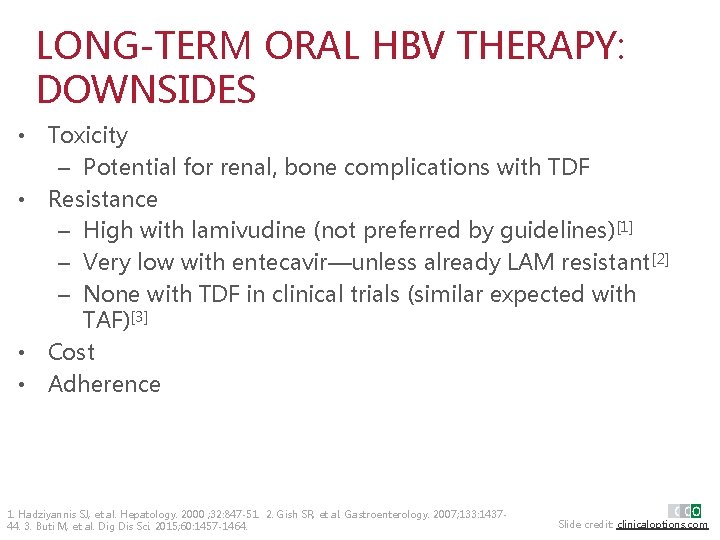
LONG-TERM ORAL HBV THERAPY: DOWNSIDES • Toxicity – Potential for renal, bone complications with TDF • Resistance – High with lamivudine (not preferred by guidelines)[1] – Very low with entecavir—unless already LAM resistant[2] – None with TDF in clinical trials (similar expected with TAF)[3] • Cost • Adherence 1. Hadziyannis SJ, et al. Hepatology. 2000 ; 32: 847 -51. 2. Gish SR, et al. Gastroenterology. 2007; 133: 143744. 3. Buti M, et al. Dig Dis Sci. 2015; 60: 1457 -1464. Slide credit: clinicaloptions. com

WHEN AND WHAT TO START
![GUIDELINES: WHEN TO START HBV THERAPY HBe. Ag Positive Guidelines AASLD[1] HBe. Ag Negative](http://slidetodoc.com/presentation_image_h/b6f1f3519aa4a078e92992e2634a0a0f/image-17.jpg "GUIDELINES: WHEN TO START HBV THERAPY HBe. Ag Positive Guidelines AASLD[1] HBe. Ag Negative")
GUIDELINES: WHEN TO START HBV THERAPY HBe. Ag Positive Guidelines AASLD[1] HBe. Ag Negative HBV DNA, IU/m. L ALT Liver Disease > 20, 000 ≥ 2 x ULN N/A ≥ 2000 ≥ 2 x ULN N/A N/A Cirrhosis Continue indefinitely in HBe. Ag-negative pts with cirrhosis 1. Terrault NA, et al. Hepatology. 2016; 63: 261 -283. Slide credit: clinicaloptions. com
![GUIDELINES: WHEN TO START HBV THERAPY HBe. Ag Positive Guidelines AASLD[1] EASL[2] HBe. Ag](http://slidetodoc.com/presentation_image_h/b6f1f3519aa4a078e92992e2634a0a0f/image-18.jpg "GUIDELINES: WHEN TO START HBV THERAPY HBe. Ag Positive Guidelines AASLD[1] EASL[2] HBe. Ag")
GUIDELINES: WHEN TO START HBV THERAPY HBe. Ag Positive Guidelines AASLD[1] EASL[2] HBe. Ag Negative HBV DNA, IU/m. L ALT Liver Disease > 20, 000 ≥ 2 x ULN N/A ≥ 2000 ≥ 2 x ULN N/A N/A Cirrhosis > 2000 > ULN* Moderate inflammation or fibrosis* > 20, 000 > 2 x ULN N/A *In pts with HBV DNA > 2000 IU/m. L, treatment indicated if ALT > ULN and/or at least moderate fibrosis. 1. Terrault NA, et al. Hepatology. 2016; 63: 261 -283. 2. EASL. J Hepatol. 2017; 67: 370 -398. Slide credit: clinicaloptions. com
![GUIDELINES: WHAT TO START AS INITIAL HBV THERAPY Treatment Preferred[1, 2] Notes Entecavir Yes](http://slidetodoc.com/presentation_image_h/b6f1f3519aa4a078e92992e2634a0a0f/image-19.jpg "GUIDELINES: WHAT TO START AS INITIAL HBV THERAPY Treatment Preferred[1, 2] Notes Entecavir Yes")
GUIDELINES: WHAT TO START AS INITIAL HBV THERAPY Treatment Preferred[1, 2] Notes Entecavir Yes High potency, high genetic barrier to resistance Tenofovir alafenamide* Yes High potency, high genetic barrier to resistance Tenofovir disoproxil fumarate† Yes High potency, high genetic barrier to resistance Peginterferon Should only be considered as initial therapy for pts with mild/moderate CHB or selected pts with compensated cirrhosis (no portal hypertension) Less safe in pts with cirrhosis, contraindicated in pts with decompensated cirrhosis Adefovir No Low genetic barrier to resistance Lamivudine No Low genetic barrier to resistance Telbivudine No Low genetic barrier to resistance *AASLD guidelines not yet updated since approval of TAF. †Pts receiving TDF: monitor renal function, consider monitoring BMD in pts at risk. [1] ETV, TDF, TAF have very favorable safety profiles [2] 1. Terrault NA, et al. Hepatology. 2016; 63: 261 -283. 2. EASL. J Hepatol. 2017; 67: 370 -398. Slide credit: clinicaloptions. com

CURRENT OPTIONS IN 2018
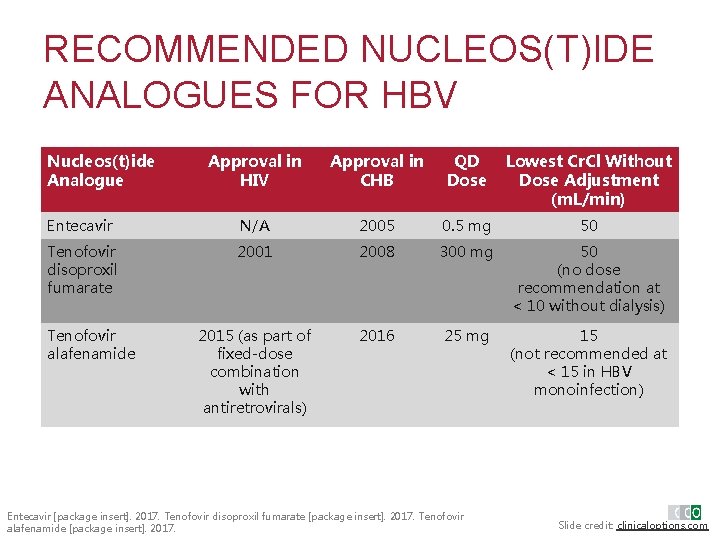
RECOMMENDED NUCLEOS(T)IDE ANALOGUES FOR HBV Nucleos(t)ide Analogue Approval in HIV Approval in CHB QD Dose Lowest Cr. Cl Without Dose Adjustment (m. L/min) Entecavir N/A 2005 0. 5 mg 50 Tenofovir disoproxil fumarate 2001 2008 300 mg 50 (no dose recommendation at < 10 without dialysis) 2015 (as part of fixed-dose combination with antiretrovirals) 2016 25 mg 15 (not recommended at < 15 in HBV monoinfection) Tenofovir alafenamide Entecavir [package insert]. 2017. Tenofovir disoproxil fumarate [package insert]. 2017. Tenofovir alafenamide [package insert]. 2017. Slide credit: clinicaloptions. com
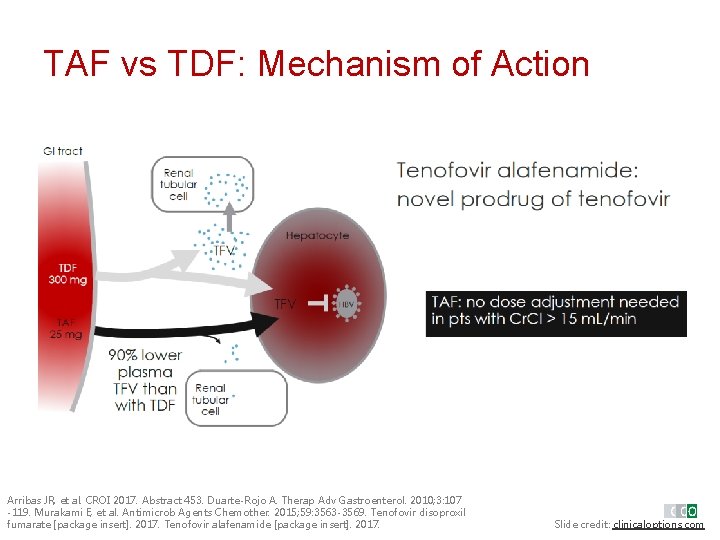
TAF vs TDF: Mechanism of Action Renal tubul ar cell Arribas JR, et al. CROI 2017. Abstract 453. Duarte-Rojo A. Therap Adv Gastroenterol. 2010; 3: 107 -119. Murakami E, et al. Antimicrob Agents Chemother. 2015; 59: 3563 -3569. Tenofovir disoproxil fumarate [package insert]. 2017. Tenofovir alafenamide [package insert]. 2017. Slide credit: clinicaloptions. com
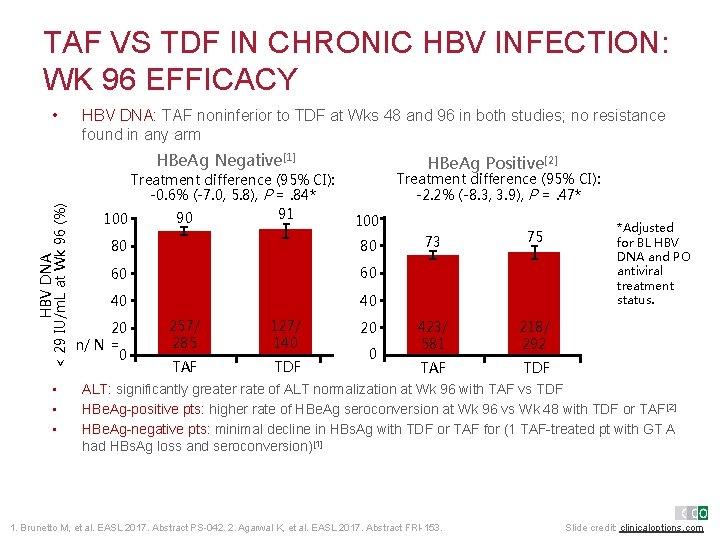
TAF VS TDF IN CHRONIC HBV INFECTION: WK 96 EFFICACY • HBV DNA: TAF noninferior to TDF at Wks 48 and 96 in both studies; no resistance found in any arm HBV DNA < 29 IU/m. L at Wk 96 (%) HBe. Ag Negative[1] • • • Treatment difference (95% CI): -0. 6% (-7. 0, 5. 8), P =. 84* 91 90 100 HBe. Ag Positive[2] Treatment difference (95% CI): -2. 2% (-8. 3, 3. 9), P =. 47* 100 80 80 60 60 40 40 20 n/ N = 0 257/ 285 127/ 140 TAF TDF 20 0 73 75 423/ 581 218/ 292 TAF TDF *Adjusted for BL HBV DNA and PO antiviral treatment status. ALT: significantly greater rate of ALT normalization at Wk 96 with TAF vs TDF HBe. Ag-positive pts: higher rate of HBe. Ag seroconversion at Wk 96 vs Wk 48 with TDF or TAF[2] HBe. Ag-negative pts: minimal decline in HBs. Ag with TDF or TAF for (1 TAF-treated pt with GT A had HBs. Ag loss and seroconversion)[1] 1. Brunetto M, et al. EASL 2017. Abstract PS-042. 2. Agarwal K, et al. EASL 2017. Abstract FRI-153. Slide credit: clinicaloptions. com
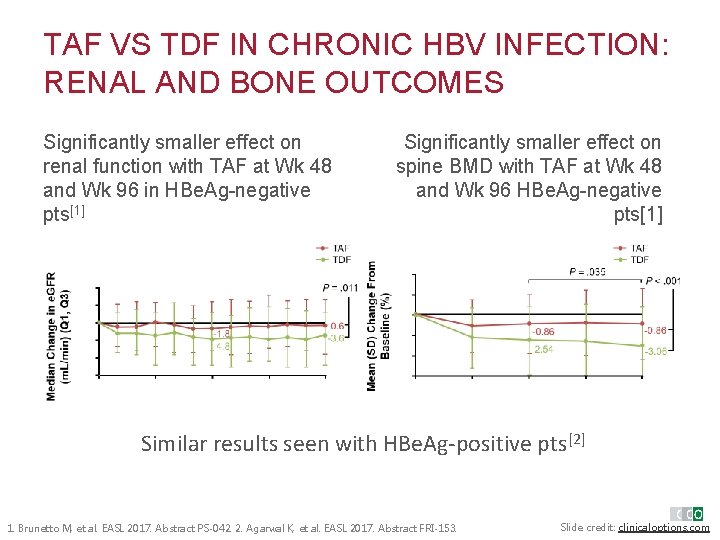
TAF VS TDF IN CHRONIC HBV INFECTION: RENAL AND BONE OUTCOMES Significantly smaller effect on renal function with TAF at Wk 48 and Wk 96 in HBe. Ag-negative pts[1] § Significantly smallereffect Significantly smaller on on spine withat. TAF spine BMDBMD with TAF Wk at 48 Wk and 96 HBe. Agand 48 Wk 96 Wk HBe. Ag-negative pts[1] Similar results seen with HBe. Ag-positive pts[2] 1. Brunetto M, et al. EASL 2017. Abstract PS-042. 2. Agarwal K, et al. EASL 2017. Abstract FRI-153. Slide credit: clinicaloptions. com
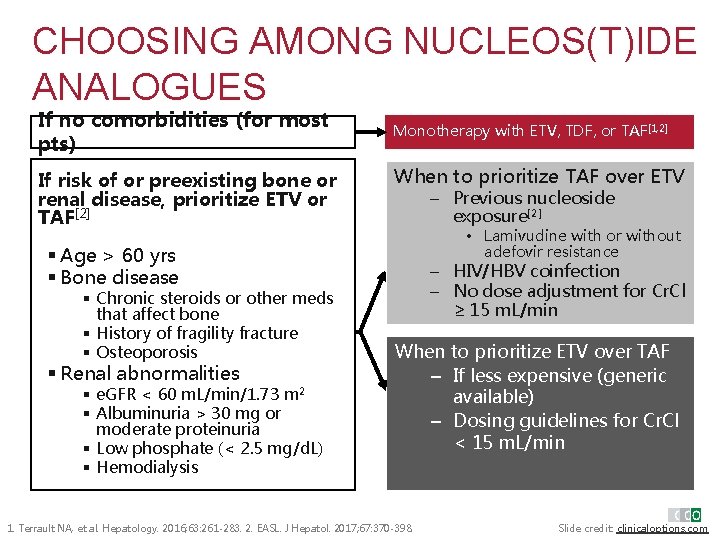
CHOOSING AMONG NUCLEOS(T)IDE ANALOGUES If no comorbidities (for most pts) If risk of or preexisting bone or renal disease, prioritize ETV or TAF[2] Monotherapy with ETV, TDF, or TAF[1, 2] When to prioritize TAF over ETV – Previous nucleoside exposure[2] • Lamivudine with or without adefovir resistance § Age > 60 yrs § Bone disease § Chronic steroids or other meds that affect bone § History of fragility fracture § Osteoporosis § Renal abnormalities § e. GFR < 60 m. L/min/1. 73 m 2 § Albuminuria > 30 mg or moderate proteinuria § Low phosphate (< 2. 5 mg/d. L) § Hemodialysis – HIV/HBV coinfection – No dose adjustment for Cr. Cl ≥ 15 m. L/min When to prioritize ETV over TAF – If less expensive (generic available) – Dosing guidelines for Cr. Cl < 15 m. L/min 1. Terrault NA, et al. Hepatology. 2016; 63: 261 -283. 2. EASL. J Hepatol. 2017; 67: 370 -398. Slide credit: clinicaloptions. com
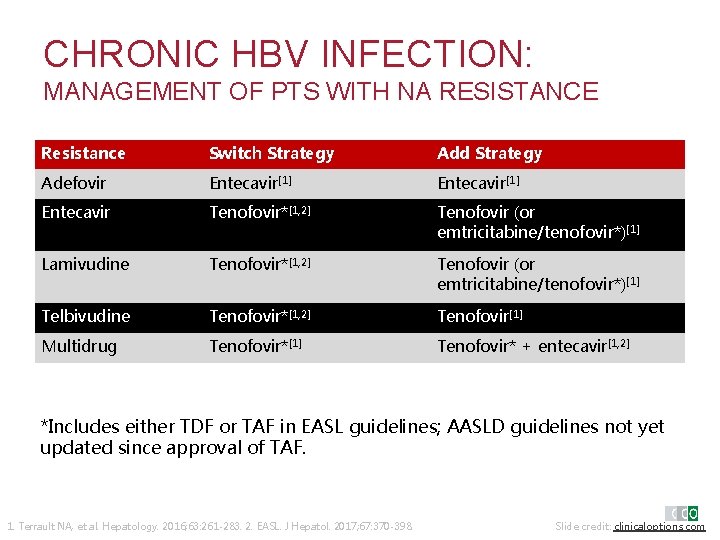
CHRONIC HBV INFECTION: MANAGEMENT OF PTS WITH NA RESISTANCE Resistance Switch Strategy Add Strategy Adefovir Entecavir[1] Entecavir Tenofovir*[1, 2] Tenofovir (or emtricitabine/tenofovir*)[1] Lamivudine Tenofovir*[1, 2] Tenofovir (or emtricitabine/tenofovir*)[1] Telbivudine Tenofovir*[1, 2] Tenofovir[1] Multidrug Tenofovir*[1] Tenofovir* + entecavir[1, 2] *Includes either TDF or TAF in EASL guidelines; AASLD guidelines not yet updated since approval of TAF. 1. Terrault NA, et al. Hepatology. 2016; 63: 261 -283. 2. EASL. J Hepatol. 2017; 67: 370 -398. Slide credit: clinicaloptions. com
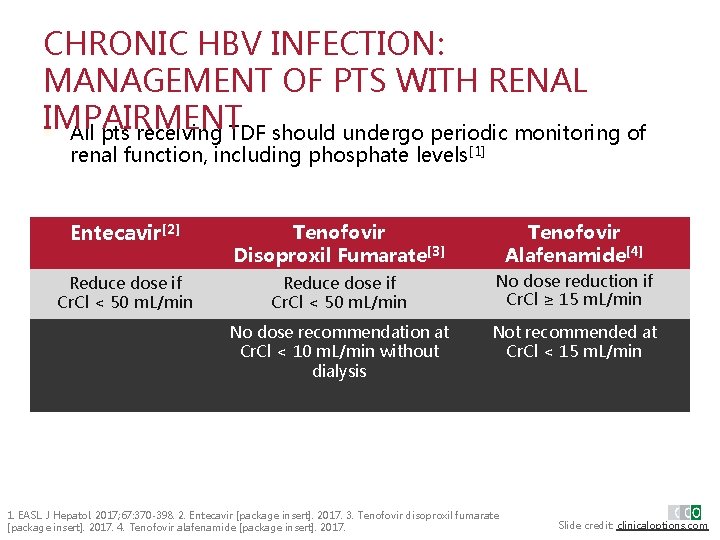
CHRONIC HBV INFECTION: MANAGEMENT OF PTS WITH RENAL IMPAIRMENT § All pts receiving TDF should undergo periodic monitoring of renal function, including phosphate levels[1] Entecavir[2] Tenofovir Disoproxil Fumarate[3] Tenofovir Alafenamide[4] Reduce dose if Cr. Cl < 50 m. L/min No dose reduction if Cr. Cl ≥ 15 m. L/min No dose recommendation at Cr. Cl < 10 m. L/min without dialysis Not recommended at Cr. Cl < 15 m. L/min 1. EASL. J Hepatol. 2017; 67: 370 -398. 2. Entecavir [package insert]. 2017. 3. Tenofovir disoproxil fumarate [package insert]. 2017. 4. Tenofovir alafenamide [package insert]. 2017. Slide credit: clinicaloptions. com
SHOULD PATIENTS RECEIVING TDF SWITCH TO TAF?
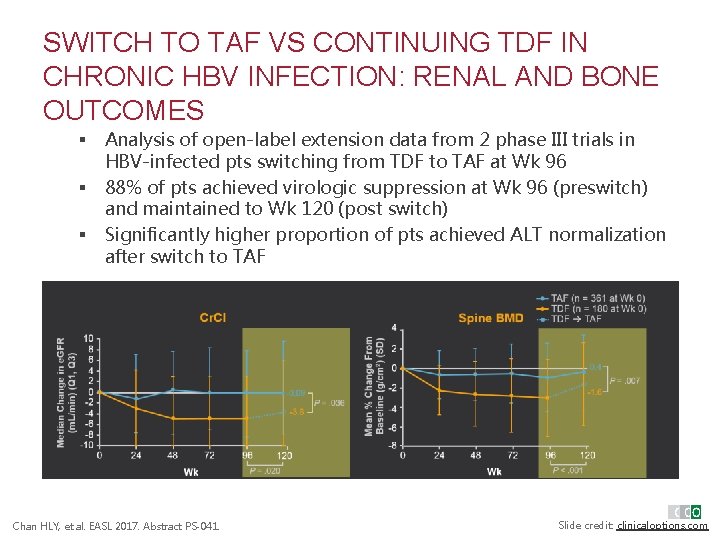
SWITCH TO TAF VS CONTINUING TDF IN CHRONIC HBV INFECTION: RENAL AND BONE OUTCOMES § § § Analysis of open-label extension data from 2 phase III trials in HBV-infected pts switching from TDF to TAF at Wk 96 88% of pts achieved virologic suppression at Wk 96 (preswitch) and maintained to Wk 120 (post switch) Significantly higher proportion of pts achieved ALT normalization after switch to TAF Chan HLY, et al. EASL 2017. Abstract PS-041. Slide credit: clinicaloptions. com
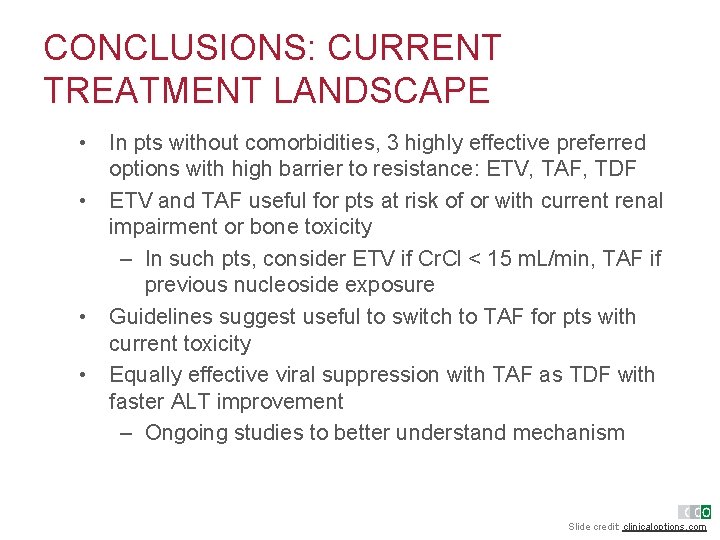
CONCLUSIONS: CURRENT TREATMENT LANDSCAPE • In pts without comorbidities, 3 highly effective preferred options with high barrier to resistance: ETV, TAF, TDF • ETV and TAF useful for pts at risk of or with current renal impairment or bone toxicity – In such pts, consider ETV if Cr. Cl < 15 m. L/min, TAF if previous nucleoside exposure • Guidelines suggest useful to switch to TAF for pts with current toxicity • Equally effective viral suppression with TAF as TDF with faster ALT improvement – Ongoing studies to better understand mechanism Slide credit: clinicaloptions. com
SUMMARY • NA therapy is highly effective but not curative – HBV DNA suppressed but low HBs. Ag loss • Long-term therapy required • For most pts: ETV, TAF or TDF similar – TAF has similar efficacy with improved renal and bone safety compared with TDF

MORE CCO COVERAGE OF HBV INFECTION AVAILABLE ONLINE Online Interactive Treatment Decision Tool on first-line treatment options CME-certified Interactive Virtual Presentation reviewing key data and insights Clinical. Thought Commentaries from expert faculty www. clinicaloptions. com/HBVlandscape
- Slides: 32