
Evolutionary History of Bird Feathers https en wikipedia
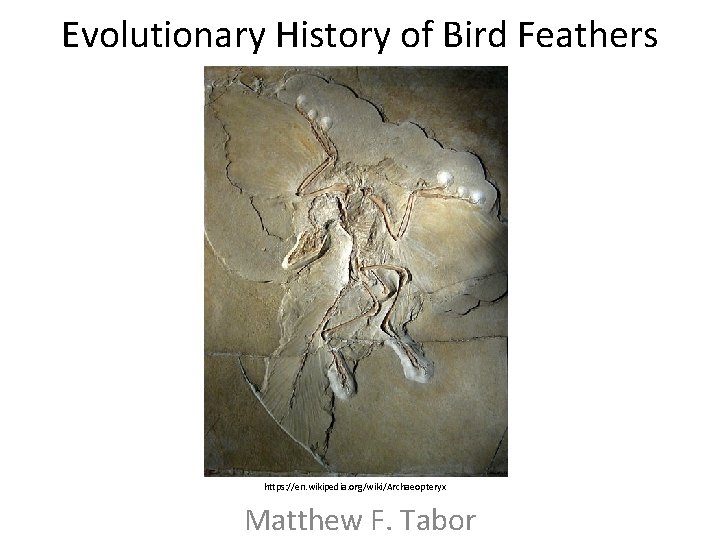
Evolutionary History of Bird Feathers https: //en. wikipedia. org/wiki/Archaeopteryx Matthew F. Tabor
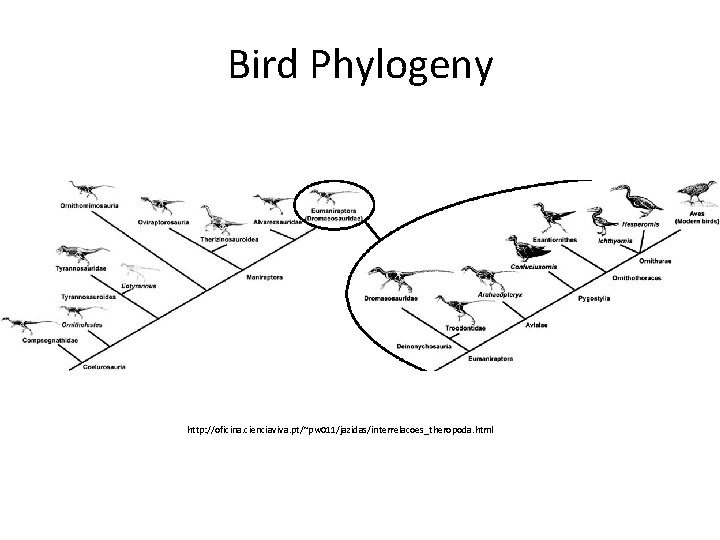
Bird Phylogeny http: //oficina. cienciaviva. pt/~pw 011/jazidas/interrelacoes_theropoda. html
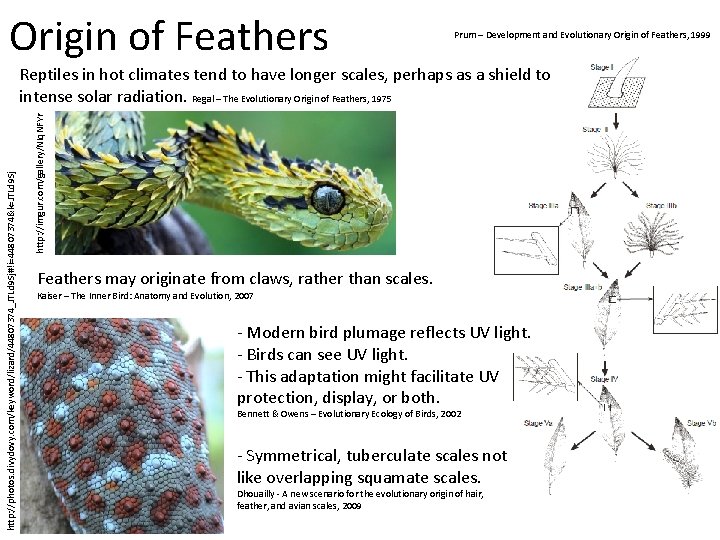
Origin of Feathers Prum – Development and Evolutionary Origin of Feathers, 1999 http: //imgur. com/gallery/NIq. NFYr http: //photos. divydovy. com/keyword/lizard/44807374_JTLd 9 Sj#!i=44807374&k=JTLd 9 Sj Reptiles in hot climates tend to have longer scales, perhaps as a shield to intense solar radiation. Regal – The Evolutionary Origin of Feathers, 1975 Feathers may originate from claws, rather than scales. Kaiser – The Inner Bird: Anatomy and Evolution, 2007 - Modern bird plumage reflects UV light. - Birds can see UV light. - This adaptation might facilitate UV protection, display, or both. Bennett & Owens – Evolutionary Ecology of Birds, 2002 - Symmetrical, tuberculate scales not like overlapping squamate scales. Dhouailly - A new scenario for the evolutionary origin of hair, feather, and avian scales, 2009
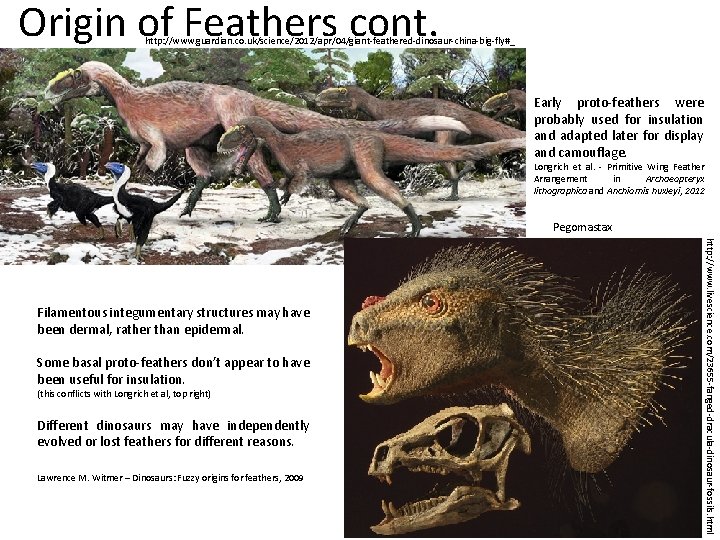
Origin of Feathers cont. http: //www. guardian. co. uk/science/2012/apr/04/giant-feathered-dinosaur-china-big-fly#_ Early proto-feathers were probably used for insulation and adapted later for display and camouflage. Longrich et al. - Primitive Wing Feather Arrangement in Archaeopteryx lithographica and Anchiornis huxleyi, 2012 Pegomastax Some basal proto-feathers don’t appear to have been useful for insulation. (this conflicts with Longrich et al, top right) Different dinosaurs may have independently evolved or lost feathers for different reasons. Lawrence M. Witmer – Dinosaurs: Fuzzy origins for feathers, 2009 http: //www. livescience. com/23655 -fanged-dracula-dinosaur-fossils. html Filamentous integumentary structures may have been dermal, rather than epidermal.
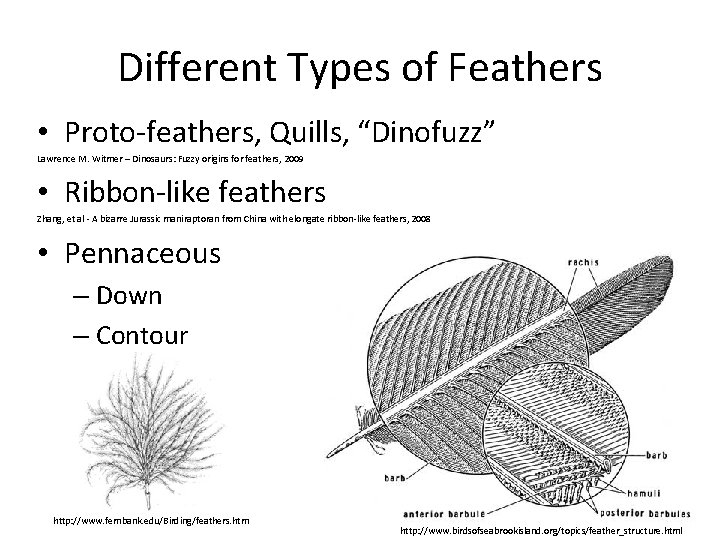
Different Types of Feathers • Proto-feathers, Quills, “Dinofuzz” Lawrence M. Witmer – Dinosaurs: Fuzzy origins for feathers, 2009 • Ribbon-like feathers Zhang, et al - A bizarre Jurassic maniraptoran from China with elongate ribbon-like feathers, 2008 • Pennaceous – Down – Contour http: //www. fernbank. edu/Birding/feathers. htm http: //www. birdsofseabrookisland. org/topics/feather_structure. html
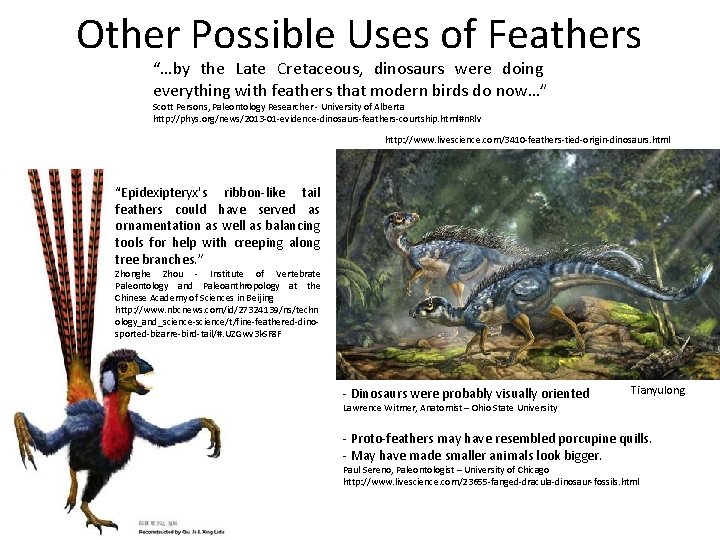
Other Possible Uses of Feathers “…by the Late Cretaceous, dinosaurs were doing everything with feathers that modern birds do now…” Scott Persons, Paleontology Researcher - University of Alberta http: //phys. org/news/2013 -01 -evidence-dinosaurs-feathers-courtship. html#n. Rlv http: //www. livescience. com/3410 -feathers-tied-origin-dinosaurs. html “Epidexipteryx's ribbon-like tail feathers could have served as ornamentation as well as balancing tools for help with creeping along tree branches. ” Zhonghe Zhou - Institute of Vertebrate Paleontology and Paleoanthropology at the Chinese Academy of Sciences in Beijing http: //www. nbcnews. com/id/27324139/ns/techn ology_and_science-science/t/fine-feathered-dinosported-bizarre-bird-tail/#. UZGwv 3 k. SF 8 F - Dinosaurs were probably visually oriented Tianyulong Lawrence Witmer, Anatomist – Ohio State University - Proto-feathers may have resembled porcupine quills. - May have made smaller animals look bigger. Paul Sereno, Paleontologist – University of Chicago http: //www. livescience. com/23655 -fanged-dracula-dinosaur-fossils. html
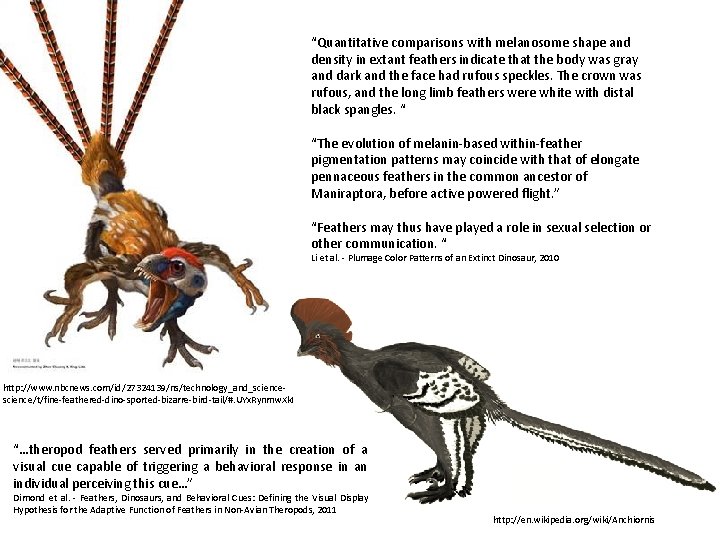
“Quantitative comparisons with melanosome shape and density in extant feathers indicate that the body was gray and dark and the face had rufous speckles. The crown was rufous, and the long limb feathers were white with distal black spangles. “ “The evolution of melanin-based within-feather pigmentation patterns may coincide with that of elongate pennaceous feathers in the common ancestor of Maniraptora, before active powered flight. ” “Feathers may thus have played a role in sexual selection or other communication. “ Li et al. - Plumage Color Patterns of an Extinct Dinosaur, 2010 http: //www. nbcnews. com/id/27324139/ns/technology_and_science/t/fine-feathered-dino-sported-bizarre-bird-tail/#. UYx. Rynmw. Xk. I “…theropod feathers served primarily in the creation of a visual cue capable of triggering a behavioral response in an individual perceiving this cue…” Dimond et al. - Feathers, Dinosaurs, and Behavioral Cues: Defining the Visual Display Hypothesis for the Adaptive Function of Feathers in Non-Avian Theropods, 2011 http: //en. wikipedia. org/wiki/Anchiornis
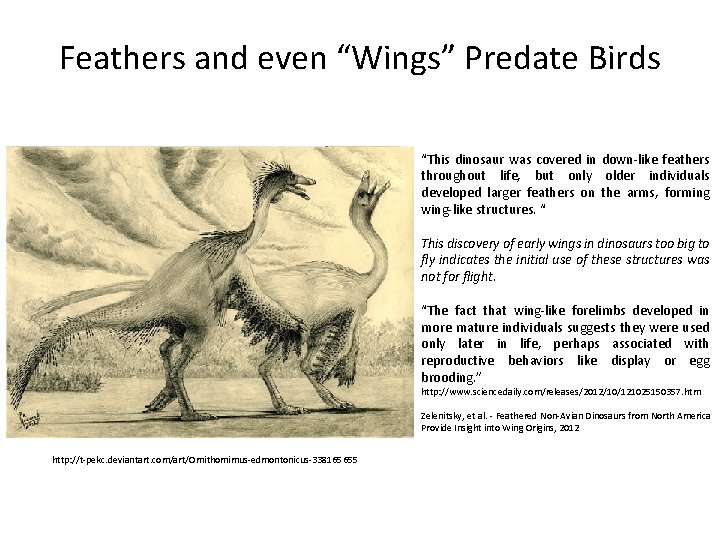
Feathers and even “Wings” Predate Birds “This dinosaur was covered in down-like feathers throughout life, but only older individuals developed larger feathers on the arms, forming wing-like structures. “ This discovery of early wings in dinosaurs too big to fly indicates the initial use of these structures was not for flight. “The fact that wing-like forelimbs developed in more mature individuals suggests they were used only later in life, perhaps associated with reproductive behaviors like display or egg brooding. ” http: //www. sciencedaily. com/releases/2012/10/121025150357. htm Zelenitsky, et al. - Feathered Non-Avian Dinosaurs from North America Provide Insight into Wing Origins, 2012 http: //t-pekc. deviantart. com/art/Ornithomimus-edmontonicus-338165655
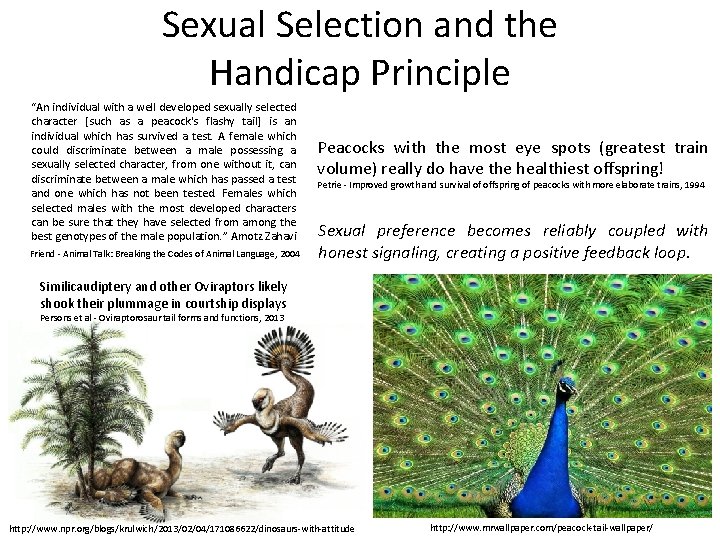
Sexual Selection and the Handicap Principle “An individual with a well developed sexually selected character [such as a peacock's flashy tail] is an individual which has survived a test. A female which could discriminate between a male possessing a sexually selected character, from one without it, can discriminate between a male which has passed a test and one which has not been tested. Females which selected males with the most developed characters can be sure that they have selected from among the best genotypes of the male population. ” Amotz Zahavi Friend - Animal Talk: Breaking the Codes of Animal Language, 2004 Peacocks with the most eye spots (greatest train volume) really do have the healthiest offspring! Petrie - Improved growth and survival of offspring of peacocks with more elaborate trains, 1994 Sexual preference becomes reliably coupled with honest signaling, creating a positive feedback loop. Similicaudiptery and other Oviraptors likely shook their plummage in courtship displays Persons et al - Oviraptorosaur tail forms and functions, 2013 http: //www. npr. org/blogs/krulwich/2013/02/04/171086622/dinosaurs-with-attitude http: //www. mrwallpaper. com/peacock-tail-wallpaper/
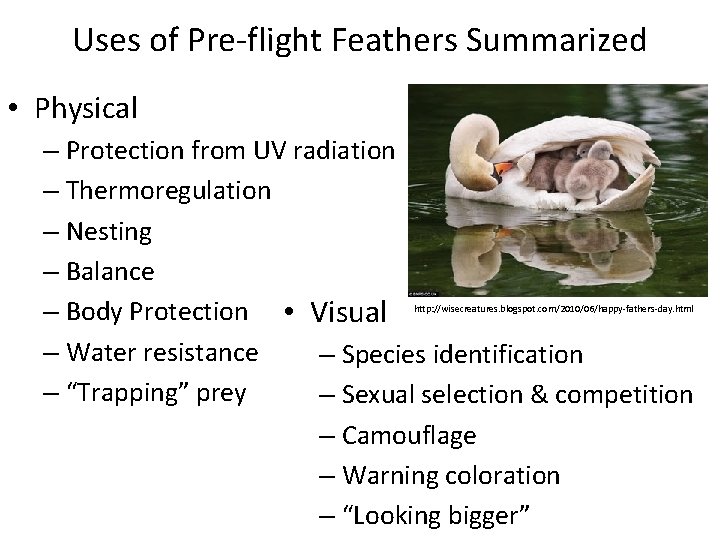
Uses of Pre-flight Feathers Summarized • Physical – Protection from UV radiation – Thermoregulation – Nesting – Balance – Body Protection • Visual – Water resistance – Species identification – “Trapping” prey – Sexual selection & competition – Camouflage – Warning coloration – “Looking bigger” http: //wisecreatures. blogspot. com/2010/06/happy-fathers-day. html
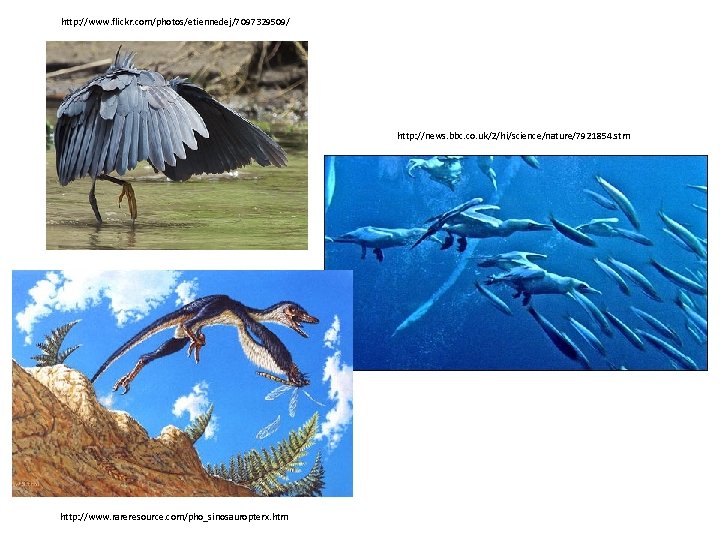
http: //www. flickr. com/photos/etiennedej/7097329509/ http: //news. bbc. co. uk/2/hi/science/nature/7921854. stm http: //www. rareresource. com/pho_sinosauropterx. htm
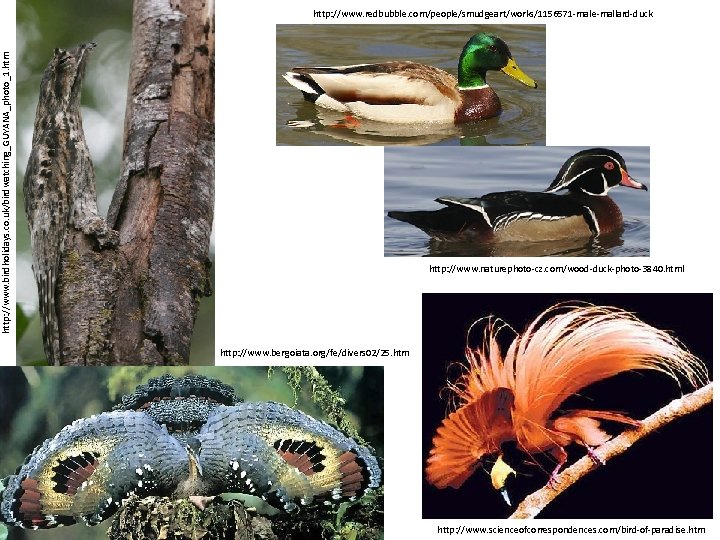
http: //www. birdholidays. co. uk/birdwatching_GUYANA_photo_1. htm http: //www. redbubble. com/people/smudgeart/works/1156571 -male-mallard-duck http: //www. naturephoto-cz. com/wood-duck-photo-3840. html http: //www. bergoiata. org/fe/divers 02/25. htm http: //www. scienceofcorrespondences. com/bird-of-paradise. htm
Conclusion • Multiple avian anatomical and behavioral characteristics predate flight by millions of years. • Flight was a bonus of avian evolution; not a “goal. ” • Multiple avian features were adaptations to selection pressures unrelated to flight, but were coopted to flight in late theropod evolution. • Only one of these clades survived the K-T extinction event and was ecologically released as modern birds. • Emergence of flight was multifactorial and cannot be reduced to a single simple model.
References • • • • Bennett & Owens (2002) Evolutionary Ecology of Birds. Oxford, NY: Oxford University Press Dhouailly (2009) A new scenario for the evolutionary origin of hair, feather, and avian scales. Journal of Anatomy, 214(4), 587– 606. doi: 10. 1111/j. 1469 -7580. 2008. 01041. x Dimond, Cabin & Brooks (2011) Feathers, Dinosaurs, and Behavioral Cues: Defining the Visual Display Hypothesis for the Adaptive Function of Feathers in Non-Avian Theropods. BIOS, 82(3), 58 -63: doi: 10. 1893/011. 082. 0302 Friend (2004) Animal Talk: Breaking the Codes of Animal Language. New York, NY: Free Press Kaiser (2007) The Inner Bird: Anatomy and Evolution. University of British Columbia Press Li, Gao, Vinther, Shawkey, Clarke, D’Alba, Meng, Briggs & Prum (2010) Plumage Color Patterns of an Extinct Dinosaur. Science, 327 (5971), 1369 -1372: doi: 10. 1126/science. 1186290 Longrich, Vinther, Meng, Li & Russell (2012) Primitive Wing Feather Arrangement in Archaeopteryx lithographica and Anchiornis huxleyi. Current Biology, 22, 1– 6: doi: 10. 1016/j. cub. 2012. 09. 052 Persons, Currie & Norell (2013) Oviraptorosaur tail forms and functions. Acta Palaeontologica Polonica, doi: 10. 4202/app. 2012. 0093 Petrie (1994) Improved growth and survival of offspring of peacocks with more elaborate trains. Nature, 371, 598 -599: doi: 10. 1038/371598 a 0 Prum (1999) Development and Evolutionary Origin of Feathers. Journal of Experimental Zoology (Molecular and Developmental Evolution), 285, 291 -306. Witmer (2009) Fuzzy origins for feathers. Nature, 458, 293 -295: doi: 10. 1038/458293 a Zelenitsky, Therrien, Erickson, De. Buhr, Kobayashi, Eberth, & Hadfield (2012) Feathered Non-Avian Dinosaurs from North America Provide Insight into Wing Origins. Science, 338, 510 -14: doi: 10. 1126/science. 1225376 Zhang, Zhou, Xu, Wang & Sullivan (2008) A bizarre Jurassic maniraptoran from China with elongate ribbon-like feathers. Nature, 455, 1105 -1108: doi: 10. 1038/nature 07447
- Slides: 14