
Evolutionary Game Theory Game classification 2 person discrete
- Slides: 17
Evolutionary Game Theory • Game classification • 2 -person discrete contests – General solution – Hawk-Dove-Bourgeouis • n-person, continuous strategy competitions
Game theory • Economic vs evolutionary game theory – Economic games are zero-sum, i. e. increasing the payoff to one player decreases the payoff to others. Evolutionary games need not be zero-sum. – Economic games use money as currency, evolutionary games use fitness. • Game solution is the best strategy – Social scientists require rational behavior, evolution requires natural selection – A pair of strategies which represent the best replies to each alternative is a Nash equilibrium.
What is an ESS? • Strategy = the behavioral response of an individual • ESS = a strategy which if adopted by all members of a population cannot be invaded by any alternative strategy • Game theory is needed when the fitness consequences of a behavior depend on what others are doing, i. e. is frequency dependent
Game classification • Strategy set – Discrete or continuous • Role symmetry – Symmetric vs asymmetric • Opponent number – 2 -person contests vs n-person scrambles • Sequential dependence – if outcomes of early decisions constrain later decisions, then the entire sequence is the game and each decision is a bout within the game. These are dynamic games.
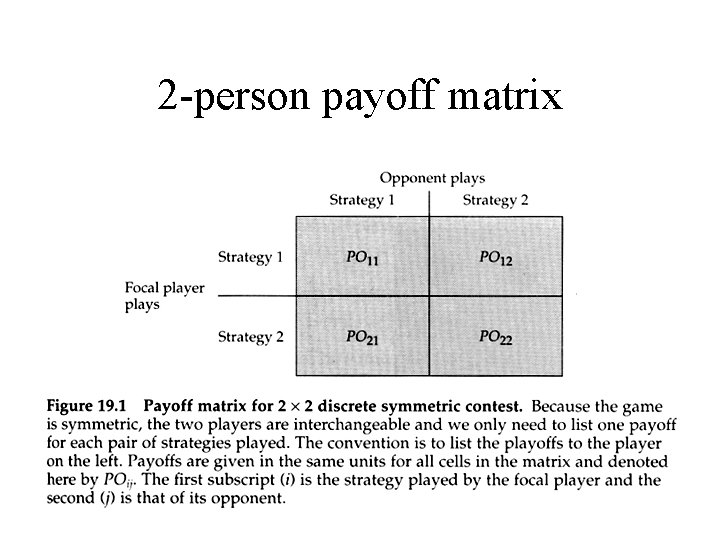
2 -person payoff matrix
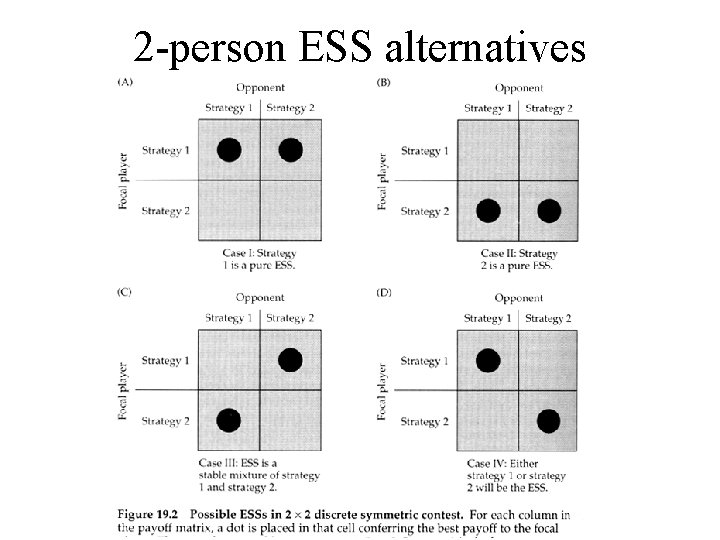
2 -person ESS alternatives
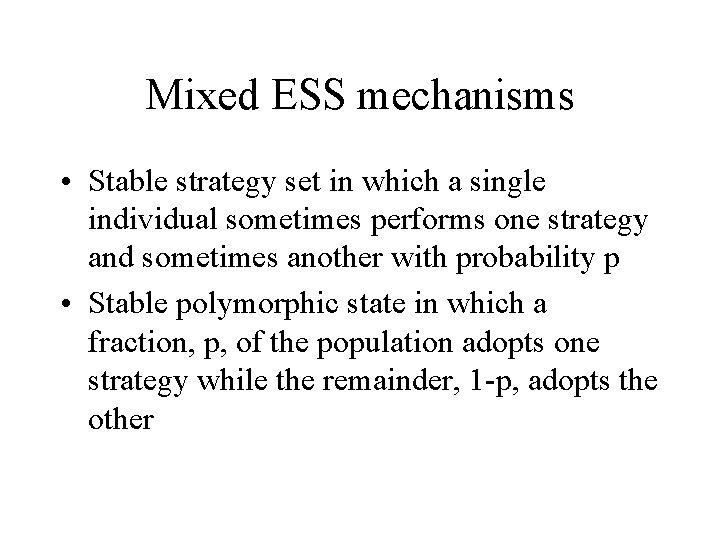
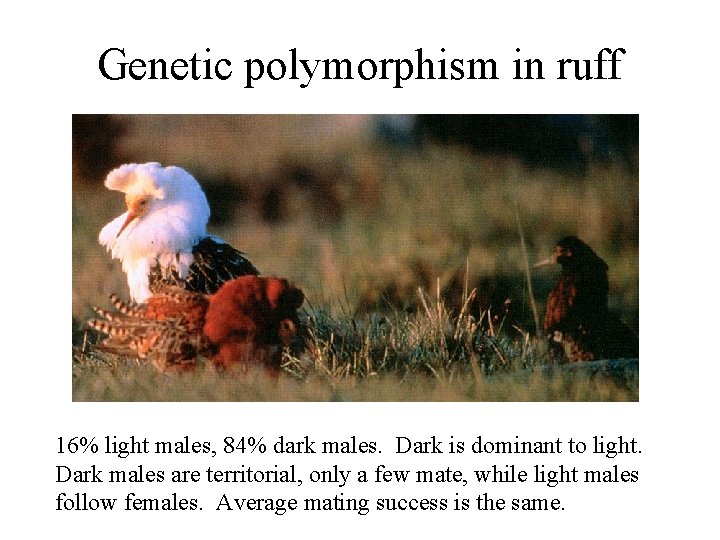
Mixed ESS mechanisms • Stable strategy set in which a single individual sometimes performs one strategy and sometimes another with probability p • Stable polymorphic state in which a fraction, p, of the population adopts one strategy while the remainder, 1 -p, adopts the other
Genetic polymorphism in ruff 16% light males, 84% dark males. Dark is dominant to light. Dark males are territorial, only a few mate, while light males follow females. Average mating success is the same.
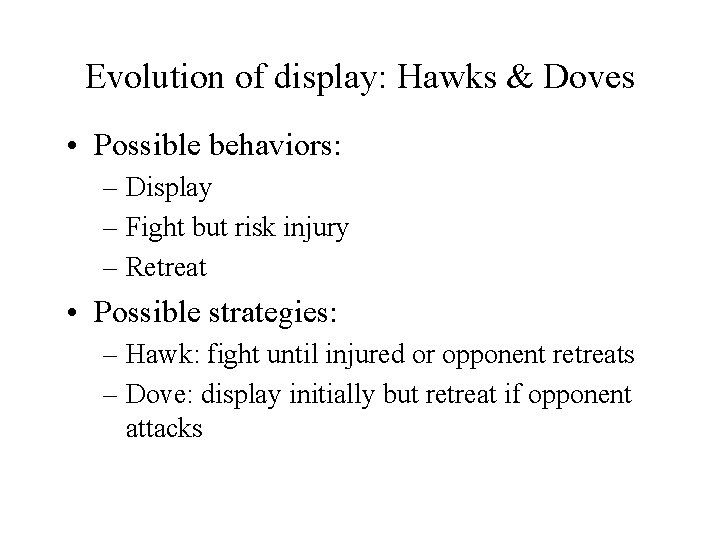
Evolution of display: Hawks & Doves • Possible behaviors: – Display – Fight but risk injury – Retreat • Possible strategies: – Hawk: fight until injured or opponent retreats – Dove: display initially but retreat if opponent attacks
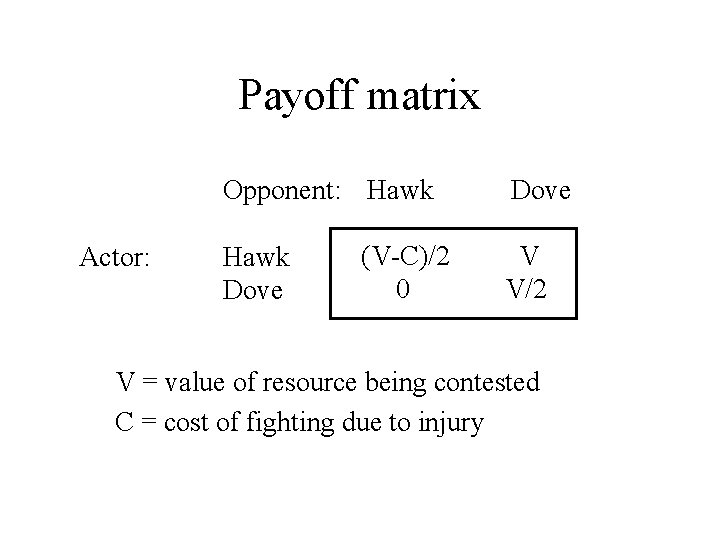
Payoff matrix Opponent: Hawk Actor: Hawk Dove (V-C)/2 0 Dove V V/2 V = value of resource being contested C = cost of fighting due to injury
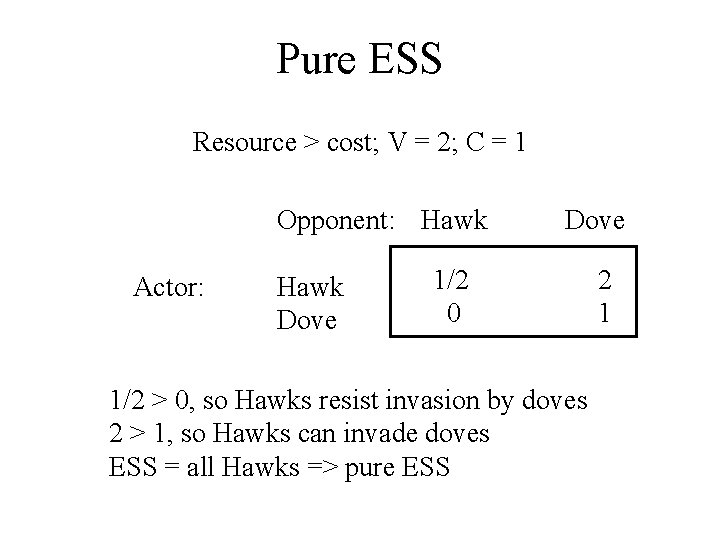
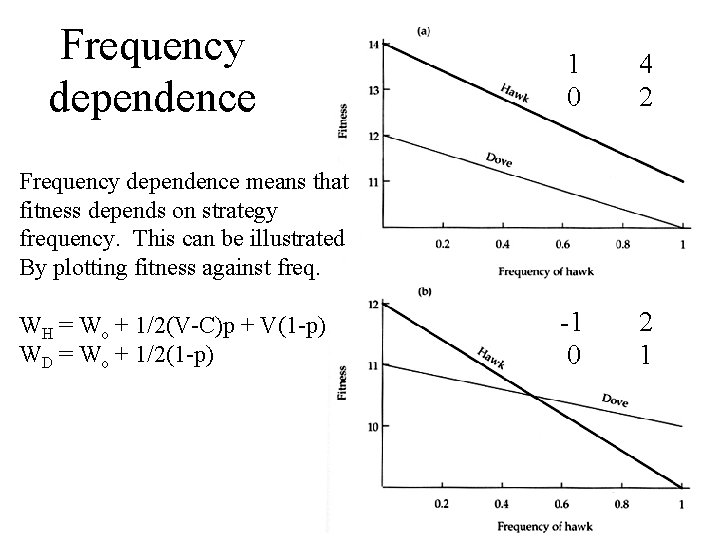
Pure ESS Resource > cost; V = 2; C = 1 Opponent: Hawk Actor: Hawk Dove 1/2 0 1/2 > 0, so Hawks resist invasion by doves 2 > 1, so Hawks can invade doves ESS = all Hawks => pure ESS 2 1
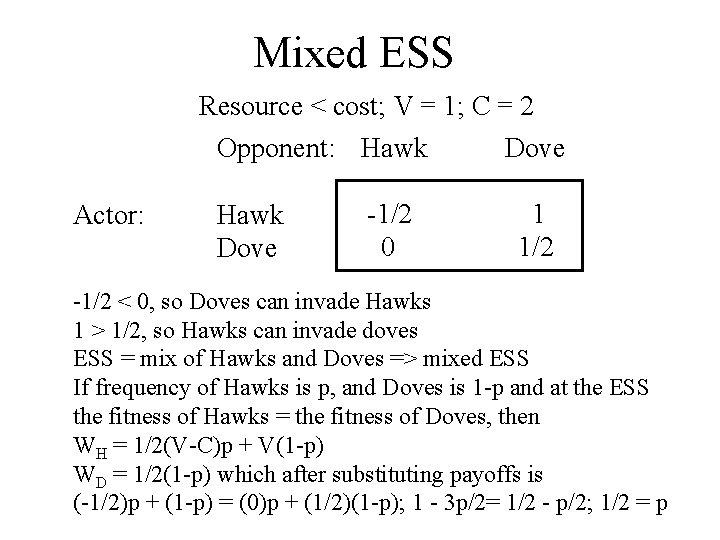
Mixed ESS Resource < cost; V = 1; C = 2 Opponent: Hawk Actor: Hawk Dove -1/2 0 Dove 1 1/2 -1/2 < 0, so Doves can invade Hawks 1 > 1/2, so Hawks can invade doves ESS = mix of Hawks and Doves => mixed ESS If frequency of Hawks is p, and Doves is 1 -p and at the ESS the fitness of Hawks = the fitness of Doves, then WH = 1/2(V-C)p + V(1 -p) WD = 1/2(1 -p) which after substituting payoffs is (-1/2)p + (1 -p) = (0)p + (1/2)(1 -p); 1 - 3 p/2= 1/2 - p/2; 1/2 = p
Frequency dependence 1 0 4 2 -1 0 2 1 Frequency dependence means that fitness depends on strategy frequency. This can be illustrated By plotting fitness against freq. WH = Wo + 1/2(V-C)p + V(1 -p) WD = Wo + 1/2(1 -p)
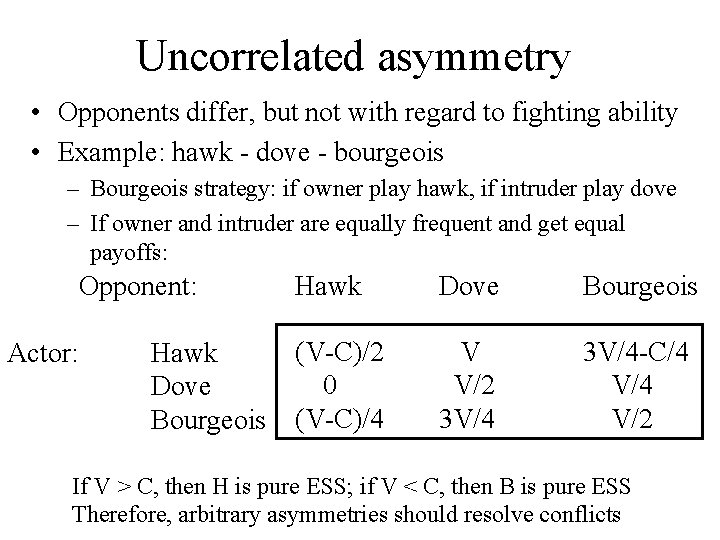
Uncorrelated asymmetry • Opponents differ, but not with regard to fighting ability • Example: hawk - dove - bourgeois – Bourgeois strategy: if owner play hawk, if intruder play dove – If owner and intruder are equally frequent and get equal payoffs: Opponent: Actor: Hawk Dove Bourgeois (V-C)/2 0 (V-C)/4 V V/2 3 V/4 -C/4 V/2 If V > C, then H is pure ESS; if V < C, then B is pure ESS Therefore, arbitrary asymmetries should resolve conflicts
Finding the ESS by simulations If you have a Mac computer, you can download the game theory Simulation from Keith Goodnight at http: //gsoft. smu. edu/GSoft. html
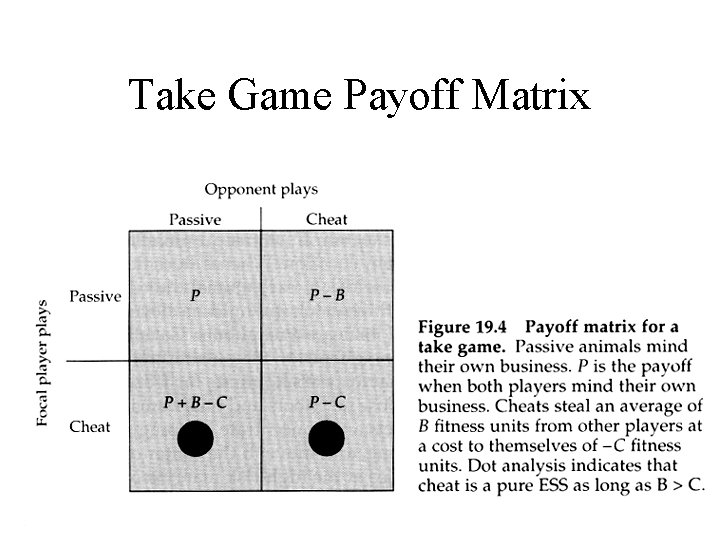
Take Game Payoff Matrix
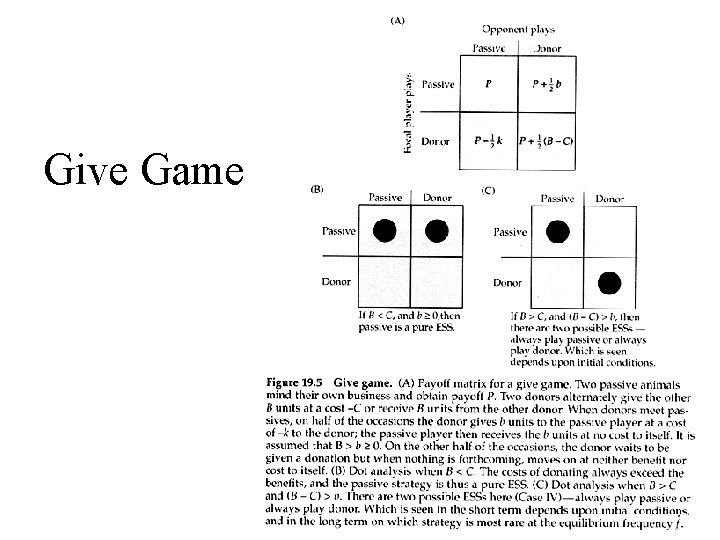
Give Game