
EVOLUTIONARY EVIDENCE and PATTERNS ARTIFICIAL SELECTION NATURAL SELECTION
- Slides: 19
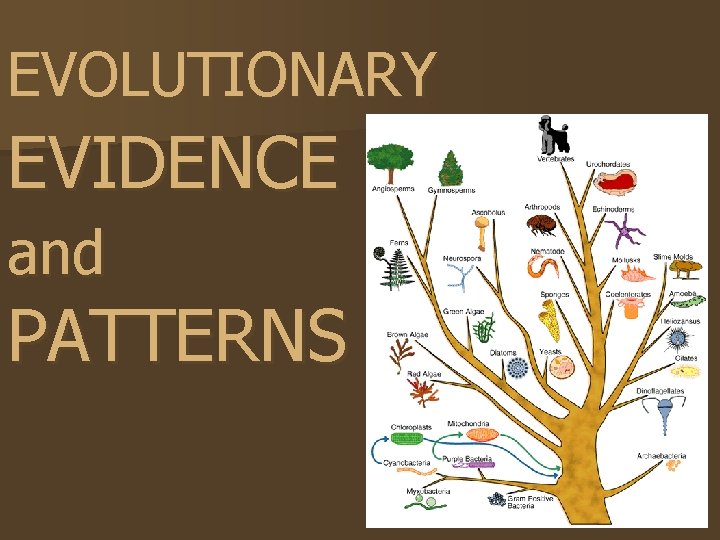
EVOLUTIONARY EVIDENCE and PATTERNS
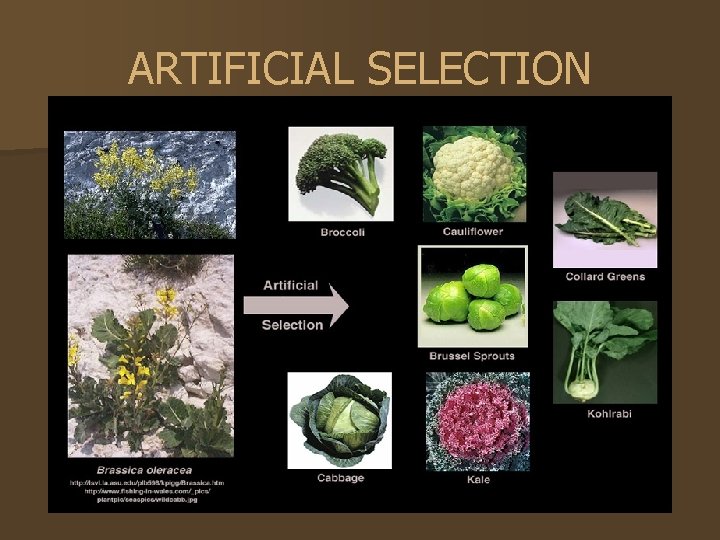
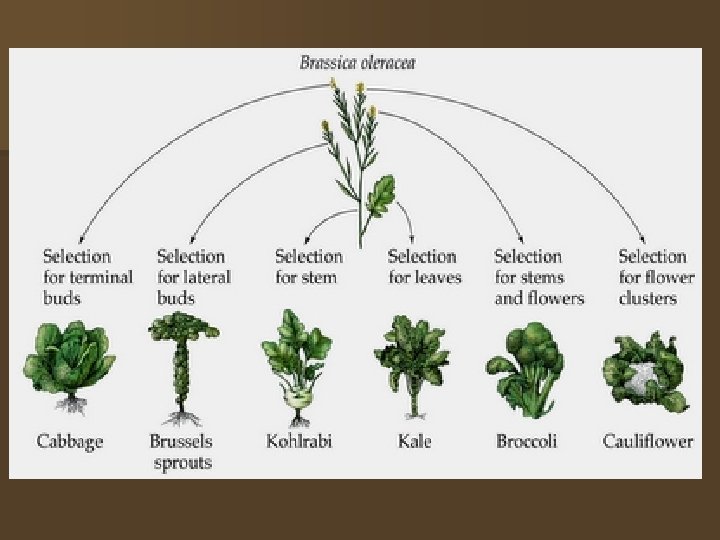
ARTIFICIAL SELECTION
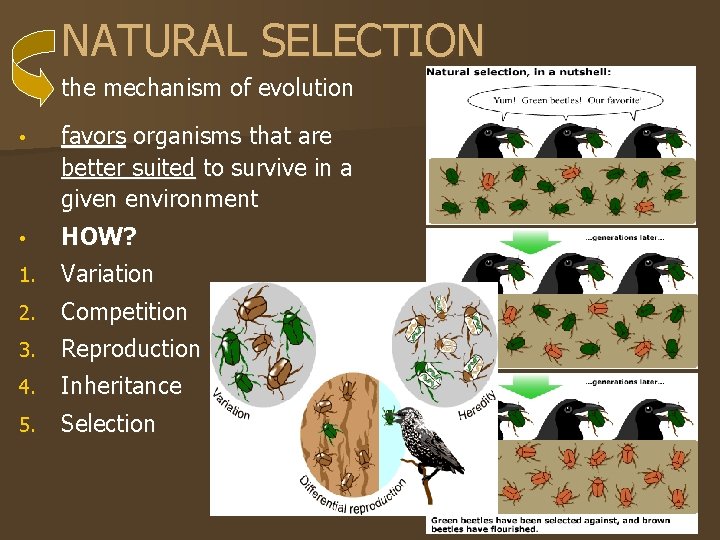
NATURAL SELECTION the mechanism of evolution • favors organisms that are better suited to survive in a given environment • HOW? 1. Variation 2. Competition 3. Reproduction 4. Inheritance 5. Selection
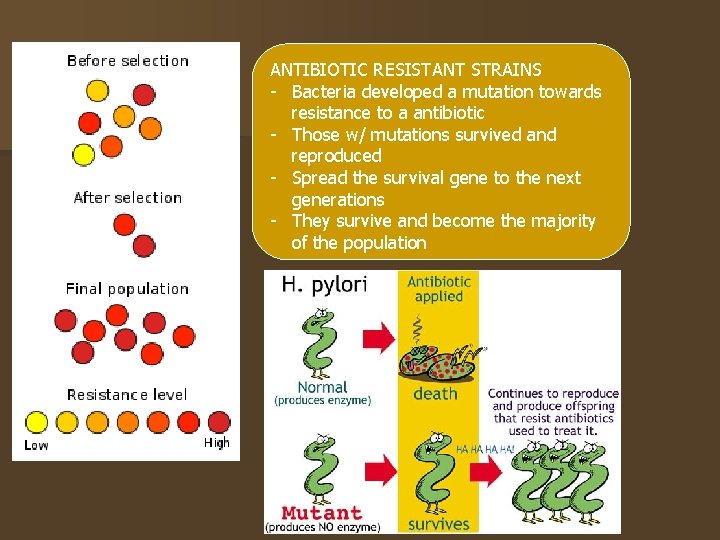
ANTIBIOTIC RESISTANT STRAINS - Bacteria developed a mutation towards resistance to a antibiotic - Those w/ mutations survived and reproduced - Spread the survival gene to the next generations - They survive and become the majority of the population
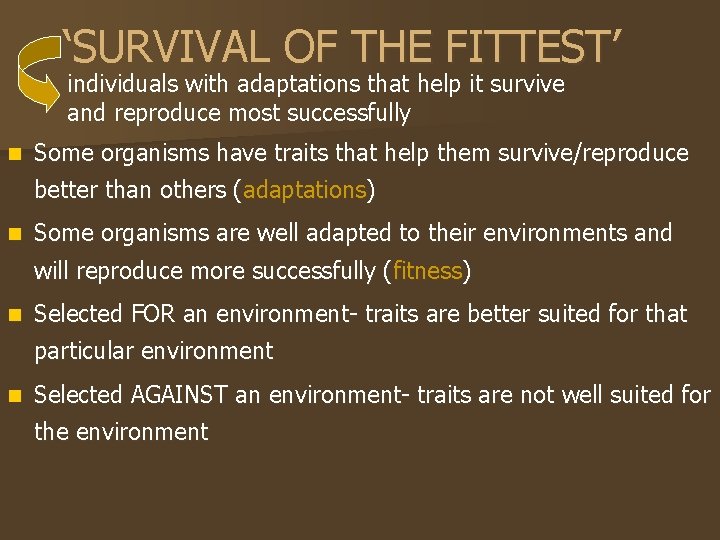
‘SURVIVAL OF THE FITTEST’ individuals with adaptations that help it survive and reproduce most successfully n Some organisms have traits that help them survive/reproduce better than others (adaptations) n Some organisms are well adapted to their environments and will reproduce more successfully (fitness) n Selected FOR an environment- traits are better suited for that particular environment n Selected AGAINST an environment- traits are not well suited for the environment
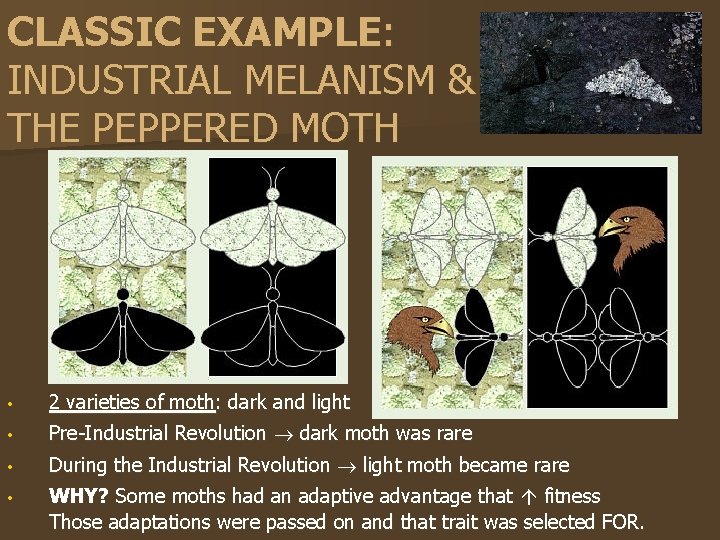
CLASSIC EXAMPLE: INDUSTRIAL MELANISM & THE PEPPERED MOTH • 2 varieties of moth: dark and light • Pre-Industrial Revolution dark moth was rare • During the Industrial Revolution light moth became rare • WHY? Some moths had an adaptive advantage that fitness Those adaptations were passed on and that trait was selected FOR.
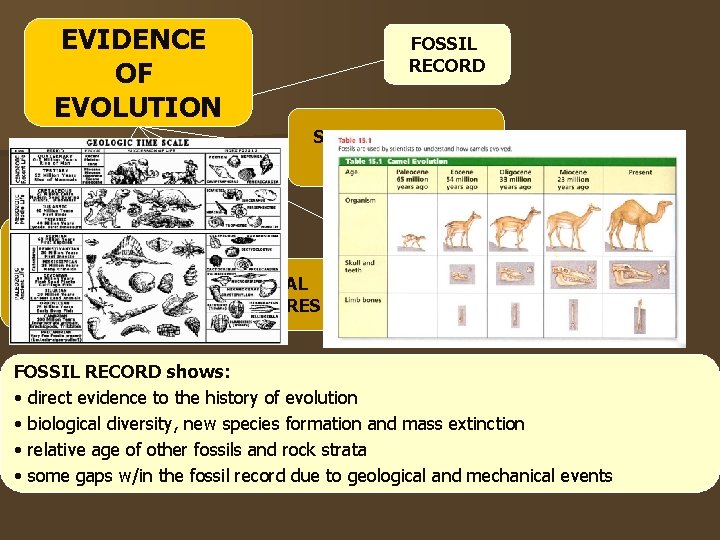
EVIDENCE OF EVOLUTION FOSSIL RECORD SIMILARITIES IN BIOCHEMISTRY EMBRYOLOGY HOMOLOGOUS & ANALOGOUS STRUCTURES VESTIGIAL STRUCTURES FOSSIL RECORD shows: • direct evidence to the history of evolution • biological diversity, new species formation and mass extinction • relative age of other fossils and rock strata • some gaps w/in the fossil record due to geological and mechanical events
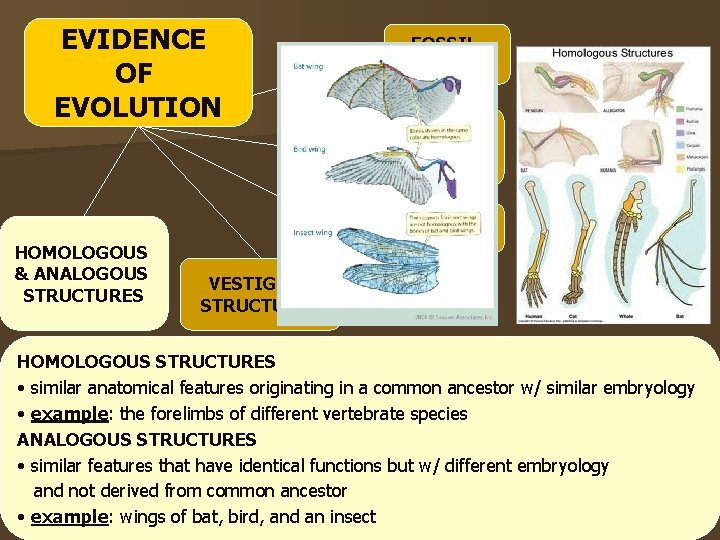
EVIDENCE OF EVOLUTION FOSSIL RECORD SIMILARITIES IN BIOCHEMISTRY EMBRYOLOGY HOMOLOGOUS & ANALOGOUS STRUCTURES VESTIGIAL STRUCTURES HOMOLOGOUS STRUCTURES • similar anatomical features originating in a common ancestor w/ similar embryology • similar features that originated in a common ancestor with similar embryology • example: the forelimbs of different vertebrate species ANALOGOUS STRUCTURES • similar features that have identical functions but w/ different embryology and not derived from common ancestor • example: wings of bat, bird, and an insect
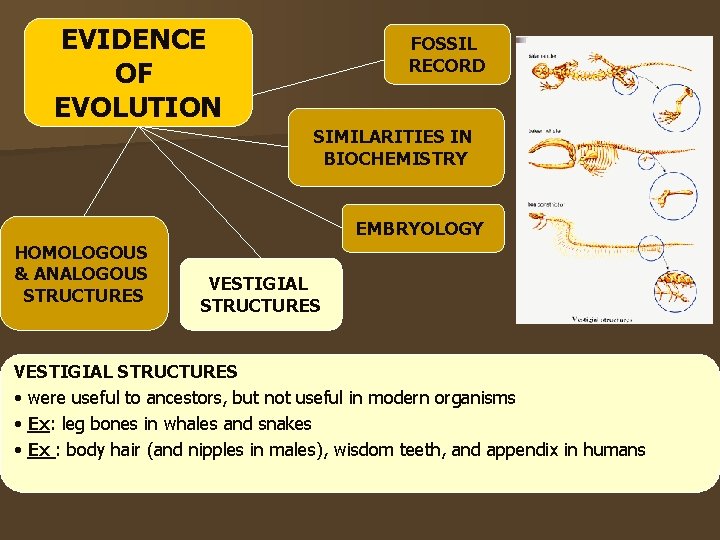
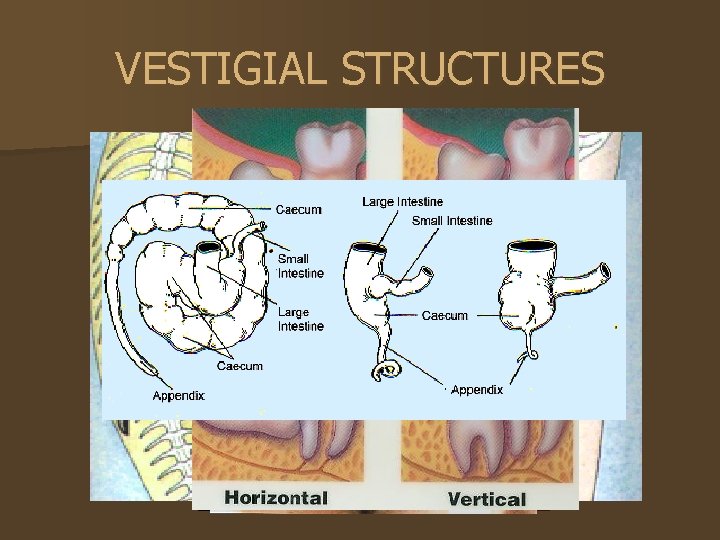
EVIDENCE OF EVOLUTION FOSSIL RECORD SIMILARITIES IN BIOCHEMISTRY EMBRYOLOGY HOMOLOGOUS & ANALOGOUS STRUCTURES VESTIGIAL STRUCTURES • were useful to ancestors, but not useful in modern organisms • Ex: leg bones in whales and snakes • Ex : body hair (and nipples in males), wisdom teeth, and appendix in humans
VESTIGIAL STRUCTURES
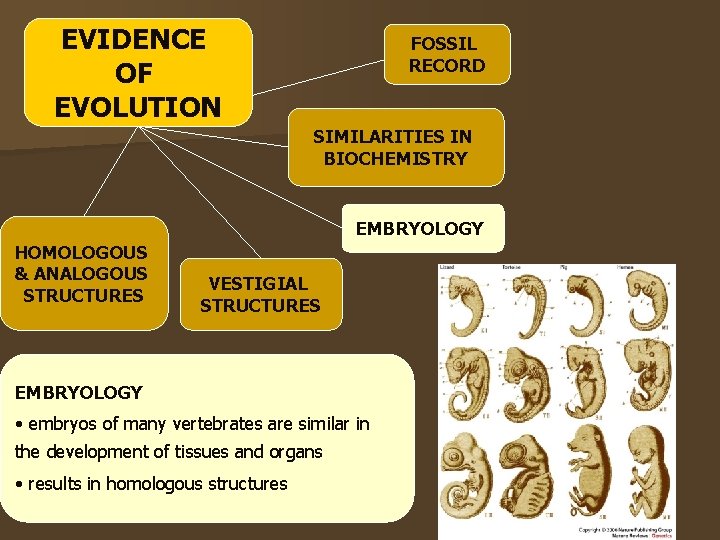
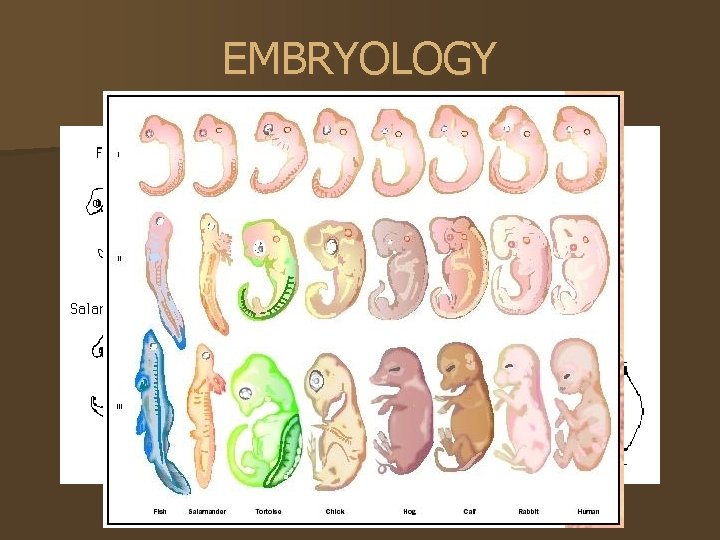
EVIDENCE OF EVOLUTION FOSSIL RECORD SIMILARITIES IN BIOCHEMISTRY EMBRYOLOGY HOMOLOGOUS & ANALOGOUS STRUCTURES VESTIGIAL STRUCTURES EMBRYOLOGY • embryos of many vertebrates are similar in the development of tissues and organs • results in homologous structures
EMBRYOLOGY
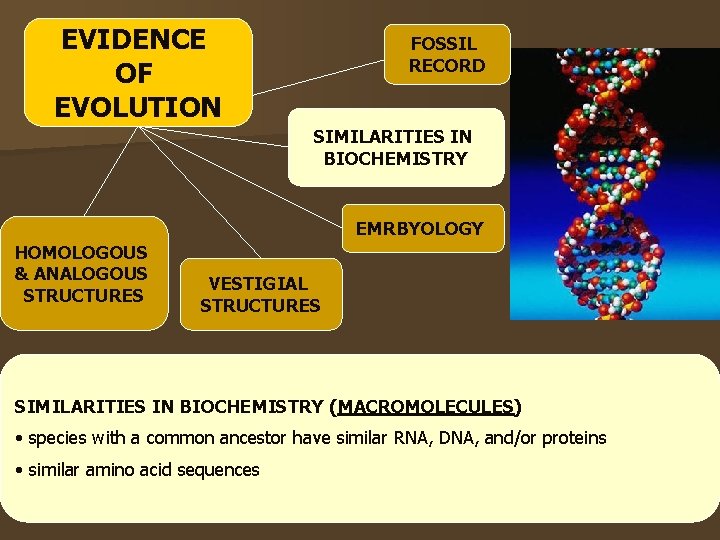
EVIDENCE OF EVOLUTION FOSSIL RECORD SIMILARITIES IN BIOCHEMISTRY EMRBYOLOGY HOMOLOGOUS & ANALOGOUS STRUCTURES VESTIGIAL STRUCTURES SIMILARITIES IN BIOCHEMISTRY (MACROMOLECULES) • species with a common ancestor have similar RNA, DNA, and/or proteins • similar amino acid sequences
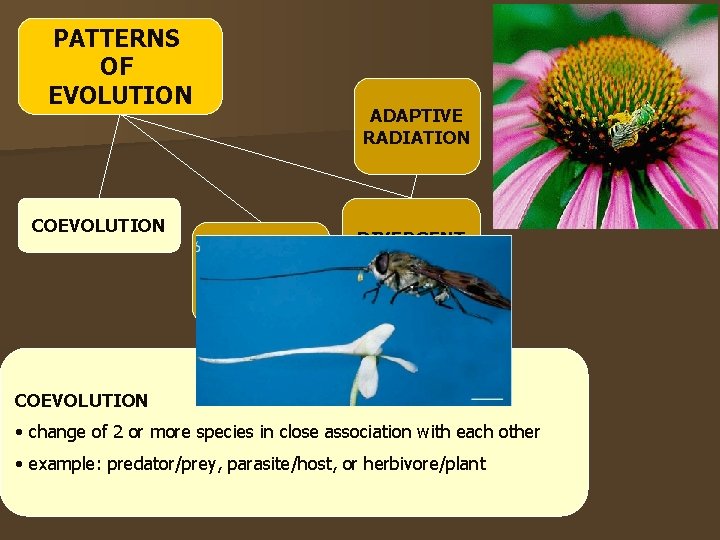
PATTERNS OF EVOLUTION ADAPTIVE RADIATION COEVOLUTION CONVERGENT EVOLUTION DIVERGENT EVOLUTION COEVOLUTION • change of 2 or more species in close association with each other • example: predator/prey, parasite/host, or herbivore/plant
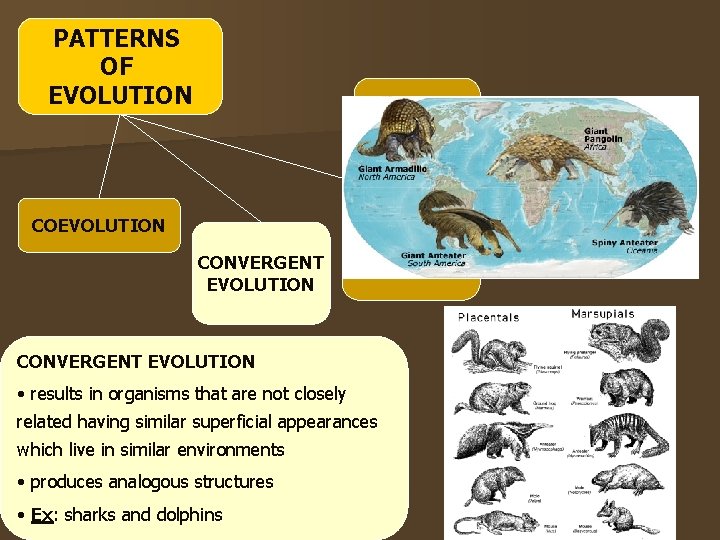
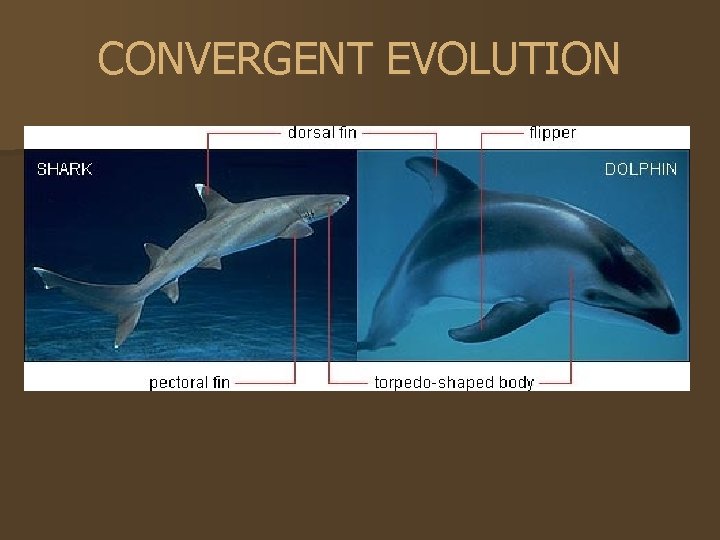
PATTERNS OF EVOLUTION ADAPTIVE RADIATION COEVOLUTION CONVERGENT EVOLUTION DIVERGENT EVOLUTION CONVERGENT EVOLUTION • results in organisms that are not closely related having similar superficial appearances which live in similar environments • produces analogous structures • Ex: sharks and dolphins
CONVERGENT EVOLUTION
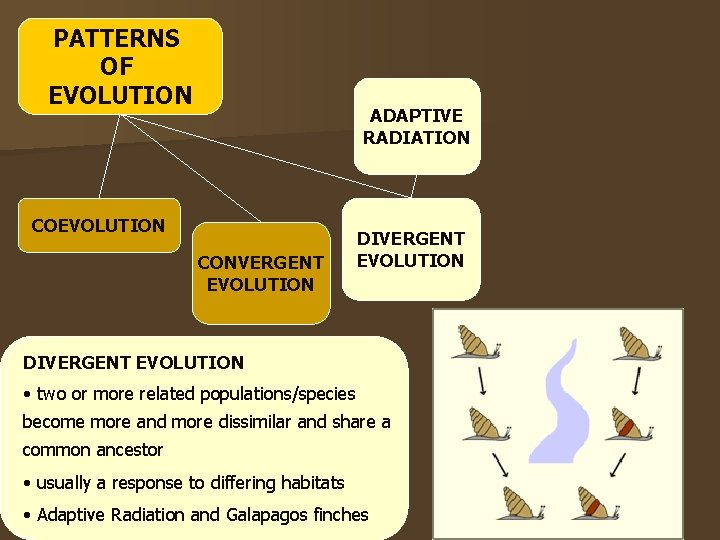
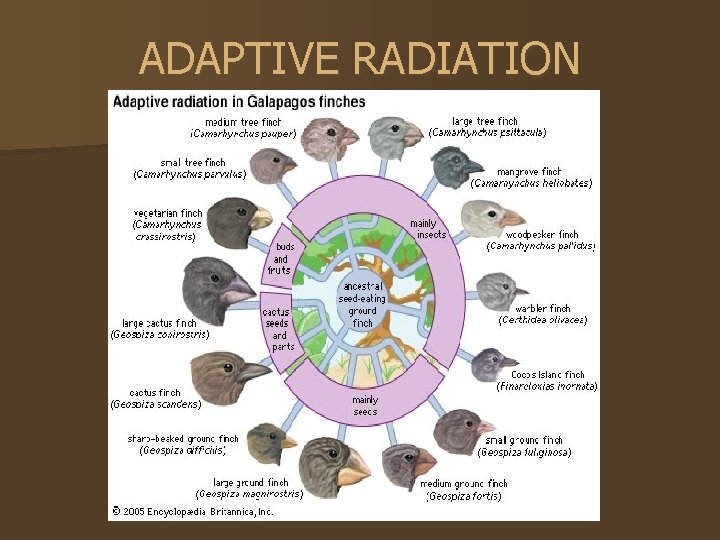
PATTERNS OF EVOLUTION ADAPTIVE RADIATION COEVOLUTION CONVERGENT EVOLUTION DIVERGENT EVOLUTION • two or more related populations/species become more and more dissimilar and share a become more and more dissimilar common ancestor • usually a response to differing habitats • Adaptive Radiation and Galapagos finches
ADAPTIVE RADIATION