
Evolutionary Computation Instructor Sushil Louis sushilcse unr edu

- Slides: 53
Evolutionary Computation Instructor: Sushil Louis, sushil@cse. unr. edu, http: //www. cse. unr. edu/~sushil
Syllabus • http: //www. cse. unr. edu/~sushil/ • Objectives: • Study evolutionary computing fundamentals: Genetic Algorithms, Evolution Strategies, Genetic Programming • Study applications • Investigate or develop project • Investigate interesting research problem (theory or application), publish research • Develop interesting software that solves a problem • Project report • Publish at a good research conference or journal – automatic A
Today • Problems and how to solve them • What problems are appropriate for EC? • What techniques can we use on such problems (other than EC? ) • What problems are not appropriate for EC approaches (later) • Introduction to EC • Assignment 0 • Missionaries and Cannibals • Black box hill climbing
Problems • Farmer, fox, goose, grain – cross a river • 30 digit combination lock • Shortest path, Traveling salesman • Truss design, turbine design, airplane wing design, airport gate scheduling, game tactics, battery design, fusion modeling, protein folding, …. • Make a spaces of possible solutions, search for solution • GA Applications • GA techniques for application classes • Niche: Poorly-understood problems
Combination lock • Farmer, fox, goose, grain • What is the search space? Size? • 30 digit combination lock • What is the search space? Size? • Approach: Search through the space of possible solutions until we find the actual solution • Possible solution generator, solution recognizer • Exhaustive search: BFS, DFS, … • There is a specific order for generating next solution • Randomized search: • No order • Either way: Time needed: |Search space size|/2. 0 • 10^30 * 0. 5
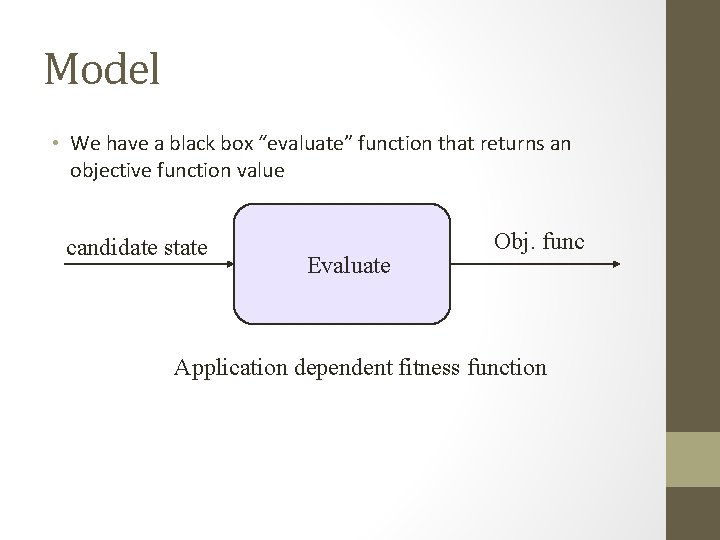
Model • We have a black box “evaluate” function that returns an objective function value candidate state Evaluate Obj. func Application dependent fitness function
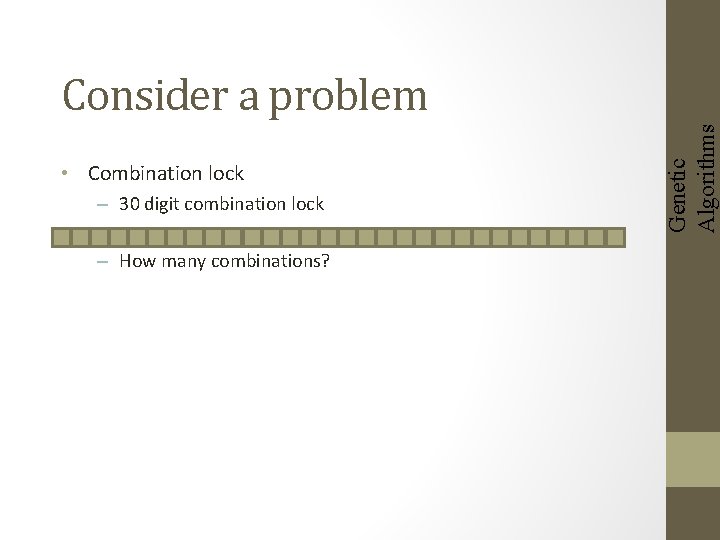
• Combination lock – 30 digit combination lock – How many combinations? Genetic Algorithms Consider a problem
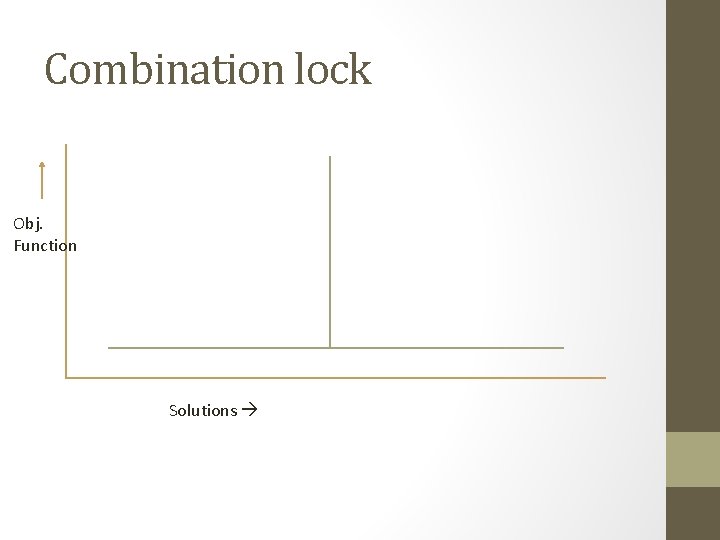
Generate and test 1. 2. Generate a candidate solution and test to see if it solves the problem Repeat • Information used by this algorithm • You know when you have found the solution • No candidate solution is better than another EXCEPT for the correct combination
Combination lock Obj. Function Solutions
• Exhaustive Search – How many must you try before p(success)>0. 5 ? – How long will this take? – Will you eventually open the lock? – Random Search – Same! – RES Random or Exhaustive Search Genetic Algorithms Generate and Test is Search
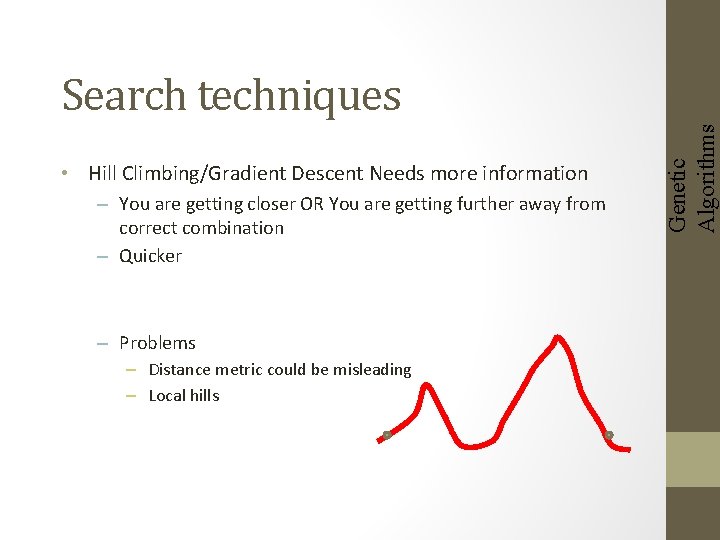
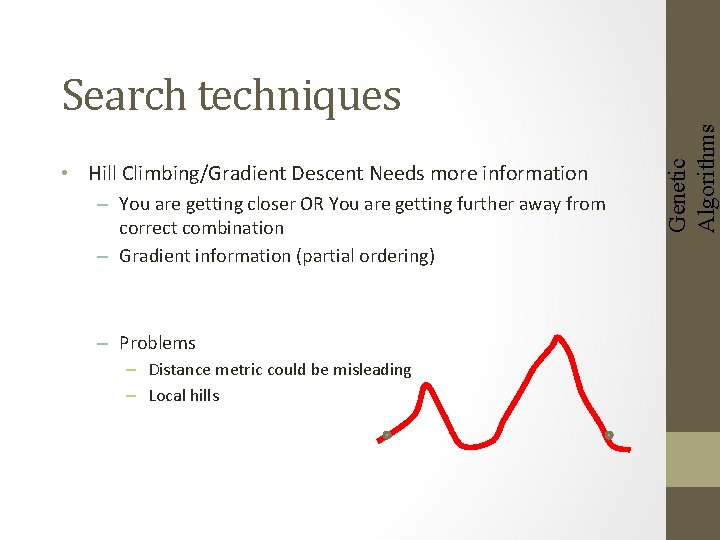
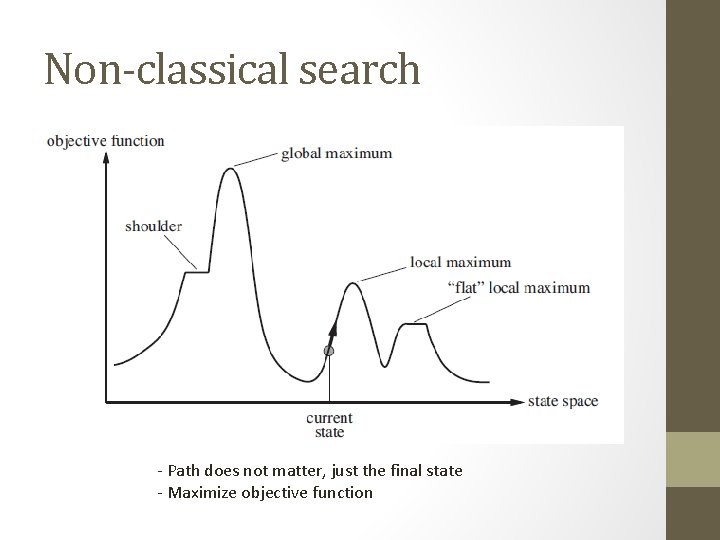
• Hill Climbing/Gradient Descent Needs more information – You are getting closer OR You are getting further away from correct combination – Quicker – Problems – Distance metric could be misleading – Local hills Genetic Algorithms Search techniques
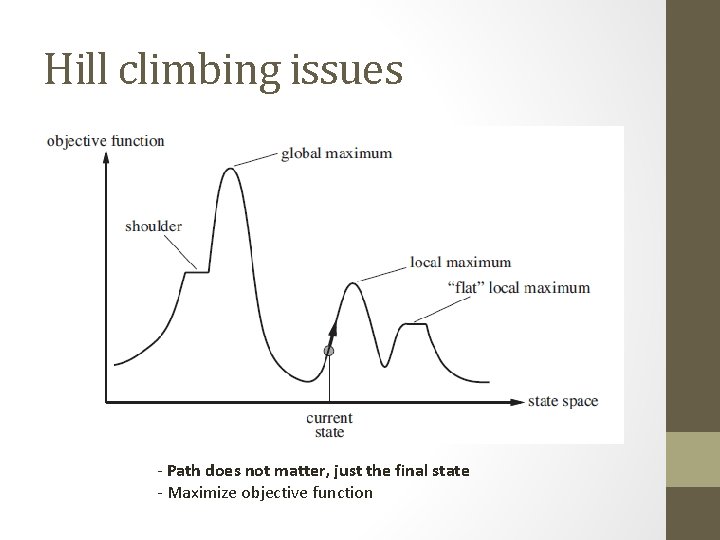
Hill climbing issues - Path does not matter, just the final state - Maximize objective function
Search as a solution to hard problems • Strategy: generate a potential solution and see if it solves the problem • Make use of information available to guide the generation of potential solutions • How much information is available? • Very little: We know the solution when we find it • Lots: linear, continuous, … • A little: Compare two solutions and tell which is “better”
Search tradeoff • Very little information for search implies we have no algorithm other than RES. We have to explore the space thoroughly since there is no other information to exploit • Lots of information (linear, continuous, …) means that we can exploit this information to arrive directly at a solution, without any exploration • Little information (partial ordering) implies that we need to use this information to tradeoff exploration of the search space versus exploiting the information to concentrate search in promising areas
Exploration vs Exploitation • More exploration means • Better chance of finding solution (more robust) • Takes longer • Versus • More exploitation means • Less chance of finding solution, better chance of getting stuck in a local optimum • Takes less time
Choosing a search algorithm • The amount of information available about a problem influences our choice of search algorithm and how we tune this algorithm • How does a search algorithm balance exploration of a search space against exploitation of (possibly misleading) information about the search space? • What assumptions is the algorithm making?
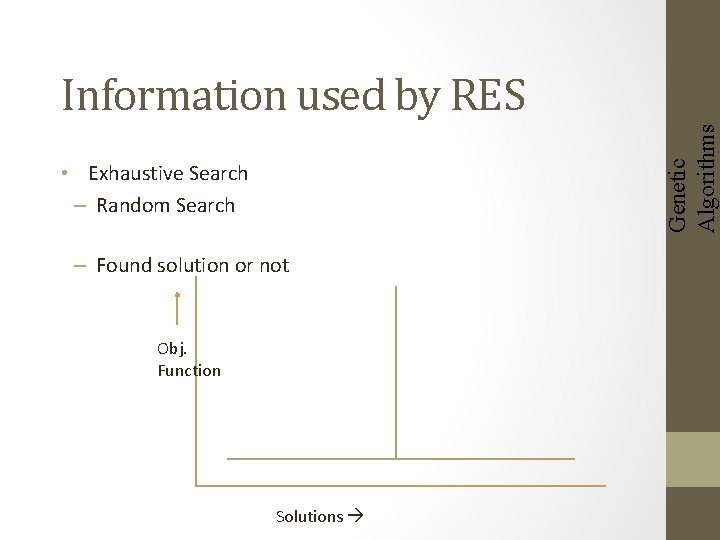
Genetic Algorithms Information used by RES • Exhaustive Search – Random Search – Found solution or not Obj. Function Solutions
• Hill Climbing/Gradient Descent Needs more information – You are getting closer OR You are getting further away from correct combination – Gradient information (partial ordering) – Problems – Distance metric could be misleading – Local hills Genetic Algorithms Search techniques
• Parallel hillclimbing – Everyone has a different starting point – Perhaps not everyone will be stuck at a local optima – More robust, perhaps quicker Genetic Algorithms Search techniques
• Parallel hillclimbing with information exchange among candidate solutions • Population of candidate solutions • Crossover for information exchange • Good across a variety of problem domains Genetic Algorithms
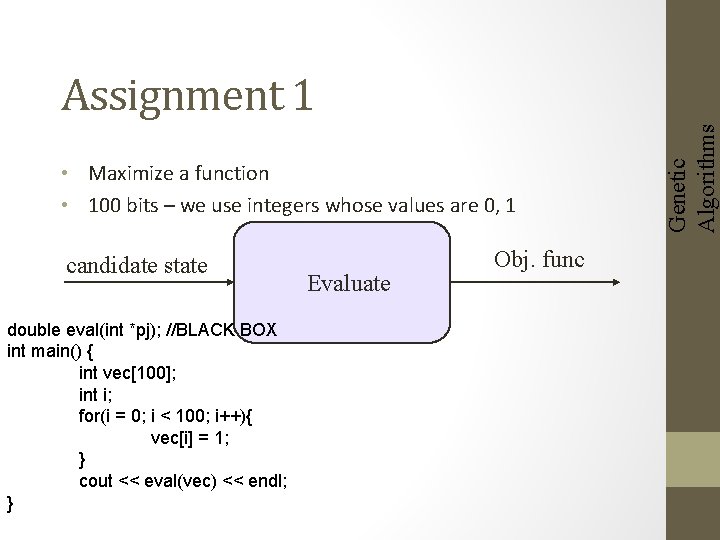
• Maximize a function • 100 bits – we use integers whose values are 0, 1 candidate state double eval(int *pj); //BLACK BOX int main() { int vec[100]; int i; for(i = 0; i < 100; i++){ vec[i] = 1; } cout << eval(vec) << endl; } Evaluate Obj. func Genetic Algorithms Assignment 1
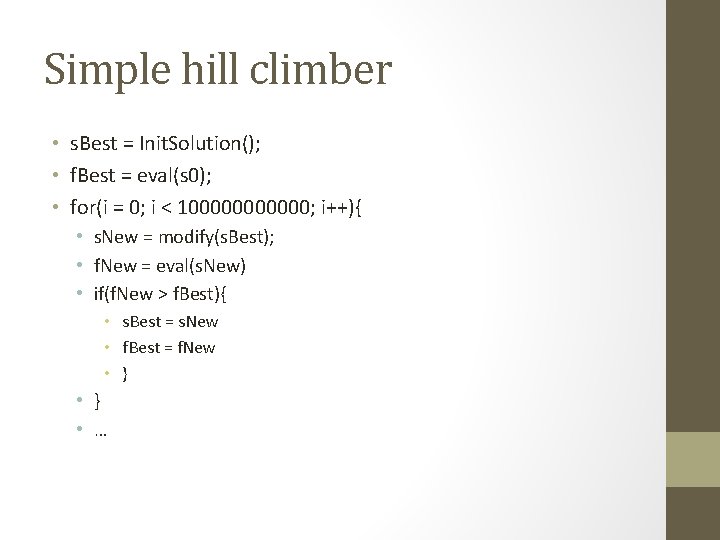
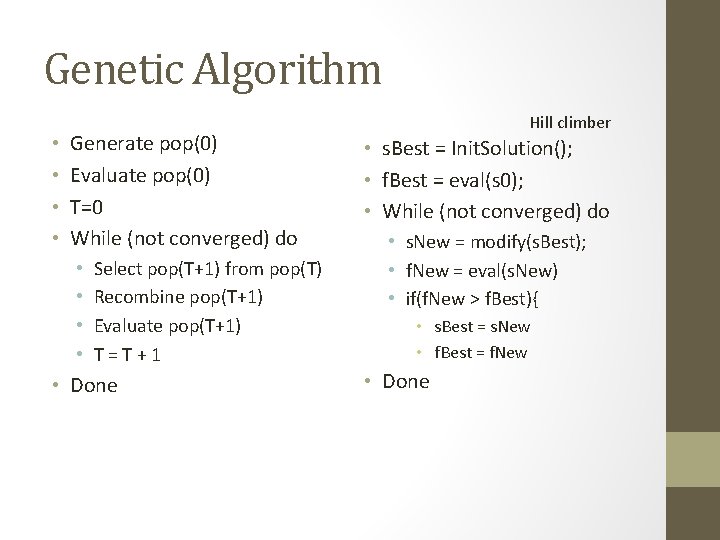
Simple hill climber • s. Best = Init. Solution(); • f. Best = eval(s 0); • for(i = 0; i < 1000000; i++){ • s. New = modify(s. Best); • f. New = eval(s. New) • if(f. New > f. Best){ • s. Best = s. New • f. Best = f. New • } • …
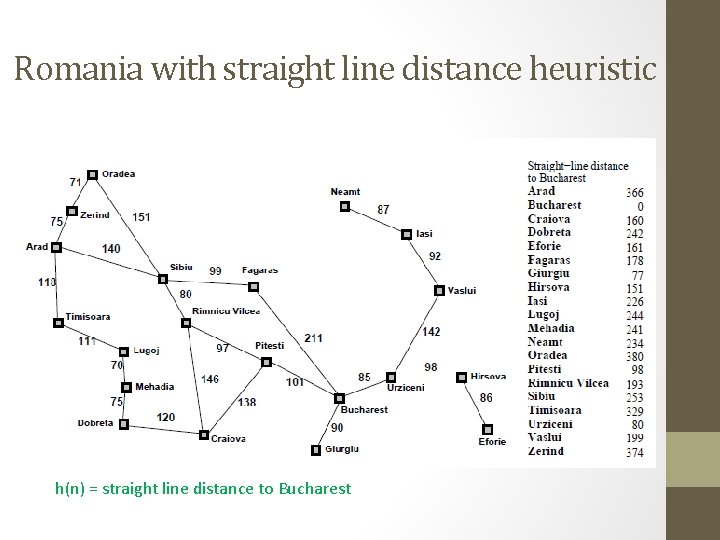
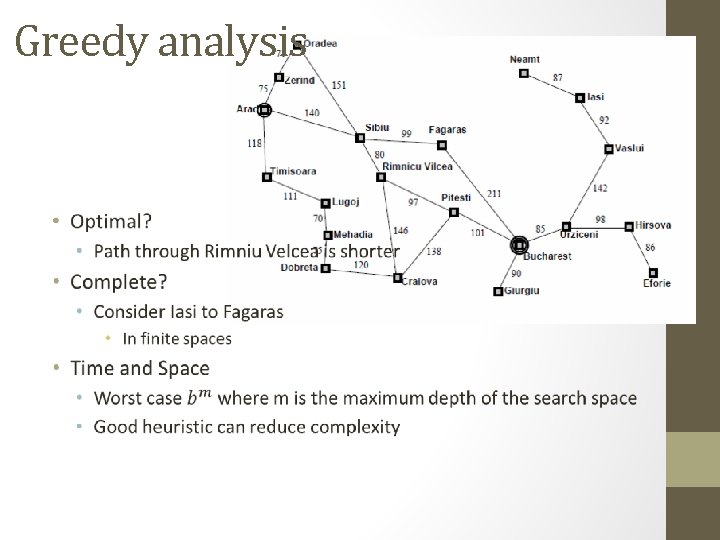
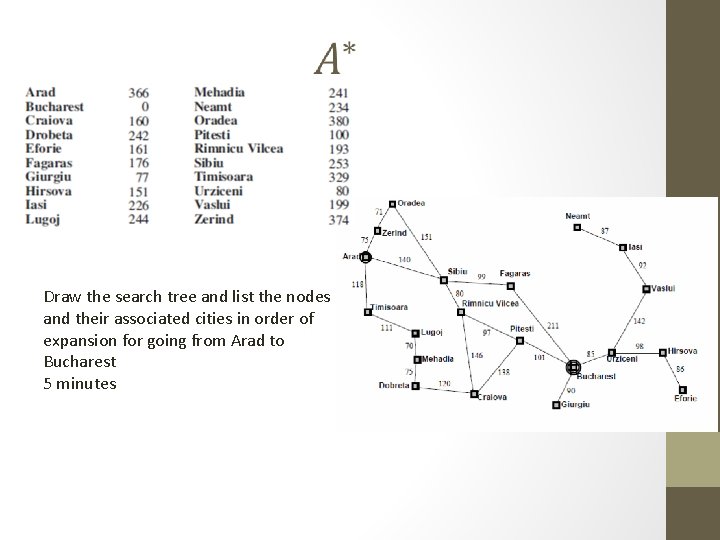
Romania with straight line distance heuristic h(n) = straight line distance to Bucharest
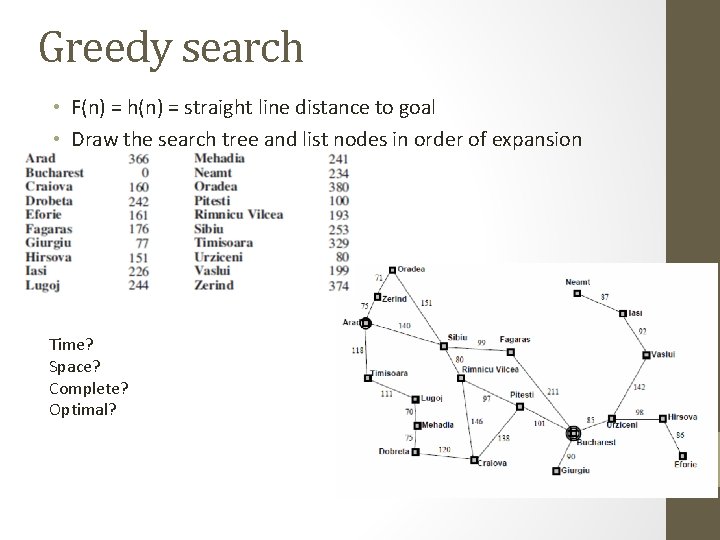
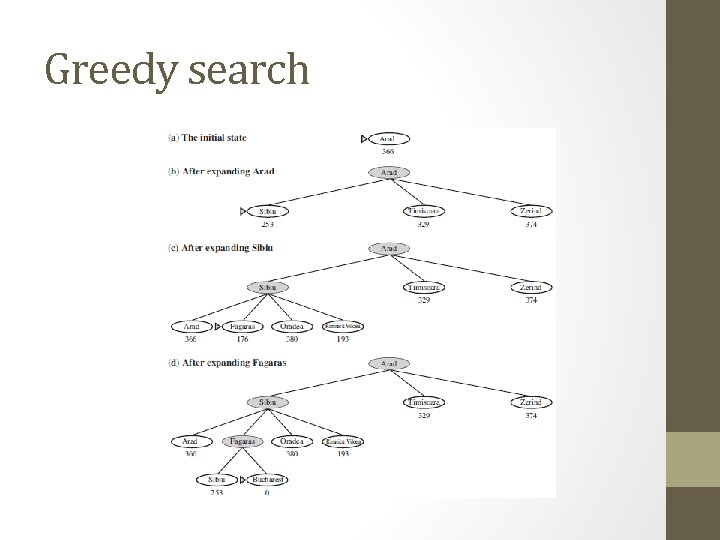
Greedy search • F(n) = h(n) = straight line distance to goal • Draw the search tree and list nodes in order of expansion Time? Space? Complete? Optimal?
Greedy search
Greedy analysis •
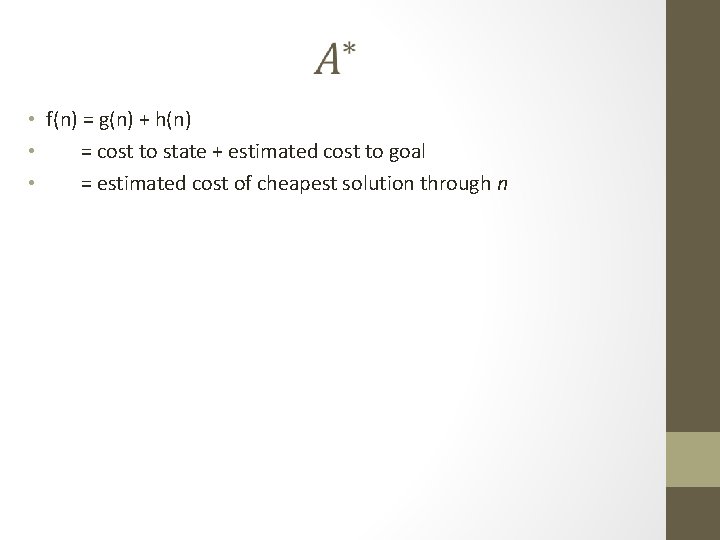
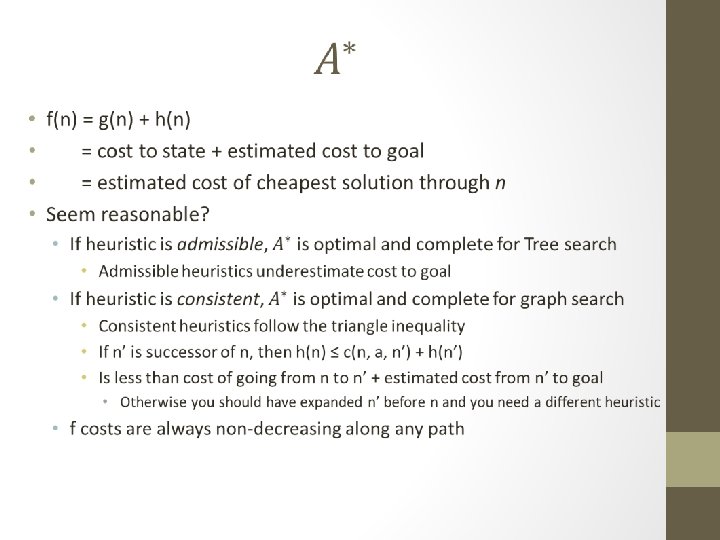
• f(n) = g(n) + h(n) • = cost to state + estimated cost to goal • = estimated cost of cheapest solution through n
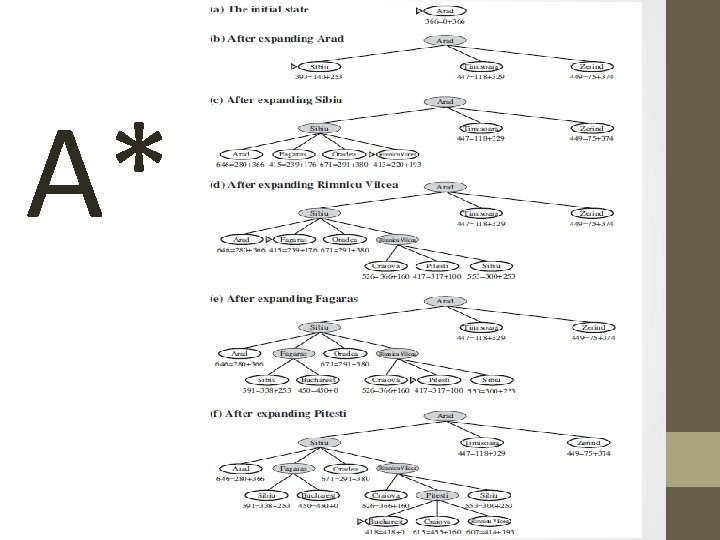
Draw the search tree and list the nodes and their associated cities in order of expansion for going from Arad to Bucharest 5 minutes
A*
Non-classical search - Path does not matter, just the final state - Maximize objective function
• • • Boeing 777 engines designed by GE I 2 technologies ERP package uses Gas John Deere – manufacturing optimization US Army – Logistics Cap Gemini + Ki. Q – Marketing, credit, and insurance modeling Genetic Algorithms Applications
• Poorly-understood problems – Non-linear, Discontinuous, multiple optima, … – No other method works well • Search, Optimization, Machine Learning • Quickly produces good (usable) solutions • Not guaranteed to find optimum Genetic Algorithms Niche
• 1960’s, Larry Fogel – “Evolutionary Programming” • 1970’s, John Holland – “Adaptation in Natural and Artificial Systems” • 1970’s, Hans-Paul Schwefel – “Evolutionary Strategies” • 1980’s, John Koza – “Genetic Programming” – – Natural Selection is a great search/optimization algorithm GAs: Crossover plays an important role in this search/optimization Fitness evaluated on candidate solution GAs: Operators work on an encoding of solution Genetic Algorithms History
• 1989, David Goldberg – our textbook – Consolidated body of work in one book – Provided examples and code – Readable and accessible introduction • 2017, GECCO , 600+ attendees – Industrial use of Gas – Combinations with other techniques – Foundations Genetic Algorithms History
• • • Model Natural Selection the process of Evolution Search through a space of candidate solutions Work with an encoding of the solution Non-deterministic (not random) Parallel search Genetic Algorithms Start: Genetic Algorithms
Vocabulary • • • Natural Selection is the process of evolution – Darwin Evolution works on populations of organisms A chromosome is made up of genes The various values of a gene are its alleles A genotype is the set of genes making up an organism Genotype specifies phenotype • Phenotype is the organism that gets evaluated • Selection depends on fitness • During reproduction, chromosomes crossover with high probability • Genes mutate with very low probability
Genetic Algorithm • • Generate pop(0) Evaluate pop(0) T=0 While (not converged) do • • Select pop(T+1) from pop(T) Recombine pop(T+1) Evaluate pop(T+1) T = T + 1 • Done Hill climber • s. Best = Init. Solution(); • f. Best = eval(s 0); • While (not converged) do • s. New = modify(s. Best); • f. New = eval(s. New) • if(f. New > f. Best){ • s. Best = s. New • f. Best = f. New • Done
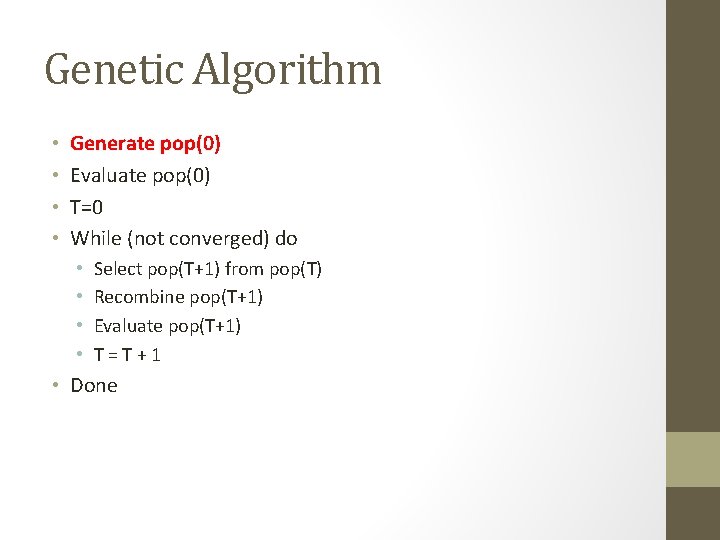
Genetic Algorithm • • Generate pop(0) Evaluate pop(0) T=0 While (not converged) do • • Select pop(T+1) from pop(T) Recombine pop(T+1) Evaluate pop(T+1) T = T + 1 • Done
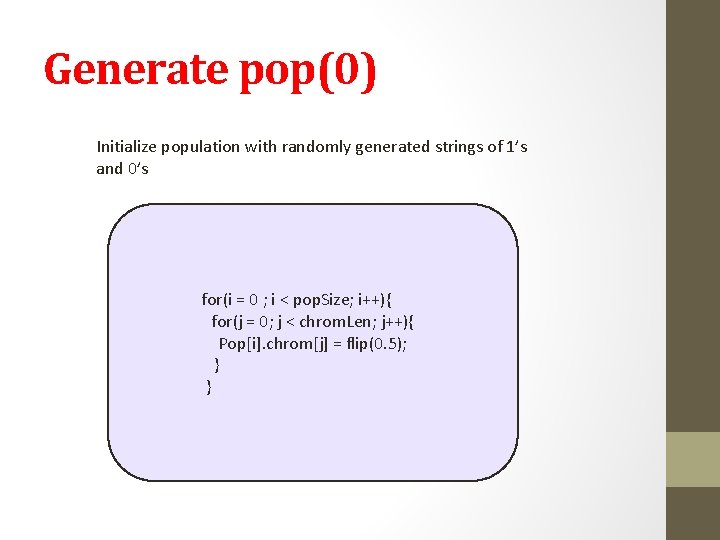
Generate pop(0) Initialize population with randomly generated strings of 1’s and 0’s for(i = 0 ; i < pop. Size; i++){ for(j = 0; j < chrom. Len; j++){ Pop[i]. chrom[j] = flip(0. 5); }
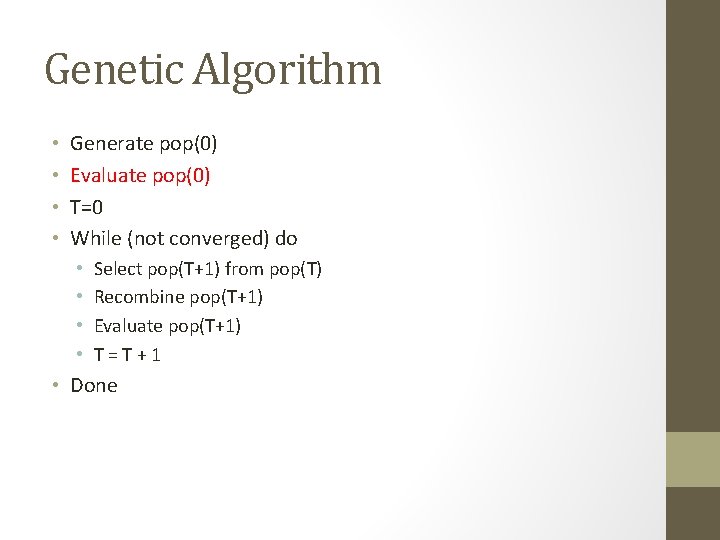
Genetic Algorithm • • Generate pop(0) Evaluate pop(0) T=0 While (not converged) do • • Select pop(T+1) from pop(T) Recombine pop(T+1) Evaluate pop(T+1) T = T + 1 • Done
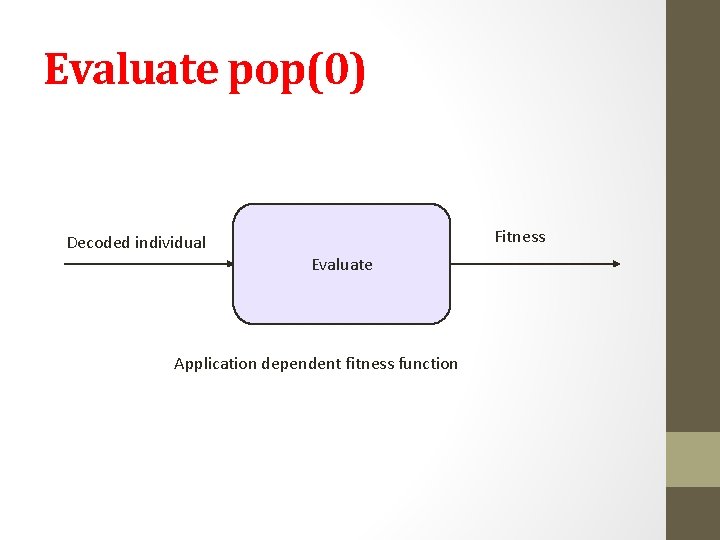
Evaluate pop(0) Decoded individual Fitness Evaluate Application dependent fitness function
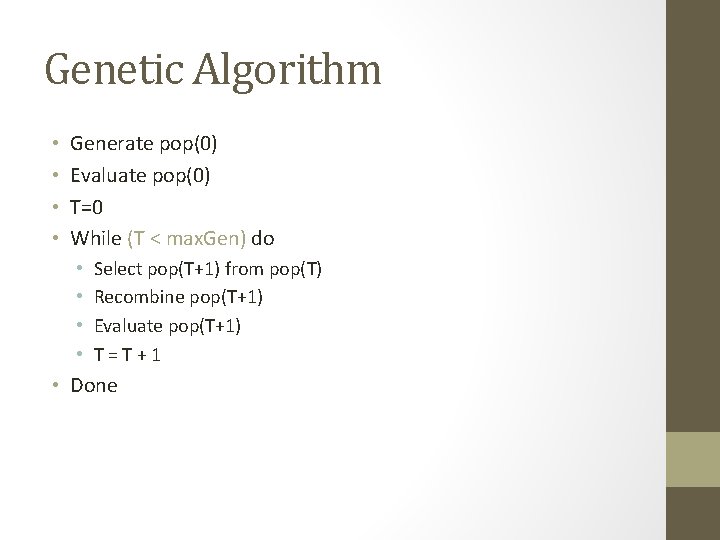
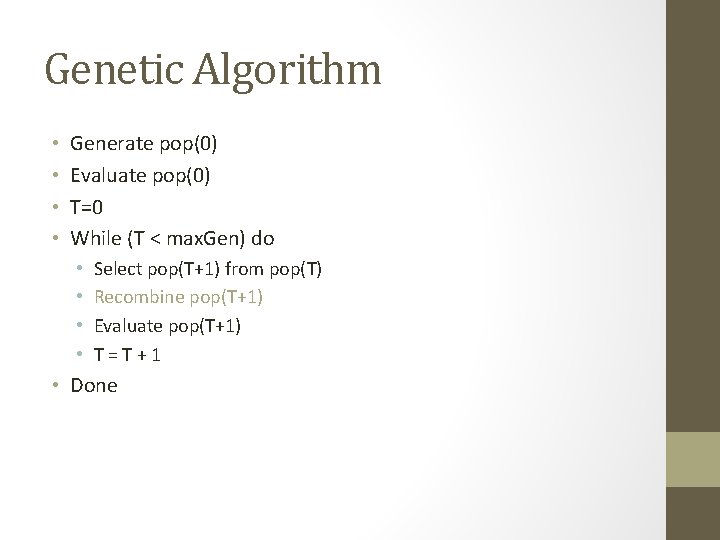
Genetic Algorithm • • Generate pop(0) Evaluate pop(0) T=0 While (T < max. Gen) do • • Select pop(T+1) from pop(T) Recombine pop(T+1) Evaluate pop(T+1) T = T + 1 • Done
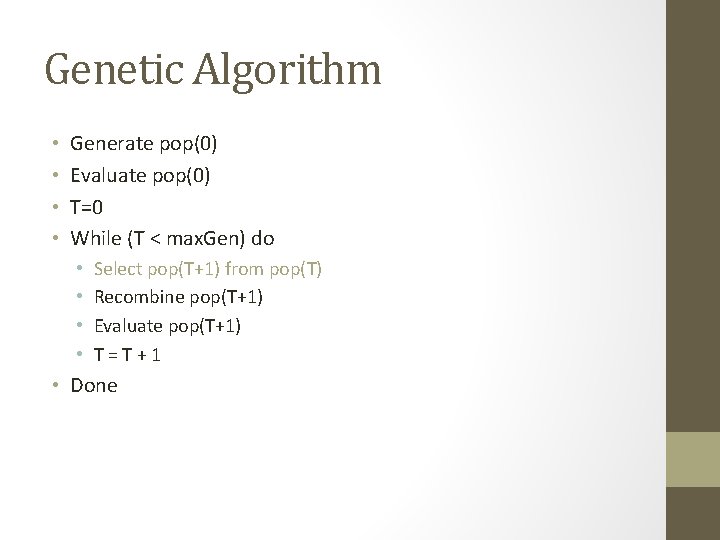
Genetic Algorithm • • Generate pop(0) Evaluate pop(0) T=0 While (T < max. Gen) do • • Select pop(T+1) from pop(T) Recombine pop(T+1) Evaluate pop(T+1) T = T + 1 • Done
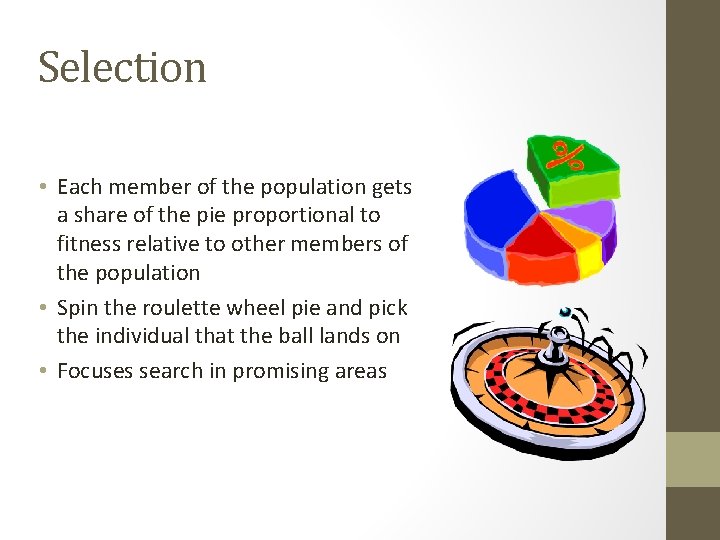
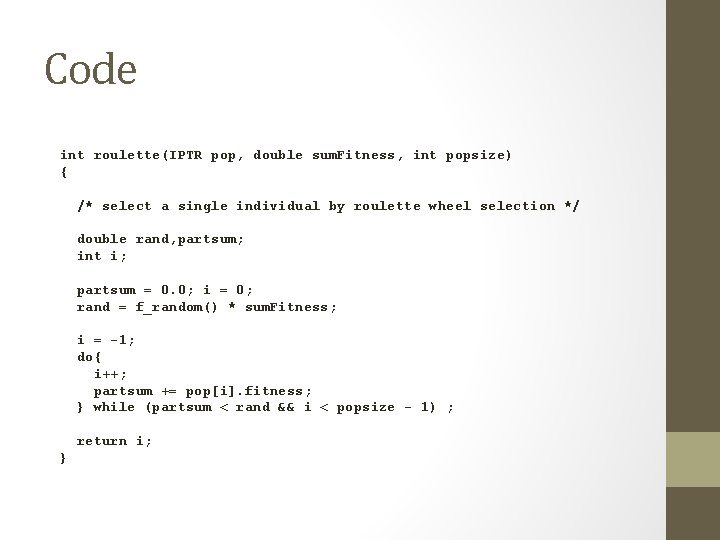
Selection • Each member of the population gets a share of the pie proportional to fitness relative to other members of the population • Spin the roulette wheel pie and pick the individual that the ball lands on • Focuses search in promising areas
Code int roulette(IPTR pop, double sum. Fitness, int popsize) { /* select a single individual by roulette wheel selection */ double rand, partsum; int i; partsum = 0. 0; i = 0; rand = f_random() * sum. Fitness; i = -1; do{ i++; partsum += pop[i]. fitness; } while (partsum < rand && i < popsize - 1) ; return i; }
Genetic Algorithm • • Generate pop(0) Evaluate pop(0) T=0 While (T < max. Gen) do • • Select pop(T+1) from pop(T) Recombine pop(T+1) Evaluate pop(T+1) T = T + 1 • Done
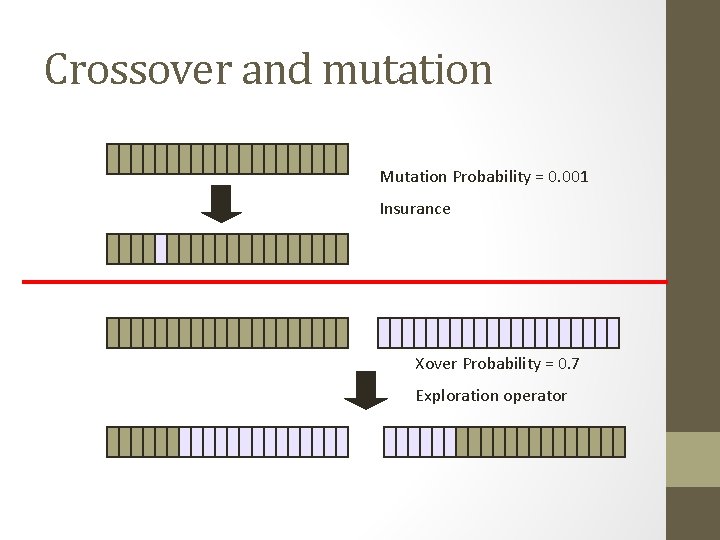
Crossover and mutation Mutation Probability = 0. 001 Insurance Xover Probability = 0. 7 Exploration operator
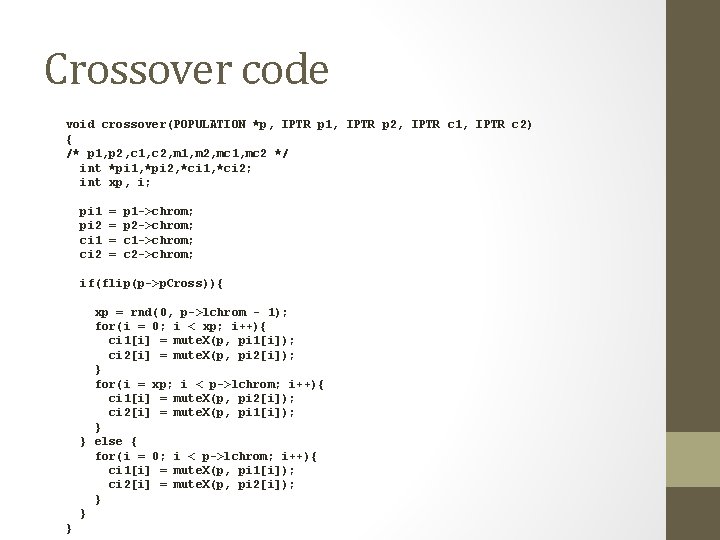
Crossover code void crossover(POPULATION *p, IPTR p 1, IPTR p 2, IPTR c 1, IPTR c 2) { /* p 1, p 2, c 1, c 2, m 1, m 2, mc 1, mc 2 */ int *pi 1, *pi 2, *ci 1, *ci 2; int xp, i; pi 1 pi 2 ci 1 ci 2 = = p 1 ->chrom; p 2 ->chrom; c 1 ->chrom; c 2 ->chrom; if(flip(p->p. Cross)){ xp = rnd(0, p->lchrom - 1); for(i = 0; i < xp; i++){ ci 1[i] = mute. X(p, pi 1[i]); ci 2[i] = mute. X(p, pi 2[i]); } for(i = xp; i < p->lchrom; i++){ ci 1[i] = mute. X(p, pi 2[i]); ci 2[i] = mute. X(p, pi 1[i]); } } else { for(i = 0; i < p->lchrom; i++){ ci 1[i] = mute. X(p, pi 1[i]); ci 2[i] = mute. X(p, pi 2[i]); } } }
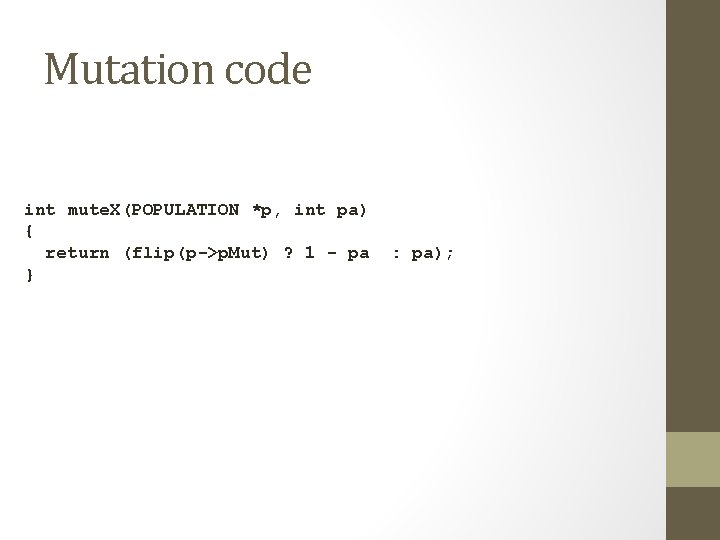
Mutation code int mute. X(POPULATION *p, int pa) { return (flip(p->p. Mut) ? 1 - pa } : pa);
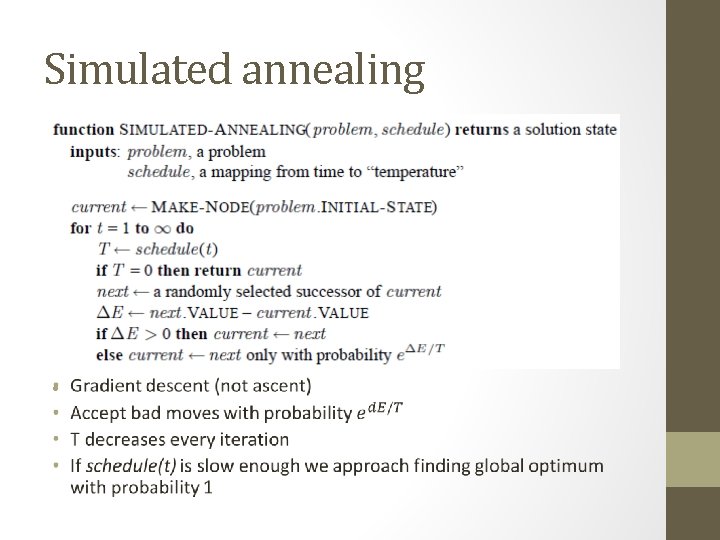
Simulated annealing •
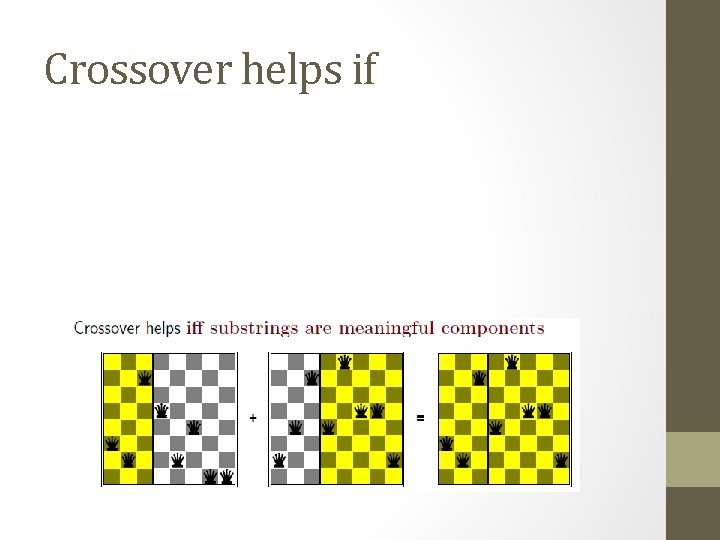
Crossover helps if
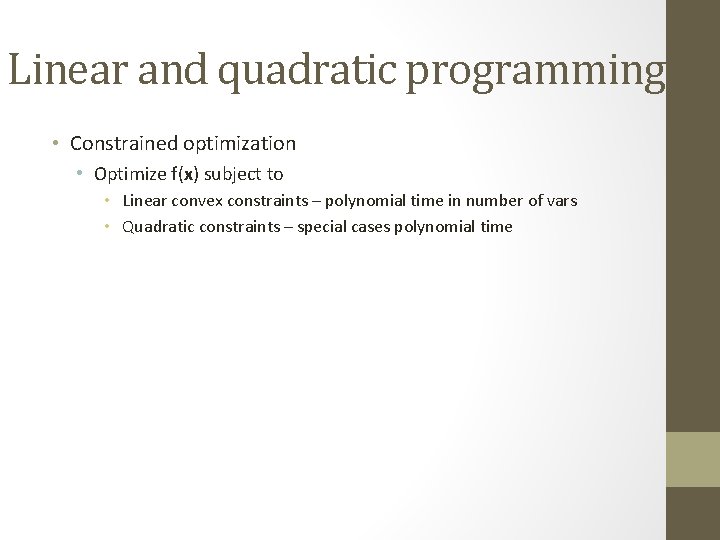
Linear and quadratic programming • Constrained optimization • Optimize f(x) subject to • Linear convex constraints – polynomial time in number of vars • Quadratic constraints – special cases polynomial time