
Evolution Why we dont study Intelligent Design Evolution
- Slides: 50
Evolution
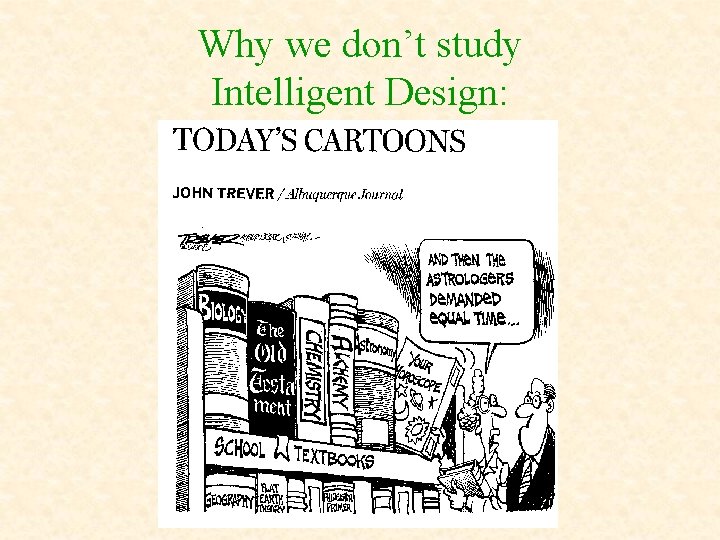
Why we don’t study Intelligent Design:
Evolution is the progressive change in a kind (not one individual, but a population) of organism over time.
Specifically, evolution is the change over time of the genetic composition of populations.
It is the process by which modern organisms have descended from ancient organisms.
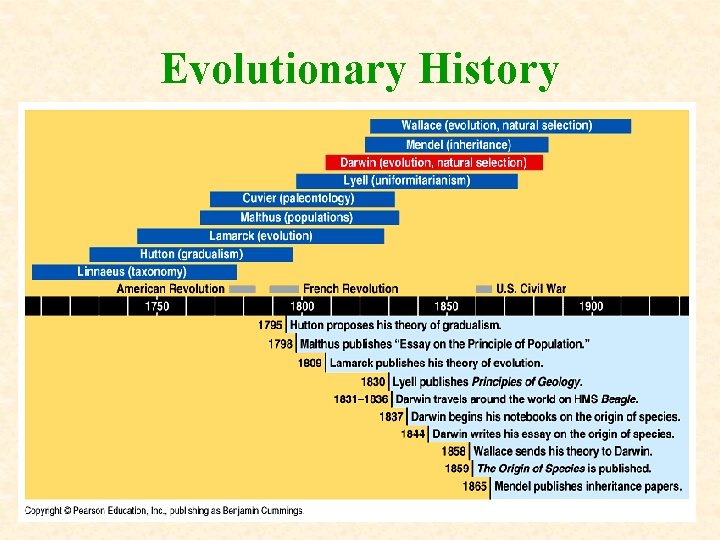
Evolutionary History • Greek philosopher Aristotle developed his Scala Naturae, or Ladder of Life, to explain his concept of the advancement of living things from inanimate matter to plants, then animals and finally man.
Evolutionary History • Aristotle’s concept of man as the "crown of creation" still plagues modern evolutionary biologists and has lead to many of the misconceptions about evolution.
Evolutionary History • “Scientists" were constrained by the prevailing thought patterns of the Middle Ages - the inerrancy of the biblical book of Genesis and the special creation of the world in a literal six days of the 24 -hour variety.
Evolutionary History • Archbishop James Ussher of Ireland, in the mid 1600's, calculated the age of the earth based on the geneologies from Adam and Eve listed in the biblical book of Genesis, working backward from the crucifixion.
Evolutionary History • According to Ussher's calculations, the earth was formed on October 22, 4004 B. C. Ussher's ideas were readily accepted, in part because they posed no threat to the social order of the times.
Evolutionary History • Geologists had for some time doubted the "truth" of a 5, 000 year old earth.
Evolutionary History • Leonardo da Vinci calculated the sedimentation rates in the Po River of Italy, and concluded it took 200, 000 years to form some nearby rock deposits.
Evolutionary History • Galileo studied fossils (evidence of past life) and concluded that they were real and not inanimate artifacts.
Evolutionary History • James Hutton, regarded as the Father of modern Geology, developed (in 1795) the Theory of Uniformitarianism, the basis of modern geology and paleontology.
Evolutionary History • According to Hutton's work, certain geological processes operated in the past in much the same fashion as they do today, with minor exceptions of rates, etc. Thus many geological structures and processes cannot be explained if the earth is only 5000 years old.
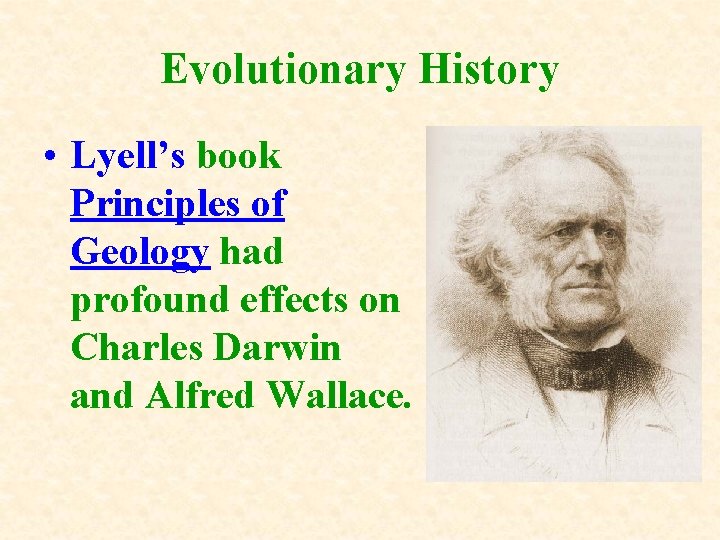
Evolutionary History • British geologist Charles Lyell refined Hutton's ideas during the 1800 s to include slow change over long periods of time. • Scientists recognized that Earth is many millions of years old.
Evolutionary History • Lyell’s book Principles of Geology had profound effects on Charles Darwin and Alfred Wallace.
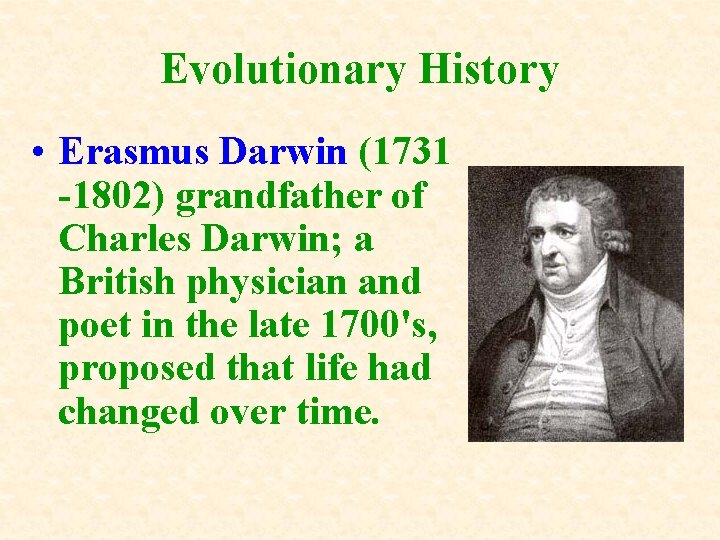
Evolutionary History • Erasmus Darwin (1731 -1802) grandfather of Charles Darwin; a British physician and poet in the late 1700's, proposed that life had changed over time.
Erasmus Darwin • His writings on both botany and zoology contained many comments that suggested the possibility of common descent based on changes undergone by animals during development, artificial selection by humans, and the presence of vestigial organs.
Erasmus Darwin • He also talked about how competition and sexual selection could cause changes in species: "The final course of this contest among males seems to be, that the strongest and most active animal should propogate the species which should thus be improved. "
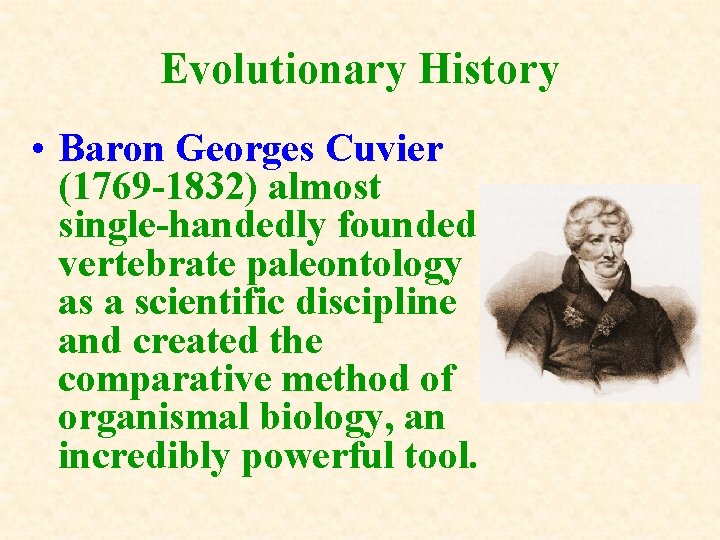
Evolutionary History • Baron Georges Cuvier (1769 -1832) almost single-handedly founded vertebrate paleontology as a scientific discipline and created the comparative method of organismal biology, an incredibly powerful tool.
Baron Georges Cuvier • It was Cuvier who firmly established the fact of the extinction of past lifeforms.
Baron Georges Cuvier • He believed that the Earth was immensely old, and that for most of its history conditions had been more or less like those of the present. However, periodic "revolutions", or catastrophes had befallen the Earth; each one wiped out a number of species. An idea known as Catastrophism.
Baron Georges Cuvier • He regarded these "revolutions" as events with natural causes, and considered their causes and natures to be an important geological problem. Although he was a lifelong Protestant, Cuvier did not explicitly identify any of these "revolutions" with Biblical or historical events.
Baron Georges Cuvier • The idea of catastrophism was a comfortable one for the times and thus was widely accepted. Cuvier eventually proposed that there had been several creations that occurred after catastrophies.
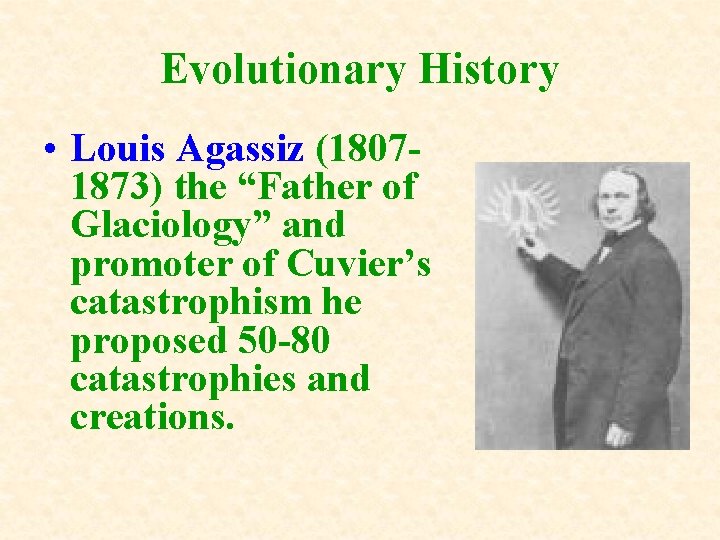
Evolutionary History • Louis Agassiz (18071873) the “Father of Glaciology” and promoter of Cuvier’s catastrophism he proposed 50 -80 catastrophies and creations.
Louis Agassiz • His finding of parallels between ontogeny, paleontology, and morphology was rapidly adopted by biologists like Haeckel and used by Darwin to support evolution.
Louis Agassiz • He was no evolutionist; in fact, he was probably the last reputable scientist to reject evolution outright for any length of time after the publication of The Origin of Species. Agassiz saw the Divine Plan of God everywhere in nature, and could not reconcile himself to a theory that did not invoke design. He defined a species as "a thought of God. "
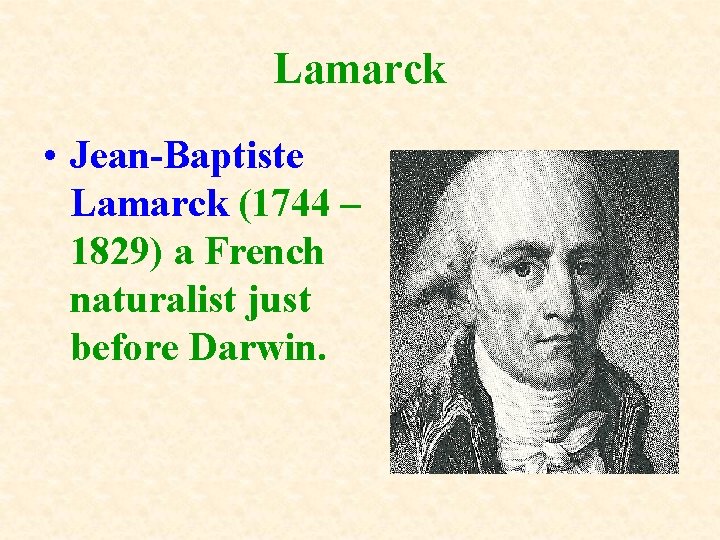
Lamarck • Jean-Baptiste Lamarck (1744 – 1829) a French naturalist just before Darwin.
Lamarck • Proposed “by selective use or disuse of organs, organisms acquired or lost certain traits during their lifetime. These traits could then be passed on to their offspring. Over time, this process led to change in a species. ”
Lamarck’s Theory of Evolution: The Inheritance of Acquired Traits 1. All organisms have an innate tendency toward complexity and perfection. – Ancestors of birds acquired an urge to fly, kept trying to fly, eventually their wings increased in size and now they are suited to flying.
Lamarck’s Theory of Evolution: The Inheritance of Acquired Traits 2. Organisms could alter the size or shape of particular organs by using their bodies in new ways. – Birds try to use their front limbs to fly and they grew wings. – If a winged animal did not use its wings they would decrease in size and disappear.
Lamarck’s Theory of Evolution: The Inheritance of Acquired Traits 3. Acquired characteristics could be inherited. – If a bird spent its life trying to fly and developed larger wings, then its offspring would inherit larger wings.
Lamarck Lamarck's theory of evolution is incorrect in several ways: He did not know how traits are inherited. He did not know that an organism's behavior has no effect on its inheritable characteristics.
Lamarck However, Lamarck was one of the first to develop a scientific theory of evolution and realize that organisms are adapted to their environments. In this way, he paved the way for the work of later biologists.
Evolutionary History • Thomas Malthus (1766 -1834) • A political economist who was concerned about, what he saw as, the decline of living conditions in nineteenth century England.
Thomas Malthus • He blamed this decline on three elements: 1. The overproduction of young; 2. The inability of resources to keep up with the rising human population; and 3. The irresponsibility of the lower classes.
Thomas Malthus • To combat this, Malthus suggested the family size of the lower class ought to be regulated such that poor families do not produce more children than they can support.
Thomas Malthus • In Essay on the Principle of Population (1798), Malthus concluded that unless family size was regulated, man's misery of famine would become globally epidemic and eventually consume man.
Thomas Malthus • His view that poverty and famine were natural outcomes of population growth and food supply was not popular among social reformers who believed that with proper social structures, all ills of man could be eradicated.
Thomas Malthus • Although Malthus thought famine and poverty natural outcomes, the ultimate reason for those outcomes was divine institution. He believed that such natural outcomes were God's way of preventing man from being lazy.
Thomas Malthus • Both Darwin and Wallace independently arrived at similar theories of Natural Selection after reading Malthus. • Unlike Malthus, they framed his principle in purely natural terms, both in outcome and in ultimate reason. By so doing, they extended Malthus' logic further than Malthus himself could ever take it.
Thomas Malthus • Both Darwin and Wallace realized that producing more offspring than can survive establishes a competitive environment among siblings, and that the variation among siblings would produce some individuals with a slightly greater chance of survival.
Evolutionary History
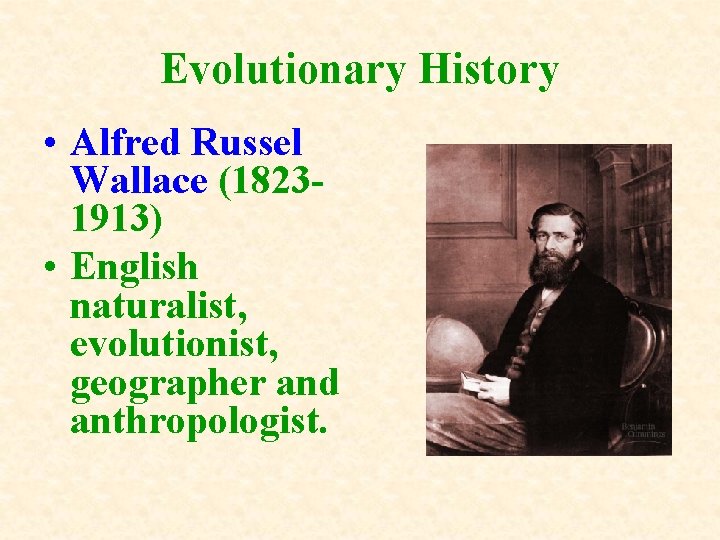
Evolutionary History • Alfred Russel Wallace (18231913) • English naturalist, evolutionist, geographer and anthropologist.
Alfred Russel Wallace • He spent many years in South America, publishing salvaged notes in Travels on the Amazon and Rio Negro in 1853. • In 1854, Wallace left England to study the natural history of Indonesia.
Alfred Russel Wallace • While in Indonesia he contracted Malaria, but influenced by Malthus’ ideas on population growth he managed to write down his ideas on natural selection in an essay titled “On the Tendency of Varieties to Depart Indefiniely from the Original Type. ”
Alfred Russel Wallace • He sent his essay to Darwin in hopes that he would share it with Lyell. Seeing that Wallace shared his own ideas regarding the “species question, ” Darwin presented Wallace’s paper and along with some of his own writings to the Linnean Society meeting in July of 1858.
Alfred Russel Wallace • His essay also motivated Darwin to publish a shortened version of the work he had been planning and was years away from completing (a work that Darwin never did complete).
Alfred Russel Wallace • On November 24 th, 1859, the shortened book “On the Origin of Species…” was published and Darwin was forever associated with Evolution. • However, most prominent scientists were well aware of Wallace’s contributions. Today some think of him as the “codeveloper” of theory of natural selection.