
Evolution What is Evolution What is a theory




- Slides: 32
Evolution What is Evolution What is a theory Give Evidence of Evolution Asexual vs Sexual Reproduction
What is Evolution? What is your initial Reaction? Should it be taught in School? What is Creationism? Should it be taught in school?
ev·o·lu·tion n. 1. A gradual process in which something changes into a different and usually more complex or better form. P a. Change in the genetic composition of a population during successive generations, as a result of natural selection acting on the genetic variation among individuals, and resulting in the development of new species. b. The historical development of a related group of organisms; phylogeny.
Not Black and White…. Your stance on Evolution may fall anywhere on the continuum Life arose out of complete Randomness with no Outside direction Life created by God Literal 6 days sun-up To sun-down God created life, But did it over a longer Period of time and directs Changes observed today God directed life To form out of randomness, With evolution directing the changes ? ? “Intelligent Design” ? ? ?
Evolution Peppered Moth Example Variation in population, White normal, Black produced initially by mutation Black increased in numbers after industrial revolution in England ** Evolution acts on the Phenotype, not the Genotype
Theory Substantiated by repeated experimentation and observation of evidence Is “Best explanation” of evidence, NOT Fact Don’t use “Just a Theory” (implication of not substantiated), or imply that it is 100% correct. Compare to Hypothesis and Law
Evidence for Evolution 1. Natural Selection/Adaptation 2. Fossil Record 3. Embryology 4. Homologous Structures/Vestigual structures 5. DNA Sequences
Natural Selection Lamarck (1809) Acquired Characteristics Darwin (1859) “Origin of Species By Means of Natural Selection” HMS Beagle (1831) 22 yrs old Galapagos Islands Volcanic Islands Characteristics of the Organisms: Unique to islands, resemble S. A. mainland Finches:
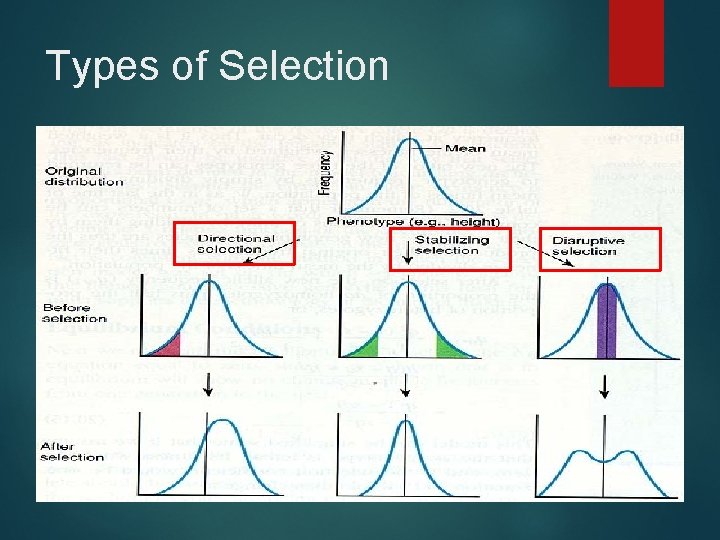
Natural Selection 1. Individuals with most favorable variation for an environment survive and pass on to next generation 2. Organisms produce more offspring than can survive 3. Overtime, offspring of survivors make up a larger percentage of population
Mechanisms of natural selection Mutation Genetic Drift – Chance processes Population Size Gene Flow Immigration Emmigration
Types of Selection
Artificial Selection Breeding of organisms with desired traits to obtain more organisms with those traits
Fossil Record Fossil: physical evidence of prehistoric plant or animal life Shells or old bones Traces of dead organisms Footprints of human ancestors Insects trapped in tree sap Animals buried in tar Formation/Types: Mineralization Casts Molds Whole body (frozen, tar, tree sap)
Which fossils are older? Dinosaurs Jawed Fish Which are the youngest fossils? Which are the oldest?
Embryology
Embryology All sexual reproducing organisms begin with fertilized egg/sperm and develop into a mass of cells Related organisms share a similar development More advanced organisms (humans, mammals) have longer development periods
Homologous Structures “Same” Development Pattern Not Same Function Human arms, whale pectoral flipper, birds wings Analogous Structures have different development, but “comparable” function Birds and insect wings
Vestigual Structures Organ or structure that does not seem to have a function in the organism Is functional in other “lower” organisms Human appendix and rabbit’s ceacum Human tailbone and animal tails Used to indicate how organisms are related
DNA Sequences Which of the following organisms would be most similar (related)? Organism A: AATTACCGGAGAGCGGCCAGGACTTATTACCA Organism B: AACTAGGCGAGAGCGGCCACGACTTAGGACCA Organism C: AATTACCGGAGACCGGGGAGGACTTATTACCA Organism D: ATTTAAAATTCCGGACTAGTAGGACTTATTACCA
Cladogram
Antibiotic Resistance
Summary of Evidence Embryology Fossil Record (Relative age of species) Homologous Structures (vs. Analogous) Vestigial Organs (No longer function: tailbone humans, appendix) Molecular Sequences in Pesticide/Antibiotic Resistance Natural Selection/Survival of the fittest Sexual vs. Asexual Reproduction Biogeography (distribution: Similar fossils found on shoreline of Africa and South America or marine) Natural Selection
Asexual Reproduction Organisms: Plants (budding, tubors, rhizomes, bulbs, plant fragments and cuttings) Bacteria: binary fission Insects: parthenogenesis unfertilized eggs develop into adult Honeybees: fertilized egg = female unfertilized egg = male Higher animals: cloning
Why Asexual Why Not? Only one parent required Exact characteristics (DNA) of parent Well adapted individuals will remain well adapted Beneficial for quick reproducing organisms
Some Methods of Asexual Reproduction 1. binary fission -- involves an equal division of both the organism cytoplasm and nucleus to form two identical organisms -- the diagram of the protist below is example of this
2. budding -- involves one parent dividing its nucleus (genetic material) equally, but cytoplasm unequally -- the diagram of a yeast below is an example of this
Cloning is the production of identical genetic copies. All forms of asexual reproduction are variations of the cell division process of mitosis.
Why Sexual Reproduction Eliminated harmful mutations Provides genetic recombination (half from mom/half from dad) Beneficial for slow reproducing organisms Humans could reproduce once/year (average) Bacteria can reproduce every couple of hours Allows for “survival of the fittest” All members are the same from asexual (unless a mutation)
Sexual vs Asexual Reproduction What is the difference? What organisms reproduce each way? One vs. two parents required Unicellular and plants can usually undergo Asexual What is the advantage of each? Asexual: Best adapted individual is maintained, all offspring will be identical (unless mutation) (Best in very stable enviroment) Sexual: Purge harmful mutations, allows new genetic combinations (new characteristics) that can be “selected for” (best in changing environment) What is the disadvantage of each? Asexual: Rapidly changing environment could eliminate the population unless a mutation Sexual: Best traits are not always passed on to the next generation