
Evolution What does it mean to you Write
- Slides: 27
Evolution What does it mean to you? Write what you think “evolution” means from a scientific point of view and then write what “evolution” means to you personally.
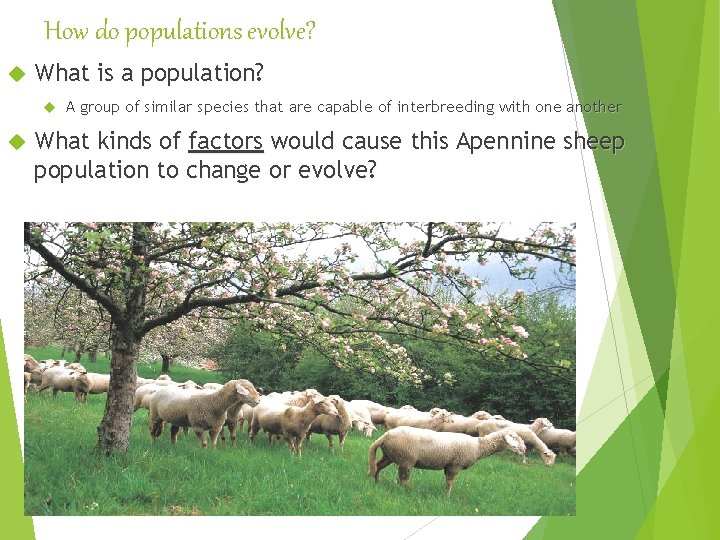
How do populations evolve? What is a population? A group of similar species that are capable of interbreeding with one another What kinds of factors would cause this Apennine sheep population to change or evolve?
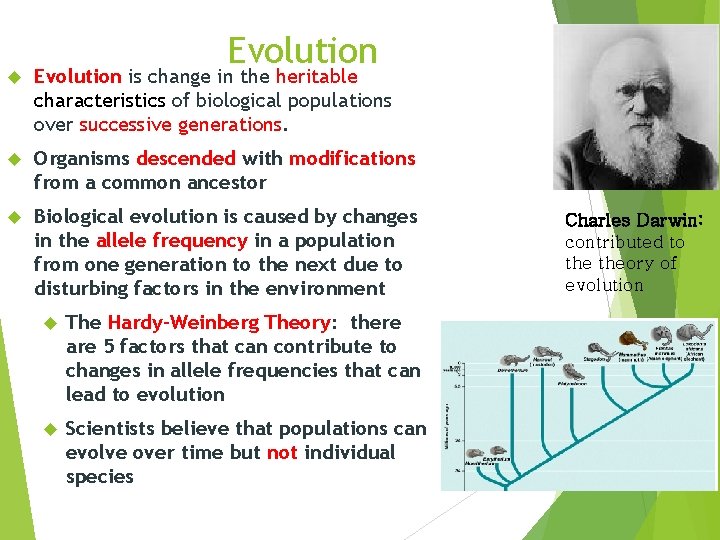
Evolution is change in the heritable characteristics of biological populations over successive generations. Organisms descended with modifications from a common ancestor Biological evolution is caused by changes in the allele frequency in a population from one generation to the next due to disturbing factors in the environment The Hardy-Weinberg Theory: there are 5 factors that can contribute to changes in allele frequencies that can lead to evolution Scientists believe that populations can evolve over time but not individual species Charles Darwin: contributed to theory of evolution
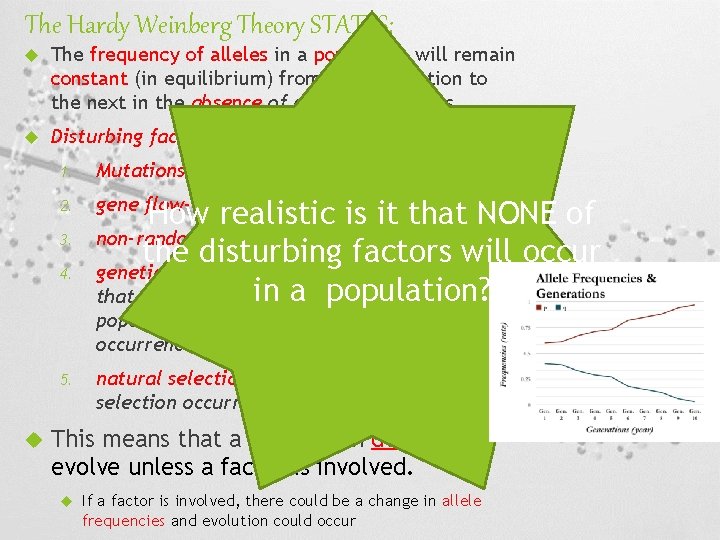
The Hardy Weinberg Theory STATES: The frequency of alleles in a population will remain constant (in equilibrium) from one generation to the next in the absence of disturbing factors. Disturbing factors: 1. Mutations- so NO genetic mutations can occur 2. gene flow- NO migration can occur 3. 4. How realistic is it that NONE of non-random mating- mating must be random the disturbing factors will occur genetic drift- populations must be large so ain population? that alleles can’t in drift and out of a a population due to a random natural occurrence 5. natural selection- NO natural or sexual selection occurring This means that a population does NOT evolve unless a factor is involved. If a factor is involved, there could be a change in allele frequencies and evolution could occur
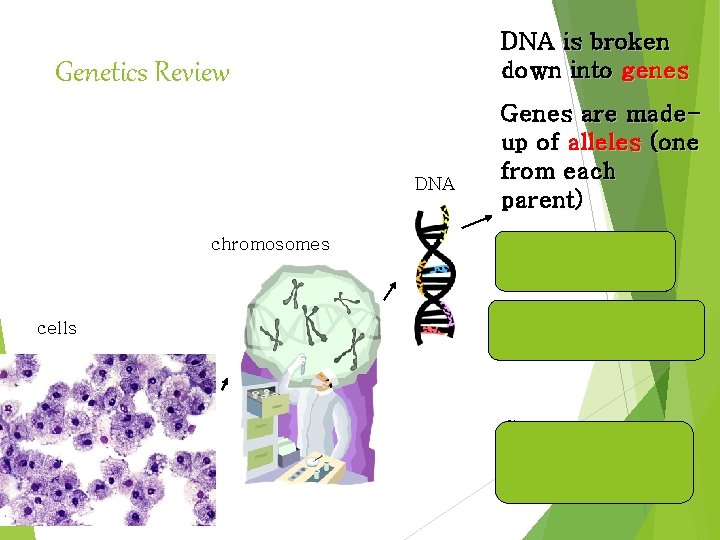
DNA is broken down into genes Genetics Review DNA chromosomes cells Genes are madeup of alleles (one from each parent) A: dominant allele a: recessive allele Genotypes: AA or Aa or aa
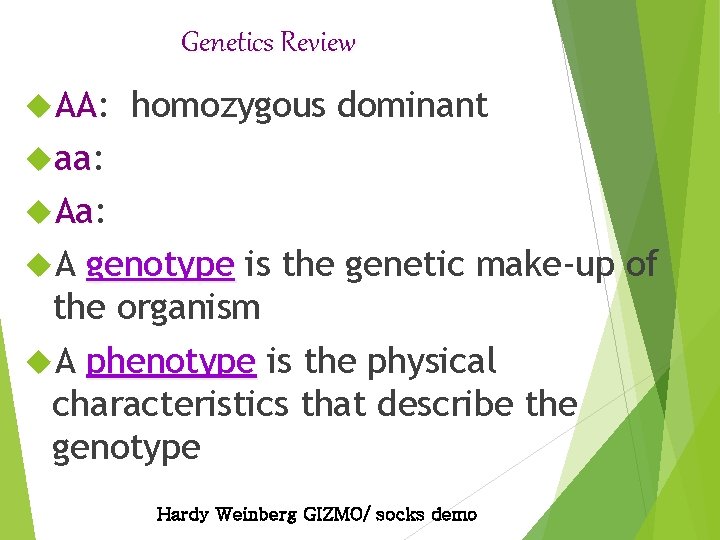
Genetics Review AA: AA homozygous dominant aa: aa Aa: Aa A genotype is the genetic make-up of the organism A phenotype is the physical characteristics that describe the genotype Hardy Weinberg GIZMO/ socks demo
Reflection: Did the allele frequencies change in the Hard-Weinberg demonstration or Gizmo? Explain. Let’s see how the five factors can alter the frequency of alleles in a population
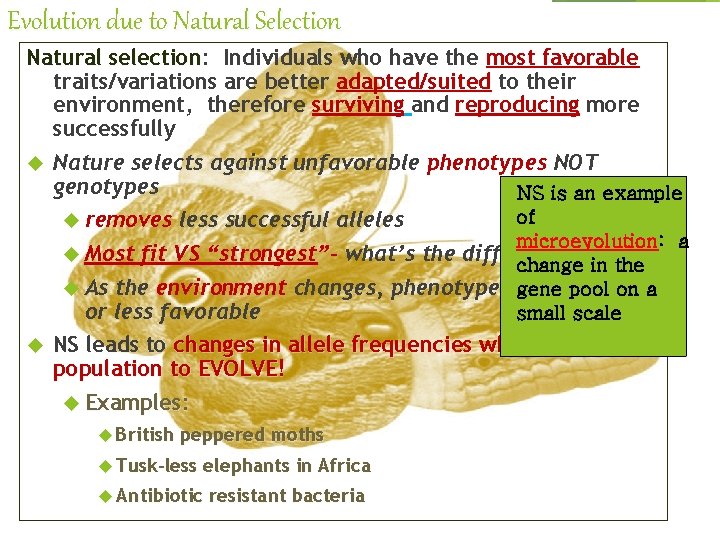
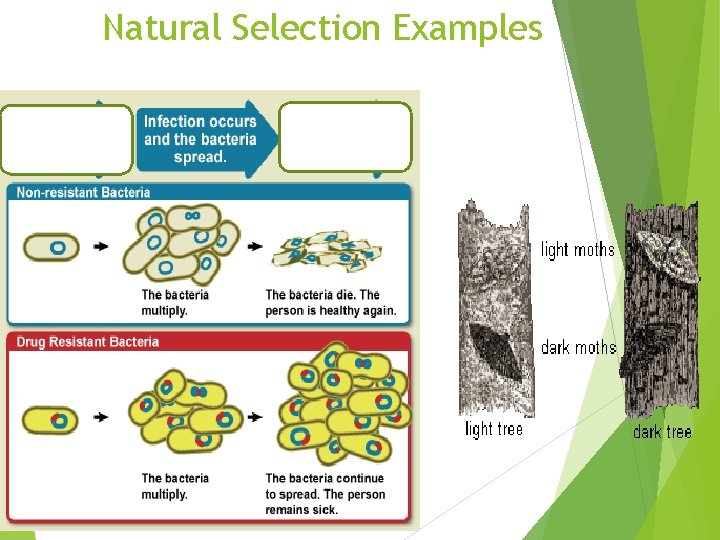
Evolution due to Natural Selection Natural selection: selection Individuals who have the most favorable traits/variations are better adapted/suited to their environment, therefore surviving and reproducing more successfully Nature selects against unfavorable phenotypes NOT genotypes NS is an example of removes less successful alleles microevolution: a Most fit VS “strongest”- what’s the difference? change in the As the environment changes, phenotypes gene become poolmore on a or less favorable small scale NS leads to changes in allele frequencies which causes the population to EVOLVE! Examples: British peppered moths Tusk-less elephants in Africa Antibiotic resistant bacteria
Natural Selection Examples
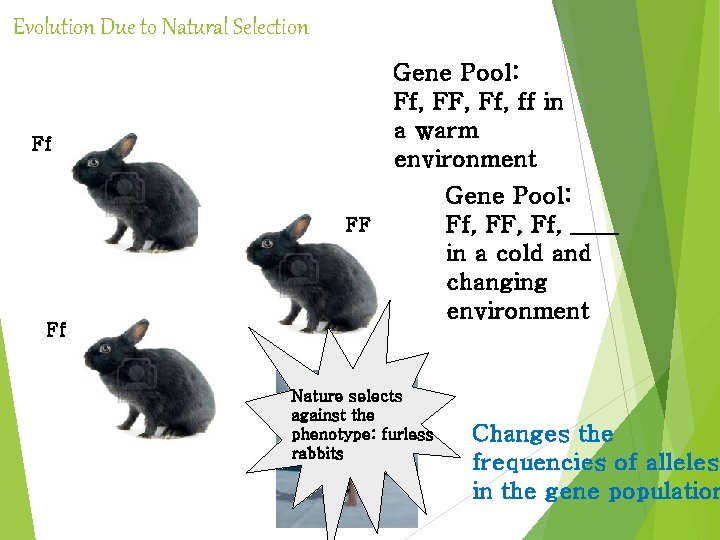
Evolution Due to Natural Selection Gene Pool: Ff, FF, Ff, ff in a warm environment Ff Gene Pool: Ff, FF, Ff, ____ in a cold and changing environment FF Ff ff Nature selects against the phenotype: furless rabbits Changes the frequencies of alleles in the gene population
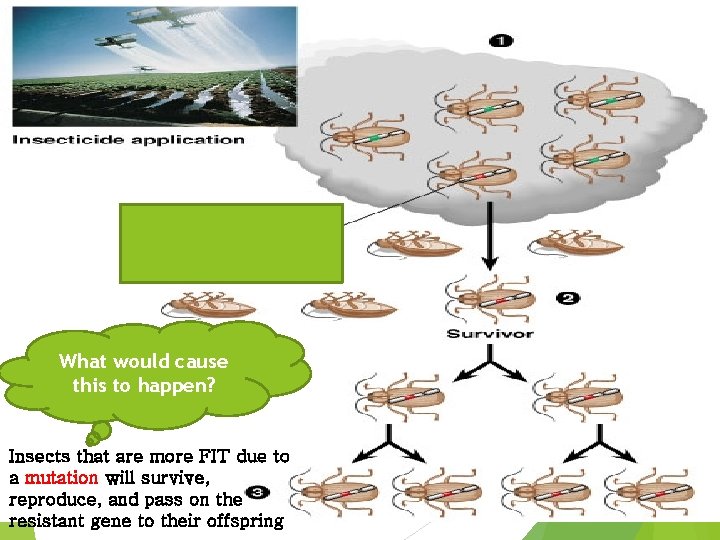
What would cause this to happen? Insects that are more FIT due to a mutation will survive, reproduce, and pass on the resistant gene to their offspring
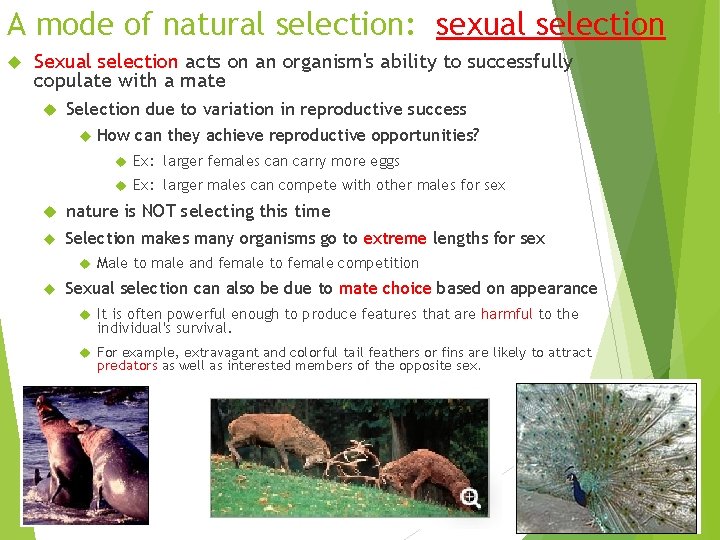
A mode of natural selection: sexual selection Sexual selection acts on an organism's ability to successfully copulate with a mate Selection due to variation in reproductive success How can they achieve reproductive opportunities? Ex: larger females can carry more eggs Ex: larger males can compete with other males for sex nature is NOT selecting this time Selection makes many organisms go to extreme lengths for sex Male to male and female to female competition Sexual selection can also be due to mate choice based on appearance It is often powerful enough to produce features that are harmful to the individual's survival. For example, extravagant and colorful tail feathers or fins are likely to attract predators as well as interested members of the opposite sex.
Natural Selection in humans (take notes) http: //www. dnatube. com/video/11930/Natural-Selection-in-Humans
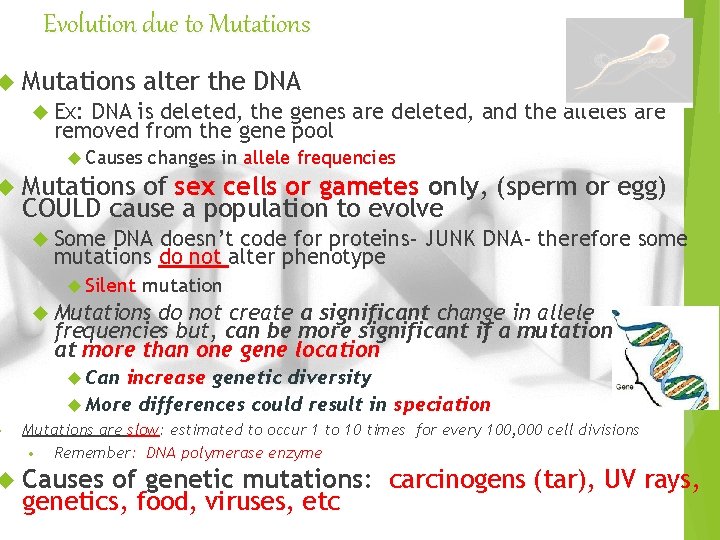
Evolution due to Mutations alter the DNA Ex: DNA is deleted, the genes are deleted, and the alleles are removed from the gene pool Causes changes in allele frequencies Mutations • of sex cells or gametes only, (sperm or egg) COULD cause a population to evolve Some DNA doesn’t code for proteins- JUNK DNA- therefore some mutations do not alter phenotype Silent mutation Mutations do not create a significant change in allele frequencies but, can be more significant if a mutation occurs at more than one gene location Can increase genetic diversity More differences could result in speciation Mutations are slow: estimated to occur 1 to 10 times for every 100, 000 cell divisions • Remember: DNA polymerase enzyme Causes of genetic mutations: carcinogens (tar), UV rays, genetics, food, viruses, etc
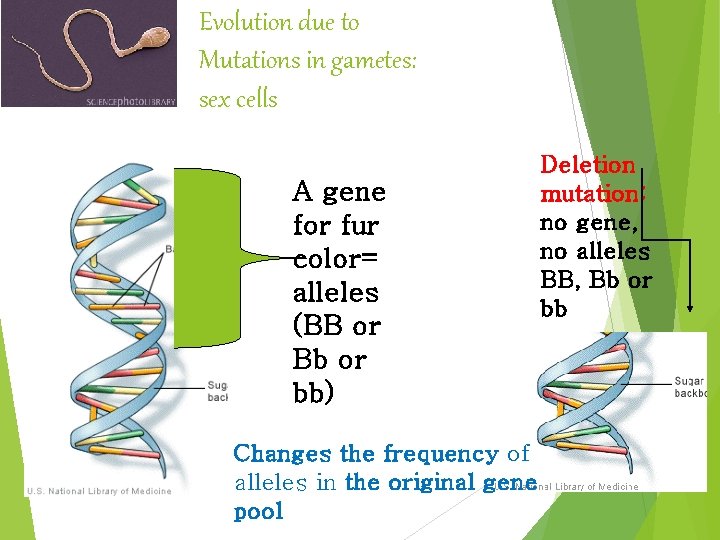
Evolution due to Mutations in gametes: sex cells A gene for fur color= alleles (BB or Bb or bb) Changes the frequency of alleles in the original gene pool Deletion mutation: no gene, no alleles BB, Bb or bb
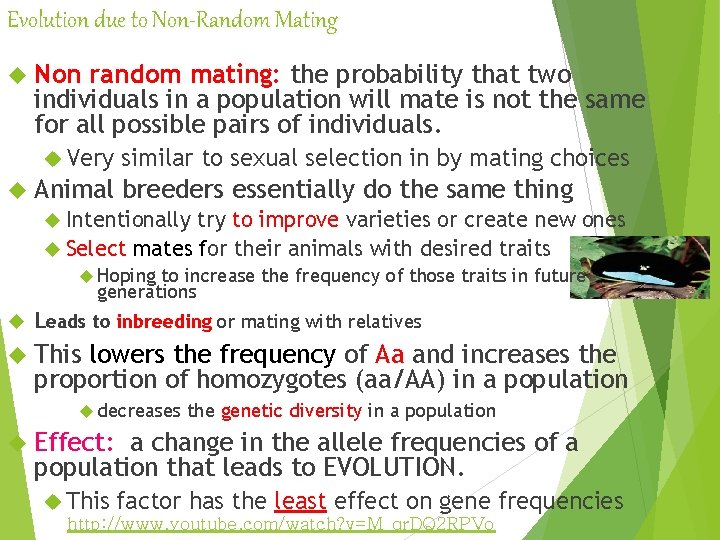
Evolution due to Non-Random Mating Non random mating: the probability that two individuals in a population will mate is not the same for all possible pairs of individuals. Very similar to sexual selection in by mating choices Animal breeders essentially do the same thing Intentionally try to improve varieties or create new ones Select mates for their animals with desired traits Hoping to increase the frequency of those traits in future generations Leads to inbreeding or mating with relatives This lowers the frequency of Aa and increases the proportion of homozygotes (aa/AA) in a population decreases the genetic diversity in a population Effect: a change in the allele frequencies of a population that leads to EVOLUTION. This factor has the least effect on gene frequencies http: //www. youtube. com/watch? v=M_qr. DQ 2 RPVo
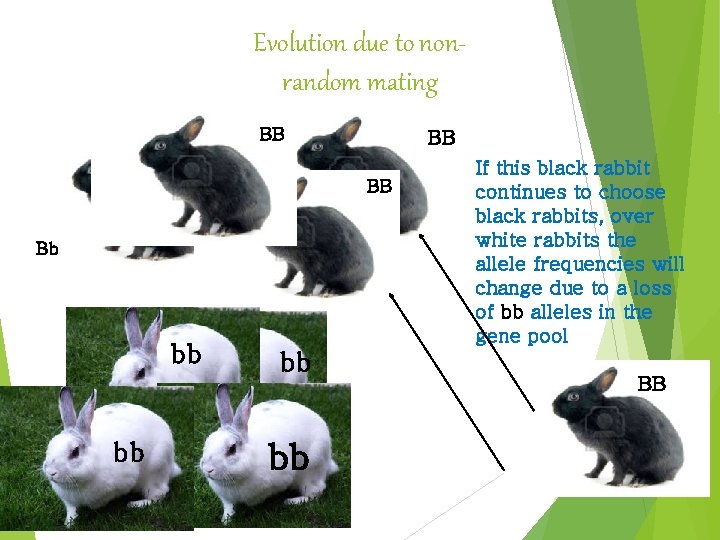
Evolution due to nonrandom mating BB BB BB Bb bb bb If this black rabbit continues to choose black rabbits, over white rabbits the allele frequencies will change due to a loss of bb alleles in the gene pool BB
Evolution due to Gene Flow Gene flow: movement of alleles in or out of a population due to migration of individuals Immigrants: Immigrants new individuals bring new alleles into the gene pool Emigrants: Results: individuals remove alleles from a gene pool a change in allele frequencies: EVOLUTION
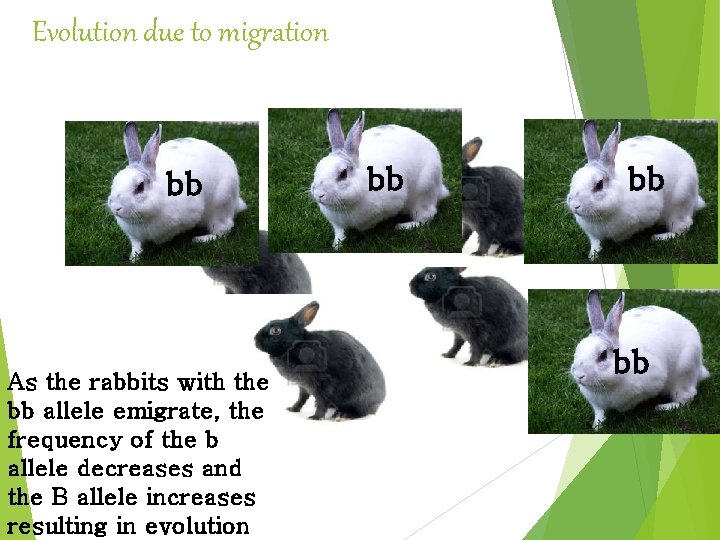
Evolution due to migration bb As the rabbits with the bb allele emigrate, the frequency of the b allele decreases and the B allele increases resulting in evolution bb bb bb
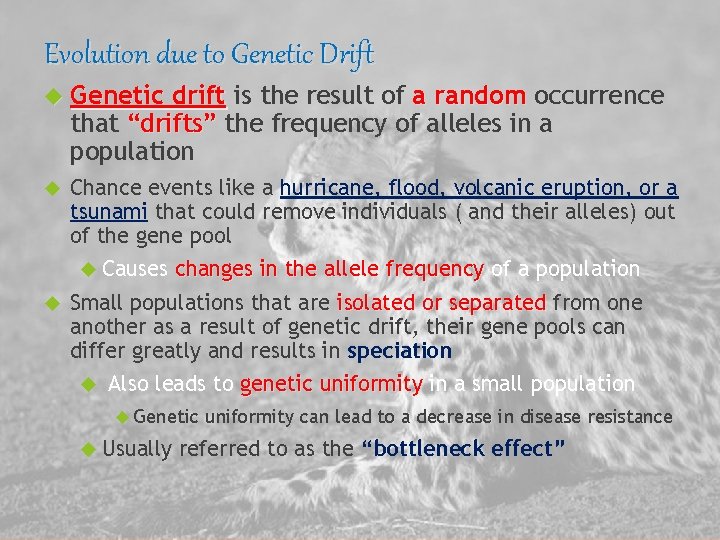
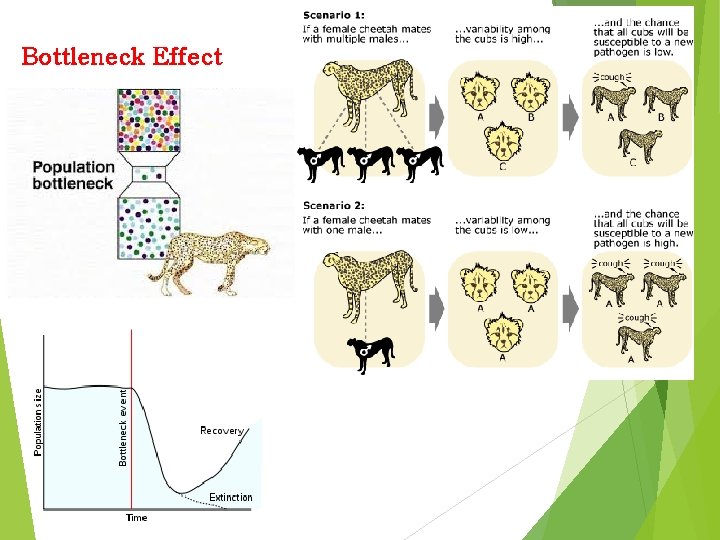
Evolution due to Genetic Drift Genetic drift is the result of a random occurrence that “drifts” the frequency of alleles in a population Chance events like a hurricane, flood, volcanic eruption, or a tsunami that could remove individuals ( and their alleles) out of the gene pool Causes changes in the allele frequency of a population Small populations that are isolated or separated from one another as a result of genetic drift, their gene pools can differ greatly and results in speciation Also leads to genetic uniformity in a small population Genetic Usually uniformity can lead to a decrease in disease resistance referred to as the “bottleneck effect”
Bottleneck Effect
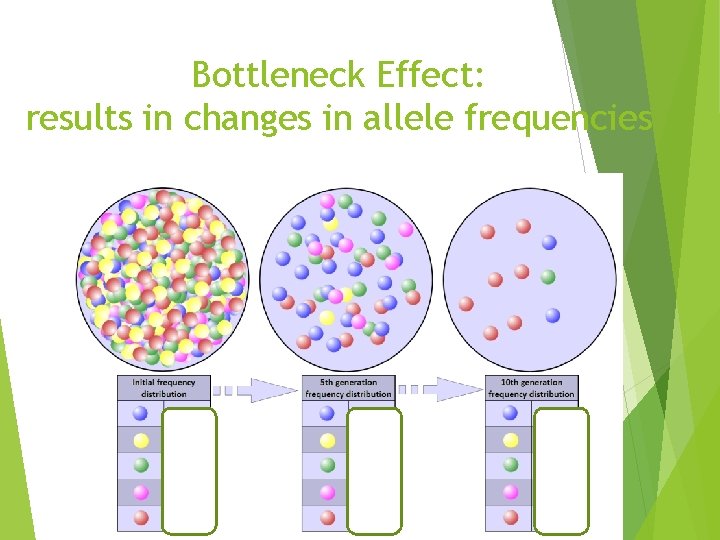
Bottleneck Effect: results in changes in allele frequencies
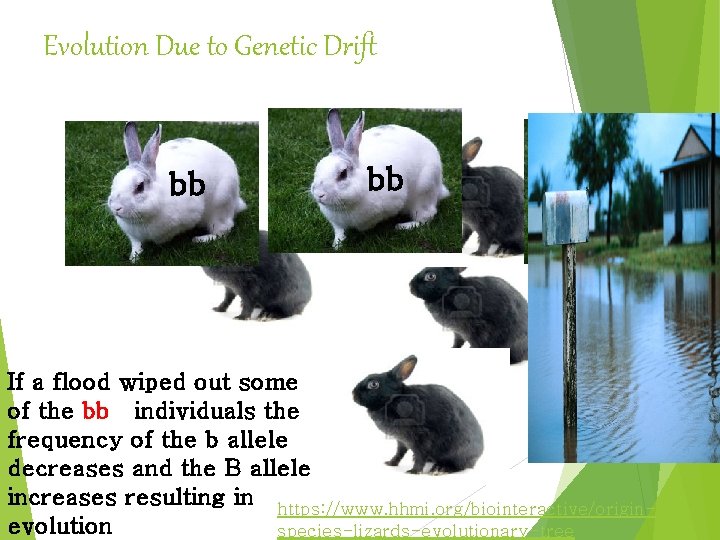
Evolution Due to Genetic Drift bb bb If a flood wiped out some of the bb individuals the frequency of the b allele decreases and the B allele increases resulting in https: //www. hhmi. org/biointeractive/originevolution species-lizards-evolutionary-tree
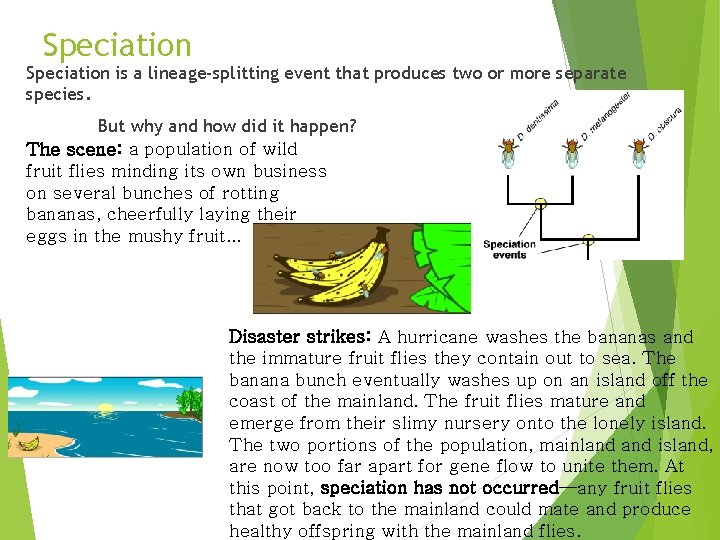
Speciation is a lineage-splitting event that produces two or more separate species. But why and how did it happen? The scene: a population of wild fruit flies minding its own business on several bunches of rotting bananas, cheerfully laying their eggs in the mushy fruit. . . Disaster strikes: A hurricane washes the bananas and the immature fruit flies they contain out to sea. The banana bunch eventually washes up on an island off the coast of the mainland. The fruit flies mature and emerge from their slimy nursery onto the lonely island. The two portions of the population, mainland island, are now too far apart for gene flow to unite them. At this point, speciation has not occurred—any fruit flies that got back to the mainland could mate and produce healthy offspring with the mainland flies.
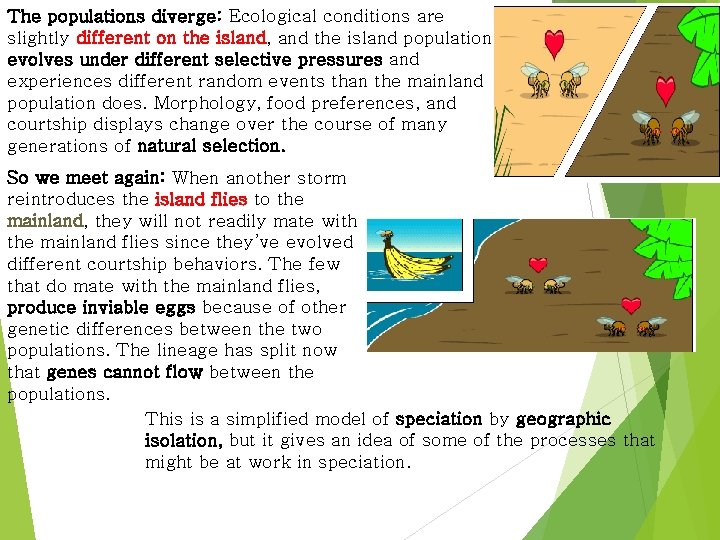
The populations diverge: Ecological conditions are slightly different on the island, and the island population evolves under different selective pressures and experiences different random events than the mainland population does. Morphology, food preferences, and courtship displays change over the course of many generations of natural selection. So we meet again: When another storm reintroduces the island flies to the mainland, they will not readily mate with the mainland flies since they’ve evolved different courtship behaviors. The few that do mate with the mainland flies, produce inviable eggs because of other genetic differences between the two populations. The lineage has split now that genes cannot flow between the populations. This is a simplified model of speciation by geographic isolation, but it gives an idea of some of the processes that might be at work in speciation.
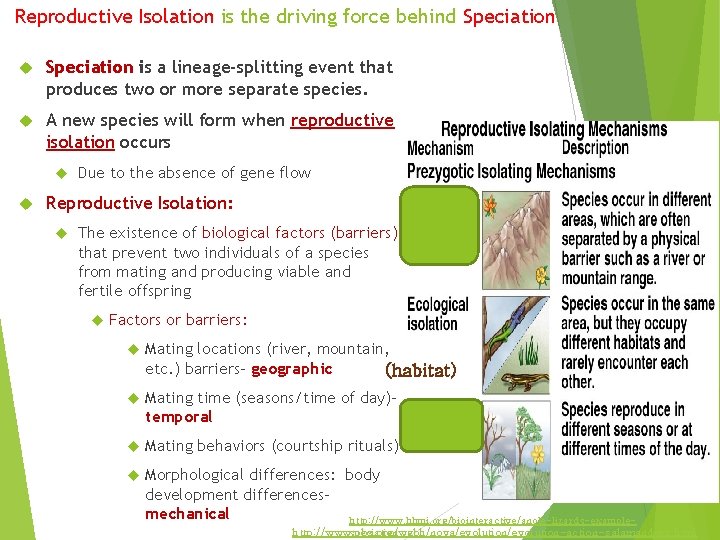
Reproductive Isolation is the driving force behind Speciation is a lineage-splitting event that produces two or more separate species. A new species will form when reproductive isolation occurs Due to the absence of gene flow Reproductive Isolation: The existence of biological factors (barriers) that prevent two individuals of a species from mating and producing viable and fertile offspring Factors or barriers: Mating locations (river, mountain, etc. ) barriers- geographic (habitat) Mating time (seasons/time of day)temporal Mating behaviors (courtship rituals) Morphological differences: body development differencesmechanical http: //www. hhmi. org/biointeractive/anole-lizards-examplehttp: //www. pbs. org/wgbh/nova/evolution-action-salamanders. html speciation