
Evolution Unit Chapters 22 23 24 AP Biology
Evolution Unit § Chapters 22, 23, 24, § AP Biology (25 and 26? ) Test on Friday, March 13, 2015

Charles Darwin (1809 -1882) • Born in England • Attended medical school, HATED IT, and dropped out to become a priest • Liked to stuff birds instead of dissect humans • Didn’t like grave robbing for bodies • Boarded the H. M. S. Beagle for a 5 year UNPAID journey as a naturalist
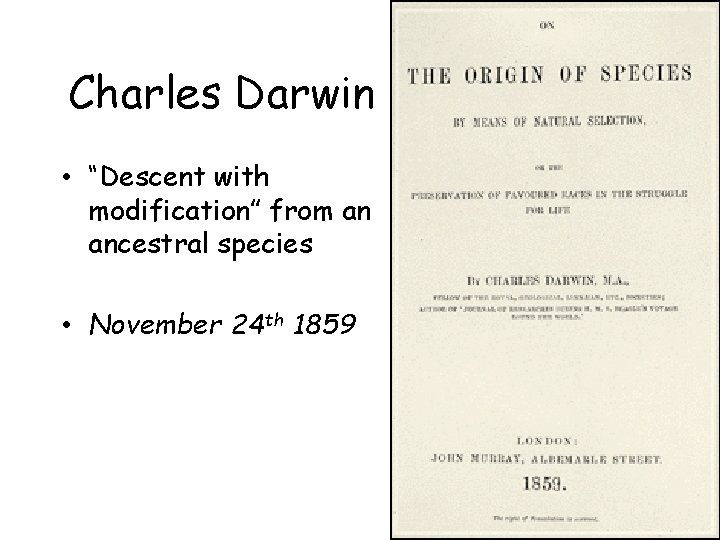
Charles Darwin • “Descent with modification” from an ancestral species • November 24 th 1859
What is Evolution? • Change in the genetic makeup of a population over time. GENE POOL! • Fitness – those with favorable variations will survive and reproduce. – Populations can evolve, not individuals. • Diverse gene pool good for long-term survival of a species. Genetic variations are important!
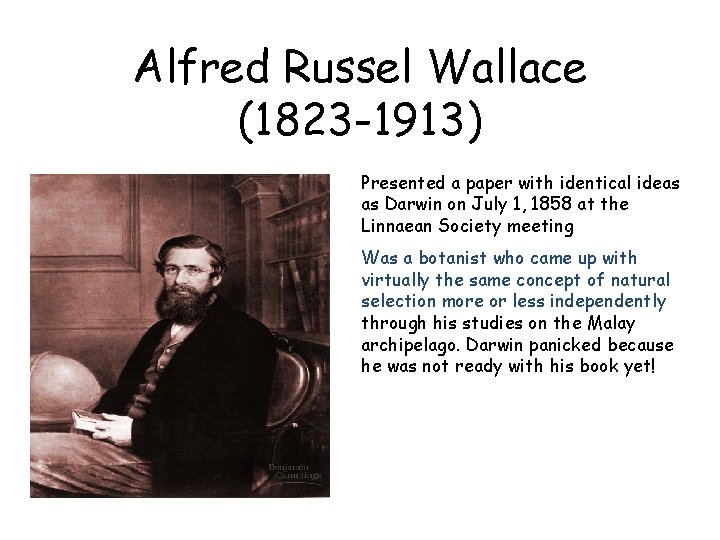
Alfred Russel Wallace (1823 -1913) Presented a paper with identical ideas as Darwin on July 1, 1858 at the Linnaean Society meeting Was a botanist who came up with virtually the same concept of natural selection more or less independently through his studies on the Malay archipelago. Darwin panicked because he was not ready with his book yet!
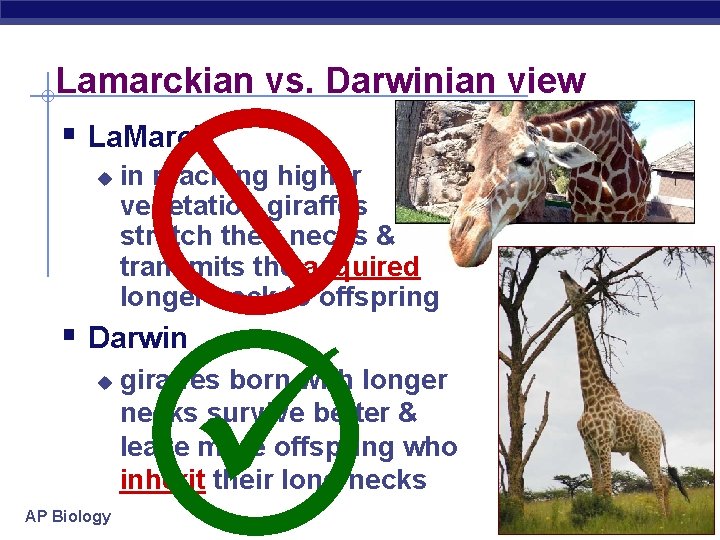
Lamarckian vs. Darwinian view § La. Marck u in reaching higher vegetation giraffes stretch their necks & transmits the acquired longer neck to offspring § Darwin u AP Biology giraffes born with longer necks survive better & leave more offspring who inherit their long necks
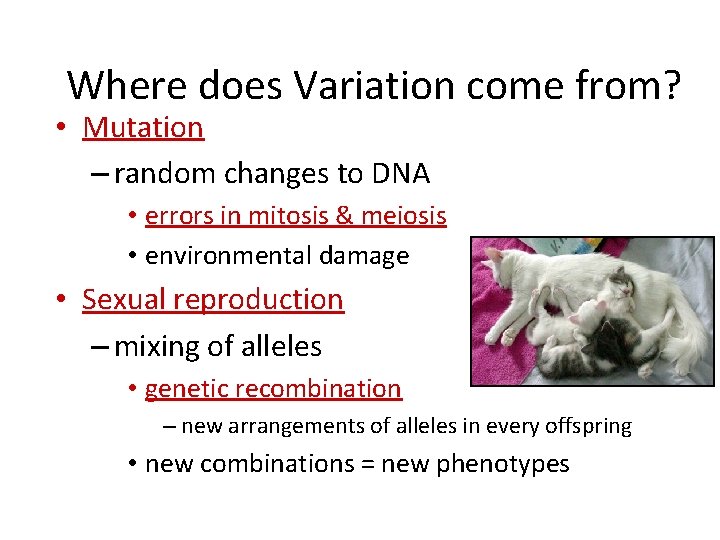
Where does Variation come from? • Mutation – random changes to DNA • errors in mitosis & meiosis • environmental damage • Sexual reproduction – mixing of alleles • genetic recombination – new arrangements of alleles in every offspring • new combinations = new phenotypes
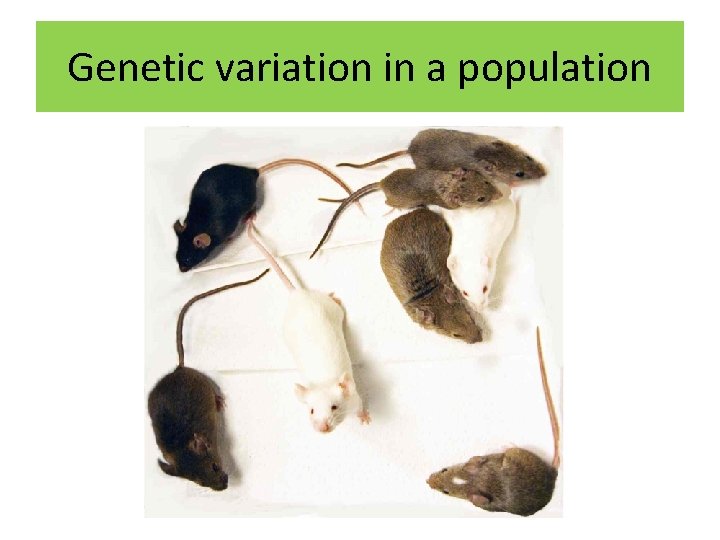
Genetic variation in a population
Evolution Things to remember: a. Individuals cannot evolve. Populations evolve. b. Natural selection is the mechanism of evolution. c. Evolution occurs by chance (NOT GOAL ORIENTED).
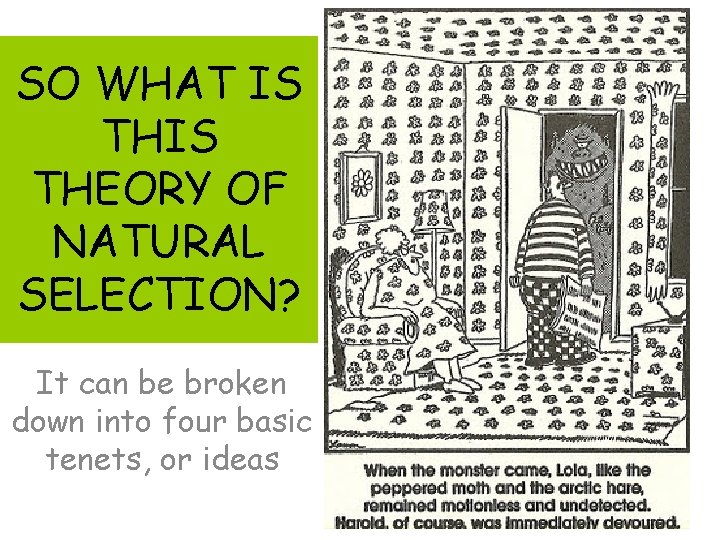
SO WHAT IS THEORY OF NATURAL SELECTION? It can be broken down into four basic tenets, or ideas
Theory of Natural Selection 1. Organisms are capable of producing huge numbers of offspring. 2. Those offspring are variable in appearance and function, and some of those variations are heritable.
Theory of Natural Selection 3. Environmental resources are limited, and those varied offspring must compete for their share. 4. Survival and reproduction of the varied offspring is not random. Those individuals whose inherited characteristics make them better able to compete for resources will live longer and leave more offspring than those not as able to compete for those limited resources.
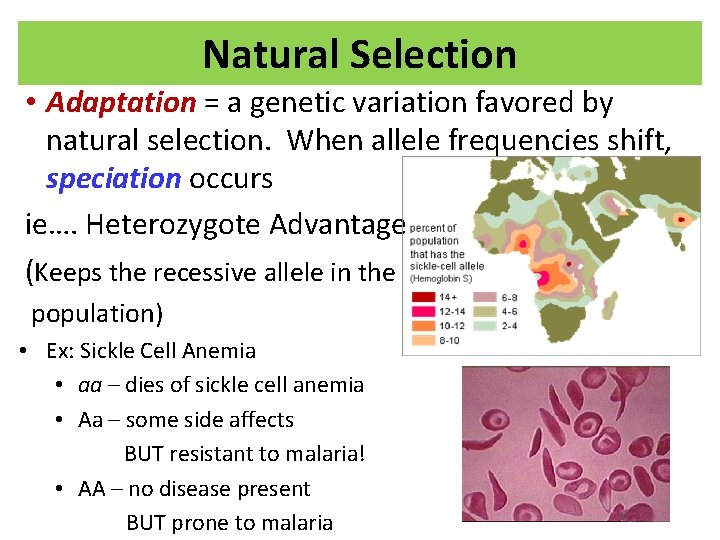
Natural Selection • Adaptation = a genetic variation favored by natural selection. When allele frequencies shift, speciation occurs ie…. Heterozygote Advantage (Keeps the recessive allele in the population) • Ex: Sickle Cell Anemia • aa – dies of sickle cell anemia • Aa – some side affects BUT resistant to malaria! • AA – no disease present BUT prone to malaria
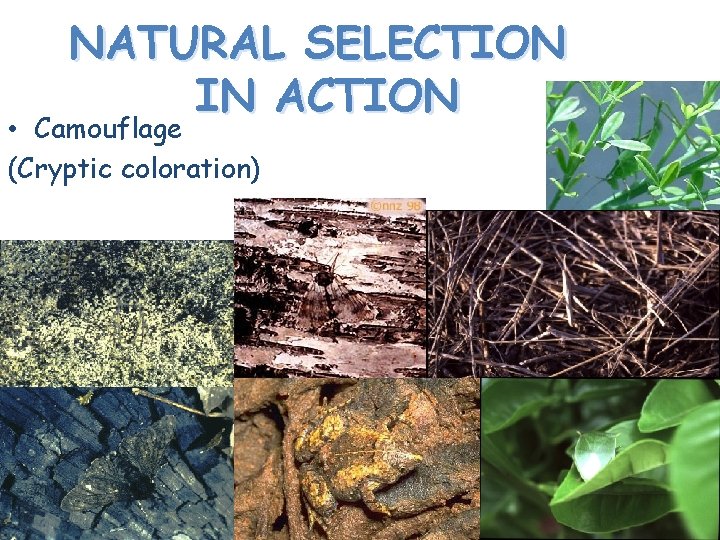
NATURAL SELECTION IN ACTION • Camouflage (Cryptic coloration)
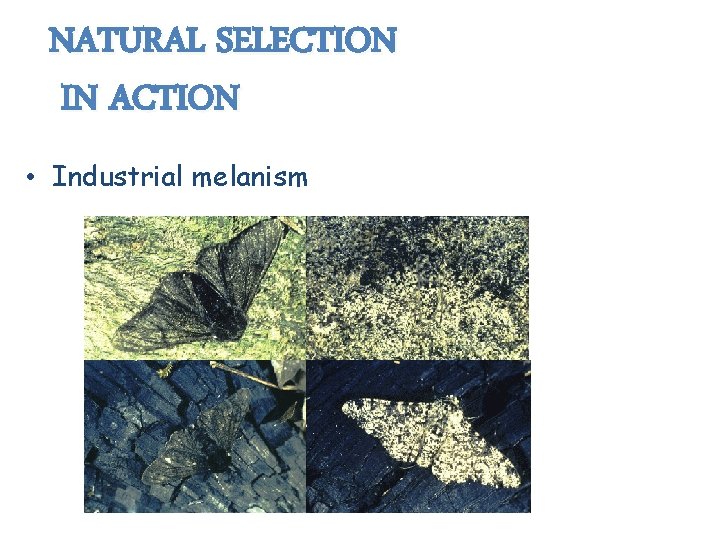
NATURAL SELECTION IN ACTION • Industrial melanism
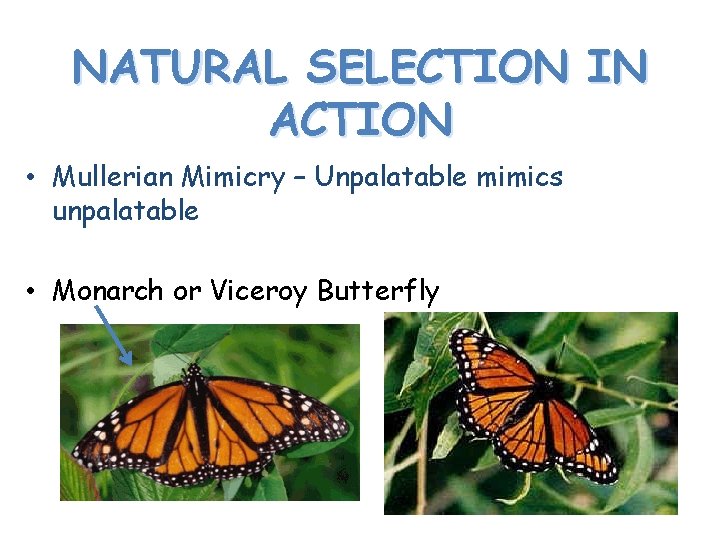
NATURAL SELECTION IN ACTION • Mullerian Mimicry – Unpalatable mimics unpalatable • Monarch or Viceroy Butterfly
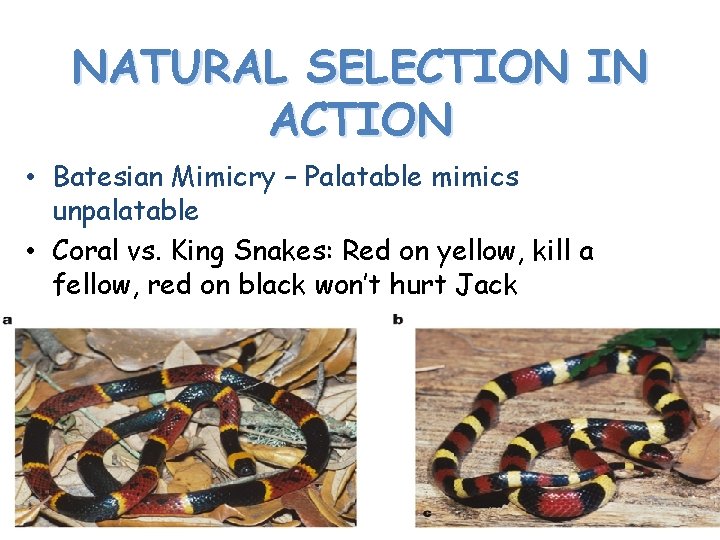
NATURAL SELECTION IN ACTION • Batesian Mimicry – Palatable mimics unpalatable • Coral vs. King Snakes: Red on yellow, kill a fellow, red on black won’t hurt Jack
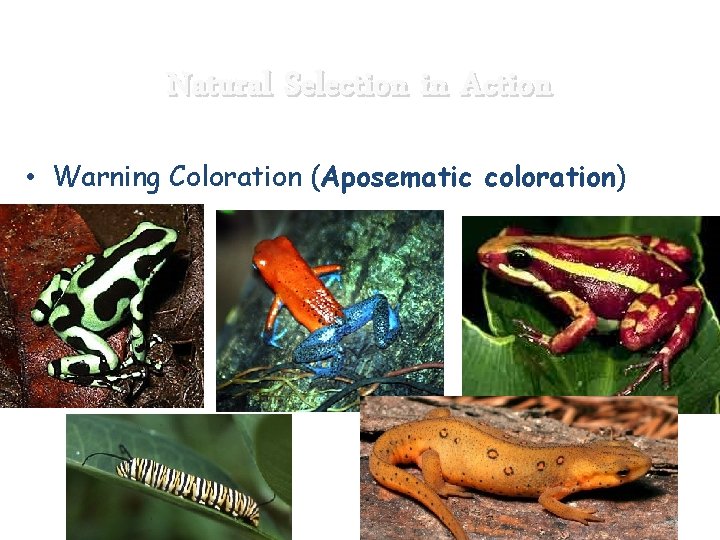
Natural Selection in Action • Warning Coloration (Aposematic coloration)
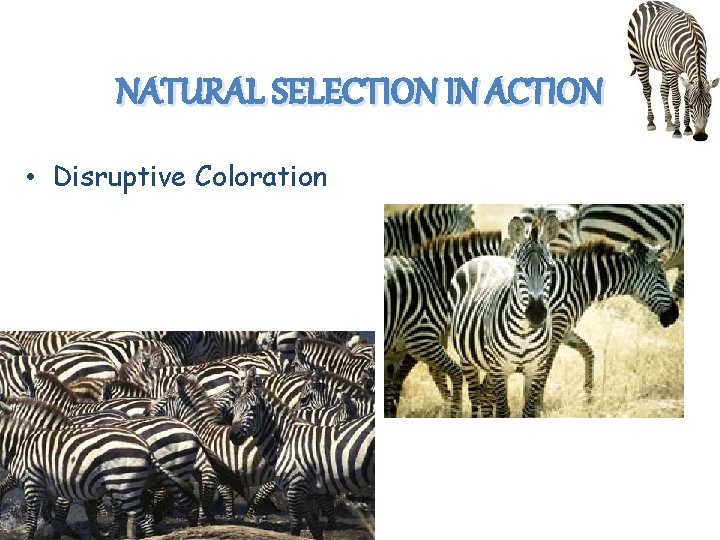
NATURAL SELECTION IN ACTION • Disruptive Coloration
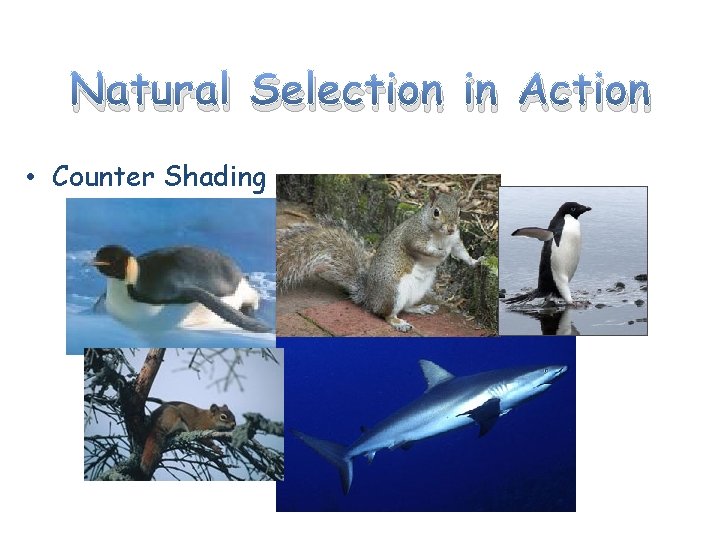
Natural Selection in Action • Counter Shading
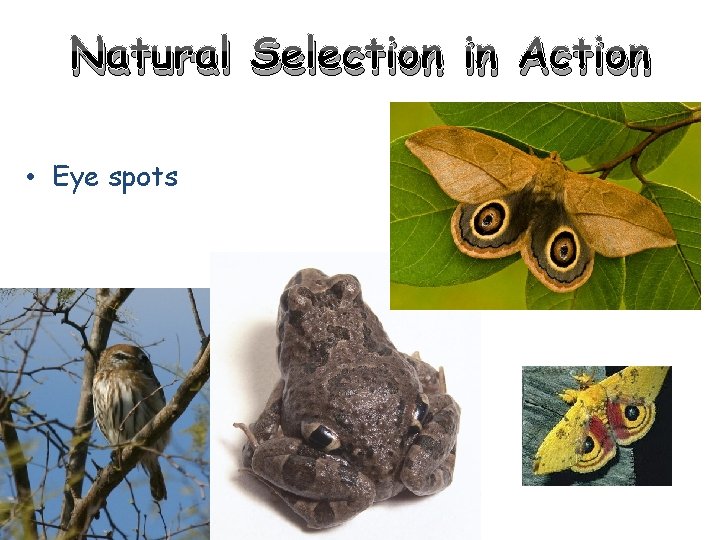
Natural Selection in Action • Eye spots
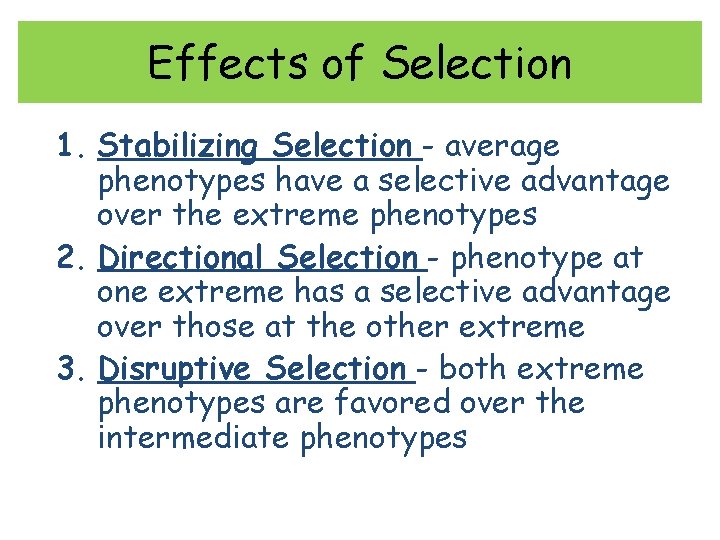
Effects of Selection 1. Stabilizing Selection - average phenotypes have a selective advantage over the extreme phenotypes 2. Directional Selection - phenotype at one extreme has a selective advantage over those at the other extreme 3. Disruptive Selection - both extreme phenotypes are favored over the intermediate phenotypes
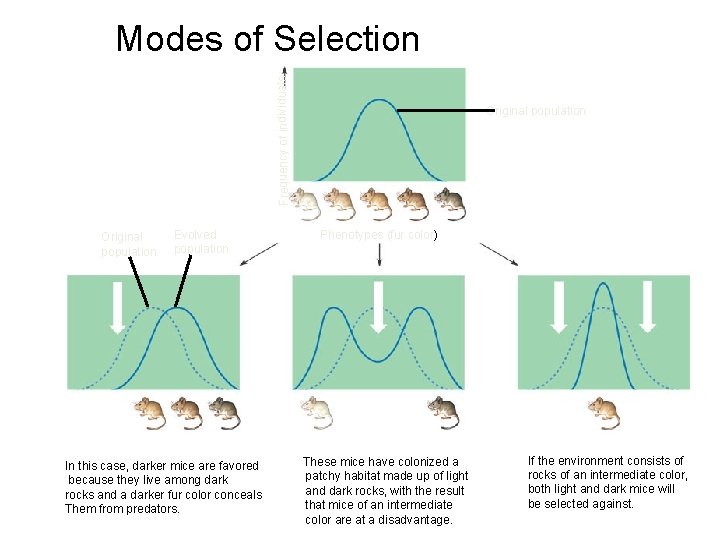
Frequency of individuals Modes of Selection Original population Evolved population In this case, darker mice are favored because they live among dark rocks and a darker fur color conceals Them from predators. Original population Phenotypes (fur color) These mice have colonized a patchy habitat made up of light and dark rocks, with the result that mice of an intermediate color are at a disadvantage. If the environment consists of rocks of an intermediate color, both light and dark mice will be selected against.
In addition to natural selection, evolutionary change is also driven by random processes… AP Biology
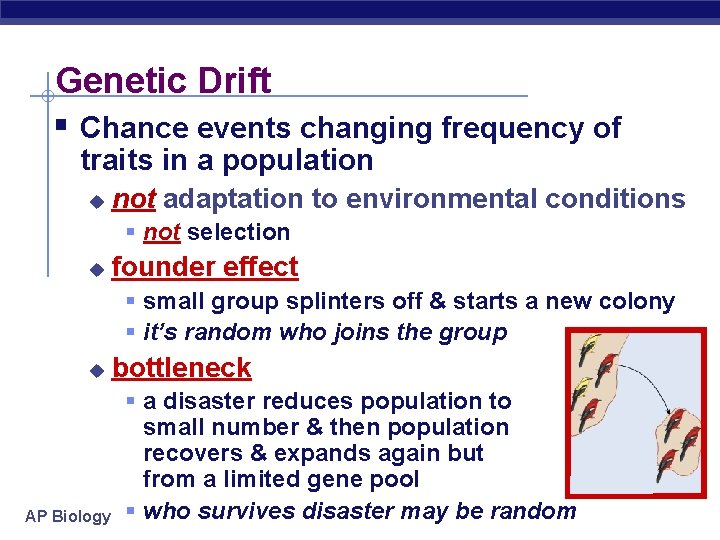
Genetic Drift § Chance events changing frequency of traits in a population u not adaptation to environmental conditions § not selection u founder effect § small group splinters off & starts a new colony § it’s random who joins the group u AP Biology bottleneck § a disaster reduces population to small number & then population recovers & expands again but from a limited gene pool § who survives disaster may be random
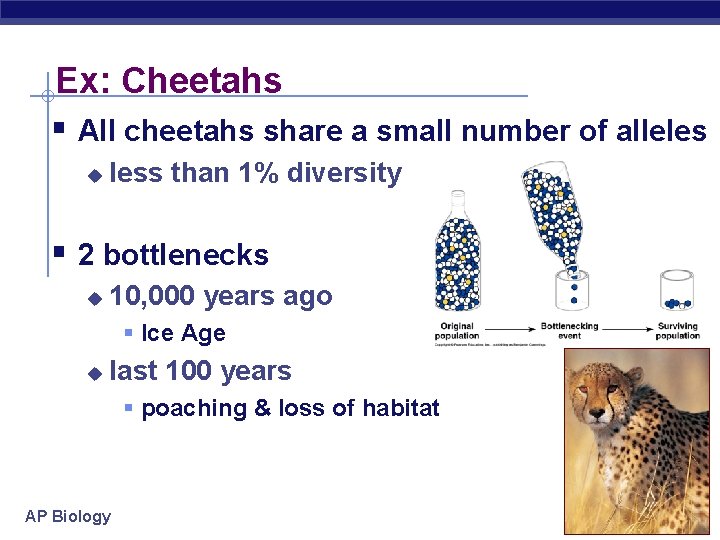
Ex: Cheetahs § All cheetahs share a small number of alleles u less than 1% diversity § 2 bottlenecks u 10, 000 years ago § Ice Age u last 100 years § poaching & loss of habitat AP Biology
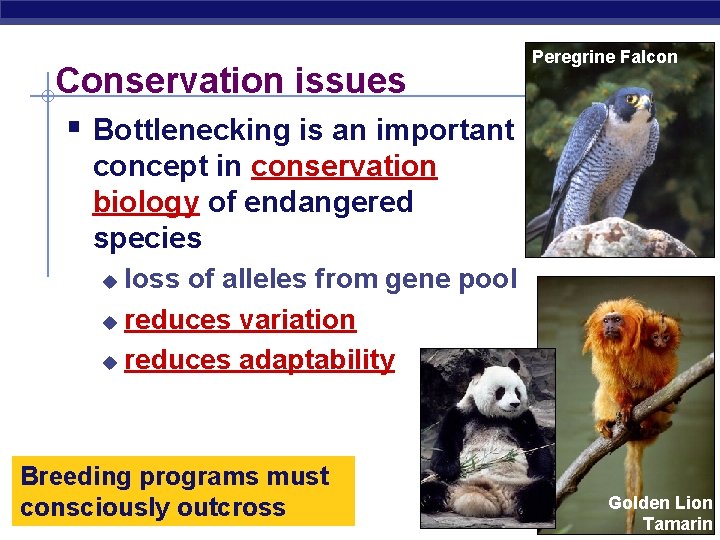
Conservation issues § Bottlenecking is an important Peregrine Falcon concept in conservation biology of endangered species loss of alleles from gene pool u reduces variation u reduces adaptability u Breeding programs must consciously outcross AP Biology Golden Lion Tamarin
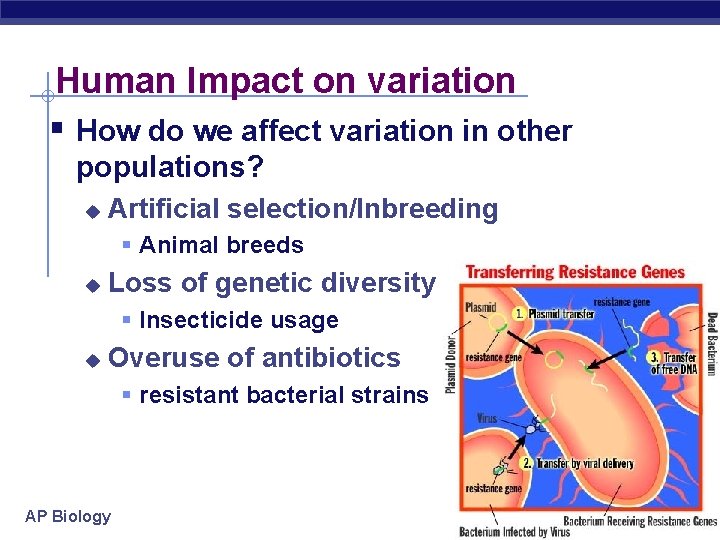
Human Impact on variation § How do we affect variation in other populations? u Artificial selection/Inbreeding § Animal breeds u Loss of genetic diversity § Insecticide usage u Overuse of antibiotics § resistant bacterial strains AP Biology
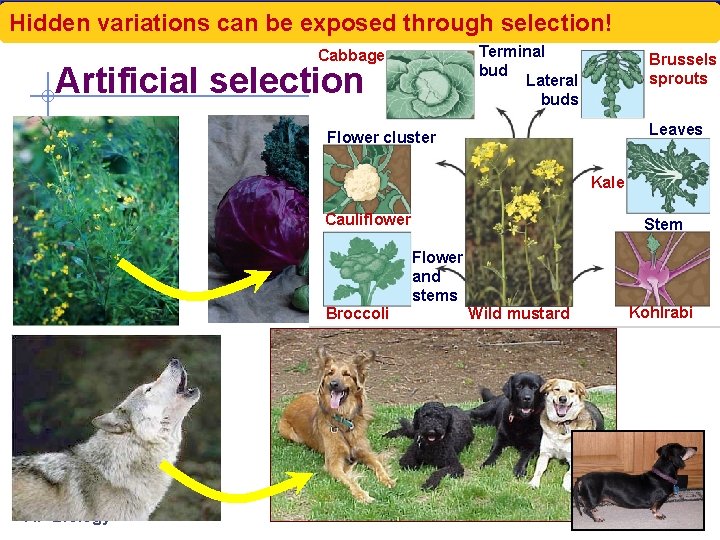
Hidden variations can be exposed through selection! Terminal bud Lateral buds Cabbage Artificial selection Brussels sprouts Leaves Flower cluster Kale Cauliflower Stem Flower and stems Broccoli AP Biology Wild mustard Kohlrabi
Note the Difference • Macroevolution -Evolutionary change above the species level e. g. the appearance of feathers on dinosaurs • Macroevolutionary change –Is the cumulative change during thousands of small speciation episodes • Microevolution –Is change in the genetic makeup of a population from generation to generation AP Biology
- Slides: 30