
EVOLUTION TEST REVIEW Are you ready 1 Evolution
- Slides: 30
EVOLUTION TEST REVIEW Are you ready? ?
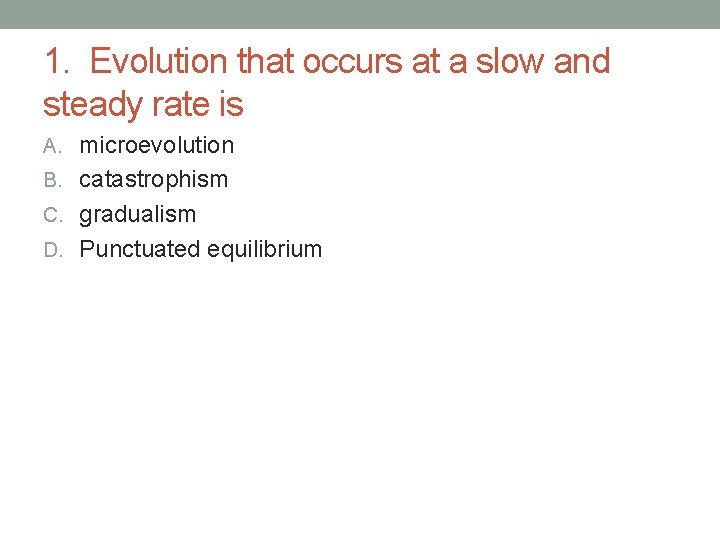
1. Evolution that occurs at a slow and steady rate is A. microevolution B. catastrophism C. gradualism D. Punctuated equilibrium
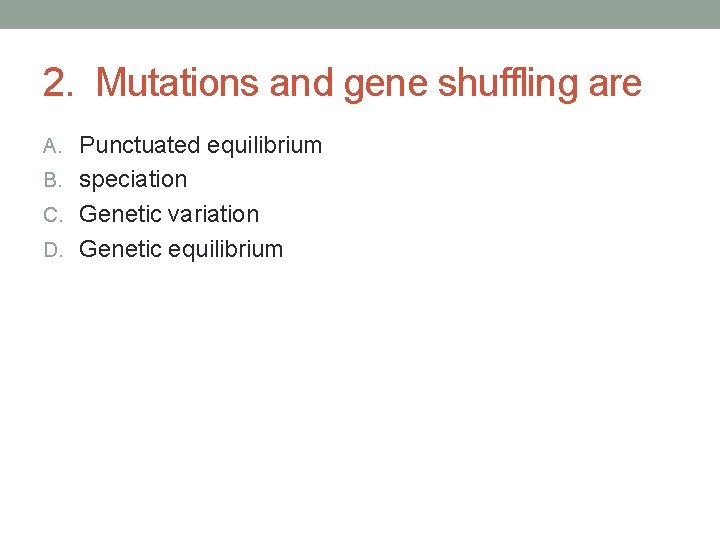
2. Mutations and gene shuffling are A. Punctuated equilibrium B. speciation C. Genetic variation D. Genetic equilibrium
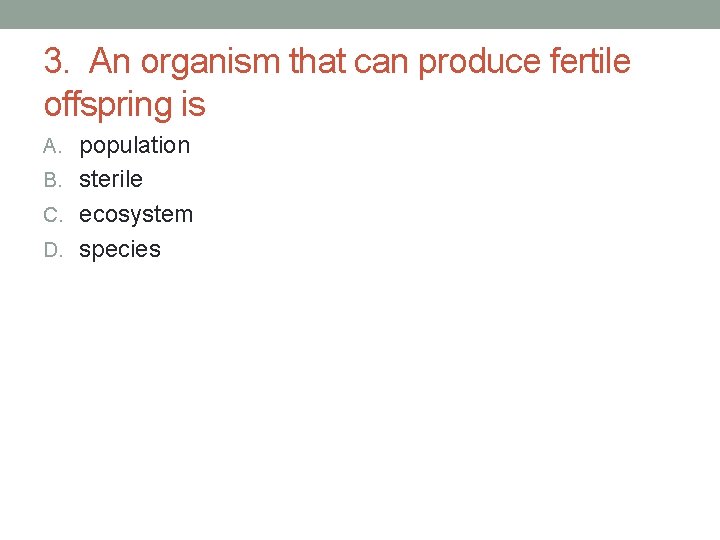
3. An organism that can produce fertile offspring is A. population B. sterile C. ecosystem D. species
4. Who wrote the Theory of Acquired Traits? A. Darwin B. Lamarck C. Lyell D. Hutton
5. Occurs when two or more species reproduce at different times. A. speciation B. Temporal isolation C. Behavioral Isolation D. Geographic isolation
6. What demonstrates evidence of endosymbiotic theory? A. Mitochondria go through binary fission. B. DNA in chloroplasts. C. DNA in Mitochondria D. All of these
7. Why are cyanobacteria significant in Earth’s history? A. They produce oxygen. B. They produce carbon dioxide. C. They created organisms through endosymbiosis. D. They became eukaryotic cells.
8. Whose theory demonstrated how a population would NOT evolve if 5 conditions are met? A. Miller and Urey B. Hardy and Weinberg C. Hutton and Lyell D. Watson and Crick
9. The ability of an organism to survive and reproduce is A. adaptation B. evolution C. fitness D. diversity
10. Evolution in which organisms evolve similar structures do to environment is A. Adaptive radiation B. Divergent Evolution C. Convergent Evolution D. gradualism
11. Geologic eras from oldest to most recent… A. Cenozoic, mesozoic, precambrian, paleozoic B. Paleozoic, mesozoic, cenozoic, precambrian C. Precambrian, paleozoic, cenozoic, mesozoic D. Precambrian, paleozoic, mesozoic, cenozoic
12. What were the earliest life forms? A. viruses B. bacteria C. fungus D. animals
13. Whose 1950 experiment showed that basic organic molecules could come from inorganic molecules? A. Hardy and Weinberg B. Miller and Urey C. Hutton and Lyell D. Watson and Crick
14. Occurs when mating rituals are different. A. Behavioral isolation B. Geographic isolation C. Temporal isolation D. Microevolution
15. What theory explains how prokaryotes became eukaryotes? A. Theory of use and disuse B. Theory of Natural Selection C. Endosymbiotic Theory D. Endergonic Theory
16. Said the human population would outgrow food supply. A. Darwin B. Malthus C. Lyell D. Hutton
17. Transitions between eras are marked by A. periods B. Mass extinctions C. Alignment of the planets D. epochs
18. Which of the following is NOT a statement of natural selection? A. Descent with modification B. Adaptation C. Overproduction D. Organisms develop the traits they need.
19. All the genetic information in a population represents A. Allele frequency B. Gene pool C. fitness D. equilibrium
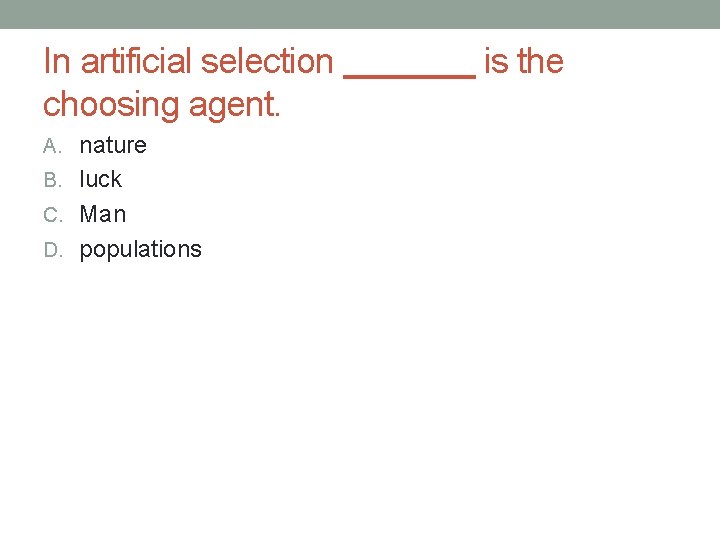
In artificial selection choosing agent. A. nature B. luck C. Man D. populations is the
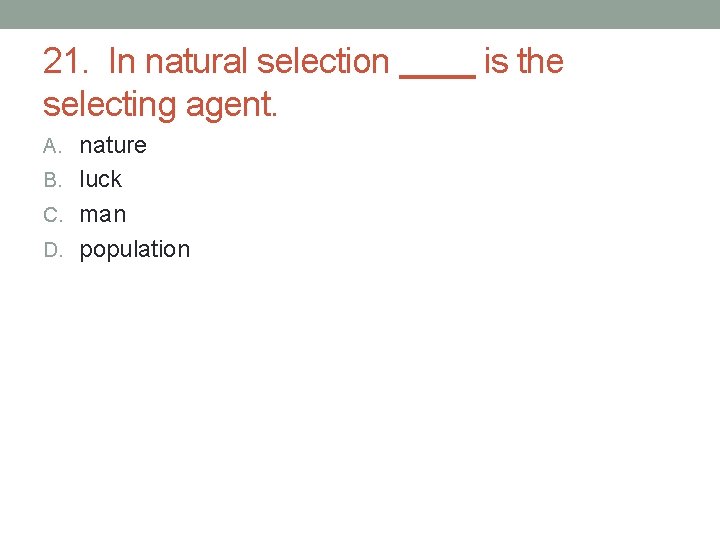
21. In natural selection selecting agent. A. nature B. luck C. man D. population is the
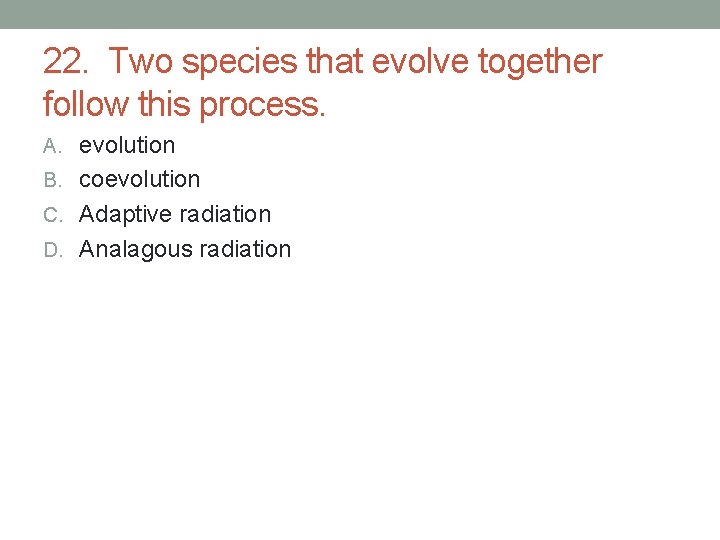
22. Two species that evolve together follow this process. A. evolution B. coevolution C. Adaptive radiation D. Analagous radiation
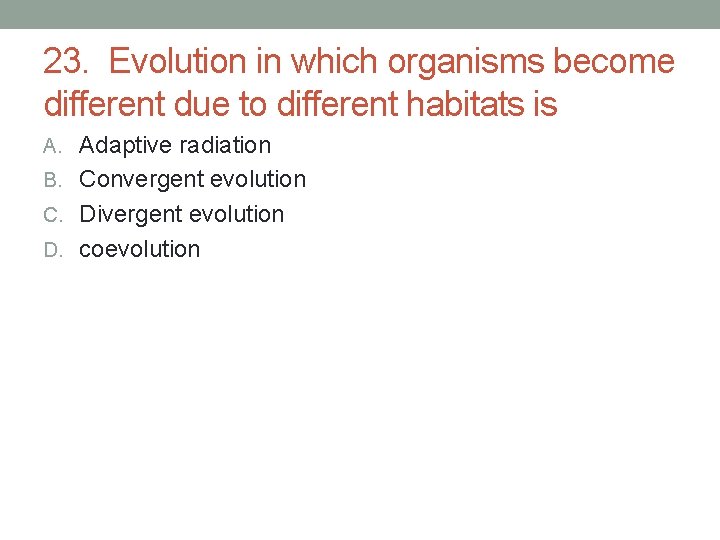
23. Evolution in which organisms become different due to different habitats is A. Adaptive radiation B. Convergent evolution C. Divergent evolution D. coevolution
24. Biochemical adaptations like venom or octopus ink are A. Physiological adaptations B. Structural adaptations C. Behavioral adaptations D. Temporal adaptations
25. Isolation due to physical barriers. A. Temporal isolation B. Geographic isolation C. Behavioral isolation D. Evolution
MAKE SURE YOU KNOW… • Darwin • Hutton/Lyell • La. Mark • Malthus • Wallace
Make sure you can identify graphs for • Directional selection • Normal selection • Disruptive selection • Stabilizing selection
The Four statements of Natural Selection: • Variation • Overproduction • Adaptation • Descent with Modification
Proof of Evolution: • Fossils • Homologous Structures • Analagous Structures • Vestigial Structures • Comparative Embryology