
Evolution Survival of the Fittest Predator Prey 1


- Slides: 9
Evolution Survival of the Fittest Predator / Prey 1
Preview of Microscope Proficiency Test Checklist for microscope test (failure to demonstrate any of the items listed below will result in a failed microscope test): 1. 2. 3. 4. 5. 6. 7. 8. 9. Slide is placed on stage between stage clips (not under the clips) Slide is focused at 4 X Uses nosepiece to change objective Does NOT use coarse adjustment knob once you have switched to a higher objective than the 4 x (ONLY FINE adjustment knob for 10 X and 40 X). Slide is focused at 10 X Slide is focused at 40 X At the end, change objective lens to 4 X (use nosepiece) Stage down Hand slide back. 2
Evolution Change in allele frequency in the population is evolution Natural selection is the mechanism by which evolution takes place If you have a trait that makes you more successful in the environment, you are more likely to successfully produce offspring and pass that trait on. “Survival of the Fittest” Ability to produce viable offspring 3
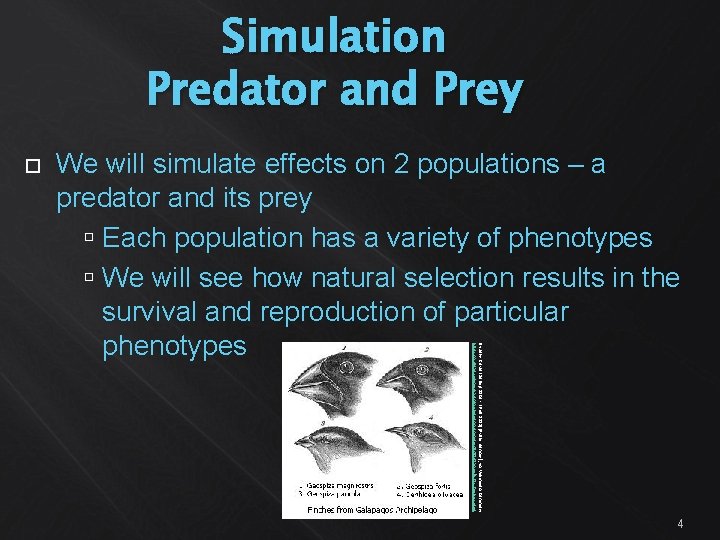
Simulation Predator and Prey By John Gould (14. Sep. 1804 - 3. Feb. 1881) [Public domain], via Wikimedia Commons https: //upload. wikimedia. org/wikipedia/commons/9/97/Darwin%27 s_finches. jpeg We will simulate effects on 2 populations – a predator and its prey Each population has a variety of phenotypes We will see how natural selection results in the survival and reproduction of particular phenotypes 4
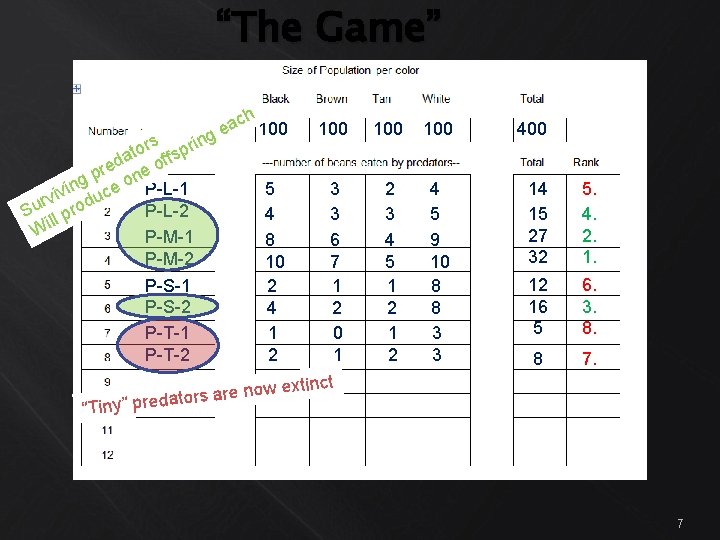
“The Game” The players: Predators – that’s you! Different size forceps will represent different phenotypes of predators. Prey – beans varying in color and size. Set up on “lawn” 100 of each color prey will be placed on lawn (400 prey) 2 predators of each phenotype will compete (8 predators) The game: For 60 seconds, while holding the forceps vertically, predators will “eat” beans and place them into their stomach (small plastic cup) 5
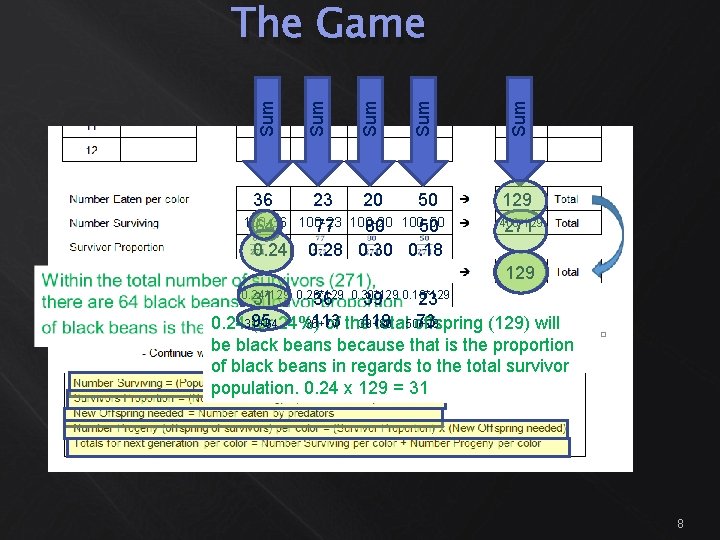
The winners: “The Game” The four most successful predators (measured by # of beans captured) will win while the other four will be eliminated. Each of the 4 winning predators have one offspring of its kind resulting in 8 predators for next round The “other” winners: Surviving beans! By counting the eaten beans per color, calculate the remaining beans per color on the lawn The color with the most beans (most successful beans) will have the most offspring. The next round calls for 400 beans to start with The total number of eaten beans has to be replaced by offspring. Since offspring depends on number of survivors per color, the surviving ratio will be used to determine the offspring per color. 6
“The Game” ch a g e rin s tor ffsp a d o e r p one g ivin duce P-L-1 v r P-L-2 Su l pro l i W P-M-1 P-M-2 P-S-1 P-S-2 P-T-1 P-T-2 ators “Tiny” pred 100 100 400 14 5 3 2 4 4 3 5 15 27 8 6 4 9 32 10 7 5 10 12 2 1 8 16 4 2 8 5 1 0 1 3 2 1 2 3 8 ow extinct 5. 4. 2. 1. 6. 3. 8. 7. are n 7
Sum Sum Sum The Game 36 23 20 50 129 100 -36 100 -23 100 -20 100 -50 400 -129 64 77 80 50 271 0. 24 0. 28 0. 30 0. 18 129 0. 24*129 0. 28*129 0. 30*129 0. 18*129 31 36 39 23 95 113 119 73 31+64 36+77 39+80 50+23 0. 24 (or 24%) of the total offspring (129) will be black beans because that is the proportion of black beans in regards to the total survivor population. 0. 24 x 129 = 31 8
List of Activities 1. 2. 3. “To. Do” page 114 Complete sheets 116 – 118 Answer all questions page 119 Preparation for next Lab: Practice the with a Microscope Finish all activities from all exercises in your Lab Manual. 9