
Evolution strategies Luis Mart DEEPUCRio ES quick overview

- Slides: 30
Evolution strategies Luis Martí DEE/PUC-Rio
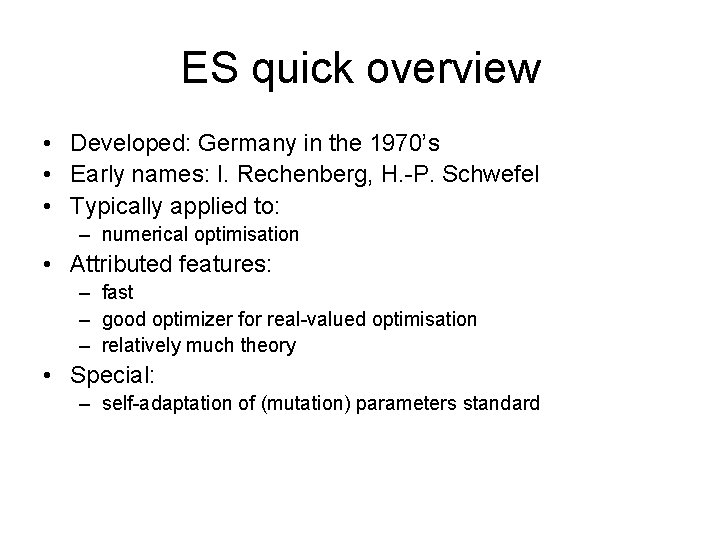
ES quick overview • Developed: Germany in the 1970’s • Early names: I. Rechenberg, H. -P. Schwefel • Typically applied to: – numerical optimisation • Attributed features: – fast – good optimizer for real-valued optimisation – relatively much theory • Special: – self-adaptation of (mutation) parameters standard
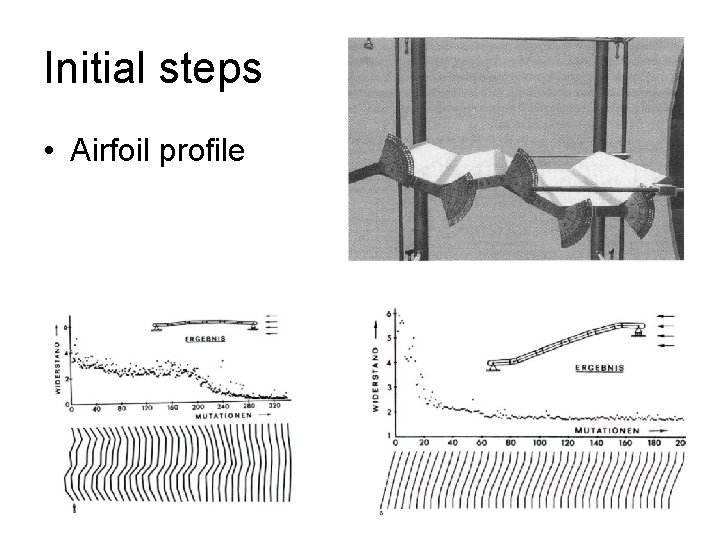
Initial steps • Airfoil profile
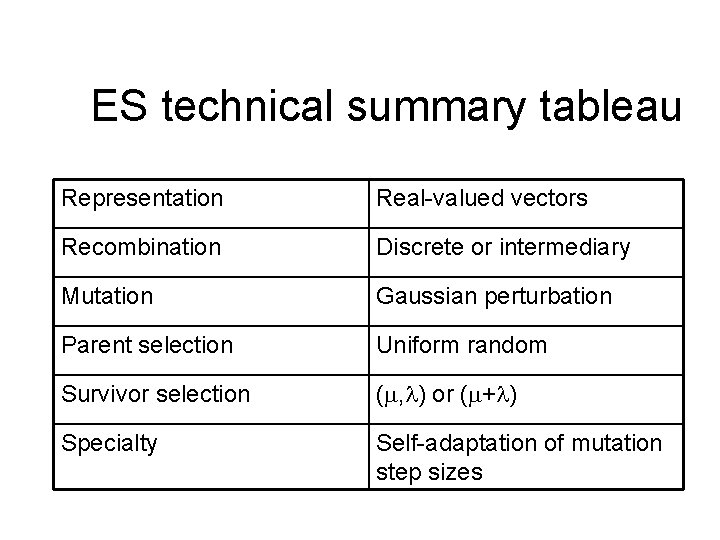
ES technical summary tableau Representation Real-valued vectors Recombination Discrete or intermediary Mutation Gaussian perturbation Parent selection Uniform random Survivor selection ( , ) or ( + ) Specialty Self-adaptation of mutation step sizes
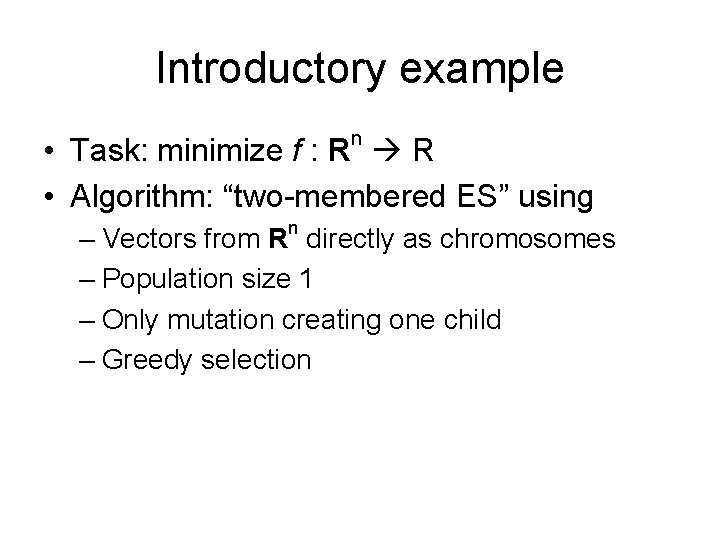
Introductory example n • Task: minimize f : R R • Algorithm: “two-membered ES” using n – Vectors from R directly as chromosomes – Population size 1 – Only mutation creating one child – Greedy selection
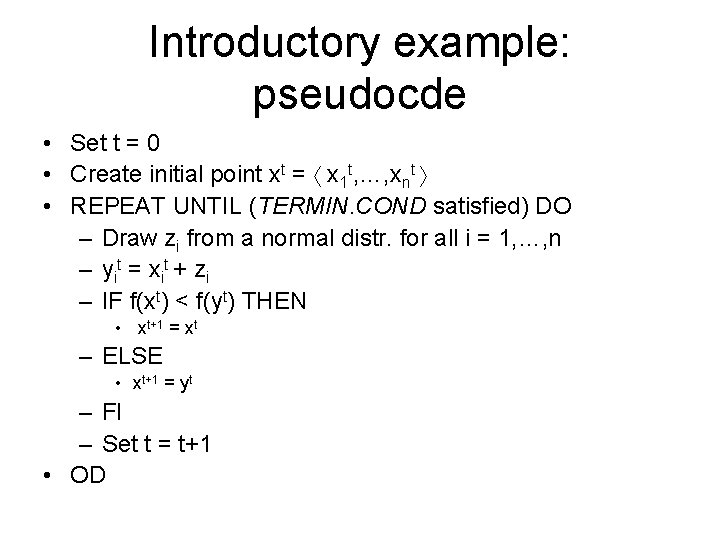
Introductory example: pseudocde • Set t = 0 • Create initial point xt = x 1 t, …, xnt • REPEAT UNTIL (TERMIN. COND satisfied) DO – Draw zi from a normal distr. for all i = 1, …, n – yit = xit + zi – IF f(xt) < f(yt) THEN • xt+1 = xt – ELSE • xt+1 = yt – FI – Set t = t+1 • OD
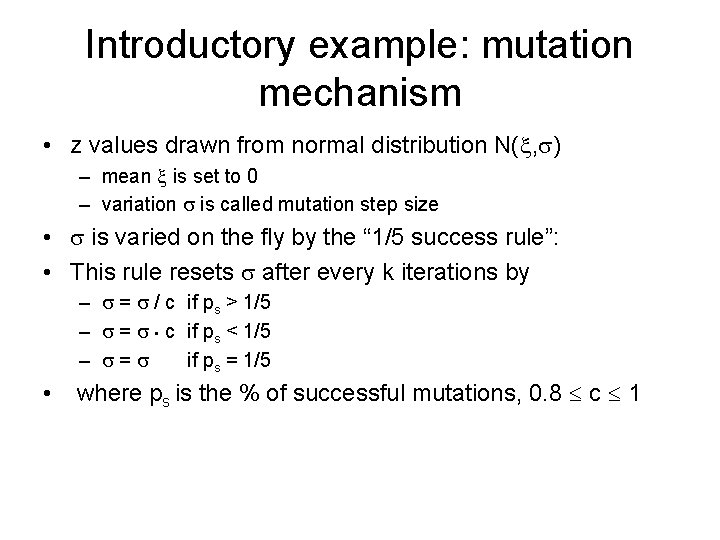
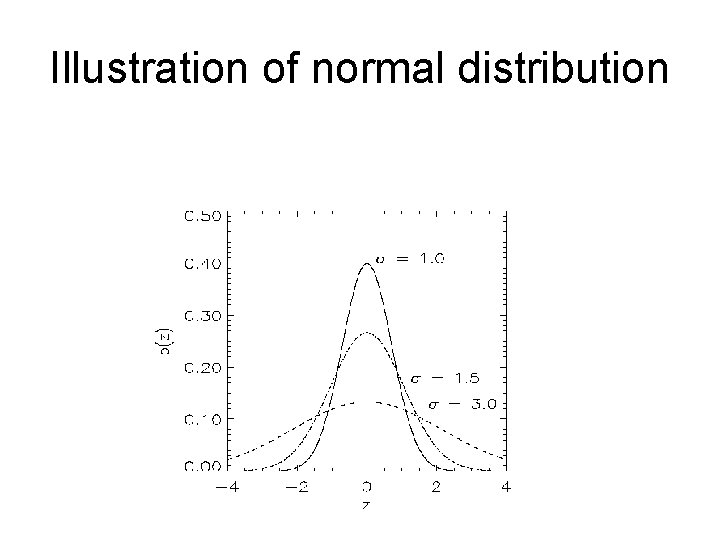
Introductory example: mutation mechanism • z values drawn from normal distribution N( , ) – mean is set to 0 – variation is called mutation step size • is varied on the fly by the “ 1/5 success rule”: • This rule resets after every k iterations by – = / c if ps > 1/5 – = • c if ps < 1/5 – = if ps = 1/5 • where ps is the % of successful mutations, 0. 8 c 1
Illustration of normal distribution
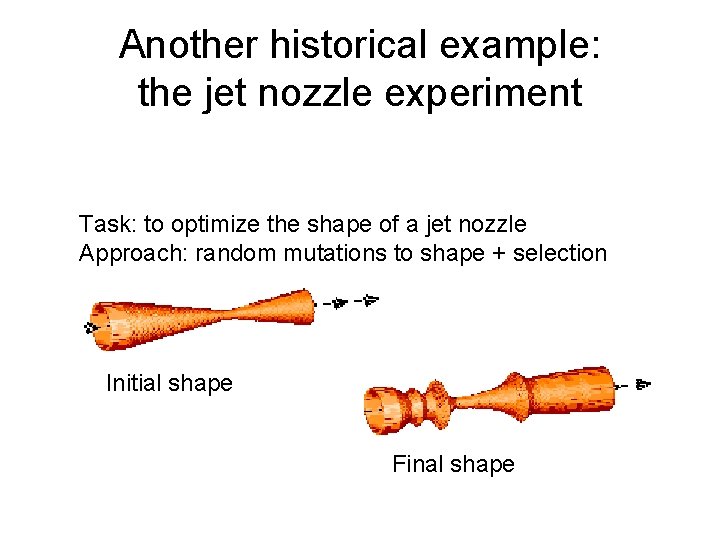
Another historical example: the jet nozzle experiment Task: to optimize the shape of a jet nozzle Approach: random mutations to shape + selection Initial shape Final shape
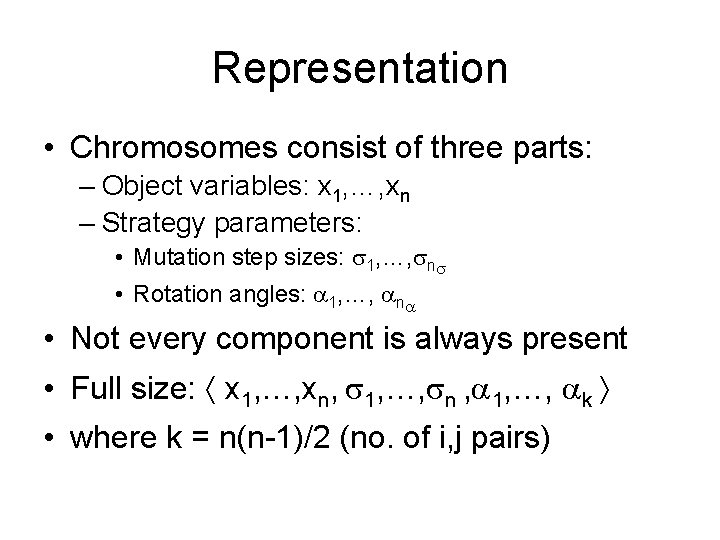
Representation • Chromosomes consist of three parts: – Object variables: x 1, …, xn – Strategy parameters: • Mutation step sizes: 1, …, n • Rotation angles: 1, …, n • Not every component is always present • Full size: x 1, …, xn, 1, …, n , 1, …, k • where k = n(n-1)/2 (no. of i, j pairs)
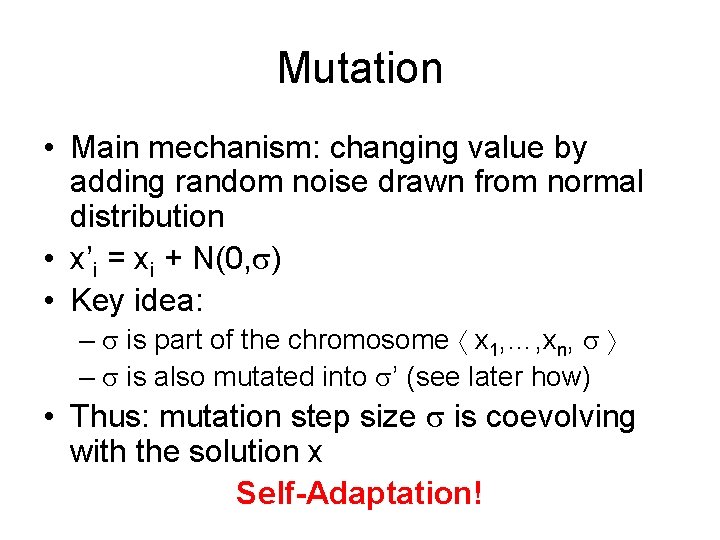
Mutation • Main mechanism: changing value by adding random noise drawn from normal distribution • x’i = xi + N(0, ) • Key idea: – is part of the chromosome x 1, …, xn, – is also mutated into ’ (see later how) • Thus: mutation step size is coevolving with the solution x Self-Adaptation!
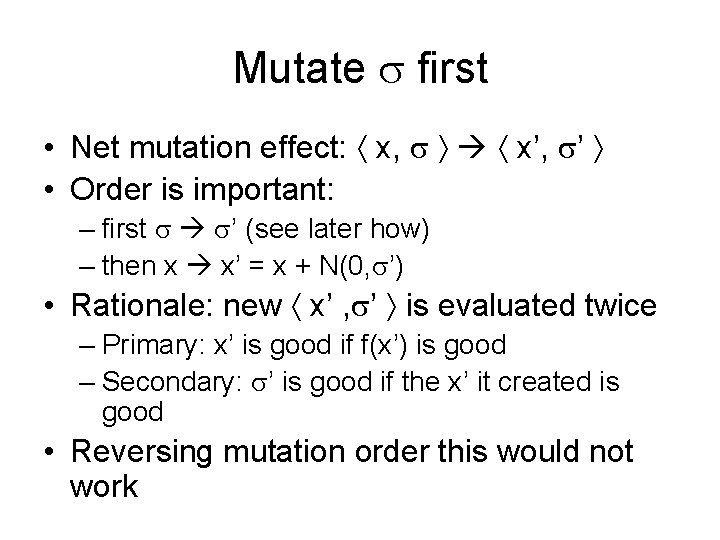
Mutate first • Net mutation effect: x, x’, ’ • Order is important: – first ’ (see later how) – then x x’ = x + N(0, ’) • Rationale: new x’ , ’ is evaluated twice – Primary: x’ is good if f(x’) is good – Secondary: ’ is good if the x’ it created is good • Reversing mutation order this would not work
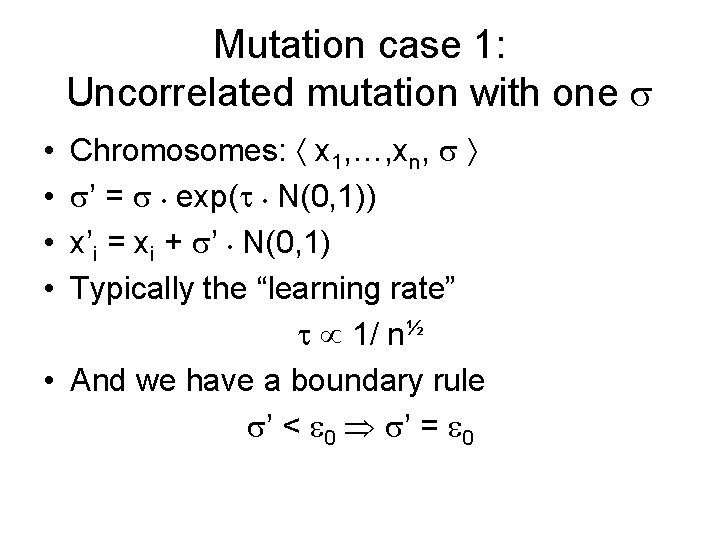
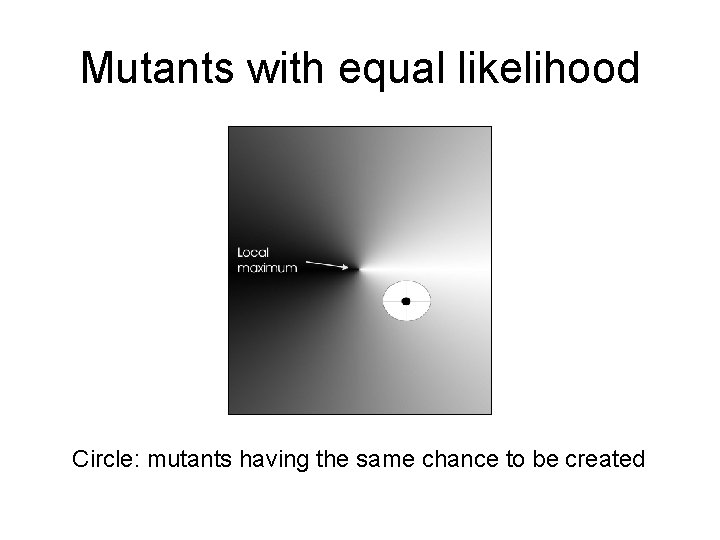
Mutation case 1: Uncorrelated mutation with one Chromosomes: x 1, …, xn, ’ = • exp( • N(0, 1)) x’i = xi + ’ • N(0, 1) Typically the “learning rate” 1/ n½ • And we have a boundary rule ’ < 0 ’ = 0 • •
Mutants with equal likelihood Circle: mutants having the same chance to be created
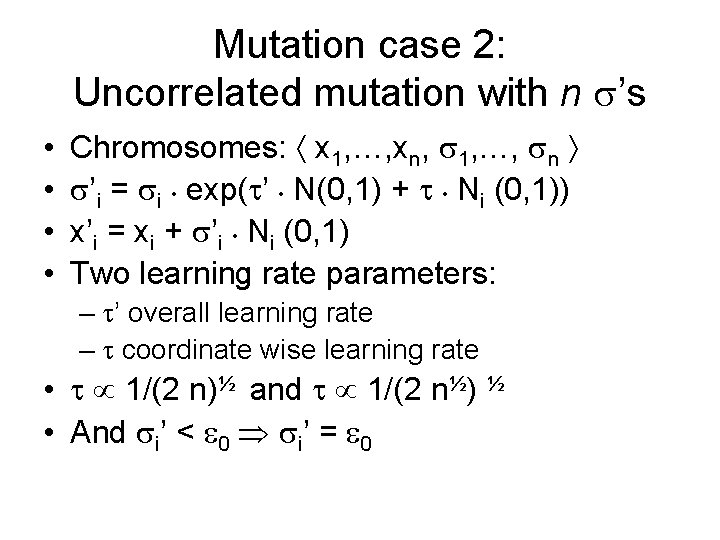
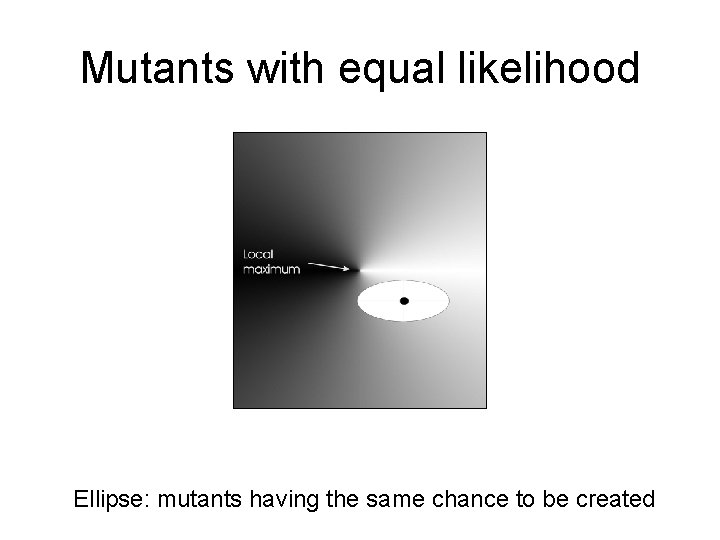
Mutation case 2: Uncorrelated mutation with n ’s • • Chromosomes: x 1, …, xn, 1, …, n ’i = i • exp( ’ • N(0, 1) + • Ni (0, 1)) x’i = xi + ’i • Ni (0, 1) Two learning rate parameters: – ’ overall learning rate – coordinate wise learning rate • 1/(2 n)½ and 1/(2 n½) ½ • And i’ < 0 i’ = 0
Mutants with equal likelihood Ellipse: mutants having the same chance to be created
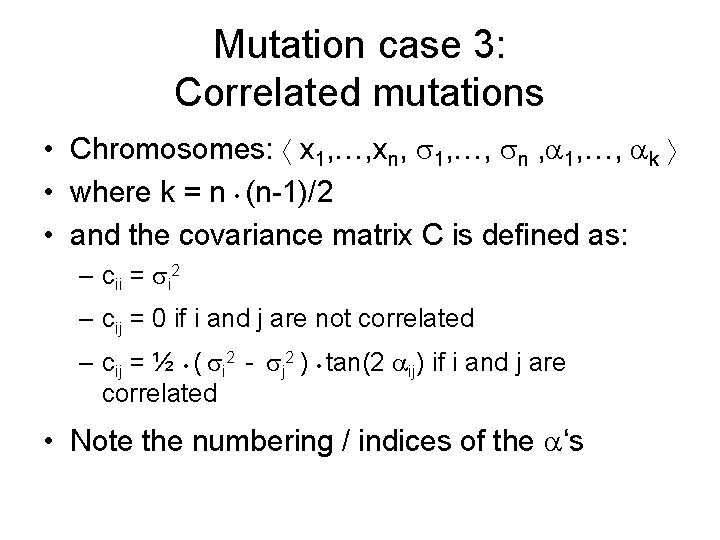
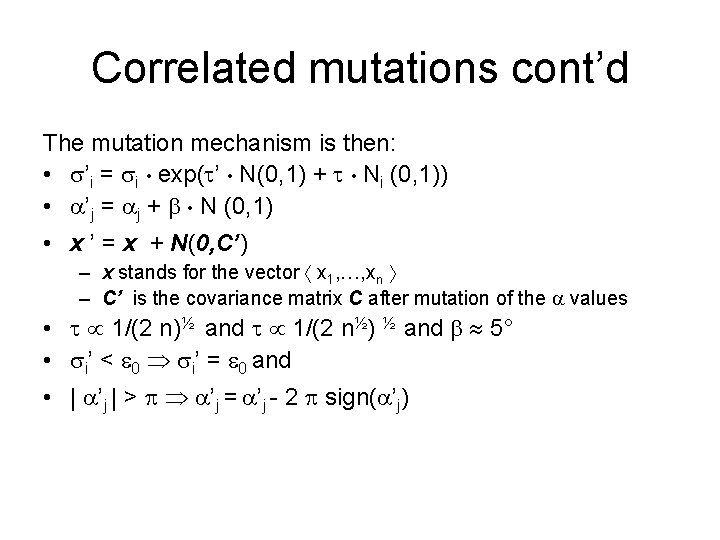
Mutation case 3: Correlated mutations • Chromosomes: x 1, …, xn, 1, …, n , 1, …, k • where k = n • (n-1)/2 • and the covariance matrix C is defined as: – cii = i 2 – cij = 0 if i and j are not correlated – cij = ½ • ( i 2 - j 2 ) • tan(2 ij) if i and j are correlated • Note the numbering / indices of the ‘s
Correlated mutations cont’d The mutation mechanism is then: • ’i = i • exp( ’ • N(0, 1) + • Ni (0, 1)) • ’j = j + • N (0, 1) • x ’ = x + N(0, C’) – x stands for the vector x 1, …, xn – C’ is the covariance matrix C after mutation of the values • 1/(2 n)½ and 1/(2 n½) ½ and 5° • i’ < 0 i’ = 0 and • | ’j | > ’j = ’j - 2 sign( ’j)
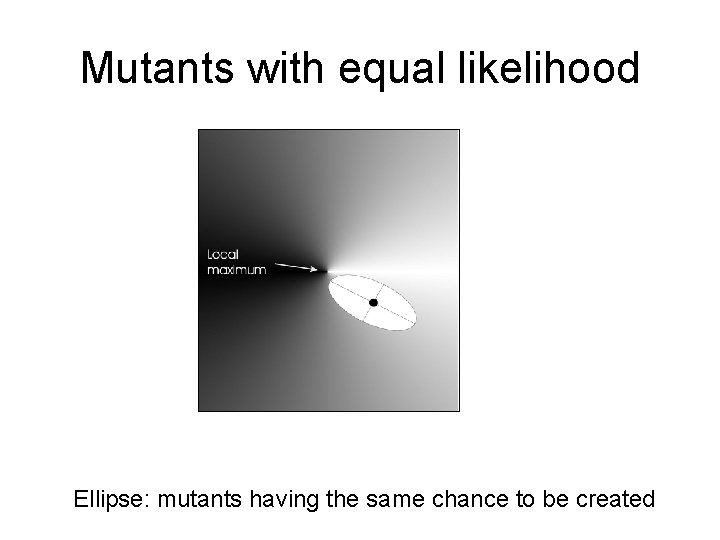
Mutants with equal likelihood Ellipse: mutants having the same chance to be created
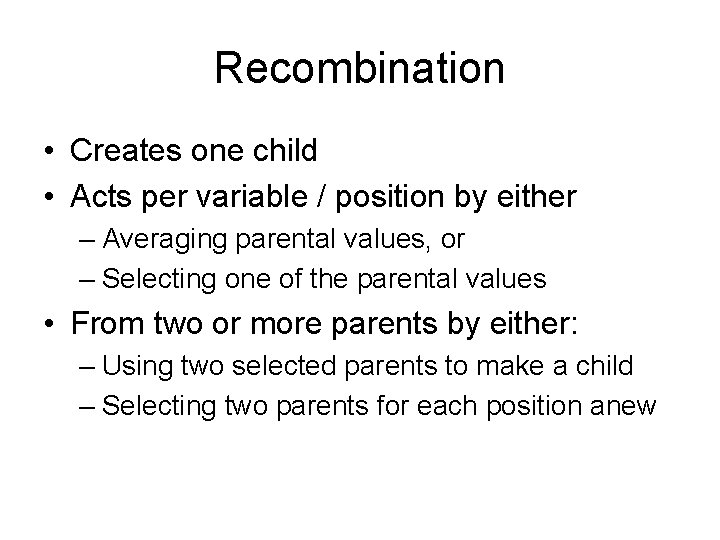
Recombination • Creates one child • Acts per variable / position by either – Averaging parental values, or – Selecting one of the parental values • From two or more parents by either: – Using two selected parents to make a child – Selecting two parents for each position anew
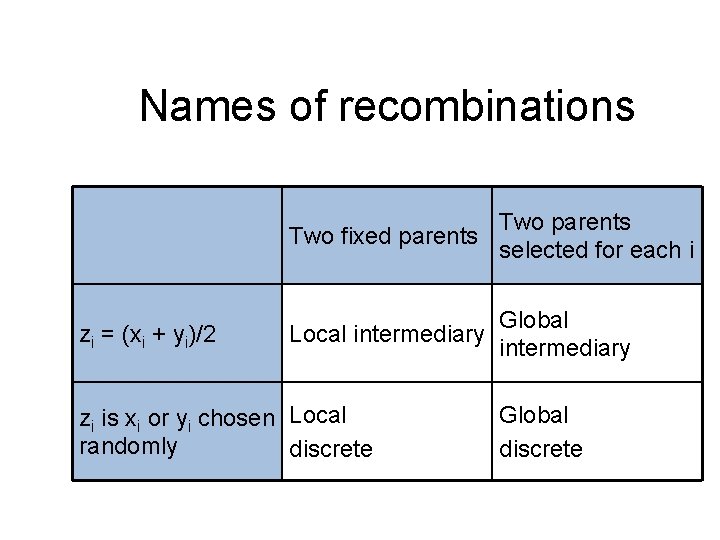
Names of recombinations Two fixed parents zi = (xi + yi)/2 Two parents selected for each i Global Local intermediary zi is xi or yi chosen Local randomly discrete Global discrete
Parent selection • Parents are selected by uniform random distribution whenever an operator needs one/some • Thus: ES parent selection is unbiased every individual has the same probability to be selected • Note that in ES “parent” means a population member (in GA’s: a population member selected to undergo variation)
Survivor selection • Applied after creating children from the parents by mutation and recombination • Deterministically chops off the “bad stuff” • Basis of selection is either: – The set of children only: ( , )-selection – The set of parents and children: ( + )selection
Survivor selection cont’d • ( + )-selection is an elitist strategy • ( , )-selection can “forget” • Often ( , )-selection is preferred for: – Better in leaving local optima – Better in following moving optima – Using the + strategy bad values can survive in x, too long if their host x is very fit • Selective pressure in ES is very high ( 7 • is the common setting)
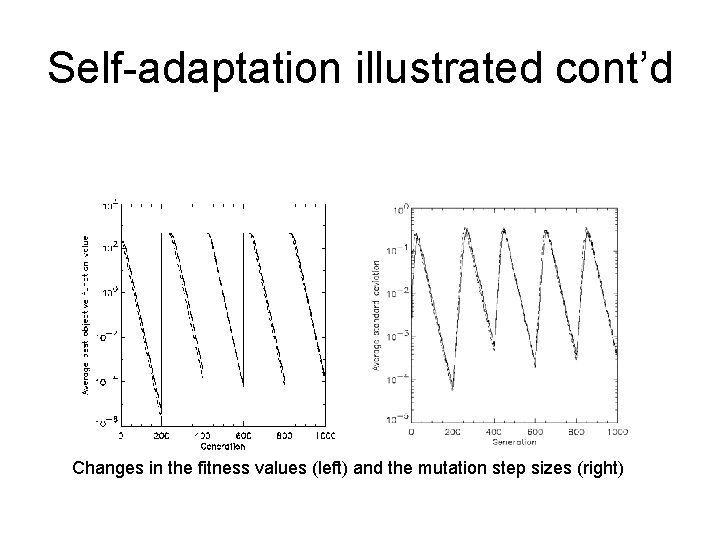
Self-adaptation illustrated • Given a dynamically changing fitness landscape (optimum location shifted every 200 generations) • Self-adaptive ES is able to – follow the optimum and – adjust the mutation step size after every shift !
Self-adaptation illustrated cont’d Changes in the fitness values (left) and the mutation step sizes (right)
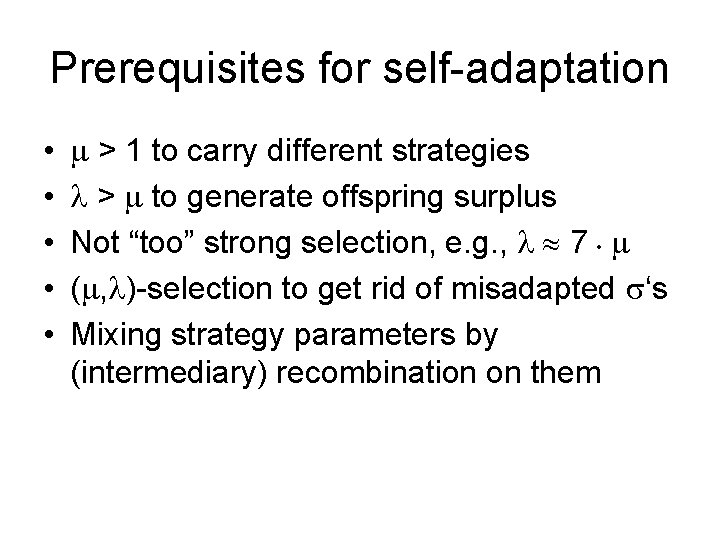
Prerequisites for self-adaptation • • • > 1 to carry different strategies > to generate offspring surplus Not “too” strong selection, e. g. , 7 • ( , )-selection to get rid of misadapted ‘s Mixing strategy parameters by (intermediary) recombination on them
Example application: the cherry brandy experiment • Task to create a colour mix yielding a target colour (that of a well known cherry brandy) • Ingredients: water + red, yellow, blue dye • Representation: w, r, y , b no self-adaptation! • Values scaled to give a predefined total volume (30 ml) • Mutation: lo / med / hi values used with equal chance • Selection: (1, 8) strategy
Example application: cherry brandy experiment cont’d • Fitness: students effectively making the mix and comparing it with target colour • Termination criterion: student satisfied with mixed colour • Solution is found mostly within 20 generations • Accuracy is very good
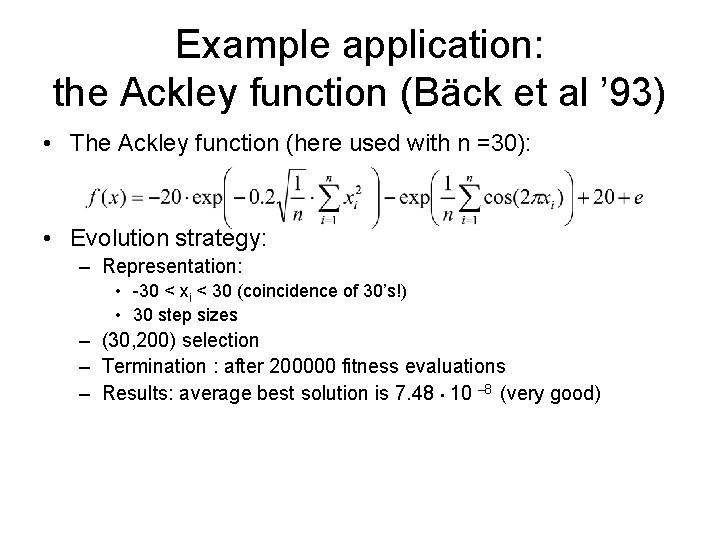
Example application: the Ackley function (Bäck et al ’ 93) • The Ackley function (here used with n =30): • Evolution strategy: – Representation: • -30 < xi < 30 (coincidence of 30’s!) • 30 step sizes – (30, 200) selection – Termination : after 200000 fitness evaluations – Results: average best solution is 7. 48 • 10 – 8 (very good)