
Evolution Section 1 Darwins Theory of Natural Selection
- Slides: 15
Evolution Section 1: Darwin’s Theory of Natural Selection Section 2: Evidence of Evolution Section 3: Shaping Evolutionary Theory Click on a lesson name to select.
Section 1 Evolution Darwin’s Theory of Natural Selection Darwin on the HMS Beagle § Darwin’s role on the ship was as naturalist and companion to the captain. § His job was to collect biological and geological specimens during the ship’s travel.
Section 1 Evolution Darwin’s Theory of Natural Selection The Galápagos Islands § Darwin began to collect mockingbirds, finches, and other animals on the four islands. § He noticed that the different islands seemed to have their own, slightly different varieties of animals.
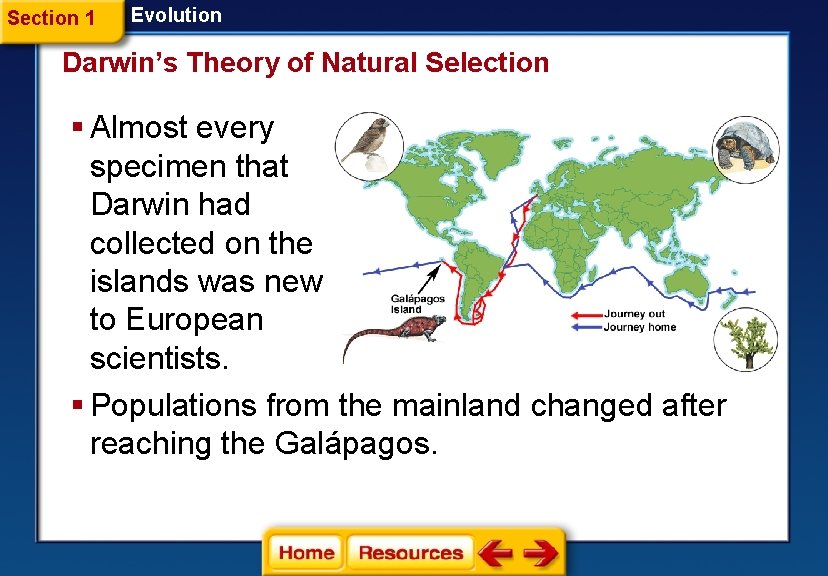
Section 1 Evolution Darwin’s Theory of Natural Selection § Almost every specimen that Darwin had collected on the islands was new to European scientists. § Populations from the mainland changed after reaching the Galápagos.
Section 1 Evolution Darwin’s Theory of Natural Selection Darwin Continued His Studies § Darwin hypothesized that new species could appear gradually through small changes in ancestral species. § Darwin inferred that if humans could change species by artificial selection, then perhaps the same process could work in nature.
Section 1 Evolution Darwin’s Theory of Natural Selection § Individuals in a population show variations. § Variations can be inherited. § Organisms have more offspring than can survive on available resources. § Variations that increase reproductive success will have a greater chance of being passed on.
Section 1 Evolution Darwin’s Theory of Natural Selection The Origin of Species § Darwin published On the Origin of Species by Means of Natural Selection in 1859. § Darwin’s theory of natural selection is not synonymous with evolution. § It is a means of explaining how evolution works.
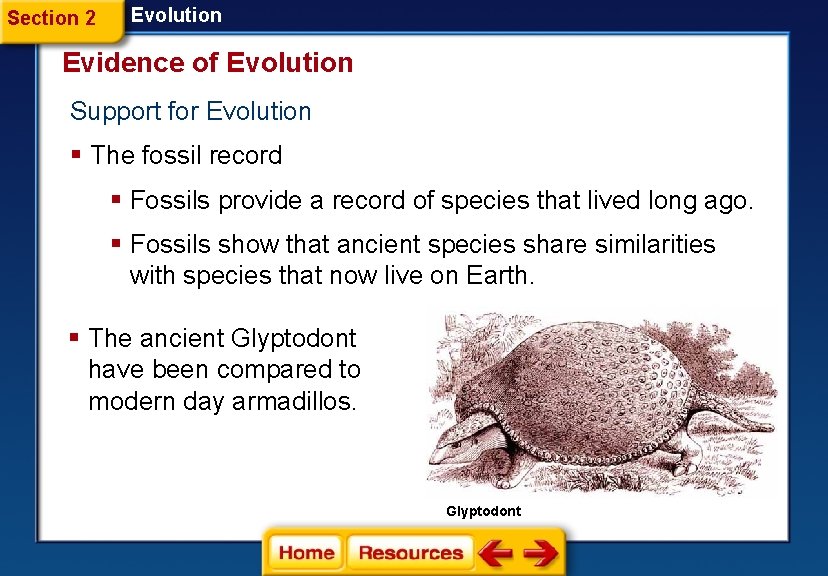
Section 2 Evolution Evidence of Evolution Support for Evolution § The fossil record § Fossils provide a record of species that lived long ago. § Fossils show that ancient species share similarities with species that now live on Earth. § The ancient Glyptodont have been compared to modern day armadillos. Glyptodont
Section 2 Evolution Evidence of Evolution § Derived traits are newly evolved features, such as feathers, that do not appear in the fossils of common ancestors. § Ancestral traits are more primitive features, such as teeth and tails, that do appear in ancestral forms. § Anatomically similar structures inherited from a common ancestor are called homologous structures.
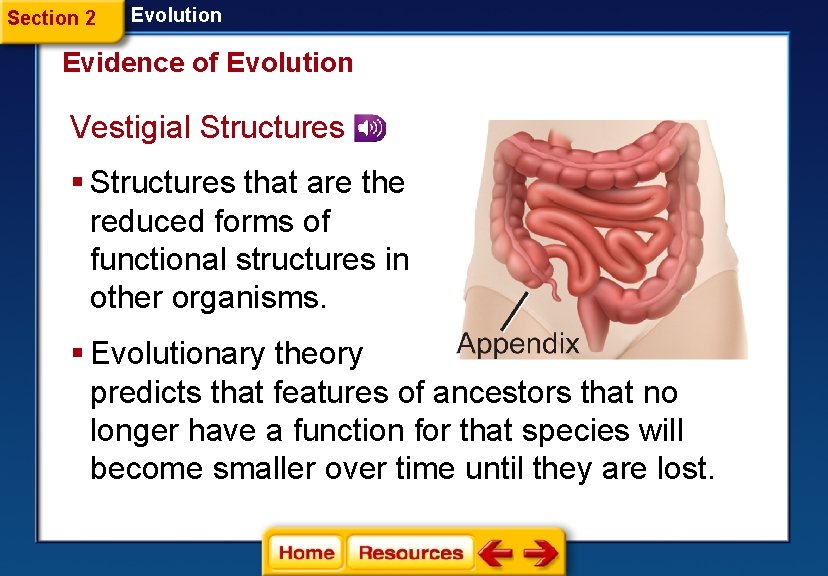
Section 2 Evolution Evidence of Evolution Vestigial Structures § Structures that are the reduced forms of functional structures in other organisms. § Evolutionary theory predicts that features of ancestors that no longer have a function for that species will become smaller over time until they are lost.
Section 2 Evolution Evidence of Evolution § Analogous structures can be used for the same purpose and can be superficially similar in construction, but are not inherited from a common ancestor. § Show that functionally similar features can evolve independently in similar environments
Section 2 Evolution Evidence of Evolution Comparative Embryology § Vertebrate embryos exhibit homologous structures during certain phases of development but become totally different structures in the adult forms.
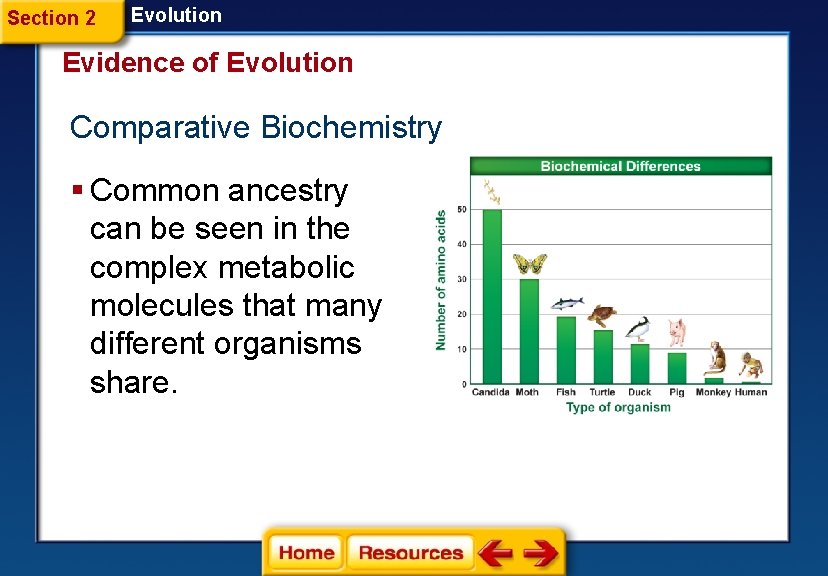
Section 2 Evolution Evidence of Evolution Comparative Biochemistry § Common ancestry can be seen in the complex metabolic molecules that many different organisms share.
Section 2 Evolution Evidence of Evolution § Comparisons of the similarities in these molecules across species reflect evolutionary patterns seen in comparative anatomy and in the fossil record. § Organisms with closely related morphological features have more closely related molecular features.
Section 2 Evolution Evidence of Evolution Geographic Distribution § The distribution of plants and animals that Darwin saw first suggested evolution to Darwin. § Patterns of migration were critical to Darwin when he was developing his theory. § Evolution is intimately linked with climate and geological forces.