
Evolution of Wireless Communication By Chandra Thapa Evolution
Evolution of Wireless Communication By Chandra Thapa
Evolution of Wireless Systems ØGuglielmo Marconi invented the wireless telegraph in 1896 Ø Communication by encoding alphanumeric characters in analog signal Ø Sent telegraphic signals across the Atlantic Ocean ØFirst public mobile (car-based) telephone system (MTS) introduced in 1946 Ø Analog frequency modulation Ø High power BS tower to cover 50 miles radius Ø Inefficient (120 K spectrum for a voice connection)

Evolution of Wireless Sys. (Contd) ØImproved mobile telephone system (IMTS) developed in 1960 ØFull duplex services and direct-dialing Ø 23 FM channels with BW reduced to 25 -30 KHz ØCellular concept ØExploits the attenuation of radio signal with distance to achieve frequency reuse. Øoriginally proposed by D. H. Ring in 1947 ØBell Labs began work on cellular telephone system in the late 1960 s.
Evolution of Wireless Sys. (2. 5 G) Ø 2 G telephony is highly successful ØEnhancement to 2 G on data service Ø GSM: HSCSD and GPRS Ø IS-95: IS-95 b Ø IS-136: D-AMPS+ and CDPD ØThe improved data rate is still too low to support multimedia traffic ØITU initiated 3 G standardization effort in 1992, and the outcome is IMT-2000.

Evolution of Wireless Sys. (1 G) ØHandoff was not solved until the development of microprocessor, efficient remote-controlled RF synthesizer, and switching center. Ø 1 G Cellular System Ø Designed in 1970 s, deployed in early 1980 s Ø Analog, 42 control channels, 790 voice channels Ø Handoff performed at BS based on received power Ø AMPS in US; TACS in part of Europe; NTT in Japan; C 450 in West German, and NMT in some countries. Ø Became highly popular; AMPS still popular in US!
Evolution of Wireless Sys. (2 G) Ø 2 G Systems Ø Digital cellular telephony Ø Modest data support, incompatible Ø GSM: a common TDMA technology for Europe; claim about 3/4 of subscribers worldwide. Ø IS-54 and IS-136: TDMA technology in US; compatible with AMPS; Ø IS-95: CDMA; standardized in 1993; South Korea and Hong Kong deployed it in 1995; US in 1996.
Evolution of Wireless Sys. (3 G) ØIMT-2000 comprises several 3 G standards: ØEDGE, data rate up to 473 Kbps, backward compatible with GSM/IS-136 Øcdma 2000 (Qualcomm), data rate up to 2 Mbps, backward compatible with IS-95 ØWCDMA (Europe), introduces a new 5 MHz channel structure; data rate up to 2 Mbps; ØTD-SCDMA (China), CDMA in TDD fashion
Evolution of Wireless Sys. (4 G) Problems of 3 G systems ØImmature 3 G license auction increases the financial burden ØDifficult to extend to higher data rates ØNo unified standard (political factors dominate) 4 G systems ØResearch initiated, but still not well-defined ØData-oriented, seamless integrated with wireline ØIndoor data rate up to 100 Mbps, outdoor data rate up to 20 Mbps.
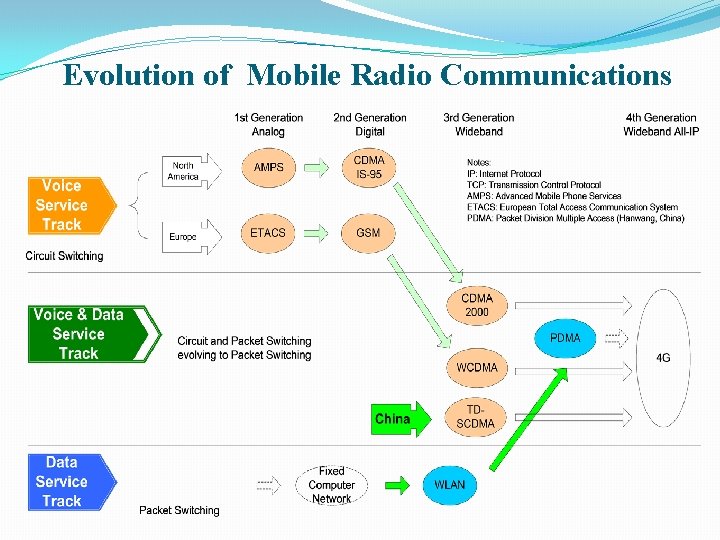
Evolution of Mobile Radio Communications
Trends in Wireless Comm. Ø Personal Communications (Goal of mobile communications) Ø All IP based (IPv 6) (Packet switched) Ø Flexible platform of complementary access systems( Combination of different wireless access systems, Hot spot services will be introduced by high-speed wireless access (>100 mbps)) Ø Higher system capacity (Users/Service, 5 -10 times higher than Ø Ø Ø Ø 3 G) Higher Transmission Data rate Higher frequency efficiency More advanced multimedia applications Improved Qo. S Realize high levels of security and authentication Global coverage Global roaming
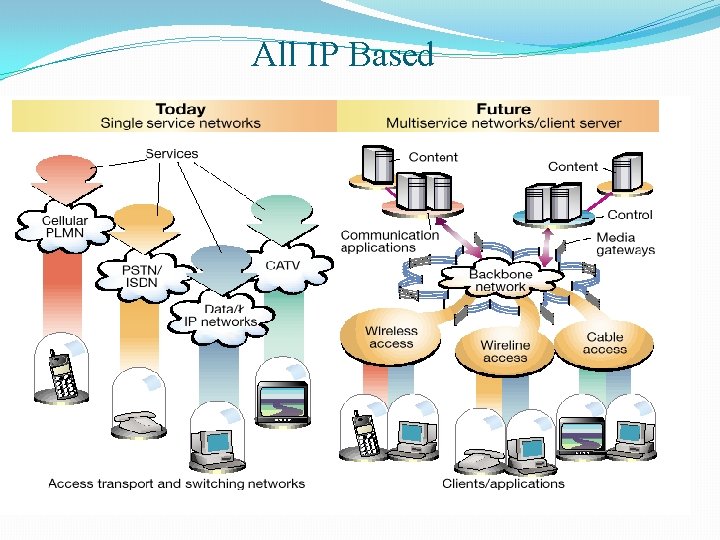
All IP Based
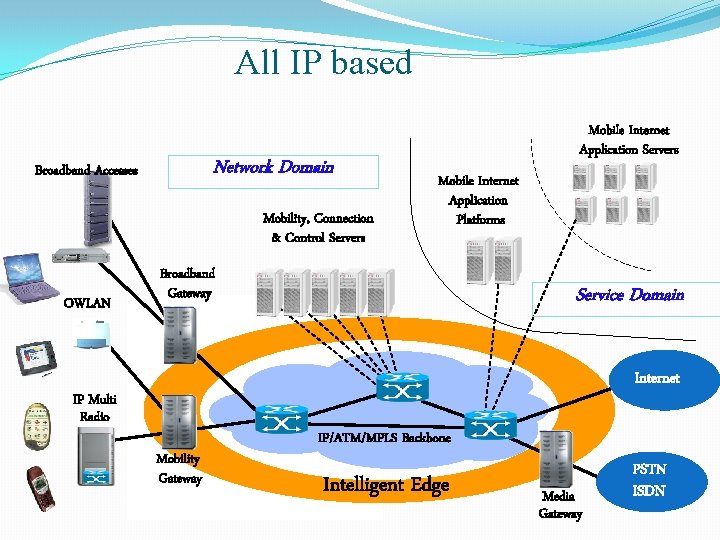
All IP based Network Domain Broadband Accesses Mobility, Connection & Control Servers OWLAN Mobile Internet Application Servers Mobile Internet Application Platforms Broadband Gateway Service Domain Internet IP Multi Radio Mobility Gateway IP/ATM/MPLS Backbone Intelligent Edge Media Gateway PSTN ISDN
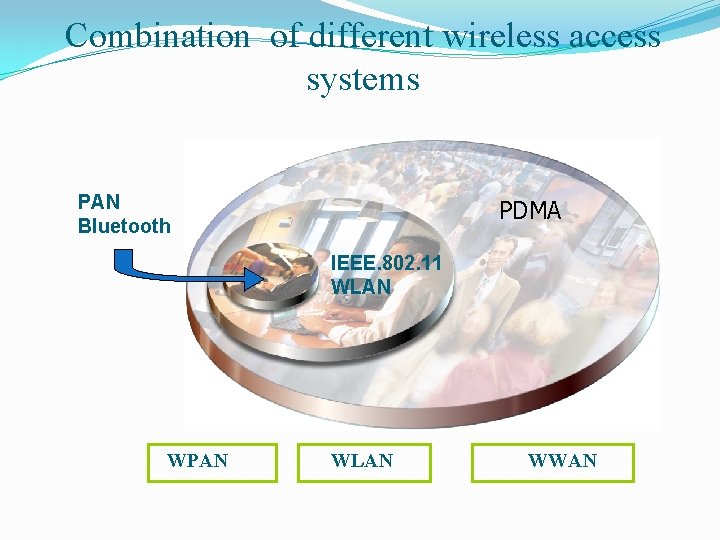
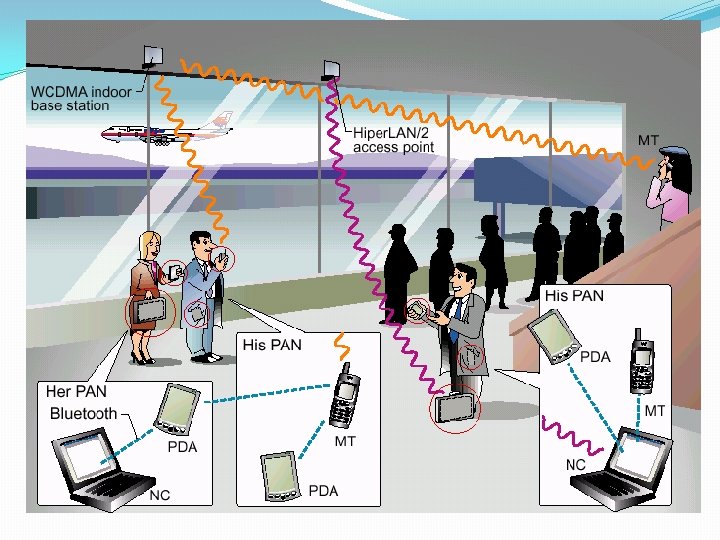
Combination of different wireless access systems PAN Bluetooth PDMA IEEE. 802. 11 WLAN WPAN WLAN WWAN
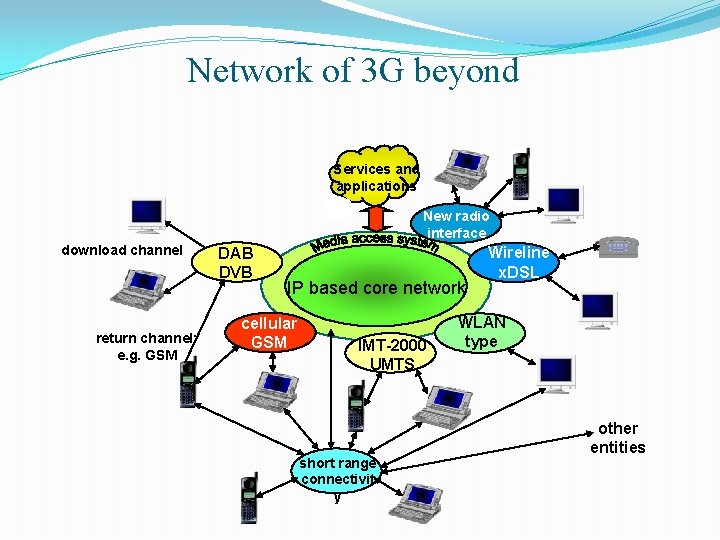
Network of 3 G beyond Services and applications New radio interface download channel return channel: e. g. GSM DAB DVB IP based core network cellular GSM IMT-2000 UMTS short range connectivit y Wireline x. DSL WLAN type other entities
Transmission Data Rate Ø Ø Ø Highest data rate(3 G) Ø at least 144 Kb/s in a vehicular environment, Ø 384 Kb/s in a pedestrian environment, Ø 2048 Kb/s in an indoor office environment. Highest data rate (4 G) Ø 2 Mbps in a vehicular environment, 20 Mbps in a pedestrian environment Ø Wide Area, high velocity: 100 Mbps Ø Indoor, lower velocity: 1 Gbps Evolution of transmission data rate
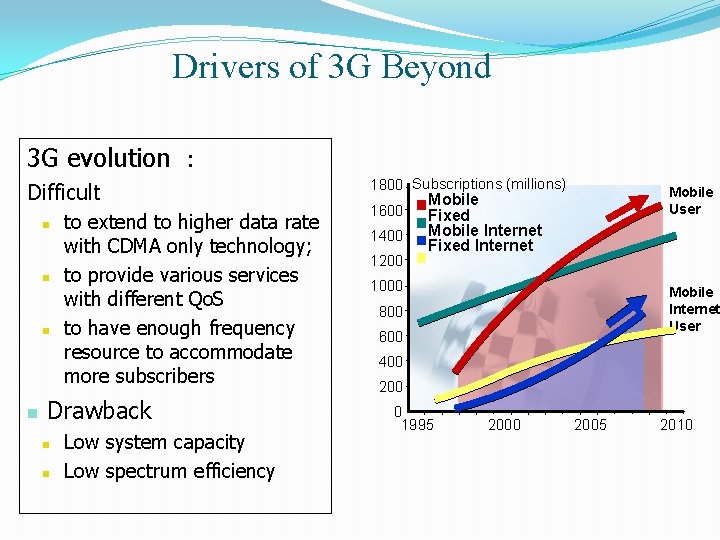
Drivers of 3 G Beyond 3 G evolution : Difficult n n to extend to higher data rate with CDMA only technology; to provide various services with different Qo. S to have enough frequency resource to accommodate more subscribers Drawback n n Low system capacity Low spectrum efficiency 1800 Subscriptions (millions) 1600 1400 1200 Mobile User Mobile Fixed Mobile Internet Fixed Internet 1000 Mobile Internet User 800 600 400 200 0 1995 2000 2005 2010
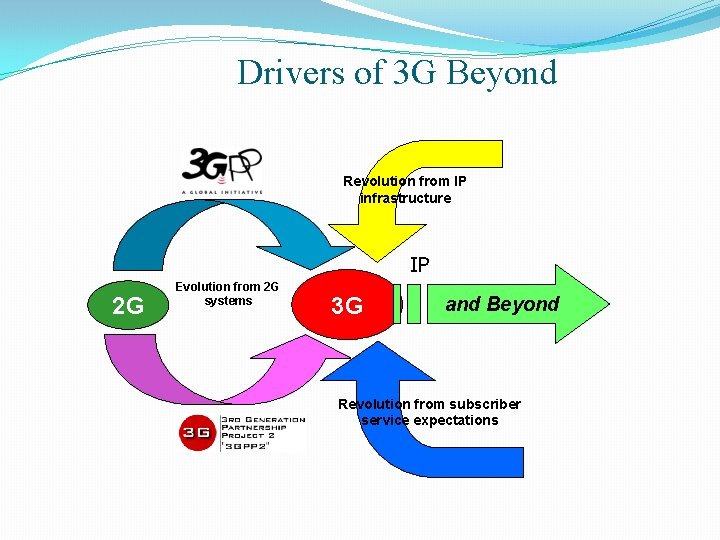
Drivers of 3 G Beyond Revolution from IP infrastructure IP 2 G Evolution from 2 G systems 3 G and Beyond Revolution from subscriber service expectations
Multimedia Services ØInternet access ØShopping/banking(e-commerce) ØVideo conferencing ØVideo on demand ØTelemedicine ØDistance learning
Challenges ØUnreliable Channels ØScarce Spectrum and Resource Management ØStringent Power Budget ØSecurity ØLocation and Routing ØInterfacing with Wired Networks ØHealth Concern ØDiversified Standards and Political Struggle
- Slides: 20