
EVOLUTION OF VERY MASSIVE POPULATION III STARS T
![Abundance Pattern ε=0. 0025、 jet=15 o EMP (extremely metal-poor) stars Metal-poor stars ([Fe/H]<-3) (Cayrel](https://slidetodoc.com/presentation_image_h2/4ae2a110f4a4a061a56dffb5a5612f14/image-9.jpg "Abundance Pattern ε=0. 0025、 jet=15 o EMP (extremely metal-poor) stars Metal-poor stars ([Fe/H]<-3) (Cayrel")
![• IGM (inter galactic medium) (redshift z: 2~4. 5) • Observation: [C/Si] <~](https://slidetodoc.com/presentation_image_h2/4ae2a110f4a4a061a56dffb5a5612f14/image-11.jpg "• IGM (inter galactic medium) (redshift z: 2~4. 5) • Observation: [C/Si] <~")
- Slides: 15
EVOLUTION OF VERY MASSIVE POPULATION III STARS T. Ohkubo, H. Umeda, K. Maeda, K. Nomoto, T. Suzuki, S. Tsuruta, M. J. Rees First Stars III Workshop, July 16 -20 2007, Santa Fe, 1 NM, USA
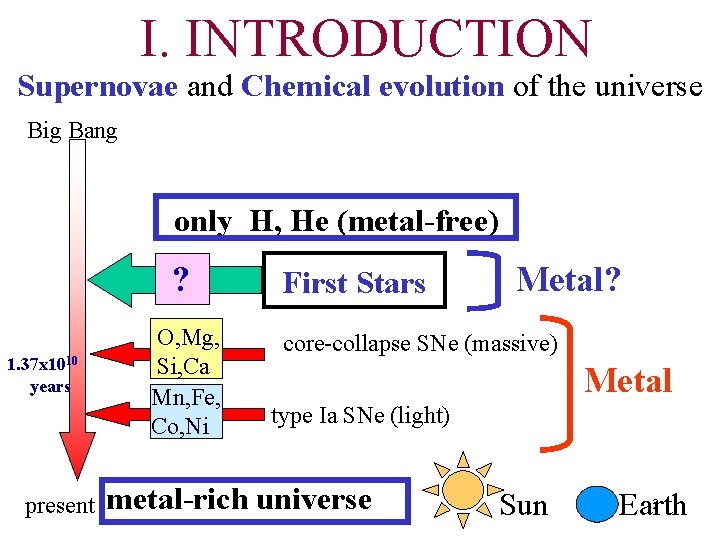
I. INTRODUCTION Supernovae and Chemical evolution of the universe Big Bang only H, He (metal-free) ? 1. 37 x 1010 years present O, Mg, Si, Ca Mn, Fe, Co, Ni First Stars Metal? core-collapse SNe (massive) Metal type Ia SNe (light) metal-rich universe Sun 2 Earth
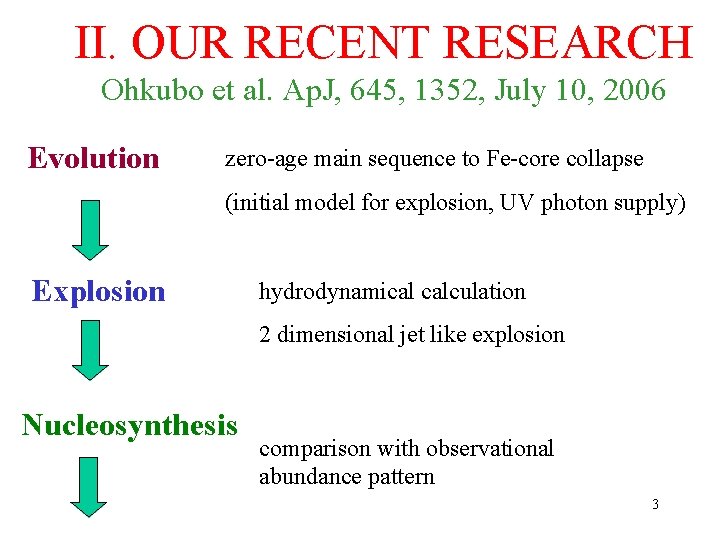
II. OUR RECENT RESEARCH Ohkubo et al. Ap. J, 645, 1352, July 10, 2006 Evolution zero-age main sequence to Fe-core collapse (initial model for explosion, UV photon supply) Explosion hydrodynamical calculation 2 dimensional jet like explosion Nucleosynthesis comparison with observational abundance pattern 3
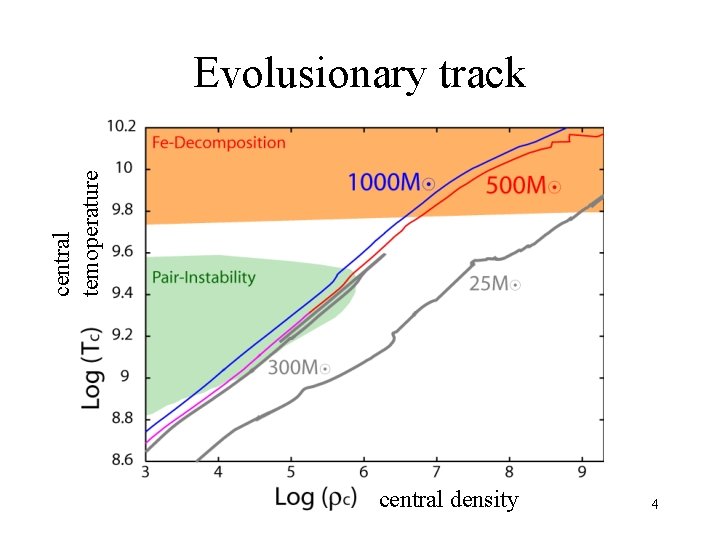
central temoperature Evolusionary track central density 4
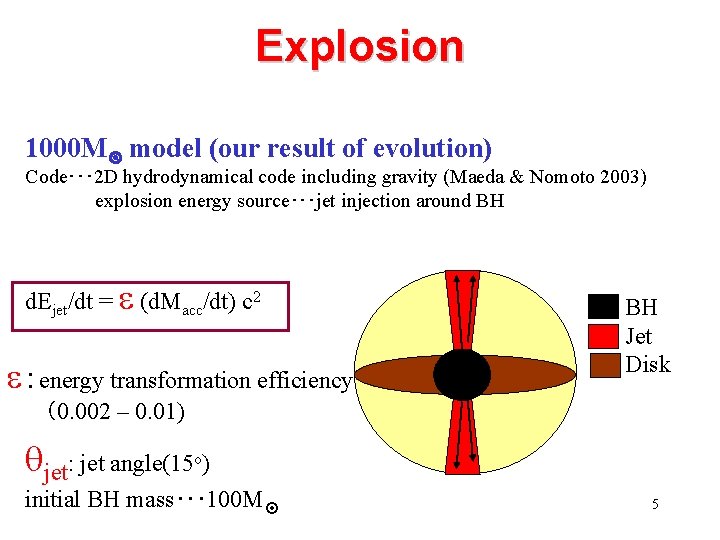
Explosion 1000 M model (our result of evolution) Code・・・ 2 D hydrodynamical code including gravity (Maeda & Nomoto 2003) explosion energy source・・・jet injection around BH d. Ejet/dt = (d. Macc/dt) c 2 :energy transformation efficiency BH Jet Disk (0. 002 – 0. 01) jet: jet angle(15 o) initial BH mass・・・ 100 M 5
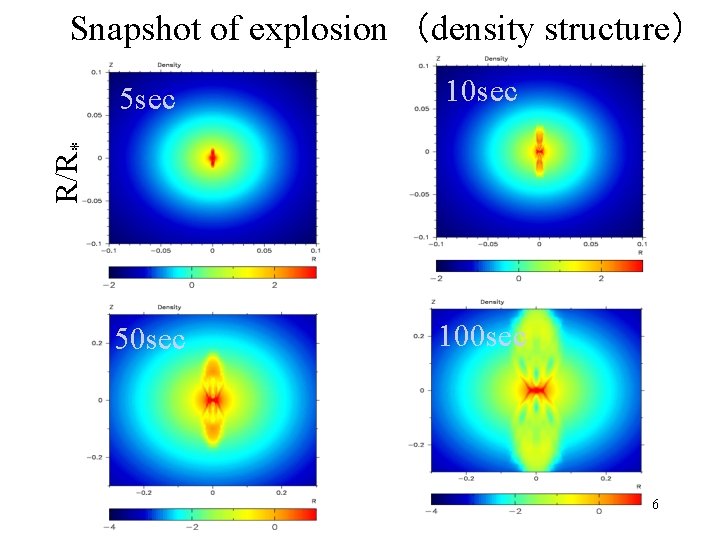
Snapshot of explosion (density structure) 10 sec 50 sec 100 sec R/R* 5 sec 6
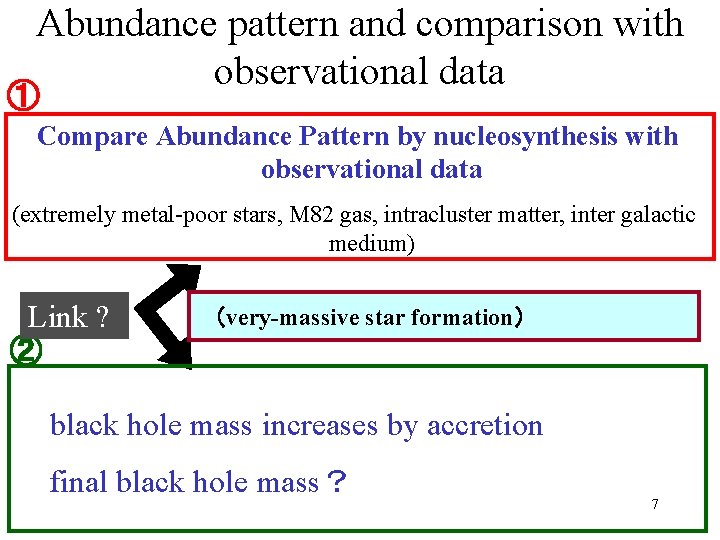
Abundance pattern and comparison with observational data ① Compare Abundance Pattern by nucleosynthesis with observational data (extremely metal-poor stars, M 82 gas, intracluster matter, inter galactic medium) Link ? ② (very-massive star formation) black hole mass increases by accretion final black hole mass? 7
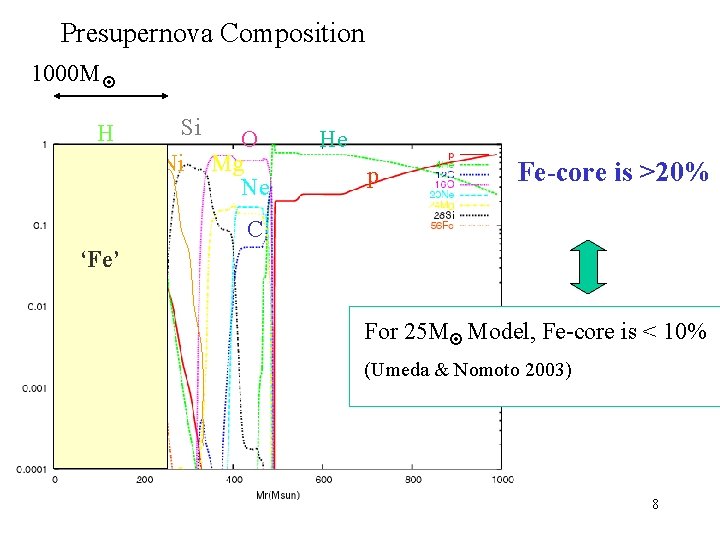
Presupernova Composition 1000 M H e p Si 56 Ni O Mg Ne He p Fe-core is >20% C ‘Fe’ F e For 25 M Model, Fe-core is < 10% (Umeda & Nomoto 2003) 8
Abundance Pattern ε=0. 0025、 jet=15 o EMP (extremely metal-poor) stars Metal-poor stars ([Fe/H]<-3) (Cayrel et al. 2004) there is discrepancy in [O/Fe] ε=0. 005、 jet=15 o ICM (intracluster matter) [O/Fe] < 0 , [Si/Fe] >0 : Consistent 9
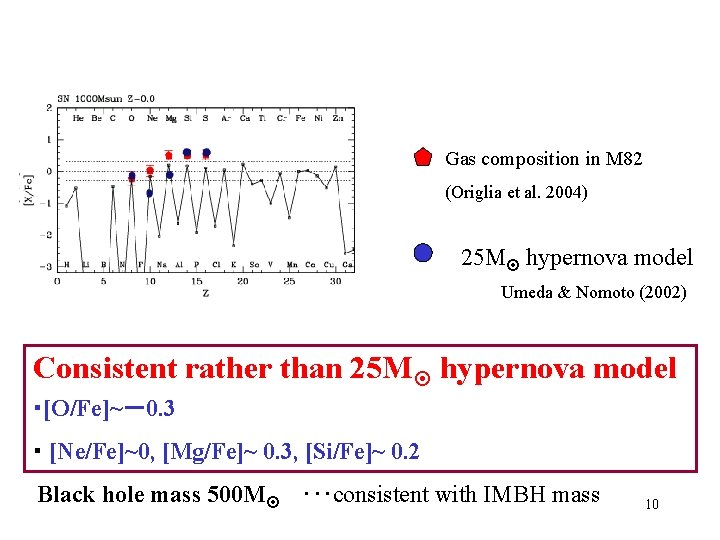
M 82 hot gas Gas composition in M 82 (Origlia et al. 2004) 25 M hypernova model Umeda & Nomoto (2002) Consistent rather than 25 M hypernova model ・[O/Fe]~-0. 3 ・ [Ne/Fe]~0, [Mg/Fe]~ 0. 3, [Si/Fe]~ 0. 2 Black hole mass 500 M ・・・consistent with IMBH mass 10
• IGM (inter galactic medium) (redshift z: 2~4. 5) • Observation: [C/Si] <~ -0. 5 (Aguirre et al. 2004) • Yields by PISNe: [C/Si] ~ -2. 0 -- -1. 7 • Our 1000 M yields: [C/Si] ~ -0. 78 ---0. 65 Consistent in order of magnitude with observational ratio 11
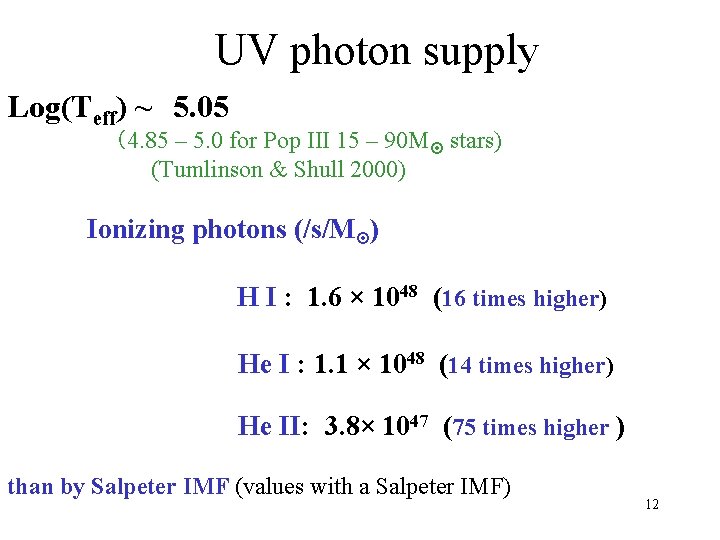
UV photon supply Log(Teff) ~ 5. 05 (4. 85 – 5. 0 for Pop III 15 – 90 M stars) (Tumlinson & Shull 2000) Ionizing photons (/s/M ) H I : 1. 6 × 1048 (16 times higher) He I : 1. 1 × 1048 (14 times higher) He II: 3. 8× 1047 (75 times higher ) than by Salpeter IMF (values with a Salpeter IMF) 12
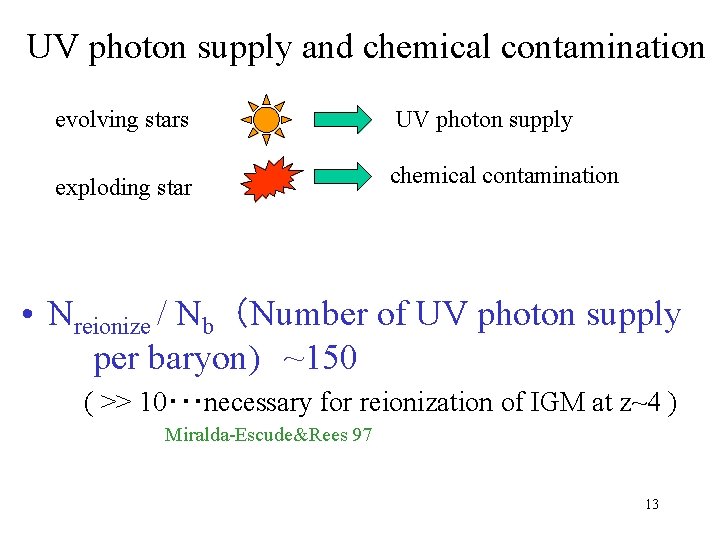
UV photon supply and chemical contamination evolving stars UV photon supply exploding star chemical contamination • Nreionize / Nb (Number of UV photon supply per baryon) ~150 ( >> 10・・・necessary for reionization of IGM at z~4 ) Miralda-Escude&Rees 97 13
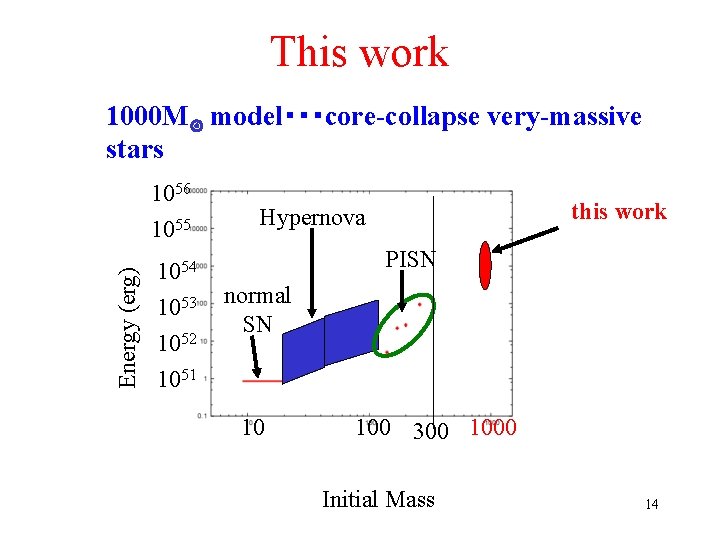
This work 1000 M model・・・core-collapse very-massive stars Energy (erg) 1056 1055 1054 1053 1052 1051 this work Hypernova PISN normal SN 10 100 300 1000 Initial Mass 14
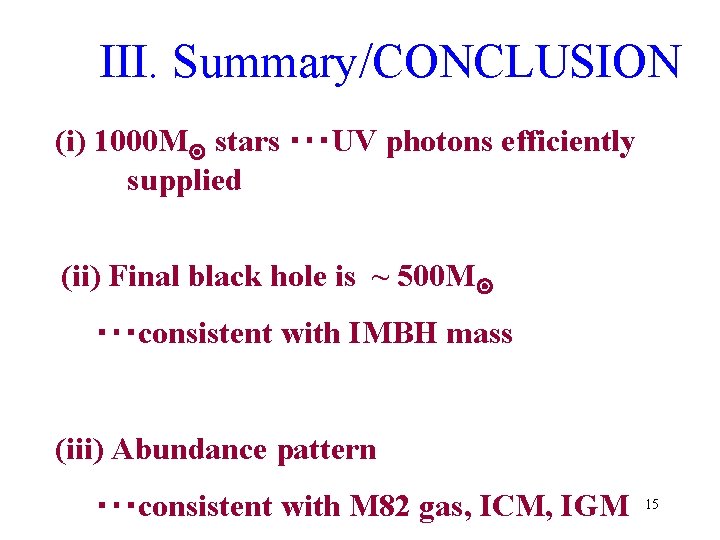
III. Summary/CONCLUSION (i) 1000 M stars ・・・UV photons efficiently supplied (ii) Final black hole is ~ 500 M ・・・consistent with IMBH mass (iii) Abundance pattern ・・・consistent with M 82 gas, ICM, IGM 15