
Evolution of the Tetrapods Evolution of the Tetrapods
- Slides: 77
Evolution of the Tetrapods
Evolution of the Tetrapods
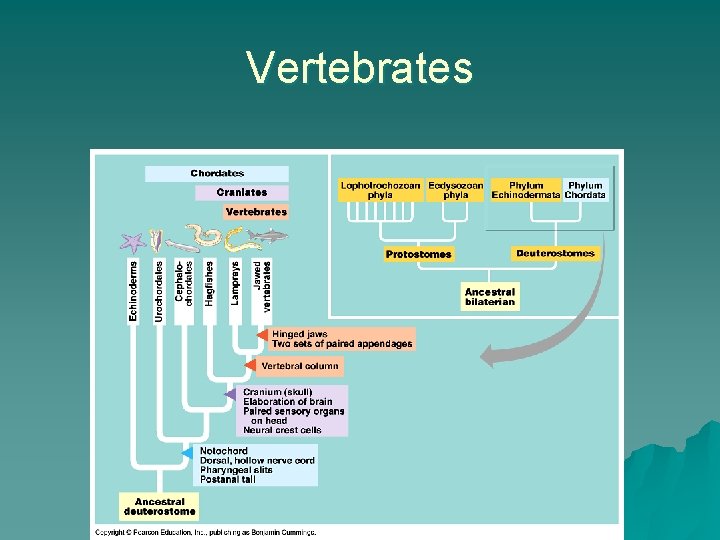
Vertebrates
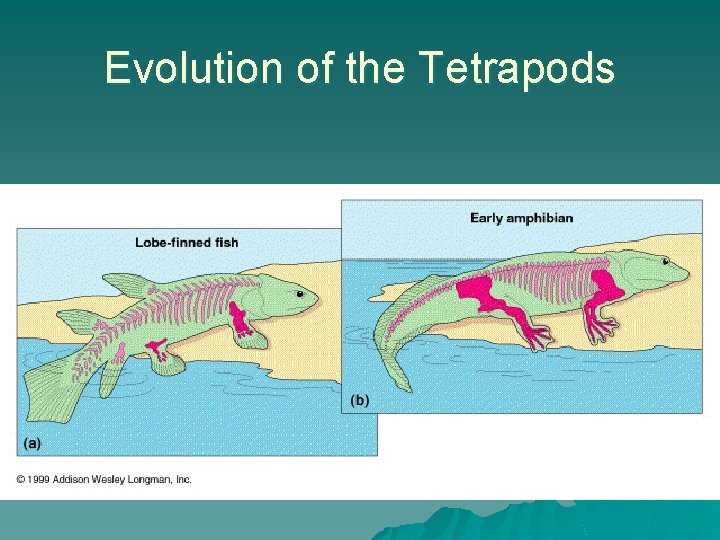
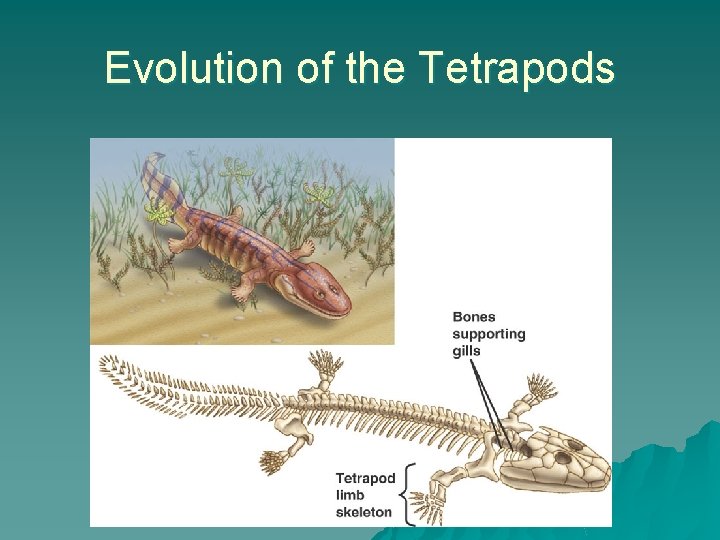
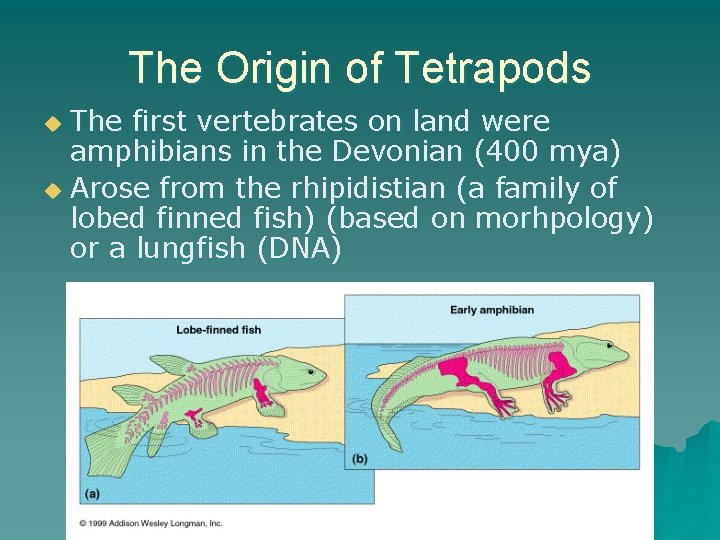
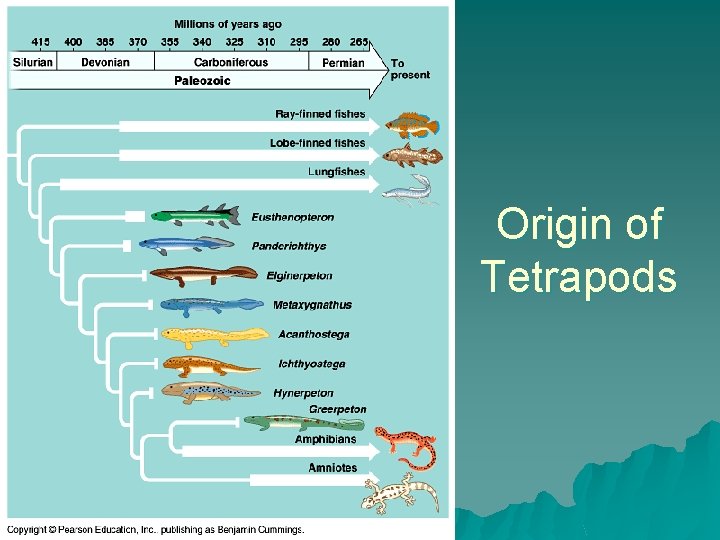
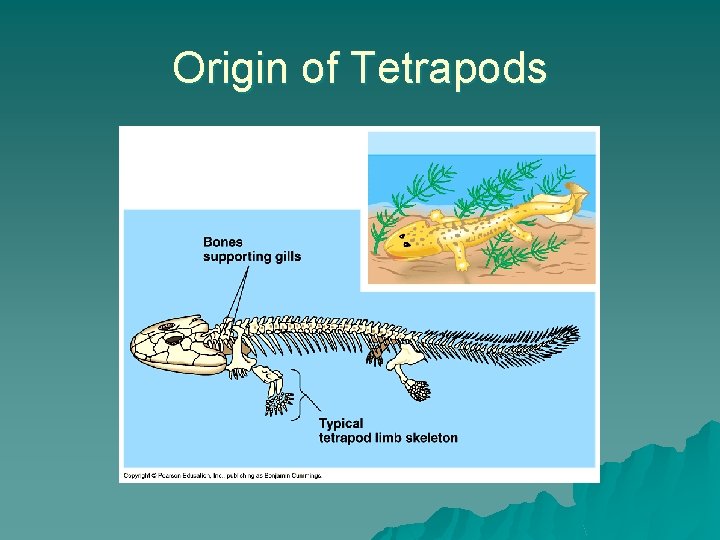
The Origin of Tetrapods The first vertebrates on land were amphibians in the Devonian (400 mya) u Arose from the rhipidistian (a family of lobed finned fish) (based on morhpology) or a lungfish (DNA) u
Origin of Tetrapods
Origin of Tetrapods
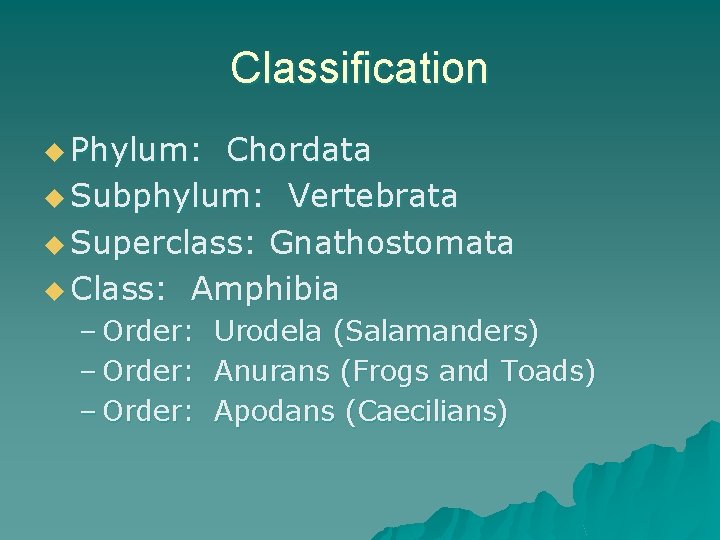
Classification u Phylum: Chordata u Subphylum: Vertebrata u Superclass: Gnathostomata u Class: Amphibia – Order: Urodela (Salamanders) – Order: Anurans (Frogs and Toads) – Order: Apodans (Caecilians)
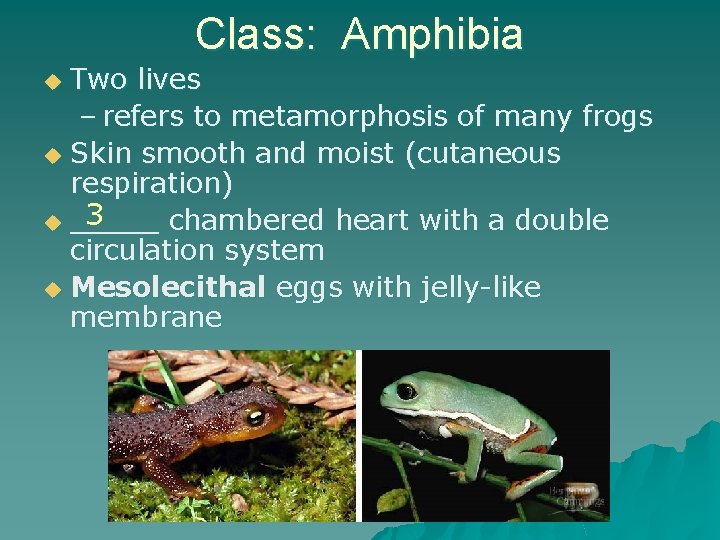
Class: Amphibia Two lives – refers to metamorphosis of many frogs u Skin smooth and moist (cutaneous respiration) 3 u _____ chambered heart with a double circulation system u Mesolecithal eggs with jelly-like membrane u
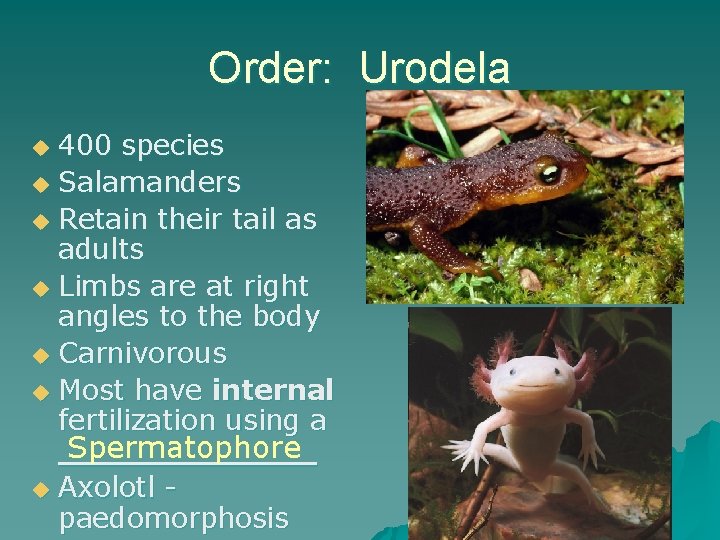
Order: Urodela 400 species u Salamanders u Retain their tail as adults u Limbs are at right angles to the body u Carnivorous u Most have internal fertilization using a Spermatophore _______ u Axolotl paedomorphosis u
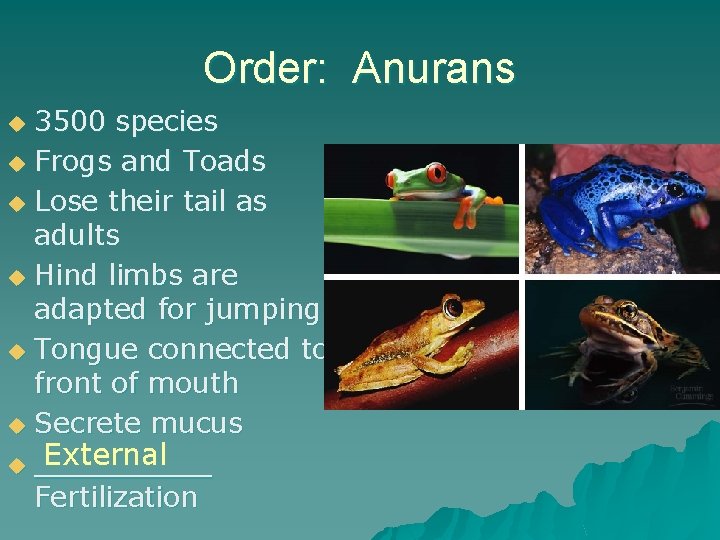
Order: Anurans 3500 species u Frogs and Toads u Lose their tail as adults u Hind limbs are adapted for jumping u Tongue connected to front of mouth u Secrete mucus External u _____ Fertilization u
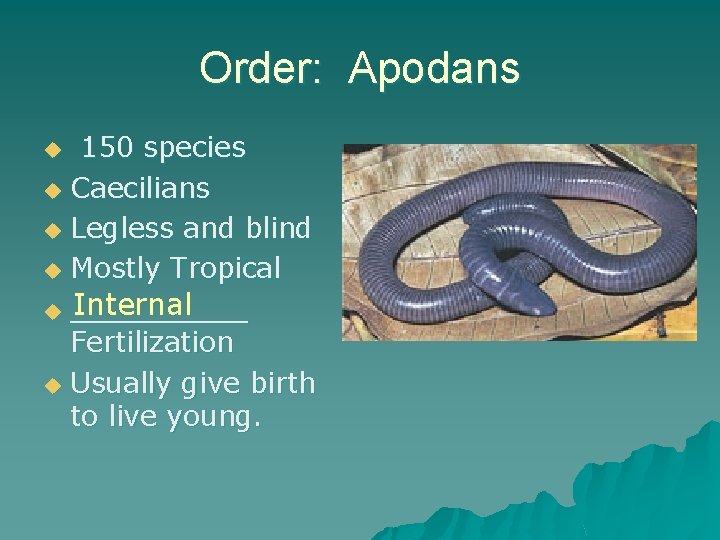
Order: Apodans 150 species u Caecilians u Legless and blind u Mostly Tropical Internal u _____ Fertilization u Usually give birth to live young. u
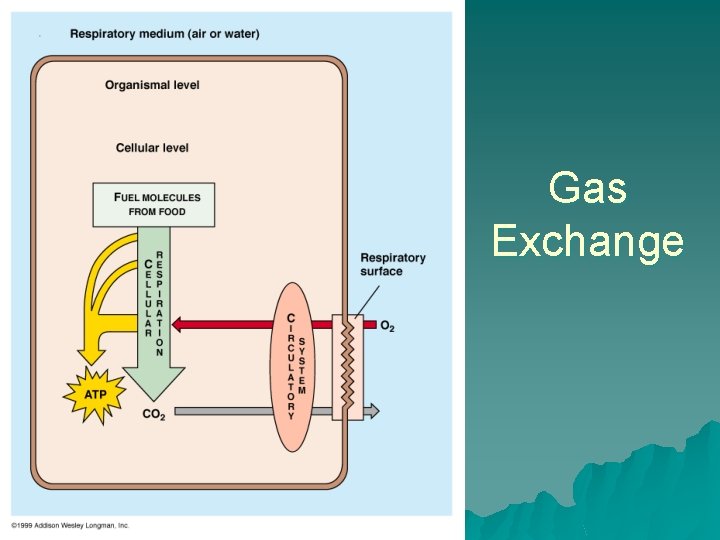
Gas Exchange
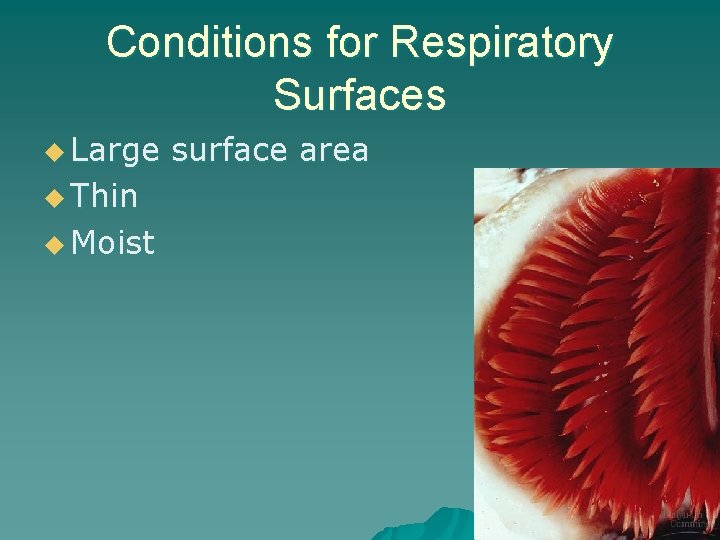
Conditions for Respiratory Surfaces u Large u Thin u Moist surface area
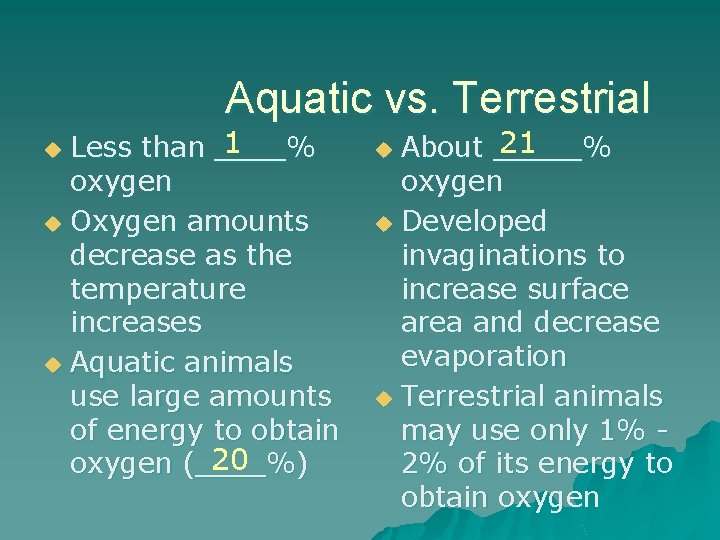
Aquatic vs. Terrestrial 1 Less than ____% oxygen u Oxygen amounts decrease as the temperature increases u Aquatic animals use large amounts of energy to obtain 20 oxygen (____%) u 21 About _____% oxygen u Developed invaginations to increase surface area and decrease evaporation u Terrestrial animals may use only 1% 2% of its energy to obtain oxygen u
Respiratory Surfaces u Cutaneous Respiration u Gills u Tracheal u Lungs Systems
Cutaneous Respiration u Direct diffusion of gases between the organism and the environment u Found in Porifera, Cnidarians, Platyhelminthes, nematodes, Annelids, and some Amphibians u Supplements other organisms (amphibians)
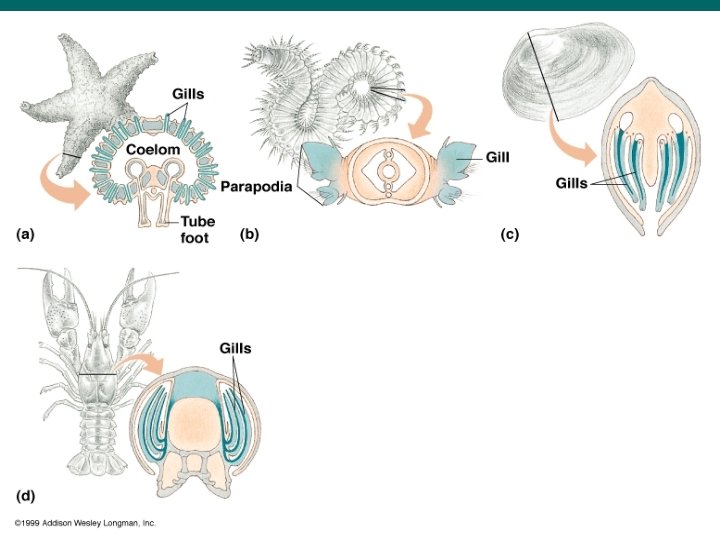
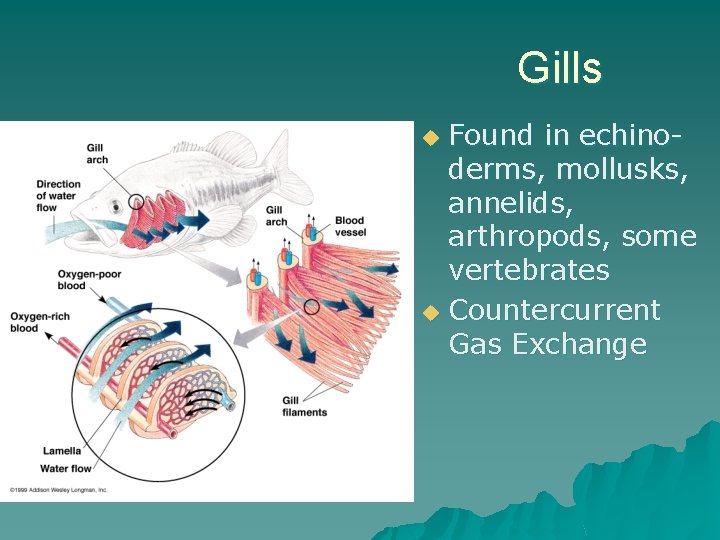
Gills Found in echinoderms, mollusks, annelids, arthropods, some vertebrates u Countercurrent Gas Exchange u
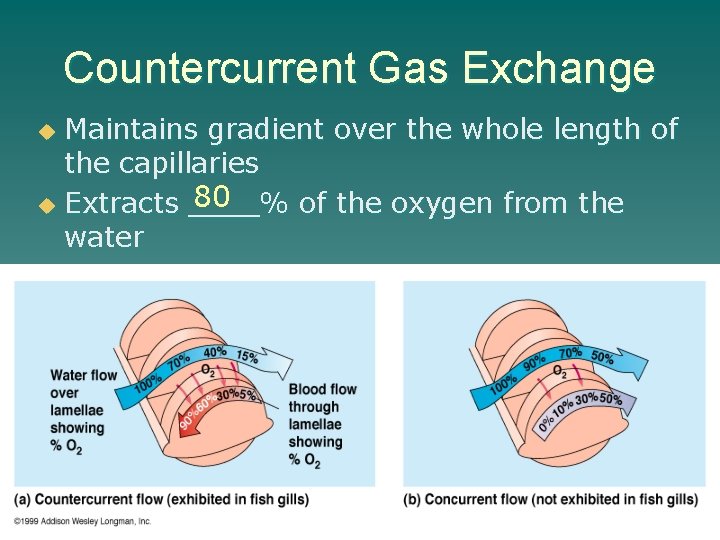
Countercurrent Gas Exchange Maintains gradient over the whole length of the capillaries 80 u Extracts ____% of the oxygen from the water u
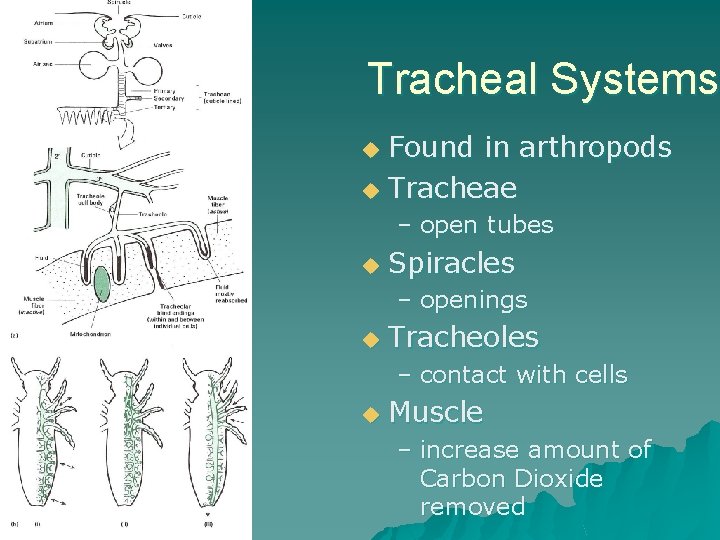
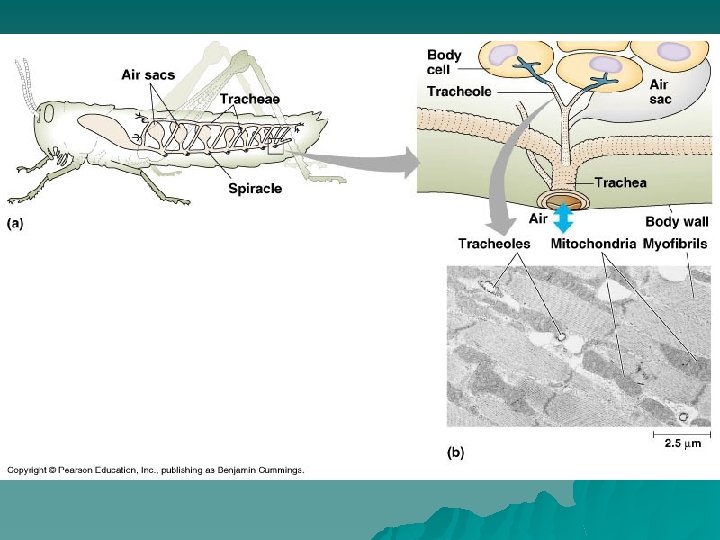
Tracheal Systems Found in arthropods u Tracheae u – open tubes u Spiracles – openings u Tracheoles – contact with cells u Muscle – increase amount of Carbon Dioxide removed
Tracheal Systems
Diffusion Lungs u Found in invertebrates u Gas moved primarily by diffusion – may be increased by body movement u Modifications – snails - cavity with gill modified into lung – scorpions and spiders - invaginations of the abdomen
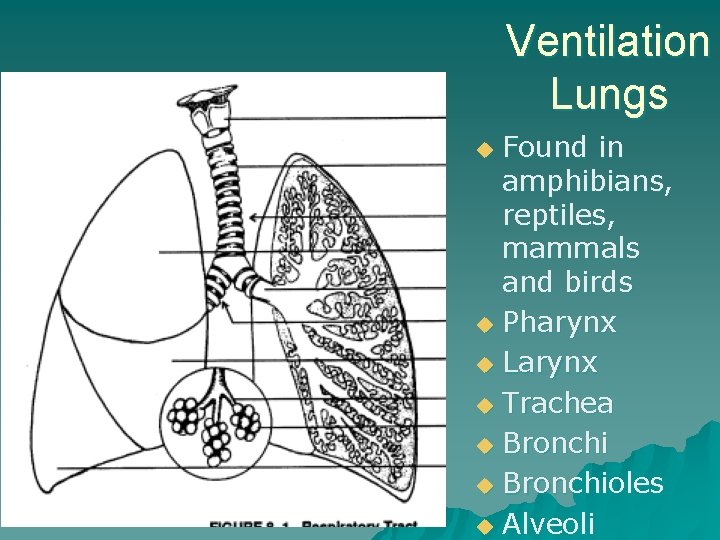
Ventilation Lungs Found in amphibians, reptiles, mammals and birds u Pharynx u Larynx u Trachea u Bronchioles u Alveoli u
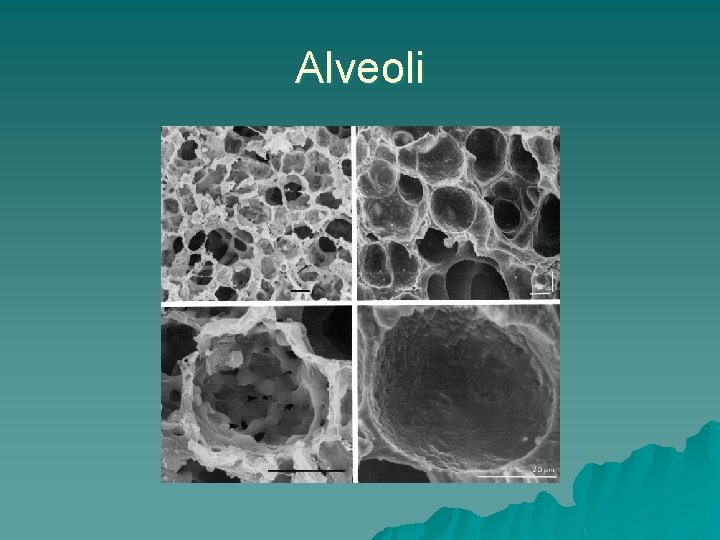
Alveoli
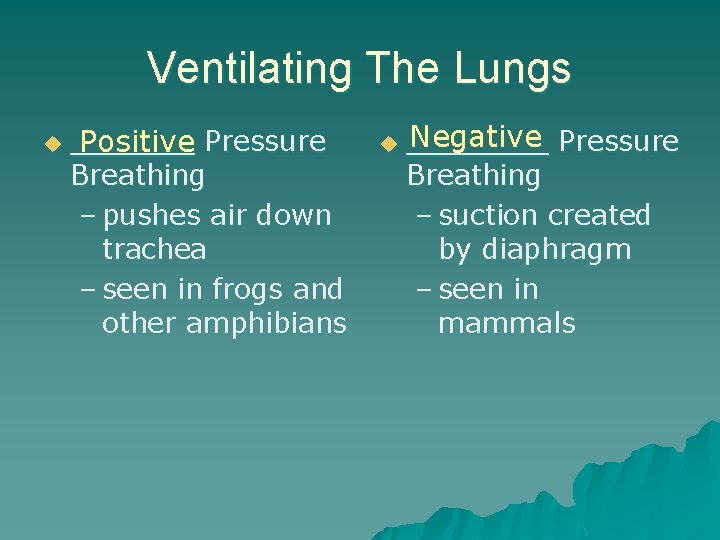
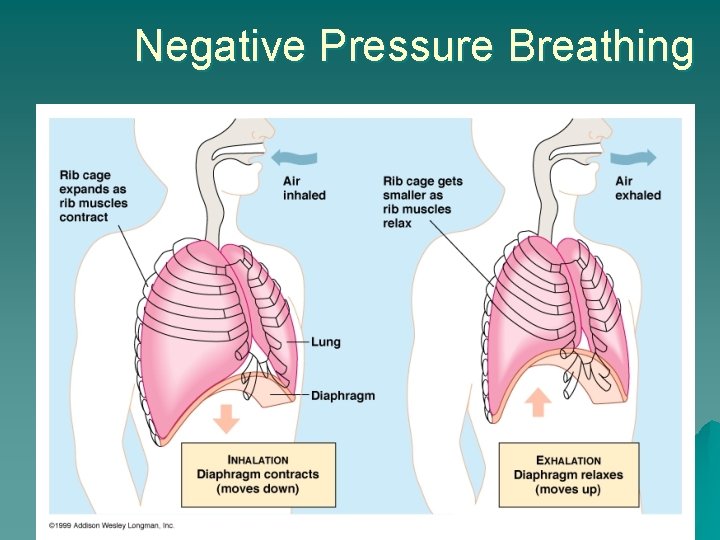
Ventilating The Lungs u _______ Positive Pressure Breathing – pushes air down trachea – seen in frogs and other amphibians u Negative Pressure ____ Breathing – suction created by diaphragm – seen in mammals
Negative Pressure Breathing
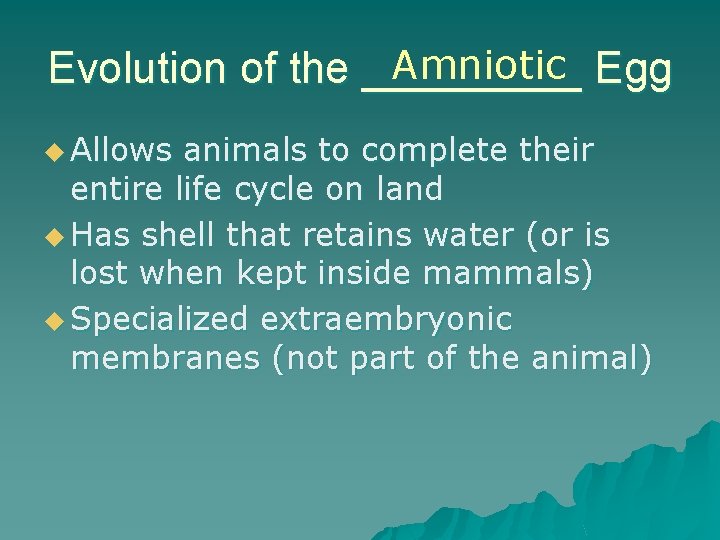
Amniotic Egg Evolution of the _____ u Allows animals to complete their entire life cycle on land u Has shell that retains water (or is lost when kept inside mammals) u Specialized extraembryonic membranes (not part of the animal)
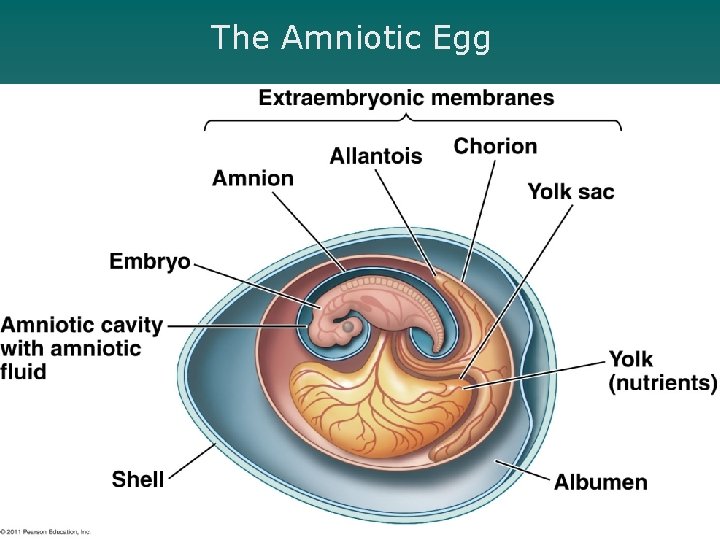
The Amniotic Egg
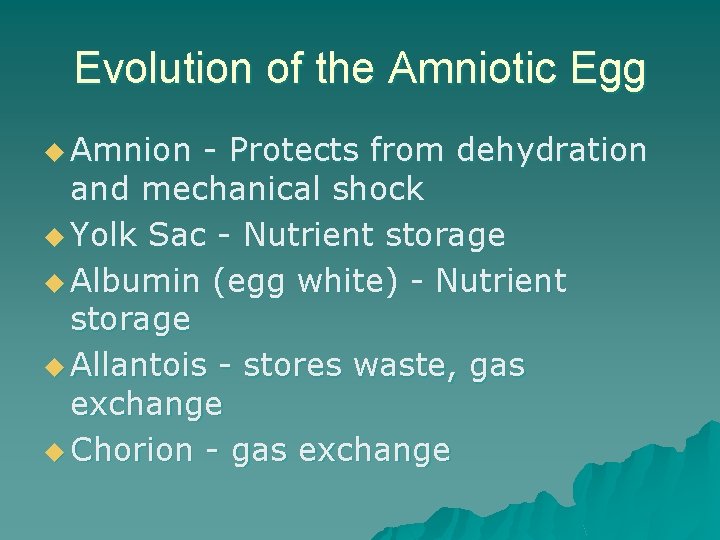
Evolution of the Amniotic Egg u Amnion - Protects from dehydration and mechanical shock u Yolk Sac - Nutrient storage u Albumin (egg white) - Nutrient storage u Allantois - stores waste, gas exchange u Chorion - gas exchange
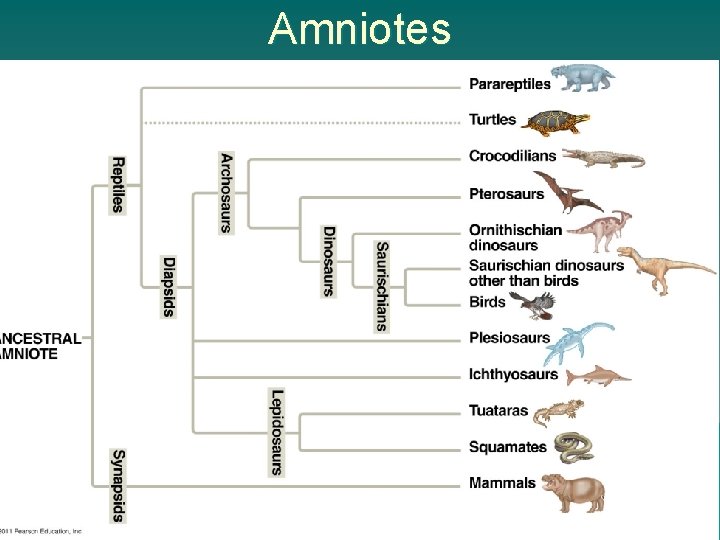
Amniotes
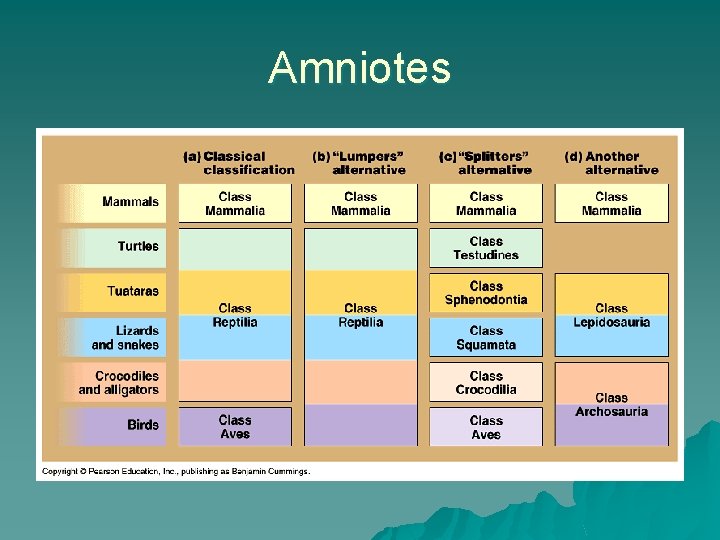
Amniotes
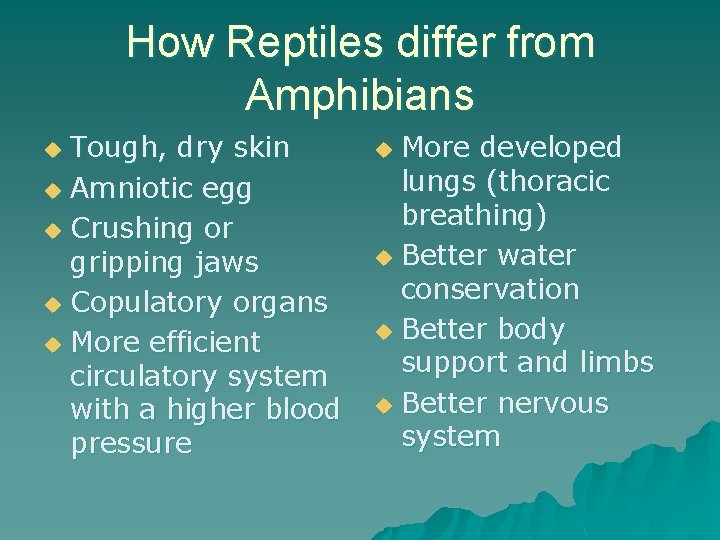
How Reptiles differ from Amphibians Tough, dry skin u Amniotic egg u Crushing or gripping jaws u Copulatory organs u More efficient circulatory system with a higher blood pressure u More developed lungs (thoracic breathing) u Better water conservation u Better body support and limbs u Better nervous system u
Classification u Phylum: Chordata u Subphylum: Vertebrata u Superclass: Gnathostomata u Class: Reptilia (not real) – Class: Testudines (Turtles and Tortoises) – Class: Spenodontia (Tuataras) – Class: Squamata (Lizards and Snakes) – Class: Crocodilia (Crocodiles and Alligators)
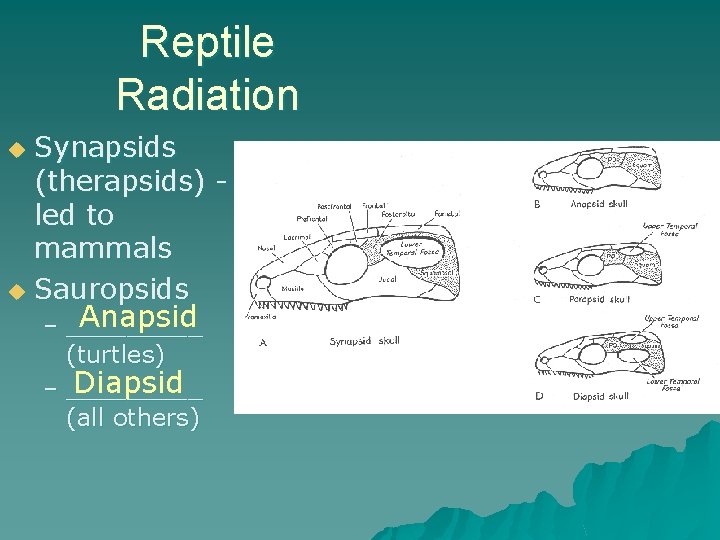
Reptile Radiation Synapsids (therapsids) led to mammals u Sauropsids u Anapsid – _____ (turtles) Diapsid – _____ (all others)
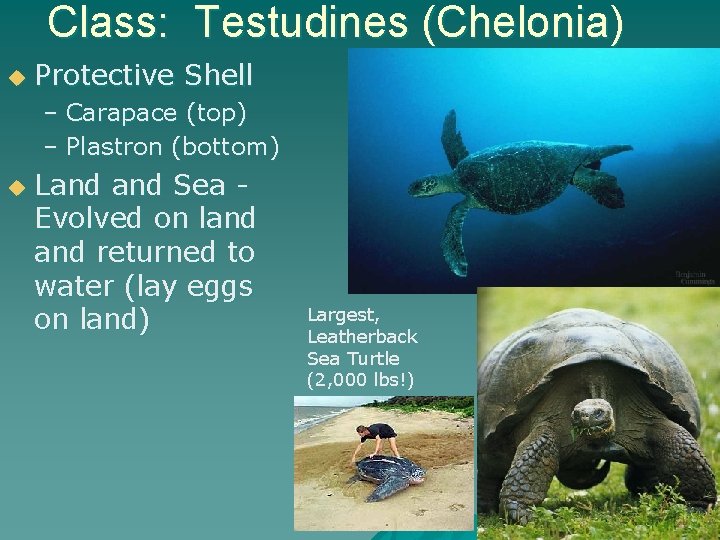
Class: Testudines (Chelonia) u Protective Shell – Carapace (top) – Plastron (bottom) u Land Sea Evolved on land returned to water (lay eggs on land) Largest, Leatherback Sea Turtle (2, 000 lbs!)
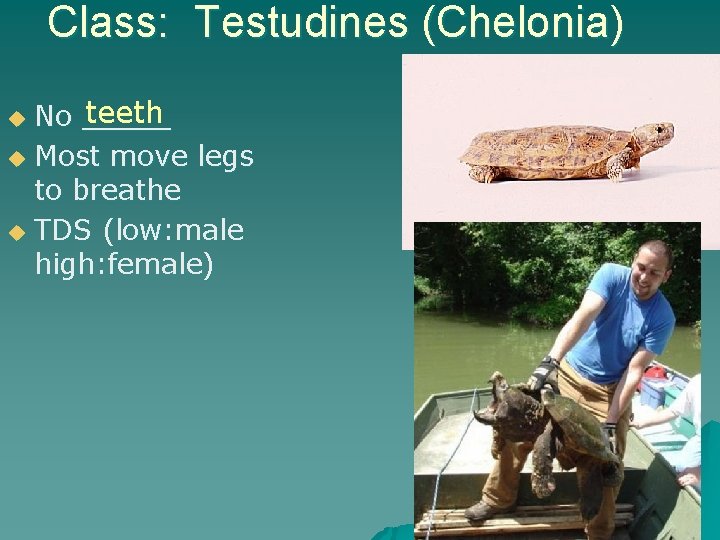
Class: Testudines (Chelonia) teeth No _____ u Most move legs to breathe u TDS (low: male high: female) u
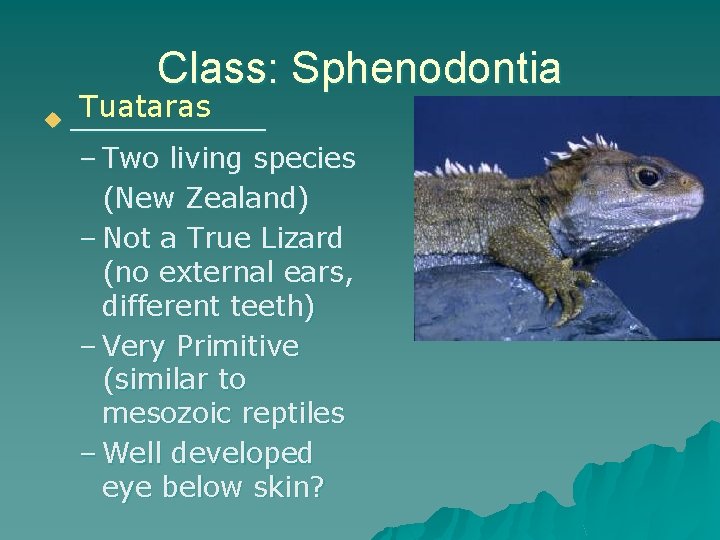
Class: Sphenodontia u Tuataras ______ – Two living species (New Zealand) – Not a True Lizard (no external ears, different teeth) – Very Primitive (similar to mesozoic reptiles – Well developed eye below skin?
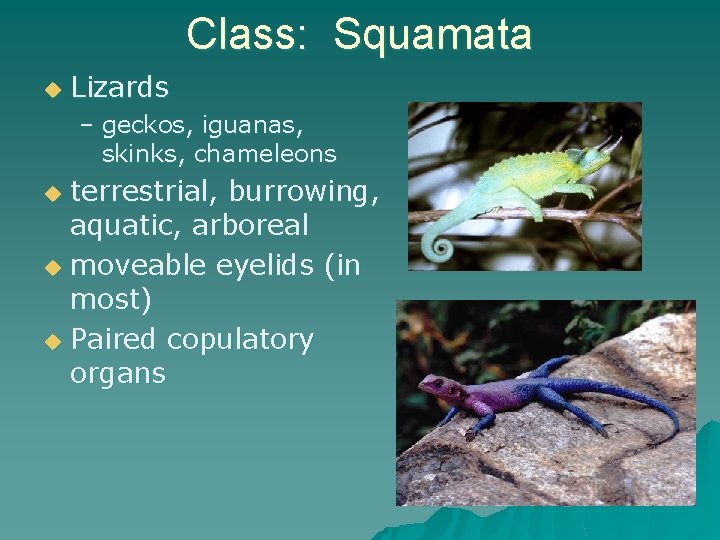
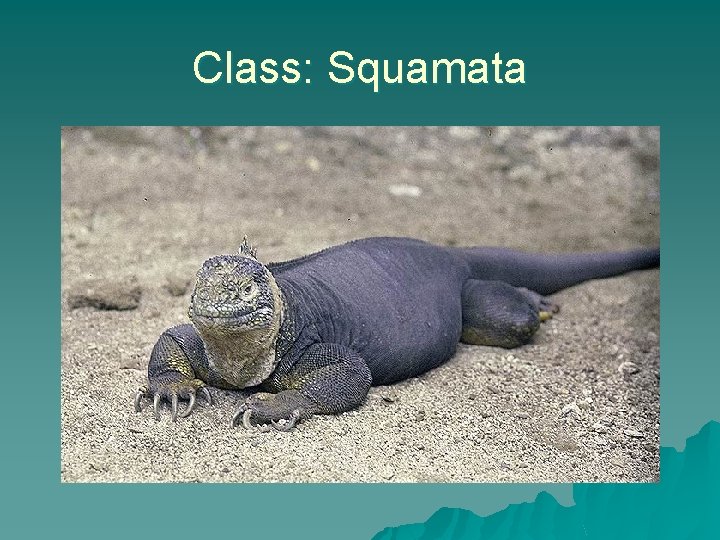
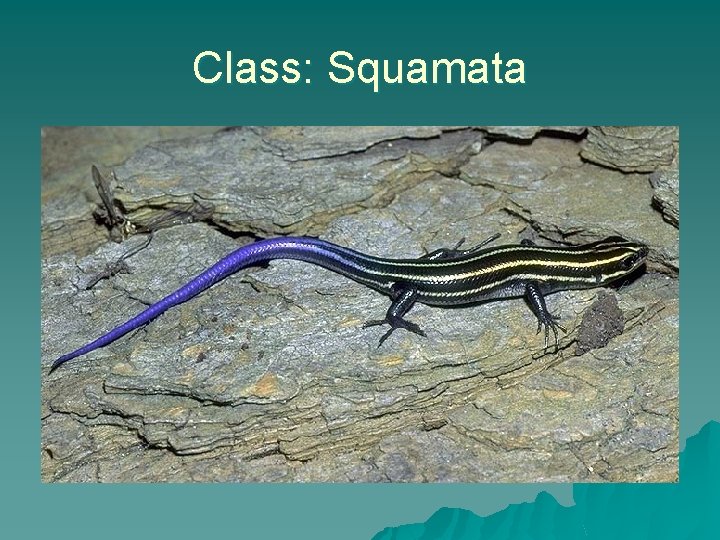
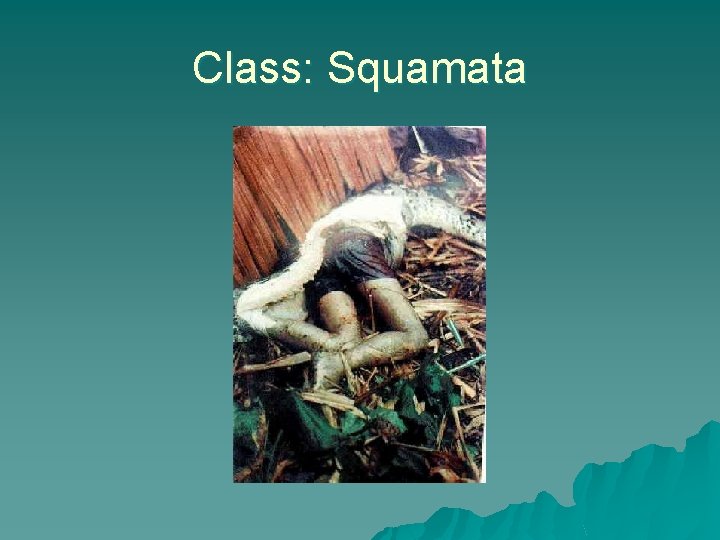
Class: Squamata u Lizards – geckos, iguanas, skinks, chameleons terrestrial, burrowing, aquatic, arboreal u moveable eyelids (in most) u Paired copulatory organs u
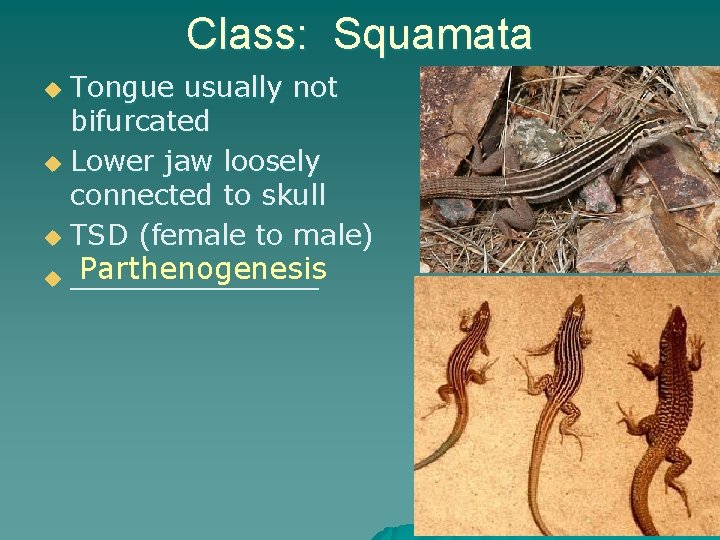
Class: Squamata Tongue usually not bifurcated u Lower jaw loosely connected to skull u TSD (female to male) Parthenogenesis u _______ u
Class: Squamata
Class: Squamata
Class: Squamata
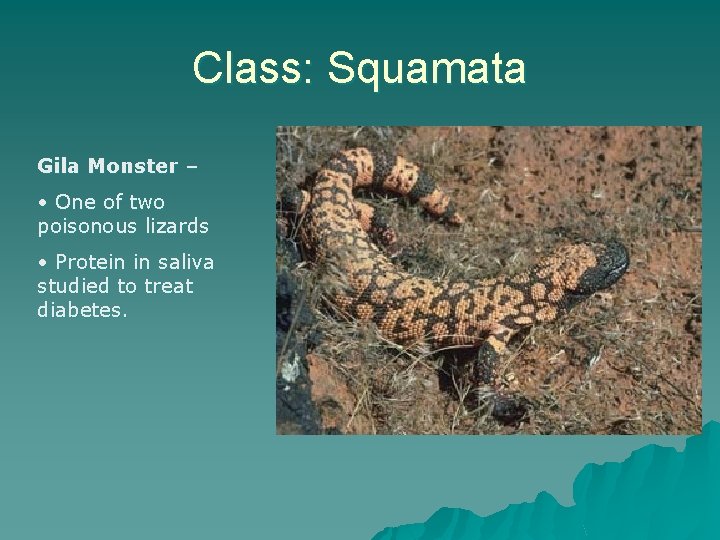
Class: Squamata Gila Monster – • One of two poisonous lizards • Protein in saliva studied to treat diabetes.
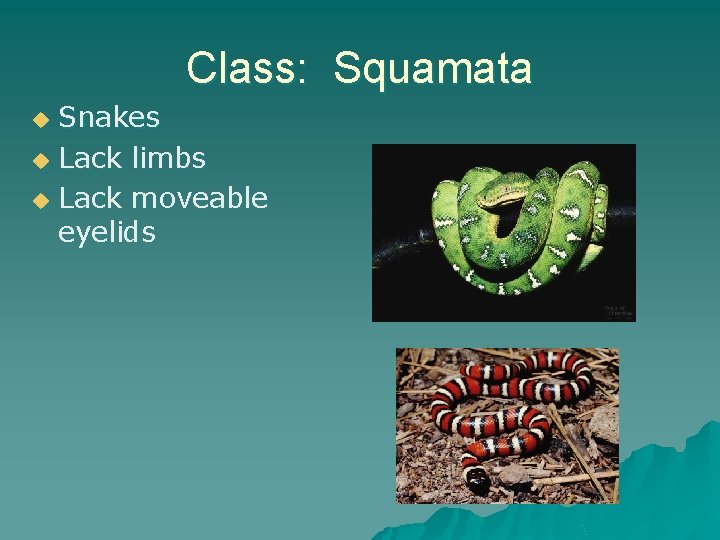
Class: Squamata Snakes u Lack limbs u Lack moveable eyelids u
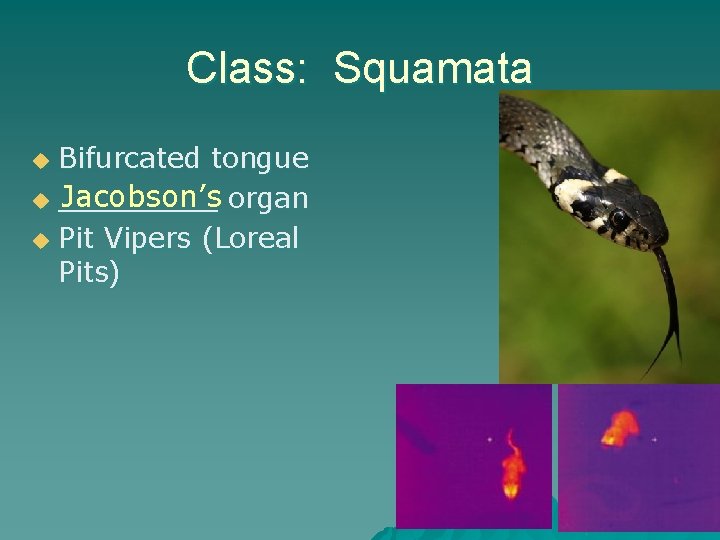
Class: Squamata Bifurcated tongue Jacobson’s organ u _____ u Pit Vipers (Loreal Pits) u
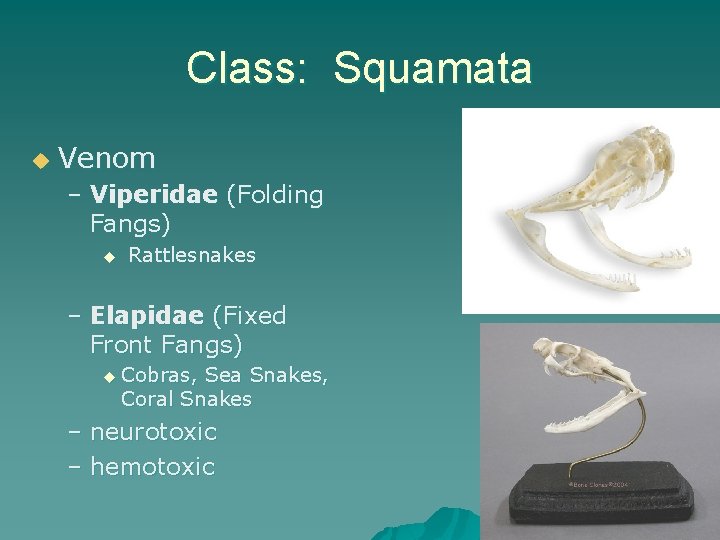
Class: Squamata u Venom – Viperidae (Folding Fangs) u Rattlesnakes – Elapidae (Fixed Front Fangs) u Cobras, Sea Snakes, Coral Snakes – neurotoxic – hemotoxic
Class: Squamata
Class: Squamata
Class: Squamata
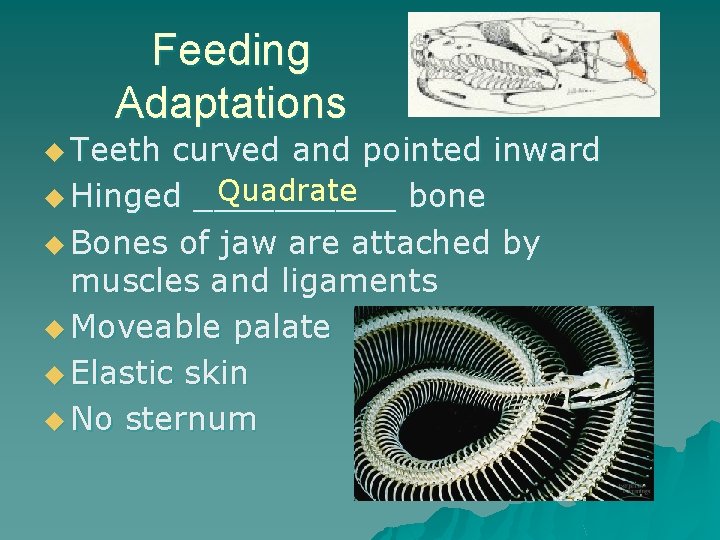
Feeding Adaptations u Teeth curved and pointed inward Quadrate u Hinged _____ bone u Bones of jaw are attached by muscles and ligaments u Moveable palate u Elastic skin u No sternum
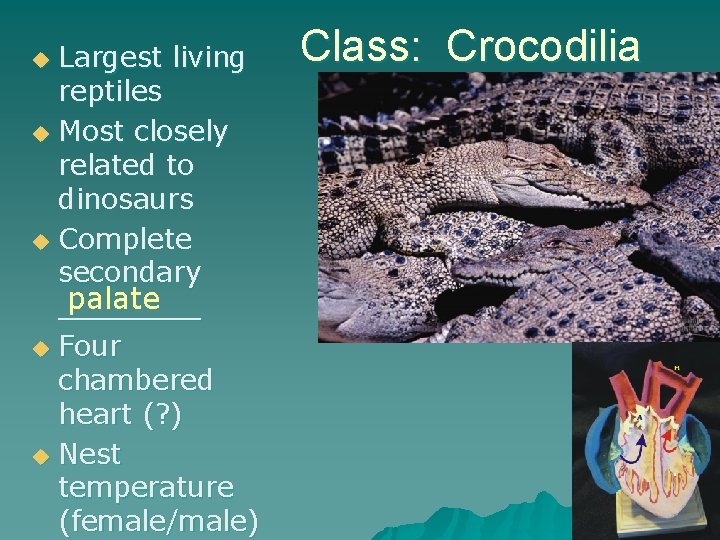
Largest living reptiles u Most closely related to dinosaurs u Complete secondary palate ____ u Four chambered heart (? ) u Nest temperature (female/male) u Class: Crocodilia
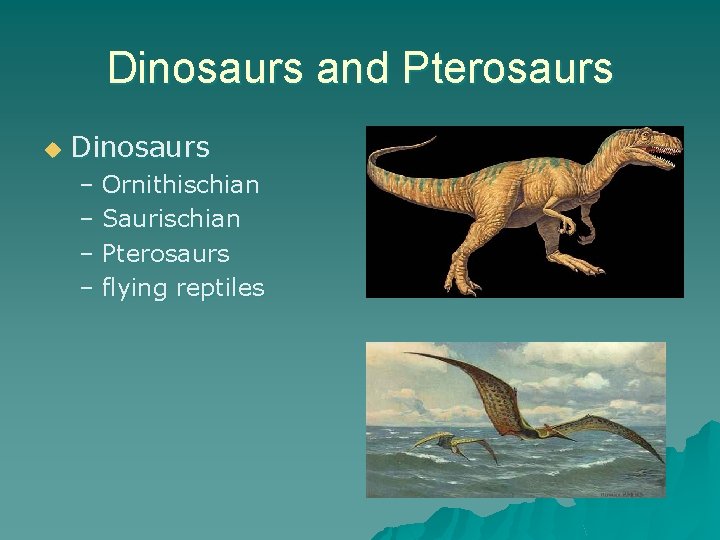
Dinosaurs and Pterosaurs u Dinosaurs – Ornithischian – Saurischian – Pterosaurs – flying reptiles
Animal Structure and Function (4 th exam)
Animal Nutrition
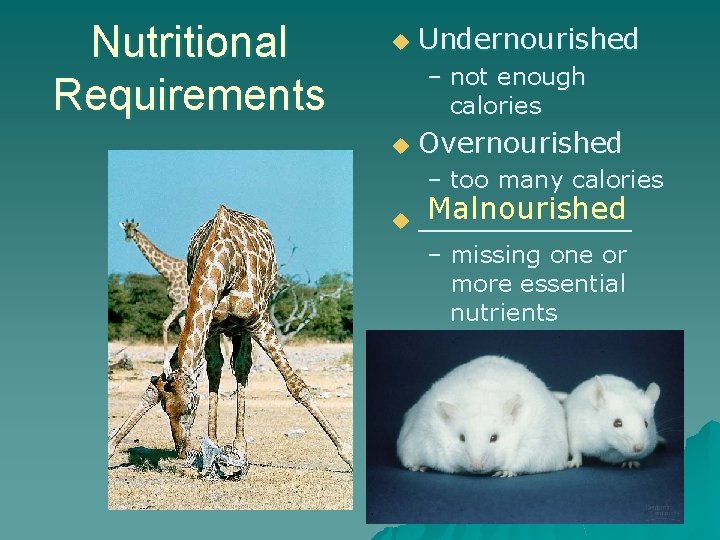
Nutritional Requirements u Undernourished – not enough calories u Overnourished – too many calories u Malnourished ______ – missing one or more essential nutrients
Essential Nutrients u Essential Amino Acids Fatty Acids Vitamins Minerals
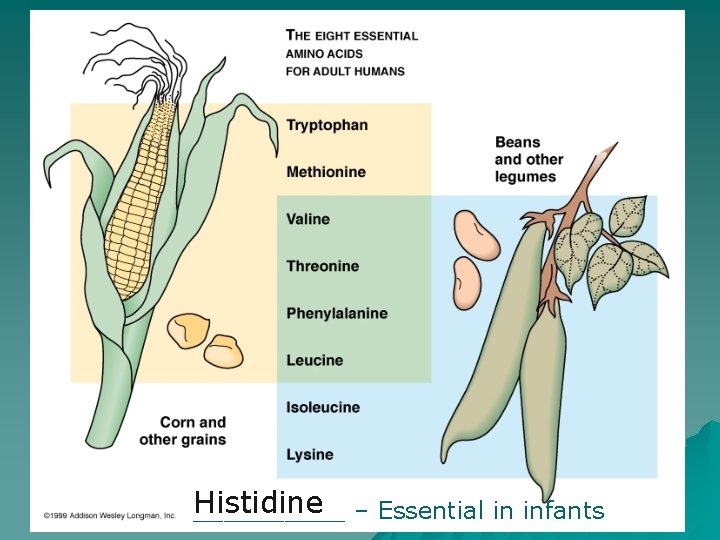
Essential Amino Acids u Found in proteins – 20 different types u 8 essential in adult humans (9 infants) u all in animal proteins u vegetarians need to eat grains and beans
Histidine _____ – Essential in infants
Essential Fatty Acids u Unsaturated fatty acids – used to make phospholipids for membranes
Essential Vitamins u Fat Soluble – stored in fat D, A, K, E – ______ u Water Soluble – excreted in urine – B complex and C
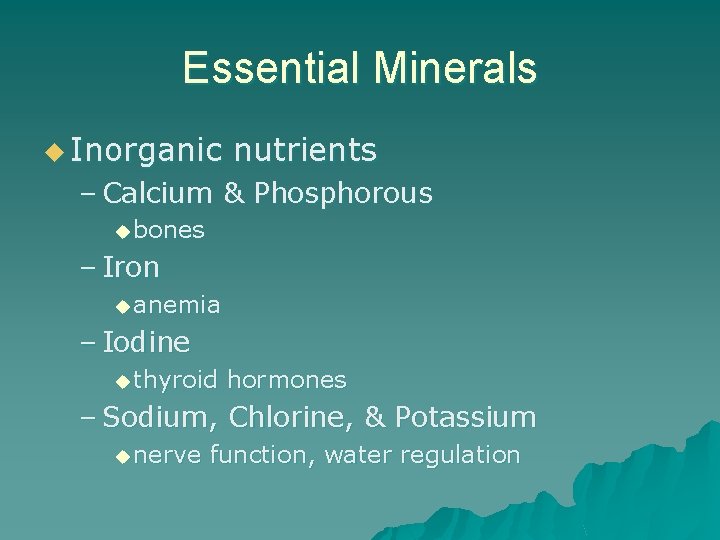
Essential Minerals u Inorganic nutrients – Calcium & Phosphorous u bones – Iron u anemia – Iodine u thyroid hormones – Sodium, Chlorine, & Potassium u nerve function, water regulation
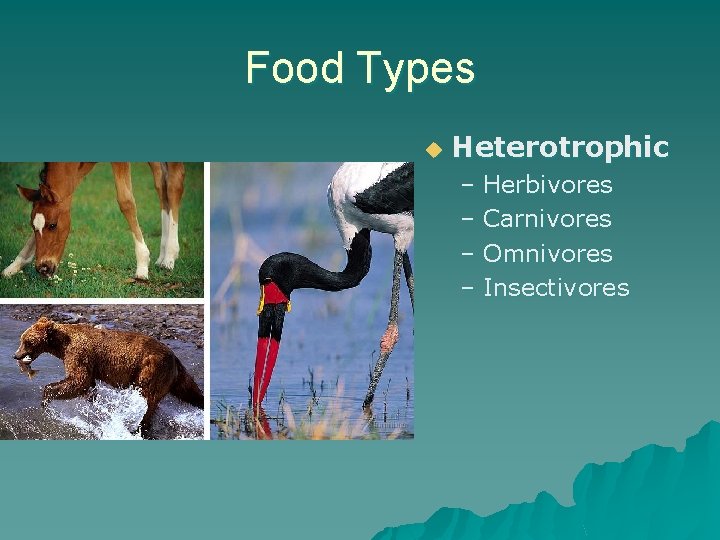
Food Types u Heterotrophic – Herbivores – Carnivores – Omnivores – Insectivores
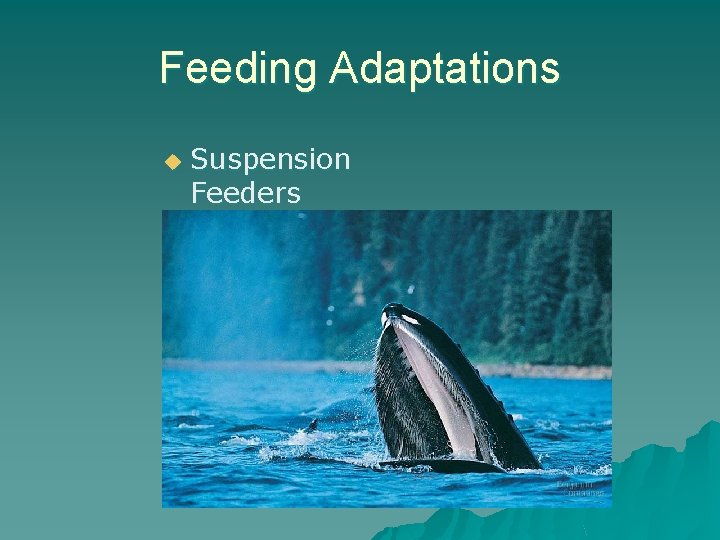
Feeding Adaptations u Suspension Feeders
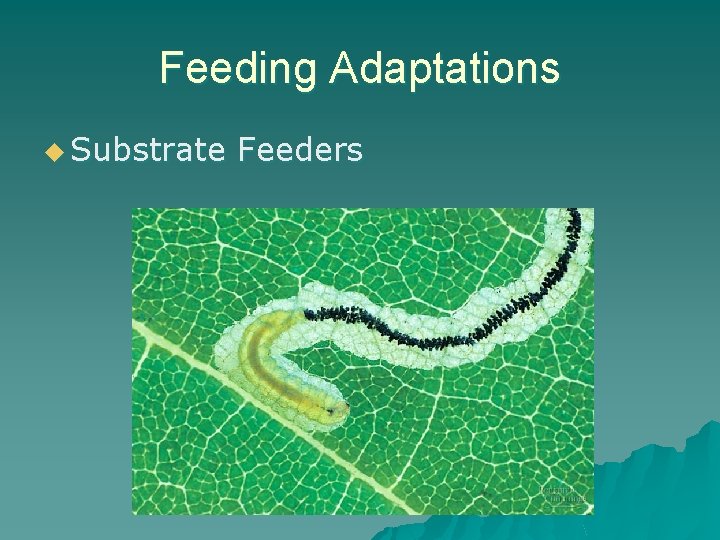
Feeding Adaptations u Substrate Feeders
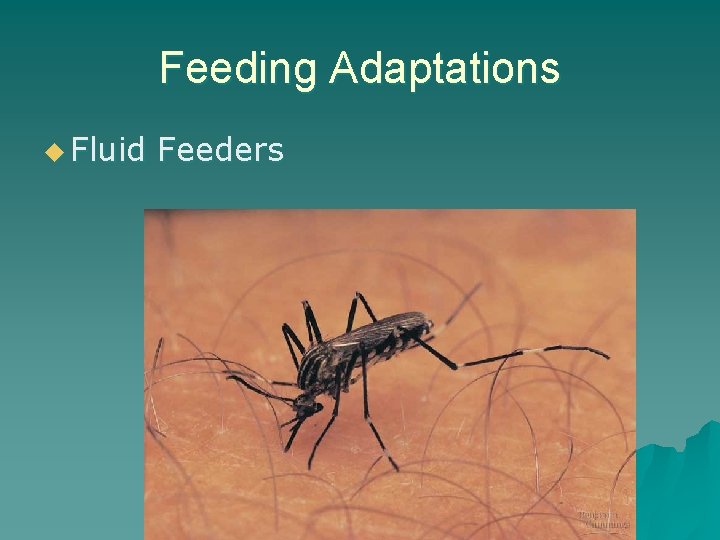
Feeding Adaptations u Fluid Feeders
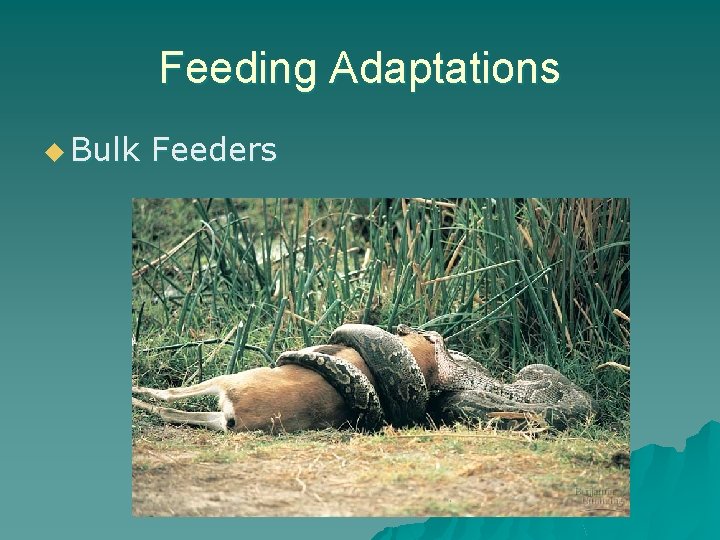
Feeding Adaptations u Bulk Feeders
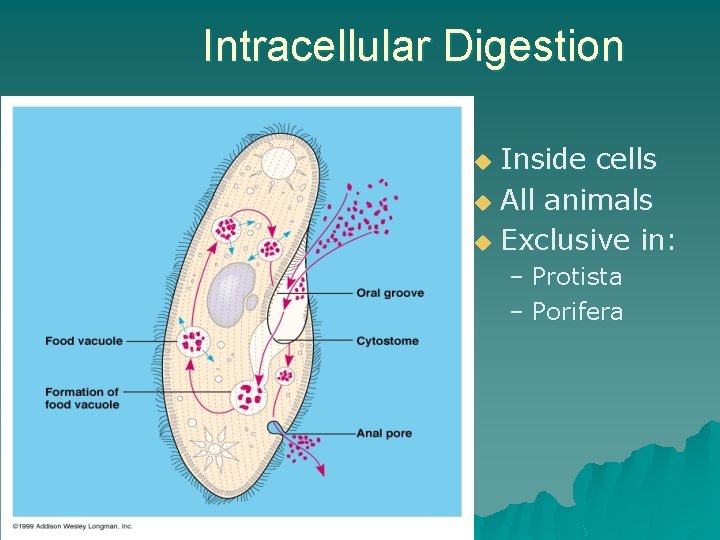
Intracellular Digestion Inside cells u All animals u Exclusive in: u – Protista – Porifera
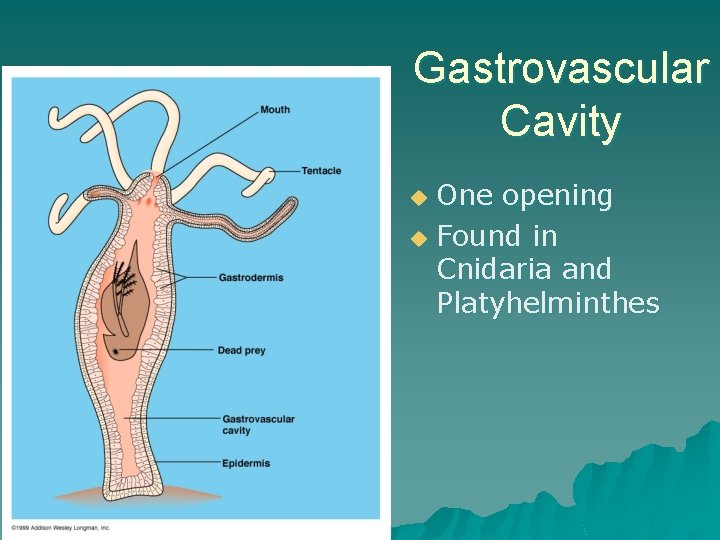
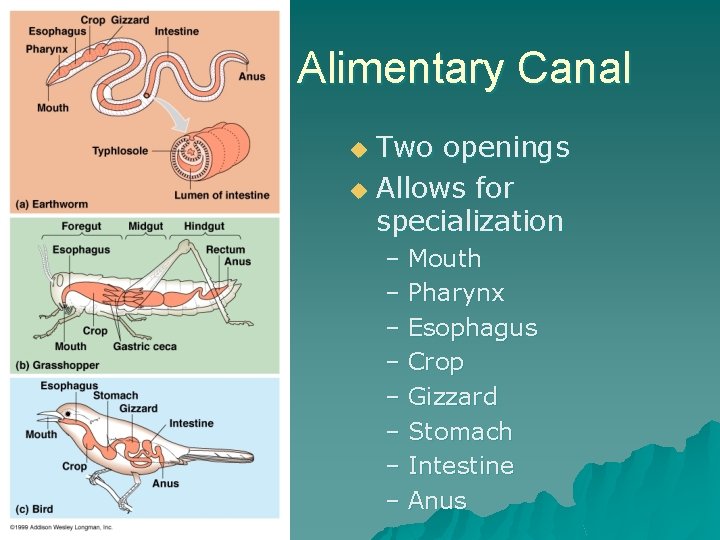
Extracellular Digestion u Outside cells u All animals above the sponges u Two Types Gastrovascular Cavity – _________ Alimentary Canal – _________
Gastrovascular Cavity One opening u Found in Cnidaria and Platyhelminthes u
Alimentary Canal Two openings u Allows for specialization u – Mouth – Pharynx – Esophagus – Crop – Gizzard – Stomach – Intestine – Anus
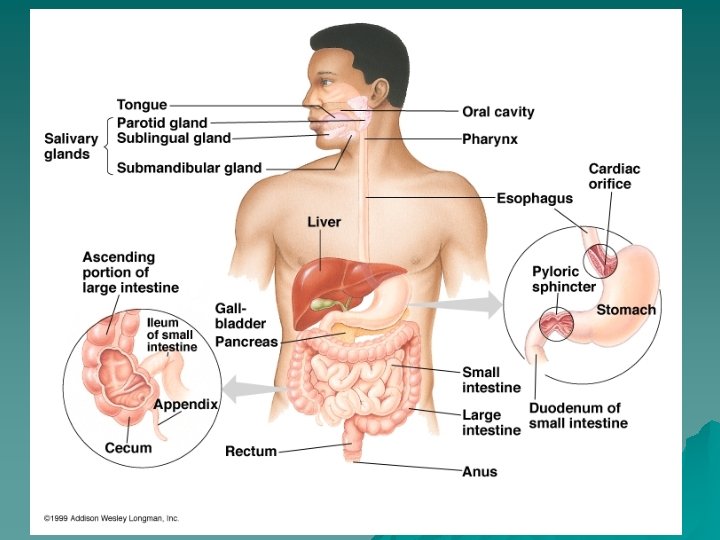
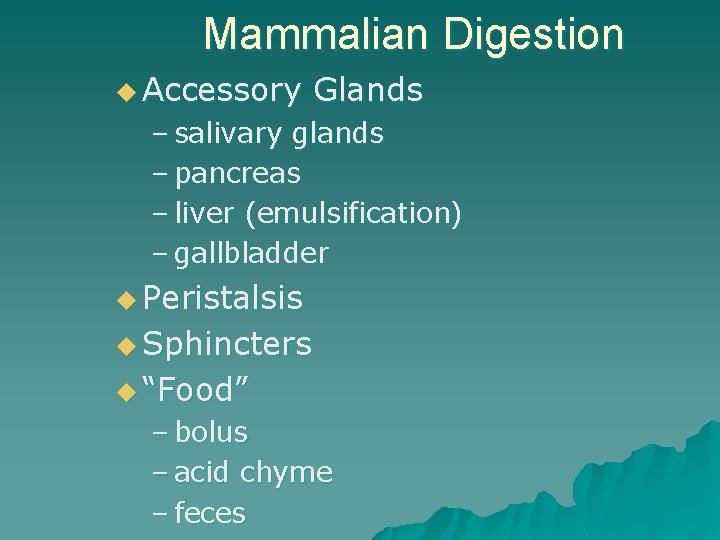
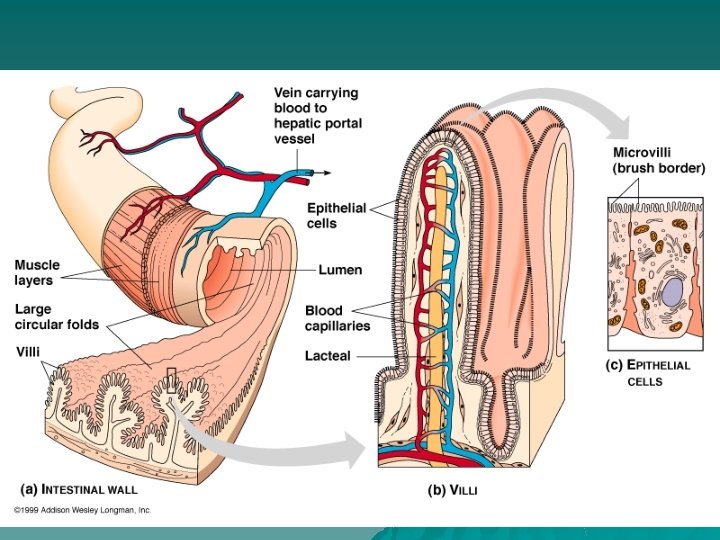
Mammalian Digestion u Accessory Glands – salivary glands – pancreas – liver (emulsification) – gallbladder u Peristalsis u Sphincters u “Food” – bolus – acid chyme – feces
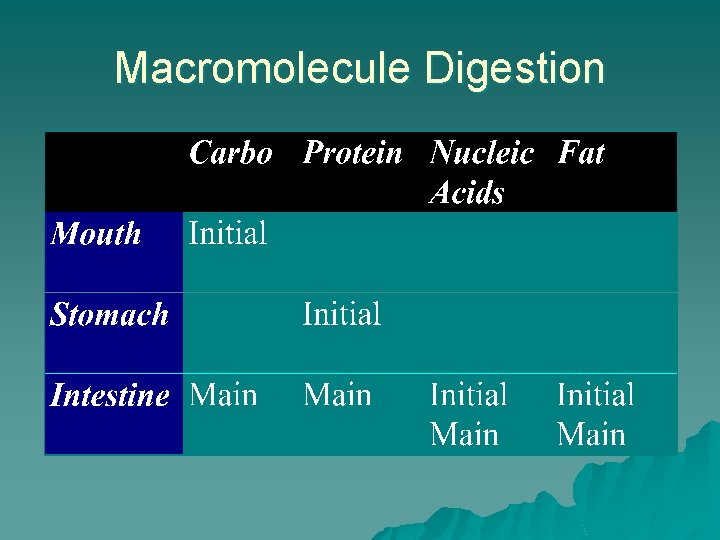
Macromolecule Digestion
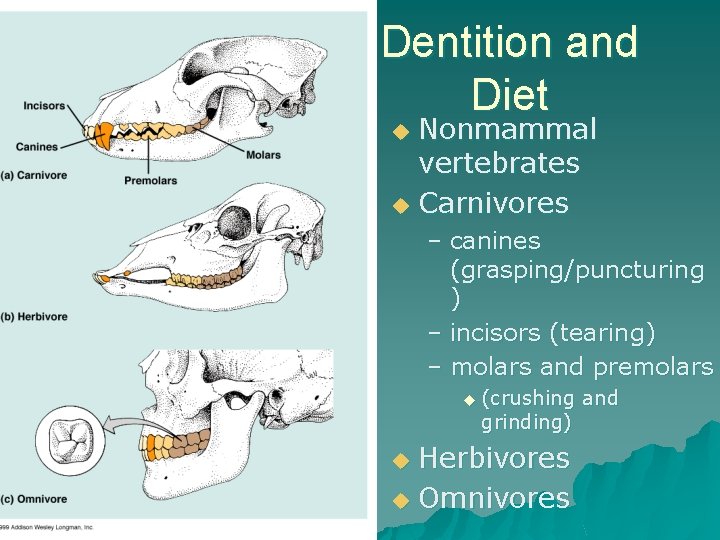
Dentition and Diet Nonmammal vertebrates u Carnivores u – canines (grasping/puncturing ) – incisors (tearing) – molars and premolars u (crushing grinding) Herbivores u Omnivores u and
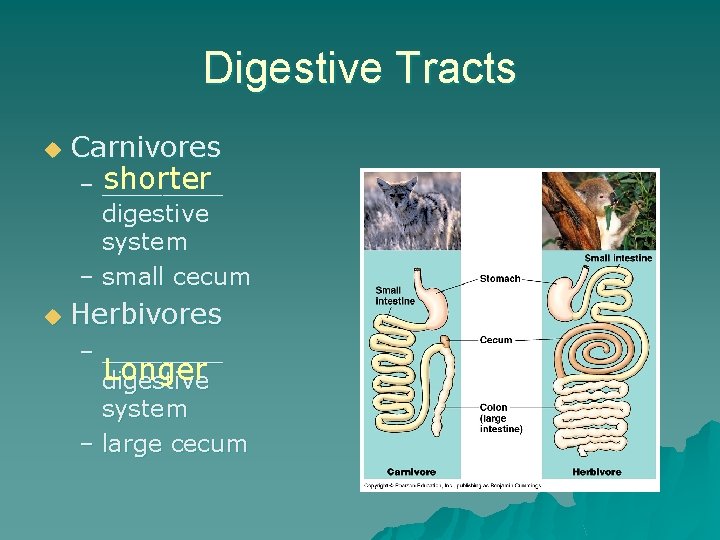
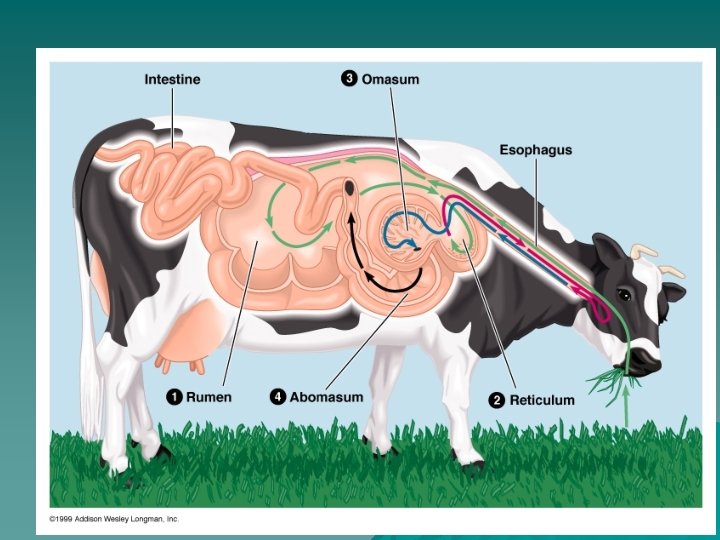
Digestive Tracts u Carnivores u Herbivores shorter – ____ digestive system – small cecum – ____ Longer digestive system – large cecum