
EVOLUTION OF THE PLAYING HABITS OF POKER PLAYERS
EVOLUTION OF THE PLAYING HABITS OF POKER PLAYERS Magali Dufour, Ph. D. Élise Roy, MD. , MSc. 1 Natacha Brunelle, Ph. D. Sylvia Kairouz, Ph. D. Louise Nadeau, Ph. D. Adèle Morvannou, Msc.
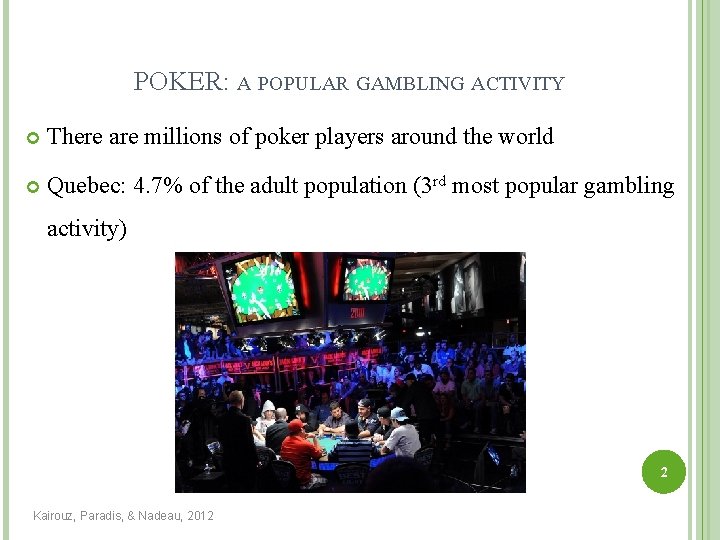
POKER: A POPULAR GAMBLING ACTIVITY There are millions of poker players around the world Quebec: 4. 7% of the adult population (3 rd most popular gambling activity) 2 Kairouz, Paradis, & Nadeau, 2012
POKER: IS IT A RISKY GAMBLING ACTIVITY? Concern: prevalence of gambling problems (9. 1 to 17. 2%) Consequences financial problems mental health problems Problematic gamblers vs those without a problem: elevated number of gambling activities, high frequency of gambling, playing more on the Internet, elevated level of impulsivity and anxiety and higher presence of erroneous beliefs 3 Bjerg, 2010; Fiedler & Wilcke, 2012; Kairouz et Nadeau (2014); European Council, 2012; Barrault & Varescon, 2013 a, 2013 b; Hopley, Dempsey, & Nicki, 2012; Barrault, Untas, & Varescon, 2014; Hopley, Wagner, & Nicky, 2014; Brosowski, Meyer, & Hayer, 2012; Kairouz, Paradis, & Nadeau, 2012; Hopley & Nicki, 2010
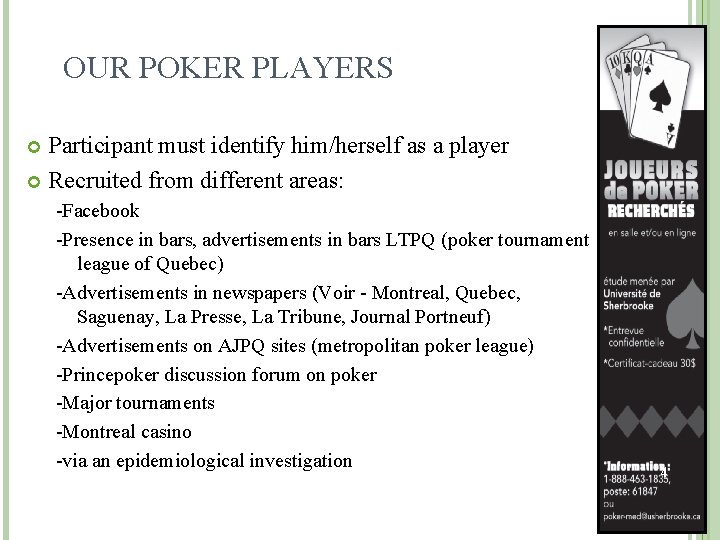
OUR POKER PLAYERS Participant must identify him/herself as a player Recruited from different areas: -Facebook -Presence in bars, advertisements in bars LTPQ (poker tournament league of Quebec) -Advertisements in newspapers (Voir - Montreal, Quebec, Saguenay, La Presse, La Tribune, Journal Portneuf) -Advertisements on AJPQ sites (metropolitan poker league) -Princepoker discussion forum on poker -Major tournaments -Montreal casino -via an epidemiological investigation 4
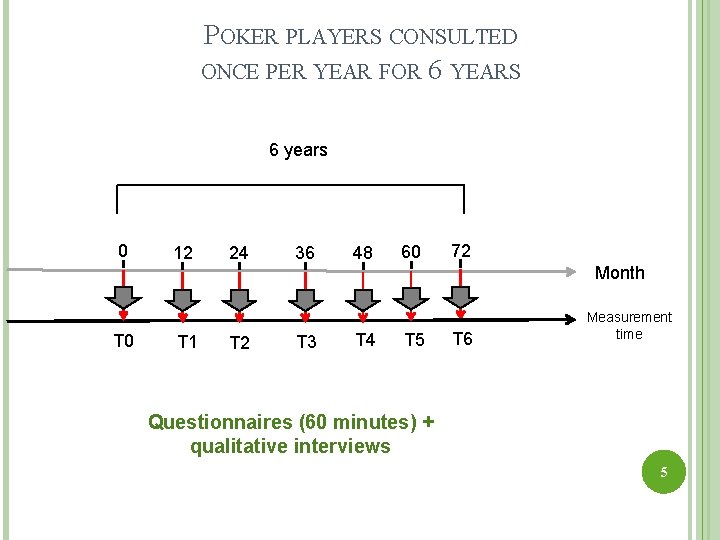
POKER PLAYERS CONSULTED ONCE PER YEAR FOR 6 YEARS 6 years 0 T 0 12 T 1 24 T 2 36 T 3 48 T 4 60 72 Month T 5 T 6 Measurement time Questionnaires (60 minutes) + qualitative interviews 5
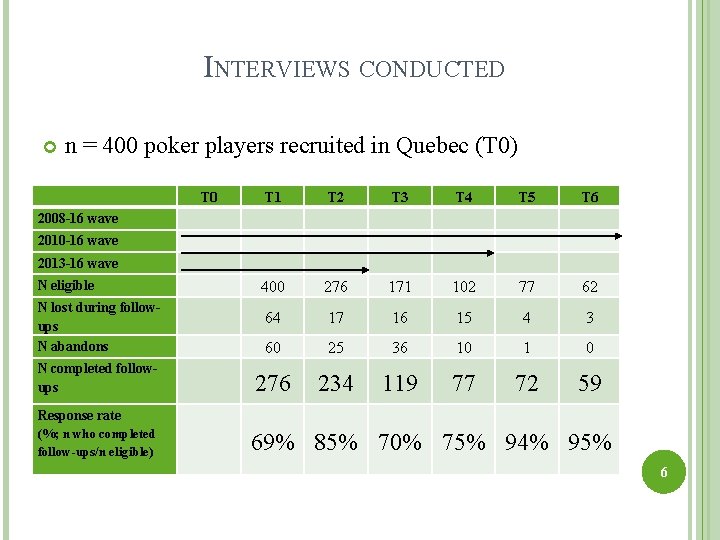
INTERVIEWS CONDUCTED n = 400 poker players recruited in Quebec (T 0) T 1 T 2 T 3 T 4 T 5 T 6 2008 -16 wave 2010 -16 wave 2013 -16 wave 400 276 171 102 77 62 64 17 16 15 4 3 60 25 36 10 1 0 276 234 119 77 72 59 69% 85% 70% 75% 94% 95% N eligible N lost during followups N abandons N completed followups T 0 Response rate (%; n who completed follow-ups/n eligible) 6
PROFILE OF PARTICIPANTS (N=400) 51% preferred playing poker in a room or among friends 49% preferred playing poker on the Internet No "purely" Internet players, for the most part Played on average 4 other gambling activities (lottery, scratch cards) 7
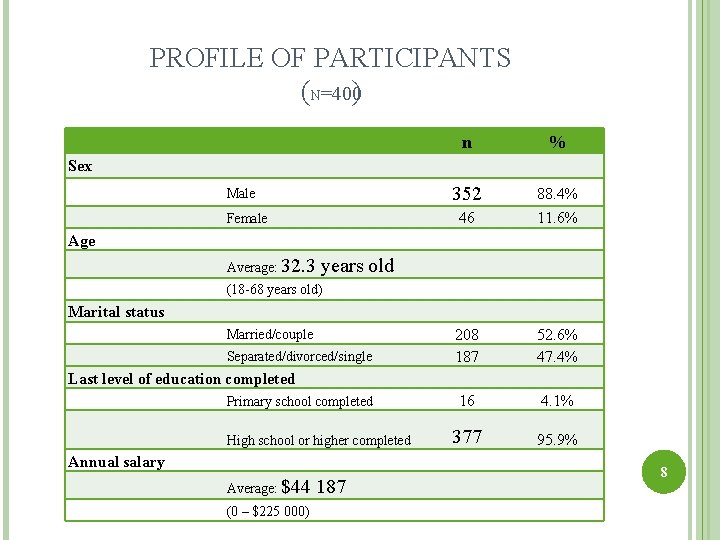
PROFILE OF PARTICIPANTS (N=400) Sex Male Age Female Average: 32. 3 years old (18 -68 years old) Marital status Married/couple Separated/divorced/single Last level of education completed Primary school completed High school or higher completed n % 352 88. 4% 46 11. 6% 208 187 52. 6% 47. 4% 16 4. 1% 377 95. 9% Annual salary Average: $44 187 (0 – $225 000) 8
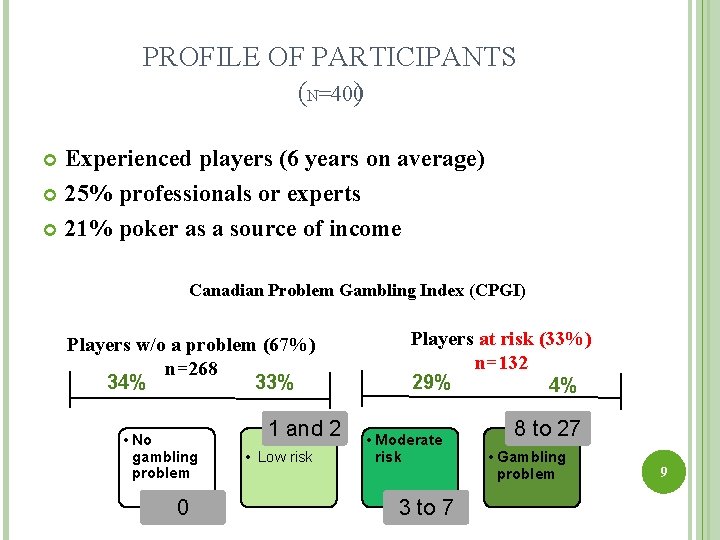
PROFILE OF PARTICIPANTS (N=400) Experienced players (6 years on average) 25% professionals or experts 21% poker as a source of income Canadian Problem Gambling Index (CPGI) Players w/o a problem (67%) n=268 33% 34% • No gambling problem 0 1 and 2 • Low risk Players at risk (33%) n=132 29% 4% • Moderate risk 3 to 7 8 to 27 • Gambling problem 9
HOW MANY BECOME PATHOLOGICAL GAMBLERS? (N=276) Over the course of 3 years, on average per year 2. 07% of players became pathological gamblers over the 3 year observation period 16. 8% of players experienced an increased risk of having gambling problems 10
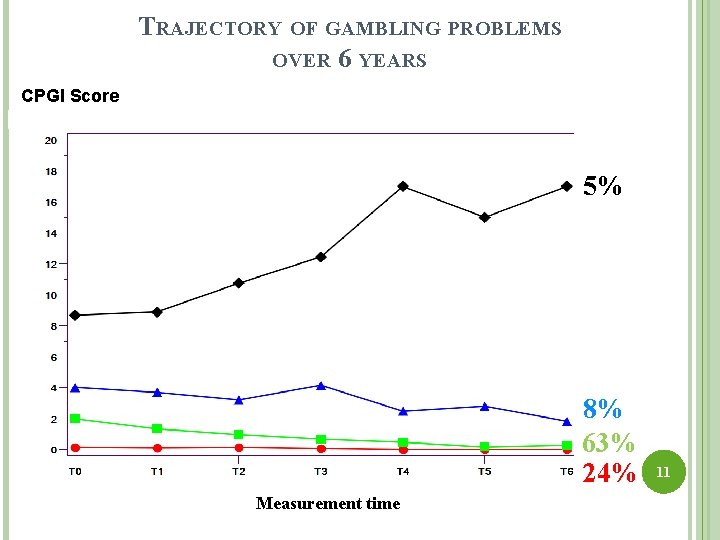
TRAJECTORY OF GAMBLING PROBLEMS OVER 6 YEARS CPGI Score 5% 8% 63% 24% Measurement time 11
FINDINGS FROM THE ANALYSIS OF TRAJECTORIES Only 5% of players were problematic and remained as such For the rest, the risk diminished (reassuring!) But what differentiates excessive players who remain as such (traj. 4)? 12
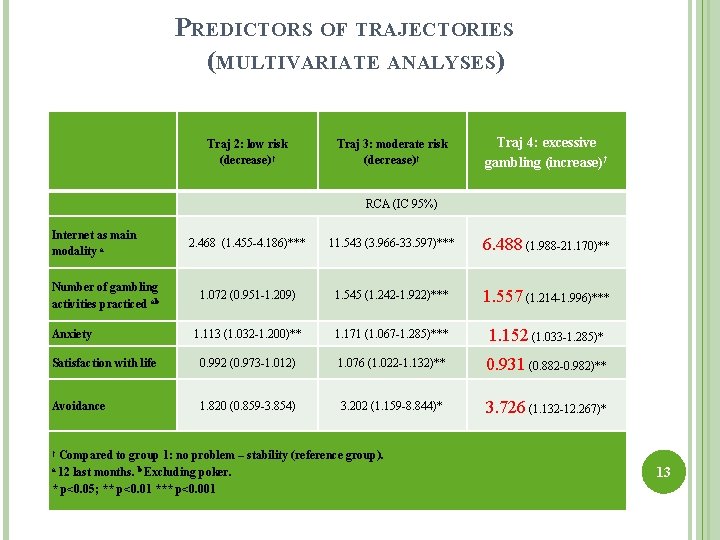
PREDICTORS OF TRAJECTORIES (MULTIVARIATE ANALYSES) Traj 2: low risk (decrease)† Internet as main modality a Traj 3: moderate risk (decrease)† Traj 4: excessive gambling (increase)† RCA (IC 95%) 2. 468 (1. 455 -4. 186)*** 11. 543 (3. 966 -33. 597)*** 6. 488 (1. 988 -21. 170)** 1. 072 (0. 951 -1. 209) 1. 545 (1. 242 -1. 922)*** 1. 557 (1. 214 -1. 996)*** 1. 113 (1. 032 -1. 200)** 1. 171 (1. 067 -1. 285)*** 1. 152 (1. 033 -1. 285)* Satisfaction with life 0. 992 (0. 973 -1. 012) 1. 076 (1. 022 -1. 132)** 0. 931 (0. 882 -0. 982)** Avoidance 1. 820 (0. 859 -3. 854) 3. 202 (1. 159 -8. 844)* 3. 726 (1. 132 -12. 267)* Number of gambling activities practiced ab Anxiety † Compared to group 1: no problem – stability (reference group). a 12 last months. b Excluding poker. * p<0. 05; ** p<0. 01 *** p<0. 001 13
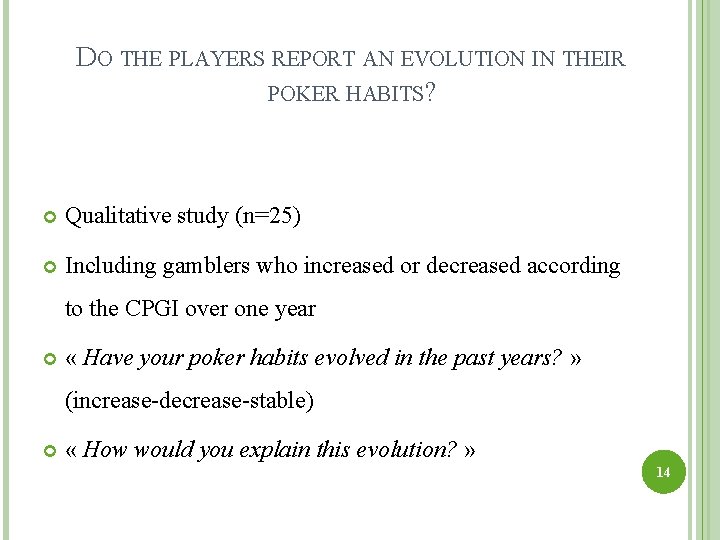
DO THE PLAYERS REPORT AN EVOLUTION IN THEIR POKER HABITS? Qualitative study (n=25) Including gamblers who increased or decreased according to the CPGI over one year « Have your poker habits evolved in the past years? » (increase-decrease-stable) « How would you explain this evolution? » 14
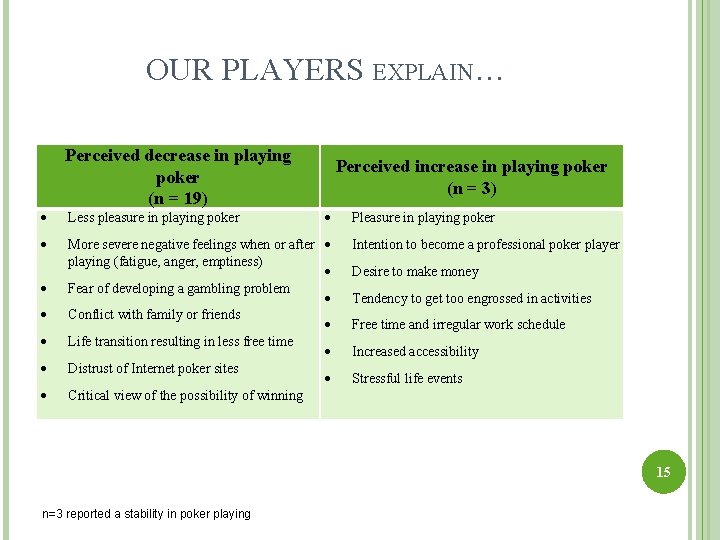
OUR PLAYERS EXPLAIN … Perceived decrease in playing poker (n = 19) Less pleasure in playing poker Perceived increase in playing poker (n = 3) More severe negative feelings when or after playing (fatigue, anger, emptiness) Fear of developing a gambling problem Conflict with family or friends Life transition resulting in less free time Distrust of Internet poker sites Critical view of the possibility of winning Pleasure in playing poker Intention to become a professional poker player Desire to make money Tendency to get too engrossed in activities Free time and irregular work schedule Increased accessibility Stressful life events 15 n=3 reported a stability in poker playing
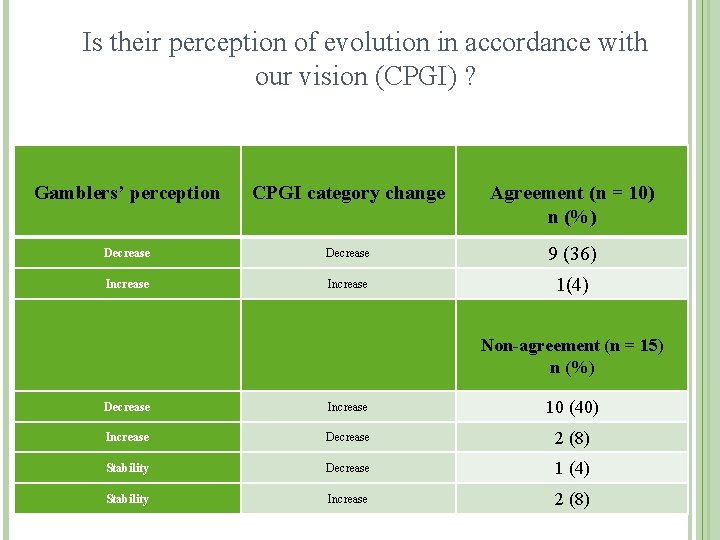
Is their perception of evolution in accordance with our vision (CPGI) ? Gamblers’ perception CPGI category change Agreement (n = 10) n (%) Decrease 9 (36) Increase 1(4) Non-agreement (n = 15) n (%) Decrease Increase 10 (40) Increase Decrease 2 (8) Stability Decrease 1 (4) Stability Increase 2 (8) 16
What we can learn from this study Few players developed gambling problems However, certain had a risk that increased, even if they are not pathological gamblers therefore, identify these players to prevent consequences A small group of players who were already pathological remained as such (5%) target these aspects in prevention and treatment: number of gambling activities, Internet, anxiety, satisfaction with life and avoidance 17
What we can learn from this study Some perceived a decrease, when there was actually an increase in risk Strategies to see their gambling habits: tables with losses and revenues A telephone call/year to check in? Think of themselves as being different from other players Distrustful, questioning general prevention and being hesitant with respect to treatments Advice from players: play in a healthy manner, that is to say recreationally and for fun and not for money; have other hobbies 18
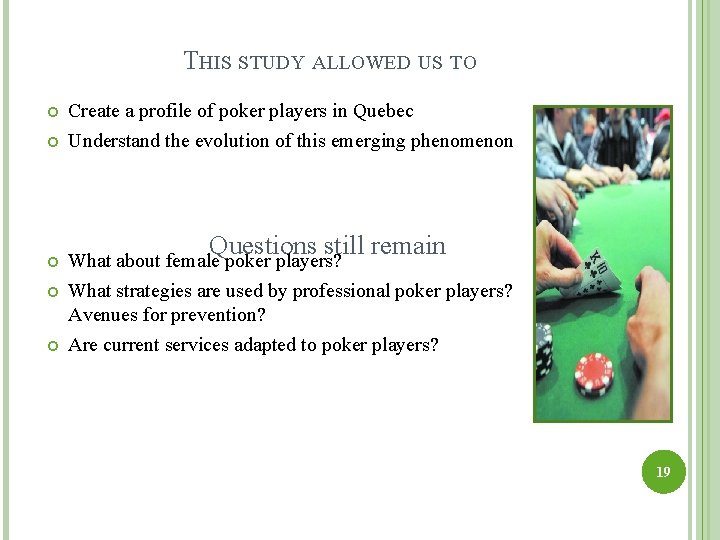
THIS STUDY ALLOWED US TO Create a profile of poker players in Quebec Understand the evolution of this emerging phenomenon Questions still remain What about female poker players? What strategies are used by professional poker players? Avenues for prevention? Are current services adapted to poker players? 19
THANK YOU TO ALL PARTICIPANTS! AND TO THE ENTIRE TEAM… Adèle Morvannou Caroline Apotheloz Émélie Laverdière Catherine Williams Daniela Gonzales Pierre-Axel Pejouan Patricia Auger Gregory Jaquet Séverine Petit Julie Gauthier Isabelle Richer Josée Meunier Andréa Isabelle-Roy Adeline Chaumillon Véronique Chadillon. Farinacci Geneviève Devoy Lauriane Drolet Catherine Pinet Élaine Lesage-Mann Catherine Arseneault Sabrina Champoux Pascale Couvrette Sara-Maude Joubert Vincent Jolivet Isabelle Martin Daniel Ochoa 20
- Slides: 20