
Evolution of the LHCb RICH System for Phase
Evolution of the LHCb RICH System for Phase II Carmelo D’Ambrosio on behalf of the RICH Team Drive for upgrades in LHC: more physics and physics reach. How? By increasing Luminosity. Drag: Resources, Space (for the moment at least, the sub-det envelopes are defined). In the LHCb roadmap … : Upg 1 a 2021 will see the first upgrade of the RICHes and LHCb (x 10 present Lumi); Upg 1 b Upg 2 2025 may see a small upgrade in preparation for 2030, a major possible upgrade (HL-LHC, x 50 present Lumi). 23 March 2018, Carmelo, Annecy 1
Strategy • Keep peak Occupancies (time and space) < 30% • Improve Single Photon Cherenkov Angle precision to < 0. 5 mrad In short, we want a digital camera with: • Lots of quality pixels Photodetectors and assoc. electronics • An excellent lens Optical and gas systems • A fast and precise shutter Gating and time resolution 23 March 2018, Carmelo, Annecy 2
A few slides to show a possible way to improve the LHCb RICH System* *For the sake of simplicity, let us suppose to be able to use Si. PM detectors. Also, quite simple calculations here, no detailed simulations 23 March 2018, Carmelo, Annecy 3
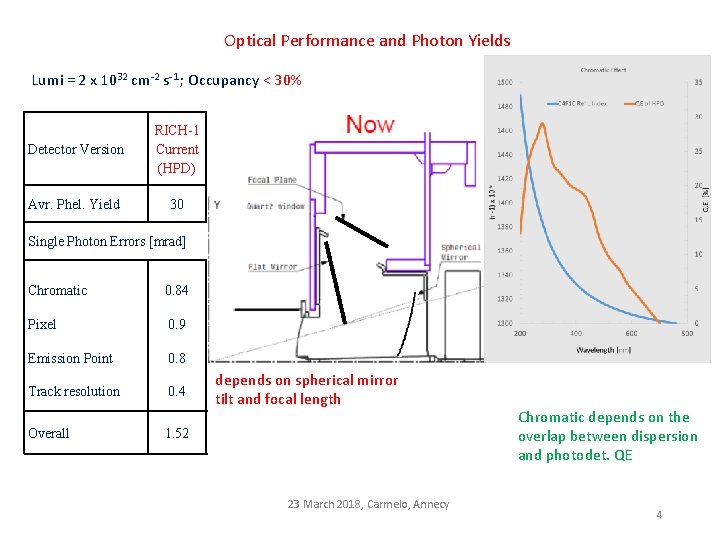
Optical Performance and Photon Yields Lumi = 2 x 1032 cm-2 s-1 ; Occupancy < 30% Detector Version RICH-1 Current (HPD) RICH-1 Upgraded RICH-1 Upg 2 RICH-2 Upgraded RICH-2 Upg 2 Avr. Phel. Yield 30 40 (rms=8) 60 - 40 22 (rms=5) 30 0. 58 0. 24 – 0. 12 0. 32 ~0. 1 0. 44 0. 15 0. 19 0. 07 0. 37 0. 1 0. 22 0. 1 Single Photon Errors [mrad] Chromatic 0. 84 Pixel 0. 9 Emission Point 0. 8 Track resolution Overall 0. 4 1. 52 0. 4 ? 0. 4 depends on spherical mirror tilt and focal length 0. 9 0. 5 (0. 3 – 0. 2) 0. 60 ? 0. 4? 0. 47 (0. 16) 23 March 2018, Carmelo, Annecy Chromatic depends on the overlap between dispersion and photodet. QE 4

Optical Performance and Photon Yields Lumi ≤ 2 x 1033 cm-2 s-1 ; Occupancy < 30% Detector Version RICH-1 Upg 1 RICH-1 Upgraded RICH-1 Upg 2 Avr. Phel. Yield 40 40 (rms=8) Upg 1 RICH-2 Upgraded RICH-2 Upg 2 60 - 40 22 (rms=5) 30 0. 58 0. 24 – 0. 12 0. 32 ~0. 1 0. 44 0. 15 0. 19 0. 07 0. 37 0. 1 0. 22 0. 1 Single Photon Errors [mrad] Chromatic 0. 58 Pixel 0. 44 Emission Point 0. 37 Track resolution Overall 0. 4 0. 9 0. 4 ? 0. 4 depends on spherical mirror tilt and focal length 0. 9 0. 5 (0. 3 – 0. 2) 0. 60 ? 0. 4? 0. 47 (0. 16) 23 March 2018, Carmelo, Annecy Chromatic depends on the overlap between dispersion and photodet. QE 5
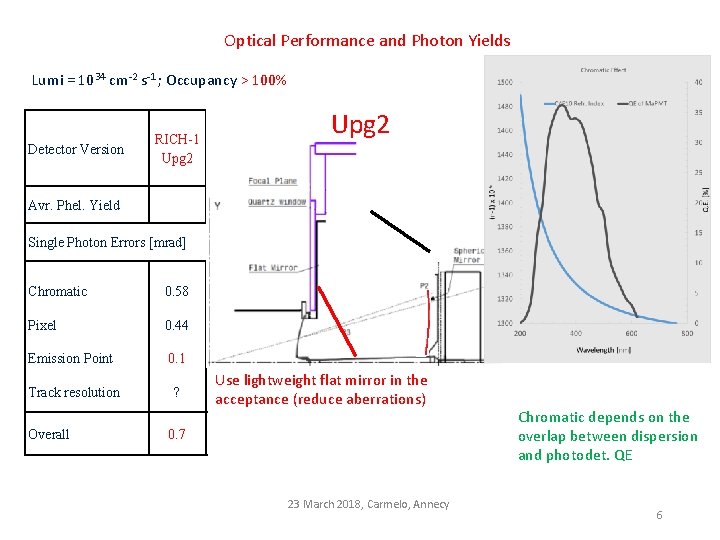
Optical Performance and Photon Yields Lumi = 1034 cm-2 s-1 ; Occupancy > 100% Detector Version RICH-1 Upg 2 Avr. Phel. Yield RICH-1 Upgraded RICH-1 Upg 2 40 (rms=8) Upg 2 RICH-2 Upgraded RICH-2 Upg 2 60 - 40 22 (rms=5) 30 0. 58 0. 24 – 0. 12 0. 32 ~0. 1 0. 44 0. 15 0. 19 0. 07 0. 37 0. 1 0. 22 0. 1 Single Photon Errors [mrad] Chromatic 0. 58 Pixel 0. 44 Emission Point 0. 1 Track resolution Overall ? 0. 7 0. 4 ? 0. 4? Use lightweight flat mirror in the acceptance (reduce aberrations) 0. 9 0. 5 (0. 3 – 0. 2) 0. 60 0. 47 (0. 16) 23 March 2018, Carmelo, Annecy Chromatic depends on the overlap between dispersion and photodet. QE 6
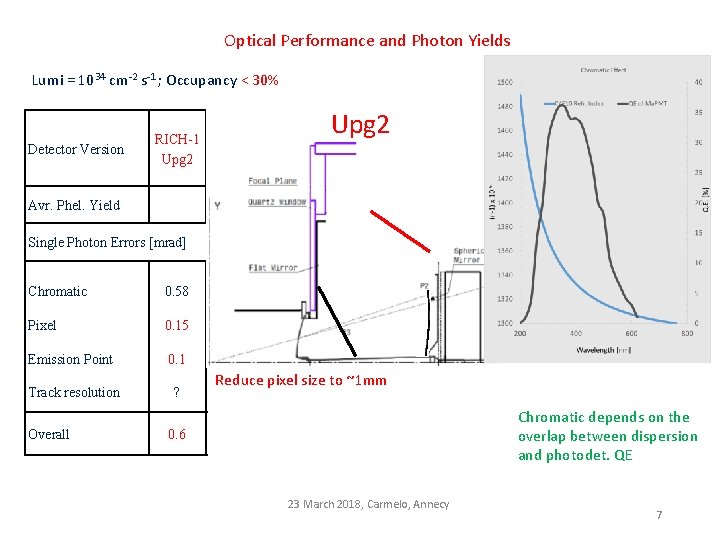
Optical Performance and Photon Yields Lumi = 1034 cm-2 s-1 ; Occupancy < 30% Detector Version RICH-1 Upg 2 Avr. Phel. Yield RICH-1 Upgraded RICH-1 Upg 2 40 (rms=8) Upg 2 RICH-2 Upgraded RICH-2 Upg 2 60 - 40 22 (rms=5) 30 0. 58 0. 24 – 0. 12 0. 32 ~0. 1 0. 44 0. 15 0. 19 0. 07 0. 37 0. 1 0. 22 0. 1 Single Photon Errors [mrad] Chromatic 0. 58 Pixel 0. 15 Emission Point 0. 1 Track resolution Overall ? 0. 6 0. 4 ? 0. 4 Reduce pixel size to ~1 mm 0. 9 0. 5 (0. 3 – 0. 2) 0. 60 ? 0. 4? 0. 47 (0. 16) 23 March 2018, Carmelo, Annecy Chromatic depends on the overlap between dispersion and photodet. QE 7
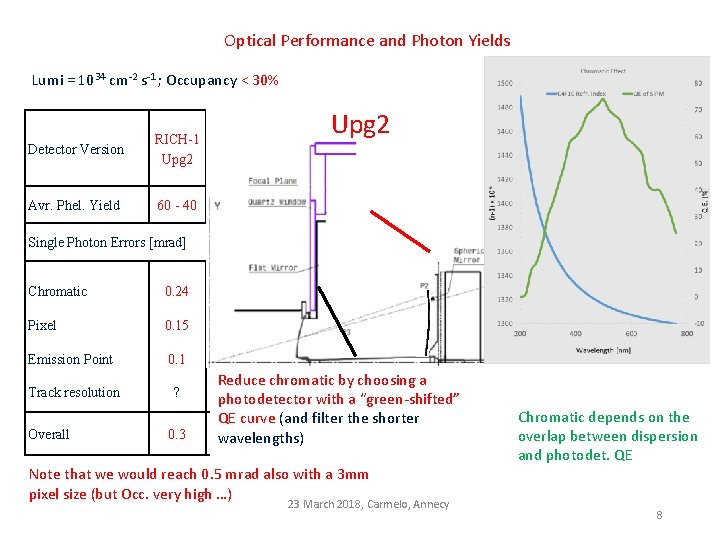
Optical Performance and Photon Yields Lumi = 1034 cm-2 s-1 ; Occupancy < 30% Detector Version RICH-1 Upg 2 RICH-1 Upgraded RICH-1 Upg 2 Avr. Phel. Yield 60 - 40 40 (rms=8) Upg 2 RICH-2 Upgraded RICH-2 Upg 2 60 - 40 22 (rms=5) 30 0. 58 0. 24 – 0. 12 0. 32 ~0. 1 0. 44 0. 15 0. 19 0. 07 0. 37 0. 1 0. 22 0. 1 Single Photon Errors [mrad] Chromatic 0. 24 Pixel 0. 15 Emission Point 0. 1 Track resolution Overall ? 0. 3 0. 4 ? 0. 4? Reduce chromatic by choosing a photodetector with a “green-shifted” QE curve (and filter the shorter 0. 9 0. 5 (0. 3 – 0. 2) 0. 60 0. 47 (0. 16) wavelengths) Note that we would reach 0. 5 mrad also with a 3 mm pixel size (but Occ. very high …) 23 March 2018, Carmelo, Annecy Chromatic depends on the overlap between dispersion and photodet. QE 8
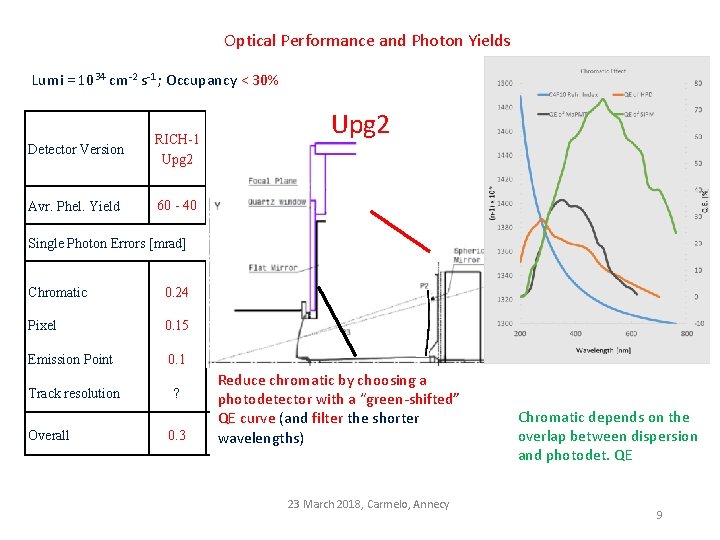
Optical Performance and Photon Yields Lumi = 1034 cm-2 s-1 ; Occupancy < 30% Detector Version RICH-1 Upg 2 RICH-1 Upgraded RICH-1 Upg 2 Avr. Phel. Yield 60 - 40 40 (rms=8) Upg 2 RICH-2 Upgraded RICH-2 Upg 2 60 - 40 22 (rms=5) 30 0. 58 0. 24 – 0. 12 0. 32 ~0. 1 0. 44 0. 15 0. 19 0. 07 0. 37 0. 1 0. 22 0. 1 Single Photon Errors [mrad] Chromatic 0. 24 Pixel 0. 15 Emission Point 0. 1 Track resolution Overall ? 0. 3 0. 4 ? 0. 4? Reduce chromatic by choosing a photodetector with a “green-shifted” QE curve (and filter the shorter 0. 9 0. 5 (0. 3 – 0. 2) 0. 60 0. 47 (0. 16) wavelengths) 23 March 2018, Carmelo, Annecy Chromatic depends on the overlap between dispersion and photodet. QE 9
The same discussion is valid also for RICH 2* * However, if the flat mirrors go into acceptance, then the array boxes need adaptation 23 March 2018, Carmelo, Annecy 10
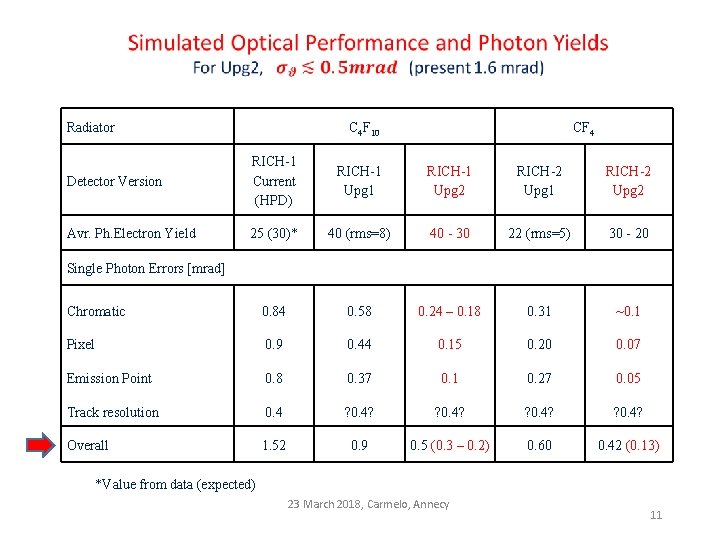
Radiator C 4 F 10 CF 4 Detector Version RICH-1 Current (HPD) RICH-1 Upg 1 RICH-1 Upg 2 RICH-2 Upg 1 RICH-2 Upg 2 Avr. Ph. Electron Yield 25 (30)* 40 (rms=8) 40 - 30 22 (rms=5) 30 - 20 Chromatic 0. 84 0. 58 0. 24 – 0. 18 0. 31 ~0. 1 Pixel 0. 9 0. 44 0. 15 0. 20 0. 07 Emission Point 0. 8 0. 37 0. 1 0. 27 0. 05 Track resolution 0. 4 ? 0. 4? Overall 1. 52 0. 9 0. 5 (0. 3 – 0. 2) 0. 60 0. 42 (0. 13) Single Photon Errors [mrad] *Value from data (expected) 23 March 2018, Carmelo, Annecy 11
A word of caution The RICH Detectors will not work without a consequent tracking system. At these high angular resolutions (0. 1 – 0. 2 mrad) from the RICHes: • Angular resolution required from the tracker < 0. 2 mrad • Multiple scattering from particles in the RICHes (can we roughly measure p? )*; • Particle trajectory bent by stray and not stray magnetic fields; 23 March 2018, Carmelo, Annecy 12
With Luminosities increasing (see Sajan) Time resolution (time granularity) will also help disentangle busy events, while delivering more information: Provide the system with time gating capabilities (≤ 1 ns) Provide the system with time resolution ~0. 2 to 1 ns (time resolution on single photon) and ~50 to 150 ps (time resolution with ~40 detected photons). 23 March 2018, Carmelo, Annecy 13
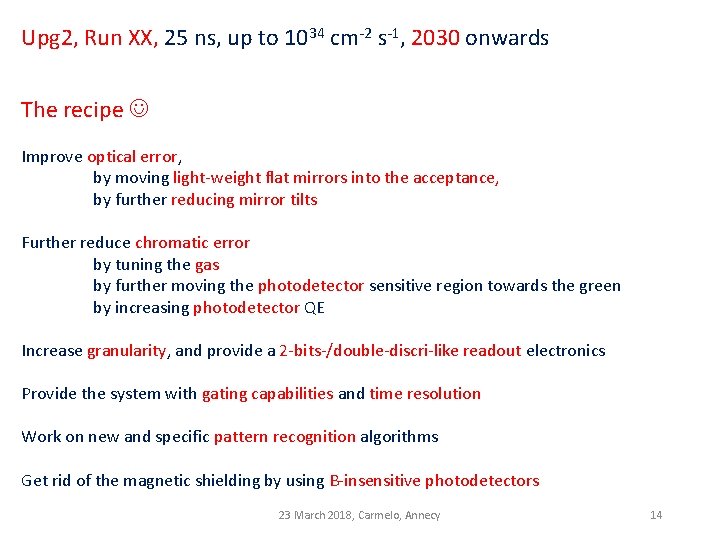
Upg 2, Run XX, 25 ns, up to 1034 cm-2 s-1, 2030 onwards The recipe Improve optical error, by moving light-weight flat mirrors into the acceptance, by further reducing mirror tilts Further reduce chromatic error by tuning the gas by further moving the photodetector sensitive region towards the green by increasing photodetector QE Increase granularity, and provide a 2 -bits-/double-discri-like readout electronics Provide the system with gating capabilities and time resolution Work on new and specific pattern recognition algorithms Get rid of the magnetic shielding by using B-insensitive photodetectors 23 March 2018, Carmelo, Annecy 14
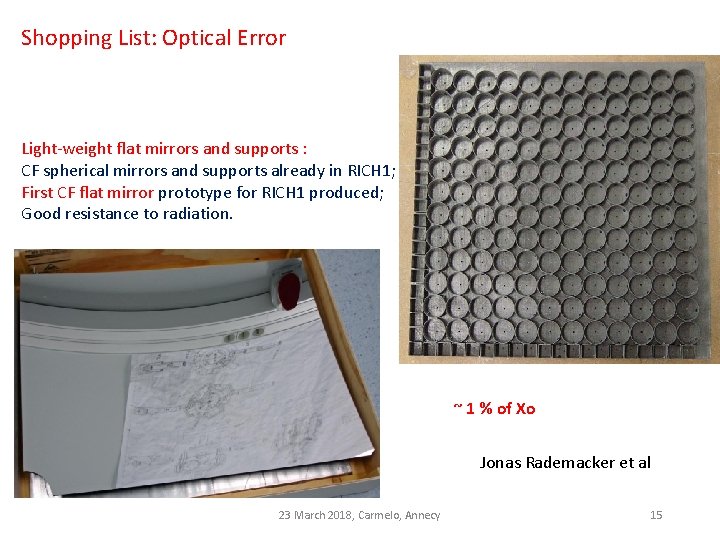
Shopping List: Optical Error Light-weight flat mirrors and supports : CF spherical mirrors and supports already in RICH 1; First CF flat mirror prototype for RICH 1 produced; Good resistance to radiation. ~ 1 % of Xo Jonas Rademacker et al All marked in red needs R&D!! 23 March 2018, Carmelo, Annecy 15
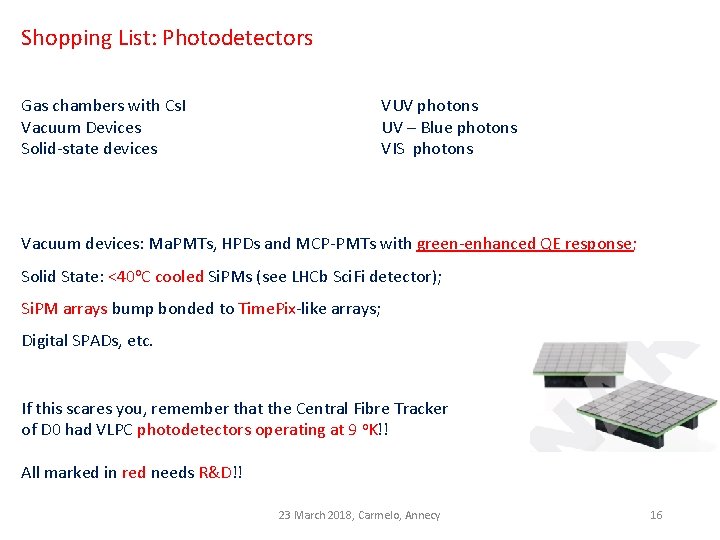
Shopping List: Photodetectors Gas chambers with Cs. I Vacuum Devices Solid-state devices VUV photons UV – Blue photons VIS photons Vacuum devices: Ma. PMTs, HPDs and MCP-PMTs with green-enhanced QE response; Solid State: <40 o. C cooled Si. PMs (see LHCb Sci. Fi detector); Si. PM arrays bump bonded to Time. Pix-like arrays; Digital SPADs, etc. If this scares you, remember that the Central Fibre Tracker of D 0 had VLPC photodetectors operating at 9 o. K!! All marked in red needs R&D!! 23 March 2018, Carmelo, Annecy 16
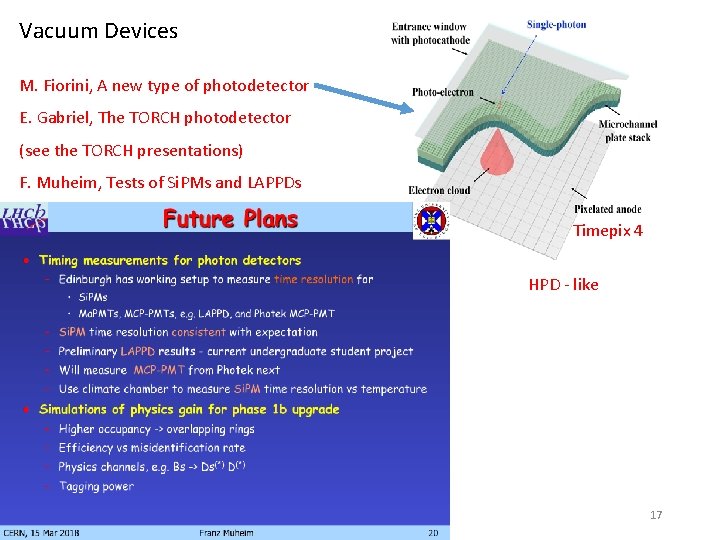
Vacuum Devices M. Fiorini, A new type of photodetector E. Gabriel, The TORCH photodetector (see the TORCH presentations) F. Muheim, Tests of Si. PMs and LAPPDs Timepix 4 HPD - like 23 March 2018, Carmelo, Annecy 17
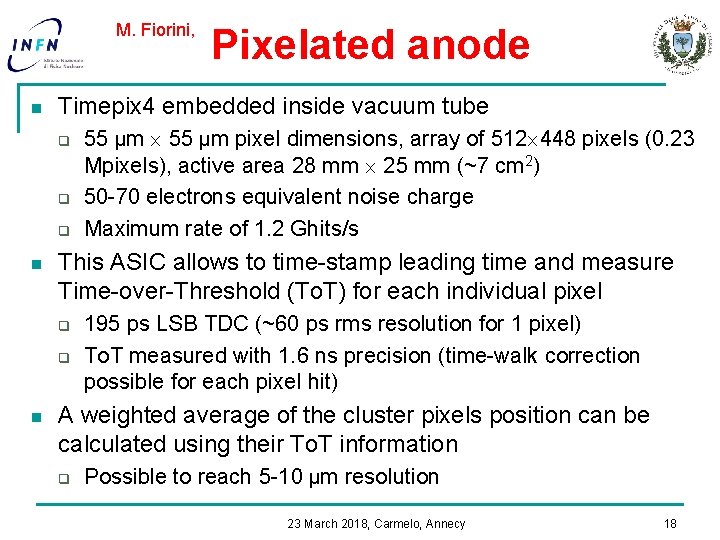
M. Fiorini, n Timepix 4 embedded inside vacuum tube q q q n 55 μm pixel dimensions, array of 512 448 pixels (0. 23 Mpixels), active area 28 mm 25 mm (~7 cm 2) 50 -70 electrons equivalent noise charge Maximum rate of 1. 2 Ghits/s This ASIC allows to time-stamp leading time and measure Time-over-Threshold (To. T) for each individual pixel q q n Pixelated anode 195 ps LSB TDC (~60 ps rms resolution for 1 pixel) To. T measured with 1. 6 ns precision (time-walk correction possible for each pixel hit) A weighted average of the cluster pixels position can be calculated using their To. T information q Possible to reach 5 -10 μm resolution 23 March 2018, Carmelo, Annecy 18
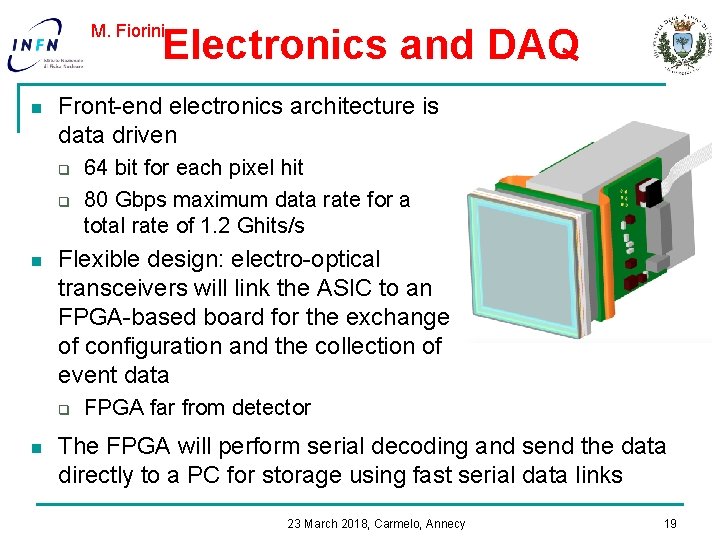
M. Fiorini, Electronics and DAQ n Front-end electronics architecture is data driven q q n Flexible design: electro-optical transceivers will link the ASIC to an FPGA-based board for the exchange of configuration and the collection of event data q n 64 bit for each pixel hit 80 Gbps maximum data rate for a total rate of 1. 2 Ghits/s FPGA far from detector The FPGA will perform serial decoding and send the data directly to a PC for storage using fast serial data links 23 March 2018, Carmelo, Annecy 19
A word about Si. PMs + High QE in the green, good single photon sensitivity, becoming cheap and easy to produce arrays with punchthrough technologies, insensitive to magn. field, etc Very sensitive to neutrons and ionizing particles; High dark count rates (DCR), depend on: - Temperature, a factor ~2 every 10 o. C, - Surface, ~linear, - Structure, - Operational electric conditions. 1. Cool down (develop cooling and vacuum systems to host the array); 2. Use microlenses to decrease diode surface: optimize diode shape, increase array active surface and improve time resolution; 3. Gate inside the 25 ns LHC clock (1 ns or less); 4. Implement neutron plastic shields: RICH 1 will be “wrapped” in plastic, instead of iron! 23 March 2018, Carmelo, Annecy 20
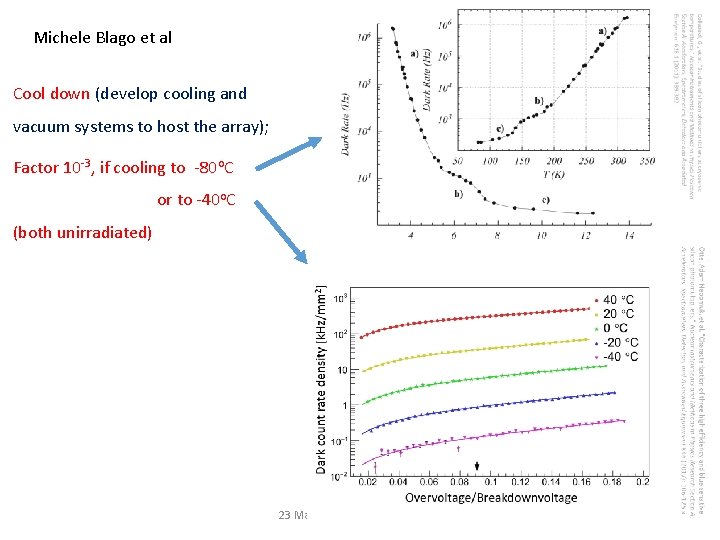
Michele Blago et al Cool down (develop cooling and vacuum systems to host the array); Factor 10 -3, if cooling to -80 o. C or to -40 o. C (both unirradiated) 23 March 2018, Carmelo, Annecy 21
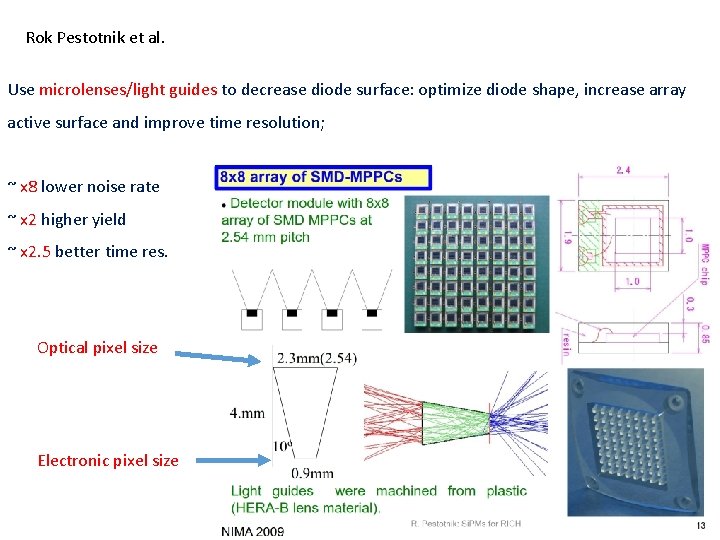
Rok Pestotnik et al. Use microlenses/light guides to decrease diode surface: optimize diode shape, increase array active surface and improve time resolution; ~ x 8 lower noise rate ~ x 2 higher yield ~ x 2. 5 better time res. Optical pixel size Electronic pixel size 23 March 2018, Carmelo, Annecy 22
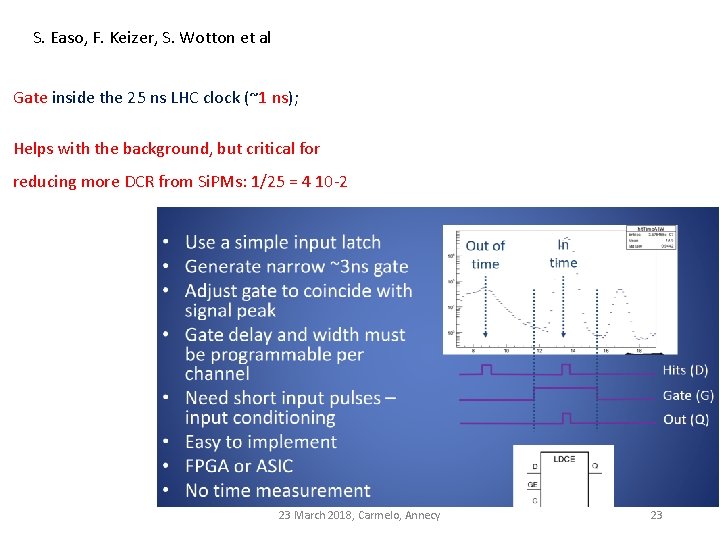
S. Easo, F. Keizer, S. Wotton et al Gate inside the 25 ns LHC clock (~1 ns); Helps with the background, but critical for reducing more DCR from Si. PMs: 1/25 = 4 10 -2 23 March 2018, Carmelo, Annecy 23
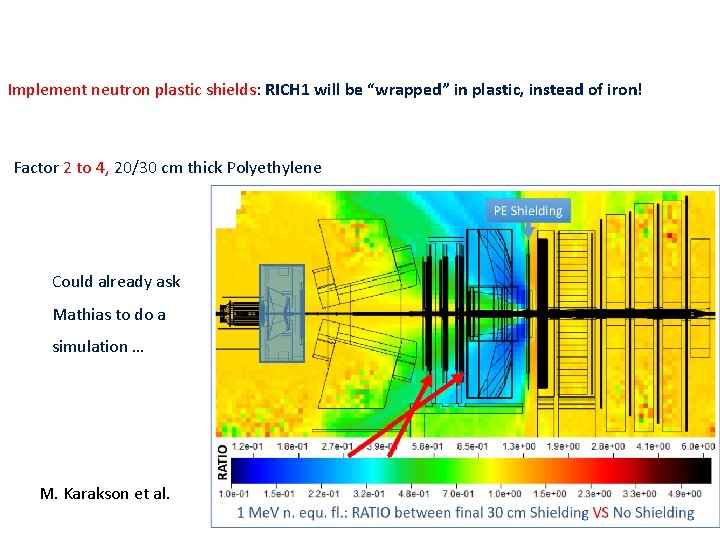
Implement neutron plastic shields: RICH 1 will be “wrapped” in plastic, instead of iron! Factor 2 to 4, 20/30 cm thick Polyethylene Could already ask Mathias to do a simulation … M. Karakson et al. 23 March 2018, Carmelo, Annecy 24
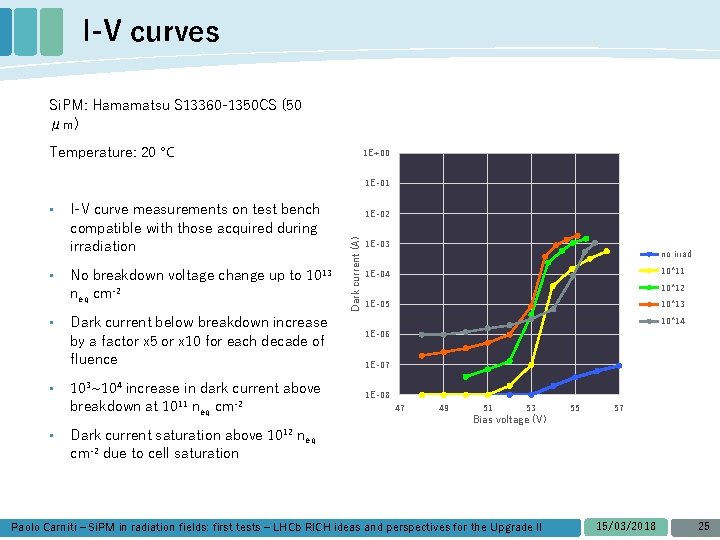
I-V curves Si. PM: Hamamatsu S 13360 -1350 CS (50 μm) Temperature: 20 °C 1 E+00 1 E-01 • • I-V curve measurements on test bench compatible with those acquired during irradiation No breakdown voltage change up to 1013 neq cm-2 Dark current below breakdown increase by a factor x 5 or x 10 for each decade of fluence 103~104 increase in dark current above breakdown at 1011 neq cm-2 1 E-02 Dark current (A) • 1 E-03 no irrad 10^11 1 E-04 10^12 1 E-05 10^13 10^14 1 E-06 1 E-07 1 E-08 47 49 51 53 Bias voltage (V) 55 57 Dark current saturation above 1012 neq cm-2 due to cell saturation Paolo Carniti – Si. PM in radiation fields: first tests – LHCb RICH ideas and perspectives for the Upgrade II 15/03/2018 25
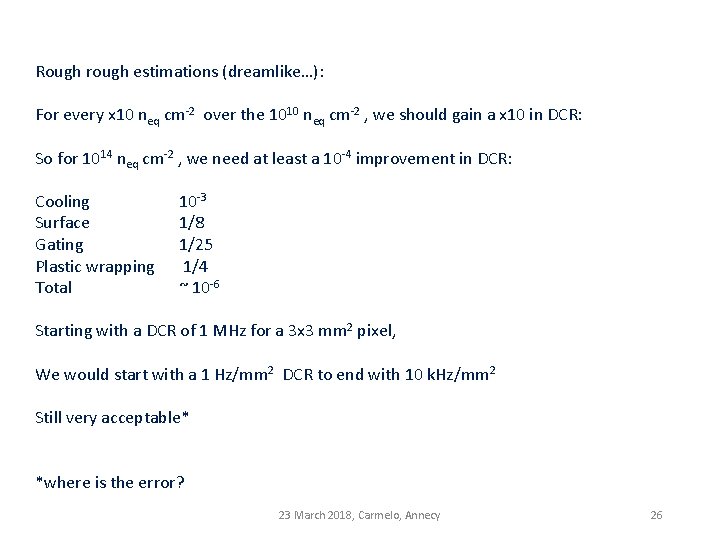
Rough rough estimations (dreamlike…): For every x 10 neq cm-2 over the 1010 neq cm-2 , we should gain a x 10 in DCR: So for 1014 neq cm-2 , we need at least a 10 -4 improvement in DCR: Cooling Surface Gating Plastic wrapping Total 10 -3 1/8 1/25 1/4 ~ 10 -6 Starting with a DCR of 1 MHz for a 3 x 3 mm 2 pixel, We would start with a 1 Hz/mm 2 DCR to end with 10 k. Hz/mm 2 Still very acceptable* *where is the error? 23 March 2018, Carmelo, Annecy 26
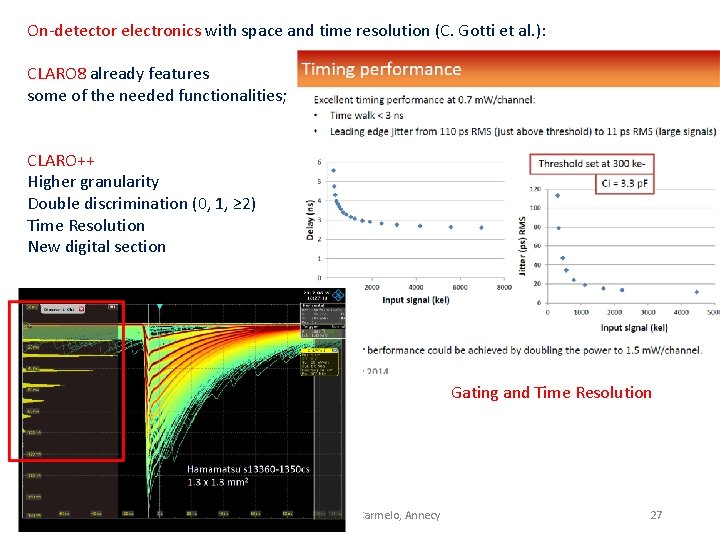
On-detector electronics with space and time resolution (C. Gotti et al. ): CLARO 8 already features some of the needed functionalities; CLARO++ Higher granularity Double discrimination (0, 1, ≥ 2) Time Resolution New digital section Gating and Time Resolution 23 March 2018, Carmelo, Annecy 27
23 March 2018, Carmelo, Annecy 28
23 March 2018, Carmelo, Annecy 29
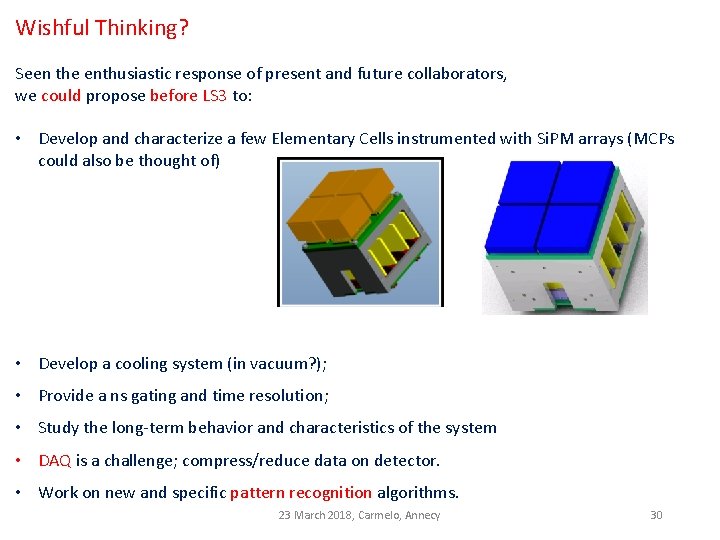
Wishful Thinking? Seen the enthusiastic response of present and future collaborators, we could propose before LS 3 to: • Develop and characterize a few Elementary Cells instrumented with Si. PM arrays (MCPs could also be thought of) • Develop a cooling system (in vacuum? ); • Provide a ns gating and time resolution; • Study the long-term behavior and characteristics of the system • DAQ is a challenge; compress/reduce data on detector. • Work on new and specific pattern recognition algorithms. 23 March 2018, Carmelo, Annecy 30
Simulations (see Sajan) Start with the following configuration: Si. PMs based RICHes, Si. PM: ~1 x 1 mm 2 with lens 2. 8 x 2. 8 mm 2 Microcells ≥ 75 μm High QE, green extended Front-end with double discriminator (0, 1, ≥ 2) Gated 1 ns 200 ps time resolution New Smart ID (64 bits) “Time sensitive” New pattern recognition New PID software tools 23 March 2018, Carmelo, Annecy 31
Conclusions Through further improvements and staying in the present envelope, the LHCb RICHes could continue to perform PID efficiently at luminosities up to 1034 cm-2 s-1. The single-photon cherenkov angle resolution could be squeezed from 1. 6/0. 7 mrad (present system) to 0. 2/0. 1 mrad for RICH 1 and 2 respectively. A critical point will be the development of green-enhanced photodetectors with high space and good time resolution (cooled Si. PMs, PMTs, HPDs and MCPs). Highly granular and power-saving front-ent electronics with 2 -bit-like, time readout and serial. The tracking system has to follow in term of resolution. We see the future of LHCb RICHes as high-precision, green-enhanced, compact machines. 23 March 2018, Carmelo, Annecy 32
- Slides: 32