
Evolution of the lattice defects in TantalumTungsten alloys

- Slides: 23
Evolution of the lattice defects in Tantalum-Tungsten alloys under irradiation Iuliia Ipatova; Iuliia. ipatova@manchester. ac. uk 14 th of September 2016
Outline • Introduction: ISIS neutron spallation source application • Experimental results before irradiation • Irradiation experiments in Dalton Cumbrian Facility • Study of irradiated Tantalum-Tungsten samples • Conclusions
Ta-W alloys are of prime importance: • to build state-of-the-art ion beam lines in irradiation facility at increasing beam powers (within the framework of the National Nuclear Users Facility) • to understand the stability of target materials which are used at neutron spallation sources (i. e. ISIS). FYI: The ISIS target station uses the high energy protons produced by the ISIS accelerator to generate neutrons by the spallation process and to modify their characteristics to make them useful for neutron scattering experiments.
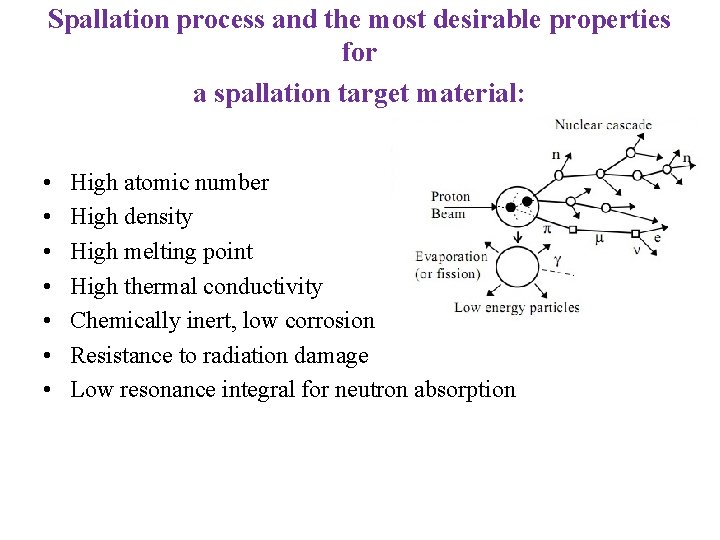
Spallation process and the most desirable properties for a spallation target material: • • High atomic number High density High melting point High thermal conductivity Chemically inert, low corrosion Resistance to radiation damage Low resonance integral for neutron absorption
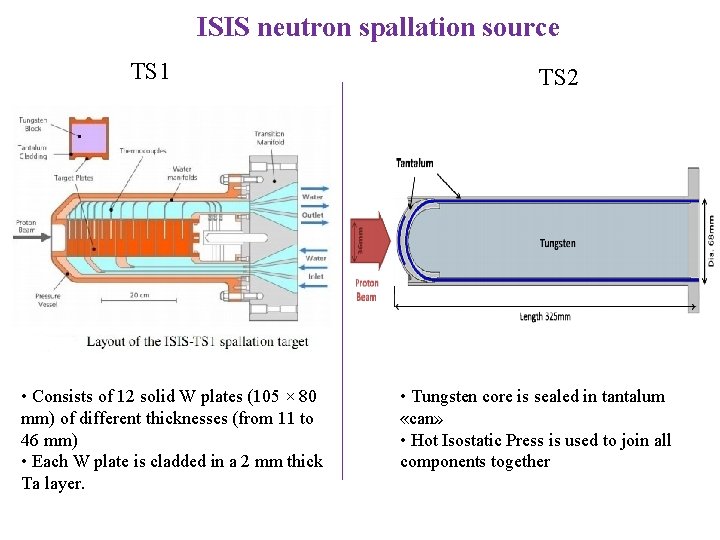
ISIS neutron spallation source TS 1 • Consists of 12 solid W plates (105 × 80 mm) of different thicknesses (from 11 to 46 mm) • Each W plate is cladded in a 2 mm thick Ta layer. TS 2 • Tungsten core is sealed in tantalum «can» • Hot Isostatic Press is used to join all components together
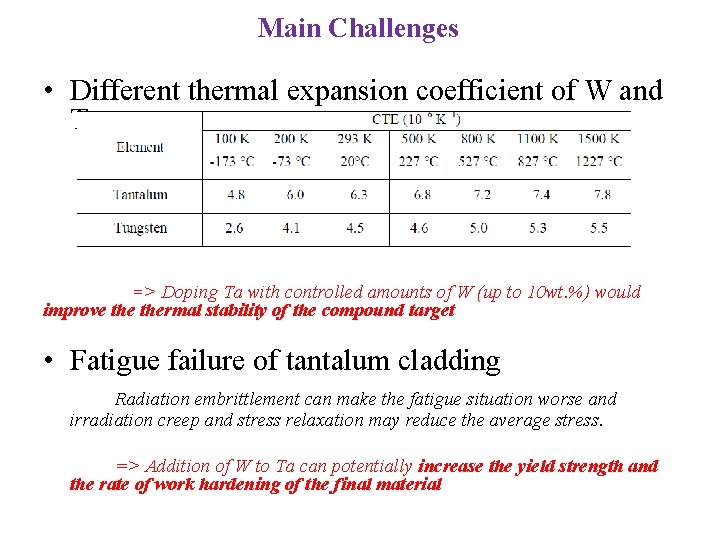
Main Challenges • Different thermal expansion coefficient of W and Ta => Doping Ta with controlled amounts of W (up to 10 wt. %) would improve thermal stability of the compound target • Fatigue failure of tantalum cladding Radiation embrittlement can make the fatigue situation worse and irradiation creep and stress relaxation may reduce the average stress. => Addition of W to Ta can potentially increase the yield strength and the rate of work hardening of the final material
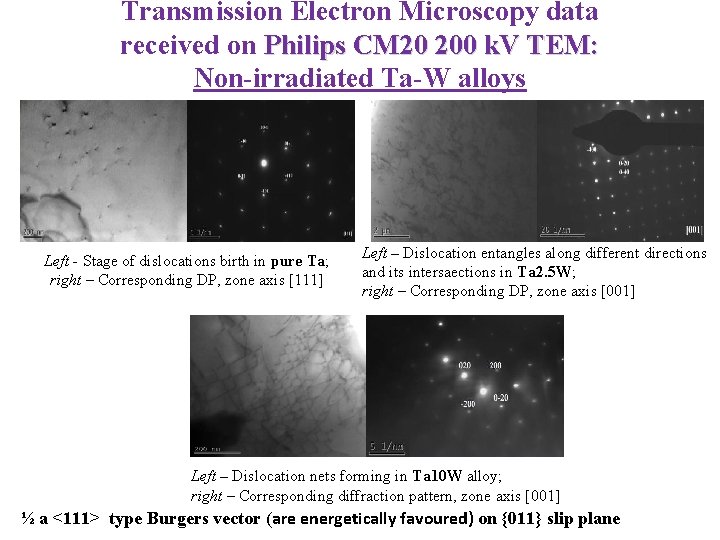
Transmission Electron Microscopy data received on Philips CM 20 200 k. V TEM: Non-irradiated Ta-W alloys Left - Stage of dislocations birth in pure Ta; right – Corresponding DP, zone axis [111] Left – Dislocation entangles along different directions and its intersaections in Ta 2. 5 W; right – Corresponding DP, zone axis [001] Left – Dislocation nets forming in Ta 10 W alloy; right – Corresponding diffraction pattern, zone axis [001] ½ a <111> type Burgers vector (are energetically favoured) on {011} slip plane
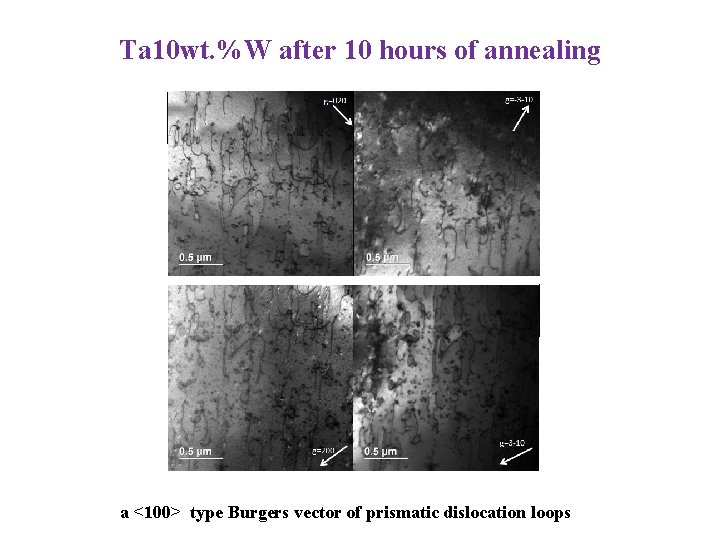
Ta 10 wt. %W after 10 hours of annealing a <100> type Burgers vector of prismatic dislocation loops
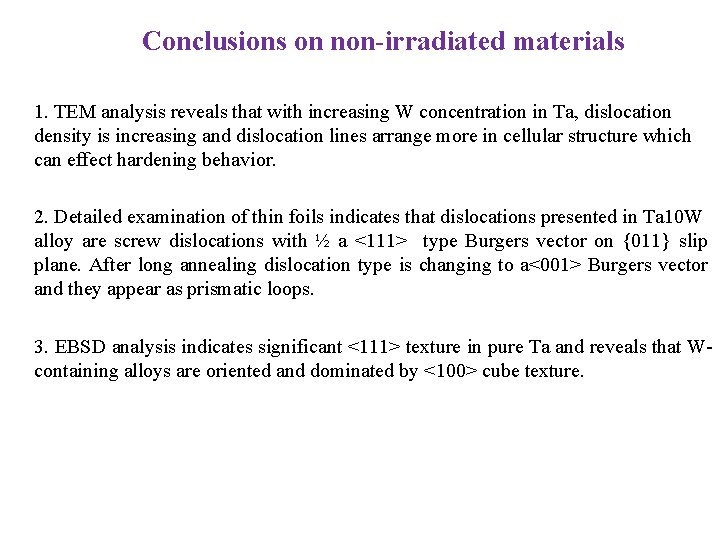
Conclusions on non-irradiated materials 1. TEM analysis reveals that with increasing W concentration in Ta, dislocation density is increasing and dislocation lines arrange more in cellular structure which can effect hardening behavior. 2. Detailed examination of thin foils indicates that dislocations presented in Ta 10 W alloy are screw dislocations with ½ a <111> type Burgers vector on {011} slip plane. After long annealing dislocation type is changing to a<001> Burgers vector and they appear as prismatic loops. 3. EBSD analysis indicates significant <111> texture in pure Ta and reveals that Wcontaining alloys are oriented and dominated by <100> cube texture.
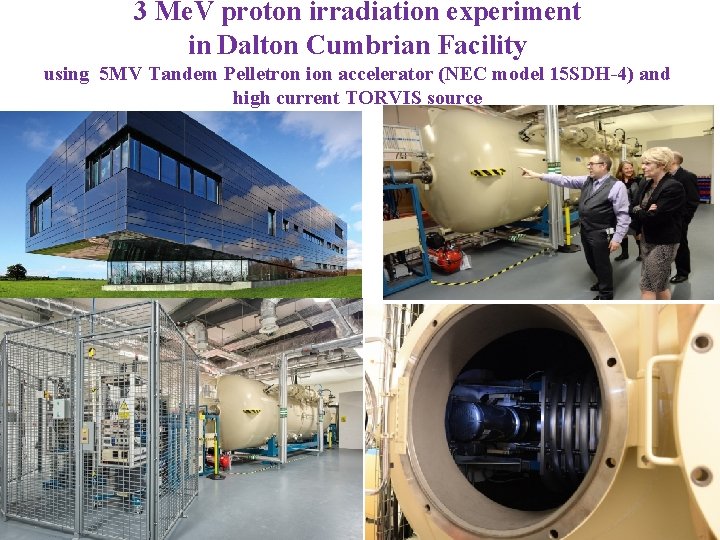
3 Me. V proton irradiation experiment in Dalton Cumbrian Facility using 5 MV Tandem Pelletron ion accelerator (NEC model 15 SDH-4) and high current TORVIS source
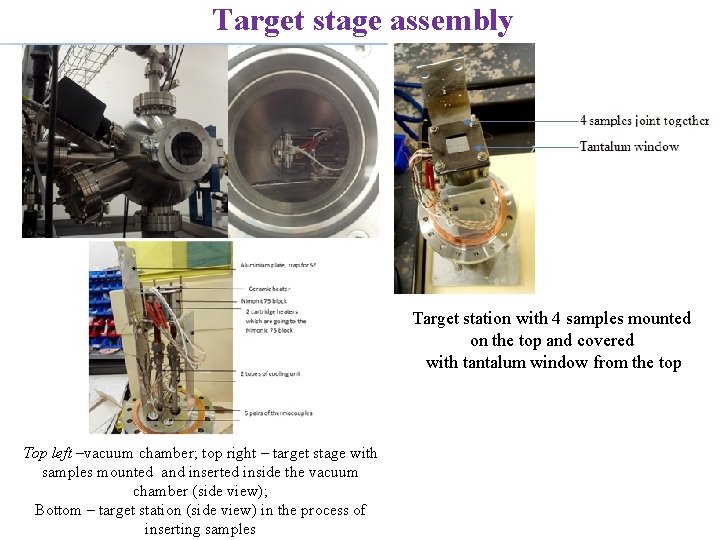
Target stage assembly Target station with 4 samples mounted on the top and covered with tantalum window from the top Top left –vacuum chamber; top right – target stage with samples mounted and inserted inside the vacuum chamber (side view); Bottom – target station (side view) in the process of inserting samples
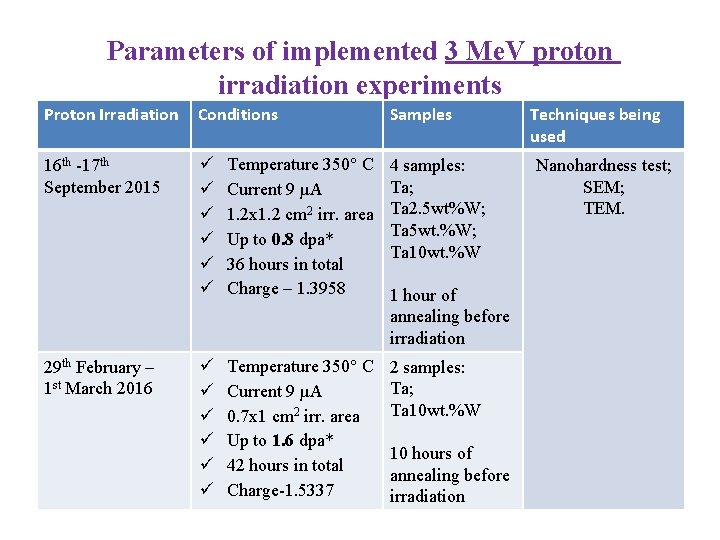
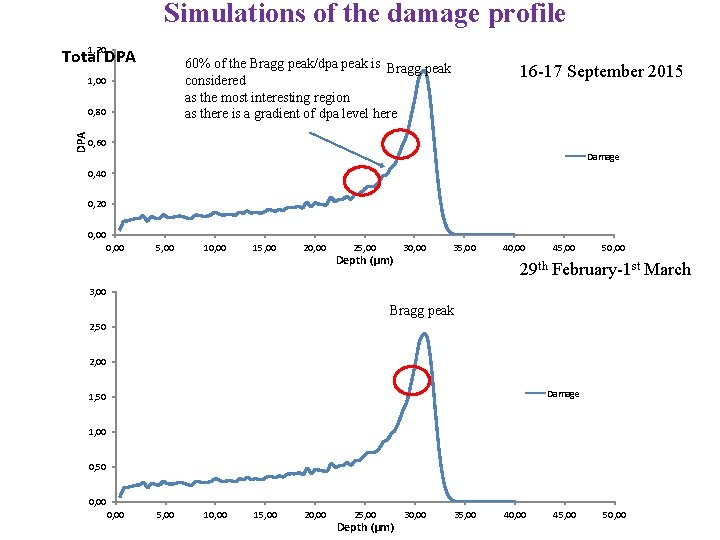
Parameters of implemented 3 Me. V proton irradiation experiments Proton Irradiation Conditions Samples 16 th -17 th September 2015 Temperature 350° C Current 9 µA 1. 2 x 1. 2 cm 2 irr. area Up to 0. 8 dpa* 36 hours in total Charge – 1. 3958 4 samples: Ta; Ta 2. 5 wt%W; Ta 5 wt. %W; Ta 10 wt. %W Temperature 350° C Current 9 µA 0. 7 x 1 cm 2 irr. area Up to 1. 6 dpa* 42 hours in total Charge-1. 5337 2 samples: Ta; Ta 10 wt. %W 29 th February – 1 st March 2016 1 hour of annealing before irradiation 10 hours of annealing before irradiation Techniques being used Nanohardness test; SEM; TEM.
Simulations of the damage profile 1, 20 Total DPA 60% of the Bragg peak/dpa peak is Bragg peak considered as the most interesting region as there is a gradient of dpa level here 1, 00 DPA 0, 80 16 -17 September 2015 0, 60 Damage 0, 40 0, 20 0, 00 5, 00 10, 00 15, 00 20, 00 25, 00 Depth (μm) 30, 00 35, 00 40, 00 45, 00 50, 00 29 th February-1 st March 3, 00 Bragg peak 2, 50 2, 00 Damage 1, 50 1, 00 0, 50 0, 00 5, 00 10, 00 15, 00 20, 00 25, 00 Depth (μm) 30, 00 35, 00 40, 00 45, 00 50, 00
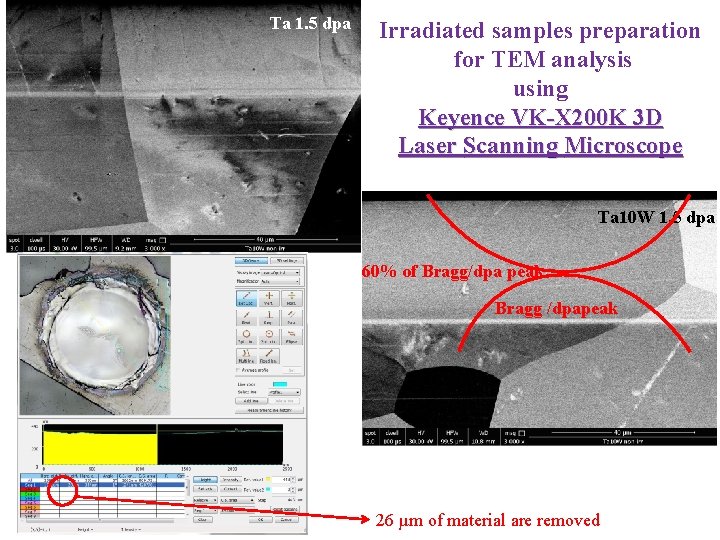
Bragg Peak position determination by experimental methods • Scanning electron microscopy (back scattered electron detector) • Nano hardness test • Transmission electron microscopy Bright imaging
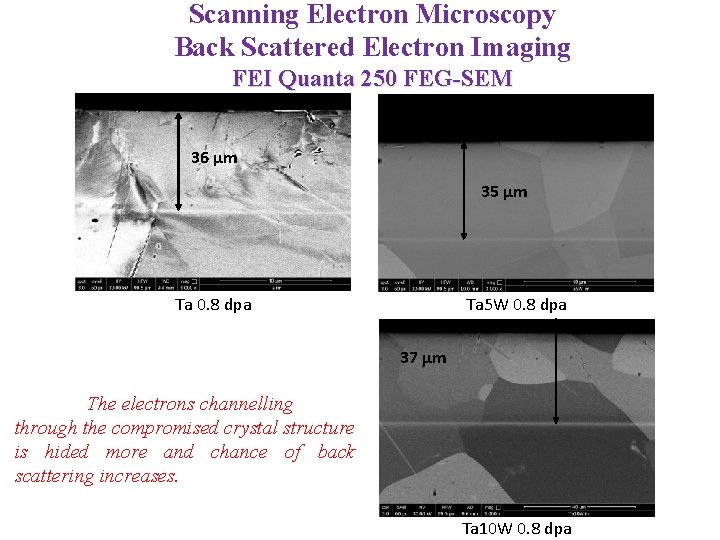
Scanning Electron Microscopy Back Scattered Electron Imaging FEI Quanta 250 FEG-SEM 36 µm 35 µm Ta 0. 8 dpa Ta 5 W 0. 8 dpa 37 µm The electrons channelling through the compromised crystal structure is hided more and chance of back scattering increases. Ta 10 W 0. 8 dpa
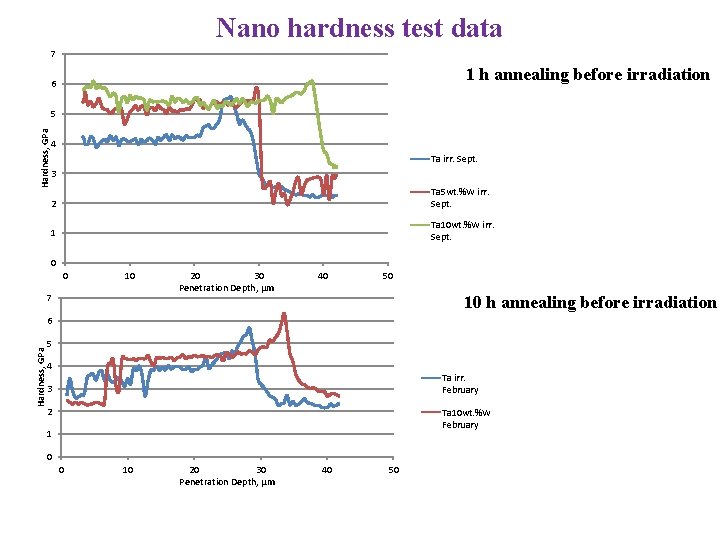
Nano hardness test data 7 6 Hardness, GPa 5 4 Ta irr. Sept. 3 2 Ta 5 wt. %W irr. Sept. 1 Ta 10 wt. %W irr. Sept. 0 10 20 30 Penetration Depth, µm Hardness, GPa 0 Penetration Depth, µm 40 50
Ta 1. 5 dpa Irradiated samples preparation for TEM analysis using Keyence VK-X 200 K 3 D Laser Scanning Microscope Ta 10 W 1. 5 dpa 60% of Bragg/dpa peak Bragg /dpapeak 26 µm of material are removed
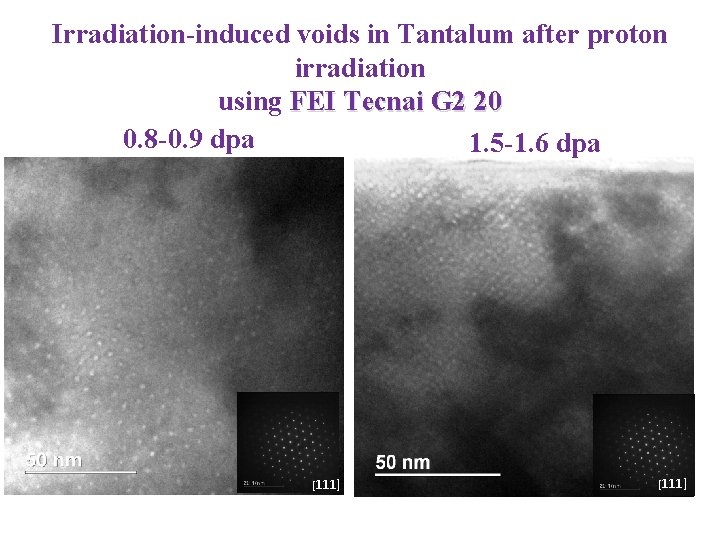
Irradiation-induced voids in Tantalum after proton irradiation using FEI Tecnai G 2 20 0. 8 -0. 9 dpa 1. 5 -1. 6 dpa [111]
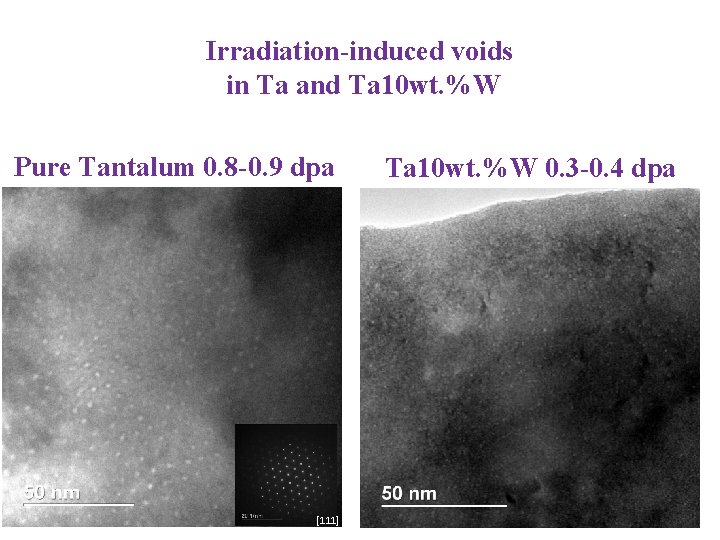
Irradiation-induced voids in Ta and Ta 10 wt. %W Pure Tantalum 0. 8 -0. 9 dpa [111] Ta 10 wt. %W 0. 3 -0. 4 dpa
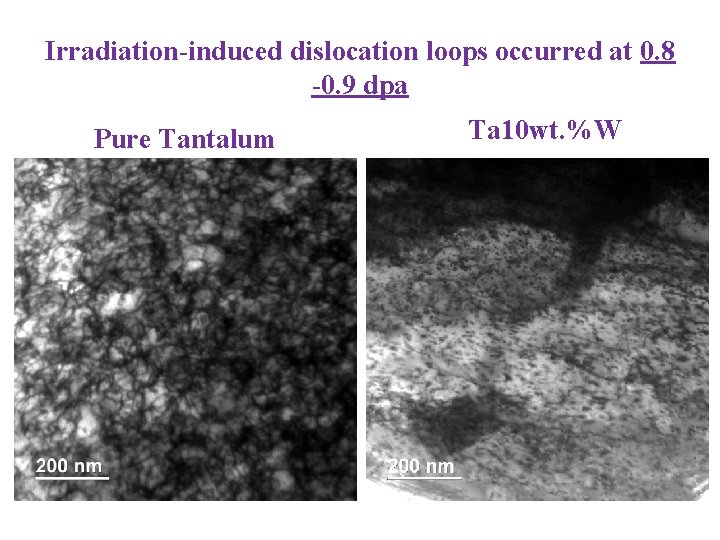
Irradiation-induced dislocation loops occurred at 0. 8 -0. 9 dpa Pure Tantalum Ta 10 wt. %W
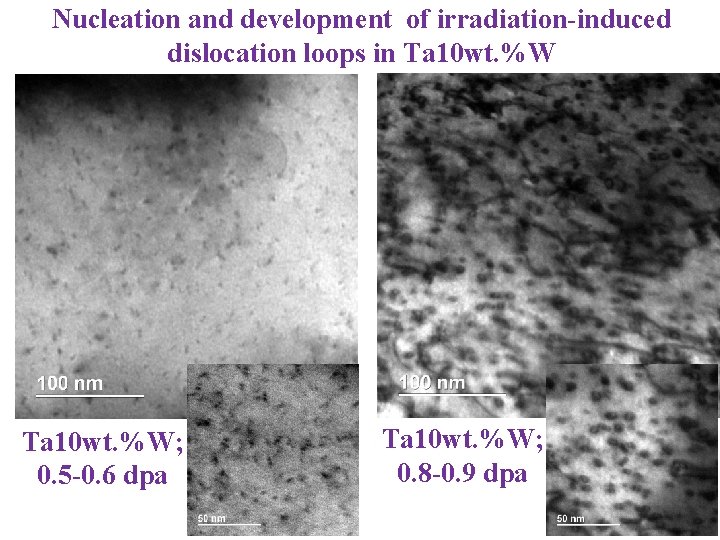
Nucleation and development of irradiation-induced dislocation loops in Ta 10 wt. %W; 0. 5 -0. 6 dpa Ta 10 wt. %W; 0. 8 -0. 9 dpa
First obvious conclusions on proton irradiated Ta-W samples • Data of SRIM calculations, hardness test and SEM comparably coincide and Bragg peak position with the highest density of irradiation-induced defects might be determined at around 30 -35µm • Voids arrays occur in pure irradiated Tantalum at 0. 8 -0. 9 dpa level. At 1. 5 -1. 6 dpa these void arrays are distributed denser and the distance between void walls is smaller • Ta 10 wt. %W alloy (at 0. 3 -0. 4 dpa) contains voids which are smaller and do not arrange in perfect arrays. They are located more randomly. At 0. 5 -0. 6 and 0. 80. 9 dpa loops take place and they are increasing in diameter with higher dpa • Addition of W into Ta may slow down the growth of irradiation-induced voids and loops which may cause hardening of the material by pinning dislocations and preventing their glide during deformation which will affect life time of the final material component?
Any comments/questions? Thank you! Iuliia. ipatova@manchester. ac. uk